Iranian journal of educational Sociology
(Interdisciplinary Journal of Education)Available online at: http://www.iase-idje.ir/
Volume 2, Number 2, July2019
Application Model of Implementing Knowledge Management
Training
Lida Rajabi Sangtarashani1,Asodollah Mehrara1
1.Department of Management, Qaemshahr Branch, Islamic Azad University, Qaemshahr, Iran.
Article history:
Received date: 11 January 2019 Review date: 13 March 2019 Accepted date: 21 March 2019
Abstract
purpose: The purpose of the present study was to present an
applied model for implementing knowledge management training. The purpose of this study was applied method, and descriptive-survey. Methodology: The statistical population of the study consisted of Mazandaran city managers. The analysis was based on data collected from 10 mayors and 295 staff of qualitative and quantitative subjects, using stratified random sampling and Cochran formula (for quantitative phase). The sampling method was "Samples containing rich information". Data were collected in a qualitative phase using semi-structured interviews based on data theory and in a quantitative phase using a designed questionnaire Exploratory and confirmatory factor analysis and Friedman test were used for data analysis.
Findings: The results showed that the model of knowledge
management training implementation includes: organizational culture, organizational structure, information technology, human resources, knowledge process, leadership and leadership support, organizational learning, organizational strategies, communication, environment, it was motivation and benchmarking.
Conclusion: Knowledge management as a process effectively
utilizes the competencies, experiences, specialties, skills, talents, thoughts, ideas, actions and imaginations of individuals and integrates them into the organization's information resources to achieve its goals.
Keywords:
Implementing, Knowledge Management Training
Please cite this article as: Sangtarashani L R, Mehrara A. (2019). Application Model of Implementing Knowledge Management Training. Iranian journal of educational Sociology. 2(2):78-89.
corresponding author: [email protected]
79| Application Model of Implementing Knowledge …Volume 2, Number 2, 2019
__________________________________________________________________
1. Introduction
In the present age, responding to the needs of customers and employees is possible only by relying on up-to-date knowledge and keeping up with global information, using new technologies and saving time and resources. Knowledge as the driving force behind the organization's work has led managers to emphasize the power of knowledge in the organization rather than relying on employees' physical ability. In such circumstances, creating and creating knowledge in the organization alone cannot be the solution to achieving the goals and missions of the organization; in fact, the knowledge created must be circulated within the body of the organization and transmitted to all levels (Abdi & Safaei, 2014). Achieving the goals of the organization depends on the quality of its human capital, and the quality of human capital is also made possible through continuous training, learning from the experiences inside and outside the organization. Human capital education not only plays a key role in creating the knowledge and skills of the staff, but also contributes to increasing the profits and revenues of the organization. In this regard, establishing effective strategic knowledge management is recognized in organizations (Hoda, 2017).
The need to use the knowledge management system as one of the new models of management and its importance is not hidden from anyone. Occurrence of re-work and parallelization in work-like areas of staff, inconsistency in approaches or differing understanding of organizational policies, lack of awareness of the integrated organizational perspective, loss of knowledge and insights of experienced employees leaving their organization, lack of The ability to properly and adequately share best practices and innovations individually, the lack of teamwork, and the sharing of experiences and values, and the loss of time and cost are all reasons that make the use of knowledge management all the more necessary (Khosravipour, Jafari & Abdi, 2017).
Successful organizations around the world, such as Shell, make millions of dollars in profits annually by establishing knowledge management and as a provider of specialized training courses. In contrast, most organizations are a permanent customer of knowledge and technology in the knowledge markets due to the lack of member experiences, lack of experience and irrelevant training, and spend a large percentage of their revenue on technical and up-to-date knowledge acquisition (Adly & et al., 1986). Knowledge has always been important to individuals and organizations, but it has become more important now. This issue arises from the exercise of the power of knowledge to achieve continued success and sustainable competitive advantage (Adly & et al., 1986).
Economic theorists regard knowledge as the only source of new organizations' competitive advantage and the key to their success, arguing that knowledge is the only source that is difficult or even impossible to replicate. Nonaka and Takhe Ochi (2016) argue that despite the belief in economics that uncertainty is only certainty, the long-standing source of competitive advantage is knowledge. Therefore, such a resource should be safeguarded, improved, and managed, rather than by chance by knowledge, with the help of appropriate techniques and techniques to help it grow and expand better because effective knowledge management leads to value creation in organizations and countries. Policy makers have found that in addition to tangible assets, knowledge management is a tool for organizational effectiveness and achievement of development goals (Fambed & Onianka, 2017).
Today, the main challenge for organizations is to understand KM and how to implement it, and their greatest aspiration is to define a proper KM system and manage it in a successful way. On the other hand, globalization and competition have made knowledge to be recognized as the most valuable strategic resource and the ability of the organization to use knowledge to exploit market opportunities and problem-solving is its most important ability (Wang & Chang, 2007). However, it must be borne in mind that the successful implementation of KM requires a comprehensive and comprehensive view of various organizational factors. Successful organizations are the ones that transform their employees' knowledge into organizational capability, but some organizations, despite the large investments they make to exploit the knowledge created
in their organizations, the lack of success and the enormous hardware and software investments made to deploy KM do not deliver the expected results (Wang & Spinwall, 2005).
In addition, factors affecting the ability to implement knowledge management can be considered as a set of actions and activities that must be considered for successful implementation of knowledge management. In other words, success factors are those intra-organizational factors that are controllable for the organization. External factors, such as environmental impacts, are only taken into consideration in order to know about their process because organizations do not have much control over the implementation and implementation of KM (Kazemi and Malekzadeh, 2012). In order to properly implement knowledge management processes and to avoid wasting money, one should also take a positive look at this and along with sound knowledge and comprehensive planning, using other organizations' experiences to achieve the desired results. Found (Akhavan & et al., 2010). Therefore, due to the lack of rich and sufficient knowledge management experience in many organizations, managers should consider the key factors in the success of knowledge management implementation when establishing knowledge management systems in their organization. Despite the increasing importance of KM for the competitiveness of organizations, lack of proper understanding of its facilitating factors makes it difficult for organizations to achieve KM goals (Khauri & et al., 2016).
One of the most important challenges identified is the ability to understand KM and its goals, yet there is no general consensus on the concept of KM (Rezaei & et al., 2015: 42). Levy and Hazan (2016) have identified knowledge management as an applied aspect of organizational culture, expressed how to establish cultural change with the help of organizational agility, and considered this culture change to require knowledge management initiative (Rezaei & et al., 2015). Knowledge management is nowadays a very important factor for the organization's performance and the success of projects. Researchers 'analysis of organizations' performance confirms that having up-to-date knowledge and information has become an indispensable necessity for organizations to survive. Evaluating the trends of developments in contemporary society shows that power technologies are gradually replacing science-based technologies. Therefore, management of organizations should rely on superior knowledge to make the right decisions and improve knowledge-based practices. Organizations have adopted new strategic policies such as knowledge management in order to integrate employees' intellectual capital, including multiple amounts and areas of knowledge about customers, processes, products, and the entire value chain in the organization at different levels. Controlled and made available in appropriate and effective ways. Nobel laureate Simon Kuznets argues that the major endowment of advanced economies is not that they have much physical and material capital but rather a collection of dense knowledge that from tested knowledge and exploration gained from empirical knowledge and capacity and training The people, the knowledge to effectively lie (Rezaeian, 2016: 2). Knowledge management as a process of effectively combining competencies, experiences, specialties, skills, talents, thoughts, ideas, actions and ideas into the organization's information resources to achieve its goals. (Salo, 2009: 103).
In a study conducted by Nehardani & et al. (1979) entitled Designing a Knowledge Management Model at Technical and Vocational University with Entrepreneurial Education Training Strategy, the findings of the research model were obtained with the following conditions. Strategies include: 1- Entrepreneurial technician training 2- Improving human resources 3- Qualification of university education as well as causal conditions including: 1- Human resources potential 2- University mission (entrepreneurship); Areas include: 1- Intellectual capital 2- Knowledge creation 3- Management strategy as well as interventionist conditions include: 1- Organizational structure 2- Team work 3- Organizational culture 4- Knowledge sharing and finally Implications: Knowledge management strategy at university; Managers Excellent guidance to the university in achieving the mission and purpose of the organization (training of skilled technicians and entrepreneurs). In a study conducted by Khosravi Pour, Jafari & Abdi (1986) entitled Designing an Optimal Knowledge Management Model for Supervisors in Iran Case Study: National Accounting Court, Using Survey Research Method and Testing A sample t-test examines the status of knowledge management components
81| Application Model of Implementing Knowledge …Volume 2, Number 2, 2019
__________________________________________________________________
and their ranking. The statistical population of the study consisted of auditors and auditing experts of the State Accounting Court and 234 individuals were selected by simple random sampling. The second section presents an integrated and optimized model for the establishment and implementation of knowledge management in the Accounting Tribunal, which emphasizes on a supervisory approach, focusing on knowledge mapping and designing a knowledge management code. In a study conducted by Adlie & et al. (1986), providing a native model for knowledge management implementation in offshore companies, the data collection tools in the quantitative section, questionnaire and in the qualitative section, interviews with experts He was aware. The findings of the study showed that knowledge management in the industrial organizations studied is in a relatively undesirable condition and these organizations face numerous challenges for the establishment of knowledge management. The research findings also revealed the necessity of designing a native model for knowledge management deployment. In a study conducted by Khavari Khorasani & et al. (2016), designing a model of facilitating factors in the implementation of the knowledge management strategy of the National Olympic Committee of the Islamic Republic of Iran, using exploratory factor analysis, 13 factors in the form of five factors. The main factors identified in the knowledge management facilitator questionnaire were identified. Then, the proposed model was fitted to the structural equation modeling method. The results showed that all goodness of fit indices were within acceptable range. five-factor model for knowledge management success at the National Olympic Committee was also presented. In addition, considering the coefficients of impact of each factor on knowledge management, it was found that HR has the most role in successful implementation of knowledge management and other factors are: information technology, organizational culture, knowledge management strategy and structure. Organizational.
"Factors Influencing Knowledge Management Applying for Technology Investment in the Southern United States" is a research title by Merleau (2016) and the purpose of this study is to quantitatively investigate the factors affecting the use of knowledge management (KM) in capital. IT was in the southern United States. The relationship between predictor and criterion variables was evaluated using concurrent regression model to support the results of comprehensive research questions. Eight predictor variables (explicit knowledge, knowledge system, supervisor, peer, guide, motivation, usefulness, and user satisfaction) independently returned knowledge utilization scores. Lee & et al. (2016) research entitled “Can Competitive Benefits Be Achieved Through Knowledge? A case study of SMEs ", the findings showed that knowledge management has a direct, positive and significant relationship with technology innovation (TI) and competitive advantage (CA), while technology innovation has positive and significant effects. It has competitive advantages. Competitive technology is associated with the mediating role of knowledge management and competitive advantage and has proven to be a positive and important relationship. Yumin Wang and Yuching Wang (2016) conducted a study called “Determinants of Corporate Knowledge Management System: An Empirical Study”. Survey data were obtained from 291 Taiwan trade areas. Confirmatory factor analysis and logistic regression technique were used to investigate the relationship hypothesis. The results of this study show that technological innovation factors (perceived resources, complexity and capability), organizational factors (support of top managers, organizational culture) and environmental factors (competitive pressure) in applying knowledge management system in companies Have important implications. "Information Technology Resources, Knowledge Management Capacity, and Competitive Advantages: Modifying the Role of Resource Commitment" is a study by Maav & et al. (2016). Information was obtained from 168 Chinese organizations through empirical evidence that the results indicated that 3 types of information technology sources (namely information technology ultrastructure, human information technology and information technology relationship) positively affect knowledge management ability. Affects and positively correlates with competitive advantage. In addition, the study identified two positive effects of quasi-equilibrium resource commitment on the relationship of information technology resources. Clearly, resource
commitment increases directly and positively and demonstrates the human and resource effects of the relationship on KM.
2. Methodology
This study was applied in terms of purpose and mixed in terms of method. The statistical population of the study consisted of mayors with excellent management experience in the cities of Mazandaran province and the elected professors of management in the universities of Mazandaran province (Qualitative) and all the official, contracted, contracted, volumetric and corporate staff of Sari municipality (quantitative) in summer 1977 (1255). There were people. The analysis was based on data collected from 10 mayors and 295 staff from qualitative and quantitative subjects, using stratified random sampling and Cochran formula (for quantitative stage). The sampling method was "Samples containing rich information" (for the qualitative stage) from the target population. Required information in the qualitative phase using semi-structured interviews based on data theory and in the quantitative phase, using a designed questionnaire, including 88 items based on the 5-item Likert spectrum, collected through soft - SPSS and AMOS were analyzed. The results of qualitative analysis indicate that the model of implementation of knowledge management education in municipalities includes 12 variables: organizational culture, organizational structure, information technology, human resources, knowledge process, leadership and leadership support, organizational learning, organizational strategies, Communication is the environment, motivation (motivation), and benchmarking. Exploratory and confirmatory factor analysis and Friedman test were used for data analysis.
3. Findings
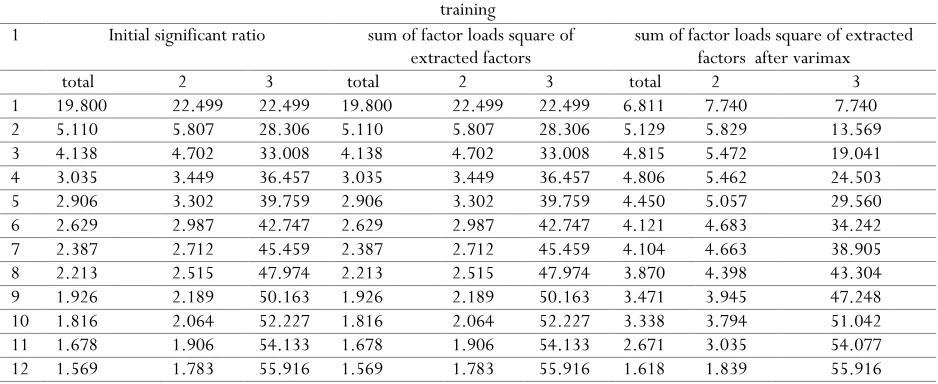
KMO index and Bartlett test were used to investigate the structure of implementation of the native knowledge management model. The results showed that the value of KMO (sampling adequacy) was 0.881 and the significance level was 0.0009. Therefore, in addition to the adequacy of sampling, the implementation of factor analysis based on the correlation matrix studied will also be justified. The basic statistical features shown in the implementation of the principal components analysis are presented in Table (1).
In Table (1) the Eigenvalues of 12 research agents; greater than 1, which together account for approximately 55.91% of the total variance, among them Eigenvalue of the first factor equals 22.449, Eigenvalue of the second factor equals with 807/5, third factor equal to 4.702, fourth factor 449/3, fifth factor 302/3, sixth factor 987/2, seventh factor 2,712, eighth factor 2,515, ninth factor 2/29, factor 2 The tenth factor is 2.064, the eleventh factor is 1.906 and the twelfth factor is 1.783. Following are the results of exploratory factor analysis and quantification of each of the key components of KM implemented by the principal components method and the Varimax era. In questions of any dimension, questions with a subscription ratio of less than 0.50 indicate that these questions are not well matched to the rest of the questions and should be eliminated, although this should be done step by step. Step done. The results are presented in Table 2 of the rotated matrix of components of Varimax knowledge management implementation model. Results indicated that 12 factors (HR, knowledge process, organizational learning, communication, environment, motivational measures, organizational culture, organizational structure, information technology, leadership and leadership support, organizational strategies, and benchmarking) were considered. In general, questions 3, 6, 8, 13, 16, 20, 22, 25, 27, 30, 37, 42, 44, 47, 51, 58, 74, 83 and 86 were removed from the questionnaire and finally the questionnaire with the number 69 questions turned up.
83| Application Model of Implementing Knowledge …Volume 2, Number 2, 2019
__________________________________________________________________
Table 1. Factors extracted and percentage of variance explained by implementation components of knowledge management training
1 Initial significant ratio sum of factor loads square of
extracted factors sum of factor loads square of extracted factors after varimax
total 2 3 total 2 3 total 2 3
1 19.800 22.499 22.499 19.800 22.499 22.499 6.811 7.740 7.740 2 5.110 5.807 28.306 5.110 5.807 28.306 5.129 5.829 13.569 3 4.138 4.702 33.008 4.138 4.702 33.008 4.815 5.472 19.041 4 3.035 3.449 36.457 3.035 3.449 36.457 4.806 5.462 24.503 5 2.906 3.302 39.759 2.906 3.302 39.759 4.450 5.057 29.560 6 2.629 2.987 42.747 2.629 2.987 42.747 4.121 4.683 34.242 7 2.387 2.712 45.459 2.387 2.712 45.459 4.104 4.663 38.905 8 2.213 2.515 47.974 2.213 2.515 47.974 3.870 4.398 43.304 9 1.926 2.189 50.163 1.926 2.189 50.163 3.471 3.945 47.248 10 1.816 2.064 52.227 1.816 2.064 52.227 3.338 3.794 51.042 11 1.678 1.906 54.133 1.678 1.906 54.133 2.671 3.035 54.077 12 1.569 1.783 55.916 1.569 1.783 55.916 1.618 1.839 55.916 *Note numbers are standing for 1- Component2-Variance percent3- Variance from cumulative percent in turn
Confirmatory Factor Analysis of Knowledge Management Implementation Training: Structure Measurement Model shows Standard Coefficients, with CFI, GFI values of 0.872 and 0.722, respectively, and RMSEA of 0.052 And the chi-square to freedom ratio is also less than 3 (1.804). Consequently, the structure designed to implement knowledge management training is appropriate.
Content validity and AVE (diagnostic validity) were used to determine the validity of the questionnaire. Using this coefficient, questions with a factor load less than 0.4 were eliminated in each construct. In general, according to the results of the mean AVE variance extraction, all the components in the measurement model obtained its value above the limit. The criterion was larger than 0.5 indicating convergent validity, and the composite reliability (construct reliability) indicated that the values obtained from the components were higher than the criterion of 0.07 and therefore the values obtained from The AVE and CR questionnaires were confirmed in Table (2).
*note: Numbers are standing for 1-humanistic source 2-aknowledgment process3-orgenization learning4-relationship5-environment6-motivational task7-orgenizational culture 8-orgenizational construction 9-information technology 10-leathership and supportive leadership 11-orgenization strategies12-testing
1
2
8
9 7 6 5 4
3
11
12 10
85| Application Model of Implementing Knowledge …Volume 2, Number 2, 2019
__________________________________________________________________
Table 2. Structural Reliability Analysis Used - Knowledge Management Deployment Model
Variables Cronbach alpha (Correlation Reliability ) average variance extracted
humanistic source 0.88 0.91 0.62
acknowledgment process 0.88 0.91 0.62
organization learning 0.89 0.92 0.70
relationship 0.91 0.93 0.70
environment 0.91 0.93 0.66
motivational task 0.91 0.93 0.65
organizational culture 0.89 0.92 0.70
organizational construction 0.90 0.92 0.62
information technology 0.87 0.90 0.60
leadership and supportive leadership 0.88 0.91 0.68
organization strategies 0.86 0.90 0.64
testing 0.89 0.92 0.75
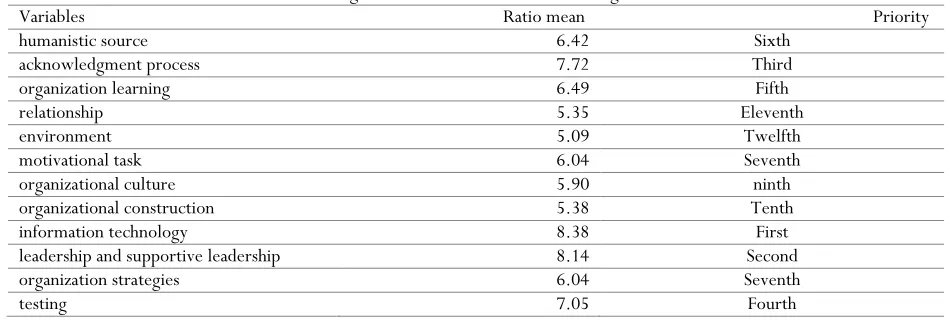
The constructs used in this study had acceptable reliability in terms of composite reliability in all three criteria. After descriptive analysis of research variables, the importance of each dimension of indigenous knowledge management model was evaluated by Friedman test. In this test, the researcher uses the rank and the test statistic or the value of Sig. The test didn't matter.
Table 3. Ranking of research model dimensions using Friedman test
Variables Ratio mean Priority
humanistic source 6.42 Sixth
acknowledgment process 7.72 Third
organization learning 6.49 Fifth
relationship 5.35 Eleventh
environment 5.09 Twelfth
motivational task 6.04 Seventh
organizational culture 5.90 ninth
organizational construction 5.38 Tenth
information technology 8.38 First
leadership and supportive leadership 8.14 Second
organization strategies 6.04 Seventh
testing 7.05 Fourth
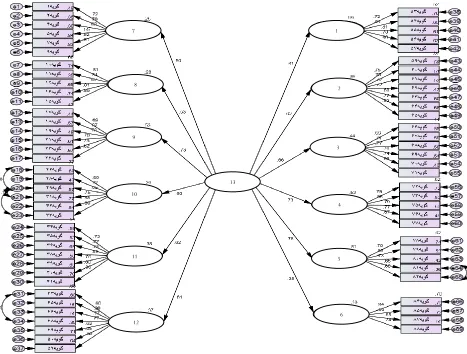
Successful Deployment Model and Successful Implementation of Knowledge Management System Training: Standard Factor of Human Resource Variables, Knowledge Process, Organizational Learning, Communication, Environment, Motivational Measures, Organizational Culture, Organizational Structure, Information Technology, Leadership and Leadership Support, Strategies Organizational benchmarking shows that all of these variables had an impact on the implementation of the knowledge management system.
Figure 2. Native Model of Knowledge Management System Implementation Training in Standard Coefficients Mode Note: 1. Organizational Culture 2. Organizational Structure 3. Information Technology 4. Leadership and Leadership Support 5. Organizational Strategies 6. Benchmarking 7. human resources. 8.Knowledge process. 9.Organizational learning. 10.Communications. 11.Environment. 12.Motivational actions. 13.Implementation and knowledge management
3 2 1
12 11 10 9 8 7
6 5 4 13
87| Application Model of Implementing Knowledge …Volume 2, Number 2, 2019
__________________________________________________________________
Figure 2 shows the output of the relationships among the components of the native model of knowledge management system deployment in standard coefficients:
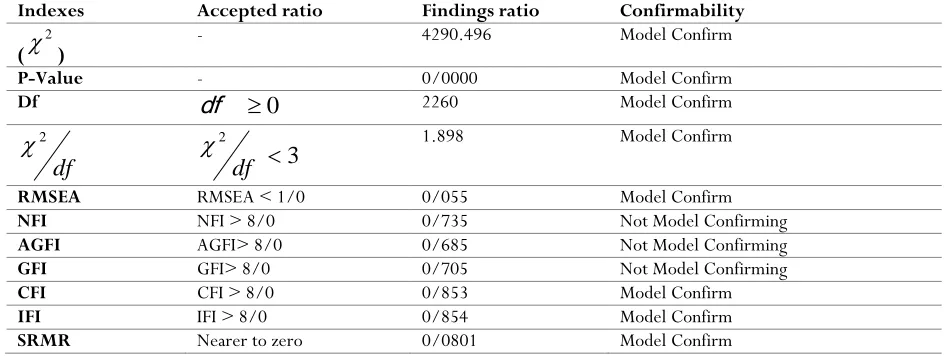
Table 4. Indicators of Fit Indigenous Model Implementation of Knowledge Management System Indexes Accepted ratio Findings ratio Confirmability
(
) - 4290.496 Model Confirm
P-Value - 0/0000 Model Confirm
Df 2260 Model Confirm
1.898 Model Confirm
RMSEA RMSEA < 1/0 0/055 Model Confirm
NFI NFI > 8/0 0/735 Not Model Confirming
AGFI AGFI> 8/0 0/685 Not Model Confirming
GFI GFI> 8/0 0/705 Not Model Confirming
CFI CFI > 8/0 0/853 Model Confirm
IFI IFI > 8/0 0/854 Model Confirm
SRMR Nearer to zero 0/0801 Model Confirm
As shown in Table (4), the chi-square statistic value in model 4290/4290 was also 2260, with a ratio of 1.898 which was acceptable. On the other hand, model fit indices such as CFI and IFI were all acceptable and appropriate, and SRMR was 0.0801.
4. Conclusion
According to the results of standard coefficients, t-values and P-value in confirmatory factor analysis, organizational culture factors (standard coefficient 0.81 and t 508/11 values), organizational structure (standard coefficient 0.62 and values Information Technology (Coefficient 0.66 and T 938.8), Human Resources (Coefficient 0.50, and T 527.7), Knowledge Process (Coefficient 0.53, and T 288). 8/8), leadership and leadership support (0.73 standard coefficient and 11/12 t values), organizational learning (0.73 standard coefficient and 9.946 t values), organizational strategies (0.78 standard coefficient and 7272 t values). / 11), communication (standard coefficient 0.60 and t values of 8.834), environment (Rib of 0.62 and T values of 9.99), incentives (motivational measures) (standard coefficient of 0.61 and T values of 9.517) and benchmarking (standard coefficient of 0.35 and T values of 488.5), Have a significant and positive impact on the implementation of knowledge management training.
Proper knowledge management and administration is a successful method. On the other hand, globalization and competition have made knowledge to be recognized as the most valuable strategic resource and the ability of the organization to use knowledge to exploit market opportunities and problem-solving is its most important ability (Wang & Chang, 2007). However, it must be borne in mind that the successful implementation of KM requires a comprehensive and comprehensive view of various organizational factors. Successful organizations are the ones that transform their employees' knowledge into organizational capability, but some organizations, despite the large investments they make to exploit the knowledge created in their organizations, the lack of success and the enormous hardware and software investments made to deploy KM do not deliver the expected results (Wang & Spinwall, 2005).
In addition, factors affecting the ability to implement knowledge management can be considered as a set of actions and activities that must be considered for successful implementation of knowledge management. In other words, success factors are those intra-organizational factors that are controllable for the organization. External factors, such as environmental impacts, are only taken into consideration in order to know about their process because organizations do not have much control over the implementation and implementation of KM (Kazemi and Malekzadeh, 2012). In order to properly implement knowledge management processes
2 0 df df 2
2 3
df
and to avoid wasting money, one should also take a positive look at this and along with sound knowledge and comprehensive planning, using other organizations' experiences to achieve the desired results. Found (Akhavan et al., 2010). Therefore, due to the lack of rich and sufficient knowledge management experience in many organizations, managers should consider key factors in the success of knowledge management implementation when establishing knowledge management systems in their organization. Be. Despite the increasing importance of KM for the competitiveness of organizations, lack of proper understanding of its facilitating factors makes it difficult for organizations to achieve KM goals (Khauri et al., 2016). Finally, it can be acknowledged that knowledge management as a process is effectively composed of competencies, experiences, specialties, skills, talents, thoughts, ideas, actions and perceptions of individuals and their integration into resources. Uses information from the organization to achieve its goals.
References
Bedokhti A A, Kianifar F. (2015). Investigating the Relationship between Knowledge Management and Organizational Performance in Iranian Internationalized Companies (Case Study: Chemical and Food Industries), Modern Marketing Research Journal, Special Issue of the Fourth National Conference on Management and Entrepreneurship, Khansar 94.
Hasanzadeh M A, Janbaz M, shadi F, Sohrabi F, Imam R, Damirchi S. (2016). Evolution of Knowledge Management, Knowledge Management Monthly, Center for Strategic Studies and Studies, Ports and Maritime Organization, Tehran.
Gharbi K, Lili, Hamidi Mehrzad, Sajadi Seye N, Jalali Farahani M. (2016). Designing a Model of Facilitating Factors in Implementing the Knowledge Management Strategy of the National Olympic Committee of the Islamic Republic of Iran, Sport Management Studies. 38(2):183-204.
Khosravi Pour N, Jafari S M, Abdi M R. (2017). Designing an Optimal Knowledge Management Model for Supervisors in Iran Case Study: State Accounting Court, Journal of Auditing Knowledge. 17(69):309 -328.
Rezaei M, Rezaei S, Rezaei V. (2015). Knowledge Management Strategies and Agility in the Publishing Industry, Quarterly Book Mehr. 16(2):38-53.
Rezaeian W. (2016). Application of Knowledge Management in Organizational Decision Making, National Conference on Management and Humanities Research in Iran, June, 95, Tehran.
Abdi M, Safaei S. (2014). Presenting a Model for Establishing and Implementing a Knowledge Management System in the Tax Administration of Iran, Tax Research Bulletin, No. 21 -69.
Adli F, Ahmadi Z, Mehran G, Fekri AA. (2017), Introducing a Native Model for Knowledge Management Implementation in Marine Training Companies, Marine Science Education Research Quarterly, 11(3) 16-30.
Mohammadi J, Jamali Nejad M, (2012). Performance Evaluation of Some Special Services in 14 Municipal Areas of Isfahan Metropolitan Area, Quarterly Journal of Environmental Planning. 5 (16):107-124.
Nahdarani H, Moghul A, Zende Del A, Nodehy H. (1979). Designing a Knowledge Management Model in Technical and Vocational University with Entrepreneurial Education Training Strategy, Research in Educational Systems, Spring Letter.(12): 629-651. Nikokar Gh, Soltani M R, Pashaie Houlasu A. (2014). Investigation of Knowledge Management Infrastructure in an Armed Forces
University, Information Technology Management. 6(3):11-28.
Akhavan P, Oliaei E, Dastranj N, Saghafi F. (2010). Developing knowledge management cycle processes based on knowledge management success factors. Journal of Science and Technology Policy. 3(2):1-12.
Fombad Madeleine C, Onyancha O. (2017). Knowledge Management for Development: Rethinking the Trends of Knowledge Management Research in South Africa. Journal of Information & Knowledge Management.16 (3): 34-45.
Hadi W. (2017). A New Model for Integrating Phases of Decision-Making and Knowledge Base for Improving Customer Satisfaction. Journal of Information & Knowledge Management.16 (3):99-109.
Kazemi M, Malekzadeh G. (2012). Critical factors on successful implementation of knowledge management in small technology firm’s places in technology incubators. Journal of Tomorrow Management. 11(32): 45-62.
Lee V, Foo Alex T, Lai-Ying O. (2016).Can competitive advantage be achieved through knowledge management? A case study on SMEs,Expert Systems with Applications.
Mao H, Liu S, Zhang J, Deng Zhaohua. (2016). Information technology resource, knowledge management capability, and competitive advantage: The moderating role of resource commitment, International Journal of Information Management. 36 (2016):1062–1074.
Merlo T. (2016). Factors influencing knowledge management use in technology enterprise in Southern United States, Procedia Computer Science. 99(2016):15 – 35.
Nonaka I, Takeuchi H, Redman, William M. (2016). The Knowledge-Creating Company: How Japanese Companies Create the Dynamics of Innovation. MP3 CD – Audiobook.
89| Application Model of Implementing Knowledge …Volume 2, Number 2, 2019
__________________________________________________________________
Sagsan M, Tolga Medeni I, Medeni Tunç Durmu. (2016). Knowledge management paradigms: implementation through individual fuzzy-based education, Procedia Computer Science. 102: 259 – 266.
Salo N. (2009). The Implications of Knowledge Management Sustainability for Leadership in an Organization: An Exploration and Analysis of Leadership Theories and Knowledge Manage- ment Practices in Bangwita Flores. Indonesia. Journal of NTT Studies. 1 (2): 95-135.
Wang Jun D, Liu O, Li M.(2015). A Synthetic Method for Knowledge Management Performance Evaluation Based on Triangular Fuzzy Number and Group Support Systems, Applied Soft Computing Journal.
WangYu-Min, Wang Yao-Ching, (2016), Determinants of firms' knowledge management systemimplementation: An empirical study, Computers in Human Behavior 64 ,829e842.
Wang T, Chang T. (2007). Forecasting the probability of successful knowledge management by consistent fuzzy preference relations. Expert Systems with Application. 32(3):801-13.
Wong K Y, Aspinwall E. (2005). An empirical study of the important factors for knowledge management adoption in the SME sector. J know Manag. 9(3): 64-82.