SUGGEST SOLUTIONS FOR DIFFUSION AND IMPLEMENTATION OF
ACTIVITY-BASED COSTING IN VIETNAM
Tandung Huynh
School of Business Administration, Hunan University, China; Faculty of Accounting and Auditing in Industrial University of Ho Chi Minh City, Vietnam
Guangming Gong
School of Business Administration, Hunan University, China
Huyhanh Huynh
Faculty of Accounting and Auditing in Industrial University of Ho Chi Minh City, Vietnam
ABSTRACT
Activity-Based Costing (ABC) was developed by Robert S. Kaplan in the mid-1980s and up to now the academics, researchers as well as accounting practitioners have perceived it as the normative appropriate cost system. It has been considered as a method to overcome the shortcomings of the traditional costing. However, theapplication the new method as ABC is a challenge for Vietnamese companies because most of them have used traditional costing for calculating product cost. Changing from traditional costing system to ABC system will face many difficulties. In the fierce competitive business environment, along with the growth of Vietnamese companies – it means that the production of product diversity, machinery and equipment invested more and more modernly and automatically, leads indirect costs increasing and major proportion in total costs. These characteristics are suitable for the application of ABC method to calculate product cost and provide information for management. In addition, increasing of pressure from consumers and competitors force Vietnamese businesses to find a more modern approach to help them achieve advantage competition and increase profitability. Thus, application of ABC method is need for Vietnamese companies. This paper attempts to find obstacles to ABC application and suggests solutions for ABC diffusion and implementation in Vietnam.
Keywords:
Activity-Based Costing (ABC), ABC application, Vietnamese companies, Solution1.
INTRODUCTION
In today business environment, the businesses are facing the global competition. Reduce costs, increase profit and get more advantages are the aims of any businesses. In order to achieve these aims, they attempt to apply the strategic management methods. ABC is believed as the most
Asian Economic and Financial Review
174 modern costing system that can provide proper and confident information for decision-making. However, ABC is more complex than traditional costing in both theory and practice. Beside difficulties of ABC techniques, adopting it still faces other difficulties come from internal organizations such as resistance of the leaders, employee don’t wants to change to new environment, lack of understanding about ABC, lack of cooperation from other departments. Additionally, lack of support from State and professional organizations, weak in finance, and human resource contribute to obstruct ABC adoption and implementation.
ABC can use alone or can integrate with other costing system such as standard costing, target costing. ABC system has many advantages than traditional costing system, can meaningfully improve the operations of a business. However, the application of ABC system in Vietnamese organizations is never easy. There are many reasons such as employee may worry, for example, that his or her job will be identified as a non-value-added activity and eliminated, lack of support of managers, inadequate of accounting human resource etc. None of the cost management tools we have studied constitutes a panacea for success. Moreover, some organizations will inevitably benefit more from any of these tools than other organizations will (Hilton, 2002). Prior researches presented several key factors that can increase the likelihood of successful implementation of ABC organizational culture, top-management support and commitment, change champion, change process, and continuing education (Shields and Young, 1989).
ABC method is very popular in many developed countries and more familiar with many developing counties such as China, Thailand, Malaysia, Singapore, etc. However, it is still a new method in Vietnam. There were very few research related to ABC issued in Vietnam. The status of ABC research in Vietnam was presented in section three of this paper. Shortcoming of ABC research has contributed obstacle to implementing ABC in Vietnamese companies. This paper attempts to analyze the factors affecting ABC adoption in Vietnamese companies and suggests solutions to promote ABC implementation in Vietnam.
2.
OVERVIEW ABC METHOD
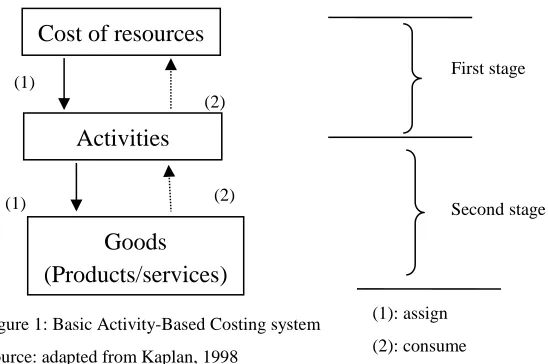
with the cost drive or very loose relationship with them. When arbitrary allocations are used, no cause – and – effect relationship can be established between the cost object and the resources. The basic model of ABC system is shown on the figure 1.
ABC provides not only accurate financial information but also non-financial information for managers’ at all organizational levels. They perceive ABC information as more accurate and reliable than those generated by traditional costing, and are willing to use them for decision-making and performance evaluation. ABC helps companies to clearly identify the root of costs that are incurred in business, the activities that consume costs to create values and the activities that consume costs but do not create values for the business. It also has an important role that helps organizations achieve and maintain a competitive position in the global market. The previous empirical surveys indicated that ABC has been applied in many countries around the world and has brought many benefits for business e.g. (Cooper and Kaplan, 1991; Khozein and Dankoob, 2011; Innes and Mitchell, 1995
;
Chen et al., 1993).Several empirical researches have been carried out relating to the successful implementation of ABC among companies that have adopted it e.g. (Chen and Park., 1993; Chongruksut and Brooks, 1993; Innes and Mitchell, 1995; Cohen and Kaimenaki., 2005). The more detailed information about ABC adoption rate were done by prior authors that were presented on table 1. In among of developing countries surveyed in Asia and Africa, Malaysia and Thailand had the ABC implementation rate higher than other countries. Although ABC has certain limitations, overall it has provided so many advantages and benefits to organizations when it was applied successfully.
Cost of resources
(1)
(1)
(2)
(2)
Activities
Goods
(Products/services)
First stage
Second stage
(1): assign
(2): consume Figure 1: Basic Activity-Based Costing system
176 Table-1. The results of ABC adoption rates were surveyed by previous researchers
Researcher Nation Rate (%) Researcher Nation Rate (%)
Corrigan (1996) Australia 12 Cotton et al.
(2003a,b) UK 17.5
Warwick and Reeve (1997) Australia 10 Al-Omiri and Drury
(2007a,b) UK 15
Chenhall and Langfield-Smith
(1998) Australia 56
Askarany and
Yazdifar (2009a,b) UK 15.2
Askarany and Smith (2004) Australia 19 Armitage and
Nicholson (1993) US 11
Baird et al. (2004) Australia 78 Hosseini et al.
(1997) US 28
Groot (1999) US 17.7
Askarany and Yazdifar (2009a,b) Australia 23.4 Ittner et al. (2002) US 26
Gosselin (1997) Canada 47.8 Kiani & Sangeladji
(2003) US 52
Kip and Augustin (2007) Germany 19 Kip and Augustin
(2007) US 21
Pavlatos and Paggios (2009) Greek 23.5 Bescos et al. (2001) France 23
Duffy and McCahey (2002) Ireland 55 Alcouffe (2002) France 15.9
Pierce and Brown (2004) Ireland 27.9 Cauvin & Neumann
(2007) France
23
Fawzi (2008) Ireland 26.3 Rahmouni (2008) France 33.3
Cotton et al (2003) New Zealand 20.3 Chen et al (2001) China (Hong
Kong) 11
Askarany and Yazdifar (2009a,b) New Zealand 22.5 Joshi (2001) India 20
Bj¨ ornenak (1997) Norway 40 Maelah and Ibrahim
(2007) Malaysia 36
Innes and Mitchell (1991) UK 6 Chongruksut (2002) Thailand 11.9
Nicholls (1992) UK 10 Chongruksut et
Brooks (1993) Thailand 35
Tayles & Drury UK 13 Sartorius et al.
(2007) South Africa 11.6
Innes and Mitchell (1995) UK 21 Toomas Haldma and
Kertu Lääts (2002) Estonian 7
Yakhou and Dorweiler (1995) UK 48 Azzouz Elhamma
(2012) Morocco 12.9
Tayles & Drury (2001) UK 23
Source: Information was adapted from Askarany and Yazdifar and other previous researches.
3.
ABC RESEARCH AND ITS ADOPTION IN VIETNAM
Although ABC is very popular in developed countries, however it is a new costing model in Vietnam. Even it has not been taught in many Vietnamese universities. First, we look in the management accounting textbooks that popularly used in Vietnam written by some of professors, doctors, or lecturers. These textbooks only simply introduce ABC method, see (Nguyen, 2003; Pham et al., 2008; Pham and Tran, 2011). Other research related ABC method in Vietnam that
released by public domain so many few. It was not only few in practice but also in theory. There were just some researches that related to simply introduced ABC theory and gave example of this method for calculating the cost of products. Some research briefly introduced ABC method, see (Phạm, 2006; Quang, 2009; Tran, 2008; Chuc, 2009). Other research applied ABC method to
it were so many few and very simple in Vietnam. With such researches and training cannot help Vietnamese enterprise when they want to explore and implement ABC method.
4.
THE
KEY
FACTORS
OBSTRUCTING
ABC
IMPLEMENTATION
SUGGEST SOLUTIONS
Based on the key factors that can increase the likelihood of successful implementation of ABC that prior researches presented, and the resources related to ABC researches in Vietnam.
4.1.
The key factors obstructing ABC implementation in Vietnam
- The low quality of current accounting human resourcesVietnam lacks expertise in accounting resources and professional accountants to perform accounting activities for businesses. According to the opinion of domestic and foreign enterprises, the number of accounting students as well as accounting practitioners in Vietnam is large number, but the majority proportion of them does not meet the requirements of employers. Some prior researchers pointed out that the quality of accounting human resources remains debatable and the supply is still inadequate to meet demands especially lack of knowledge of management accounting (Dang, 2011; Tran Phuoc, 2011).
- Accounting education and training in Vietnamese universities has been inadequate
Vietnamese universities lag far behind compared with universities in Southeast Asian countries (Vallely and Wilkinson, 2008). Majo (2011) presented that Vietnamese universities lack qualified
and experienced staff and professional development programs for existing staff at universities. National education researchers have also strongly criticized the poor quality of accounting education in Vietnamese universities. Additionally, lack accounting textbooks and accounting documents for study and research. The textbooks are various, written and issued by university lecturers. However, in general, textbooks are to explain and to provide specific guidance to accounting standards issued by Ministry of Finance other than deeply analyze principles, except for accounting principles on double entry and credit-debit entry.
- The conservative ideology of Vietnamese managers
In the perspective of economic management, the level of economic management of Vietnamese managers is low. Most of them are still impacted by mechanisms of the subsidy period; depending on the State and backward thinking towards innovation by management still exist. Managerial weaknesses are also an anchor to drag and obstruct the application of modern management methods in general and ABC in particular.
- Lack of research, especially in management accounting
Based on results of papers mentioned in the SJR1 that were published on international journals, the number of research documents of Vietnam were very few in comparison with other countries in the region. The total of Vietnamese research papers published in international journals from 1996 to 2010 was only 10,904. They only equal 18% of articles published of Thailand, 20% of
178 Malaysia’s, and 10% of Singapore’s. In particular, the economic, administrative, accounting and finance sectors published 162 articles in international journals during the 15 years. This was equal to 17% of Thailand's, 8% of Malaysia’s, 4% of Singapore’s and 39% of Indonesia’s, and 46% of Philippines’.
- Suspense between the costs and benefits
Apply ABC method is more costly and more timely than traditional costing. In the short term, managers have not seen the benefits of the ABC method, so they hesitate to change from tradition costing system to ABC system.
4.2.
The solution suggestion to diffuse ABC method in Vietnam
- The collaboration on the departments, working groupsIn order to successfully apply ABC method requires cooperation between departments within the organization as well as the spirit of teamwork. There were many empirical studies indicate that incorporated between departments, working groups contributing to the success of applying the ABC method e.g. (Baird, 2007), (Drake et al., 2001).
- Innovation in accounting higher education and training
According to the results published by World Economic Forum from 2008 to 20012, Vietnamese higher education ranked very low, and in the period 2011-2012, this position was lower, Vietnamese higher education and training ranked 103 in among of 142 countries that were surveyed. Compared with other countries in Southeast Asia Vietnam has the lowest rank.
The big problems that exist in the accounting education system in Vietnam are that there is too much emphasis on financial accounting, and accounting education is still largely based on prescribed accounting systems. When developing an accounting course curriculum, education institutions must follow the framework of Ministry of Education and Training. Accordingly, the rate of the major subjects is very small in total subjects. In addition, many courses lack practical skills training, educational programs and their education methods are backward. The quality of lecturers is not high, most of them lack experience in the professional accounting practice. Thus, the accounting education system in Vietnam should be reformed as soon as possible. Accounting education reform is essential to match the ongoing economic and accounting reforms. The focus on accounting regulations should be shifted to accounting principles and accounting standards. Additionally, other subjects such as management accounting, finance, taxation, auditing, information technology, risk management, foreign language, and business law should be emphasized. So improving the quality of education, in particular accounting and auditing in higher education and training institutions to meet the actual needs and keep up with other countries in the region is an urgent matter that the Vietnamese education sector must focus on.
- Enhance the role of professional associations in the diffusion and promote application of the
ABC system.
a member of ASEAN Federation of Accountants (AFA) in 1998. However, VAA and VACPA mainly guide by answering the questions and discussing the problems related to financial accounting. There are very few documents that are related to ABC and there was not any announcement about the application of the ABC system in Vietnam that was published on their website. Up to now, Vietnam has no management accounting professional association. The State should soon establish a management accounting professional association that will specialize in research and guidance on the application of management accounting as well as modern management tools to help Vietnamese enterprises to improve their competitiveness in order to survive and develop in the midst of global competition.
- Promote accounting research, especially in ABC method
The researches related to ABC method have taken place from the late 1980s in many countries in the world. The researches carried out both in the theory and practice of ABC method. The research results have help organizations clearly understand: the nature of ABC method; the factors affect ABC adoption and implementation; and how to apply ABC method successfully. In Vietnam, researches related to ABC method so many little, so businesses lack significant resources for reference and study. To solve this problem, researchers and practitioners should more explore and research on ABC system. Government and professional associations should support and promote ABC project by research funding and purchase of materials as well as the scientific journals.
- Changing manager views and thinking
Although Vietnam has changed from planned economy to market economy but the planned economy management policy is still impact on Vietnamese managers. Most of managers maybe hesitate to adopt new management technique in which includes ABC method. Additionally, most of Vietnamese enterprises are small and medium enterprises (SMEs). According to the Vietnam Chamber of Commerce and Industry (VCCI), to the date of 31 Dec 2011, Vietnam had 543,963 enterprises, with a capital of about 6,000,000 billion VND. In the total of enterprises, there were nearly 97% SMEs, mainly private enterprises. A major proportion of small and medium enterprise’s managers cannot adopt new management technique because they have low education. According to the survey conducted in 2011, there were above 55.63% of SMEs owners have education below high school and very few owners were trained on basic business management Viet Nga (2011). Therefore, traditional costing system has existed for many decades and it has many
limitations in today’s business environment but it is popularly applied in Vietnam.
- Apply ABC method must be associated with internal resources and business requirements
There is not any standard for a business when applying ABC method. When applying ABC method, managers must research and design ABC model suitable for their business. Even worse, some organizations think they can get an ABC system by buying an ABC software package. The software provides a template to input, process, and report information, but it cannot provide the thinking required to build a cost-effective ABC model.
180 accounting
ABC method needs the input data with large volumes and more complex than traditional costing system. In order to apply ABC method, organization should use accounting software suitable for the current situation and meet the scalability in the future. Organizations should select the software that serves both financial accounting and management accounting. Especially, it can keep track of the detailed information for meeting the requirements of each cost incurred to serve ABC application.
5.
CONCLUSION
Vietnam has changed from planed economy to market economy for three decades and joined WTO in 2006. The global competition has pushed Vietnamese to produce and supply products and services with large scale, and more diversity. These are good conditions for enterprises apply the cost method are typical of modern methods ABC. With an increasingly competitive environment tough growing science and technology development have a strong impact to the production and supply of goods and services as at present, the application of costing methods are not traditional longer relevant. Most of the decisions of managers in the selection of product structure, pricing decisions are related to the production costs as well as supplying products to consumers. Information not accurate costs will lead administrators to bad decisions. To survive and develop, the Vietnam enterprises should select costing methods more accurate alternative method for calculating the cost of traditional, ABC is a costing model provides accurate and flexible information reliability that businesses consider Vietnam can choose.
However, the application of ABC in Vietnamese companies is now very difficult with such factors obstructing as we discussed above. In order to apply ABC method successfully, these obstacles must be removed first. This paper also provide information for Universities, professional associations, education and training for accounting human resources institutions to provide consistent policies in making the right solution, especially in accounting higher education and training innovation, to help the businesses adoption and implementation of ABC system.
6.
ACKNOWLEDGEMENTS
Authors thank to editorial board of Asian Economic and Financial Review, Reviewers, and all previous researchers that our paper cited.
REFERENCES
Baird, K., 2007. Adoption of activity management practices in public sector organizations.
Accounting and Finance, 47(4): 551-569.
Chen, G.M., M. Firth and K. Park, 1993. The implementation and benefits of
activity-based costing: A hong kong study. Asian Review of Accounting, 9(2): 23-37.
Chongruksut, W. and A. Brooks, 1993. The adoption and implementation of
Chuc, A.T., 2009. Phương pháp kế toán chi phí dựa trên mức độ hoạt động. Hội kiểm toán
viên hành nghề Việt Nam
Activity-based costing. Vietnam Association of Certified Public Accountants
(translated). Available from
http://www.vacpa.org.vn/index.php?o=modules&n=forum&f=forum_detail
&idforum=319
[
Accessed 8 Jan 2013]
Cohen, S., G. Venieris and E. Kaimenaki, 2005. Abc: Adopters, supporters, deniers and
unawares. Managerial Auditing Journal, 20(9): 981-1000.
Cooper, R. and Kaplan, R.S., 1991. Profit priorities from activity-based costing. Harvard
Business Review, 69(3): 130-135.
Dang, V.T., 2011. Innovative the curriculum and method of training accounting – auditing
for undergraduates. Discussion forum.
Drake, A., Haka, S. F., & Ravenscroft, S. P., 2001. An ABC Simulation Focusing on
Incentives and Innovation. Issues in Accounting Education, 16(3): 443-471.
Askarany, D., & Yazdifar, H., 2012. An investigation into the mixed reported adoption
rates for ABC: Evidence from Australia, New Zealand and the UK. International
Journal of Production Economics, 135(1): 430–439.
Hilton, R.W., 2002. Managerial accounting: Creating value in a dynamic business
environment 5
thEd. China Machine Press.
Huynh T.D., Gong G.M., Tran P., 2013. Comparison of Activity-Based Costing and
Traditional Costing - the necessity applies ABC method in Vietnam. Journal of
Ho Chi Minh City University of Industry, 1(10): 58-70.
Khozein, A. and Dankoob, M., 2011 Activity Based Costing system and its succeed
implementing in Organizations. Australian Journal of Basic and Applied Sciences,
5(10): 613-619.
Innes, J. and F. Mitchell, 1995. A survey of Activity-Based Costing in the UK’s largest
companies. Management Accounting Research, 6(2): 137-153.
Majo, G., 2011. Difficulties experienced by universities in reviewing their teaching
program – recommendations for support by business groups. Vietnam, Discussion
Forum.
Nguyen T. B., 2003. Management accounting. Dai Hoc Quoc Gia Publisher.
Pham, R., 2006. Kế toán chi phí dựa trên hoạt ộng.
Activity-Based Costing - ABC (translated). Available from
http://www.lrc.ctu.edu.vn/pdoc/20/Ke%20toan%20chi%20phi%20dua%20t
ren%20hoat%20dong.pdf
[A
ccessed 15 Jan 2013]
Pham, V.D., D.N. Que and Bui Van Duong, 2008. Management accounting. Thong Ke
Publisher
182