O R I G I N A L R E S E A R C H
Exercise Ameliorates Emphysema Of Cigarette
Smoke-Induced COPD In Mice Through The
Exercise-Irisin-Nrf2 Axis
This article was published in the following Dove Press journal:
International Journal of Chronic Obstructive Pulmonary Disease
Hiroaki Kubo Kazuhisa Asai Kazuya Kojima Arata Sugitani Yohkoh Kyomoto Atsuko Okamoto Kazuhiro Yamada Naoki Ijiri
Tetsuya Watanabe Kazuto Hirata Tomoya Kawaguchi
Department of Respiratory Medicine, Graduate School of Medicine, Osaka City University, Osaka, Japan
Background: Oxidative stress is one of the important mechanisms underlying the patho-genesis of chronic obstructive pulmonary disease (COPD). Irisin is a type of myokine secreted from the muscle during exercise and acts against oxidative stress via nuclear factor erythroid 2-related factor 2 (Nrf2), a transcription factor with antioxidant properties. Here, we examined the emphysema suppressive effects of the exercise-irisin-Nrf2 axis in mice.
Methods:Mice were divided into three groups, namely, the control, smoking, and exercise + smoking groups. All mice from the smoking and exercise + smoking groups were exposed to cigarette smoke once a day. The mice from the exercise + smoking group were adapted to a treadmill once a day. To investigate the Nrf2 cascade, after 12 weeks, serum irisin concentration and Nrf2 and heme oxygenase-1 (HO-1) expression in the lung homogenate were determined. To evaluate cigarette smoke-induced COPD, the number of inflammatory cells in bronchoalveolar lavagefluid (BALF), mean linear intercept (MLI), and destructive index in the lung tissue were examined.
Results:Serum irisin concentration and the expression levels of Nrf2 and HO-1 in the lung homogenate were significantly higher in mice from the exercise + smoking group than in those from the control and smoking groups. The proportion of neutrophils in the BALF was significantly lower in the exercise + smoking group than in the smoking group. The MLI and destructive index were also significantly smaller in mice from the exercise + smoking group than mice from the smoking group.
Conclusion: Irisin secreted from the muscle during exercise may exert protective effects against oxidative stress via Nrf2 and HO-1, and ameliorate emphysema of cigarette smoke-induced COPD. The exercise-irisin-Nrf2 axis may serve as a novel target for COPD treatment.
Keywords:chronic obstructive pulmonary disease, oxidative stress, exercise, irisin, nuclear factor erythroid 2-related factor 2, heme oxygenase-1
Background
Chronic obstructive pulmonary disease (COPD) is a pulmonary disease caused by prolonged inhalation of noxious gas, mainly cigarette smoke, and results in poorly
reversible airflow limitation.1There are 98 hazardous components found in smoke.2
Moreover, cigarette smoke contains a large amount of oxidants.3Oxidative stress is
considered one of the important mechanisms of COPD pathogenesis.4 Airflow
limitation in COPD follows a progressive course characterized by chronic cough, sputum production, shortness of breath,and a reduction in the ability to perform
Correspondence: Kazuhisa Asai Department of Respiratory Medicine, Graduate School of Medicine, Osaka City University, 1-4-3 Asahimachi, Abeno-Ku, Osaka 545-8585, Japan
Tel +81 6 6645 3916 Fax +81 6 6646 6160
Email [email protected]
International Journal of Chronic Obstructive Pulmonary Disease
Dove
press
open access to scientific and medical research
Open Access Full Text Article
International Journal of Chronic Obstructive Pulmonary Disease downloaded from https://www.dovepress.com/ by 118.70.13.36 on 22-Aug-2020
physical activity, such as walking and climbing stairs.5 The decline in physical activity was recently shown to be correlated with COPD prognosis, and physical activity
level is most associated with COPD mortality.6
Therefore, there is a growing interest in maintaining and improving the physical activity of patients with COPD.
Muscle mass is reduced due to cachexia in COPD,7and a
previous study reported a significant association between
quadricep strength and physical activity level in patients
with COPD.8 However, the biological mechanism
under-lying the improvement in the prognosis of patients with COPD following maintenance of physical activity has not been elucidated.
Irisin, a circulating hormone-like myokine secreted from the muscle during exercise, has gained much
atten-tion owing to its mechanism of acatten-tion.9We reported that
serum irisin level was significantly lower in patients with
COPD than in healthy subjects and that it correlated with
physical activity level.10We also showed that serum irisin
level significantly correlated with lung diffusing capacity
for carbon monoxide divided by alveolar volume and the percentage of low-attenuation area in patients with
COPD.11
Nuclear factor erythroid 2-related factor 2 (Nrf2) is a transcription factor exhibiting antioxidant capacity. Following oxidative stress, Nrf2 translocates to the nucleus of a cell and binds to antioxidant response element (ARE) to initiate the transcription of antiox-idant genes and the subsequent expression of the cor-responding proteins. The activation of the Nrf2-ARE signaling pathway is a major mechanism involved in
cellular defense against oxidative stress.12 A previous
report showed that Nrf2-deficient mice were highly
susceptible to cigarette smoke-induced lung injury.13,14
However, overexpression of Nrf2 is known to protect
against cigarette smoke-induced cell apoptosis.15 We
found that irisin significantly enhanced the expression
of Nrf2 and reduced the cigarette smoke extract
(CSE)-induced apoptosis of A549 cells.11 Based on these
reports, we hypothesize that irisin secreted from the muscle during exercise may enhance Nrf2 expression in the lung and ameliorate emphysema of cigarette smoke-induced COPD. To address this hypothesis, we examined emphysema suppression and Nrf2-ARE sig-naling pathway activation by irisin secreted from the muscle in response to exercise in a COPD mouse model.
Materials And Methods
Animals
C57BL/6 male mice (4 weeks old, weighing 18–20 g) were
obtained from Japan SLC (Shizuoka, Japan) and maintained under pathogen-free conditions at a controlled temperature of 23 °C ± 2 °C and a 12 h light/dark cycle. The mice were fed a standard diet and had free access to water. The mice were divided into three groups as follows: 1) control (n = 8), 2) smoking (n = 8), 3) exercise + smoking (n = 8) group. The animals were acclimatized to the environment for a week before experiments began. Animal experimentation was approved by the Ethics Committee of the Institutional Animal Care and Use of Osaka City University Graduate School of Medicine (17,023, 6/11/2017). All animal experi-ments were conducted in accordance with the Regulations on Animal Experiments in Osaka City University following the Guidelines for Proper Conduct of Animal Experiments in Japan.
Experimental Model Of Smoke-Induced
COPD
All mice from the smoking and exercise + smoking groups were exposed to cigarette smoking (18 cigarettes/day)
once a day, for 60 min per session, five times per week.
Commercially marketed Peace non-filter cigarette (2.3 mg
nicotine and 28 mg tar/cigarette; Japan Tobacco, Tokyo, Japan) and a cigarette smoke inhalation experimental
sys-tem for small animals (SG-300; Shibata Scientific
Technology, Tokyo, Japan) were used for the exposure to cigarette smoke. Cigarette smoke exposure was performed for 12 weeks.
Treadmill Aerobic Training
All mice from the exercise + smoking group were forced to run on a motor-driven treadmill (TMS-8B; Melquest, Toyama, Japan). After gradually increasing the speed dur-ing a 5 min preparation time, the mice were subjected to the same treadmill protocol (0° incline, 18 m/min) once a
day, for 30 min per session,five times per week. Treadmill
aerobic training was performed before the exposure to cigarette smoke for 12 weeks.
Treatments And Preparation For
Evaluation
At the end of the 12-week experimental period, the mice
were sacrificed under isoflurane, 3 h after the last exercise
session or 24 h after the last exposure to smoke.
International Journal of Chronic Obstructive Pulmonary Disease downloaded from https://www.dovepress.com/ by 118.70.13.36 on 22-Aug-2020
Laparotomy was performed and 0.5–1 mL of blood was collected from the cava vein. Following blood collection, the mice were tracheotomized and cannulated, and the lung was lavaged thrice with 0.5 mL phosphate-buffered
saline (PBS) for collection of bronchoalveolar lavagefluid
(BALF). After bronchoalveolar lavage, the right lung was carefully excised. The right lower lobe was soaked in
RNAlater (Invitrogen by Thermo Fisher Scientific,
Waltham, MA, USA) for gene expression analysis, while the other right lobe was instantly frozen in liquid nitrogen for protein expression analysis. The left lung was carefully excised and soaked in 10% formalin for histological analysis.
Evaluation Of Serum Irisin Level
The collected blood was centrifuged at 8,200 × g at 4 °C for
10 min, and the serum was stored at −80 °C. Serum irisin
concentration was evaluated with a commercially available enzyme-linked immunosorbent assay kit (EK-067-29, Phoenix Pharmaceuticals, Inc., Burlingame, USA) according
to the manufacturer’s instructions.
Gene Expression Analysis
The right lower lobe was disrupted and homogenized in RLT lysis buffer (Qiagen NV, Venlo, Netherlands). Total RNA was extracted with the RNeasy mini kit (Qiagen NV, Venlo, Netherlands). Complementary DNA (cDNA) was obtained by reverse transcription of the mRNA with the
Ready-to-Go T-primed first-strand kit (GE Healthcare,
Little Chalfont, UK). The cDNA was subjected to real-time quantitative polymerase chain reaction (PCR) on an Applied Biosystems 7500 real-time PCR system (Thermo
Fisher Scientific) with TaqMan gene expression assays for
Nrf2 (Mm00477784_m1). The relative level of Nrf2
mRNA was normalized to that of the housekeeping gene
36B4(Mm00725448_s1), as previously described.16
Western Blot Analysis
The right lung other than the lower lobe was subjected to Western blot analysis. About 30 mg of lung sample was treated with 300 µL of radioimmunoprecipitation assay buffer (Beyotime Biotechnology, Shanghai, China) supple-mented with the protease inhibitor phenylmethanesulfonyl
fluoride (Beyotime Biotechnology) and Protease Inhibitor
Cocktail (Cell Signaling Technology, USA) for homogeni-zation. After homogenization, the samples were placed on ice for 5 min and centrifuged at 11,800 × g and 4 °C for 4 min. The supernatant was collected and the protein
concentration was determined using the colorimetric bicinchoninic acid protein assay kit (Pierce, Waltham,
MA, USA) according to the manufacturer’s
recommenda-tions. The proteins were subjected to sodium dodecyl
sul-fate polyacrylamide gel electrophoresis with
Mini-PROTEAN TGX Precast Protein Gels (4561023, Bio-Rad, Hercules, California, USA) and the separated bands were
transferred onto polyvinylidene fluoride membranes. The
membranes were incubated with primary anti-Nrf2 antibody (1:500; ab137550, Abcam, Cambridge, UK), anti-HO-1
antibody (1:250; ab13248, Abcam), or anti-β-actin antibody
(1:1,000; ab8227, Abcam) at 4 °C overnight. The mem-branes were then incubated with the corresponding second-ary antibodies for 2 h at room temperature. After washing the membranes, SuperSignal West Dura Extended Duration
Substrate (Thermo Fisher Scientific, Rockford, IL, USA)
was used for detection. Western blot signals were acquired
using a Fuji LAS-4000 fluorescence imager (Fujifilm
Corporation, Tokyo, Japan).β-actin was used to normalize
the level of target protein.
Bronchoalveolar Lavage Fluid Analysis
The recovered BALF was centrifuged at 1,200 × g and 4 °C for 10 min, and the supernatant collected. The cell pellet was resuspended in 1 mL of PBS and subjected to a cytos-pin procedure using a Shandon Cytoscytos-pin 3 centrifuge
(Shandon Scientific Co., London, England). The slides
were stained with Diff-Quick, and enumeration of cells and differential cell counts (neutrophils, lymphocytes, macrophages, and eosinophils) were performed according to the hematological criteria.
Quantitative Evaluation Of Lung
Emphysema
The left lung was perfused andfixed with 10% formalin for
24–48 h at positive pressure (25 cm H2O), and submitted to
histological routine. Three-micrometer thick slices were stained with hematoxylin and eosin for analysis of the level of emphysema. Airspace size was evaluated by deter-mining the mean linear intercept (MLI), as previously
described.17Moreover, the destructive index was also
deter-mined to evaluate destruction, as previously described.18
Statistical Analysis
Data are expressed as mean ± standard deviation. Differences were evaluated with one-way analysis of variance, followed by a multiple comparison procedure. Differences were
International Journal of Chronic Obstructive Pulmonary Disease downloaded from https://www.dovepress.com/ by 118.70.13.36 on 22-Aug-2020
considered significant forp< 0.05. All statistical analyses were performed with GraphPad Prism 7.04 (GraphPad Software, San Diego, CA, USA).
Results
Mice From The Smoking Group Gained
Less Weight Than The Control And
Exercise + Smoking Groups
One mouse from the control group was excluded from the analysis due to missing. Three mice from the exercise + smoking group were excluded from the analysis, owing to their inability to run or death due to treadmill accident. In addition, one mouse from the smoking group was excluded from the analysis due to blood collection failure.
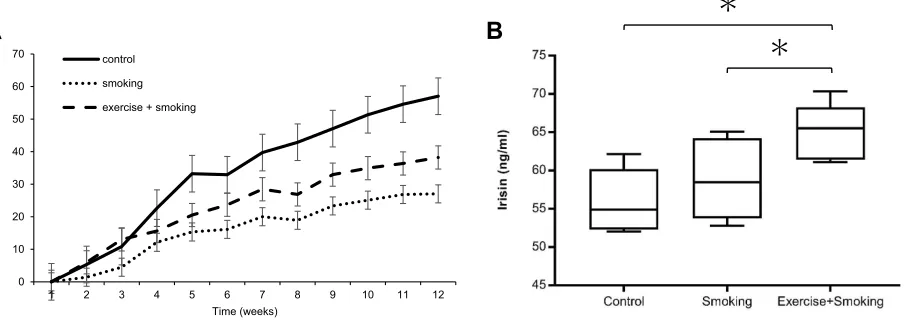
After the 12-week experimental period, the mice from the smoking group did not gain as much weight as those from the control group. Although the mice from the exer-cise + smoking group gained more weight than those from the smoking group, these mice did not gain as much
weight as the mice from the control group (Figure 1A).
Serum Irisin Concentration Was Elevated
In Mice From The Exercise + Smoking
Group
Serum irisin concentration was significantly elevated in mice
from the exercise + smoking group compared to
concentra-tions from the control and smoking groups (p < 0.05;
Figure 1B). In contrast, no significant differences in serum
irisin concentration were observed between the mice from the control and smoking groups.
Nrf2 And HO-1 Expression Levels Were
Elevated In Mice From The Exercise +
Smoking Group
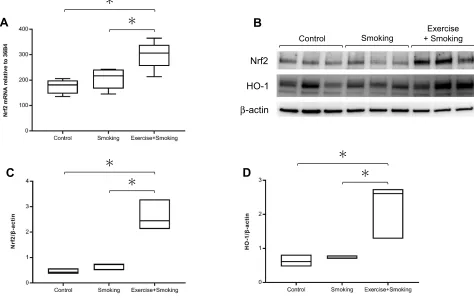
We evaluated Nrf2 mRNA expression in the lung homo-genate by real-time PCR as an indicator of antioxidant
capacity. Nrf2 mRNA expression was significantly higher
in mice from the exercise + smoking group than in
mice from the control and smoking groups (p < 0.05;
Figure 2A). No significant difference was observed in
Nrf2 mRNA expression between the mice from the control and smoking groups. Furthermore, we evaluated protein expression of Nrf2 and HO-1, which was regulated by
Nrf2, with Western blot analysis (Figure 2B). Nrf2 protein
expression was upregulated in mice from the exercise + smoking group compared to the expression in mice from
the control and smoking groups (p < 0.05; Figure 2C).
HO-1 protein expression was also upregulated in mice from the exercise + smoking group compared to the expression in mice from the control and smoking groups
(p< 0.05;Figure 2D). There was no significant difference
in Nrf2 and HO-1 protein expression between the mice from the control and smoking groups.
Proportion Of Neutrophils In The BALF
Was Suppressed Following Exercise
To examine the influence of cigarette smoke exposure on
BALF and the changes induced by exercise, we enumerated
B
A
0 10 20 30 40 50 60 70
1 2 3 4 5 6 7 8 9 10 11 12
)
%(
s
e
g
n
a
h
c
t
h
gi
e
w
y
d
o
B
Time (weeks) control
smoking
exercise + smoking
Figure 1Changes in body weight and serum irisin concentration.
Notes:(A) Body weight changes of mice. Values are presented as the mean ± SD. (B) Serum irisin concentration in the exercise + smoking group were significantly higher than in the control and smoking groups. *P<0.05.
Abbreviation:SD, standard deviation.
International Journal of Chronic Obstructive Pulmonary Disease downloaded from https://www.dovepress.com/ by 118.70.13.36 on 22-Aug-2020
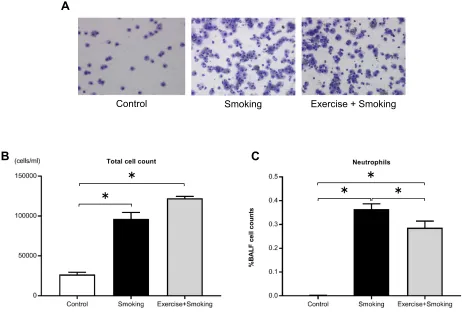
cell population in the BALF and evaluated the proportion of different cells. Representative images of BALF from each
group are shown inFigure 3A. Total cell count and
propor-tion of neutrophils in the BALF were significantly higher in
mice from the smoking group than in those from the control
group (p< 0.05;Figure 3BandC). No significant difference
was noted in the total cell count in the BALF of mice from
the exercise + smoking and smoking groups (Figure 3B).
However, the proportion of neutrophils in BALF was
sig-nificantly lower in mice from the exercise + smoking group
than in mice from the smoking group (p< 0.05;Figure 3C).
Exercise Ameliorated Emphysema Of
Cigarette Smoke-Induced COPD
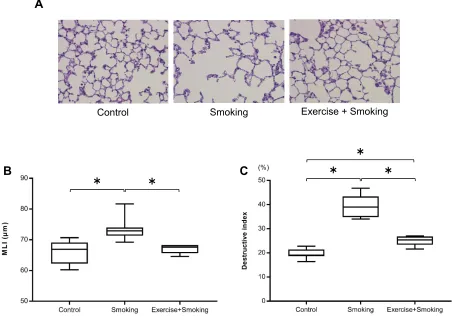
Representative histologic images of the lung from each group
are shown inFigure 4A. Exposure to cigarette smoke for 12
weeks resulted in the development of pulmonary emphysema in mice from the smoking group. Interestingly, lung tissues from the exercise + smoking group showed lower alveolar destruction than that observed in the lung tissues of the mice
from the smoking group. The MLI was significantly larger in
mice from the smoking group than in mice from the control group, and the MLI for mice from the exercise + smoking
group was significantly lower than that of mice from the
smoking group (p< 0.05;Figure 4B). No significant
differ-ence was reported in the MLI between the mice from the control and exercise + smoking groups. Moreover, the
destructive index was significantly larger in mice from
the smoking group than in those from the control group, and
the destructive index was significantly lower in mice from the
exercise + smoking group than in those from the smoking
group (p< 0.05;Figure 4C). However, unlike the MLI, the
destructive index in mice from the exercise + smoking group was not as small as that in mice from the control group.
Discussion
The present study demonstrated that treadmill exercise increased the serum concentration of irisin, enhanced Nrf2 and HO-1 expression in the lung, and suppressed emphysema of cigarette smoke-induced COPD in mice.
A
Nrf2
HO-1
Exercise + Smoking Smoking
Control
β-actin
B
C
D
Figure 2Nrf2 and HO-1 expression in the lung homogenate.
Notes:(A) Nrf2 mRNA expression in mice from the exercise + smoking group was significantly increased compared to expression in mice from the control and smoking groups. (B–D) Nrf2 and HO-1 protein expression in mice from the exercise + smoking group were significantly increased compared to expression in mice from the control and smoking groups. Western blot analysis of Nrf2 and HO-1 were normalized toβ-actin and measured by densitometry. *P<0.05.
Abbreviations:Nrf2, nuclear factor erythroid 2-related factor 2; HO-1, heme oxygenase-1.
International Journal of Chronic Obstructive Pulmonary Disease downloaded from https://www.dovepress.com/ by 118.70.13.36 on 22-Aug-2020
We have previously reported the irisin-mediated signifi -cant increase in the expression of Nrf2 and the reduction in the CSE-induced alveolar epithelial cell apoptosis, which
are deemed important in emphysema progression.11 Our
findings indicate that the exercise-induced irisin
expres-sion activates the Nrf2-ARE signaling pathway and attenu-ates lung damage induced by cigarette smoke. In addition, we showed that treadmill exercise inhibited cigarette
smoke-induced neutrophil infiltration in BALF.
COPD is the third leading cause of death worldwide
following ischemic heart disease and stroke.19 Hence, the
development of a novel prevention and treatment strategy for COPD is desirable. Oxidant-antioxidant imbalance and protease-antiprotease imbalance hypotheses are associated
with COPD etiology.20,21Cigarette smoke is a major cause
of COPD and contains many oxidants, which are known to
induce apoptosis of alveolar epithelial cells.3The
interven-tion against oxidative stress could serve as a novel strategy for COPD prevention and treatment. Nrf2 is expressed in
various human organs, including the lung. The activation of the Nrf2-ARE signaling pathway is a major cellular
defense mechanism against oxidative stress.22,23Nrf2 and
other downstream antioxidants, such as HO-1, play a pro-tective role against oxidative stress caused by harmful
substances, such as cigarette smoke.24 Previous studies
have reported that Nrf2-deficient mice were very sensitive
to cigarette smoke-induced lung injury.13,14 However, the
overexpression of Nrf2 is thought to mediate protective
effects against cigarette smoke-induced cell apoptosis.15
We have previously shown that Nrf2 expression was
sig-nificantly decreased in the bronchial and alveolar epithelial
cells of patients with COPD compared to those from con-trol subjects, and that Nrf2 exhibited a protective role
against CSE-induced apoptosis.25 These reports suggest
that the Nrf2-ARE pathway protects against the oxidant-antioxidant imbalance in cigarette smoke-induced emphy-sema. In our study, Nrf2 expression was slightly higher in mice from the smoking group than in those from the
Control Smoking Exercise + Smoking
A
B
C
Figure 3Total cell count and proportion of neutrophils in the BALF.
Notes:(A) Representative images of the BALF from each group are shown at 200x magnification. (BandC) The proportion of neutrophils in the BALF was attenuated in mice from the exercise + smoking group compared to mice in the smoking group; however, the number of total cells was not attenuated. Values are presented as the mean ± SD. *P<0.05.
Abbreviations:BALF, bronchoalveolar lavagefluid; SD, standard deviation.
International Journal of Chronic Obstructive Pulmonary Disease downloaded from https://www.dovepress.com/ by 118.70.13.36 on 22-Aug-2020
control group, but no significant difference was observed. Nrf2 expression tended to increase as an endogenous anti-oxidant mechanism against cigarette smoke. However, these inductions by cigarette smoke were considered potentially weaker than the oxidants contained in cigarette smoke, and thus the mice developed emphysema. In
con-trast, Nrf2 expression significantly increased in mice from
the exercise + smoking group compared to the expression in those from the smoking group. Antioxidants could exert stronger effects than cigarette smoke-induced oxidants and suppress the development of emphysema.
Irisin is a novel myokine mainly released by skeletal muscles in response to exercise. Exercise induces the expression of peroxisome proliferator-activated
receptor-γ co-activator 1α (PGC-1α), a transcriptional cofactor
expressed in the skeletal muscle. PGC-1α stimulates the
synthesis and secretion of fibronectin type III
domain-containing protein 5 (FNDC5). Irisin is secreted as a
product of FNDC5.26–28 In the present study, the serum
concentration of irisin was elevated 3 h after treadmill running. Previous studies have also reported an increase in the serum concentration of irisin 3 to 6 h after treadmill
running in mice, using a similar protocol.29–32 We
pre-viously reported that serum irisin levels in patients with
COPD were significantly lower than those in healthy
subjects.10 Serum irisin concentration has been reported
to correlate with muscle mass.33 Cachexia is a common
and serious comorbidity of COPD associated with
increased mortality and loss of peripheral muscle mass.7
Therefore, serum irisin concentration in patients with COPD may be lower than that in healthy subjects because of the reduction in muscle mass due to cachexia in COPD. Moreover, shortness of breath and reduction of muscle mass due to cachexia in COPD may result in lower levels
Control Smoking Exercise + Smoking
A
B
C
Figure 4MLI and destructive index for the mice from each group.
Notes: (A) Representative histologic images, stained with hematoxylin-eosin, of lung sections from each group are shown at 200x magnification. (B) The MLI was significantly larger in mice from the smoking group than mice in the control group while the MLI was significantly smaller in mice from the exercise + smoking group than mice in the smoking group. The difference in MLI was not significant between the control and exercise + smoking groups. (C) The destructive index was significantly larger in mice from the smoking group than in mice from the control group. The destructive index was attenuated in mice from the exercise + smoking group compared to mice from the smoking group. *P<0.05.
Abbreviation:MLI, mean linear intercept.
International Journal of Chronic Obstructive Pulmonary Disease downloaded from https://www.dovepress.com/ by 118.70.13.36 on 22-Aug-2020
of physical activity and serum irisin. In our results, the mice in the exercise + smoking group had a larger weight gain than the mice in the smoking group. Therefore, daily exercise has the potential to prevent reduction of muscle mass due to cachexia in COPD. Since the discovery of irisin in 2012, several studies have reported its physiolo-gical role. Irisin circulates in the blood and induces brown-ing of the white adipose tissue through an increase in the expression of uncoupling protein-1. As a result, there is an increase in heat production in adipocytes and a subsequent amelioration in metabolic diseases such as obesity, dysli-pidemia, and diabetes. A recent report revealed the
impor-tant role of irisin in bone and neurogenesis.34,35
Considering the metabolic properties of irisin, several studies have focused on its therapeutic potential for the treatment of metabolic disorders such as type 2 diabetes
and obesity.9 Moreover, the anti-inflammatory and
anti-oxidative effects of irisin have also gained attention of
the scientific community,36 and several reports on the
antioxidant effects of irisin have been published. Irisin was shown to alleviate the endothelial dysfunction in type 2 diabetes, at least in part, by reducing oxidative/
nitrative stress.37 Furthermore, irisin exerts a beneficial
role in the prevention of hepatic steatosis through the attenuation of oxidative stress in an arginine
methyltrans-ferase-3-dependent manner.38 Other studies showed that
irisin alleviated hepatic ischemia/reperfusion injury by
relieving oxidative stress,39and protected the heart against
ischemia/reperfusion-induced oxidative stress.40 Zhang
et al have recently reported the irisin-mediated attenuation of vascular injury through the activation of the protein
kinase B/mechanistic target of rapamycin/Nrf2 pathway.41
These reports support our hypothesis that irisin enhances the expression of Nrf2 and suppresses emphysema of cigarette smoke-induced COPD.
Whether exercise improves emphysema of cigarette smoke-induced COPD in humans is not yet completely understood. However, several studies have shown that
exer-cise suppressed pulmonary emphysema and inflammatory
cell infiltration in the BALF of COPD mice, consistent with
the results of the present study.42–44However, these reports
mainly focused on different mechanisms other than irisin and Nrf2,such as modulation of signal transducer and activator of
transcription 3, anti-inflammatory mediators, and antioxidant
enzymes. A report described the elevation in Nrf2 expression in the diaphragm in response to exercise and showed that treadmill aerobic training protected diaphragm muscle wast-ing induced by cigarette smoke exposure through the
upregulation in the expression of antioxidant genes such as
Nrf2andHO-1.45We focused on the serum level of irisin and
expression of Nrf2 in the lung tissue and found that the MLI
and destructive index were significantly decreased in mice
from the exercise + smoking group compared to those from the smoking group, suggesting that these mice had decreased emphysema. This result may be related to the antioxidant and antiprotease effects observed along with the increase in Nrf2 expression. A previous study reported that smoking elevated
neutrophil elastase activity in Nrf2-deficient mice compared
to activity in wild-type mice.13 The high elastase activity
observed in Nrf2-deficient mice may be attributed to the
reduced anti-elastase activity. Thus, Nrf2 may be protective against the development of emphysema through the regula-tion of not only the oxidant-antioxidant balance but also the protease-antiprotease balance.
We showed that treadmill exercise inhibited cigarette
smoke-induced neutrophil infiltration in the BALF.
Although Nrf2 suppresses inflammation as a secondary
consequence of its antioxidant effect, Nrf2 also directly
suppresses the inflammatory response. Nrf2 was bound to
the proximity of the proinflammatory cytokine genes,
including IL-6 and IL-1b, and inhibited the
lipopolysac-charide-induced expression of these genes.46 The
Nrf2-mediated transcriptional interference was reported to be independent of reactive oxygen species level and ARE.
This study has some limitations. First, we could not
definitively show a causal relationship between irisin and
Nrf2, while our previous study showed the direct irisin-Nrf2
pathway in vitro.11The suppressive effect on emphysema
could also be related to other mechanisms such as other hormones or myokines induced by exercise. Second, we failed to analyze the mice from the exercise group without smoking. Therefore, we do not know what the levels of markers might be with exercise only. Third, the gastrocne-mius muscle and adipose tissue were not measured or analyzed. Thus, we did not evaluate the effects of exercise and cachexia. Fourth, male mice were used in this study because COPD is more common in male. Therefore, we did not discuss any gender differences in response to exercise. To clarify the irisin-Nrf2 axis and the effect on emphysema suppression, additional studies with Nrf2 knockout mice or mice injected with irisin are warranted. However, the over-expression of irisin in mice was shown to cause mitochon-drial overdrive with the production of reactive oxygen species, eventually resulting in an increase in the apoptosis
of cardiomyocytes under a hypoxic environment.47
Therefore, the dose of irisin injection should be carefully
International Journal of Chronic Obstructive Pulmonary Disease downloaded from https://www.dovepress.com/ by 118.70.13.36 on 22-Aug-2020
chosen. Furthermore, irisin was reported to bind to theαV
class of integrins as an agonist.48This report enabled us to
perform a detailed investigation of the irisin-Nrf2 axis.
Conclusion
Irisin secreted from the muscles in response to exercise circulates in the blood, increases the expression of Nrf2 in the lung, and suppresses cigarette smoke-induced alveolar apoptosis, all of which may potentially ameliorate emphy-sema development. Our results provide a model to explain why COPD patients with high physical activity have better prognosis and may highlight a promising approach for the development of a strategy for the treatment of patients with COPD.
Acknowledgments
This work was supported by research grants from the Japan Society for the Promotion of Science KAKENHI, Grant Number 19K08660 to K. Asai.
Disclosure
The authors report no conflicts of interest in this work.
References
1. Hogg JC, Timens W. The pathology of chronic obstructive pulmonary disease. Annu Rev Pathol. 2009;4:435–459. doi:10.1146/annurev. pathol.4.110807.092145
2. Talhout R, Schulz T, Florek E, van Benthem J, Wester P, Opperhuizen A. Hazardous compounds in tobacco smoke. Int J Environ Res Public Health.2011;8(2):613–628. doi:10.3390/ijerph8020613
3. Pryor WA, Stone K. Oxidants in cigarette smoke. Radicals, hydrogen peroxide, peroxynitrate, and peroxynitrite. Ann N Y Acad Sci.
1993;686:12–27; discussion 27–18. doi:10.1111/j.1749-6632.1993. tb39148.x
4. Sundar IK, Yao H, Rahman I. Oxidative stress and chromatin remo-deling in chronic obstructive pulmonary disease and smoking-related diseases. Antioxid Redox Signal. 2013;18(15):1956–1971. doi:10.10 89/ars.2012.4863
5. Wheaton AG, Cunningham TJ, Ford ES, Croft JB. Employment and activity limitations among adults with chronic obstructive pulmonary disease–United States, 2013.MMWR Morb Mortal Wkly Rep.2015;64 (11):289–295.
6. Waschki B, Kirsten A, Holz O, et al. Physical activity is the strongest predictor of all-cause mortality in patients with COPD: a prospective cohort study.Chest.2011;140(2):331–342. doi:10.1378/chest.10-2521 7. Remels AH, Gosker HR, Langen RC, Schols AM. The mechanisms of
cachexia underlying muscle dysfunction in COPD.J Appl Physiol (1985).
2013;114(9):1253–1262. doi:10.1152/japplphysiol.00790.2012 8. Waschki B, Spruit MA, Watz H, et al. Physical activity monitoring in
COPD: compliance and associations with clinical characteristics in a multicenter study.Respir Med. 2012;106(4):522–530. doi:10.1016/j. rmed.2011.10.022
9. Mahgoub MO, D’Souza C, Al Darmaki R, Baniyas M, Adeghate E. An update on the role of irisin in the regulation of endocrine and metabolic functions. Peptides. 2018;104:15–23. doi:10.1016/j. peptides.2018.03.018
10. Ijiri N, Kanazawa H, Asai K, Watanabe T, Hirata K. Irisin, a newly discovered myokine, is a novel biomarker associated with physical activity in patients with chronic obstructive pulmonary disease.
Respirology.2015;20(4):612–617. doi:10.1111/resp.12513
11. Sugiyama Y, Asai K, Yamada K, et al. Decreased levels of irisin, a skeletal muscle cell-derived myokine, are related to emphysema associated with chronic obstructive pulmonary disease.Int J Chron Obstruct Pulmon Dis.2017;12:765–772. doi:10.2147/COPD 12. Kensler TW, Wakabayashi N, Biswal S. Cell survival responses to
environmental stresses via the Keap1-Nrf2-ARE pathway.Annu Rev Pharmacol Toxicol. 2007;47:89–116. doi:10.1146/annurev.pharmtox. 46.120604.141046
13. Iizuka T, Ishii Y, Itoh K, et al. Nrf2-deficient mice are highly susceptible to cigarette smoke-induced emphysema. Genes Cells.
2005;10(12):1113–1125. doi:10.1111/j.1365-2443.2005.00905.x 14. Rangasamy T, Cho CY, Thimmulappa RK, et al. Genetic ablation of
Nrf2 enhances susceptibility to cigarette smoke-induced emphysema in mice. J Clin Invest. 2004;114(9):1248–1259. doi:10.1172/JCI2 00421146
15. Huang C, Wang JJ, Ma JH, Jin C, Yu Q, Zhang SX. Activation of the UPR protects against cigarette smoke-induced RPE apoptosis through up-regulation of Nrf2. J Biol Chem. 2015;290(9):5367–5380. doi:10.1074/jbc.M114.603738
16. Okamoto A, Nojiri T, Konishi K, et al. Atrial natriuretic peptide protects against bleomycin-induced pulmonaryfibrosis via vascular endothelial cells in mice: ANP for pulmonaryfibrosis.Respir Res.
2017;18(1):1. doi:10.1186/s12931-016-0492-7
17. Thurlbeck WM. The internal surface area of nonemphysematous lungs.Am Rev Respir Dis.1967;95(5):765–773. doi:10.1164/arrd.19 67.95.5.765
18. Saetta M, Shiner RJ, Angus GE, et al. Destructive index: a measure-ment of lung parenchymal destruction in smokers.Am Rev Respir Dis.1985;131(5):764–769. doi:10.1164/arrd.1985.131.5.764 19. Quaderi SA, Hurst JR. The unmet global burden of COPD. Glob
Health Epidemiol Genom.2018;3:e4. doi:10.1017/gheg.2018.1 20. McGuinness AJ, Sapey E. Oxidative stress in COPD: sources,
mar-kers, and potential mechanisms.J Clin Med.2017;6:2. doi:10.3390/ jcm6020021
21. Houghton AM. Matrix metalloproteinases in destructive lung disease.
Matrix Biol.2015;44–46:167–174. doi:10.1016/j.matbio.2015.02.002 22. Bocci V, Valacchi G. Nrf2 activation as target to implement thera-peutic treatments. Front Chem. 2015;3:4. doi:10.3389/fchem.2015. 00004
23. Nguyen T, Nioi P, Pickett CB. The Nrf2-antioxidant response element signaling pathway and its activation by oxidative stress.J Biol Chem.
2009;284(20):13291–13295. doi:10.1074/jbc.R900010200
24. Cho HY, Kleeberger SR. Association of Nrf2 with airway pathogen-esis: lessons learned from genetic mouse models. Arch Toxicol.
2015;89(11):1931–1957. doi:10.1007/s00204-015-1557-y
25. Yamada K, Asai K, Nagayasu F, et al. Impaired nuclear factor erythroid 2-related factor 2 expression increases apoptosis of airway epithelial cells in patients with chronic obstructive pulmonary disease due to cigarette smoking.BMC Pulm Med.2016;16:27. doi:10.1186/ s12890-016-0189-1
26. Bostrom P, Wu J, Jedrychowski MP, et al. A PGC1-alpha-dependent myokine that drives brown-fat-like development of white fat and thermogenesis.Nature.2012;481(7382):463–468. doi:10.1038/nature 10777
27. Castillo-Quan JI. From white to brown fat through the PGC-1alpha-dependent myokine irisin: implications for diabetes and obesity.Dis Model Mech.2012;5(3):293–295. doi:10.1242/dmm.009894 28. Schumacher MA, Chinnam N, Ohashi T, Shah RS, Erickson HP.
The structure of irisin reveals a novel intersubunit beta-sheetfi bro-nectin type III (FNIII) dimer: implications for receptor activation.J Biol Chem. 2013;288(47):33738–33744. doi:10.1074/jbc.M113.51 6641
International Journal of Chronic Obstructive Pulmonary Disease downloaded from https://www.dovepress.com/ by 118.70.13.36 on 22-Aug-2020
29. Liu J, Cui XY, Yang YQ, et al. Effects of high-intensity treadmill training on timeliness and plasticity expression of irisin in mice.Eur Rev Med Pharmacol Sci.2015;19(12):2168–2173.
30. Pang M, Yang J, Rao J, et al. Time-dependent changes in increased levels of plasma irisin and muscle PGC-1alpha and FNDC5 after exercise in mice. Tohoku J Exp Med.2018;244(2):93–103. doi:10. 1620/tjem.244.93
31. Brenmoehl J, Albrecht E, Komolka K, et al. Irisin is elevated in skeletal muscle and serum of mice immediately after acute exercise.
Int J Biol Sci.2014;10(3):338–349. doi:10.7150/ijbs.7972
32. Nygaard H, Slettalokken G, Vegge G, et al. Irisin in blood increases transiently after single sessions of intense endurance exercise and heavy strength training. PLoS One. 2015;10(3):e0121367. doi:10. 1371/journal.pone.0121367
33. Huh JY, Panagiotou G, Mougios V, et al. FNDC5 and irisin in humans: I. Predictors of circulating concentrations in serum and plasma and II. mRNA expression and circulating concentrations in response to weight loss and exercise.Metabolism.2012;61(12):1725– 1738. doi:10.1016/j.metabol.2012.09.002
34. Grygiel-Gorniak B, Puszczewicz M. A review on irisin, a new protagonist that mediates muscle-adipose-bone-neuron connectivity.
Eur Rev Med Pharmacol Sci.2017;21(20):4687–4693.
35. Rodrigues K, Pereira RM, de Campos TDP, et al. The role of physical exercise to improve the browning of white adipose tissue via POMC neurons. Front Cell Neurosci.2018;12:88. doi:10.3389/fncel.2018. 00088
36. Askari H, Rajani SF, Poorebrahim M, Haghi-Aminjan H, Raeis-Abdollahi E, Raeis-Abdollahi M. A glance at the therapeutic potential of irisin against diseases involving inflammation, oxidative stress, and apoptosis: an introductory review.Pharmacol Res.2018;129:44–55. doi:10.1016/j.phrs.2018.01.012
37. Zhu D, Wang H, Zhang J, et al. Irisin improves endothelial function in type 2 diabetes through reducing oxidative/nitrative stresses.J Mol Cell Cardiol.2015;87:138–147. doi:10.1016/j.yjmcc.2015.07.015 38. Park MJ, Kim DI, Choi JH, Heo YR, Park SH. New role of irisin in
hepatocytes: the protective effect of hepatic steatosis in vitro.Cell Signal.2015;27(9):1831–1839. doi:10.1016/j.cellsig.2015.04.010
39. Bi J, Zhang J, Ren Y, et al. Irisin alleviates liver ischemia-reperfusion injury by inhibiting excessive mitochondrialfission, promoting mito-chondrial biogenesis and decreasing oxidative stress. Redox Biol.
2019;20:296–306. doi:10.1016/j.redox.2018.10.019
40. Wang Z, Chen K, Han Y, et al. Irisin protects heart against ischemia-reperfusion injury through a SOD2-dependent mitochondria mechan-ism. J Cardiovasc Pharmacol. 2018;72(6):259–269. doi:10.1097/ FJC.0000000000000608
41. Zhang M, Xu Y, Jiang L. Irisin attenuates oxidized low-density lipoprotein impaired angiogenesis through AKT/mTOR/S6K1/Nrf2 pathway.J Cell Physiol.2019;234(10):18951–18962.
42. Toledo-Arruda AC, Vieira RP, Guarnier FA, et al. Time-course effects of aerobic physical training in the prevention of cigarette smoke-induced COPD. J Appl Physiol (1985). 2017;123(3):674– 683. doi:10.1152/japplphysiol.00819.2016
43. Rodrigues Brandao-Rangel MA, Bachi ALL, Oliveira-Junior MC, et al. Exercise inhibits the effects of smoke-induced COPD involving modulation of STAT3.Oxid Med Cell Longev.2017;2017:6572714. doi:10.1155/2017/6572714
44. Toledo AC, Magalhaes RM, Hizume DC, et al. Aerobic exercise attenu-ates pulmonary injury induced by exposure to cigarette smoke.Eur Respir J.2012;39(2):254–264. doi:10.1183/09031936.00003411 45. Vieira Ramos G, Choqueta de Toledo-arruda A, Maria
Pinheiro-Dardis C, et al. Exercise prevents diaphragm wasting induced by cigarette smoke through modulation of antioxidant genes and metal-loproteinases. Biomed Res Int. 2018;2018:5909053. doi:10.1155/ 2018/5909053
46. Kobayashi EH, Suzuki T, Funayama R, et al. Nrf2 suppresses macro-phage inflammatory response by blocking proinflammatory cytokine transcription.Nat Commun.2016;7:11624. doi:10.1038/ncomms11624 47. Ho MY, Wen MS, Yeh JK, et al. Excessive irisin increases oxidative stress and apoptosis in murine heart.Biochem Biophys Res Commun.
2018;503(4):2493–2498. doi:10.1016/j.bbrc.2018.07.005
48. Kim H, Wrann CD, Jedrychowski M, et al. Irisin mediates effects on bone and fat via alphav integrin receptors.Cell.2018;175(7):1756– 1768.e1717. doi:10.1016/j.cell.2018.10.025
International Journal of Chronic Obstructive Pulmonary Disease
Dove
press
Publish your work in this journal
The International Journal of COPD is an international, peer-reviewed journal of therapeutics and pharmacology focusing on concise rapid reporting of clinical studies and reviews in COPD. Special focus is given to the pathophysiological processes underlying the disease, inter-vention programs, patient focused education, and self management
protocols. This journal is indexed on PubMed Central, MedLine and CAS. The manuscript management system is completely online and includes a very quick and fair peer-review system, which is all easy to use. Visit http://www.dovepress.com/testimonials.php to read real quotes from published authors.
Submit your manuscript here:https://www.dovepress.com/international-journal-of-chronic-obstructive-pulmonary-disease-journal
International Journal of Chronic Obstructive Pulmonary Disease downloaded from https://www.dovepress.com/ by 118.70.13.36 on 22-Aug-2020