Emission Characteristics for a HCCI Diesel Engine
with EGR Using Split Injection Methodology
Changhee Lee 1), Jaewoo Chung 2) and Kihyung Lee 3)
1) Department of Mechanical and Automotive Engineering, Songwon University, Songarm-ro, Gwangju-ci, South Korea, 503742
2) Gas Engine system R&D center Green Car Power System R&D Division, KATECH, Chunan-si, Korea, 330-912
3) Department of Mechanical Engineering, Hanyang University, Kyounggi-do, South Korea, 51140
* Corresponding author: [email protected]
Abstract
Currently, for the serious air pollution and global warming effect caused by the substance released from the present vehicle, it is expected that the regulatory requirements for the emission will become more stringent. A new concept of the combustion technology that can reduce the NOx and PM related to combustion is urgently needed. To cope with such social demands, many developed countries are efforts to develop the environment friendly vehicle engine at the national lever in order to satisfy with strengthening emission control. As a main combustion technology among new combustion technology for the new generation engine, the homogenous charge compression engine (HCCI) is expanding its application range by
Preprints (www.preprints.org) | NOT PEER-REVIEWED | Posted: 29 October 2017 doi:10.20944/preprints201710.0175.v1
© 2017 by the author(s). Distributed under a Creative Commons CC BY license.
employing multiple combustion mode, catalyst, direct fuel injection and partially premixed combustion.
In this paper, a multi-injection method in order to apply the HCCI combustion method without mainly altering engine specifications and practicality by referring to the results of the HCCI engine was investigated. Applied with forced charging, exhaust gas recirculation (EGR) and compression ratio change, it was evaluated to the possibility of securing optimum fuel economy and emission reduction in the IMEP 0.8 MPa range.
Keywords
HCCI (Homogeneous Charged Compression Ignition); EGR (Exhaust Gas Recirculation); multiple injections; compression ratio; intake pressure
1. Introduction
emissions. This approach is exemplified by a technique commonly known as homogeneous charge compression-ignition (HCCI) [1-7].
Many names have been given to combustion concepts with HCCI characteristics, such as Active Thermo-Atmosphere Combustion ATAC [8] and Compression-Ignition Homogeneous Charge CIHC [9], Premixed Lean Diesel Combustion PREDIC [10], Premixed Charge Compression Ignition PCCI [11], Activated Radical Combustion AR [12], Controlled Auto-Ignition CAI [13,14,15], Stratification Charged Compression Ignition SCCI [14, 16], Homogeneous charge Intelligent Multiple Injection Combustion System HIMICS [17], Uniform Bulky Combustion System UNIBUS [18], or Modulated Kinetics MK [19]. Nevertheless, the worldwide accepted expression, which was formed by Thring [20], is HCCI. The concept of HCCI combustion were applied in two-stroke engine and eliminate misfire and stabilization the combustion process at part load was investigated [8, 21]. Furthermore, it has turned out that HCCI combustion is only possible at moderate loads and engine speed, due to uncontrollable and premature knock-like combustion at higher loads and partial burning at very low loads or high engine speed. In the case of higher loads and especially at full load, conventional diesel spray combustion or gasoline SI-combustion has to be used. This so-called dual-mode concept [22, 23] is only attractive for applications with a very high or very low load.
One of the most important benefits of HCCI combustion is the enormous reduction of NOx raw emission of 90-98% in comparison to conventional combustion [13, 22, 23, and 24] because the HCCI engines can be operated under the ultra-lean mixture condition, and low temperature combustion. But, with an increase in load, the peak combustion temperatures rise and the advantage over the conventional engines decreases [22]. The formation of soot requires fuel-rich zones and temperature above 1400 K [24, 25], which are not present due to the homogeneous lean mixture. However, fuel deposition on the walls may result in
poor mixture preparation and in local fuel-rich regions that are subject to incomplete combustion and produce soot. This can especially happen during early direct injection, because pressure and temperature inside the cylinder are low and fuel penetrations increased. Compared to conventional combustion concepts, HCCI combustion usually results in significantly higher HC emissions [25, 26]. This is cause by the low combustion temperatures due to the lean mixture or the high EGR rates. EGR is usually needed to lengthen the combustion duration in order to avoid extreme heat release rates. In case of excessive EGR this can result in misfiring and thus in a significant increase of HC emissions. On the other hand, EGR can also help to reduce the amount of unburned hydrocarbons, because they will increase the charge temperature especially in the case of internal EGR [16] and reduce the lean mixtures limit, thus, of course increase the combustion and emission behaviors.
In this paper, a multi-injection method in order to apply the HCCI combustion method without mainly altering engine specifications in the aspect of multiple combustion mode and practicality by referring to the results of the HCCI engine was used. Applied with forced charging, exhaust gas recirculation (EGR) and compression ratio change, it was investigated to possibility of securing optimum fuel economy and emission reduction in the IMEP 0.8MPa range. As the 2nd stage injection system was applied to this study rather than the implementation of a complete HCCI combustion, there is a tendency of partial premixed diesel combustion, discussed the effects of various combustion factors for improving combustion and exhaust performance.
2. Experimental methodology
2.1 Experimental apparatus
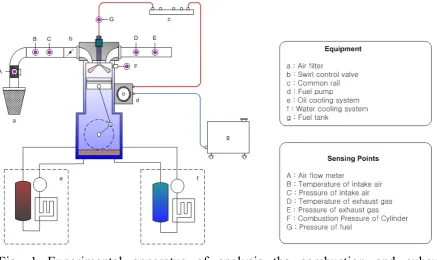
Table 1. Figure 1 demonstrates the schematic diagram of analysis the combustion and exhaust performance in a HCCI engine. The engine specifications affected on the HCCI combustion are insisted of the swirl ratio of intake port, the configuration of combustion chamber, the compression ratio and the fuel supply system of HCCI system. As shown in Figure 1, there are composed of engine dynamo-meter, control panel, data acquisition system and sensors. The experimental apparatus also included the dynamo-meter system manufactured by AVL (AC 126kW). The pressure sensors of cylinder pressure and intake pressure were measured with the piezo-electric (Kistler model 6051B) of cylinder pressure and the piezo-resistance (Kistler model 4045A2), respectively. The charge output form this transducer was converted to amplified voltage using an amplifier (Kistler model 5015) and then was recorded at 0.25oCA resolution with the sampling signals form the shaft encoder. The heat release rate was calculated by zero-dimension combustion model in accordance with the in-cylinder pressure averaged form 100 cycles for each operating point. As shown in Table 2, the exhaust gas composition of CO, HC and NOx emission were measured by gas analyzer (Horiba, MEXA 9100D) and smoke opacity was measured by a smoke meter (AVL 415).
Fig. 1 Experimental apparatus of analysis the combustion and exhaust performance in a HCCI engine
The variation of compression ratio is used the method of adjusting the height of the cylinder heat using the spacer. The EGR was adjusted through the opening and closing of the EGR valve in the connecting passage of the exhaust pipe and the intake pipe. When the EGR valve is not possible only with the increase in the EGR ratio, by increasing the back pressure of the exhaust pipe was adjusted EGR rate. The measurement of EGR rate at the time of the experiment was calculated using the ratio of CO2 of the exhaust gas to CO2 of the intake pipe through exhaust gas analyzer. It was used for calculation in equation (1). Supercharging implementation in this experiment was constructed supercharging system by applying a supercharger for an automobile.
EGR (%) = ( ) ( )
Table 1 Engine specifications
Engine type Single cylinder Base engine
Fuel type Diesel Diesel
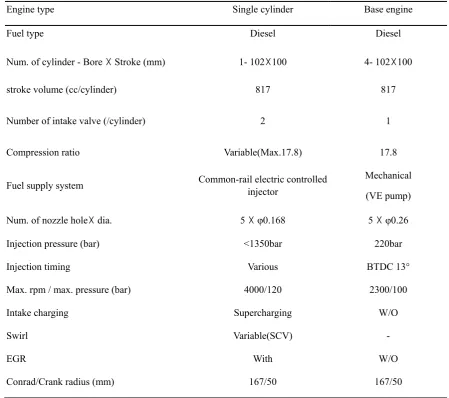
Num. of cylinder - Bore ☓ Stroke (mm) 1- 102☓100 4- 102☓100
stroke volume (cc/cylinder) 817 817
Number of intake valve (/cylinder) 2 1
Compression ratio Variable(Max.17.8) 17.8
Fuel supply system Common-rail electric controlled injector Mechanical (VE pump) Num. of nozzle hole☓ dia. 5 ☓ φ0.168 5 ☓ φ0.26 Injection pressure (bar) <1350bar 220bar
Injection timing Various BTDC 13°
Max. rpm / max. pressure (bar) 4000/120 2300/100
Intake charging Supercharging W/O
Swirl Variable(SCV) -
EGR With W/O
Conrad/Crank radius (mm) 167/50 167/50
Table 2 Specifications of dynamo and exhaust analyzer
Items Specification
Dynamo meter AVL, AC type, 126kW
Exhaust gas analyzer Horiba, MEXA 9100D
Smoke meter AVL 415
2.2 Determination of Experimental condition
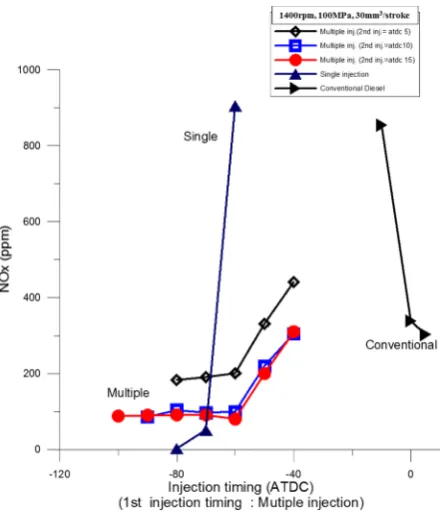
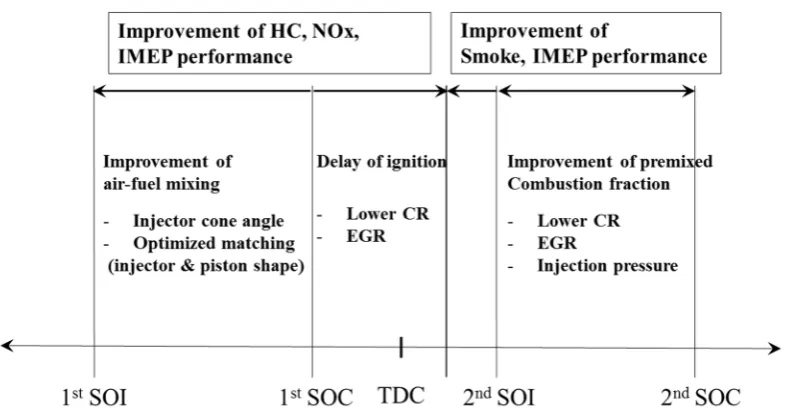
The basic combustion and emission characteristics for using 2-stage injection method were investigated and the factor to improve the combustion and emission performance was evaluated. Figure 2 showed the investigation on the combustion and exhaust characteristics of the fuel injection timing changes and variations. It indicates the schematic diagram for the qualitative characteristics in Figure 4. From the results of Figure 2 (a), as advanced 1st injection timing at the HCCI mode, the emission of NOx was excellent compared to a conventional combustion. And 2nd injection timing was relatively less affected on the NOx emission. The emissions of smoke as shown in Figure 2 (b) have a significant impact on the injection timing of 1st (early injection) and 2nd (late injection). As 1st injection timing is advanced and 2nd injection is retarded from TDC, the reduction characteristics of smoke is getter better. However, as considered to the side of injection timing 1st injection was effect on the reduction of NOx and smoke and 2nd injection was effect on the reduction of the smoke.
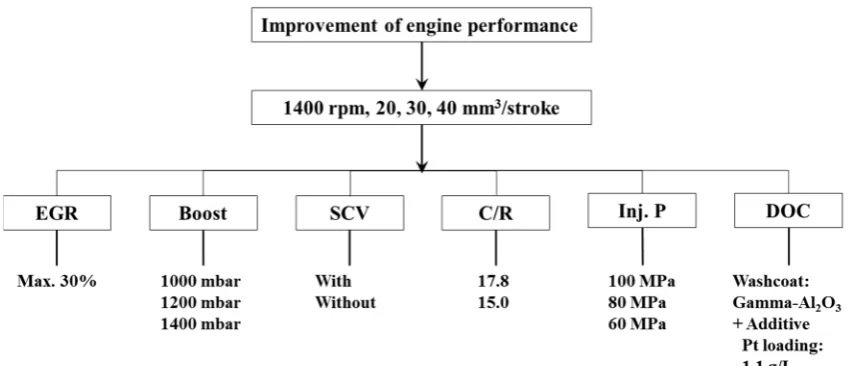
As considered to the characteristics of injection timing, exhaust gas and IMEP, the 1st injection timing has been determined to appropriate BTDC 80-60o and the 2nd injection timing has been determined to be reasonable close to ATDC 10o. The results from the characteristics stated above were considered for ways to improve performance. To improve the performance, the 1st injection timing is a delay such that the ignition of first fuel injection is close to TDC so that the combustion is active. The second fuel injection is to promote the premixed rate by delaying the ignition possible. The technical solution for realizing the research are shown in Figure 4. The experimental conditions carried out in this paper like as Figure 5.
(a) NOx
(b) Smoke
Fig. 2 Emission performance of multiple injection diesel DI-HCCI combustion (1400 rpm, 30 mm3/stroke)
Fig. 3 Effect of injection timing of multiple injection method
Fig. 5 Test parameters and conditions
3. Results and investigations
3.1 Consideration of emission characteristics and combustion control factors for the various air-fuel ratios
The combustion control factor applied to the HCCI engine has an effect between parameters. It is necessary to understand the basic concept for combustion control such as the operating condition, fuel amounts (loads). At first, the air-fuel ratio to investigate the characteristics of NOx and smoke was applied to set the range of air-fuel ratio (fuel amounts) for each factor. Figure 6 investigated the characteristics of NOx and smoke in accordance with changing the air-fuel ratio as the conditions of injection amount and supercharging rate are 20, 30, 40 mm3/stroke and 100, 1200, 1400 mbar, respectively. As the technology of HCCI using the multi-injection method was applied, the NOx emission is reduced to about 30% more than base engine (conventional engine) as shown in the Figure 6 (a). These characteristics at the split injection mode were enhanced to the premixed performance or the power performance was excellent in the performance of NOx reduction. However, the characteristics of smoke as shown
in Figure 6 (b) was badly evaluated more than base engine in case of TDC injection. For the case of the multi-injection, the injection timing which is improved the premixed performance could be confirmed that the smoke is evaluated very low.
As a result, the characteristics of the air-fuel ratio at the predetermined injection amount and the injection timing is confirmed that the boundary condition selected for application of a combustion parameter for the various combustion and improved exhaust is set before and after the A/F=30.
(b) Smoke characteristics according to the air-fuel ratio
Fig. 6 Characteristics on the emission of NOx and smoke in accordance with a air-fuel ratio (multiple injection mode)
3.2 Effect on the swirl control valve
One of the big problems with current HCCI diesel engine is poor mixing of the injected fuel and air and a lack of air mixing time. Therefore, these problems could be improved through improved mixing performance by strengthening the intake swirl flow. The role of such a swirl could be evaluated differently depending on the operating range of engine.
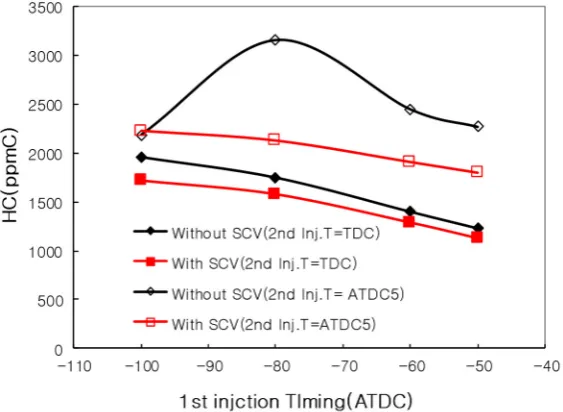
The application of SCV (swirl control valve) has been considered to apply in a relatively lean region, since it tends to reduce the intake flow amount as preventing a portion of intake port. Figure 7 showed the IMEP, A/F and emission characteristics applied the SCV as the experimental conditions were compression ratio 17.8, 1400 rpm and injection amount 20 mm3/stroke, respectively.
As SCV installed at the intake port, the power performance (0.35MPa) and the air-fuel ratio (about A/F=45) could be seen that there were loss of IMEP or a little rich. It is possible to confirm the result that the characteristics of NOx and CO emission using SCV is increased but that of HC and CO is reduced. These results are determined as a result of the effect of mixing appears more clearly than the side of the air-resistance phenomena caused by swirl flow.
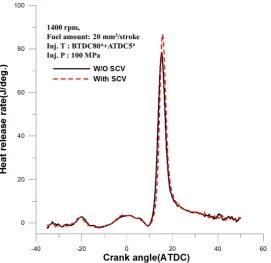
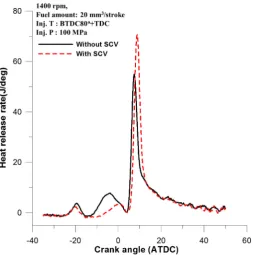
The heat release rate was investigated in order to confirm the results of these various performances in more detail, and then the result of experiment are shown in Figure 8 and 9. The main phenomenon in comparison with the results of the heat release rate is as follows;
1) The ignition delay of 1st injection according to the SCV
2) Increase in the effect on the 2nd injection timing as the 1st injection time is advanced
(a) IMEP
(b) A/F
(c) NOx
(e) HC
(f) CO
Fig. 7 IMEP and emission performance applied SCV at the multi-injection mode (20mm3/stroke, 1400 rpm)
(a) Injection timing, 1st injection: BTDC50o, 2nd injection: ATDC5o
(c) Injection timing, 1st injection: BTDC80o, 2nd injection: ATDC5o
(d) Injection timing, 1st injection: BTDC100o, 2nd injection: ATDC5o
Fig. 8 The effect on the SCV of the heat release rate during 2nd injection (1400rpm, injection amount: 20 mm3/stroke, 2nd injection timing: ATDC5o)
(a) Injection timing, 1st injection: BTDC50o, 2nd injection: TDC
(c) Injection timing, 1st injection: BTDC80o, 2nd injection: TDC
(d) Injection timing, 1st injection: BTDC100o, 2nd injection: TDC
Fig. 9 The effect on the SCV of the heat release rate during 2nd injection (1400rpm, injection amount: 20 mm3/stroke, 2nd injection timing: TDC)
3.3 Effect on the exhaust gas recirculation
The application of EGR(exhaust gas recirculation) has been applied to the technology of reducing the NOx emission by decreasing the combustion temperature at the diffusion combustion. Therefore, it is currently applied to the NOx reduction and the methodology of the ignition control through the active use of EGR. On the other hand, the excessive of EGR is to cause the problem such as increase of the combustion instability, and HC, CO. Figure 10 and 11 showed the evaluation of effecting EGR at the conditions of which are compression ratio 17.8 and 15.0, 1400 rpm, injection amount 20, 30 mm3/stroke, and the 30% of EGR rate. Figure 10 shows the characteristics of various performance according to applying EGR rate as compression ratio is 17.8. As shown in Figure 10 (a), the air-fuel ratio was evaluated less than half by using EGR. IMEP (Figure 10 (b)) was no large variation but it could be confirmed that the highest of IMEP is formed from about 10% of EGR rate. It could be applied to secure a 50 ppm or less in both of the level of injection amount 20 and 30 mm3/stroke as the rate of EGR is about 10%. Since the smoke tends to increase in accordance with increase the EGR rate in the case of the diffusion combustion, the number of smoke showed a very rich of the smoke emission (Figure 10 (c)). On the other hand, as the injection amount of split injection is 20 mm3/stroke to apply the HCCI methodology, the smoke is not reduced in accordance with increasing the EGR rate. However, in case of 30 mm3/stroke, it is dramatically increased according to increase the EGR rate.
(a) Variation of air-fuel ratio according to EGR
(b) Variation of IMEP according to EGR
(c) Variation of NOx according to EGR
(d) Variation of Smoke according to EGR
(a) NOx according to EGR rate
(b) Smoke according to EGR rate
Fig. 11 Performance characteristics of IMEP and emission applied to EGR (compression ratio: 15.0, 1400 rpm, injection amount: 20, 30mm3/stroke)
3.3 Effect on the charging pressure
(a) Characteristics of NOx emission (injection timing, 1st inj.:BTDC80o, 2nd inj.:ATDC5o)
(b) Characteristics of NOx emission (injection timing, 1st inj.:BTDC80o, 2nd inj.:ATDC10o)
(c) Characteristics of smoke emission (injection timing, 1st inj.:BTDC80o, 2nd inj.:ATDC5o)
(d) Characteristics of smoke emission (injection timing, 1st inj.:BTDC80o, 2nd inj.:ATDC10o)
4. Conclusion
In this paper, a multi-injection method in order to apply the HCCI combustion method without mainly altering engine specifications and the practicality by referring to the results of the HCCI engine was investigated. As the 2nd stage injection system was applied to this study rather than the implementation of a complete HCCI combustion, there is a tendency of partial premixed diesel combustion, discussed the effects of various combustion factors for improving combustion and exhaust performance. The conclusions were summarized as follows;
1) As considered to the characteristics of injection timing, exhaust gas and IMEP, the 1st injection timing has been determined to appropriate BTDC 80-60o and the 2nd injection timing has been determined to be reasonable close to ATDC 10o. The results from the characteristics stated above were considered for ways to improve performance. The way to improve the performance is a delay such that the ignition of first fuel injection is close to TDC so that the combustion is active. The second fuel injection is to promote the premixed rate by delaying the ignition possibly.
2) The main phenomenon in comparison with the results of the heat release rate is as follows;
a) The ignition delay of 1st injection according to the SCV
b) Increase in the effect on the 2nd injection timing as the 1st injection time is advanced
3) The air-fuel ratio was evaluated less than half by using EGR. IMEP was no large variation but it could be confirmed that the highest of IMEP is formed from about 10% of EGR rate. As the injection amount of split injection is 20 mm3/stroke to apply the HCCI methodology, the smoke is not reduced
in accordance with increasing the EGR rate. However, in case of 30 mm3/stroke, it is dramatically increased according to increase the EGR rate.
4) It is possible to lower the boost pressure rate as the excellent of premixed rate in the term of exhaust gas is at the condition of injection angle. And it could be necessary to strengthen the dilute with the relatively higher boost pressure at the condition of the partial-HCCI in case of the excellent power performance.
Reference
1) Simescu, S., Ryan, T., Neely, G., Matheaus, A., Partial Pre-Mixed Combustion with Cooled and Uncooled EGR in a Heavy-Duty Diesel Engine, SAE Technical Paper 2002-01-0963 (2002)
2) Yokota, H., Kudo, Y., Nakajima, H., Kakegawa, T., A New Concept for Low Emission Diesel Combustion, SAE Technical Paper 970891 (1997)
3) Akagawa, H., Miyamoto, T., Harada, A., Sasaki, S., Approaches to Solve Problems of the Premixed Lean Diesel Combustion, SAE Technical Paper 1999-01-0183 (1999) 4) Kimura, S., Aoki, O., Ogawa, H., Muranaka, S., New Combustion Concept for
Ultra-Clean and High-Efficiency Small DI Diesel Engines, SAE Technical Paper 1999-01-3681 (1999)
5) Hasegawa, R. and Yanagihara, H., HCCI Combustion in DI Diesel Engine, SAE Technical Paper 2003-01-0745 (2003)
6) O. Y. Kwon, J. D. Ryu, K. H. Lee and C. S. Lee, Flame and Combustion Characteristics of D.I HCCI Engine using a Visualization Engine, Tran. KSAE10 6 (2002) 100-107 7) B. H. Song, D. K. Kim and N. H. Cho, A Cycle Simulation Method for an HCCI Engine
using Detailed Chemical Kinetics, Tran. KSAE11 6 (2003) 51-58
8) Onishi, S., Jo, S., Shoda, K., Jo, P., Active Thermo-Atmosphere Combustion (ATAC) - A New Combustion Process for Internal Combustion Engines, SAE Technical Paper 790501 (1979)
9) Najt, P. and Foster, D., Compression-Ignited Homogeneous Charge Combustion, SAE Technical Paper 830264 (1983)
11)Aoyama, T., Hattori, Y., Mizuta, J., and Sato, Y., An Experimental Study on Premixed-Charge Compression Ignition Gasoline Engine, SAE Technical Paper 960081 (1996) 12)Ishibashi, Y. and Asai, M., Improving the Exhaust Emissions of Two-Stroke Engines
by Applying the Activated Radical Combustion, SAE Technical Paper 960742 (1996) 13)Oakley, A., Zhao, H., Ladommatos, N., and Ma, T., Experimental Studies on Controlled
Auto-ignition (CAI) Combustion of Gasoline in a 4-Stroke Engine, SAE Technical Paper 2001-01-1030 (2001)
14)C.H. Lee, K.H. Lee, An experimental study of the combustion characteristics in SCCI and CAI based on direct-injection gasoline engine, Experimental Thermal and Fluid Science, 31 8 (2007) 1121-1132
15)Kihyung Lee and Changhee Lee, An Experimental Study of the Extent of the Operating Region and Emission Characteristics of Stratified Combustion Using the Controlled Autoignition Method, Energy & Fuels, 20 5 (2006) 1862–1869
16)C. H. Lee and K. H. Lee, An Experimental Study on the Combustion and Emission Characteristics of a Stratified Charge Compression Ignition (SCCI) Engine, Energy & Fuels, 21 4 (2007) 1901–1907
17) Yanagihara H, Ignition Timing Control at TOYOTA, UNIBUS Combustion System. In: Duret A New Generation of Engine Combustion Processes for the Future, Paris (2001) 35-42
18) Kimura, S., Aoki, O., Kitahara, Y., and Aiyoshizawa, E., Ultra-Clean Combustion Technology Combining a Low-Temperature and Premixed Combustion Concept for Meeting Future Emission Standards, SAE Technical Paper 2001-01-0200 (2001) 19) Thring, R., Homogeneous-Charge Compression-Ignition (HCCI) Engines, SAE
Technical Paper 892068 (1989)
20) Noguchi, M., Tanaka, Y., Tanaka, T., and Takeuchi, Y., A Study on Gasoline Engine Combustion by Observation of Intermediate Reactive Products during Combustion,
SAE Technical Paper 790840 (1979)
21) Gatellier B, Walter B, Development of the High Power NADITM Concept Using Dual Diesel Combustion to Achieve Zero NOx and Particulate Emissions, THIESEL 2002 Thermo- and Fluid-Dynamic Processes in Diesel Engines, Valencia, 10th-13th September (2002) 131-143
22)Duret P, Gatellier B, Miche M, Montreito L, Zima P, Marotaux D, Blundell D, Ganser M, Zhao H, Perozzi M, Arneo L, Innovative Diesel HCCI Combustion Profess for Passenger Cars: the European SPACE LIGHT Project. EAEC Congress, paper C108 23) Stanglmaier, R. and Roberts, C., Homogeneous Charge Compression Ignition (HCCI):
Benefits, Compromises, and Future Engine Applications, SAE Technical Paper 1999-01-3682 (1999)
24) Peng, Z., Zhao, H., and Ladommatos, N., Effects of Air/Fuel Ratios and EGR Rates on HCCI Combustion of n-heptane, a Diesel Type Fuel, SAE Technical Paper
01-0747 (2003)
25) Boehm, H., Hesse, D., Jander, H., Luers, B., Pietscher, J., Wagner, H.Gg. and Weiss, M., 22nd Symposium (Int.) on Combustion. The Combustion Institute (1988) 403-411 26) M. Sj¨oberg and J. E. Dec., An Investigation into Lowest Acceptable Combustion Temperatures for Hydrocarbon Fuels in HCCI Engines. Proceedings of the Combustion Institute, 30 (2005) 2719–2726