Feature Extraction Technique: Ellipse Method
Md Saquib Seraj and Aneet Kumar DuttaDepartment of Computer Science and Engineering, Future Institute of Engineering and Management, Kolkata 700150
Abstract: Online handwriting recognition is a process in which a written character can be recognized by a computer. To be able to recognize a character a series of operations needs to be performed on that character so that finally it can be recognised automatically using artificial intelligence. The first step in online handwriting recognition is always data collection, because without the sample data no operations can be performed and no test data will be available to run the code and analyse the results. The other important processes are pre-processing, ellipse variance (the method which is being implemented in this research paper) and feature extraction. This paper deals with how the ellipse variance method can be implemented and what all are the pre requisites for the implementation of this methodology. The paper explains in details how to compute those essential data from a sequence of co-ordinate points of any given character. The character data available here is in the form of co-ordinates of pixel points followed by the pen position (i.e. x co-ordinate, y co-ordinate, pen position) where the pen position represents the pen up and the pen down conditions.
Keywords: Online, handwriting, ellipse, bounding, feature extraction.
INTRODUCTION:
Online handwriting recognition is day by day becoming an area of interest for the researchers with the increasing use of touch screen devices. This touch screen devices have the facility of writing in the screen just like we write in paper using pen. The pattern we draw in the screen contains some information and that information must be retrieved. To retrieve the information from the images drawn in screen we need to do pattern recognition. That recognised pattern is then fed to an artificial intelligence based system which learns by recognising the individual strokes and then recognising the entire character, word or a whole paragraph. Here, "Online" means that the data available is in pixel format and each pixel is represented in terms of the x and y co-ordinates, therefore the collected sample data here is represented as a sequence of pixel points.
Areas of application of this research are:
1) Online handwriting translator: Suppose we are sending a message written in Bengali to a Chinese person. In normal circumstances the Chinese person will not be understand anything about the message. But in case we can retrieve the information from the Bengali message by pattern recognition and translate the information to Chinese then the Chinese person will be able to understand.
2) In Banks the signature of a person is checked manually till today. So if we can recognise the pattern of the signature and store the characteristics of the strokes used in the signature in the database then later this characteristics and patterns can be matched with the signature that need to be checked.
One of the very important steps in the process of online handwriting recognition is the feature extraction of each character using which each character is automatically recognised by the artificial intelligence system. For feature extraction, the character needs to be bounded by a closed figure like rectangle, circle or ellipse, the figure is then divided into four zones and various traits of each character are hence recognised which are then used for the recognition process. In this paper we have attempted to explain the Elliptical method as the technique being used for feature extraction and have explained how each factor necessary for the generation of the ellipse around the character is being computed.
The ellipse being drawn around the character has its centre as the centroid of the character, i.e. the centroid or the centre of the gravity of the character is calculated and that co-ordinate is used as the centre of the ellipse being drawn. The drawn figure encloses most of the pixels of the character and those bounded pixels are used for feature recognition of the respective characters.
Steps involved in handwriting recognition:
1. Data Collection 2. Pre processing
Unit Distance Points
Normalised 90 points
Scaling (512x512) 3. Ellipse Variance 4. Feature Extraction
1. DATA COLLECTION:
Data collection is the first and the foremost step in online handwriting recognition where the data can be collected by taking samples using digitizers or light pens. Data is collected online (meaning that the data available is in pixel format represented as x coordinate, y coordinate, pen position) for each character. There are approximately 250 samples of each of the 50 characters that are being used in this research work. We are using the characters of the Indian language Bengali.
2. PRE-PROCESSING:
I. Unit Distance Points: Pre-processing refers to the
processing of the data before feature extraction. The first step in getting the normalised data is to make all the points equi-distant from each other, i.e. the distance between any two pixel points is always same.
II. 90 Points Normalization: The next step is to
done to bring all the characters to a common normalised platform based on which any programming logic can be easily implemented.
III. Scaling: The data collected online varies in terms of its
size, that is some collected date are large in size where as some are very small, this inconsistency in terms of size creates ambiguity in the minds of the programmer as to how to write a generalised code for all such collected data, therefore all such data needs to be scaled down to the same size. The maximum size of each character used in this paper is 512x512 pixel points. This is the third and the final of the pre-processing steps.
3. ELLIPTICAL METHOD (Ellipse Variance method):
To draw an ellipse around the character we need to know the co-ordinates of the centre of the ellipse, the length of the major axis and the length of the minor axis of the ellipse. The centre of the ellipse is nothing but the centroid (or the centre of the gravity) of the character around which the ellipse is being drawn. This is the first thing that is needed for drawing the ellipse.
The centroid can be calculated using the formula gx = ∑ xi
gy = ∑ yi
where (gx , gy) is the co-ordinate of the centroid of the
character which will be used as the centre of the ellipse to be drawn, N is the total number of points i.e. 90 and (xi , yi)
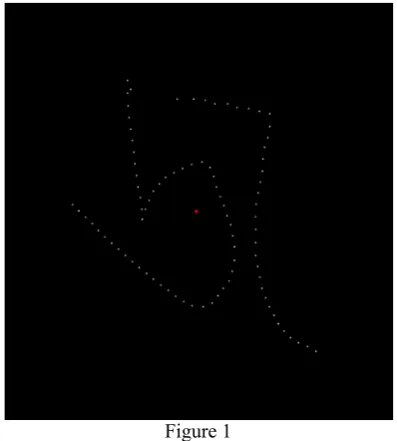
are the co-ordinates of the pixel points of the character. The red dot in Figure 1 below represents the centroid of the Bengali character জ (JA).
Figure 1
Next we need to calculate the length of the major axis and the length of the minor axis. For the length of the major and the minor axis we find the farthest point in the x direction and y direction respectively from the centroid (gx , gy).
Farthest point in the x-axis can be computed by calculating the distance between the centroid of the character (gx , gy)
and the points on either side of the centroid. The green line in Figure 2 and Figure 3 divides the image into two halves
and shows how the maximum distance between the points (xi , yi) and the centroid is computed and the respective
co-ordinates are noted down to mark as the starting of the axis of the ellipse being drawn. The distance can be calculated using the formula–
Distance = gx
Figure 2
Figure 3
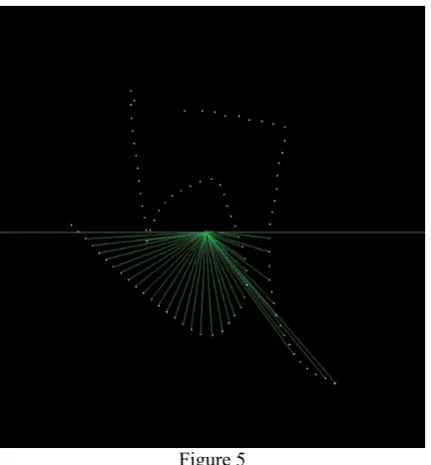
Similarly, figure 4 and figure 5 indicates how the farthest point in the y-axis can be computed using the same distance formula.
Figure 5
If the distance between the farthest point in the x-axis and the centroid (distance x) is greater than that between the farthest point in the y-axis and the centroid (distance y) then the distance x becomes the length of the major axis and the length of the minor axis is the distance y, else the y-axis is the major y-axis and the distance y is the length of the major axis and x-axis becomes the minor axis and the length of the minor axis is the distance y.
One thing to be noted is that if we simply try to find the maximum value of co-ordinate x and co-ordinate y from the set of co-ordinates of the pixel points of the character then the value obtained will be wrong because it will always be the co-ordinate towards the lower right corner of the scaled image since the co-ordinates of that pixel point is always the greatest in number (maximum is (512,512)) but it may or may not be the farthest point from the centroid. Now using the draw ellipse function and passing as parameters (gx , gy), distance x and distance y we get the
ellipse as shown in the Figure 6 and Figure 7. In figure 6, the major axis is the y-axis and in figure 7, the major axis is the x-axis.
Figure 6
Figure 7
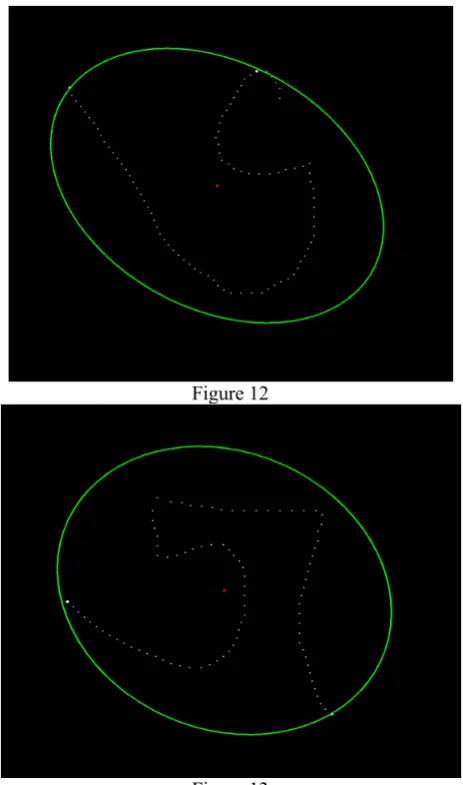
The ellipse drawn is at an angle 0 degree with the major axis, as evident in the figures 6 and 7 above. In both the figures 6 and 7, two bright spots are visible, which mark the farthest pixels in x and y direction respectively. It is evident that the farthest pixels does not lie on the axes in both the cases, which means that the farthest points may or may not lie on the axes for all the characters and therefore the ellipse being drawn should not always make an angle 0 degree with its major axes, instead it should be tilted at an angle made by the farthest point and the centroid of the ellipse.
So, there needs to be a way to find the angle of tilt for the ellipse being drawn.
The slope between any two points can be calculated using the two point formula
Slope (m) =
We know that, slope (m) = tan Θ Therefore, Θ = tan-1 m
Now the same ellipse can be drawn using the angle Θ with its axis.
If we divide the character into four zones or quadrants then there are four possible regions where the farthest point can exists.
CASE 1
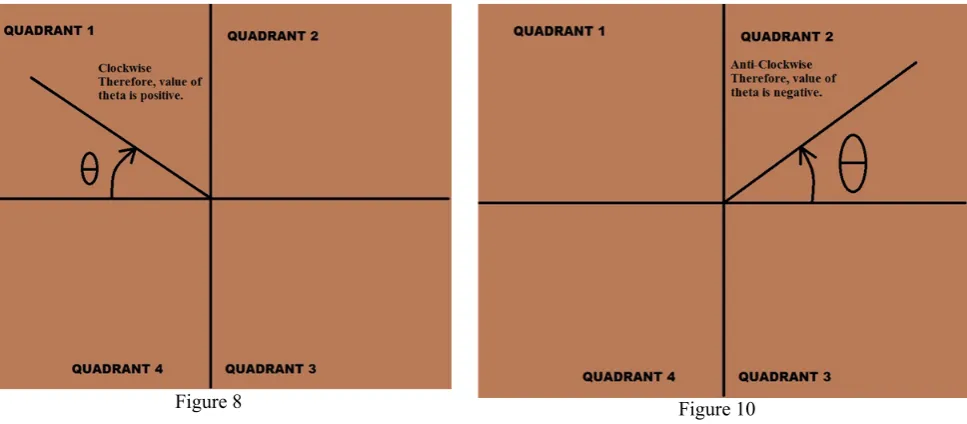
When X < gx and Y < gy, where X and Y are the
Figure 8
CASE 2
X > gx and Y > gy, this is same as case 1, the angle here is
vertically opposite to that of case 1.
Figure 9
If the major axis is the x axis, then the ellipse is tilted to an angle of – Θ (minus Θ), this is done to get the major axis start from the farthest point in the x direction. A positive value of Θ tilts the ellipse in anti-clockwise direction, therefore a negative value of Θ is used as the tilt angle. If the major axis is the y-axis and the farthest point on the y-axis lies in the first or the third quadrant (as shown by Figures 8 and 9) then to tilt the y-axis of the ellipse to an angle Θ the ellipse is made to tilt at an angle (90- Θ), i.e. a positive Θ vale for an anticlockwise tilt of the ellipse generated. This orients the ellipse with the same angle as that made by the farthest point in the major axis.
CASE 3
X>gx and Y<gy, the Θ value calculated here is negative
since it is calculated anti-clockwise.
Figure 10
CASE 4
X<gx and Y>gy, i.e. Θ value lies in the fourth quadrant and
the value is calculated anticlockwise, hence is negative.
Figure 11
In figure 10 and 11, the farthest point is taken in either the second or the fourth quadrant, both of them give a negative value of Θ.
If x-axis is the major axis, a negative Θ value tilts the ellipse in anti-clockwise direction but the required tilt is in the clockwise direction towards the second quadrant, therefore the tilt angle is – Θ (minus theta). Thus it can be said that irrespective of the quadrant of the farthest point, if the major axis is axis is x-axis, then the ellipse needs to be oriented at an angle – Θ.
If the major axis is the y-axis, then in case 3 and case 4 the ellipse needs to be tilted clockwise to be oriented with the farthest point. The value of Θ obtained is negative in both of these cases but for clockwise tilt the required Θ should be a positive value. To tilt the ellipse clockwise we set the tilt angle to be -(Θ +90.0) which always results a positive value and orients the ellipse with the farthest pixel.
Figure 12
Figure 13
4. FEATURE EXTRACTION:
This ellipse can be used to extract certain features of the characters which will be different for each character. This phase is what teaches the artificial intelligence system the characteristics of each character and those are used in the recognition process.
The features extracted are:
1. The distance of each pixel point from the centroid. 2. The angle between each pixel point and the centroid. 3. The number of pixels in each quadrant of the ellipse. 4. The length of the chord in each quadrant of the ellipse.
ACKNOWLEDGEMENT:
We would like to show our gratitude to our Guide Prof. Shibaprasad Sen, Assistant Professor of Future Institute of Engineering and Management, CSE department, Sonarpur. We thank him for his constant support and encouragement during the course of the research without which we would not have become so focussed on our work and would not have achieved this.
REFERENCES:
1. Rajib Ghosh, “A survey of Methods and Strategies in Online Bengali Handwritten Word Recognition”.