Flying-fox Heat Event Response
Guidelines SEQ
Dr. Tania Bishop BVSc (Hons1a), MANZCVS (Avian Health)
Ms Rachel Lyons BRTP(Hons), GC Env. Man.
Table of Contents
1.0 INTRODUCTION ... 3
2.0 IDENTIFICATION OF HEAT STRESS EVENT (HSE) SITES ... 5
3.0 FLYING-FOX BEHAVIOUR MONITORING ... 6
4.0 SITE MONITORING & INFORMATION DISSEMINATION ... 10
5.0 COMMUNICATION ... 11
6.0 RESPONSE GUIDELINES ... 13
WORK PLACE HEALTH & SAFETY - WH&S (PHYSICAL & EMOTIONAL) ... 19
7.0 HSE RESPONSE LOGISTICS ... 21
8.0 ROLES ... 23
DETAILED ROLE DELINIATION ... 25
9.0 RESPONSE EQUIPMENT AND SETUP ... 28
10.0 TRIAGE PROTOCOL ... 31
TRIAGE - ALL BATS THAT REQUIRED MOVING FROM CAMP FOR TRIAGE ... 31
TRIAGE - BATS REQUIRING IMMEDIATE EUTHANASIA ... 32
CORRECT TRANSPORT PROCEDURE ... 32
11.0 AFTER THE EVENT – MANAGING FLYING-FOXES POST HSE ... 33
MANAGING FLYING-FOXES POST HSE ... 34
REHABILITATION ... 34
13.0 BIBLIOGRAPHY ... 36
14.0 APPENDICES ... 37
14.1 SEQ HSE CAMP STRATEGIES – GATHERED AT HSE WORKSHOP ... 37
14.2 HEAT STRESS DATA RECORDING... 44
14.3 INDIVIDUAL OUTCOME FORMS ... 48
14.4 VOLUNTEER SIGN ON SHEET ... 49
14.5 INCIDENT REPORT ... 50
14.6 COMMUNICATION EXAMPLE ... 51
14.6 WORKSHOP QUESTIONNAIRE FOR INITIAL DATA COLLECTION ... 52
14.6 ABLV AND FLYING-FOX HANDLING ... 61
1.0
INTRODUCTION
Flying-fox populations are increasingly threatened by heat events, starvation events and other stressors due to habitat clearing and human/flying-fox conflict.
These factors are unlikely to resolve, meaning that a well-coordinated and timely approach to flying-fox disasters is imperative for the mitigation of further flying-fox population impacts.
Key Words –
Flying-fox, disaster management, heat events, heat stress, roost management, physiology, veterinary management.
The following document aims to give a framework for all stakeholders for the prevention, preparedness, response and recovery of flying-foxes during such events.
Stakeholders who may find this document useful would include, but are not limited to: - Land Managers
- Decision makers - Researchers - Conservationists - Veterinarians
- Wildlife professionals - Wildlife carers
The following document was created after a flying-fox heat response forum was sponsored by LGAQ and hosted by Logan City Council, convened by Mrs Lee-Anne Veage. Environment Officers, Wildlife Officers and key wildlife carers experienced in flying-fox heat event responses representing each of the key regions in the greater SEQ region were in attendance of a full day conference and workshop. The data from the questionnaire found in Appendix 14.6 was collated and utilised to form the following document.
The document was written by Dr. Tania Bishop BVSc(hons1a) MANZCVS (Avian Health) and co-authored by Ms. Rachel Lyons BRTP(Hons), GC Env. Man.
The document has been reviewed by the following people due to their key expertise in the field:
Dr. Peggy Eby
Dr. Alison Peel
Mr David Zammit
Mrs Lee-Anne Veage
Attendees at the forum contributing to data:
Rodney Adam – Environment officer - Logan City council Tim Shields – Environment officer – Ipswich City Council Darren McPherson – Environment Officer – Somerset Council Jenny Davis – Wildlife Officer – Redland City Council
Lisa Bailey – Wildlife officer – Redland city council Raeleen Draper – Wildlife officer – sunshine coast council Glenn Miechel – Wildlife officer – sunshine coast council
Andrew Evans – Environment officer – Moreton Bay Regional Council Martin Bennett – Environment officer – Lockyer Valley Regional Council Robyn Jones – Wildlife Officer – Brisbane City Council
Michelle Chubb Kerry Turner Helen Mcleish Sue Morris Rachel Lyons Keith Falkiner Michael Jansen Jane Shead Bill Shead
Charmaine Brayley Jade Lewis
Sammy Ringer Byron Cann Lorna Smith Dee Smith Linda Darcy
2.0
IDENTIFICATION OF HEAT STRESS EVENT
(HSE) SITES
Heat stress variables that determine the susceptibility of a roost during a heat stress event (HSE) include the following:
Weather/Climate
Temperature >40°C & No. of consecutive days Humidity
Wind direction – West and North
Camp attributes
Size of camp and history of prior heat events
Camp composition – understory, mid-storey and canopy – open / closed structure – incredibly important Proximity to water
Topography / aspect / altitude
Location – westerly aspects, heat islands Crowding at camps
Camp Capacity
Human Activity and site tenure – incidental or intentional disturbance Other stressors for camp e.g. camp management, food shortages Splintering of camps
Demographics
Time of year – mating; pregnant lactating female, pregnant females Number, age and developmental stage of juveniles
Species composition
3.0 FLYING-FOX
BEHAVIOUR MONITORING
Flying-fox monitoring is critically important before, during and after a response.
NORMAL BEHAVIOUR (CLASSIFIED AS
CATEGORY 1)
A greater understanding of “ normal” behaviour (Classified as Category 1) will aid in an understanding of abnormal behaviour so to indicate if a response is going to be required.
The time of year, ambient temperature and relative humidity should always be considered as an essential part of information when interpreting any behaviour.
The percentage (%) and demographics of animals carrying out such behaviours are also important. i.e.; pregnant/lactating females fanning only versus the entire colony fanning. Pregnant and lactating females can start fanning at temperatures as low as 23 C due to the higher metabolic demands of their physiological state. Whilst observing these behaviours is important and can act as early warning systems of arising issues, it is also important to note that these behaviours can be normal in these animals.
Behavioural progression from animals showing signs of heat stress through to heat stroke will always follow a predictable consistent progression. (Snoyman et al., 2012). This progression is as follows:
WING FANNING (CLASSIFIED AS CATEGORY 2)
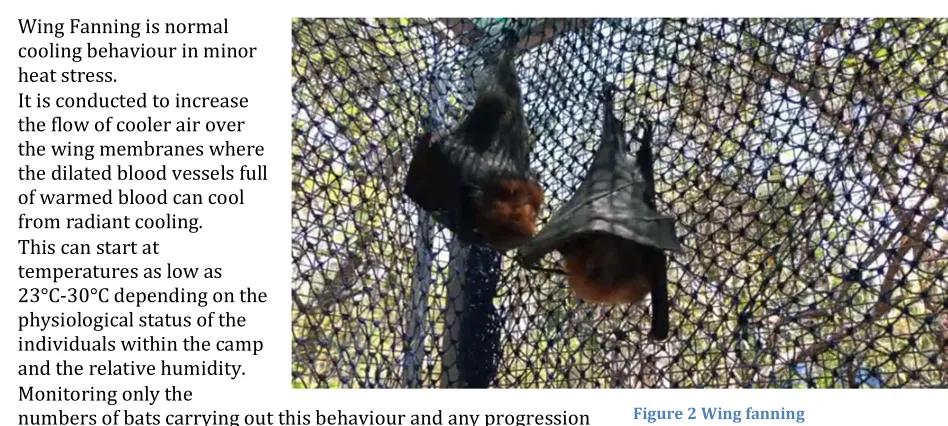
Wing Fanning is normal cooling behaviour in minor heat stress.
It is conducted to increase the flow of cooler air over the wing membranes where the dilated blood vessels full of warmed blood can cool from radiant cooling.
This can start at temperatures as low as 23°C-30°C depending on the physiological status of the individuals within the camp and the relative humidity.
Monitoring only the
numbers of bats carrying out this behaviour and any progression needs to be noted at this point.
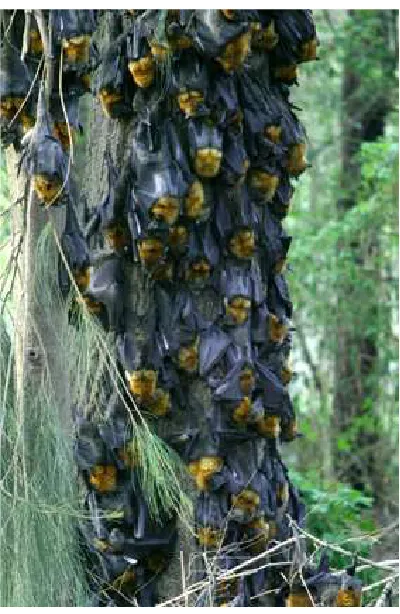
Figure 1 Normal behaviour
CLUSTERING (CATEGORY 3a)
Bats start to move further down the trees into the middle-storey vegetation. Thermal imaging has revealed that bats are
attempting to move to cooler microclimates within the camp. (Welbergen et al. 2012)
Bats will continue to fan during this time and if temperatures continue to rise they will start panting and wrist licking.
Whilst this stage does not immediately trigger an alert, bats starting to carry out this behaviour need to be monitored and response groups need to be placed on alert for the possible need of an on-site response.
This behavioural stage should be posted on alert platforms and once confirmed, preparations for response should be coordinated.
It is important to note that bats at this stage
should never be disturbed. Disturbance is likely to risk bats becoming stressed and taking flight, causing serious heat stroke and possible death.
CLUMPING (CATEGORY 3b)
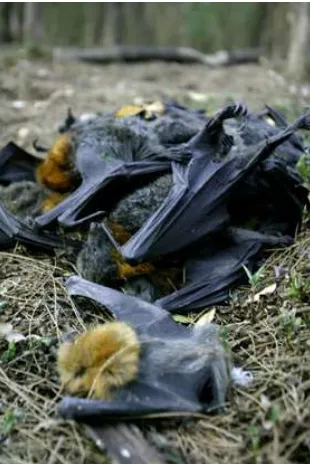
Flying-foxes at this stage will roost on top of each other.
This can occur on:
- Shaded side of the trees - Under logs
- The understorey - In tree hollows - The base of trees - On the ground
These clumps can consist of in excess of 50+ flying-foxes.
At this stage flying-foxes should not yet be approached for spraying, as many would not tolerate spraying at this point.
At this time HSE response personnel should be in place and set-up for a response, should the sensitivity of the roost, location and resources allow.
Figure 3 Clustering
PANTING/WRIST LICKING AT THE BOTTOM OF TREES (CATEGORY 4)
At this stage a response should have been triggered and a response site should already be set up ready to go, if intervention is suitable for the roost and site.
Bats start to pant and lick their wrists. Ambient temperature has continued to rise and clumping in cooler microclimates and wing fanning has failed to lower their core body temperatures.
Wrist licking and panting is utilised as a means of using evaporative cooling to lower core body temperatures.
In high humidity heat events, this is hampered by high humidity affecting the ability of bodily fluids to evaporate and cool the body.
In low humidity heat events, this will be very
effective at cooling the body, however it will be
extremely costly as flying-foxes will dehydrate very quickly.
This is why HIGH and LOW humidity events require a different approach to spraying timing and monitoring.
Bats will become very dehydrated and become hypoglycaemic and vague due to the effort of fanning and heat stroke starting to affect body functioning.
Bats will move to the bottom of the trees and those with no mid-storey may fall from the upper canopy with severe heat stroke.
At this stage, monitoring needs to be undertaken very carefully.
Rescuers need to very cautiously approach bats at the base of trees to monitor for any signs of distress and bats trying to lift off.
Rescuers then MUST move away as quietly as possible to avoid bats lifting at this critical stage.
Any seizuring animals should be taken for euthanasia ONLY if a licenced carer is available AND other nearby bats are not stressed or show signs of lift on approach.
Seizuring flying-foxes should not be removed from the camp if there is not someone licenced for euthanasia immediately present, as dying unaided in the presence of humans will be far more stressful for the animal.
If the bats are tolerant of a quiet approach, an attempt at spraying with water and a backpack spray can be attempted.
Start gently with the stream as a good spray…DO NOT MIST in a high humidity event, (>70% humidity) as this only worsens the situation through heightening humidity levels.
Gradually increase the intensity of the spraying so that each bat gets saturated directly with water.
Move on to observe the next area and come back and observe the previously sprayed bats after 15 minutes.
After three (3) attempts at good spraying – those remaining bats that have not responded (i.e. climbing back into the mid-storey) should be taken for triage.
Do not immediately remove orphans that are roosting in trees, as mothers will often come back for babies once the situation has settled. It will become apparent over the next 24-48 hours if juveniles are truly orphaned.
Figure 5 Wrist Licking
4.0 SITE MONITORING & INFORMATION
DISSEMINATION
At the Logan HSE Forum, there was consensus of the need for monitoring camps at regular intervals throughout the year to gain a better understanding of specific camp behaviour. Understanding normal behaviours of camps help to understand when abnormal behaviours are occurring. Monitoring of camps in the lead-up, during and after events is necessary.
The Logan Forum attendees discussed the need for more teams to be educated in reading camp and flying fox behaviours.
The Logan Forum attendees identified the need and moved to establish a ‘SEQ Disaster Management’ Facebook page with strict terms of reference and for regional coordination of events, education and admin scrutiny of posts. It is located at the following link -
https://www.facebook.com/groups/187708728487898/
Other tools are available to help monitor weather outlook, current temperatures, potential heat stress events forecasting and flying-fox roost information:
- Bureau of Meteorology (BOM) http://www.bom.gov.au/
- Flying-fox Heat Stress Forecaster https://www.animalecologylab.org/ff-heat-stress-forecaster.html - Weather zone http://m.weatherzone.com.au/
- National Flying Fox Monitoring Viewer http://www.environment.gov.au/webgis-framework/apps/ffc-wide/ffc-wide.jsf
Looking forwards, the Forum attendees identified that it would be ideal to gain funding to obtain: - Data loggers (temperature and humidity) in camps –
- Remote cameras in camps to enable remote behaviour monitoring; and - Regular personnel to monitor flying-fox roosts
- Pre-event heat event triage and trauma care training for consistency in approach
- Orphan and adult flying-fox care with an emphasis also on disaster management and triage consistent across all carer groups.
5.0 COMMUNICATION
There is a clear need to enhance the communication of HSE’s both within the rehabilitation and rescue networks but also more widely in the local community.
Multiple flying fox rescue groups exist in SEQ and a multitude of sites effected by HSE exists which can create difficulties and inefficiencies in resources where communication is lacking.
FACEBOOK COMMUNICATION SITE
A Flying Fox Disaster Management Forum Facebook Group was identified within the Logan 2017 HSE forum as being a useful tool to enhance communication within the operational response groups.
https://www.facebook.com/groups/187708728487898/
The Facebook group is established to “aid in response coordination and information dissemination related to Flying Fox Disaster Management, including heat stress events, starvation events, storm events and any other event involving multiple camps and/or flying foxes.”
The group will operate as per the following points which were proposed at the Logan Forum:
Have a rotation of Council officers acting as site moderators.
Include standardised communication leaflets to use in disaster events.
Store relevant information / protocol / documentation.
Real time videos of behaviours can be uploaded and consensus can be made on whether a response is required or further monitoring.
Allows for structural framework support for disaster management PPRR – prevention, preparedness, response and recovery.
Ensure that information is standardised and correct for media and community information.
Debriefing events post disasters, to offer support and fine-tune responses for future events.
Identify training requirements. Responses and triage are very varied with considerable variation between groups.
Training on camp monitoring and bat behaviour identification associated with disaster responses.
Training on smooth coordination, role defining and deployment of resources in a disaster event.
Allow dissemination of information about 'at-risk' camp activity and the need to deploy resources and/or people to affected areas.
MEDIA AND COMMUNITY
Various options exist for general community awareness raising of HSE’s. These include:
Pre-prepared standardised statements or flyers to physically letter-box drop with a list of key message points, so that correct and consistent information is disseminated to the community and/or media. It is important that common messages of communication are used.
Local bat rescuer getting to know locals as well as foster links with local government. Examples of strategies in action include:
Standardised media releases and letter box drops - Refer Appendix 14.5 - community letter box drop flyer.
Door to Door approaches to local community directly affected by HSE.
Bi-monthly community newsletter – ‘camp neighbours’ – e.g. Sunshine Coast Regional Council.
Call centre scripting (including after hours) for Council’s – Ipswich City Council update call centre scripting – business hours.
Information signs at colonies with contact details for site coordinator/ rescue group/s; including temporary corflute signs at key times. – i.e. have pre-prepared corflute signs that are erected at camps during HSE peak times with information and contact numbers. Needs to be organised with local council. Care must be taken regarding media contact protocols, particularly involving Council Officers.
With regards to media content, have pre-planned media statements or key points to get across so to stay on message. Appoint a Media Spokesperson who is not in the hot zone, preferably a person that is in charge and is not in the thick of the rescue, so they can be objective and look professional in the media to instil confidence in public.
Any media information needs to focus on the environmental and economic value of flying-foxes, as well as the human aspect, whilst also addressing any health concerns that members of the public may have.
Reinforce the existence of Flying-fox local networks and show the community that there are plans in place to both help the bats and protect the community and that Groups and Local Government are on the same page.
GENERAL COMMUNICATION BETWEEN OPERATIONAL RESPONDERS
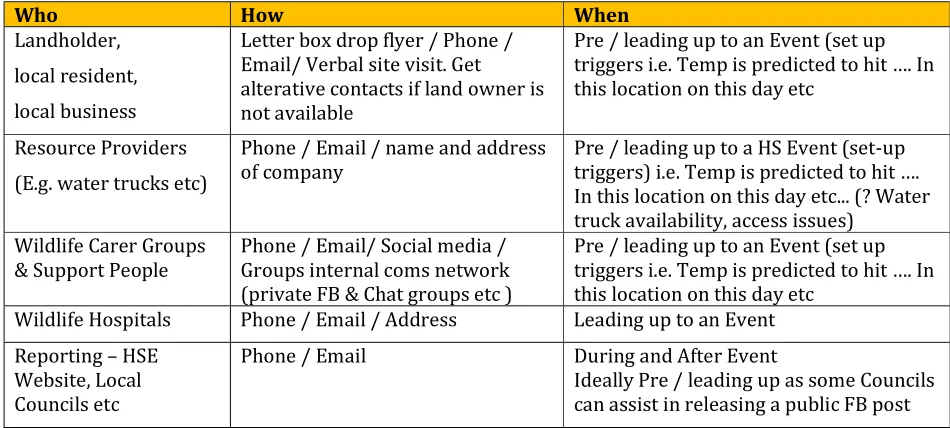
Various stakeholders exist at roost sites and during HSE’s. The following table is a guide to identify stakeholders who should be informed and/or included with options on methods of contact and suggested timeframes.
Who How When
Landholder, local resident, local business
Letter box drop flyer / Phone / Email/ Verbal site visit. Get alterative contacts if land owner is not available
Pre / leading up to an Event (set up triggers i.e. Temp is predicted to hit …. In this location on this day etc
Resource Providers (E.g. water trucks etc)
Phone / Email / name and address
of company Pre / leading up to a HS Event (set-up triggers) i.e. Temp is predicted to hit …. In this location on this day etc... (? Water truck availability, access issues)
Wildlife Carer Groups
& Support People Phone / Email/ Social media / Groups internal coms network (private FB & Chat groups etc )
Pre / leading up to an Event (set up triggers i.e. Temp is predicted to hit …. In this location on this day etc
Wildlife Hospitals Phone / Email / Address Leading up to an Event Reporting – HSE
Website, Local Councils etc
Phone / Email During and After Event
Ideally Pre / leading up as some Councils can assist in releasing a public FB post Table 1. Identified stakeholders and methods of communication for pre, during and post HSE
6.0 RESPONSE GUIDELINES
Below is an overview of the process in response to a flying-fox disaster using the PPRR methodology relating to
Prevention, Preparedness, Response and Recovery. This is then followed by detailed information on each section for further reference and guidance.
The HSE Forecaster may provide a few days notice as to a potential heat stress event, so a large part of a successsful response is preparation. If a HSE is predicted and the decision is made to respond, then clear criteria based on the environmental conditions, roost characteristics and the progression of the bats' behavioural responses to the heat on the day, will determine the timing of intervention. It needs to be recognised that it is not likely possible to save every bat on the day and a triage plan should be followed to achieve the ultimate aim: to minimise flying-fox suffering and deaths.
PREVENTION
Ensure that camp vegetation structure is as intact as possible, having canopy, mid-storey and
lower/understorey vegetation as a refuge. Undertake vegetation rehabilitation to improve this where required.
Aim to maintain camp vegetation structure where possible when any vegetation management plans are formulated.
PREPAREDNESS
Ensure that carers are well versed in flying-fox behaviour.
Know local colonies. – consider having personnel assigned to regular monitoring of camps during the year to get to know the camps behaviours.
Regularly and carefully monitor weather forecasts and camps
Ensure that carers are aware of plans in advance and have all the information on response plans, communication chains and locations of resources in advance of any issues arising.
Ensure good communication channels exist to disseminate information.
Facebook communication site – ensure that all relevant plans and triage templates are readily available and information can be efficiently and easily disseminated should an issue arise. This may assist in coordinating volunteers monitoring camps.
Ensure that all community and media information is correct and standardised to facilitate the
consistent and correct information being provided to the general public on what is happening as soon as possible, or in the lead up to a possible event.
Contact your local Council Wildlife/Environment Officer to inform/advise of potential activities. This is also useful in the event the Council has trained and available staff to assist in HSE preparedness and response.
Ensure that the location of any resources is known, maintained and stocked correctly.
Roles are clearly defined and the contact details of members involved in specific roles is easily accessible.
Paperwork for data collection including site- induction sheets, tag numbers and bat details are all ready and stored with triage and rescue equipment in advance. Refer Event Data forms provided in Appendix 14.2 and 14.3.
Ensure that all recording paperwork is standardised so that it can be compiled in the event of a multi-location disaster.
Ensure that maps including access points to camps are available to everyone (FB site) – include UBD references, address, and GPS coordinates, mud maps.
event of a bushfire; triage locations; division quadrants in the roost; volunteer resting area away from triage; signage locations; sign-in/out locations etc.
Triggers for monitoring, responding and recovery stages - E.g. Heat Stress Forecaster website has indicated a high risk - discuss need to respond on Flying-fox Disaster Facebook site and trigger response.
List of close-by facilities - wildlife hospitals, vets that have vaccinated staff and are happy to take flying-foxes, service stations, hospitals (human), shops (for welfare, consumables, gloves, ice), and local government.
The HSE plan should be scalable from a 1 day to a multi-day event.
Have role responsibility guidelines so groups can work out who is rescuing, transporting, working in triage, caring off site, who will replace the first wave of rescuers in a multi-day event etc.
Have reliable links for information like BOM, Met-eye (also has a user-friendly interface), local FB pages, Local Government.
Have up to date contacts for Local Government, land holders happy to allow access, local and nearby bat groups /rescuers / carers.
Risk assessment and fatigue management guidelines including a roster system to allow rotation in the event of the incident scaling up to a multi -day.
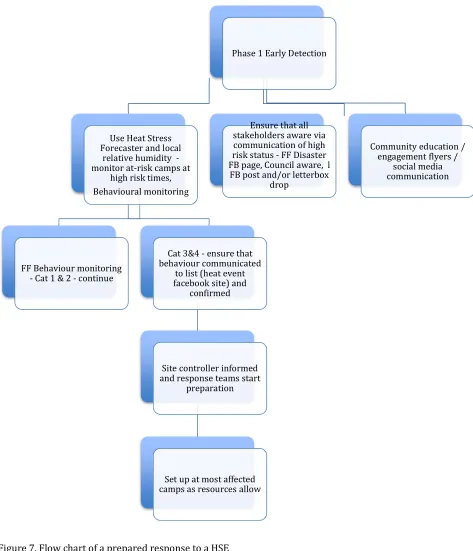
Figure 7. Flow chart of a prepared response to a HSE
Phase 1 Early Detection
Use Heat Stress Forecaster and local
relative humidity -monitor at-risk camps at
high risk times, Behavioural monitoring
FF Behaviour monitoring - Cat 1 & 2 - continue
Cat 3&4 - ensure that behaviour communicated
to list (heat event facebook site) and
confirmed
Site controller informed and response teams start
preparation
Set up at most affected camps as resources allow
Ensure that all stakeholders aware via communication of high risk status - FF Disaster FB page, Council aware, l
FB post and/or letterbox drop
Community education / engagement flyers /
RESPONSE
The ability and timeliness of responses will depend on the sensitivity of the camp, availability of resources, environmental and site conditions.
The monitoring of flying fox behaviour is essential to determine appropriate and relative scale of responses.
Inform local Council contact. – some councils will have an approved response team to aid with public engagement and information.
Ensure that public communication has occurred in lead up to event – if signs indicate a need to respond, ensure that all equipment boxes have been audited and are completely stocked and that communication with all stakeholders both direct and via social media has occurred. Carry out public communication methods.
Once confirmed that a response is to occur – establish personnel available to attend.
Site controller to co-ordinate communication with personnel in each role and trigger communication.
Site should be set up as per the protocol of logistics on site.
Roles should already have been established.
The following behavioural guide (Table 2) and decision support tree (Figure 8) will assist in the deliberations of a HSE intervention:
Behaviour Response
Cat 2 Wing fanning Observe
Cat 3a Shade seeking Observe
Cat 3a Clustering Observe / prepare for possible response Cat 3b Clumping/ Licking Observe / prepare
Salivating Observe / prepare
Panting Observe / prepare
Cat 4 Bats on ground / disorientated
Observe in sensitive camps. (those with flighty / stressy flying-foxes) In tolerant camps - Direct spray 3 times with 15-minute intervals. Retrieve to treat only if vet or euthanasia carer is on-site, leave in-situ if not.
Falling from trees Observe in sensitive camps.
In tolerant camps - Direct spray 3 times with 15-minute intervals. Retrieve to treat only if vet or euthanasia carer is on-site, leave in-situ if not.
Seizing / non-responsive Observe in sensitive camps.
In tolerant camps - Retrieve only if euthanasia carer is on-site, leave in-situ if not.
Deceased Observe and monitor.
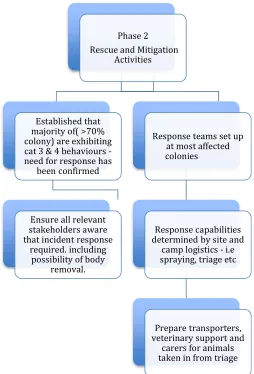
Figure 8. Response flow chart to a phase 2 Rescue and Mitigation HSE
Phase 2 Rescue and Mitigation
Activities
Established that majority of( >70% colony) are exhibiting cat 3 & 4 behaviours -need for response has
been confirmed
Ensure all relevant stakeholders aware that incident response
required. including possibility of body
removal.
Response teams set up at most affected colonies
Response capabilities determined by site and
camp logistics - i.e spraying, triage etc
Prepare transporters, veterinary support and
RECOVERY
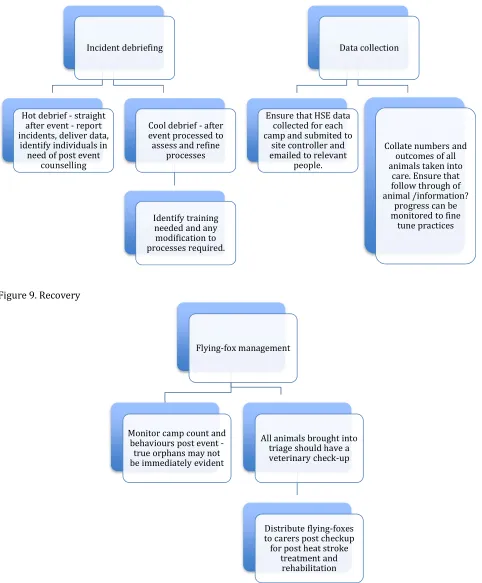
Both Incident Debriefing and Data Collection are essential if we are to collectively learn from events and improve our practices into the future.
Figure 9. Recovery
Figure 10. Flying-fox management flowchart Incident debriefing
Hot debrief - straight after event - report incidents, deliver data,
identify individuals in need of post event
counselling
Cool debrief - after event processed to assess and refine
processes
Identify training needed and any modification to processes required.
Data collection
Ensure that HSE data collected for each camp and submited to
site controller and emailed to relevant
people.
Collate numbers and outcomes of all animals taken into
care. Ensure that follow through of animal /information?
progress can be monitored to fine
tune practices
Flying-fox management
Monitor camp count and behaviours post event
-true orphans may not be immediately evident
All animals brought into triage should have a veterinary check-up
Distribute flying-foxes to carers post checkup
for post heat stroke treatment and
RESPONSE
Veterinary treatment and sending any bats taken in for triage to carers – document progress and outcomes for these bats including all relevant medical data need to be collated in order to later refine responses and follow up on success of post treatment bats.
All post HSE orphans also need close follow-up and data on growth rate and health issues through care.
Any bats found dead or alive with bands attached need to be reported to
http://www.environment.gov.au/science/bird-and-bat-banding/get-involved/report-band-sightings
Any bats with radio-tracking collars need to be reported also. (details should be on the radio tracker).
Hot and cold debriefs – can be an SEQ wide event if a HSE has occurred at multiple sites – Correct information collected
- Facilitates emotional support of those involved;
- Allows analysis of techniques that worked, did not work and how procedure can be modified and/or improved;
- Also allows evaluation of response – in cold debriefs – was protocol carried out? Was it effective? What could be changed or improved?
Ensure, you take the time to review and ask if there were there other factors involved which caused that particular camp to be more susceptible? Can anything be done to avoid that in the future? E.g. camp rehabilitation.
Data should be collected using the form located in Appendix 14.2 and 14.3, and the completed forms sent to the individuals listed on the form in addition to the carer group and Local Council where requested.
WORK PLACE HEALTH & SAFETY - WH&S (PHYSICAL & EMOTIONAL)
What WH&S Procedures need to be in place?
WH&S, induction; triage parameters; transport and media / public information standardised across camps.
Ideal to pursue opportunities forCollective / Shared Workplace/Occupational Health & Safety Policies and Procedures between Groups.
HSE’s should be viewed as ‘Incidents’ - Treat events as ‘Incidents’ with a formal Incident Controller.
Each rescue / response will vary based on camp logistics.
Ensure that anyone handling bats is vaccinated and is easily identified. Responders having copies of vaccination certificates handy in printed form or copies on their phone can do this. Groups should have a list of vaccinated people and copies of proof that they are up to date with vaccinations. One option is having simple armbands in certain bright colours for vaccinated and non-vaccinated personnel so they can be utilised more effectively.
Rescuers tagging bats with toe tags will also help with identification of bats if a scratch or bite occurs.
Have dedicated personnel, who are there to look after the rescuers welfare, someone who can stand back and watch the responders and identify anyone who needs to take a break, hydrate etc. This can be the same person who acts as a Safety Officer, First Aider; Organiser of personnel on that site etc. And should be someone who is not doing hands-on rescue.
Rescuer's welfare to be aware of: emotional fatigue, physical fatigue and heat exhaustion.
Support the people involved by providing a breakout area and have someone who is away from the rescue site who checks on them and acts as a peer supporter.
For roosts located on Council reserves, Council WH&S requirements for operations on Council Property may apply which may include Inductions, Safe Operating Procedures, Toolbox Talks etc. Speak to your local Council Wildlife or Environment Officer contact for more information.
How best to support the people involved in these events:
Briefings pre and post events – hot and cold debriefs – Hot debriefing allows data collection and all pertinent, immediate information to be exchanged whilst still fresh in people's minds. Cold debriefing allows review of the responses after processing has occurred, to discuss outcomes and where procedures can be improved / modified.
Ensure that grief counselling or general counselling is available to those that need it.
Assistance in talking to people who may require counselling but may not be able to identify it.
7.0 HSE RESPONSE LOGISTICS
Each camp is unique, however the HSE operative should be the same. What on-site features need to be identified at a HSE site? What resources and equipment needs to be on standby? How do we enact their availability?
Feature Details Enaction
Site Access Permission & Landholder Support
Access approval (best arranged pre-event), identification of any existing Planning and Response documentation (E.g. Moreton Bay Council’s)
Obtain maps / mud maps of all camps to identify these and logistics of responses
Access Logistics Locked gates, parking, footpaths or tracks,
no-go zones, maps/ fences Obtain maps / mud maps of all camps to identify these and logistics of responses
- each group to take mud map and using triage logistics prepare a plan including site controller position and sign on, any barriers to protect MOP, information signage,
evacuation points, triage setup - identify local amenities Health and safety Needs to be identified in roles – under
induction / site controller and first aid officer Headquarters / operative tent, inductions, sign in-out sheets, first aid, drinking water, shade, wash station, PPE.
Sanitary amenities.
Any amenities? Part of any pre-plan for a rescue site is to ID amenities close by like Shopping centres, service stations , Private residences
Evacuation points
See Appendix 14.7 & pg. 16 - HSE Roles
See Templates – Appendix 14.2, 14.3, 14.4
- Induction site form - Data
- Camp monitoring – number, species and behaviour recording
Infrastructure Water, power, shade structures, toilets. Resources backpack sprayers, water trucks.
Marquee, shade structure, trestle tables If available to site, assess in advance and enact use as soon as possible after response initiated.
Care with use of generators and noise involved stressing bats. Rescue and care Triage area, rescue / transport access and
process
Rescue Equipment - cages, poles/nets, wraps. See Following Sections in this plan
TRIAGE – Setup, Equipment and Roles
See following sections in this plan: See pg. 30-33
- TRIAGE PROCEDURES - SET UP PROCEDURES AND
EQUIPMENT
Drivers Animals to wildlife hospitals / carers
- Can also deliver supplies needed for wildlife rescue as well as items needed to support responders. E.g.; additional water, food etc.
Have on standby when HSE are predicted and inform when responses initiated.
Receiving Sites /
Treatment Facilities Veterinarians / Wildlife Hospitals on standby Have on standby when HSE are predicted and inform when responses initiated.
Rehabilitators Carers to receive animals after Veterinary
assessment and treatment Tracking of animals post heat stress treatment - See template post response data. Body Disposal Landholder and/or Council involvement Request
Existing Documentation
Create a template based on information included adapted to your camp and group
8.0 ROLES
Successful HSE responses require many and varied roles requiring differing skill and fitness levels. Roles can include:
Roles Responsibility Who? (e.g. Council, carers, vets, community, business)
Coordination Coordinators from each different region – utilise Facebook page to mobilise and direct help where most needed
Carers
Senior members who have done some training or have a good understanding of a HSE
See page 24
Colony
monitors Get to know camps regularly – i.e. maybe quarterly checks to get to know nature of camps and normal behaviour
Local Group /rescuers / carers or Local Gov.
Carers / council wildlife officers / local MOP with an interest
Senior members who have done some training or have a good understanding of a HSE
Communication Facebook page / trigger disaster event / message from Facebook page out to relevant people
Local Group /rescuers / carers or Local Gov.
Carers , area coordinators / council wildlife officers
Senior members who have done some training or have a good understanding of a HSE
See page 24
Set up and pack
up Local Group /rescuers / carers and Local Gov. Have pre-prepared list of all equipment required at a disaster event and where it will be stored with a brief mud-map of how it should be set up for differing events. Keep a stocktake of what is there and replenish used items
Carer / vaccinated or non-vaccinated Support personnel
See page 24 & 29nel
Safety officer Safety officer could be site coordinator / induction person –would be best if safety officer and human first aid were together
Local Group /rescuers / carers or whoever is responsible for the land the colon is on i.e. local Gov, will need to appoint one.
Council personnel, non-vaccinated support personnel, someone who has had some training in this field in their work or volunteer role, someone who is responsible for the site i.e. knows the location very well including any hazards.
Human first aid Safety officer could be site coordinator / induction person –would be best if safety officer and human first aid were together
A trained and current first aider See page 24
Induction / scribe / data recorder
Can be non-vaccinated – need
pre-prepared sheet of everything that needs to be recorded at a site – i.e.; time of arrival – temperatures; names and contact details of all people attending and vaccination status; ensure everyone wearing correct PPE and taking adequate rests / rotations
Support personnel – i.e. can be non-vaccinated
Ensure that all bats taken into triage are tagged and recorded
Rescue Local Group /rescuers / carers Anyone who is vaccinated and is trained in flying fox rescue See page 24 & 25
Spraying Local Group /rescuers / carers Anyone who is vaccinated and has had some training in is spraying flying foxes
See page 24 & 25
Triage and post triage
monitoring
Local Group /rescuers / carers Anyone who is vaccinated and is trained in flying fox caring, Vets and Vet nurses
Ideally, they should focus solely on triage and stabilisation.
See page 25
Euthanasia / drug licence
A Vet or Licenced Trauma Carer Anyone who holds a valid drug permit from QLD health and has had some training in euthanising flying foxes Drivers Local Group /rescuers / carers Rescuer/Support personal vaccinated
unless the bats are in 100% secure containers for transport
See page 24
Carers on standby / sitters
Local or other groups/rescuers/carers Anyone who is vaccinated and is trained in flying fox caring, Vets and Vet nurses
See page 24
Food, water
provision Local Group /rescuers / carers and Local Gov Support personnel Body removal Local Group /rescuers / carers working
with Local Gov Anyone who is vaccinated and is trained in flying fox rescue See page 25
NOTES:
Ensure where possible that the camp has been divided in quadrants with thumb tags supplied with colours corresponding to quadrants that flying-foxes were taken from – these numbers are the
transferred to any paperwork and stay with the flying-fox throughout any care / veterinary treatment.
DETAILED ROLE DELINIATION
ROLE – SITE INDUCTOR / INCIDENT CONTROLLER/SCRIBE–
Should be one incident controller, 1 scribe and 1 site inductor. Can be non-vaccinated volunteers to inform members of the public what is happening and to keep them out of the working site.
Set up clear and very visible barriers to the working site with standardised signage indicating that a heat event is taking place and only trained personnel are to pass the barriers. If this is a public area, a small through-way furthest from the site will need to be granted and fenced off.
Ideally divide colony up quadrants and assign rescuers / sprayers to set quadrants.
Standardised leaflet drop goes to neighbouring properties.
All people on site to sign in with induction officer including contact details / emergency contact person (next of kin), vaccination status and role at the site. Refer Attachment 14.4 for volunteer sign-in / recording sheet.
Ensure (and mark off) that everyone has the correct PPE for their role on site – i.e.; hat, gauntlets, nitrile gloves, long sleeves and pants, gators and sturdy shoes.
Collate numbers of animals brought in for triage including sex/ age / species.
Record approximate numbers of deaths at the site and deaths during triage, recovery or transport/ bats taken into triage and id numbers / bats that go to veterinary care and where they were taken.
Get tag colours and ID numbers of bats, prior to being taken into care and where in the colony that bat was taken from.
Record the temps and interventions of the rescuers, as well as timing and duration of sprays and responses of the bats.
Record number going to veterinary care and identification.
Important to record responses to sprays - positive or negative for future response tailoring.
Recruit volunteers to record details of bats coming into triage, vital signs and treatment given prior to going to veterinary care – ensure that all bats coming into triage have some form of ID tag.
Record any human first aid incidences and follow-up that appropriate action has been taken.
Ensure that when volunteers/carers leave the site they sign-off. ROLE - COORDINATION / COMMUNICATION
Can be non-vaccinated person looking at bat forecaster and Facebook site, coordinating teams of people to respond to camps with highest need.
Support personnel.
Council Liaison
ROLE – TRIAGE AREA SET UP AND PACK UP
Can be non-vaccinated people
Support personnel
ROLE - FOOD AND WATER PROVISION
Also can be non-vaccinated volunteers – important that adequate water and food is at each site as each person responding will need a minimum of 3-4 litres available depending on time spent at the site.
ROLE - CARERS ON STANDBY
Ability to triage and rescue flying-foxes will be limited by how any vaccinated carers are available to take on heat-affected bats post veterinary assessment.
ROLE - SAFETY OFFICER / HUMAN FIRST AID OFFICER
Full first aid kit / ideally first aid certificate.
Water for all participants -Large water containers for backpack water containers – (Camelbak etc.).
Ice vests.
Ensure that people are rotating out of the heat into shaded areas. Pull out anyone not coping or becoming faint and unwell etc.
Record the time that each rescuer started working and when they finished.
Ensure that each rescuer is wearing the appropriate PPE for their task.
Record any injuries sustained.
Record any scratches/ bites and identify quadrant that bat came from in addition to the specific bat involved.
Record each person entering the response site, including their contact details, emergency contact person (Next of Kin), vaccination status and roles.
Mark off that they have been given the appropriate level of PPE for their role.
Record any human health incidents., and sign personnel out when leaving.
Refer to Appendix 14.4 for Volunteer sign-in and 14.3 Recording sheet.
ROLE - COLONY MONITORS
Ideally people who know the colonies well, know bat behaviours well or have been trained in camp site event monitoring.
Monitor the colony leading up to and during the heat event.
Advise Rescue Personnel and Sprayers of need to intervene and timing of any spraying interventions.
Also monitoring groups of bats that have been sprayed and the response to spraying, to determine need for removing-flying-foxes for triage, euthanasia or positive response to spraying.
Monitoring post event for orphaned juveniles.
ROLE - RESCUE AND SPRAYERS
If numbers permit, send Rescuers and Sprayers to known quadrant areas identified within the camp, so that all bats that are returned from those volunteers can be identified with a thumb tag as to which location in the camp the bat came from.
When advised by Colony monitors, Rescuers and Sprayers will remove those animals in need of euthanasia or immediate triage.
When advised by the Colony monitors, Rescuers will ascertain if bats will tolerate spraying. This needs to be very carefully monitored as any additional stress at this time could cause lifting, with stress leading to possible death. If tolerated, lightly increase the intensity of water and ensure that bats are sprayed directly to effectively saturate them. Once achieved, give an interval of 15 minutes, observe and
reattempt spraying again up to 3 times, if tolerated. Success is measured by bats moving back up into the mid-storey.
Advise Monitors and Site induction personnel which bats , from which quadrants of the camp, have been sprayed, when ,for how long and how many times they have been sprayed.
Discontinue if bats are showing ANY signs of stress and/or trying to move away.
Ideally place thumb tag indicating the quadrant of which colony the bat is from. The thumb tag
ROLE - TRIAGE PERSONNEL
Ideally need at least one (1) person licenced in wildlife euthanasia and sedation practice by QLD Health.
Triage and initial stabilisation of flying-foxes delivered from camp by rescuers.
Triage and stabilisation of orphans.
Preparation of flying-foxes for transport to veterinary care ROLE - BODY REMOVAL
Any animals euthanased via Lethe barb will need to be separately placed in body bags, and not left on- site.
9.0 RESPONSE EQUIPMENT AND SETUP
OPERATION SET-UP
Ideally separate the site into zones required for response operations on-site, namely:
Site controller/ sit induction point / scribe
Triage area
Flying-fox stabilisation and recovery
Rescue supplies and rest areas including sprayer refill sites
First Aid areas
Transport preparation area
Set up clear barriers to demarcate zones, including:
– Cool zones where non-vaccinated people can be present
– Clear hot zones where strictly only vaccinated people can be present Ensure:
– Clear signage and barriers are erected to keep members of the public safe.
– Have jobs handy such as water collection, food provision etc. for concerned members of the public to feel included without impeding progress.
– Ensure that clear evacuation / exit points are defined in the case of bushfire.
PPE FOR PARTICULAR ROLES
TRIAGE
Triage – gauntlets
Niltrile gloves
RESCUE
Long pants
Gators
Enclosed sturdy shoes
Long-sleeved shirt
Hat etc
Nitrile gloves with or without thick leather gloves and gauntlets
Water - minimum 3L per rotation
TRANSPORT
None required once animals in enclosures
SITE SETUP EQUIPMENT
The following list of equipment is recommended for Response Operations:
Laminated list of all equipment in relevant containers with checklist for lost/broken/used items
Community information flyers
Standardised protocols and role outlines
AM/FM Radio – Emergency updates
Map of camps and mud map of triage and rescue site locations including possible evacuation points
Traffic / barricading material to keep unvacc / MOP out
F10 hand wash
Back pack sprayers with extension nozzles
Saw
Multi-tools – (e.g. gerber)
Human first aid kits – including snake bite bandages
ID tags
Hats or wrist bands to indicate roles in camp
iPhone / cameras for recording bat behaviour
Water containers (human drinking)
Backpack water carriers (human drinking) - ? camelbak or similar
Water (spraying bats)
Ice vests for people
Shade structures
Foldable chairs
Trestle tables – induction site, rest sites, first aid
Clip boards / iPad if available for data recording
Head lamps
Bat thumb tags
Pens / pencils and masking tape for labels
PPE – nitrile gloves, gauntlets, gators, sturdy shoes, Face masks
Personal care pack (personal meds; headache tablets; snacks; specific dietary requirements)
Check list to record equipment needing replacing for further responses
List of local amenities, service stations, Council contact.
TRIAGE ZONE SET-UP
TRIAGE EQUIPMENT
GENERAL ITEMS
Standardised protocols and role outlines
Esky and ice
Battery operated fans – at least 9 per site
Trestle tables – 3 – initial triage, fluid table and third for post fluids monitoring.
Good lighting – halogen lamps
Spray bottles and tepid water
Cages – open wire for increased circulation
Towels – large and small
Thermometers
Body bags
Water – camel backs for people or adequate cool water
Ice vests – people
Shade structures
Hand washing stations (tubs)
Cages- transport and holding
Head lamps
Body bags
Check list to record equipment needing replacing for further responses
CONSUMABLES
Syringes various sizes – 1ml (50 minimum), 3ml (50 minimum) 10ml (50 minimum), 20ml – (50 minimum) 60ml – (50 minimum)
Needles – 25G; 23G; 18 G- 1 inch (100 each minimum)
2.5% glucose saline fluid bags 500ml bags – 2 minimum – (need to be refrigerated after first use)
Hartmann’s fluid bags 1L – 4 minimum
F10 hand wash
Vet wrap – 2 x 5cm diameter rolls per response
Tubigrib – medium 1 x roll
Fixomul tape – 1 roll
Self-warming hot packs – pack 50
Gauze swabs – pack 50-100
Alcohol swabs (not for cooling) – 1 tub per table – alcohol in cotton balls)
MEDICAL EQUIPMENT Stethoscope
Pulse oximeter (if funding allows)
MEDICATIONS
Trauma carer drug permits – (only if personnel with valid and current permit are present) pamlin; lethebarb; alfaxan; fluids (must go in lockable safe below)
Lockable portable safe
Betadine
Flamazine ointment
False tears / lacrilube
Glucodin powder
IMPORTANT NOTE:
10.0 TRIAGE PROTOCOL
Ideally at least one (1) person licenced in wildlife euthanasia and sedation practice by QLD Health should be present during response operations.
Bats that have responded to three (3) sprays and have shown great improvement in demeanour but not 100% - give 10% SC fluids – (50:50 2.5% Glucose/saline and Hartmann’s).
NO bat brought in from a heat event should receive hydration via oral fluids.
All bats that have been brought in from a heat event, that have not been returned to the camp, up the tree, require veterinary examination, as they will have organ damage due to heat stroke.
Brighter bats that have responded to spraying and have a stable rectal temperature after spraying, can be kept in care for 48 hrs and then returned to wild or released if no veterinary facilities are available.
TRIAGE - ALL BATS THAT REQUIRED MOVING FROM CAMP FOR TRIAGE
Bats not responding to spraying or that appear to be deteriorating despite spraying, or are not responsive at all during spraying, need to come in for triage / veterinary treatment.
Those with obvious injuries and seizuring animals need to come in for triage / veterinary treatment.
Need to use judgement as to whether you remove the seizuring animal or non-responsive / injured animal at the risk of not being able to spray a large group and/or disturbing them. Remember any additional stress at this point could mean death for all of the bats in a group.
Ideally give any responsive Bat Pamlin @ 0.5mg/kg IM if licenced to do so. This helps with myopathy and reduced anxiety of handling and further increasing of body temperature.
Any seizuring animal give 1mg/kg IM or per rectum (Pamlin will absorb per rectum even in shocky bats and may be safer than giving an injection to a seizuring animal)
Glucose should be administered orally (either a glucodin powder paste or less than 1ml of concentrated liquid; or on gums as well as in SC or IV fluids. Glucose will cross the mucous membrane into the blood stream even in quite shocky bats.
Monitor rectal temperature initially and then every minute until the rectal temperature drops below 40°C – stop sprays with tepid water and fanning at 40°C.
Continue to monitor rectal temperature every 2-5 minutes after this time, as shock can cause the temperature to drop rapidly going into hypothermia as shock worsens.
Place False Tears in all bat eyes (gel is best).
Note any bat that may have regurgitated (for veterinary attention) during rescue or triage.
Leave non-euthanased dead mums in place for a few days where possible, as this often aids rescue of orphaned young who may come down from the tree.
Bats can go into transport cages once rectal temperature and temperament has been stable at 37-38 °C and Oral Mucous Membrane Capillary Refill Time (OMMCRT) has been around 2-3 seconds or less for 10 minutes – continue to monitor these animals for regression every 10 minutes
If seizuring recurs in these animals or temperature drops again below normal and not responding to repeating treatment – euthanasia required.
IF AT ALL POSSIBLE: ALL BATS THAT ARE BROUGHT IN FOR TRIAGE, SHOULD BE SEEN BY A
TRIAGE - BATS REQUIRING IMMEDIATE EUTHANASIA
Seizuring not controlled after Pamlin, glucose and/or cooling.
Severe respiratory distress.
Initial rectal temperatures of >41.5°C.
Blind / non-responsive animals.
Animals with concurrent injuries – e.g.; fractures, severe lacerations etc.
Animals whose rectal temperatures drop below 35°C and have Oral Mucous Membrane Capillary Refill Time (OMMCRT) of greater than >3 seconds and won’t respond to SC fluids and warming
TRIAGE – ORPHANS
Orphaned bats in a heat event may not be immediately apparent.
Searching the camp for weak, emaciated juveniles in the days post heat event will identify those needing to be brought into care.
Some will come down to dead mothers left on the ground up to 2-3 days after the event.
Care must be taken not to remove healthy juveniles whose mothers may return.
When observing the camp for orphaned young, ensure that any activity within the camp is stopped by 5.30 pm so that normally crèched juveniles are not mistaken for orphaned young.
Orphans of a heat event will need specialised care.
Orphaned young during heat events will also be suffering from a degree of heat stroke and resultant organ damage.
All orphaned young in a heat event should be seen by a wildlife veterinarian in order to determine if treatment for aspiration pneumonia and adequate fluid therapy with or without gut protectant treatment is started if required.
Aspiration pneumonia is extremely common in orphaned flying-foxes in heat stroke, as they will often be hypoglycaemic and their GI tracts are often damaged by heat and will not be absorbing nutrients and fluids normally.
This means that their body condition and development needs to be closely monitored, as their ability to absorb nutrients from formula in care, will not be the same as normal orphaned flying-foxes.
Fluid therapy is vitally important for at least the first week post heat event and oral feeds should not be started until orphans have been rehydrated adequately and supplemented with glucose.
An initial feed of glucodin should be attempted – (not more than 2ml) and the amount given orally should increase gradually in order to avoid aspiration and resultant pneumonia.
Feeds need to be increased conservatively as the GI (Gastro intestinal) tract will also have compromised ability to digest and absorb due to damage.
CORRECT TRANSPORT PROCEDURE
Open wire cages to allow good air flow.
Ensure that each box is positioned to allow air flow to reach all bats in transport.
Ensure that transport has air-conditioning with or without adequate air flow to reach the wildlife hospital or carer.
Ensure that the wildlife hospital or carer groups are aware that flying-fox patients from the heat event will require their attention and will be transported to them, so they are aware and prepared for their arrival.
DO NOT wrap flying-foxes in transport cages. This will prevent further radiated or evaporative cooling even if the towels are wet and will continue to increase the temperature of the flying-foxes.
DO NOT offer flying-foxes oral fluids post heat event rescue – they are at risk of aspirating.
11.0 AFTER THE EVENT – MANAGING
FLYING-FOXES POST HSE
Ideally all flying-foxes that have survived a heat event and need to come in to care should see a wildlife veterinarian
All flying-foxes that survive a heat event should be held in care for at least 6 weeks, as the full extent of damage due to heat stroke may not be immediately apparent and significant recovery and rehabilitation will be
required to overcome the myopathy and organ damage due to heat stroke. All flying-foxes will have some degree of:
Gastro Intestinal Tract Damage
- This can range from full gut lining sloughing to a reduced ability to digest and absorb nutrients. - Depending on the degree of damage, intensive antibiotic and gut protectant treatment with or without - fluid therapy may be needed.
- All bats should be placed on gut protectants post HSE such as Carafate in smoothies. - All bats will require nutritional supplementation with high protein diets.
Renal/Kidney Damage
- This can be direct from heat damage to indirect from severe dehydration.
- Fluid therapy is vitally important especially in the first 48 hours and up to at least the first week post HSE.
- Oral intake of volumes greater than 2 ml should not be attempted until rehydration and glucose
supplementation has occurred and the flying-fox is showing signs of improved hydration, a OMMCRT of two (2) seconds or less and is strong enough to hang unassisted and is moving and grooming normally.
Damage to the Thalamus
- Some flying-foxes surviving the initial insults of an HSE may have permanent damage to the thalamus, the temperature regulating centre of the brain, making them more prone to succumbing in future events.
- Surviving flying-foxes (mainly adults) need to be monitored closely whilst in care, to ensure that they can thermoregulate normally prior to release.
Myopathy
- This can be exertional due to prolonged fanning to attempt cooling (often for several days leading into a heat event) or non-exertional from direct damage due to heat.
- Myopathy may be initially apparent as severe stiffness and reluctance to extend wings, move around or invert to defaecate and urinate.
- Myopathy can also be subtle and become apparent weeks into care, with muscle wasting occurring to a greater degree than expected from a normal bat in care.
Vascular Bed Damage
- This is usually seen in flying-foxes as damage to the wing membranes.
- If flying-foxes survive the initial insult to vascular beds, damage to vascular beds throughout the body can become apparent as wing-sloughing or inflammation of the membranes and can be mistaken for slimy wing.
- This can occur up to 6 weeks post HSE and needs to be treated aggressively to avoid membrane scarring and contraction
MANAGING FLYING-FOXES POST HSE
Initial considerations- Due to their high basal metabolic rates, flying-foxes are usually hypoglycaemic post HSE.
- This leads to weakness and disorientation combined with direct damage to the brain due to excessively high body temperature.
- The GI tract will also have a poor blood supply due to dehydration and shock and direct damage. Anything given orally will sit in the GI tract and regurgitation and resultant aspiration is a common and often life-threatening sequelae needing immediate and aggressive treatment.
- Hence, SC or IV fluid therapy is vital in the initial management of flying-foxes post HSE.
- ALL FLYING-FOXES SHOULD BE GIVEN NO ORAL FLUIDS other than small (up to 1ml of 50% glucose or ideally glucodin paste on oral mucous membranes), until adequate hydration has been achieved and the flying-fox is strong enough to hang and move normally and is bright.
- Even then, oral supplantation needs to be started with small volumes gradually increasing intake as tolerated.
Nutritional Supplementation
- High protein smoothies with gut protectants such as carafate should be given to all flying-foxes in care post HSE to offset losses due to GI tract and renal compromise.
- Even so, supplementation needs to be started conservatively and gradually increased whilst monitoring body condition and hydration closely.
REHABILITATION
- Adult flying-foxes taken into care during a HSE should be kept for a minimum of 6 weeks.
- Once complications have been overcome, all flying-foxes need adequate time in large flight aviaries to ensure that they are capable of increasing their fitness, strength and range of motion required for flight in the wild.
12.0 HSE REPORTING
Data has the capacity to better frame our responses to HSE’s as well as to provide valuable information on the effect of HSE’s on the flying-fox population as a whole.
Event Data (Refer Appendix 14.2 & 14.3) should be entered on the Flying Fox heat stress forecaster, within which a data entry form exists. https://www.animalecologylab.org/ff-heat-stress-forecaster.html
Reporting should also occur to the relevant Regional Council and EHP via the incident or site coordinator.
Data can be collected by having a hot debrief (immediately after the event) and then at a cold debrief later (after the event giving a good overall picture) – ensure that data collected is entered into heat stress forecaster data, but also retain a copy of any data for use locally in future responses. We need to ensure the ability to track bats post HSE treatment and care, to assess future success of bats affected that survive.
13.0 BIBLIOGRAPHY
Gfeller, G 2005, ‘Heatstroke’, in Ettinger, SJ & Feldman, EC, Textbook of Veterinary Internal Medicine, 6th edn, St Louis, Missouri.
Snoyman, S, Jasmina, M, Brown,C 2012, 'Nursing females are more prone to heats stress: Demography matters when managing flying -foxes for climate change', Applied Animal Behaviour Science, vol 142 pp. 90-97. Welbergen, 2012 ISBN: 978-84-87790-69-0
Https://www.flickr.com/photos/sandyfernee/2366877935
https://www.logan.qld.gov.au/__data/assets/pdf_file/0013/333031/DEHP_Living-near-flying-foxes-fact-sheet.pdf
Flying-fox Disaster Response Plan 2018
37
14.0 APPENDICES
14.1 SEQ HSE CAMP STRATEGIES – GATHERED AT HSE WORKSHOP
SUBREGIONAL RESPONSES
1.
HSE Prone Camps, Appropriate Response Action Which camps have historically had HSE and which NEW camps may be of concern?
Based on the individual characteristics of each camp – i.e. demeanour of bats; accessibility; local resources; camp structure and vegetation, what are appropriate intervention methods for managing heat stress?
i.e.; water truck/ute sprayers; shade provision; backpack spraying; no intervention until late stages, as bats are too unaccustomed to human presence?
GYMPIE REGIONAL COUNCIL
Camp Tenure / LandManager – Contact Details Existing planning and response documents Appropriate
Response Action Access Site Response Coordination Principle Carer Groups - First Responders
Resources Available and Contact Details
Site Issues Monitoring
Activities Alternate Remediation Action Widgee Crossing Gympie Council Sewage Treatment Plant and Waterway
Nil No Intervention
during Event – Very stressy camp.
Good Street Access Difficult access (creek line) for large part of site.
Rachel Lyons
(WIldcare) Wildcare Annara
RSPCA – Eumundi Bat Rescue Sunshine Coast Rescue Equipment – Wildcare Basic Triage Equipment Wildcare Trauma Carer – Rachel Lyons
Veterinary Support – RSPCA Eumundi & Australia Zoo Wildlife Hospital
Difficult access (creek line) for large part of site, LRFF camp in summer, Very Weedy, Very flighty camp, WH&S issues (terrain, water, dense vegetation), Maternity site GHFF & BFF.
Afternoon monitoring organised by Rachel Lyons on susceptible days.
EHP 3 monthly monitoring.
Ongoing Cats Claw Creeper Vine Management (Bio control and Manual), Improve Buffering of Roost through vegetation plantings. Careful weed replacement over time. Difficult rehab site – very expensive project.
Kandanga Private Property – Contact via Terri Ridgeway & Rachel Lyons
Nil No Intervention
during Event – Very stressy camp.
Via Private Property Access – difficult access
Terri Ridgeway (Bat
Rescue) Bat Rescue Sunshine Coast
Wildcare Annara RSPCA – Eumundi Rescue Equipment – Wildcare Basic Triage Equipment Access requires notification of landholder and tenants. Large GHFF maternity site. Landholder when
Flying-fox Disaster Response Plan 2018
38
Wildcare Trauma Carer – Rachel Lyons
Veterinary Support – RSPCA Eumundi & Australia Zoo Wildlife Hospital
SUNSHINE COAST REGIONAL COUNCIL
Camp Tenure /
Land Manager – Contact Details Existing planning and response documents Appropriate
Response Action Access Site Response Coordination Principle Carer Groups - First Responders
Resources Available and Contact Details
Site Issues Monitoring
Activities Alternate Remediation Action
Palmwoods – Jubilee Drive
DTMR Nil Potential Spray
Intervention during Event if FF’s allow
Via DTMR Claire Smith
(Sunshine Coast Wildlife Rescue / Bat Rescue Sunshine Coast (Carmel Givens) Sunshine Coast Wildlife Rescue, Bat Rescue Sunshine Coast Rescue Equipment – Wildcare Basic Triage Equipment Veterinary Support – Australia Zoo Wildlife Hospital HSE monitoring organised by Wildlife Rescue Sunshine Coast on susceptible days.
SCC 3 monthly monitoring.
Mid-storey Vegetation Management
Landsborough Council
Reserve Nil Potential Spray Intervention
during Event if FF’s allow (Carmel Givens) Bat Rescue Sunshine Coast Bat Rescue Sunshine Coast, BCRQ Rescue Equipment – BRSC Basic Triage Equipment Veterinary Support – Australia Zoo Wildlife Hospital HSE monitoring organised by Carmel Givens on susceptible days. Bat Rescue Sunshine Coast
SCC 3 monthly monitoring. Ongoing Vegetation Management Mary Cairncross Council
Reserve Nil No Intervention during Event –
Observe. (Carmel Givens) Bat Rescue Sunshine Coast Bat Rescue Sunshine Coast BCRQ Rescue Equipment – BRSC Basic Triage Equipment Veterinary Support – Australia Zoo Wildlife Hospital HSE monitoring organised by Carmel Givens?? on susceptible days.
SCC 3 monthly monitoring.
?
Flying-fox Disaster Response Plan 2018
39
Camp Tenure / Land Manager – Contact Details Existing planning and response documents Appropriate
Response Action Access Site Response Coordination Principle Carer Groups - First Responders
Resources Available and Contact Details
Site Issues Monitoring
Activities Alternate Remediation Action
Caboolture Private Property – contacted via door knock
No intervention during event – large site, multiple observation sites
Through
private property BDWR & BCRQ AZWH Triage area - driveway of
private property
BDWR Triage Trailer
No power
No water Monthly monitoring by
Council. HSE – Volunteers Margaret Snowden Replant understorey at Colburn way
Woodford Council
Reserve Council Response Plan – Council Sites No intervention during event – no
water. Two locations.
2 access points Gabi Friebe Bat Rescue
Sunshine Coast AZWH
Triage area –
Webb Lane No power No water Monthly monitoring by
Council. HSE – Gabi Friebe
Burpengary Council
Reserve Council Response Plan – Council Sites Potential Spray Intervention Easy Access Byron Cann BDWR AZWH BDWR Triage Trailer No power No water Monthly monitoring by
Council. HSE – Gabi Friebe
Community education
Dayboro Private Property – Chris Frazer via Phone
No intervention
during event Monthly monitoring by
Council. HSE – Landholder?
Community Education
BRISBANE CITY COUNCIL
Camp Tenure /Land Manager – Contact Details Existing planning and response documents Appropriate
Response Action Access Site Response Coordination Principle Carer Groups - First Responders
Resources Available and Contact Details
Site Issues Monitoring
Activities Alternate Remediation Action
Mt Ommaney Private – LFW Property Contact landholder via phone / visitation Manage exotic groundcovers, tobacco bush and devils fig. Canopy
comprises E.
tereticornis Vileys Scrub Mt Ommaney Brisbane City Council Reserve Enter via
Summit Street Water Tank and Tap onsite.
Picnic Tables and shelter on Site
Deer also present on site - Risk
Nil – good vegetation all strata
Westlake Drive Brisbane City Council Reserve Enter via
Summit Street Water Tank and Tap onsite.
Picnic Tables and shelter on Site
Deer also present on site - Risk
Nil – good vegetation all strata