An Approach to implement viscous dissipative Couette flow
between vertical permeable plates with Thermal radiation
effect on Magneto Hydro Dynamic
Pratyush Kumar Patnaik & Shailendra D Deo
1Research Scholar, Department of Mathematics, Gondwana University, Godichiroli, Mahasartra, India. 2N S Science and Arts College, Bhadrawati, Dist: Chandrapur, Maharastra.
Abstract:
The objective of this paper to find the numerical solution of unsteady magneto hydro dynamic free convective Couette flow of viscous incompressible fluid confined between two vertical permeable parallel plates in the presence of thermal radiation is performed. A uniform magnetic field which acts in a direction orthogonal to the permeable plates, and uniform suction and injection through the plates are applied. The magnetic field lines are assumed to be fixed relative to the moving plate. The momentum equation considers buoyancy forces while the energy equation incorporates the effects of thermal radiation. The fluid is considered to be a gray absorbing – emitting but non – scattering medium in the optically thick limit. The Roseland and approximation is used to describe the radioactive heat flux in the energy equation. The two plates are kept at two constant but different temperatures and the viscous and Joule dissipations are considered in the energy equation. The non – linear coupled pair of partial differential equations are solved by an efficient Crank Nicholson method. With the help of graphs, the effects of the various important flow parameters entering into the problem on the velocity, temperature and concentration fields within the boundary layer are discussed. Also the effects of these flow parameters on skin friction coefficient and rates of heat and mass transfer in terms of the Nussle and Sherwood numbers are presented numerically in tabular form.
Keywords: Free convection, MHD, Viscous dissipative fluid, Thermal radiation, Coquette flow, Finite difference method.
Introduction:
The study of free convection flow is useful for energy – related engineering applications such as geophysics and problems involving the spread of pollution. Soriano et al. [1] studied free convection
flow along an isothermal vertical finite plate using perturbation analysis, and the velocity and temperature fields were obtained for small Gash of number. This problem was extended by Soriano and Wang – Tzu [2] to include moderate Gash of numbers by using a numerical finite difference scheme. The effect of natural convection on unsteady Coquette flow was studied by Singh [3]. The Laplace transform technique was used to obtain the velocity and temperature fields, the skin friction and rate of heat transfer. It was observed that an increase in the Gash of number results in an increase in the flow velocity. Jha [4] extended the work of Singh [3] by discussing the combined effects of natural convection and a uniform transverse magnetic field when the magnetic field is fixed relative to the plate or fluid. Using the Laplace transform technique, exact solutions were obtained for the velocity and temperature fields.
[3] and [5]. The velocity has also been found to increase with increasing Gash of number.
Couette flows find widespread applications in geophysics, planetary sciences and also many areas of industrial engineering. For many decades engineers have studied such flows with and without rotation and also for both the steady case and unsteady case. Both Newtonian and non – Newtonian flows with for example magnetic field effects and heat transfer have also been examined. Such studies have entailed many configurations including the flow between rotating plates, rotating concentric cylinders, etc. In rotating Coquette flows a viscous layer at the boundary is instantaneously set into motion. An early study of unsteady Coquette flow was reported by Vidyanidhi and Nigam [8] who studied the viscous flow between rotating parallel plates under constant pressure gradient. Verma and Sehgal [9] used the micro polar flow model to obtain analytical solutions for the Coquette flow of fluids which can support couple stresses and distributed body couples. Liu and Chen [10] investigated computationally the transient rotating Coquette flow problem. Jana and Datta [11] studied the steady Coquette flow of a viscous incompressible fluid between two infinite parallel plates, one stationary and the other moving with uniform velocity, in a rotating frame of reference. Heat transfer rates were shown to decrease with an increase in rotation parameter. Seth et al. [12] studied the transient magneto hydro dynamic Coquette flow between parallel rotating plates with one plate moving with a time – dependent velocity in its own plane. Both impulsive start and accelerated startup of the moving plate were considered.
An asymptotic solution was presented for both large and small times and shear stresses at the moving plate due to primary and secondary flows computed. An increase in rotation parameter was shown to elevate the secondary flow shear stress component but depress values of the primary flow component. Mandal and Mandal [13] obtained analytical solutions for the effects of magnetic field and Hall currents on rotating parallel plate Coquette flow. They also studied the case where the plates have arbitrary conductivity and thickness. The transient dusty suspension Coquette flow problem was studied by Kythe and Puri [14]. Singh et al. [15] obtained closed form solutions for velocity and skin friction for rotating hydro magnetic Coquette flow,
The converse effect was reported for the magnetic parameter (Hartmann number).
Main purpose of this present paper is to find the numerical solution of unsteady magneto hydrodynamic free convective Coquette flow of viscous incompressible fluid confined between two vertical permeable parallel plates in the presence of thermal radiation is performed. A uniform magnetic field which acts in a direction orthogonal to the permeable plates, and uniform suction and injection through the plates are applied. The magnetic field lines are assumed to be fixed relative to the moving plate. The momentum equation considers buoyancy forces while the energy equation incorporates the effects of thermal radiation. The fluid is considered to be a gray absorbing – emitting but non – scattering medium in the optically thick limit. The Roseland approximation is used to describe the radioactive heat flux in the energy equation.
The non – linear coupled pair of partial differential equations are solved by an efficient Crank Nicholson method which is more economical from computational point of view. The resulting system of equations are solved to obtain the velocity and temperature distributions. These solutions are useful to gain a deeper knowledge of the underlying physical processes and it provides the possibility to get a benchmark for numerical solvers with reference to basic flow configurations. The mathematical analysis and the method of solution of this paper have been presented in Section 2 and 3 respectively and the results are discussed in Section 4 and the conclusions are set out in Section 5.
Mathematical formulation:
The incompressible Newtonian fluid flows between two parallel vertical non – conducting permeable plates. These plates are located on planes
0
y
andy
h
, and are infinite in thex
and
z
directions. The plate aty
h
is stationary and the other plate moves with time – dependent velocityn o
t
U
in the positivex
direction (whereU
ois constant andn
is a non – negative integer). The temperature of the moving and stationary plates areapplied through the plates at
t
0
in the negativey
direction.x
y’
g
n o
t
U
u
y
u
0
B
oT
T
w
T
T
h
y
0
y
h
Figure 1. Physical model of the problem
We make the following simplifying assumptions.
1.
A uniform magnetic fieldB
ois applied in the positivey
direction and is assumed undisturbed as the induced magnetic field is neglected by assuming a very small magnetic Reynolds number.2.
It is assumed that the external electric field is zero and the electric field due to the polarization of charges is negligible.3.
The homogeneous chemical reaction of first order with rate constant between the diffusing species and the fluid is neglected.4.
The concentration of the diffusing species in the binary mixture is assumed to be very small in comparison with the other chemical species, which are present and hence Soret and Duffer effects are negligible.6.
The fluid is a gray and optically thick absorbing emitting but non – scattering medium.7.
The fluid has a refractive index of unity.Under the above assumptions, the governing equations are:
Continuity Equation:
0
y
u
(1) Momentum Equation:
n
o o
h
o
g
T
T
B
u
U
t
y
u
y
u
v
t
u
2 2 2
(2) Energy Equation:y
q
u
B
y
u
y
T
y
T
v
t
T
C
r o op
2 22 2 2
(3)Where
u
is the flow velocity inx
direction,
is the fluid density,g
is the acceleration due to gravity,
is the coefficient of viscosity,
is the coefficient of thermal expansion,T
is the fluid temperature,
is the electrical conductivity,C
p is the specific heat capacity at constant pressure,
is the thermal conductivity andq
ris the radioactive heat flux.
The corresponding initial and boundary conditions are
h
y
at
T
T
u
y
at
T
T
t
U
u
t
h
y
for
T
T
u
t
h w n o h,
0
0
,
:
0
0
,
0
:
0
(4)The radioactive heat flux term is simplified by making use of the Roseland approximation [36] as
y
T
k
q
r
* 43
4
(5)
Here
is Stefan – Boltzmann constant andk
* is the mean absorption coefficient. It is assumed that thetemperature differences within the flow are sufficiently small so that
T
4can be expressed as a linear function ofT
after using Taylor’s series to expand 4
T
about the free stream temperatureT
h
and neglecting higher – order terms. This results in the following approximation:4 3
4
3
4
T
hT
T
hT
(6)Using equations (5) and (6) in the last term of equation (3), we obtain:
2 2 * 3
3
16
y
T
k
T
q
hr
(7)2 2 2 2 2 * 3 2 2
3
16
u
B
y
u
y
T
k
T
y
T
t
T
C
h op
(8)To find the solutions of equations (2), (3) and (8) subject to the initial and boundary conditions (4), two cases are considered:
1. Impulsive movement of the plate at
y
0
(i.e.n
0
) and 2. Uniformly accelerated movement of the plate aty
0
(i.e.n
1
). Case – I: Impulsive movement of the platey
0
:Taking
n
0
in equation (2) and introducing the following non – dimensional quantities in equations (2), (3) and (8):
h w p o p h o o h w h w hT
T
C
U
Ec
C
T
k
R
h
a
h
B
M
U
T
T
h
g
Gr
T
T
T
T
h
t
t
h
u
u
h
y
y
2 3 * 2 2 2 2 2 2,
Pr
,
4
,
,
,
,
,
,
(9)The equations (2) and (3), using non – dimensional quantities (9) reduce to the following non
– dimensional form of equations:
1
2 2 2
u
M
Gr
y
u
t
u
(10)
2 2 2 2 23
4
3
Pr
1
u
Ec
M
y
u
Ec
y
R
R
t
(11)Where
Gr
is the thermal Gash of number,M
is the Magnetic field (Hartmann number),a
is the Acceleratingparameter,
Pr
is the Prandtl number,R
is the thermal radiation parameter andEc
is the Eckert number.The initial and boundary conditions (4) reduce to:
1
0
,
0
0
1
,
1
:
0
1
0
0
,
0
:
0
y
at
u
y
at
u
t
y
for
u
t
(12)Case – II: Uniformly accelerated movement of the plate (at
y
0
)Taking
n
1
in equation (2) and using equation (9), the equation (2) reduces to the following non – dimensional form of equation:
u
at
M
Gr
y
u
t
u
2 2 2
(13)
1
0
0
:
0
1
0
0
:
0
y
at
u
y
at
at
u
t
y
for
u
t
(14)
For practical engineering applications and the design of chemical engineering systems, quantities of interest include
the following Skin – friction, Nussle number and Sherwood number are useful to compute.
Skin – friction: The skin friction or the shear stress at the moving plate of the channel in non – dimensional form is
given by:
0 1
y
y u
(15)Nussle Number: The rate of heat transfer at the moving hot plate of the channel in non – dimensional form is given
by:
0 0
y
y
Nu
(16)Further the rate of heat transfer on the stationary plate is given by:
1 1
y
y
Nu
(17)The mathematical formulation of the problem is now completed. Equations (10), (11)& (13) present a coupled nonlinear system of partial differential equations and are to be solved by using initial and boundary conditions (12) & (14). However, exact solutions are difficult, whenever possible. Hence, these equations are solved by the Crank Nicholson method.
Numerical Solution by Crank Nicholson Method:
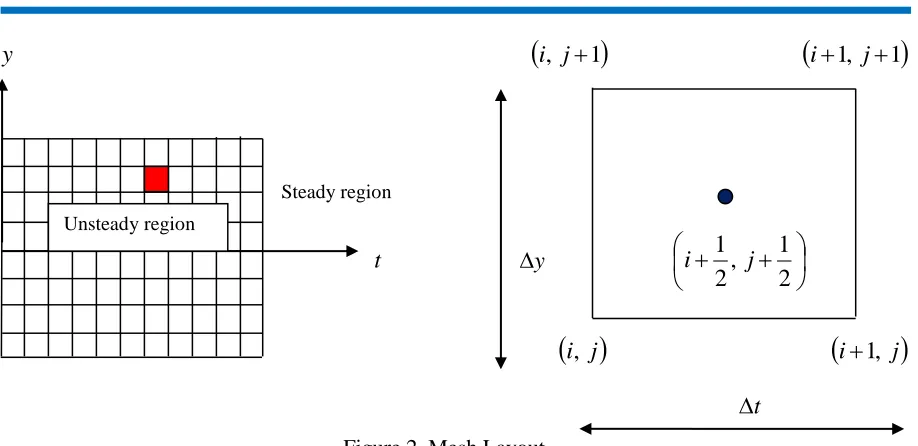
Equations (10), (11) & (13) represent coupled system of non – linear partial differential equations which are solved numerically under the initial and boundary conditions (12) & (14) using the finite difference approximations. A linearization technique is first applied to replace the non – linear terms at a linear stage, with the corrections incorporated in subsequent iterative steps until convergence is reached. Then the Crank Nicolson implicit method is used at two successive time levels [17]. An iterative scheme is used to solve the linear zed system of difference equations. The solution at a certain time step is chosen as an initial guess for next time step and the iterations are continued till convergence, within a prescribed accuracy. Finally, the resulting block tridiagonal system is solved using the generalized Thomas – algorithm [17]. Finite difference equations relating the variables are obtained by writing the equations at the midpoint of the computational cell and then replacing the different terms by their second order central difference approximations in the
y
direction. The diffusion terms are replaced by the average of the central differences at two successive time – levels. The computational domain is divided into meshesof dimension
t
and
y
in time and space respectively as shown in figure 2. We define the variablesB
u
yand y
2 , , 1 1 , 1 , 1 2 , , 1 1 , 1 , 1 , , 1 1 , 1 , 1 , , 1 1 , 1 , 14
4
2
2
M
u
u
u
u
M
Gr
y
B
B
B
B
t
u
u
u
u
j i j i j i j i j i j i j i j i j i j i j i j i j i j i j i j i
(18)
Ec
u
u
u
u
QZFO
M
L
L
L
L
R
R
t
j i j i j i j i j i j i j i j i j i j i j i j i
2 , , 1 1 , 1 , 1 2 , , 1 1 , 1 , 1 , , 1 1 , 1 , 14
4
3
4
3
Pr
1
2
(19)
at
M
u
u
u
u
M
Gc
Gr
y
B
B
B
B
t
u
u
u
u
j i j i j i j i j i j i j i j i j i j i j i j i j i j i j i j i j i j i j i j i 2 , , 1 1 , 1 , 1 2 , , 1 1 , 1 , 1 , , 1 1 , 1 , 1 , , 1 1 , 1 , 1 , , 1 1 , 1 , 14
4
4
2
2
(20)Where
QZFO
represents the viscous dissipation term which are known from the solution of the momentumequations and can be evaluated at the midpoint
2
1
,
2
1
j
i
of the computational cell. Computations have beenmade for
Gr
2.0,Pr
0.71,R
2.0,M
2.0,F
0.3,a
2.0 andt
0.1. Grid – independence studies show that the computational domain0
t
and
1
y
1
can be divided into intervals with step sizes
y
i
,
j
1
i
1
,
j
1
Steady region
t
y
2
1
,
2
1
j
i
i
,
j
i
1
,
j
t
Figure 2. Mesh Layout
Results and Discussions:
We solve the similarity equations (18), (19) and (20) numerically subject to the boundary conditions given by (12) & (14). Graphical representations of the numerical results are illustrated in figure (3) through figure (15) to show the influences of different numbers on the boundary layer flow. In this study, we investigate the influence of the effects of material parameters such as Grashof number (Gr), Prandtl number (Pr), Hartmann number (M), Thermal radiation parameter (R) and Eckert number (Ec) separately in order to clearly observe their respective effects on the velocity and temperature profiles of the flow have been observed through graphically in the cases of impulsive movement of the plate (i.e. n = 0) and uniformly accelerated movement of the plate (i.e. n = 1) . And also skin friction coefficient
(
o)
, Rate of heat and mass transfer coefficients(
Nu
o&
Nu
1)
respectively have been observed through tabular forms. During the course of numerical calculations of the velocity (u) and temperature (θ), the values of the Prandtl number are chosen for Mercury (Pr
= 0.025), Air at 25oC and one atmospheric pressure (Pr
= 0.71), Water (Pr
= 7.00) and Water at 4oC
(Pr
= 11.40). For the physical significance, the numerical discussions in the problema
2.0 andt
0.1 stable values for velocity and temperature and fields are obtained. Figures (3) and (4) illustrate the effects of Gr (thermal Grashof number) on the velocity field. We observe that the velocity of fluid increases with increasing thermal Grashof number in both the cases. It is due to reason that increases in give rise to buoyancy effects resulting in more induced flows. Figures (5) and (6) display the effects of Hartmann number M (magnetic parameter) on the velocity field. It is observed that the velocity of fluid increases with increasing magnetic parameter in case of impulsive movement of the plate (i.e. n = 0), but decreases with increasing magnetic parameter in case of uniformly accelerated movement of the plate (i.e. n = 1). Figures (4) and (5) represent the velocity profiles for different values of Pr (Prandtl number). It is observed that the velocity of fluid decreases as the value of Prandtl number increases in both the cases. This is in agreement with the physical fact that the thermal boundary layer thickness decreases with increasing.Figure 3. Velocity profiles for different values of Thermal Grashof number in case of impulsive
movement of the plate
Figure 4. Velocity profiles for different values of
Thermal Grashof number in case of uniformly
accelerated movement of the plate
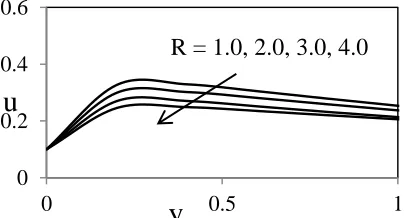
The effects of radiation parameter on the velocity profiles are presented in figures (3) and (4). From these figures, we observe that as the value of R (radiation parameter) increases, the velocity decreases in both the cases when the other physical parameters are fixed. The effect of viscous dissipation (Eckert number) on the velocity profiles is shown in the figures (4) and (5) in case of impulsive movement of the plate (i.e. n = 0) and accelerated movement of the plate (i.e. n = 1). The Eckert number (Ec) expresses the relationship between the kinetic energy in the flow and the enthalpy. It embodies the conversion of kinetic energy into internal energy by work done against the viscous fluid stresses. From these figures the velocity profiles are increasing with increasing values of Eckert number in both the cases.
Figure 5. Velocity profiles for different values of Thermal radiation parameter in case of impulsive movement of the plate
Figure 6. Velocity profiles for different values of Thermal radiation parameter in case of uniformly accelerated movement of the
plate
0
0.5
1
1.5
0
0.5
1
u
y
Gr = 1.0, 3.0, 5.0, 7.0
0
0.1
0.2
0.3
0.4
0.5
0.6
0
0.5
1
u
y
Gr = 1.0, 3.0, 5.0, 7.0
0
0.5
1
1.5
0
0.5
1
u
y
R = 1.0, 2.0, 3.0, 4.0
0
0.2
0.4
0.6
0
0.5
1
u
y
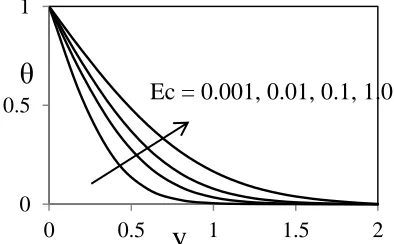
The temperature profiles are illustrated in figures (5) to (6) for different values of Prandtl number, radiation parameter and Eckert number respectively. In figure (5), it can be seen that the temperature of the fluid is inversely proportional to the value of Pr. Thus increasing reduces the temperature in the system. This trend is generally due to the decrease of the thermal diffusivity at high value of Pr. From figure (3), it is clear that an increase in the radiation parameter results in decreasing the temperature within the boundary layer, as well as a decrease in the thermal boundary layer thickness. The influence of the viscous dissipation parameter i.e., the Eckert number (Ec) on the temperature profiles are shown in figure (7). From this figure (7) we observed that the temperature profiles are reducing with
Figure 7: Temperature Profiles for different values of Eckert number
Table – 1: Skin friction in case of impulsive movement of the plate
Gr
Pr
M
R
Ec
o2.0 0.71 2.0 2.0 0.001 – 0.9973134
4.0 0.71 2.0 2.0 0.001 – 0.2873451
2.0 7.00 2.0 2.0 0.001 – 1.7731157
2.0 0.71 4.0 2.0 0.001 – 0.2014462
2.0 0.71 2.0 4.0 0.001 – 1.6500381
2.0 0.71 2.0 2.0 0.100 – 0.1179032
Table – 2: Skin friction in case of uniformly accelerated movement of the plate
Gr
Pr
M
R
Ec
o2.0 0.71 2.0 2.0 0.001 – 0.9273543
4.0 0.71 2.0 2.0 0.001 – 0.1827641
2.0 7.00 2.0 2.0 0.001 – 1.7126543
2.0 0.71 4.0 2.0 0.001 – 1.7993425
2.0 0.71 2.0 4.0 0.001 – 1.6722764
2.0 0.71 2.0 2.0 0.100 – 0.7466328
0
0.5
1
0
0.5
1
1.5
2
θ
y
Tables (1) represent the skin friction in case of impulsive movement of the plate (i.e. n = 0) and in case of uniformly accelerated movement of the plate (i.e. n = 1) respectively. From the two tables, it is clear that in case of uniformly accelerated movement of the plate the skin friction increases as the value of Hartmann number (magnetic field) increases (keeping other parameters constant), but for impulsive movement of the plate, it decreases as the value of Hartmann number increases (keeping other parameters constant). Again, the skin friction decreases as the values of the Prandtl number and radiation parameter increase (keeping other parameters constant) in both the cases (n = 0 and n = 1). When the value of thermal Grashof number is increased (keeping other parameters constant) the value of skin friction also gets increased in both the cases (n = 0 and n = 1). Further, the skin friction increases as the values of Eckert number (keeping other parameters constant) are increased in both the cases (n = 0 and n = 1).
Table – 2 shows the effect of Thermal radiation parameter, Prandtl number and Eckert number on the Nusselt number (the rate of heat transfer) at the moving and stationary plates. We see that the Nusselt number at the moving plate
Nu
ois increasing withincreasing values of radiation parameter and Prandtl number but decreasing with increasing values of Eckert number. The Nusselt number at the stationary plate
Nu
1 is decreasing with increasing values of radiation parameter and Prandtl number but increasing with increasing values of Eckert number. In order to ascertain the accuracy of the numerical results, the present results are compared with the previous results of Rajput and Sahu [12] in tables – 1 and 2 for both the cases I and II. They are found to be in an excellent agreement.Conclusions:
This work investigated is to find the numerical solution of unsteady magneto hydro dynamic free convective Coquette flow of viscous incompressible fluid confined between two vertical permeable parallel plates in the presence of thermal radiation is performed. The non – linear coupled pair of partial differential equations are solved by an efficient Crank Nicholson method. A parametric study illustrating the influence of different flow parameters on velocity, temperature and concentration fields are investigated in case of impulsive movement of the plate (i.e. n = 0) and
uniformly accelerated movement of the plate (i.e. n = 1). We conclude that the flow field and the quantities of physical interest are significantly influenced by these numbers.
1. A growing of Grashof number and Eckert number are to enhance the velocity of the flow field at all points in both the cases (n = 0 and n = 1).
2. A growing of Prandtl number and Thermal radiation parameter are to retard the velocity of the flow field at all points in both the cases (n = 0 and n = 1).
3. A growing of Hartmann number is to enhance the velocity of the flow in case of in case of impulsive movement of the plate (i.e. n = 0) and is to retard the velocity of the flow in case of uniformly accelerated movement of the plate (i.e. n = 1) at all points.
4. The temperature of the flow is increasing with increasing values of Eckert number while decreasing with increasing values of Prandtl number and Thermal radiation parameter at all the points.
5. Skin friction is increases with increasing of Hartmann number and Eckert number in case of impulsive movement of the plate (i.e. n = 0). 6. Skin friction is decreases with increasing of
Hartmann number and increases with increasing of Eckert number in case of uniformly accelerated movement of the plate (i.e. n = 1).
References:
[1]. Suriano, F. J., Kwang – Tzu, Y. and Donlon, J. A., (1965). Laminar free convection along a vertical plate at extremely small Grashof numbers, Int. J. Heat Mass Transfer, Vol.8, No. 5.
[2]. Suriano, F. J. and Kwang – Tzu, Y., (1968). Laminar free convection about vertical and horizontal plates at small and moderate Grashof numbers, Int. J. Heat Mass Transfer,Vol. 11, No. 3.
[3]. Singh, A. K., (1988). Natural convection in unsteady Couette Motion, Def. Sci. J., Vol.38, No. 1.
[4]. Jha, B. K., (2001). Natural convection in unsteady MHD couette flow, Heat and Mass Transfer, Vol. 37.
National Advisory Committee for Aeronautics, Technical Note 3971.
[6]. Singh, A. K., Gholami, H. R. and Soundalgekar, V. M., (1996). Transient free convection flow between two vertical parallel plates, Heat and Mass Transfer, Vol.31. [7]. Jha, B. K. and Apere, C. A., (2011). Magneto
hydrodynamic free convective Couette flow with suction and injection, Journal of Heat Transfer, Vol. 133, No. 9.
[8]. Vidyanidhi, V. and Nigam, S. D., (1967). J.
Math. Phys. Sci., Vol. 1, No. 85.
[9]. Verma, P. D. S. and Sehgal, M. M., (2004).
Couette flow of micro polar fluids, Int. J. Eng.
Sci., Vol. 42, pp. 65 – 78.
[10]. Liu, D. C. S. and Chen, C. F., (1973).
Numerical experiments on time – dependent
rotational Couette flow, J. Fluid Mech., Vol.
59, pp. 77 – 95.
[11]. Jana, R. N. and Datta, N., (1977). Couette
flow and heat transfer in a rotating system,
Acta Mech., Vol. 26, pp. 301 – 306.
[12]. Seth, G. S., Jana, R. N. and Maiti, M. K.,
(1982). Unsteady hydro magnetic Couette
flow in a rotating system, Int. J. Eng. Sci.,
Vol. 20, pp. 989 – 999.
[13]. Mandal, G. and Mandal, K. K., (1983). Effect
of Hall current on MHD Couette flow between thick arbitrarily conducting plates in
a rotating system, J. Physical Soc. Japan, Vol.
52, pp. 470 – 477.
[14]. Kythe, P. K. and Puri, P., (1989). Exact
solution of unsteady Couette flow of a dusty
gas, Int. Proceedings of PACAM, Rio de
Janeiro, Brazil, pp. 348 – 351.
[15]. Singh, A. K., Sacheti, N. C. and Chandran, P.,
(1994). Transient effects
inmagnetohydrodynamic Couette flow with
rotation in accelerated motion, Int. J. Eng.
Sci., Vol. 32, pp. 133 – 139.
[16]. Kearsley, A. J., (1994). A steady state model
of Couette flow with viscous heating, Int. J.
Eng. Sci., Vol. 32, pp. 179 – 186.
[17]. Nagata, M., (1998). Tertiary solutions and
their stability in rotating plane Couette flow,
J. Fluid Mech., Vol. 358, pp. 357 – 378.
[18]. Ghosh, S.K., (2002). Effect of Hall current on
MHD Couette flow in a rotating system with
arbitrary magnetic field, Czech. J. Phys., Vol.
52, pp. 51 – 63.
[19]. Hayat, T., Nadeem, S. and Asghar, S., (2004).
–B fluid in a rotating system, Int. J. Eng. Sci.,
Vol. 42, pp. 65 – 78.
[20]. Choi, C.K., Chung, T. J. and Kim, M.C.,
(2004). Buoyancy effects in plane Couette flow heated uniformly from below with
constant heat flux, Int. J. Heat Mass Transfer,