A Study on a Metrology Seal Device Using NFC
Technologies
Deok-Woo Park1 , Chungyong Kim2 and Gyu-Sik Kim3*
1,2,3
Department of Electrical and Computer Eng., University of Seoul, Seoul, 130-743, Korea * Corresponding author : Gyu-Sik Kim ([email protected])
Abstract
NFC devices are used in contactless payment systems, similar to those used in credit cards and electronic ticket smartcards and allow mobile payment to replace/supplement these systems. In this paper, in order to evaluate the performance of NFC applied to oil lubricator seal device, we implemented a seal device system and a NFC experimental system applied to oil lubricator seal device.
Keywords: NFC, contactless payment, oil lubricator, seal device, seal marker, metrology, integrated management system
1. Introduction
Near-field communication (NFC) is a set of communication protocols that enable two electronic devices, one of which is usually a portable device such as a smartphone, to establish communication by bringing them within 4 cm (1.6 in) of each other. NFC devices are used in contactless payment systems, similar to those used in credit cards and electronic ticket smartcards and allow mobile payment to replace/supplement these systems. This is sometimes referred to as NFC/CTLS (Contactless) or CTLS NFC. NFC is used for social networking, for sharing contacts, photos, videos or files. NFC-enabled devices can act as electronic identity documents and keycards. NFC offers a low-speed connection with simple setup that can be used to bootstrap more capable wireless connections.
There have been a lot of researches toward performance improvement of NFC technologies [1-8]. In [1], they propose a system of virtual coupons (so called mCoupons) that is protected against illicit use. NFC in combination with inexpensive passive tags is used to prevent attacks in a decentralized approach. In [2], the paper presents an extension simulation module for the NFCIP-1 over the network simulator (NS-2). Simulation results are compared to measurement results of a real NFC system. Results showed the efficiency of the implemented module. The simulated results differ from measured values by an approximate value of 12% for data transfer and 8% for throughput. In [3], they present the study and work realized in the project to validate and experiment the aforementioned
mechanisms. The use case chosen for the experimentation is the provisioning and personalizing of a payment application after the issuance of the UICC by the mobile network operator, as it perfectly illustrates the actual needs and considerations. In [4], the paper presents a mobile phone application which brings two new features into social networks: an advertising service and a location based service. With this application, mobile operators will play a central role in an advertising chain comprising businesses, mobile operators and online communities. In [5], they describe an innovative system providing services for tourism based on Near Field Communication technology. This work is part of the SIESTA project, co-funded by the Tuscany Region in Italy, to develop applications relying on mobile phones to support tourists visiting cities of art. In [6], they describe an automatic system for car parks payment based on Near Field Communication technology. This system has been projected and developed as part of the SIESTA project, a research project financed by the Tuscany region in Italy, to study innovative services for tourists visiting cities of art. In [7], the paper describes the latest results of StoLPan consortium, the technical and business challenges of the NFC service development, interesting findings about the current issues of the NFC market, and a summary about the StoLPan application framework containing NFC technological details. In [8], the paper introduces the NFC ecosystem and the efforts of the StoLPan consortium to combine the business process approach with their significant technology developments, addressing technical, usability, business and legal issues simultaneously.
In this paper, in order to evaluate the performance of NFC applied to oil lubricator seal device, we implemented a seal device system and a NFC experimental system applied to oil lubricator seal device.
2. Near-field Communication Technologies
protocols established a generally supported standard. When one of the connected devices has Internet connectivity, the other can exchange data with online services. NFC-enabled portable devices can be provided with application software, for example to read electronic tags or make payments when connected to an NFC-compliant apparatus. Earlier close-range communication used technology that was proprietary to the manufacturer, for applications such as stock ticket, access control and payment readers. Like other "proximity card" technologies, NFC employs electromagnetic induction between two loop antennas when NFC-enabled devices—for example a smartphone and a printer—exchange information, operating within the globally available unlicensed radio frequency ISM band of 13.56 MHz on ISO/IEC 18000-3 air interface at rates ranging from 106 to 424 kbit/s. NFC tags are passive data stores which can be read, and under some circumstances written to, by an NFC device. They typically contain data (as of 2015 between 96 and 8,192 bytes) and are read-only in normal use, but may be rewritable. Applications include secure personal data storage. NFC tags can be custom-encoded by their manufacturers or use the industry specifications.
NFC standards cover communications protocols and data exchange formats and are based on existing radio-frequency identification (RFID) standards including ISO/IEC 14443 and FeliCa.[9] The standards include ISO/IEC 18092[10] and those defined by the NFC Forum. In addition to the NFC Forum, the GSMA group defined a platform for the deployment of GSMA NFC Standards[11] within mobile handsets. GSMA's efforts include Trusted Services Manager,[12] Single Wire Protocol, testing/certification and secure element.[13]
3. Application of NFC to Metrology Seal
Device
In this paper, we attempt to develop a seal device system based on NFC technologies in order to secure the public order of a metrology commercial dealing. This system informs test agencies, suppliers, or consumers of the fault of the seal devices if the seal devices are removed or destroyed. Fig. 1 shows the schematic diagram of NFC application to metrology seal device. The metrology seal device shown in Fig.1 is located in the inside of an oil lubricator and installed to prevent the fabrication of an oil lubricator. It has only the information of the test date of the test agency. We implemented a seal markers management system as shown in Fig. 2. The integrated management program for seal markers input/out current status of affairs
is also made. So, by analyzing of the data extracted from the program, we could check who carried on or took out the seal marker.
Fig. 1 Schematic diagram of NFC application to metrology seal device
Fig. 2 Schematic diagram of seal marker management system
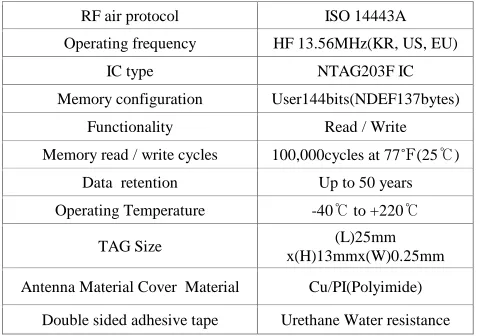
Table 1 Tag spec. of NFC seal device
RF air protocol ISO 14443A
Operating frequency HF 13.56MHz(KR, US, EU)
IC type NTAG203F IC
Memory configuration User144bits(NDEF137bytes)
Functionality Read / Write
Memory read / write cycles 100,000cycles at 77℉(25℃)
Data retention Up to 50 years
Operating Temperature -40℃ to +220℃
TAG Size (L)25mm x(H)13mmx(W)0.25mm
Antenna Material Cover Material Cu/PI(Polyimide)
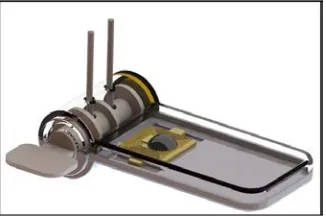
Table 1 shows the tag spec. of NFC seal device. Fig. 3 shows the (8x8)mm antenna designed for tag of NFC seal device. In order to satisfy the consumer's requirement in real time and to clear the confidence of the meter, the tester can post a NFC chip inside implemented seal device by posting the information requested by the client at any time, such as checking the information on the meter information (type approval, calibration date, calibration period, meter error, etc). We applied it to the gas lubricators as shown in Fig. 4.
Fig. 3 (8x8)mm antenna designed for tag of NFC seal device
Fig. 4 Schematic diagram of NFC applied to oil lubricator seal device
4. Experimental Results
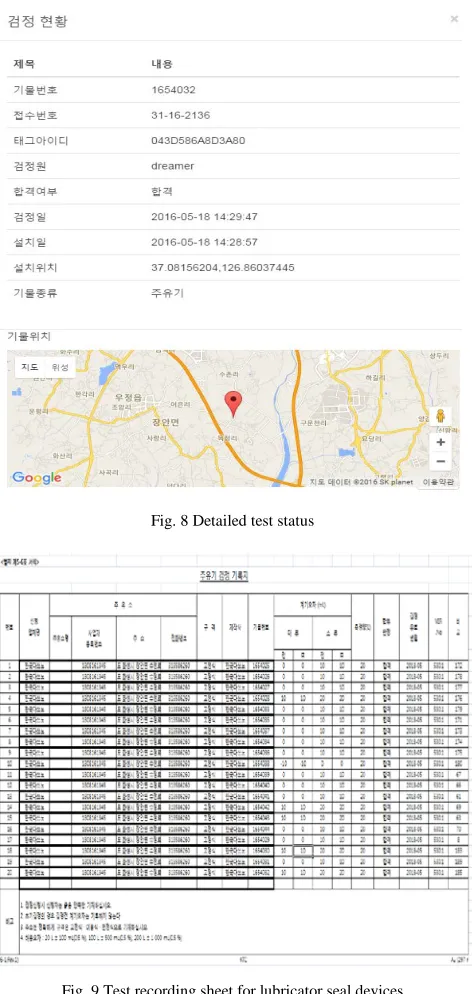
In order to evaluate the performance of NFC applied to oil lubricator seal device we implemented a seal device system as Fig. 5. Fig. 6 shows the NFC experimental system applied to oil lubricator seal device. Full test status can be viewed at the site as shown in Fig. 7. It includes the id, the number of apparatus, the number of registering, the tag id,
the name of tester, the date of inspection, the date of installing, the location of installing, and more detailed information. If we click the id 145 in Fig. 7, one can view the detailed test status as shown in Fig. 8. If we click the Excel download button which is at the right end in Fig. 7, one can download the test recording sheet for lubricator seal devices as shown in Fig. 9.
Fig. 5 Implemented seal device system
Fig. 6 NFC experimental system applied to oil lubricator seal device
Fig. 8 Detailed test status
Fig. 9 Test recording sheet for lubricator seal devices
Fig. 9, a test recording paper, is formed automatically in the integrated management system as an Excel file. It has the information of company name, the registration number of company, company address, company telephone number, and so on. This information in test recording sheet can be accessed easily using smart phones via the integrated management system. NFC tags can be positioned as location coordinates, such as Fig. 10 on a Google map, where the meter is mounted and located in places where location information is readily accessible, and the
verification can be easily detected by the test agencies, thereby preventing illegal meter movements and mounting locations.
Fig. 10 Location mark of seal devices
5. Conclusions
While smart phones are commercialized and developed for convenience, users demand more quick and convenient things. In this case, it has been able to solve users' difficulties to perform multiple tasks simultaneously and provide greater convenience to users using NFC technology, which can communicate only about within 1 centimeters of simultaneous communication unlike other short-range communications. Using these NFC capabilities and commercialization of smart phones, it will be possible to eliminate the disruption of the client's complaint by deploying a server that can be used to block the distribution of illegal meter attachments and to establish a server that can be used indirectly and equally with the public, while maintaining a reliable and fair commercial order.
Acknowledgments
This work was also supported by the National Research Foundation of Korea (NRF) grant funded by the Korea government (MSIP) (No. 2016011249).
References
[1] Aigner, M., Dominikus S., & Feldhofer, M., “A system of secure virtual coupons using NFC technology,” In Proceedings of fifth annual IEEE international conference on pervasive computing and communications workshops, pp. 362–366, 2007.
[2] Ali, W., El Kilani, W., & Hadhoud, M., “Simulation of NFCIP-1 protocol over NS-2,” In Proceedings of 7th
international conference on informatics and systems, Cairo,
[3] Alimi, V., & Pasquet, M., “Post-distribution provisioning and personalization of a payment application on a UICC based secure element,” In Proceedings of international conference on availability, reliability and security, Fukuoka, pp. 701–705, 2009.
[4] Aziza, H., “NFC Technology in mobile phone next-generation services,” In Proceedings of the 2nd international workshop on near field communication, Monaco, pp. 21–26, 2010.
[5] Baldo, D., Benelli, G., & Pozzebon, A., “The SIESTA project: Near Field Communication, based applications for tourism,” In Proceedings of 7th international symposium on communication systems networks and digital signal processing, Newcastle upon Tyne, pp. 721–725, 2010. [6] Benelli, G., & Pozzebon, A., “An automated payment
system for car parks based on near field communication technology,” In Proceedings of international conference for
internet technology and secured transactions (ICITST),
London, pp. 1–6, 2010.
[7] Benyó, B., et al., “The StoLPan view of the NFC ecosystem,” In Proceedings of the conference on wireless telecommunications symposium, Prague, pp. 1–5, 2009. [8] Benyó, B., “Business process analysis of NFC-based
services,” In Proceedings of IEEE 7th international conference on computational cybernetics, Palma de Mallorca, Spain, pp. 75–79, 2009.
[9] “Technical Specifications,” NFC Forum. Retrieved 11 December 2011.
[10]“ISO/IEC 18092:2004 Information technology - Telecommunications and information exchange between systems - Near Field Communication - Interface and Protocol (NFCIP-1),” ISO. Retrieved 11 December 2011. [11]“GSMA NFC Standards”
[12]“The Role of the Trusted Service Manager in Mobile Commerce,” (PDF). Digital Commerce (white paper). GSM Association. December 2013.
[13]“Mobile NFC Infrastructure,” (PDF). Digital Commerce. GSM Association. 30 July 2012.
[14]https://en.wikipedia.org/wiki/Near_field_communication
Deok-Woo Park was born in Korea, in 1973. He received the B.S. degree in 1999 from the Dept. of Electrical Eng., University of Hanyang, Korea. He received the M.S. degree in 2006 from the Dept. of Electrical and Computer Eng., University of Seoul, Korea. He is a Ph.D. student of the Dept. of Electrical and Computer Eng., University of Seoul, Korea. He works for Korea Testing Certification Institute.
Chungyong Kim was born in Korea, in 1991. He is an undergraduate junior in the Dept. of Electrical and Computer Eng., University of Seoul, Korea.