VOLUME 3
October 1950
Number 4
In this Issue
Editorial-Opportunities for students in The American
Society of Range Management
F.W. Albertson
275
The Challenge of the Range Researcher
Radford S. Hall
277
Mortality of Velvet Mesquite Seedlings
Harold A. Paulsen, Jr.
281
Why Haven't Farmers and Ranchers Taken to Regrassing?
Harvey L. Harris
287
Wildlife Depredations on Broadcast Seedings of Burned
Brushlands ... Walter E. Howard
291
Ranching Services: A Challenge to Rengemen
R.B. Peck
299
Condition and Grazing Capacity of Wet Meadows on the
East Slope of the Sierra Nevada Mountains
Basil K. Crane
303
Effects of Spring and Fall Grazing by Sheep on Vegetation
of the Upper Snake River Plains
Walter F. Mueggler
308
Pollarding--Age -old Practice Permits Grazing in Pays
Basque Forests... John M. Fenley
316
Book Reviews:
Missouri River Basin Agriculture Program (U.S.D.A)
Dan Fulton
319
Pigs-from Cave to Corn Belt (Towne and Wentworth)
Walt Hopkins
321
The Soil Science Society of America, Proceedings
1948
... E.J. Dyksterhuis
322
Farm Structures (Barre and Sammet)
L.H. LaFaver
323
Principles of Field Crop Production
(Martin and Leonard)... E.R. Jackman
324
A Sand Count Almanac and Sketches Here and There
(Leopold) ... R.S. Campbell
325
Conservation and Nevada-A Textbook for Use in the
Public Schools of Nevada (Wheeler et al.)
Jos. H. Robertson
325
Current Literature... Grant A. Harris
327
News and Notes ... ... ... 337
With the Sections ... ... ... 345
Society Business ... ... ... 348
Membership List as of July 1, 1950... ... 352
Index to Volume 3, 1950 ... ... ... 381
Published Quarterly by
JOURNAL OF
RANGE MANAGEMENT
EDITOR
R. S. Campbell
Southern
Forest Experiment
Station
1008 Federal
Office Building
New Orleans
12, Louisiana
EDITORIAL BOARD
TERMS
EXPIRE
1950
F. W. Albertson
Walter
P. Cottam
Department
of Botany
Botany
Department
Fort Hays Kansas
State
College
University
of Utah
Hays, Kansas
Salt Lake City, Utah
TERMS
EXPIRE
1951
B. W. Allred
U. S. Soil Conservation
Service
P. 0. Box 1898
Fort Worth
1, Texas
David F. Costello
Rocky
Mountain
Forest
and
Range
Experiment
Station
Fort Collins,
Colorado
TERMS
EXPIRE
-1952
Kenneth
B. Platt
I
E. W. Tisdale
Bureau
of Land Management
School of Forestry
Swan Island
University
of Idaho
Portland
18, Oregon
Moscow, Idaho
The Journal
of Range
Management
is published
quarterly
by the American
Society
of Range
Management
at Mount
Royal and Guilford
Avenues,
Balti-
more
2, Maryland.
Subscription,
$5.00 per year;
for students
$2.50. Single
copies
$1.50. Changes
of address
and
communications
on business
matters
should be addressed
to the Treasurer,
H. R. Hochmuth,
Bureau
of Agricultural
Economics,
Utah State Agricultural
College, Logan,
Utah;
or to the Secretary,
E. H. McIlvain,
U. S. Southern
Great
Plains
Field Stat’ion, Woodward,
Okla-
homa.
Advertising
Agent, Bell Publications,
1447 Stout Street,
Denver
2, Colorado.
Address communications
on editorial
matters
to the Editor.
Entered
as second-class
matter
?t the Post Office at Baltimore,
Maryland.
ADVERTISE
in the
Journal
of
RANGE
MANAGEMENT
Agent:
BELL PUBLICATIONS
1447 stout St. Denver 2, Colo.The
Ross
Seed
Company
Wichita, Kansas
*
Buyers and Sellers
of
Western
RANGE
Grasses
Since 1884
AMERICAN SOCIETY OF RANGE MANAGEMENT
Application for Membership
Name
Title
Business Address
-
Home Address
indicate to which address Journal
should be’ mailed
Employer or Business
Remarks
Calendar year dues are to apply ~.
Date of Application
.
Annual Dues $5.00; Students $3.00.
Journal of
Volume 3, Number
4,
lOctober, 1.950
RANGE
MANAGEMENT
Editorial
0 pportunities
for Students in the American
Society for Range Management
J
T
HE American Society of I~ange Man-
agement is a young organization but
it, has had phenomenal growth in member-
ship. The number of members increased
from 753 on January
1,1949,to more than
1800 on July 1, 1950. This rapidly increas-
ing membership reflects, in a way the
importance of the objectives of the So-
ciety in their relaGonship to the needs of
the people in the extensive range areas of
our continent.
No
country or organization can long
function at its best unless it has a program
for educating its youth. In order to further
increase the effectiveness of our Society,
a program has been initiated to stimulate
active participation by young people in-
terested in range management. For exam-
ple, any college student in range manage-
ment may become a member of the
Society for only $3.00 per year, which is
about actual cost. Nevertheless, student
members receive the Journal; they have
full privileges of voting and enjoy all
other regular Society activities.
Student local chapters are being en-
couraged. Any institution offering studies
in range management is requested to con-
sider t>he possibility
of organizing a
student chapter. At present, there are
recognized student chapters in Wyoming
and Arizona, and formation of others in
these-and other states doubtless will add
much to the development of young range
men and to t’he vigorous functioning of
U u
the Society. Pending amendments to the
Society By-laws provide that student
chapters may be organized under sponsor-
ship of ihe parent Section upon the pres-
entation of a petition signed by at least
ten student members of the Society.
A student essay contest has been an-
nounced. Prizes varying from one to ten
years free subscriptions to the Journal
are being offered for the best essays on
some phase of range management. Any
graduate or undergraduate student who
has completed one or more courses in
range management is eligible to partici-
pate. In fact, he is
urged
to do so! The
topic selected may be general or specific
in nature but must deal with some phase
of range management. The paper should
not exceed 2,500 words, and should fol-
low the standards given on the last page
of this issue of the Journal, entitled “In-
formation for Authors.” The completed
essay should be mailed to the undersigned
before November
15,
1950. Winners of
the contest will be announced in January
at the Fourth Annual Meeting of the
Society at Billings, Montana. The top
ranking essay will be published in the
Journal.
The pages of the Journal are open to
abstracts of masters or doctors theses in
range management, and to articles based
on theses, if accepted by the Editorial
Board. Range schools and graduate stu-
276
EDITORIALdents are urged to submit suitable papers
and abstracts of theses to the Editor.
It is the sincere desire of the officers
that all members will contact young peo-
ple in the range country and discuss with
them the objectives
of the Society in
order to help them see the value of being
a part of this rapidly growing organiza-
tion. It is especially important to assist
range management students in forming
student chapters and encourage them to
participate in the essay contest and other
Society activities.
The chief objective of the Society is to
“foster advancement in the science and
art of grazing land management.” This
is, indeed, a worthy objective and should
attract the interest of all young people
who are engaged in making preparation
for a life’s work in one of the many fields
of range management. Numerous prob-
lems confront those who are engaged di-
rectly or indirectly in proper utilization
of our ranges. Many of these problems
can be solved in part at least by students
through research in the various colleges
and universities. Students are much more
interested in this practical type of study
than in routine laboratory exercises. The
net result is that the student attacks his
work with greater enthusiasm and more
is accomplished.
Furthermore,
it is
through this training and background
that our youth will develop habits of
straight thinking which in a few years
will be extremely valuable when they have
the responsibility of directing the program
that now rests very largely with older
members of the Society.
F. W. Albertson, Department of Botany
Fort Hays Kansas State College, Hays,
The Challenge of the Range Researcher
RADFORD S. HALL
Assistant Executive Secretary, American National Live Stock Association, Denver, Colorado
M
&T people, upon reading or hear-
ing the subject of this talk, im-
mediately visualize it as a dissertation
on the scientific job ahead of the re-
searcher. As a matter of fact, the officer
of the American Society of Range Man-
agement who invited me to appear on
your program here in San Antonio had
that in mind, I am sure.
However, far be it from me to attempt
to tell you men what you need to do in
a ‘scientific way. That is your job. You
have a long-time program upon which
you have spnt years of planning and
study. You know your work and know it
well. I have spent hours and weeks read-
ing your reports trying to keep up with
you. I would be worse than foolish were
I to attempt to tell you what to do from
a scientific standpoint.
.
So-I
am not going to talk scientific
programs at all.
As you all know, I am here because
of my connection with the American
National
Live Stock Association,
an
organization of practical range users. I
hope and sincerely believe that I will
speak from their viewpoint. These men
have been under serious attack during
recent years as despoilers of the range.
Some reaction from that charge may creep
into this talk, but not too much I hope,
for if I were to permit it to do so it would
completely destroy the usefulness of my
appearing on your program.
The real challenge to the range. re-
searcher, as I see it, is now SALESMAN-
SHIP.
Perhaps many of you are surprised, as
salesmanship is certainly not elected as
one of the courses leading to a scientific
degree nor is it generally regarded as a
requisite for a successful scientific career.
However, your profession is in a some-
what different position than any other
science of which I know. Most scientific
researchers
pass their findings on to
other trained technicians who, in turn,
transpose them to practical use in every-
day life. For example, medical researchers
have absolutely no contact with the pa-
tients who receive the benefits of their
discoveries. New techniques perfected in
the research laboratory are passed on to
the trained doctors and often the patient
who benefits from the researchers’ find-
ings has no knowledge whatever of them
nor of their being put to use on him.
Not so in your profession. You must do
the contact job directly. For that reason
you need a qualification not required of
most researchers-Salesmanship.
I am sure that some among you will
say that many of the things I am going
to mention are nigh onto impossible of
attainment.
That is why they present
such a challenge to your group to do
something about them, for no matter
how successful you are as researchers it
will all go for naught if you do not get
it sold.
Now it has not taken me very long to
tell you what the challenge is. It will
take me a little longer to suggest some
of the “angles” to be used in getting the
job done.
As you are scientists and not accus-
tomed to the vernacular of the salesman
that word “angles” may be strange to
you. It is a term frequently used by
salesmen, particularly high-pressure, to
278
RADFORD S. HALLmean the various approaches used in
clinching a sale.
There are so many angles to the selling
job ahead of you that I hardly know
which to bring up first. I am not going
to attempt to mention all of them. In
fact I don’t know all of them but I will
attempt to point out
a
few of the most
obvious and most important.
Facts and figures mean practically
nothing in an economic way so long as
they are related only to small areas and
few animals involved in experimental
projects. Obviously, to be of any real
worth the conclusions of research must
be translated into actual volume produc-
tion by thousands of range users both
large and small, and therein lies your
task of salesmanship.
I am going to mention some do’s and
some don’ts. If some of the don’ts seem
critical, please be assured that they are
offered
in a friendly manner and are gen-
erally directed at only a few persons and
are not general.
A
PRACTICAL, LOGICAL PROGRAMFirst, in order to do a good job of sell-
ing to the range man, I believe you need
to have a practical, logical program. You
must combine the experience of the range
user down thru the years with the experi-
ments of your work. Notice the similarity
of those two words-experience
and ex-
periments-almost
the same, aren’t they?
Both in sound and meaning. Yet we often
hear of experiments which end with find-
ings at considerable variance with the
experience of the range user. Such find-
ings should be checked very carefully for
error, and if and when advanced to the
users should be put forth very skillfully.
There is a story that is widely cir-
culated that two researchers made a
study of the amount of forage taken off
a certain range by rodents. After an
extensive survey of the number of rodents
on the range and the consumption of
each rodent the surprising results were
that the rodents ate more forage than
was produced on this range. Obviously
some mistake was made, but such start-
ling and unbelieveable results do untold
harm to the general acceptance of accur-
ate and worthwhile progressive research.
Sensationalism will get you headlines
but logic will get you results on the range.
This will also apply to sentimentalism
and emotionalism. These should be di-
vorced from your approach to the user.
These approaches, sensationalism, senti-
mentalism and emotionalism are of bene-
fit in publicizing the range problems to
organizations of do-gooders in the East,
but of little avail to putting a range
program over with the range man. In-
cluded in this category sbuld be the
blind worship of trees and nature in the
raw. The fact should be recognized and
acknowledged that many of our trees are
water wasters and not water conservers
and serve no economic purpose whatever.
It should be recognized that many of our
forests are composed largely of weed
trees and are of no more value than any
other weed.
One college professor, in telling about
the Mongolian desert, described it as a
lush tropical swamp many centuries ago
and blamed over-grazing for its transi-
tion to the desert it is now. When asked
by a businessman if change in climate
wasn’t largely responsible for the differ-
ence, he replied that that was a factor,
but that over-grazing was the real cul-
prit. Such statements only infuriate the
users of the land and make it harder for
you gentlemen to get your selling job
done. Such statements harm your cause
and should be discouraged.
CHALLER'GE OF THE RANGE RESEARCHER
279
few writers and journalists to turn the
spotlight on themselves and to reap
profits from the sale of their writings. I
believe this man and his methods are
doing much to instill faith on the part
of the range users in scientific soil prac-
tices, a faith which pseudo-scientists were
destroying. He is practicing salesman-
ship-he
is instilling confidence in the
land user toward the soil scientist. On
the other hand a few writers harking back
to the Maltheusian theory of a century
ago have done untold damage to your
cause.
SIMPLE AND DIRECT APPROACH
It is important that the techniques and
methods you devise should be simple and
direct. Do not allow your scientific and
t,echnical training to cause you to lose
sight of the simple methods.
To illustrate, I might repeat a tale I
heard several years ago. According to the
story a large truck carrying a high steel
drum came to a bridge across a river
over which it had to cross.‘ Before pro-
ceeding the truck and load were com-
pared with the super structure of the
bridge. The load proved to be a couple
of inches higher than the clearance.
Several experts were called in including
a structural engineer, a hydraulic engineer
and a carpenter. The structural engineer
immediately started laying plans to raise
the top of the bridge, the carpenter sug-
gested lowering the wooden floor and
the hydraulic engineer wanted to unload
the drum, float it across the river and
then reload it. While the experts were
discussing the subject, a truck driver
came along and said, “Let some air out
of your tires and go on thru.” In order to
sell, your methods must be direct and
simple.
On the other hand, while avoiding
sensationalism
I believe you can well
use more showmanship. The two are
closely related but greatly different. You
should dramatize your findings in terms
that are readily understood by the lay-
man. Many a splendid, successfully car-
ried out research program lies buried
under a mountain of mimeographed tech-
nical phrases. Scientific names, compli-
cated formulas and endless tables can
often be supplanted by a few well chosen,
few-syllabled words that will convey the
method and purpose of a range improve-
ment technique.
Reports to the range-using public need
to be stated in concise, concrete, readily
understandable language. Put the basic
thought across so we common people can
catch on quick.
Treat your range improvement pro-
gram as you would a debutante at a
coming-out party. Avoid the cheap and
gaudy garb that will attract attention,
but cast a reflection on her character.
In other words, avoid the sensational,
emotional writings of the headline grab-
ber, but also avoid the dull, drab garb of
a Mother Hubbard as represented by a
verbosity of words and statistics that will
completely cover and shield from view
the charm of your program in the debu-
tante stage. In other words, dress her
(your program) in the attractive, reveal-
ing way that men go for most, bring out
the attractive high points, but let your
customers seek out the details after you
have aroused their interest.
,
280
RADFORD S. HALLover by showing definite advantages to
accrue to the land-user. Nothing can be
gained by running down past methods
or their proponents and users.
The same is also true of ridicule only
to a greater extent. Only harm to your
real program can result from any form of
ridicule, you must have the cooperation
of the man on the soil, and ridicule and
argument certainly will not get it.
Avoid the “There ought to be a law”
attitude, for to resort to this is to openly
admit. that you have failed to sell your
program. You have failed to convince
the user of the wisdom of your methods.
The “pass a law” method is the device
of the dictator. Cooperation is what you
need and you cannot legislate cooperation.
Go easy on the stewardship theory.
The idea so frequently expressed now
that “we hold this land in trust for future
generations.”
It is true, perhaps, but
few land owners like to hear it and it
comes perilously close to the socialistic
law of England that provides for the
confiscation of land not used according
to the government’s ideas of its proper
use.
And now the most effective angle of
all which is at your disposal in selling
your program-The
profit motive.
Show the average American-or
any
other person for that matter, where he
can make more money and he will im-
mediately adopt your method. Look at
the way hybrid corn and other improved
varieties
of grains were adopted by
farmers. Note the rapidly expanding areas
of irrigated pasture, and the cot,ton to
grass movement in the South. The dol-
lars incentive is what made America
great and it is the best tool you have to
put your improved management programs
into operation on the ranches.
RESEARCH
Research is a gamble. It cannot be conducted according to the rules of efficiency engineering.
. . .
Research must be lavish of ideas, money and time. The best advice that I can give is don’t quit easily, don’t trust anybody’s judgment but your own; es- pecially don’t take any advice from any commercial person or financial expert, and, finally, if you really don’t know what to do, match for it.. . .
The best person to decide what research work shall be done is the man who is doing the research. The next best is the head of the department. After that you leave the field of best persons and meet increasingly worse groups. The first of these is the research director, who is probably wrong more than half the time. Then comes a committee, which is wrong most of the time. Finally there is the committee of company vice presidents, which is wrong all t’he time..
Mortality of Velvet Mesquite Seedlings
HAROLD A. PAULSEN, JR.
Range Conservationist, Southwestern Forest and Range Experiment Station, Tucson, Arizona’
R
ECENT years have seen an invasion
of mesquite,
Prosopis
spp., on the
range lands of the Southwest which in
some areas has been at a phenomenal
rate. In many cases this invasion has
resulted in range lands becoming almost
worthless for livestock grazing and has
accelerated soil erosion.
Mesquite has appreciably extended its
geographical range, and within this area
has spread out from the drainage bottoms,
which were its original habitat, to the
ridges and mesa uplands. It is estimated
that mesquite now occurs on at least
60 million acres in Arizona, New Mexico,
and Texas.
Mesquite seedlings occur in great num-
bers during favorable years. For example,
Fisher (1947) has reported over 1,200
young mesquite seedlings per acre in
Texas, while in southern Arizona 416
new seedlings per acre were counted.
It is the purpose of this paper to present
some of the findings on the mortality of
naturally occurring young mesquite seed-
lings as a background for a better under-
standing of an attack on this serious
range problem. This study is part of
investigations
being conducted by the
Southwestern Forest and Range Experi-
ment Station in cooperation with the
University of Arizona under RMA Proj-
ect RM :b-4 on ecology and physiology of
undesirable range plants.
The study was conducted on the Santa
Rita
Experimental
Range,
about 30
1
Maintained by the Forest Service, U. S. Department of Agriculture for Arizona, New Mexico, and West Texas, with headquarters at Tucson.miles south of Tucson, Arizona, where
the mesquite invasion problem is rep-
resented. The study site is typical of
much of the semidesert range in t)he
Southwest covered with the tree form of
mesquite.
EXPERIMENTAL PROCEDURE
Origin of Mesquite Seedlings Studied
During late July 1948 a considerable
number of recently emerged velvet mes-
quite seedlings
(Prosopis juliflora velu-
tina
(Woot.)) were found on the Santa
Rita Experimental
Range shortly after
the start of summer rains. Only 16 per
cent of the seedlings occurred under the
crowns of seed-bearing mesquites, with
the remainder being found in small,
sandy washes and gravel fans and on the
open, more porous soils. Many of the
seedlings were in clusters ranging up to
13 seedlings per cluster. In each cluster
the seedlings emerged from an area ap-
proximately 1 inch in diameter. An exam-
ination of several of these seedling clus-
ters and data on population and food
habits of the Merriam kangaroo rat by
Reynolds and Glendening (1949) indicates
that the caches of this rodent are impor-
tant in the spread of mesquite. The num-
bers of July 1948 seedlings on this and
similar sites were 22 per acre under cattle
and rodent protection; 129 under cattle
exclusion; and 269 under grazing by cattle
and rodents. Seedling numbers on the
above sites were in direct proportion to
the number of the Merriam kangaroo
rats which averaged 1.1, 1.5, and 3.5
rats per acre, respectively. Germination
from these seed spots occurred at least
over a period of two growing seasons as
282 IIAROLD A. PAULSEN, JR.
evidenced by the presence of new and from cattle or rodents, as existed in the
old seedlings from the same cluster and moderate1.y grazed pasture in which the
also the presence of sound seeds which had exclosure was situated.
as yet not germinated (Fig. 1). At t,he time the seedlings were staked
not shown in the photograph.
The art?a on rhich mesquite seedling
mortality was studied is located at an
elevation of 3,700 feet, and receives an average of 14.5 inches of annual rainfall. The surface soil is coarse and open and is underlain by a tight, rocky subsoil at
approximately 16-20 inches.
On July 29, 1948, xl-hen the mesquite
seedlings wre 10 to 15 days old, 100
seedlings rrere staked out for observation under each of three conditions as follow:
(1) protection from cattle and rodents, obtained by placing small cones of $-inch wire mesh over seedlings located within a cattle- exclosure, (2) protection from cattle but subjected to yearlong rodent grazing as existed on seedlings within the cattle rxcloswe, and (3) no protection
out, the following observations and meas- urements were made:
1. Kumber of seedlings per cluster 2. Height of the tallest seedling
3. Evidence and cause of grazing
damage
4. Perennial vegetation within twelve inches of the seedlings
5. Distance to base of nearest sced- bearing mesquite
Subsequent observations n-we made on
all seedlings at, veekly in&v& through
September 1948, and monthly observa- tions after that time.
Measurements of root and stem lengths
vxe made five times during the 15
MORTALITY OF MESQUITE SEEDLINGS
283
times when the seedlings had just com-
pleted a critical period in their growth
cycle, when an appreciable difference
might be expected in the root and stem
lengths. Root lengths were obtained by
excavating seedlings of the same age
located adjacent to those followed in the
the study.
PERTINENT FINDINGS
Mesquite seedling mortality
begins
shortly after germination and emergence,
which follows soon after the start of
effective summer rains. By the end of
the first two growing seasons, the large
majority
of mesquite seedlings were
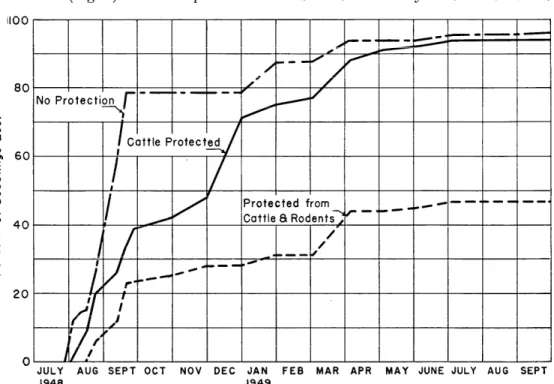
eliminated (Fig. 2). It was impossible to
seedlings lost either were entirely removed
or had been cut off at the ground level.
At this time the plants are green and
succulent and are sought out by the
rodents in the area. Leaf cutting and feed-
ing by ants and other insects also occur
at this time.
The effect of rodent grazing in reduc-
ing mesquite seedling numbers is readily
seen by a comparison of the mortality
curves (Fig. 2). While the early loss of
seedlings in the cattle protected area
was much less than on the area open to
grazing, in both cases mortality of the
seedlings at the end of the second grow-
ing season amounted to about 95 percent.
The lower mortality rate under cattle
JULY AUG SEPT OCT NOV DEC JAN FEB MAR APR MAY JUNE JULY AUG SEPT
1948 1949
FIG. 2. Cumulative mesquite seedling mortality from August 1948 through September 1949 under three levels of protection.
284 HAROLD A. PAULSEN, JR.
half survived the second summer. Seed-
ling mortality by this time is believed to
have reached the maximum and will
level off at approximately
47 percent
under protection from cattle and rodents,
94 percent under cattle protection, and
96 percent under open grazing.
The above data on mortality when
viewed in light of the emergence of 22,
129, and 269 seedlings per acre, as re-
ported by Reynolds and Glendening,
indicate that the ultimate rate of estab-
lishment of mesquite seedlings could be
in the order
12, 8,and
10per acre on
areas protected from cattle and rodents,
protected from cattle only, and on areas
open to grazing by cattle and rodents.
Drought and unusually low winter
temperatures during the period the study
was in progress doubtless contributed to
the high seedling losses. Rainfall during
July of 1948 was
23percent above the
long-time average. This plentiful moisture
brought about germination of mesquite
seeds which, since the 1948 spring bean
crop did not mature, must have been
stored in the soil at least since 1947.
During August, however, only
48percent
of the average precipitation fell. As a
result many of the seedlings began show-
ing signs of wilt’ing within three weeks
after emergence. Losses continued high
until rains occurred late in September at
which time the mortality rate generally
leveled off under all degrees of protection
(Fig. 2).
Seedling losses were low in October
and November but increased during the
winter months. The seedlings dropped
their leaves in December and appeared to
have hardened off. A low temperature of
15°F. in January resulted in additional
losses from frost heaving under all de-
grees of protection. Climatic data show
such a low temperature only once in the
last 16 years, and losses from frost heaving
are believed to be unusual on mesquite.
Additional seedling losses occurred with
releafing in the spring. Rodent and insect
grazing is believed largely responsible.
Some plants recorded as having died in
the spring probably died sometime earlier
but unless there was clear evidence of
death, the plants were carried on the
records as #living until they failed to leaf
out in the spring and the loss was definite.
Since these losses during the spring of
1949, there has been very littale change in
numbers surviving. Occasional losses oc-
curred through the summer of 1949,
evidently from a combination of grazing
and drought. By this time, however, the
seedlings were sufficiently well established
to withstand any grazing short of actual
decapitation
below the cotyledonary
node, and the root system had developed
enough that complete drought kill was
not common.
TABLE 1
Stem and root lengths of mesquite seedlings at the end of critical seasonal growing periods
PERIOD
Initial Measurement (July 29, 1948). . . . End of First Summer Growing
Period (September 1948).
. . .
End of Winter (March 1949).
.
End of Dry Spring (June 1949). End of Second Summer Growing Period (September 1949).
. . .
1 STEM LENGTH
TAP ROOT LENGTH 1
inches inches
2.2
2.2 2.0 2.2
3.0 3.7
15.0 20.6 22.2
27.1
appreciably, however, throughout the period. Excavation of representative seed- lings only 3 reeks after emergence showed t,hat tap roots averaged 13.1 inches in length (Fig. 3). This rapid elongation of
the tap root immediately following ger- mination is probably important, in the successEul establishment of the seedlings
which survived. nleasurement of the
root systems in late September 1948,
showed tap roots to br 15.0 inches in length wi-ith very little lnteral develop-
ment. At the end of the second growing season many lateral roots \vere found. Thcsc originated about 12 to 14 inches below the surface of the soil. Tap roots at this time had penetrated to a depth of 27.1 inches.
When the sredlings loafed out in the spring of 1949, dieback to the first node below the terminal bud was n&iced in almost all case& This resulted in t,he formation of several new branches from
lateral buds. Fisher, F&s, and Hopp
(19%) have reported multiple branching of honey mesquite trees following scvcro frost in,jury in Texas. Grazing, drought,
frost, or ot,her factors rhich rrsult. in
dieback will lead to the development of velvet mesquite seedlings wit,h more than
one main Arm.
These
factors, operatingin t,he past,, doubtless account in part for the presence of many of t,he multiple- stemmed trees now present in southern Ariaonn.
There was no difference in seedling
survival or mortality assoeiat,ed wth
proximity of other perennial vegetation, which consisted primarily of scattered
burrovwd; the dist~ancc to the nearest
plant averaging 7.8 inches for bot,h surviv- ing and eliminated seedlings. Losses of
single seedlings rere 77 percent. In
seedling clust,ers of 2, 3, and 4, losses were 64, 80, and Gi percent, respectively. This xould seem to indirate that under the conditions of this st,udy neither inter- nor intra-specific competition vxs as im- portant in causing seedling loss as were the factors of rodent grazing and the
generally low soil moisture conditions
during the study.
Despite a high rate of mortality
286
HAROLD A. PAULSEN, JR.intensify the mesquite problem and is
cause for even greater concern when it is
realized that the rate of increase will
become progressively larger as new trees
reach seed-bearing size.
SUMMARY
The mesquite invasion of range lands
in the Southwest has progressed rapidly
in spite of a high rate of seedling mor-
tality. A study of some of the factors
affecting the mortality of velvet mesquite
seedlings which emerged during the sum-
mer of 1948 on the Santa Rita Experi-
mental Range showed that at the close
of the second growing season, seedling
mortality was 96, 94, and 47 percent
under the following levels of protection:
open to yearlong grazing by cattle and
rodents, cattle exclusion, and protection
from cattle and rodents.
Grazing by several species of native
rodents present on the area was the most
important factor in eliminating mesquite
seedlings during the first two growing
seasons. Previous work has .shown that
one of these, the Merriam kangaroo rat,
helps to disseminate the seeds and is
associated with the occurrence of great
numbers of mesquite seedlings.
Subnormal rainfall, especially during
the first summer growing season, and
unusually low winter temperatures which
occurred during the study period, were
also important factors which contributed
to the high mortality rate.
After two growing seasons, tap roots
had developed to approximately 27 inches
in length, and it is believed that those
seedlings remaining alive at this time are
capable of surviving subsequent droughts
and developing into mature trees.
The increase in the mesquite stand
which would result from the successful
establishment of the remaining seedlings
as shown in this study would be not less
than eight trees per acre per year. As addi-
tional trees reach seed-bearing size, the
rate of increase may be expected to be-
come progressively more rapid and to
intensify the problem even further.
LITERATURE CITED
FISHER, C. E. 1947. Present information on the mesquite problem. Texas Agr. Expt. Sts. Progress Rept. No. 1056, 7 pp. (processed). FISHER, C. E., J. L. FULTS, AND H. How. 1946.
Factors affecting action of oils and water- soluble chemicals in mesquite eradication. Ecol. Mono. 16: 109-126.
REYNOLDS, H. G. AND G. E. Glendening. 1949. Merriam kangaroo rat a factor in mesquite propagation on southern Arizona range lands. Jour. Range Management 2
:
193-197.BRIEFS
The Arizona Cattlelog, of the Arizona Cattle Growers Association, goes contrary to a popular trend with this advice: “The best place to find a helping hand is at the end of your own arm.”
Why Haven’t Farmers and Ranchers
Taken to Regrassing?
HARVEY L. HARRIS
Rancher, Sterling, Colorado
M
ILLIONS of acres in the West are
lying almost worthless. With the
million dollar new wheatgrass and other
grasses having proven their value as the
best possible crops for these acres, why
is there such a lethargy? Why haven’t
we ranchers and farmers taken the ball
as all the facts and figures show we
should?
Selfishness, yes! But it goes a lot deeper.
Many individuals who have not been
sold on the income-producing values of
regrassing are naturally holding back
because of the high prices for farm prod-
ucts. Why haven’t they been sold? The
day of reckoning is near when wheat and
other crop acreages must be cut. Many of
us will be much sadder than if we had
been told in time. And why haven’t we?
Maybe, because too many researchers
read and write only research papers, while
ranchers and farmers read or hear only
popular farm or livestock articles or
reports.
OUR TECHNICIANS ARE NOT SALESMEN
By very definition, our technical men
in the agricultural colleges and various
experiment stations are trained for re-
search, for the test tubes and small
plots. To them has fallen the job of
analyzing and visualizing the problems,
and then,
with limited funds, always
limited funds,
of trying to get the most
enterprising cooperators in their districts
to experiment in the field with actual
plantings. And too many researchers are
not yet doing enough outfield tests. In-
stead, they are trying to develop a per-
fect experiment on a limited or non-
typical acreage. Then, finding a special
problem such as seepage or low fertility,
they allow this red herring to get them
off the main track.
The best engineers in any industry do
not have to sell their own “brainchildren.”
Mr. Kettering of General Motors prob-
ably couldn’t sell newspapers in competi-
tion with modern newsboys. But our
splendidly trained and loyal technicians
have been forced to try and get the whole
job done. The result-a
big array of
proven facts on every phase of the re-
grassing problems is in USDA bulletins,
college publications, and available in
every County Agent’s office. And there
they stay. Columns, tables of facts, pages
of small print, all chock-full of money
for the mere study of them. But they
are unused, unasked for-just
like Ford
building up a daily manufacturing capac-
ity of 10,000 cars without hiring a sales
force to sell them.
TECHNICIANS ARE CONSERVATIVE
Our technicians are true scientists.
They know the results of various new
grasses sometimes for years before they
will release them. Their training has
made them so. They want to be letter
perfect with no comebacks. They will
not take the calculated risk. In far more
important matters, as the winning of
wars or our international policies, we
must take these risks. Our researchers
could merely preface their 99.44 percent
findings with “it is believed”-and
we
out on the ranches and farms will take
288
HARVEY L. HARRIS
them at that, then start and get the
job done. We take a 51 percent chance
every day with the weather, the wind, and
the elements. The technicians
should
raise their sights and instead of working
on a 5 percent level of significance, report
their results at a 25 percent or 30 percent
level.
Five years ago in those laboratories it
was known that intermediate wheatgrass
was a wonderful grass, but if I had not
heard of it through a keyhole, I’d still
be trying to get some seed to plant. I
have been raising it now for 3 years. Right
at this moment there are probably newer
and better grasses, 95 percent proven,
that will not get off the small plots and
that we will not hear of for years, because
the last minutia has not been nailed
down.
Lay it on the line and let us decide.
There will be failures, but immeasurably
more will be accomplished. Take crested
wheatgrass. In their efforts to be careful
the technicians have sung from the house-
tops that crested wheatgrass was the
perfect grass for the “go-back,” or the
abandoned croplands, where you can’t or
wouldn’t plant anything else. Actually,
crested wheatgrass was always worthy of
our BEST LAND. But now with crop
acreages to be cut, there will have to be
a lot of reselling to get it onto our best
wheatlands.
LAZY MENTAL ACROBATS
We ranchers and farmers are generally
too cumbersome and mentally lazy to
take advantage of the wonderful array of
data which has been gotten together for
us. We do not like to fight through any
article that issues a mental challenge.
We generally would rather do without
something very vital for our good, if it
requires sitting down and having to
write a letter or even a postal card
(except to a mail-order house).
A leading advertising authority once
said, “If you want to get your advertis-
ing message across, write it for a lo-year-
old mentality.” For most of us out in the
fields that is a maximum. Most bulletins
are written for fellow specialists, not for
us. The obligation of state and Federal
research should be to get all data to those
who can and will have to use it. We need
the practical significance. Aim it at us
very simply. Put it cryptically, point by
point, in short sentences and simple
words.
If all these data are to be used, get
them to us automatically. Every time I
write to a new source for a bulletin, I
run into new untapped fields of knowl-
edge. But how did I know? Having some
engineering background I am luckily a
little tainted too with the technique of
research; I wrote Washington for a bibli-
ography of publications. But most of us
will not do this, partly because, from
Washington down to the local county
agent, everything is tuned for the re-
search-minded. Since we will not ask for
it, this information should be assembled
at timely intervals in a single bulletin or
progress report, and funnelled through
some agency trained in salesmanship and
advertising,
direct to the users-the
ranchers and farmers.
FARMERS, RANCHERS AND REGRASSING
289
than breaking out hundreds of thousands
of acres for wheat? When sound grazing
tests carried on by some of our U. S. Sta-
tions have proven that native range re-
seeded with some of the newer grasses
will produce 3 to 4 times as much beef
gain per acre as good native range, should
we still do nothing about it? Wouldn’t
I be silly not to plow up some of my
native range when for 3 years of testing
I averaged over 130 pounds of cattle
gain per acre on crested wheatgrass, while
on my best native grass, with the same
type of steers, I got only 30 pounds per
acre. Sure, the new grasses must be used
conservatively, but with deeper roots and
more stubble, why the delay in doing
something about it, and in a big way?
I think we all know enough about the
dangers of blowing for each of us to do
regrassing work within our own limita-
tions. When I told one leading grass
technician that I planned on breaking
100 acres of native range for regrassing,
he said wryly, “Swell! But don’t talk
about it. We could get our throats cut
for that !”
Let’s let our technicians be honest.
There will be failures, but the benefits
will far exceed the damages. Tell us
about the use of fertilizer on dry land.
There must be some formula for its safe
use where precipitation is 15 inches or
less per year. What about the studies on
legumes which have been in the nurseries
for 10 years, but still are not ready for
field use?
LACK OF SEED
The bottleneck is the lack of seed, and
it will always be, until we get the ideas
across. If we have a problem of surpluses,
it will become worse before it gets better,
so this is no time for too much theory.
195 1 will be bad. 1952 will be terrible
;
dust-bowls everywhere or farmers sud-
denly awakened to the fact that their
income is gone. And all in a matter of
months, not years. We know enough to
start the job NOW. Give us efficiency
experts who will act as liaison to t’ake
the data from the technicians and sell
it to the men out on the land. Free them
from red tape, except the urgent job
which must be done. In 1949, there were
200,000 acres seeded in Colorado, but
600,000 acres will go out of wheat in 1950
and 1951. At least 3,000,OOO and maybe
closer to 5,000,OOO acres need seeding.
We’ll never catch up at the present, rate
and not a minute should be lost in sell-
ing the program.
The Production and Marketing Ad-
ministration, knowing that something
should be done, has decided to support
the price of grass seeds in a similar fashion
to the support of other crops. Among
other grasses they placed a support price
of 10 cents a pound on crested wheat-
grass, but only if it was just about per-
fect seed, with 95 percent purity and
germination, and if beautifully bagged
and delivered to the PMA warehouses.
Wheat is still supported at $1.85 per
bushel, or somewhere near that figure.
But the grass seed to supplant wheat,
to save our hides and keep us all happy
and thriving is supported at a price that
wouldn’t even interest a banker. That is
no support price if we want action. It is
an open invitation to a certain loss. Such
seed quality does not often happen except
in a nursery. So, who is being fooled, if
we really want the job done, and quickly?
290
HARVEY L. HARRIS
the balance will still be here for cattle
forage 100 years from now.
WHAT TO Do ABOUT IT
Get eight men of the right type to-
gether around a table, have them decide
each step that should be taken-then
let’s go. Get eight men of the Billy
Mitchell and George Patton type-men
who know their subject better than any-
one else; who will take a court martial
rather than be “yes” men, and who do
do not have to worry about their jobs,
if their ideas do not happen to jibe with
Department
of Agriculture
regulation
No. PBX73. In 60 days they would have
the program visualized and the organiza-
tion set up to carry it out.
In an attempt to help these eight men,
the following suggestions might give them
a starting point.
1. Let’s do as we preach. How many
higher-ups in the bureaucracy have land
and have planted any of the new grasses,
or undertaken any of the newer methods?
2. Let the right hand know what the
left is doing. Let’s have some liaison.
Take the fetters away from our techni-
cians and let them say what they know
and think, but make them keep up-to-
date too!
3. Organize the whole effort with duties
where they should be; technical matters
and experiments to be conducted by those
who know how; promotion and selling of
the ideas to be in the hands of men who
know just as much of those phases of
the problem-with
all the wonderful
results achieved by the technical men
put at the disposal of this master sales
group.
4. Remember the market. The selling
approach
hasn’t
been too effective.
Ranchers and farmers are now rather
dubious, so some reselling is needed.
5. Have bulletins timely and on time.
If a new idea has a 50-50 chance, don’t
hold it up because of some petty insignifi-
cance. Grab a hold of present problems
like one U. S. Station which picked up
the gossip that a light colored steer did
better than a dark colored one. They
quickly proved it did if it was of better
quality originally but not because of
color. That data was in the hands of
the ranchers as soon as the experiment
was completed.
6. If a bonus of $5.00 per acre for every
acre planted is needed to encourage
regrassing, then pay it. What would
,$5,000,000 for reseeding amount to com-
pared with the increased
value on
l,OOO,OOO acres? Especially when we are
going to spend $200,000,000
on some
irrigation projects in Italy, and billions
all over the world for the help of all under-
privileged! Let’s give the “offal” of all
this money to our own right here in
this country.
7. If the price of grass seed needs
support so that it will be planted, it
should have enough of a support that
will get results.
8. Spend some of this for more grass
nurseries,
land
capability
classifiers,
agronomists, economists, farm planners
and range managers.
9. Give the State of Colorado, and
maybe your state too,
just one Exten-
sion Range Management Specialist.
Three-
fourths of this state is chiefly suitable for
grazing; income from livestock exceeds all
other crops (most of it comes from grass),
and there is no one authority functioning
on this tremendous industry from this
standpoint.
Wildlife Depredations
on Broadcast Seedings
of Burned Brushlands
WALTER E. HOWARD
Assistant Zoologist, Agricultural Experiment Station, Division of Zoology, University of California, Davis, California
I
N California, dense stands of undesir-
a,ble woody vegetation or “brush” are
being removed by burning, followed by
seeding of forage grasses or legumes
where natural reseeding of herbaceous
vegetation will not occur. This is part of
a range improvement program to convert
some of the 10 or more millions of acres
of brushland in California into more pro-
ductive
grasslands
(Love and Jones,
1947). Depredations by seed-eating ro-
dents, birds, and harvester ants may
prevent a broadcast seeding from being
successful. Such failures frequently have
been wrongfully ascribed to unfavorable
weather, adverse site conditions or poor
germination, since these factors are the
more obvious causes of failures and loss
of seed is not easily observed.
All tests included in this report were
made in Madera County while the author
was stationed at the San Joaquin Ex-
perimental Range; field observations were
made in other parts of California also.
Acknowledgments are due many ranchers
and county, state, and federal personnel
for their assistance and comments on the
depredations by wildlife in their respec-
tive localities. The material used in Table
2 and some of the field trials were done
in cooperation with Jay R. Bentley of
the California Forest and Range Experi-
ment Station. Assistance on methods of
treating seeds was provided by the Wild-
life Research Laboratory
of the U. S.
Fish and Wildlife Service,
California
Department of Agriculture, and County
Agricultural Commissioners. Milton A.
Miller and other Farm Advisors of the
University of California Agricultural Ex-
tension Service provided valuable infor-
mation to this study, and individuals of
the U. S. Forest Service and the California
Division of Forestry gave frequent help.
SEED TREATMENT
292
WALTER E. HOWARDoffered a mixture of dyed and plain seeds
rodents in control operations but, mainly,
for three and four weeks, respectively.
to protect the seeds in range seeding.
Both birds died of starvation when the
Not all small rodents are poisoned, but
uncolored ryegrass seeds were removed,
those not killed are largely repelled.
even though yellow seeds covered the
Compound
“1080”
(sodium fluoro-
entire floor of the cage.
acetate) has proven more effective than
TABLE 1
Germination of seeds, in percent, treated with dye, poisons, and a lecithin-mineral oil spreader, as determined by tests with petri dishes (P), sand (S), and 5 months after storage (5).1
SPECIES TESTED
Harding grass
Phalaris tuberosa
Rhodes grass
Chloris gayana
Orchard grass
Dactylis glomerata
Ryegrass
Lolium sp
Subterranean clover
Trijolium subterraneum
Yellow sweetclover
Melilotus oficinalis
Bur clover
Medicago hispida
Alfalfa
Medicago sativa
Purple and common vetches
Vicia spp.
LENGTH TYPE OF TEST OF IN DAYS TEST
28
14
18
14
14
7
14
7
10
S 5
P
5 S 5
P
5 S 5 S 5 S 5 S 5 S 5
CONTROL STRYCHNINE AND DYE
“1080”
AND DYE
46.50 42.50 47.50 32.25 73.00 68.25 67.50 62.25 72.00
70.00 96.25 95.25 366.00 65.75
73.00 67.25 293. 25
79.50 353.50 57.50 390.50 89.00 342.00 45.75
65.75 65.00 66.50 68.50 293.50 85.25 357.50 57.25 394.50
95.25 351.00 55.00
392.50 391.50
92.00 86.50 96.00 95.00
96.00 93.00
DDT ANLI DYE
96.00 93.75
88.50 94.25
1 The seeds were treated by H. T. McLean, Agricultural Commissioner of Madera County and tested by the Seed Laboratory of the California Department of Agriculture.
2 Roots very short. In petri dish tests, the poison accumulates around the roots.
3 Percentage of legumenous seeds having unusually hard seed coats and abnormal sprouts are not included.