• No results found

Design of an Efficient Power Control System for Computer Laboratory

N/A
N/A
Protected

Academic year: 2020

Share "Design of an Efficient Power Control System for Computer Laboratory"

Copied!
9
0
0

Loading.... (view fulltext now)

Full text

(1)

Design of an Efficient Power Control System for Computer Laboratory

751

T

Design of an Efficient Power Control System

for Computer Laboratory

Syed Zulqadar Hassan

1

, Tariq Kamal

2

, Syeda Zahra Naqvi

3

1. Electronics Department

University of Engineering & Technology Peshawar, Pakistan

[email protected]

2. Electronics Department

University of Engineering & Technology Peshawar, Pakistan

[email protected]

3, Electronics Department

University of Engineering & Technology Peshawar, Pakistan

[email protected]

Abstract:

Many attempts has been carried out to save energy in the form of energy saving devices or designing a system which helps to reduce the power consumption using the existing device. In this paper the role of modern power electronics system and microcontroller has been used to save consumption of energy in University of Engineering and Technology Peshawar Abbottabad Campus. The proposed system will provide reliable cooling and lighting system for the satisfaction of users. In this paper intelligent energy saving system and the decision making algorithm are discussed. As per algorithm the system will first check any occupant in the library. If so then the system will check the intensity of light and temperature and make decisions accordingly.

Keywords: Intelligent energy saving system (IESS), Power Electronics, Proposed System

1. INTRODUCTION

he economic growth of a community is highly reliant on energy. Production & supply of products and energy intake has powerful impact on the surroundings at local and international level. It demands an excellent stability between the use of energy for the development of social welfare and

the maintenance of atmosphere, as excessive use may lead to adverse an ecological impacts. So controlling and management of energy is essential, since the conventional source will absolutely be tired within a few decades. It’s an effort to handle the use of electricity energy through the development of innovative system with a perspective to decrease the intake of energy and consequently to decrease the bill of electricity. At the same time the saving of conventional fuel will lead to expansion of use of energy for longer period and hence the efficiency of power. The paper [1] home automation along with security is done. Voice activated automation [2] is not suitable for university’s computer laboratory because for automation it is required to store the voice command of each student. The paper [3] deals with power saving system for class rooms using microcontroller. The paper [4] show the energy saving of public building and specially air conditioning system. The paper [5] show the design of energy efficient lighting for building. The paper [6] explain smart metering for energy audit. This paper offers with the power management review, suggestions of power effective equipment available in market and design of a system based on Modern power electronics and pic-microcontroller to decrease the energy consumption.

(2)

Design of an Efficient Power Control System for Computer Laboratory

752

operating functions in details. Section 6 and 7

contains the results and conclusions.

2. SURVEY

Different aspects of electricity generation, Utilization and conservation have been studied. Analytical and field review has been completed to know about power utilization status in academic institutes.

2.1.Analytical Survey

The Universities and Colleges of America and Canada spend an average of $1.10 per square foot (ft2) on electricity [3]. According to the Survey any college or university class room building, lighting

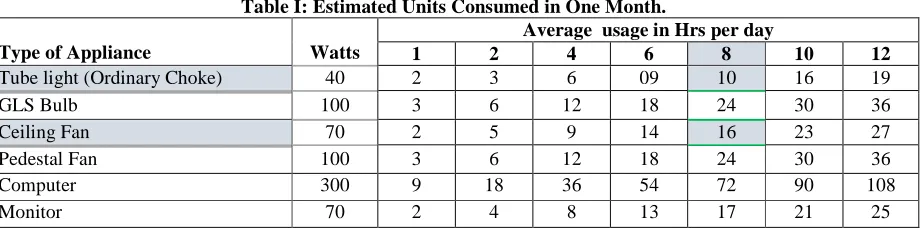
symbolizes 31 % and space heating records for 28 % of total power use, making those systems the best target for energy savings [7].In Asian countries like Pakistan, India, and Srilanka instead of space warming, space cooling is needed through ceiling fans, air cooler or air conditioners. Mostly ceiling fan is used for space cooling. In order to collect statistical data we consider the consumption of energy of different devices and their power ratings. PEPCO (Pakistan Electric Power Company) [8] has provided the approximated statics of power consumption by different appliances depending on their usage for different hours in terms of unit consumed in the course of one month as shown in Tab I.

Table I: Estimated Units Consumed in One Month.

Type of Appliance Watts

Average usage in Hrs per day

1 2 4 6 8 10 12

Tube light (Ordinary Choke) 40 2 3 6 09 10 16 19

GLS Bulb 100 3 6 12 18 24 30 36

Ceiling Fan 70 2 5 9 14 16 23 27

Pedestal Fan 100 3 6 12 18 24 30 36

Computer 300 9 18 36 54 72 90 108

Monitor 70 2 4 8 13 17 21 25

2.2. Actual Field Survey

Random survey is done in two computer labs of two engineering institutes, first in University of science and Technology Peshawar Abbottabad Campus & second in Comsats institute of information and technology Abbottabad Campus. Survey carried out in different time slots of working hours as mentioned below.

• Practical hours • Tea breaks • Lunch breaks

2.3.Survey Observation

Survey show the following observation

1. Computer labs fully occupied and all appliance turned ON

2. Computer Labs not fully occupied and all appliance turned ON

3. Computer Labs fully un-occupied and all appliance turned ON

Observation 1 shows the occupancy of student in Practical hours and found no problem.

Observation 2 shows the occupancy in Tea Break, observation 3 shows the status of appliances when no one is present in computer lab. Hence Observations 2 and 3 are of great interest which shows that there exist tremendous opportunity to save the energy in the Computer Labs by using the appliances as per the authentic requirement for the students and turning then Off when not required.

3. PROPOSED METHODOLOGY A creative approach is proposed to save the power consumption of electrical appliances generally used in the computer laboratory like fan, bulb and computer. For this the design of power management system (PMS) is required. PMS is intended to control one computer, light and fan for one student. This PMS is working on two observations.

1. Chair is free 2. Chair is not free.

(3)

Design of an Efficient Power Control System for Computer Laboratory

753

Proposed system is developed by integrating a

module of Light sensor, Temperature sensor, Power Relays, Power electronics components and Pressure

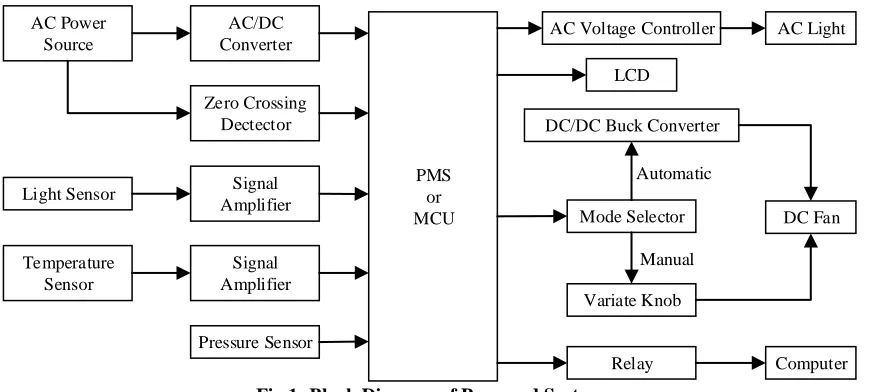
switch. The interfacing of the all the modules with PIC Microcontroller are shown in Fig 1.

PMS or MCU Light Sensor Signal

Amplifier

Temperature Sensor

Signal Amplifier

Pressure Sensor AC Power

Source

AC/DC Converter

Zero Crossing Dectector

AC Voltage Controller

LCD

Mode Selector

Relay

AC Light

DC/DC Buck Converter

Variate Knob

DC Fan

Computer Automatic

Manual

Fig 1: Block Diagram of Proposed System

5. SYSTEM OPERATING FUNCTIONS The block diagram of proposed system was shown in Figure. 1 and its parameters were described as follow:

5.1.Lighting Management

Here in this venture, LDR will sense the light illumination in Laboratory. When the illumination in the Laboratory is more, the level of resistance of LDR will reduce and the voltage fall across the LDR is less, which is later on fed to the ADC (Analog to

Digital Converter) pin of the micro-controller. Dimmers are devices used to vary the brightness of a light. By reducing or increasing the RMS voltage, it is probable to vary the brightness of the light using firing the TRIAC. Although variable-voltage devices are used for various purposes, the term dimmer is generally retained for those envisioned to control lighting. Here a single phase controlled inverter is used. Its Block outline is demonstrated in Fig 2.

Light Sensor

Vref ADC/ Pulse Decoder

Conversion (Binary into Delay in µs)

yb Inverter

DC/AC Generate PWM

AC Load

PMS or MCU

Vlight

Fig 2: Block Diagram of Lighting System

5.2.Fan Control Management

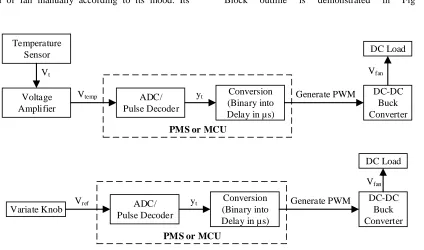
The Fan control system has two operating modes Automatic and Manual. The utilization of LM 35 sensor is extremely successful and inconvenience. It's a non-contact advanced sort temperature transducer well-suited for measuring room temperature. In automatic mode LM35 is used to detect very small variations in temperature. It specifically changes over the room temperature to yield the voltage froth. The

(4)

Design of an Efficient Power Control System for Computer Laboratory

754

speed of fan manually according to its mood. Its Block outline is demonstrated in Fig 3.

Voltage Amplifier

Vtemp ADC/

Pulse Decoder

Conversion (Binary into Delay in µs)

yt DC-DC

Buck Converter Generate PWM

DC Load

PMS or MCU Temperature

Sensor

Vt Vfan

Variate Knob Vref ADC/ Pulse Decoder

Conversion (Binary into Delay in µs)

yt DC-DC

Buck Converter Generate PWM

DC Load

PMS or MCU

Vfan

Fig 3: Block Diagram of Fan Control System (a) Automatic (b) Manual

5.3. Computer Control System

The Computer power is controlled by relay. At the point when a chair is free, the microcontroller will begin a timer and count for 300 sec (5 minutes) which will additionally displayed on LCD. In the event that no other student identification is happened on chair, the microcontroller will send an indicator signal to relay and power to computer will be cut off. Meanwhile any other student sit on the seat, the microcontroller will reset the counter and work in its

typical mode and LCD will show that seat is not free. The block diagram is shown in Fig 4.

5.4. Detection of student system

Fenix remote weight switch is utilized to sense vicinity of student on seat. Fenix remote weight switch holds four sensors which are spot at better place inside seat structure. At the point when a student sits on seat, microcontroller will on the frameworks if any of the sensors has sent the

actuation indicator.

Pressure

Switch Interrupt Relay

PC Power

PMS or MCU

Timer T>300s Generate

OFF Signal

Fig 4: Block Diagram of Computer Control System

5.5. Power Management System

The complete flows chart his shown in Fig 5. Initially the system will sense the voltage reading of LDR and

(5)

Design of an Efficient Power Control System for Computer Laboratory

755

(student is present on chair) it will keep ON the

computer, otherwise OFF. Similarly a chair is occupied by a student, it will check reading of the LDR, if it is nearly equal to zero then it means that there will be sufficient brightness in the lab and no need to ON the light so it will send no power to light by firing inverter at maximum angle. If the LDR reading is 5V means there is no light in the lab, it will send the maximum power to the light so that it will glow with maximum brightness. If the reading is between the 0 & 5, it will send power to AC load according to define slew rate which is directly related with firing angle and LDR reading. The relationship between firing angle and LDR voltage is given by (1)

(1)

Similarly aside with light control system upon the detection of student fan control system is also running with it. Fan control system will check the operating mode weather it is automatic or manual. Upon manual mode it will send power to fan with the define slew rate which is related with knob voltage

reading. Maximum set temperature (Tmax) is the maximum temperature above which fan will run with full speed similarly minimum set temperature (Tmin) is the temperature below which the fan will stop. These set points are set with potentiometer (knob) manually. Default values of Tmax and Tmin are 25ºC and 40ºC. The relationship of room temperature (Troom) and duty cycle (TD) in percent is given by (2)

(2)

(6)

Design of an Efficient Power Control System for Computer Laboratory

756

Detect Student Calculate VLDR, Troom

No

Yes

VLDR ≈ 0

F

ro

m

1

Goto 1

Yes

No

Plight = Pref

Irms=Plight/Vrms

α = αmax

Goto 1 Power on

Plight=0

VLDR < 5V

α = 0 No

Plight= Pmax

Goto 1

Yes

α = αmax

Mode Selector

Yes (Automatic)

No (Manual)

Troom>25oC

Variate Knob

Pfan = Pref

Goto 1 Pfan=0

No

Yes

Troom<40oC

Goto 1

Pfan= Pmax No

Goto 1 Pfan = Pref

Ifan=Pfan/Vfan Yes

Goto 1

Reset Timer

Start Timer

T>300sec

Yes

Vrelay=0 No

Vrelay=12V

Goto 2

Computer OFF

Goto 1

F

ro

m

2

Fi g 5: Flow Chart of Power Management System

6. RESULTS

The observation of power consumption (practically) is calculated using wattmeter connected to library’s electricity input power (Water and Power Development Authority (WAPDA)) while theoretically it is calculated with the references

power given in Tab I. Similarly the power consumption of a single cabin (Intelligent Energy Saving System (IESS)) is also calculated (Practically and theoretically). The power usage per hour (i.e.Wh)

(7)

Design of an Efficient Power Control System for Computer Laboratory

757

Tab II: Power Usage (Wh)

Day/ Time

Monday Tuesday Wednesday Thursday Friday

WAPDA IESS WAPDA IESS WAPDA IESS WAPDA IESS WAPDA IESS

8-9 AM 560 4 560 4 560 4 560 4 560 4

9-10 AM 1210 280 560 4 1050 490 950 420 560 4

10-11AM 810 210 1310 490 1350 980 850 630 850 350

11-12PM 1210 700 1210 630 1150 700 1150 350 960 560

12-1 PM 1110 630 1110 630 750 280 950 420 560 4

1-2 PM 555 175 900 735 375 70 475 175 0 0

2-3 PM 810 210 810 350 850 210 650 4 650 140

3-4 PM 710 140 520 140 650 4 650 4 650 70

The standby usage of electricity is 4Wh for this energy system because it needs some power to remain active to detect the student. Weekly power usage calculated on per day basis is shown in Tab III.

Tab III: Power Usage Per Day Day/Time WAPDA

(Wh)

IESS (Wh)

Monday 6975 2349

Tuesday 6980 2983

Wednesday 6735 2738 Thursday 6235 2007

Friday 4790 1132

Total 31715Wh 31.7 KWh

11209Wh 11.2 KWh

6.1. Results using MATLAB

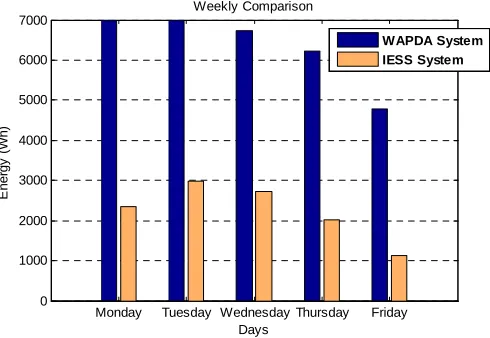
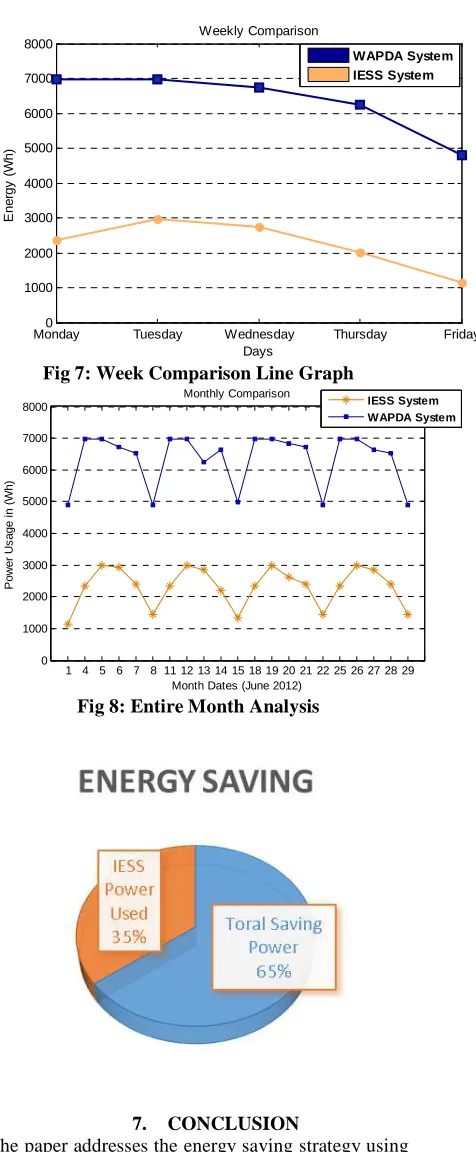
As the observations are taken manually, so it is better to compare these results graphically by using MATLAB. Based on daily readings a weekly histogram is shown in Fig 6. To elaborate the difference, same histogram is presented in line graph in Fig 7. In Fig 6 or 7, The WAPDA system uses more energy on Monday then that of other days. This is because here in Pakistan Monday is the first working day after weekend. Similarly on Friday the energy used for both the system is less due to prayer break during working hours. For getting more precise results, the readings are taken throughout month and the comparison line graph between WAPDA system and IESS system is shown in Fig 8. In this Fig the x-axis show the dates on which readings are taken. Weekend holydays are excluded from it.

After one month analysis it is concluded that this energy saving system saves energy upto 64%. It can be calculated using (3)

(3)

This analysis is done on the basis of 25 cabins and using both practically and theoretically taken reading it is also concluded that this system will use 70Wh per cabin. It depends upon the requirement of any institute. If this system will installed in homes and offices, it will work very efficiently and saves maximum energy.

Monday Tuesday Wednesday Thursday Friday

0 1000 2000 3000 4000 5000 6000 7000

Days

E

n

e

rg

y

(

W

h

)

Weekly Comparison

WAPDA System IESS System

(8)

Design of an Efficient Power Control System for Computer Laboratory

758

Monday0 Tuesday Wednesday Thursday Friday

1000 2000 3000 4000 5000 6000 7000 8000 Days E n e rg y ( W h ) Weekly Comparison WAPDA System IESS System

Fig 7: Week Comparison Line Graph

1 4 5 6 7 8 11 12 13 14 15 18 19 20 21 22 25 26 27 28 29 0 1000 2000 3000 4000 5000 6000 7000 8000

Month Dates (June 2012)

P o w e r U s a g e i n ( W h ) Monthly Comparison IESS System WAPDA System

Fig 8: Entire Month Analysis

7. CONCLUSION

The paper addresses the energy saving strategy using modern power electronics based on microcontroller for ac appliances are discussed. Based on the

analysis of principle of energy saving control methods and power management system, the power consumption reduces to the maximum limit. Automated Power Saving System for computer laboratory focuses on ways to cut down power wastage. Energy saved through this system not only reduces the financial burden but also reduces the pressure of generating power, which in turn reduces the exhaust of pollutants in the environment. The results verify the feasibility and effectiveness of the developed energy saving system and control strategy. Moreover, the efficiency and thus power factor are enhanced greatly. Due to use of power electronics conditional unit both active and reactive power saving rate are controlled, which offering great economic and social benefits. The proposed control strategy is developed for computer laboratory only and also extended to more number of consumer electronic and home appliances.

REFERENCES

[1]. Inderpreet Kaur “Microcontroller based home automation system with security” accepted for publication in International Journal of Advanced Computer Science and Applications(IJACSA)Vol 1, No 6, pp 60-65, Dec 2010.

[2]. KailashPati Dutta, PankajRai&VineetShekher “Microcontroller Based Voice Activated Wireless Automation System” accepted for publication in VSRD International Journal of Electrical, Electronics & Communication EngineeringVol 2 No 8, pp 642-649, 2012 [3]. Design of Microcontroller based Automated

Power Saving System for Classrooms Manzoor G. Ahmed*, Natique Z. Khan: Research & Reviews: Journal of Embedded System & Applications Volume 1, Issue 2, RRJoESA (2013) pp 9-16

[4]. H.E. Hua, L. Tian-yu, Z. Zhi-yong, and Z. Juan, “Energy Saving Potential of a Public Building in Jiangbei District of Chongqing,” International Conference on Management and Service Science, 20-22 Sep 2009, IEEE, pp 1-6 [5]. W. N. W. Muhamad, M. Y. M. Zain, N. Wahab,

N. H. A. Aziz, and R. A. Kadir, “Energy Efficient Lighting Design for Building”, 2010 International Conference on Intelligent Systems, Modelling and Simulation, IEEE , Dated 27-29 Jan. 2010, pp 282-286

(9)

Design of an Efficient Power Control System for Computer Laboratory

759

Metering for Next Generation Energy

Efficiency & Conservation‟‟ ,IEEE

Conference. 21-24 May 2012 pp 1-8

[7]. Managing Cost in Colleges and University by National Grid, © 2003 E Source Companies LLC

[8]. http://www.pepco.gov.pk/bill_consumption.php

BIOGRAPHIES

Syed Zulqadar Hassan, received his B.Sc. (Electronics Engineering) from University of Engineering and Technology, Peshawar in 2012 respectively with securing a Gold Medal. Currently he is engaged in doing M.Sc. (Electrical Engineering Power & Control) form Comsats Institute of Information Technology, Abbottabad Campus and acting as a Lecturer in University of Engineering and Technology (UET) Abbottabad Campus. His main research is in the area of Fuzzy Based Controller Design and Power Electronics Control.

Tariq Kamal, received his BSc degree in Electronic Engineering from University of Engineering and Technology (UET) Peshawar, Pakistan in 2012.He is currently in Comsats institute of information Technology Abbottabad Campus pursuing his Master degree in Electrical Power and Control Engineering and acting as a Lecturer in University of Engineering and Technology (UET) Abbottabad Campus. His main research is in the area of power system stability, application of adaptive intelligent controls, power electronics and electrical Machine drives.

Figure

Table I:  Estimated Units Consumed in One Month.  Average  usage in Hrs per day
Fig 1: Block Diagram of Proposed System
Fig 3.
Fig 6: Week Comparison Histogram
+2

References

Related documents

A larger, controlled clinical trial is warranted testing cognitive and somatic function in MPSI with up to 2 years of treatment with valanafusp alpha at the dose of 3

2, when the drug response is high, we found that the top two T4 cell counts and the lowest two infected monocyte/macrophage counts occurred at the fourth level (480 days) and

For the purpose of this study, MAEs were defined when there is one or combination of any MAEs (omission, patient, dose, drug/medication, time, route,

diagnosis of heart disease in children. : The role of the pulmonary vascular. bed in congenital heart disease.. natal structural changes in intrapulmon- ary arteries and arterioles.

Our data show that long-term statin therapy can significantly improve the clinical outcomes of the CAD + CKD patients, the treatment effect of statins was much more dramatic,

Morever, the partial defect of seed setting in lssr1 lines indicates that other cellulases or hydrolases with cellu- lase activity in or on the surface of pollen grains may

The purpose of this contribution is to suggest how the submarine alkaline hydrothermal vent model could be subjected to stringent tests that would indicate its failure, or

A QUALITATIVE STUDY OF THE BARRIERS TO INCIDENT REPORTING AT THE CHRISTIE NHS FOUNDATION TRUST..