ISSN 2348 – 7968
Random Access Detection Based on Compressed Sensing
in Tactile Internet
Hong Tang* Xiaoxuan Wu*, Wenwen Yang*, Lei Sun# ,
*Chongqing Key Lab of Mobile Communications Technology, Chongqing University of Posts and Telecommunications, Chongqing 400065, P. R. China
#
College of Telecommunications and Information Engineering, Nanjing University of Posts and Telecommunications, Nanjing 210003, P. R. China
E-mai: [email protected] [email protected], [email protected], [email protected]
Abstract
Tactile Internet has been proposed as a promising technology. According to the characteristic of data transmission and the demand of low latency in tactile internet, an algorithm of random access detection based compressed sensing which is used to reduce processing latency of detection has been proposed. In our algorithm, random access (RA) preambles should be designed so as to be detected in compressed sensing. Then RA preamble which is selected is modulated as RA signal and transmitted. Finally, RA preambles are detected via orthogonal matching pursuit algorithm. In simulations, the result shows that RA preamble can be detected correctly based on compressed sensing and compared to traditional random access detection, our proposed algorithm makes processing latency lower.
Keywords: Tactile Internet, Random access detection, Low latency, compressed sensing,
1. Introduction
The cellular communications developed for the Internet of Things (IoT) applications, which bridges the machines, devices, and human, become an unprecedented innovation for multimedia and data content exchange. On the other hand, when the transmission latency among terminals shrinks within a millisecond, human tactile to visual control will be changed around the world. However, the most advanced communication structure, e.g., Long-term Evolution (LTE) only achieves a typical round trip latency of 25ms, which unfortunately exceeds the 10ms requirement to enable real-time wireless gaming. Consequently, the low-latency techniques focused on realizing the millisecond transmissions need to be developed and applied in Tactile Internet [1]. this paper overviews random access technology which might be potentially considered and applied into Tactile Internet.
Because of the characteristics of low mobility, low latency and asynchronous burst of data in Tactile Internet, conventional random access technology is not suitable for Tactile Internet. The problem has some related sequence of works: In [2], contention based access (CBA) that UEs transmit packets on the randomly selected resource without having specific scheduled resources has been proposed. Although CBA can reduce the latency of random access, probability of collision has been increased. In [3], a new random access channel (RACH) has been proposed, which is divided into two channel parts, one channel part is devoted to transmit data payload, and another one is devoted to transmit control signals. In proposed RACH, control and data information is transmitted at the same time so that the transmission latency can be reduced. However, just beacause of this, the control signal somehow interferes with data information, which causes erroneous detectability of data information.
In this paper, random access (RA) detection based on compressed sensing is proposed. Compared to random access detection algorithm in LTE system, RA preambles consist of cyclic shift of gold sequence, which are transmitted by UFMC modulator and detected in the proposed algorithm. The result shows that our proposed algorithm not only detects RA preamble, but also reduces RA preamble detection latency.
The rest of this paper is structured as follows: we introduce random access detection in LTE system in Section 2 and our proposed random access detection in Section 3. Then in Section 4, performance of our proposed algorithm is evaluated. Finally, we conclude the paper in Section 5.
2. Random Access Detection in LTE System
ISSN 2348 – 7968
to evolved base station (eNB). Usually, UE launches access request by transmitting the random access preamble, then eNB detects random access preamble and responses to the UE that detected initial access request correctly by peak detection algorithm. In transmitter, Zadoff-Chu (ZC) is selected as random access preamble for initial request, because ZC sequence has special auto-correlation and inter-correlation properties that guarantee the separation of one ZC sequence from the sequence of its cyclic shift version by its correlation computation. Then, in receiver, received preamble has correlation computation with local ZC sequences in frequency domain and correlation peak value can be gotten. Finally, correlation peak value compares to noise-floor threshold in peak searching window, if correlation peak value is larger than one, preamble ID and timing advance (TA) can be estimated by its peak position information, otherwise, random access detection failed. Although the conventional RA detection algorithm has a good ability of RA detection, the processing latency of preamble detection takes more time for its correlation computation.
3. Proposed Random Access Detection
In order to reduce the processing latency of preamble detection, this paper proposes random access detection based on compressed sensing algorithm. At first, we introduce theorem of compressed sensing (CS). Then, based on the demand of CS, we propose our detection algorithm.
3.1 Compressed Sensing
Compressed sensing (CS) [5] is comprehended that original signal can be recovered with a small number of measurements, Where original signal must be sparse signal. Its definition can be described by
y
=
ψ
s
(1) Wheres
is sparse signal, which is expressed as1
N
×
vectors: s={ ,s s1 2,,sN}T; ψ is sensing matrix, which is expressed asM
×
N
vectors withM
<<
N
:1 2
{ , , , N}
ψ = ψ ψ ψ ;
y
is measurements, which isexpresses as
M
×
1
vectors: y={ ,y y1 2,,yM}T. Therefore, in order that random access can be detected with compressed sensing successfully in accordance with CS, three critical points have to be considered: 1) RA preambles should be enough to be selected for UEs and should be meet the demands of sensing matrix; 2) RA signal has to be sparse signal; 3) RA signal can be detected by CS recovery algorithm.3.2 RA Preambles Generation
As noted earlier, it is known that the sensing matrix ψ
which is composed of RA preambles must satisfy certain sufficient conditions characterized in terms of uniqueness theorem to guarantee RA signal detection. Before designing RA preambles (i.e., sensing matrix), we need to recall the definition of uniqueness theorem [6]:
Definition 1, Spark: Given a matrix φ we define ( )
Spark
σ = φ as the smallest possible number such that there exists a subgroup of σ columns from φ that are linearly dependent.
Definition 2, Lower Bound on Spark( )φ is expressed as:
1
( ) 1+
,
Spark φ
µ φ ≥
( ) (2)
Where µ φ( )is the mutual coherence of matrix φso that
there exists a matrix φ φ φ={ 1, 2,. . .φN} , the mutual
coherence of which is expressed as:
1 p
2 2
,
( ) max p q
.
q N
p q
φ φ µ φ
φ φ
≤ ≠ ≤
= (3)
Theorem 1, The
k
-sparse signals
can bereconstructed by
l
-norm solution if the matrix φ satisfies: ( ) 2 .Spark φ ≥ k (4)
Based on the uniqueness theorem, we consider gold sequences as RA preambles candidate, because of their unique autocorrelation and low cross-correlations properties. Then, we confirm the availability of gold sequences as cadidate with the uniqueness theorem.
A series of Gold sequences can be generated by using a pair of m-sequences. Different pairs of m-sequences can generate different series of Gold sequence, and each Gold sequence’s length equals to 2m+1. In addition, cross-correlation of Gold sequences has three-valued with possible values { 1,− −π( ), ( )-2}m π m where π( )m is
m+1 2
m+2 2
( )=
2
1,
2
1,
.
mfor odd m
for even m
π
+
+
( )
( ) (5)
ISSN 2348 – 7968
1 2 1 2
2 3 1 2 3 1
1 1 1 1
=
n n
n n n n
α α α β β β α α α β β β φ α α α β− β β −
,
(6)Where n is equal to2m
+
1, the length of gold sequence. Then, m is the number of shift register (i.e., the order of m-sequence). If element in matrix φ is a value {-1,1} variable, using (3) and (5), the cross-correlation of matrixφis represented as:
m+1 2
m+2 2
1 /
( )
max (2
1) / ,
(2
1) / ,
,
for odd m
for even m
n
n
n
µ φ
=
+
+
( ) ( ) (8) Consequently, m+1 2 m+2 2(2
1) / ,
( )
(2
1) / ,
.
for odd mfor even m
n
n
µ φ
=
+
+
( )( ) (9)
Based on thereom, according to (2) and (4), we can get a formula which is represented as:
m+1 2 m+2 2 , , 1 ( 1
2 2 1
1
( 1
2 2 1
.
n
for odd m
n
for even m
k
+ + + +≤
( ) ( ) ) ) (10)Where k is expressed as
k
-sparse of RA signal, that is to say, in our proposed RA preambles, if RA signal’s sparse property meets (10), RA preambles can be detected.3.3 RA Signal Transmissions
When UE intends to launch initial access request, at first, UE selects a RA preamble from proposed RA preambles, then choosed RA preamble is modulated as RA signal and transmitted finally. In the process,two key ideas should be noticed, namely sparsity and modulation. As noted in section 3.2, the sparse property of RA preamble signal required for detection should be satisfied certain condition. Consequently, RA signal can be formulated as:
1
2
1 2
[ , , ..., n]
n s s y s
φ φ
φ
=
(11)Where y is RA signal for transmission. φnare RA preambles.
s
nis a binary {0,1}variable indicating whichRA preamble is selected by host, that is, if φ1is chosen as
RA preamble, s1 is set 1 and others is set 0. As a result,
each transmited signal is sparse signal and sparsity k is equal to 1.
As far as modulation, RA signal is modulated via
OFDM and transmitted in conventional detection algorithm. However, non-synchronous transmissions are more considered in Tactile Internet, OFDM is not suitable for Tactile Internet, because of it is extremely sensitive to time synchronization. Moreover, Timing Advance (TA) cannot be acquired in detection based on compressed sensing algorithm. We have to find a modulation that makes lower demands of time synchronization. UFMC which is lower sensitive to synchronous transmission is proposed in [7]. Consequently, in this paper, we use UFMC as modulation to modulate RA singal required for transmission.
3
.4 RA Signal Detection Algorithms
In our RA signal detection based compressed sensing algorithm, RA signal is detected by orthogonal matching pursuit (OMP) which is a greedy approach to recover information in CS. When the eNB detects the RA signal successfully, corresponding RA preamble can be acquired after decoing the RA signal. Then the eNB starts acknowledging the UE with sending Ack packet. Since the RA preambles are randomly chosen by UE, the eNB can only acknowledge the RA preamble not device ID. If UE receives an Ack packet containing its preamble from eNB, it assures that the eNB has successfully detected its RA preamble and allocated resources for its transmission. If the RA preamble or the Ack packet is lost, then the UE will launch random access request again. Moreover, procedure of OMP [8] for RA signal detection is as follow:
1) Input proposed the set of RA preamblesφ, RA signal yand sparsity of RA signal
k
.2) Initialize the residualr0
=
v, the index setΛ =
0 ∅, and the iteration countert
=
1
.3) Find the index λt that solves the optimization
problem
1,.., 1
arg max
j d t,
j.
t
r
λ
=
= −φ
If the maximum occurs for multiple indices, break the tie deterministically.
4) Augment the index set and the matrix of chosen
atoms: Λt =Λt−1∪{ }λt and φt =[φt−1 φλt] ,
moreover, φ0is an empty matrix.
ISSN 2348 – 7968
2
arg min
.
t t
x
=v
−
φ
x
6) Calculate the residual:
r
t = −v φt tx.
7) Increment
t
, and return to step 3 ift
≤
k
.The detected signal has nonzero indices at the components listed in the set of Λ . Consequently, the nonzero position of the detected signal in component λj is
corresponding the jth preamble in the set RA preambles.
4. Performance Evaluation
In this section, we perform simulations to evaluate the
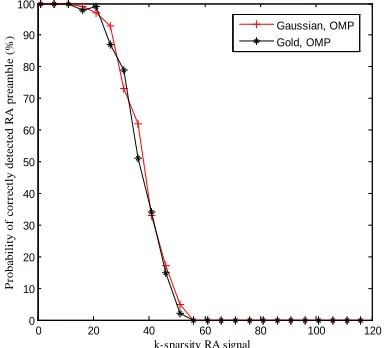
performance of our proposed scheme. Fig. 1 proves that
our designed RA preambles can be available compared to gaussian sequences [9] with OMP algorithm. It shows our designed RA preambles can be detected using OMP algorithm in CS.
0 20 40 60 80 100 120
0 10 20 30 40 50 60 70 80 90 100
k-sparsity RA signal
P
ro
b
ab
il
it
y
o
f c
o
rr
ect
ly
d
et
ec
te
d
R
A
p
ream
b
le (
%
)
Gaussian, OMP Gold, OMP
Fig. 1 Probability of successfully detected our proposed RA preamble
Fig. 2 shows that the probability of detected RA signal compared to the sparsity of RA signal in different number of RA preambles. Result shows that in the same sparsity of RA signal, the successful probability of detected RA signal is growing with the increase in the number of RA preambles. It also illustrates that when more RA preambles are available, collision will happen less in RA, however, eNB takes more process latency.
Fig. 3 compares time complexity of proposed detection algorithm with traditional detection algorithm. In traditional RA signal detection using frequency domain
theory [10], its time complexity is equal
to ο(4Nzc+6NzclogNzc) , where Nzc is length of
ZC-sequence. However, in our proposed RA signal detection using OMP algorithm, time complexity of which is equal
to ο(kMN), where k is the sparsity of RA signal, Mis the length of RA preamble and N is the number of RA preambles. Usually, ZC sequence-format 0 has been
adopted in LTE, namelyNzc
=
839. In our algorithm, twogold sequences generated by 6-sequence is shifted and adopted, therefore, the length of RA preamble isM =65, the number of RA preamblesN=130. Consequently, time complexity comparison considered single user is as table 1. According to Fig. 3, we can conclude that RA signal detection using CS detection takes less latency with increase in the number of active users.
0 20 40 60 80 100 120
0 10 20 30 40 50 60 70 80 90 100
k-sparsity of RA signal
P
ro
b
ab
il
it
y
o
f c
o
rr
ect
ly
d
et
ec
te
d
R
A
p
ream
b
les
(
%
)
66 RA preambles 130 RA preambles 258 RA preambles
Fig. 2 Probability of successfully detected in different number of RA preambles
Table 1: time complexity in different detection type
Detection Type Traditional CS
Time complexity 32746 8450
0 5 10 15 20
0 1 2 3 4 5 6 7x 10
5
Number of active users
Tim
e c
o
n
p
le
x
ity
Traditional detection CS detection
ISSN 2348 – 7968
4. Conclusions
Tactile Internet is proposed as a promising method to change the living style of human. In this paper,A novel random access detection algorithm based on compressed sensing which might be dedicated for Tactile Internet is proposed. The proposed algorithm, using redefined RA preambles and orthogonal matching pursuit algorithm, can detect random access request fast. RA preambles process latency can be reduced obviously.
Acknowledgments
This work was supported in part by the Program for Changjiang Scholars and Innovative Research Team in
University (IRT1299), Project of CSTC
(CSTC2012jjA40044, CSTC2013yykfA40010) and
special fund of Chongqing key laboratory (CSTC).
References
[1] G.P. Fettweis, “The Tactile Internet: applications and challenges,” IEEE Vehicular Technology Mag., 2014, pp.: 64-70.
[2] K. Zhou, N. Nikaein, R. Knopp, and C. Bonnet, “Contention based access for machine-type communications over LTE,” In proc. of IEEE VTC Spring, 2012, pp.: 1-5.
[3] 5GNOW, “Intermediate MAC Concept D4.1,” 2013. [4] S. Kim, K. Joo, and Y. Lim, “A delay-robust Random access
preamble detection algorithm for LTE system,” In proc. of IEEE R&W, 2012, pp.: 75-78
[5] R.G. Baraniuk, “Compressive Sensing,” IEEE Signal Processing Mag., 2008, pp.: 21-30.
[6] D.L. Donoho, and M. Elad, “Optimally sparse representation in general (nonorthogonal) dictionaries via l minimization,” In proc. Of Nat. Acad.SCI, 2003, pp.:2197-2202.
[7] F. Schaich, T. Wild, and Y.J. Chen, “Waveform Contenders for 5G-suitability for Short Packet and Low Latency Transmissions,” In proc. of IEEE VTC, 2014, pp.: 1-5. [8] L.R. Neira, and D. Lowe, “Optimized orthogonal matching
pursuit approach, ” IEEE signal processing letters, 2002,pp.:137-140.
[9] J.A. Tropp, Member, IEEE, and A.C. Gilbert, “Signal recovery from random measurements via orthogonal matching pursuit,” IEEE Trans. Inform. Theory., 2007, pp. : 4655–4666.