2016 6th International Conference on Information Technology for Manufacturing Systems (ITMS 2016) ISBN: 978-1-60595-353-3
1 INSTRUCTION
With the technological progress of Manufacturing technology and digital modeling widely adopted, large-scale equipment manufacture represented by aerospace is phasing in full three dimensional digitalization design and manufacturing methods of
product based on MBD (Model Based Definition)[1].
Full three dimensional digitalization design is being carried out in full swing, full three dimensional design standards based on CATIA, UG and Pro/E are constantly improving and has a higher level of application especially in aerospace field, itis gradually getting through the data chain of digitalization design and manufacturing. In real-world application, there are more and more MBD models designed by enterprises, it is becoming a problem to be solved urgently how to reuse the enterprise existing resources effectively, reduce development period of new product and lower the cost and raise modeling efficiency[2], research and implementation of Ontology modeling and retrieval technology of MBD model is just a solution to the problem.
In order to find the right three dimensional CAD model for reuse, many scholars at home and abroad did a lot of researches on three dimensional CAD model retrieval algorithm. Li at al. firstly used CAD model to build Feature Dependency Directed Acyclic Graph, making it possible to search CAD models completely or partly[3]. Zethaban at al. put forward an intelligent CAD model retrieval
algorithm based on group technology, using shape codes as description of CAD model and made it possible to retrieve CAD model with GT codes of
the user as input[4]. Wang Hongshen at al.
transformed partial structure retrieval of CAD model into similarity measurement of component faces of each model, achieving retrieval of partial structure
of three dimensional CAD model[5]. Zhang Shuzhen
at al. proposed a design resource algorithm of integrated product information models and achieved retrieval by taking into account function and attribute information of CAD model[6]. Firstly, these retrieval methods mainly consider traditional CAD models, and most of them only consider geometrical information of CAD models, some methods consider non-geometrical information as prerequisites, but geometrical information and non-geometrical information are correlative in MBD model, so they failed to clearly reflect reuse value of non-geometrical information; at the same time, these methods gave structural representations of traditional CAD model, but they didn’t aim at MBD
model integrated with geometrical and
non-geometrical information, failing to store and organize these structural information formally and easily to use. In order to make better use of MBD model resource, we adopt ontology technology and take OWL language as semantic descriptors of geometric feature information and non-geometric information in MBD model, then store history MBD models’ data as MBD history model data ontology
knowledge database[7], so we can acquire all
Ontology Expression of MBD Model and Research on Model
Retrieval Technology
Yu Yong, Gu Li
School of Mechanical Engineering and Automation, Beijing University of Aeronautics and Astronautics, China
Yin Pu
Institute of Telecommunication Satellite, China Academy of Space Technology, China
geometric and non-geometric information in every MBD model by searching ontology knowledge database, finally we can retrieve models that meet users’ requirements by using matching algorithm of geometric and non-geometric information.
2. BASIC CONCEPTION
2.1 Model based definition
MBD means expressing full product definition information by using integrated three dimensional entity model, adding dimension, tolerance and process information originally defined in 2D engineering drawings into three dimensional model formally. A full defined MBD dataset should include 3D geometric information, design reference,
dimension, tolerance and process information [2], as
shown in Fig. 1:
MBD Dataset
Design
Refference Model Entity Dimension and Tolerance
External
Refference ParameterExternal Model Geometry Information
Aided Geometry Information Geometry
Element
Three
Dimension Note GeometryNote
Standard Note Part Note
Annotation Note Material Note Engineering
[image:2.612.317.556.34.183.2]Notes InformationOther
Figure 1. MBD dataset.
Different from traditional 3D CAD model, MBD
model describes dimension and tolerance
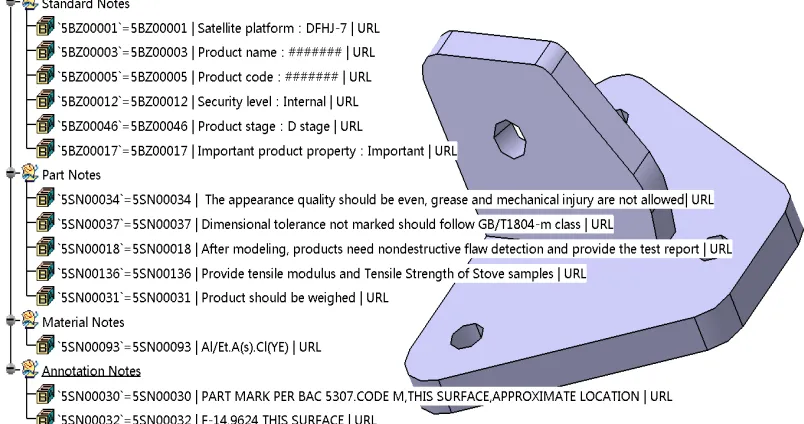
[image:2.612.103.505.337.549.2]information of some particular geometric features by adding three dimensional notes information on them; it also contains engineering information, including many process, manufacturing and checking information during product development process. Fig. 2 shows a MBD model that belongs to MBD model history database of some astronautic enterprise:
Figure 2. Part MBD dataset.
2.2 Ontology technology
Ontology originates from philosophy and aims at describing semantic information hidden in objective entity in the real world [8]. OWL is a kind of
ontology description language which is
recommended by W3C,it contains ontology elements as follows:
1) Ontology label:It describes ontology itself, including note, label, version information and ontology importing statements.
2) Class and Individual: Anowl class is a special type of resource, it describes resource collection
with common features; OWL individualsrepresent an instance of some class.
3) Property: Property play as predicate in individual statement, containing two types: Object property joins individual with individual; Data property joins individual with data.
4) Annotation and Datatype.
3. MBD MODEL ONTOLOGY MODELING
MBD model is different from traditional three dimensional CAD model, it has not only geometric feature but also 3D dimension information and engineering notes information[9]. All the information mentioned above should be completely expressed when constructing domain ontology structure. At the same time, with the purpose of MBD model information reuse, the process of constructing ontology Class and Property information of ontology should be done according to the reuse information. We refer to the MBD dataset normative definition [10]requirements put forward by Boeing Company during the process of building the skeleton structure of ontology Class(Design Reference and Other Information is not considered in this paper),
conclude MBD-Model as parent class ,
Geometry-feature class and Engineering-notes class as its child class. The former child class is built to describe entity models’ dimension and tolerance information, the latter is to describe engineering notes information.
3.1 Geometric feature class
In consideration of retaining initial design intent and design history of designers and getting better efficiency of transmitting design parameters, we choose geometry features as descriptors for expression of geometric information. MBD models mentioned in this paper are all built in CATIA, so we refer to the definition and classification in CATIA system when building child classes of Geometry-feature.
3.1.1 Sketch based features
Sketch-based features make up a large proportion in models built in CATIA system, we focused on five common features when constructing ontology classes, including Pad, Pocket, Shaft, Stiffener and Hole class, as shown in Fig. 3:
Sketch-Based Features
Pad
Shaft
Stiffener Hole
Regular-Pad
Irregular-Pad Regular-Pocket Irregular-Pocket
Rectangle-Pad
Circle-Pad Rectangle-Pocket Circle-Pocket
Simple-Hole
Complex-Hole
Tapaered-Hole Counterbored-Hole
Countersunk-Hole Counterdrilled-Hole
……
Figure 3. Sketch-Based feature ontology type and data property.
As for Pad and Pocket class, we will give detailed description of Pad class as an example. Based on whether the sketch is a regular graphic, Pad can be
divided into two child classes namely Regular-Pad (pads with regular sketches) and Irregular-Pad (pads with regular sketches); Regular-Pad is divided into
Rectangle-Sketch-Pad (pads with rectangle
sketches), Circle-Sketch-Pad (pads with circle sketches) and Hexagon-Sketch-Pad (pads with hexagon sketches), their data property is shown in Fig. 4:
Regular-Pad
Rectangle-Sketch-Pad
has-Stretchlength has-Reclength has-Recwidth
Cricle- Sketch -Pad
has-Stretchlength has-Cirdiameter
has-Reclength Rectangle length has-Recwidth Rectangle width has-Hexradius Hexagon Radius
has-Cirdiameter Circle diameter has-Stretchlength Stretch length Hexagon- Sketch -Pad
[image:3.612.317.547.134.252.2]has-Stretchlength has-Hexradius
Figure 4. Regular-Sketch-Pad ontology type and data property.
As for Irregular-Pad class, geometric feature information can’t be described with common property, so we adopt D2 shape descriptors to represent shape information of features [11] (we use n-dimensional vector to record shape descriptor line) and Oriented Bounding Box (OBB) to describe geometric dimension information of features. Geometric information of features combined with shape and geometric dimension information of features is shown in Fig. 5:
Irregular-Pad
has-OBBwidth
has-D2line
has-OBBlength
has-D2line D2 line
has-OBBlength OBB length has-OBBwidth OBB width has-OBBheight OBB height
[image:3.612.57.294.536.688.2]has-OBBheight
Figure 5. Irregular-Sketch-Pad ontology type and data property.
As for Shaft and Stiffener class, we can also use D2 shape descriptors and OBB to describe geometric information.
As for Hole class, it can be divided into Simple-Hole and Complex-Hole class. Simple-Hole has two data properties, namely has-Holedepth and has-Holediameter; Counterbored-Hole is elaborated as an example of Comeplex-Hole class which is shown in Fig. 6:
Counterbored-Hole
has-Boreddepth has-Boreddiameter
has-Holediameter has-Holediameter
has-Boreddiameter Counterbored diameter has-Boreddepth Counterbored depth has-Holediameter Hole diameter has-Holediameter Hole depth
3.1.2 Dress up features
Dress up features belong to another important kind feature type in CATIA system, we mainly extract three common feature types, namely Edge Fillet, Chamfer and Draft Angle (Draft Angle class is described by D2 shape descriptor and OBB) , classes and their data properties are shown in Fig. 7:
Dress-Up Features
Edge Fillet has-Filletradius
Chamer
has-Chamerangle has-Chamerlength
has-Filletradius Fillet radius has-Chamerlength Chamer lenght has-Chamerangle Chamer angle
[image:4.612.323.546.91.248.2]Draft Angle
Figure 7. Dress-UP feature ontology type and data property.
3.1.3 Relationship definition
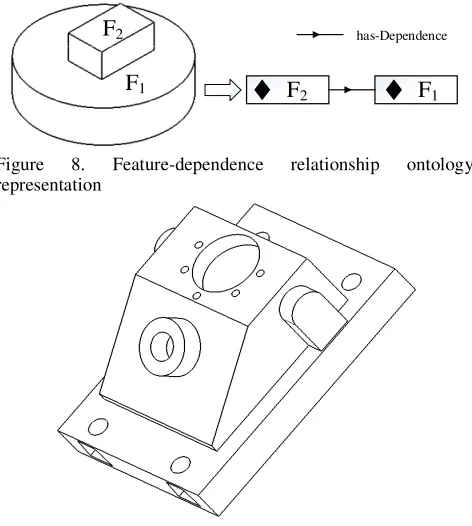
Description of feature information itself is not enough, topological relation between features should also be described. We choose feature dependence relationship to express topological structure between features[3], define has-Dependence object property to express dependence relationship between two features, it is shown in Fig. 8 how to transform feature dependence relationship between feature F2 and F1 into ontology structure:
F1
F2
F2 F1
[image:4.612.59.286.120.235.2] [image:4.612.59.295.393.656.2] [image:4.612.326.542.443.534.2]has-Dependence
Figure 8. Feature-dependence relationship ontology representation
Figure 9. MBD model geometry information.
Finally, ontology modeling of geometry information in MBD model is done, then we can acquire feature information which is needed to construct ontology structure by CATIA secondary development, instantiating features to individuals in ontology structure, building relationships between
individuals and accomplishing ontology expression of models. Fig. 9 and Fig. 10 show how to express geometric information of a MBD model by geometry feature ontology structure.
NPT-0001-Pad.1 NPT-0001-Pad.2
NPT-0001-Hole.14
NPT-0001-Hole.15
NPT-0001-Pocket.1 NPT-0001-Hole.1
NPT-0001-Hole.2 NPT-0001-Hole.13
NPT-0001-Hole.12 NPT-0001-Pad.5
NPT-0001-Pad.4
NPT-0001-Pocket.2 NPT-0001-Pad.3 NPT-0001-Hole.5
NPT-0001-Pad.7
NPT-0001-Pad.8
NPT-0001-Pad.9
NPT-0001-Pad.6
Figure 10. Model geometry information ontology.
3.2 Engineering notes class
As for engineering notes of MBD dataset, we constructed Engineering-notes as parent class, then construct Part-notes, Standard-notes, Material-notes and Annotation-notes class as its child classes according to MBD dataset structure. Part-notes class is taken as an example.
Part notes mainly describe product definition information which is necessary during technology planning, including heat treatment, part final treatment and part mark etc. The usual Definition of part notes is shown in chart 1:
Table 1. Engineering note item.
Code Note Content URL
SN00074 After molding, products need nondestructive flaw detection and provide the
test report
http://standards.we b.boeing.com/hlgw. cgi?app=BAC&spe
c=BAC5969
According to the structure in chart 1, we define engineering notes code as individual names, has-Content and has-Url as data properties, the ontology structure is shown in Fig. 11:
SN0074
After modeling, products need nondestructive flaw detection and provide the
test report has-Content
has-Url
http://standards.web.boein g.comhlgw.cgi?app=BAC
[image:4.612.331.540.601.697.2]&spec=BAC5969
Figure 11. Engineering note structure.
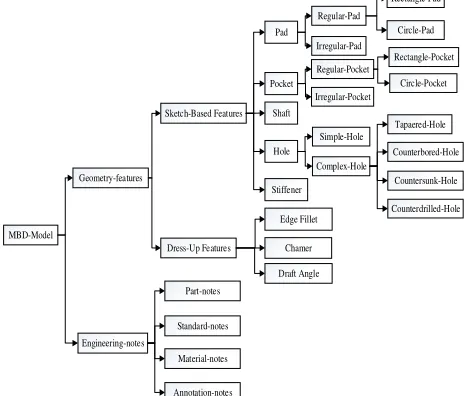
structurally [12], the final ontology class structure is shown in Fig. 12:
[image:5.612.60.293.63.261.2]Sketch-Based Features Pad Pocket Shaft Stiffener Hole Regular-Pad Irregular-Pad Regular-Pocket Irregular-Pocket Rectangle-Pad Circle-Pad Rectangle-Pocket Circle-Pocket Simple-Hole Complex-Hole Tapaered-Hole Counterbored-Hole Countersunk-Hole Counterdrilled-Hole Dress-Up Features Edge Fillet Chamer Draft Angle Geometry-features Engineering-notes MBD-Model Part-notes Standard-notes Material-notes Annotation-notes
Figure 12. MBD model full ontology structure.
Making use of CATIA secondary development, we can extract geometry features and non-geometry engineering notes information of a history MBD Model, then we instantiate these information as
individuals of ontology, reinvest ontology
individuals with properties and construct
relationships between them. Finally, we can achieve building MBD history model data ontology knowledge database by means of traversing data of all history models.
4. RETRIEVAL ALGORITHM
On the basis of accomplishment of MBD history model data ontology knowledge database, we can transform comparison problems of similarities between different MBD models into the problems of similarity evaluation between MBD model individuals in ontology database[13]. As mentioned above, every individual has geometry feature layer and non-geometry layer, so we give similarity evaluation ways of two layers respectively.
4.1 Comparison of geometry information layer The ontology storage structure of a model individual’s geometry feature layer describes model’s feature dependency directed acyclic graph, all the feature properties and feature dependency relationships respectively describe node and edge information of a graph structure, so we can use graph match algorithm to calculate similarities of geometry information layer. We changed a kind of inexact adjacent graph matching of CAD model surface properties which is used to retrieve CAD models raised by Tao Songqiao [14], because graph nodes and graph edges are all changed, so we come
up with new comparison methods of node properties and edge properties.
4.1.1 Geometry feature node information
comparison method
When comparing node properties of two geometric
features[15], we mainly consider the following
factors:
1) Geometric feature type
Firstly geometric feature type is considered, if these two geometric features are of different type, their similarity is 0 and there is no need to compare the following factors.
2) Geometry dimension
Geometry dimension information of geometry features is expressed by OBB, so we can suppose there are two geometry features whose OBB length, width, height are respectively a1,a2,a3and b1,b2, b3, their geometry dimension similarity is recorded as SQ:
3
1
1 | |
(1 )
3 max( )
i i Q i i i a b S a b = − = − −
∑
(1)3) Geometry shape
As for regular-sketch feature, we propose there are two features whose sketch length and sketch width are respectively L1,W1 and L2,W2 (as for sketch described by radius R, we count L=W=R), stretch dimension are respectively D1 and D2, so we can calculate shape similarity SD by using cosine similarity:
1 2 1 2
2 2 2 2
1 2
2 2
2 2 2
1 1 1
D L
L L W
W D L W D D
D S W + + = + + × + + (2)
As for irregular-sketch feature, feature shape information is expressed by D2 shape descriptors, so we propose that there two features whose shape distribution line are respectively H1and H2: H1= {h11, h12…, h1n} and H2= {h21, h22…, h2m}. The final shape similarity SD is calculated by EMD (Earth Mover’s Distance), EMD is an effective way of calculating distance between two vectors.
1 2
1 ( , )
D
S = −EMD H H
(3)
4) Dimension and tolerance
We suppose that there are two features whose tolerance class are respectively IT1 and IT2, surface roundness are respectively R1and R2:
1 2 1 2
1 2 1 2
1 1
(1 ) (1 )
2 max( , ) 2 max( , ) T
IT IT R T S
IT IT R R
− −
= − + −
(4)
Finally, Q1 and Q2represent two compared
features, the whole similarity is Ssum, calculation formulas is as follows:
1 2 3 1 2
1 2
0,
sum
Q D T
Q Q Q Q S
S S S
=
∂ × + ∂ × + ∂ ×
≠
=
Where ∂1 , ∂2 and ∂3 represent weight of
different comparison factor.
4.1.2 Geometry feature edge property comparison
We propose that there are two geometry features namely A and B, edge property is L(A,B) if A directs to B, calculation formulas is as follows:
0, ( , ) 1,
1
none
B has dependence A
A has dependenc L A
e B B
− −
−
=
(6)
None means there isn’t has-dependence relationship between A and B.
4.1.3 Graph match of geometry information layer
By adopting the comparison method of graph node and graph edge mentioned above and changing the graph match algorithm, we can calculate geometry information layer similarity between two compared model individuals, counted as Gsim.
4.2 Non-geometry engineering notes information comparison
Comparison of non-geometry engineering notes belongs to short-text comparison problem. Short texts in this paper—MBD engineering notes, they face special domain, include much semantic information, so we treat it in the following way of thinking:
There are many engineering notes in an MBD model, but representation degree of a single note on the whole model semantic information is very limited, so we choose to combine all engineering notes into a span of text, then it is possible to compare engineering notes of two compared MBD models by comparing engineering notes texts of MBD models.
Semantic information of a single note can be expressed by basic terminologies of machine manufacturing and unique terminologies related to product manufacturing and inspections of the company. So semantic information of an MBD model can be expressed by keywords of engineering notes text, realization procedures are presented as follows:
1) Refer to basic terminologies of manufacturing
technology in GB/T 4863-2008(T 4863-2008 basic terminology of manufacturing technology) and also collected company unique terminology included in
MBD models, then we use them to construct key-word dictionary.
2) Import key-word dictionary as user dictionary
into ICTCLAS.
3) Traversing all model individuals’ engineering notes in ontology dataset, we can build engineering notes texts of all MBD models and use them as engineering notes corpus.
4) As for the two compared models A and B, we
extract key words by using ICTCLAS added with new tokenization lexicon, then adopted TF-IDF algorithm to calculate TF-IDF weight of all key words in model A and B by using the generated corpus. Then we extract twenty key words from large to small, respectively record them as A{a1,a2,a3…a20} and B{b1,b2,b3…b20};
5) Combining all elements in vector A and B into
a new set, calculate each text word frequency for each word in the new set, record the result as word
frequency vector of A and B: CA{CA1, CA2,
CA3…CA40} and CB{ CB1, CB2, CB3…CB40};
6) Calculate cosine similarity between these two
vectors CA and CB, record the result as Esim, use it as similarity evaluation criterion of engineering notes content of two compared models.
Finally, we can combine similarity calculation of engineering notes and the former geometry
information similarity, the final similarity
calculation formula is as follows:
sim sim
Sim=
α
×G +β
×E(8)
Where
α
and β respectively represent weightof geometry and non-geometry information.
5. APPLICATION AND VERIFICATION
All data come from some aerospace enterprise, we use MBD history models of this enterprise as data source, construct ontology structure in Protégé, achieving importing 232 CATIA MBD models into ontology structure by using Jena (Ontology SDK).
In our experiments, we experimented the MBD model in Fig. 13 and distributed weight as follows:
①α =1.0 β =0.0(only concern about geometry information)
②α =0.5 β =0.5(concern about geometry and non-geometry information in the same weight)
③ α =0.25 β =0.75 (concern more about
Figure 13. Researched MBD model.
The final retrieval result is shown in table 2:
Table 2. MBD Model Retrieval Examples.
Retrieval
Model Weight
Retrieval Result Range
New-01
0
0 .0
1. β
α= =
New-01 XXX-7_21-05 XXX-7_21-09 XXX-7_21-10 XXX-7_11-03
0
5 .5
0. β α= =
New-01 XXX-7_21-09 XXX-7_21-10 XXX-7_21-05 XXX-7_11-03
0
25
0. β .
α = =
New-01 XXX-7_21-09 XXX_21-015 XXX_03-012 XXX_03-008
It can be seen from chart 2 that similar models can be retrieved according to similarity degree of geometry feature information and topology between features when we only consider geometry information similarity ( α =1.0 β =0.0 ). If
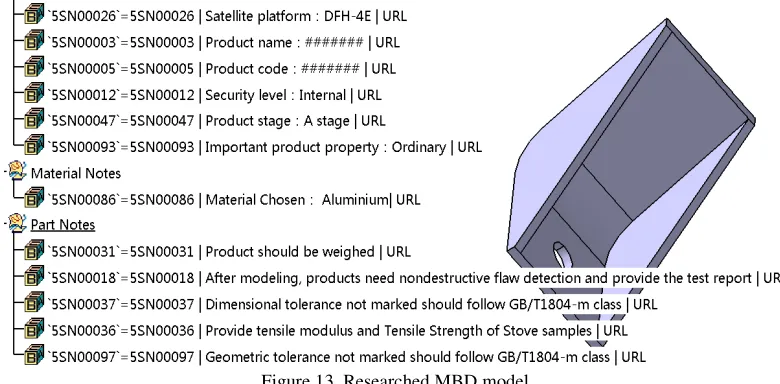
[image:7.612.56.556.269.462.2]geometry information and non-geometry is of same weight (α =0.5 β =0.5), XXX-7-21-09 has the highest similarity with the retrieved model, its engineering notes information is shown in Fig. 14:
Similar with the retrieved model, XXX-7-21-09 has engineering notes that describe product weight, non-destructive inspection, undated dimension tolerance and material selection.
Ifα =0.25 β =0.75 , there are new retrieval results in range 3, 4, 5, these models has much difference with the retrieved model, but there are many similarities in engineering notes information which is of much retrieval value.
6. CONCLUSION
This paper is aimed at MBD model retrieval, we express geometry and non-geometry information in MBD model in a structured and semantic way by using ontology technology and transform MBD history modeling data into off-line MBD history modeling ontology knowledge database so we can achieve multi-granularity retrieval. Also we propose similarity algorithm of geometry layer and non-geometry layer and have achieved MBD model retrieval considering geometry information and non-geometry information at the same time by adopting weighted calculation of two layers, it is shown in experiments that:
1) By transforming MBD history modeling data into ontology knowledge database, it will become very easy to acquire all geometry feature information and non-geometry engineering notes information, managing knowledge effectively and laying the foundation of knowledge retrieval and reasoning for modeling process of companies.
2) Different from traditional model retrieval, we consider geometry and non-geometry information and the relationship between them comprehensively, achieving retrieval of MBD models with similar
geometry semantic, design semantic or
manufacturing semantic information according to needs of the company. In this way, reuse value of MBD model is greatly improved and it will greatly improve modeling quality and efficiency for design departments.
REFERENCES
[1]Alemanni M, Destefanis F, Vezzetti E. Model-based definition design in the product lifecycle management
scenario [J]. The International Journal of Advanced Manufacturing Technology, 2011, 52 (1-4): 1-14.
[2]Wang Hong,Yu Yong,Yin Pu,at al. Research and implementation of MBD dataset definition based on association rules [J].Journal of Beijing University of Aeronautics and Astronautics, 2015, 41(12):2377-2383. [3]Li M, Fuh J Y H, Zhang Y F, at al. General and partial
shape matching approaches on feature-based CAD models to support efficient part retrieval[C], ASME, 2008.
[4]L Zehtaban D, Roller .Beyond similarity comparison: intelligent data retrieval for CAD/CAM designs[J]. Computer Aided Design and Application, 2013, 10(5):789-802.
[5]Wang Hongshen, Zhang Shusheng, Zhang Kaixing, at al. A Partial Retrieval Algorithm of 3D CAD Models Based on Attributed Graph s[J]. Journal of Computer-Aided Design & Computer Graphics, 2008(3):316-320.
[6]Zhang Ruzhen, Zhou Xionghui. A Design Resource Retrieval Algorithm Based on Integrated Product Information Model [J]. Journal of ShanghaiJiaotong University, 2007. 41(8):1248-1251.
[7]Lu Wenlong, Qin Yuchu, Liu Xiaojun, Meifa,et al. Enriching the semantics of variational geometric constraint data with ontology[J]. Computer-Aided Design, 63(2015)72-85
[8]Horrocks I. Ontologies and the semantic web [J]. Communications of the ACM, 2008, 51(12):58-67.
[9]Raphael Barbau, Sylvere Krima, et al. Onto STEP: Enriching product model data using ontologies [J]. Computer-Aided Design, 44(2012)575-590.
[10] Fan Yuqing. Model Based Definition Technology and Its Practices [J]. Aeronautical Manufacturing Technology, 2012(06): 42-47.
[11] Osada R, Funkhouser T, Chazelle B, et al. Shape distributions [J]. ACM Transactions on Graph, 2002, 21(4):807-832.
[12] Li Z, Raskin V, Ramani K. Developing engineering ontology for information retrieval[J]. Journal of Computing and Information Science in Engineering, 2008, 8: 011033-1.
[13] Tessier S, Wang Y. Ontology-based feature mapping and verification between CAD systems [J]. Advanced Engineering Informatics, 2013, 27(1):76-92.
[14] Tao Song ting, Wang Shu ting, Zheng Guangtan, Huang Zheng dong. CAD Model Retrieval Based on Inexact Graph Matching [J]. Journal of Computer-Aided Design & Computer Graphics, 2010, 22 (3): 545-552.
[15] Huang Rui, Zhang Shusheng, Bai Xiaoliang, Zhang Xing kai. Manufacturing semantics based 3D CAD model retrieval method [J]. Computer Integrated Manufacturing Systems, 2013, (06):1177-09.