Optimization of Examination Timetable Using
Harmony Search Hyper-Heuristics (HSHH)
Ms.Jayashree Rankhambe1 , Mrs.S.Kavita2
1, 2 Department of Computer Science and Engineering.
Holy Mary Institute of Technology, Hyderabad, India
Abstract:Examination timetabling is a distinct, combinatorial optimization problem which tends to be solved using stochastic search approaches such as evolutionary algorithms (EAs) and heuristic methods such as Hill-climbing, Simulated annealing, Tabu search, Genetic algorithms ,Graph coloring etc.
In this research we proposed a Harmony Search-based Hyper-heuristic (HSHH) method for capacitated examination timetabling problems. The Hyper Heuristics develop new algorithms for solving problems by combining known heuristics in different ways .It is also known as heuristics to choose heuristics. The harmony search (HS) algorithm has used which utilizes the experiences of musicians in Jazz improvisation. The Hyper heuristics technique applies Harmony Search algorithm on Heuristic harmony memory (HHM) which has low level heuristics rather than on Solution Harmony Memory (SHM). We test the proposed method using benchmark datasets introduced by Burke, Newall and Weare of University of Nottingham
Keywords:Examination timetabling, Hyper-heuristics, Heuristics, Heuristics Harmony Memory (HHM), Solution
Harmony Memory (SHM), Harmony Search (HS).
I. INTRODUCTION
Timetabling can be defined as a process of assigning certain resources or events to the limited timeslots (and rooms) according to a set of constraints [1]. The examination timetabling problem varies from one institution to another Every institution has a different set of requirements in order to effectively utilize their resources, meet the requirements of their business, provide a high level of satisfaction to their students etc. Therefore, an examination timetabling system has to be built to meet these individual requirements [2].
The examination timetabling problem can be defined as the assignment of a finite set of examinations to a finite set of time-slots and set of rooms, satisfying various constraints [10]. It involves two types of constraints; hard constraints and soft constraints. The hard constraints are strictly required to be adhered to in any circumstances. Satisfying the hard constraints produces a feasible solution [1, 2, 9, 10]. For example, two exams with common students involved cannot be scheduled into the same timeslot. Soft constraints need to be satisfied as much as possible. For example, exams taken by common students often need to be spread out over the timeslots so that students do not have to sit in two exams that are too close to each other. Due to the complexity of the real-world
timetabling problem, the soft constraints may need to be relaxed since it is not usually possible to generate solutions without violating some of them.
Examination timetabling problems can be categorized as either un-capacitated or capacitated. In capacitated problem room capacity is used for hard constraints and in the un-capacitated problem, room capacities are not considered [15].
The examination timetabling problem has been much studied and a wide variety of approaches have been taken across a variety of associated problem descriptions. Several meta-heuristic approaches have been developed for solving ETTPs which can be classified into two main types, i.e. single-based approaches e.g. Tabu search[18,21,24], simulated annealing, great deluge[17] and variable neighborhood search [6,12] and population based approaches e.g. genetic algorithms[22,23], ant colony optimization , memetic algorithms and Harmony Search algorithm[1,13,28,30]. The main idea behind the population-based is that the algorithms iteratively improve a number of solutions [4].
The Hyper-heuristics approach does not compete with problem-specific approaches, but to provide a general framework able to deliver solutions of a good quality for a wide range of optimization problems [5]. Hyper-heuristics can be categorized into approaches based on perturbative (improvement) low-level heuristics, and those based on constructive low-level heuristics [3, 17, 32]. Constructive low-level hyper-heuristics builds a solution incrementally, starting with a blank solution, and using constructive heuristics to gradually build a complete solution. Perturbative based approach starts from a complete solution and then search or select among a set of neighborhoods for better solutions [4, 7, 17]
Harmony search algorithm (HSA) is a population-based algorithm developed by Geem. HSA is a stochastic search mechanism, simple in concept, and no derivation information is required in the initial search[1].
This research is similar as given in [1],but the main objective of this research is to test the harmony search hyper-heuristic (HSHH) with more number of low level heuristics to get optimal solution.
hyper-heuristic (HSHH) algorithm is presented in Section IV. Section V discusses the Experimental results. Finally, the conclusion and future works are presented in Section VI
II. EXAMINATION TIMETABLING TROBLEM
Examination timetabling is the process of scheduling given exams to given timeslots and rooms in accordance with given hard and soft constraints. The hard constraints must be satisfied while the soft constraints are desired but not absolutely necessary. The main target is to find an examination timetabling solution that satisfies all hard constraints and minimizes the violation soft constraints as much as possible.
A. Constraints
• Constraints can usually be divided into two types:
– Hard constraints.
Hard constraints have to be satisfied under any circumstances. e.g. two exams with common students involved cannot be scheduled into the same timeslot. Timetables with no violations of hard constraints are called feasible solutions.
• Soft constraints need to be satisfied as much as possible.
E.g. two exams should not be in row
TABLE 1 HARD CONSTRAINTS
TABLE 2
SOFT CONSTRAINTS
III.PROBLEM FORMULATION
1. E-Total number of examinations 2. T-Total number of Timeslots 3. S-Total number of students 4. R-number of rooms 5. Ti-timeslot of exam i;
6. conflictij-number of students taking both exams i and j where conflictij=0 if i=j
7. CRi –capacity of Room i
8. eik –ith exam is assigned to kth room 9. studi-number of students taking exam i 10. ERi-set of rooms for exam i;
A. Feasibility Test F(x) = 0 Where
B. Hard Constraint-1 (H1)
C. Hard Constraint-2 (H2)
D. Hard Constraint-3 (H3)
IV.TECHNIQUES AND ALGORITHMS
A. Low-Level Heuristics
In this approach, three types of neighborhood structures have been employed as low-level heuristics. They are as follows
1.
Select two exams at random and swap the timeslots [1, 5, 6, 19, 20].2.
Select one exam at random and move to a new randomly selected feasible timeslot [1, 6, 19, 23].3.
Select two exams at random and swap the rooms.[6,20]B. Harmony search Hyper heuristics [1,13,28,30,31]
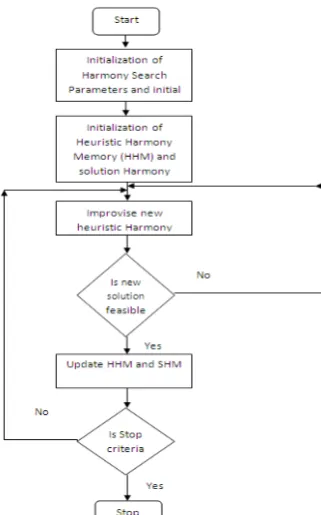
Steps involved in Harmony Search based Hyper Heuristic are
Step 1: Initialization.
The HSHH begins with setting the harmony search parameter:
1. Harmony memory size (HMS),
2. Harmony memory consideration rate (HMCR) 3. Number of iterations (NI).
4. A parameter to control Heuristic Harmony Memory (HHM) called Harmony Memory Length (HML). 5. Then the initial feasible solutions (SF) will be
generated using constructive heuristics[8,9,10,14,16,20,21]. If the solutions are
not feasibly completed, the repairing methods are used [1].
Step 2: Initialization of Harmony Memory.
HSHH consists of two different search spaces or harmony memory
1.Heuristic Harmony Memory (HHM) 2.Solution Harmony Memory (SHM).
HHM contains sets of heuristic vectors determined by HMS where every vector is a heuristics sequence (i.e. h’ ) and the length of the sequences is determined by HML.
Figure 1: Heuristic Sequence h’
Figure 2: Example Heuristics Harmony Memory (HHM) Where hi is the ith heuristic sequence.
The Solution Harmony Memory consists of two vectors. One vector has the timeslot assigned to exam and other contains the room number assigned exam (n represents number of exams).
Figure 3: Example Solution Vectors [26]
New heuristic sequence h’ is constructed randomly and applied to initial feasible solution. The new solution is evaluated using objective function. This process is repeated till SHM and HHM is filled.
Step 3: Improvise a new heuristic HM In this step, a new heuristics sequence
ℎ′= ℎ′ , ℎ′, . . . ℎ′ is generated from scratch based on
two operators: memory consideration and random consideration with given probability. The h’ is applied to random solution from solution harmony memory (SHM). Step 4: Update Heuristic Harmony Memory (HHM) and Solution Harmony Memory (SHM).
If new solution s better than worst solution in SHM then new heuristic sequence h’ will be saved in HHM and worst solution from SHM is replaced by new solution.
Step 5: Check the stop criterion.
Step 3 and step 4 are repeated until the stop criterion (NI) is met.
V. EXPERIMENTS AND RESULTS
The Harmony Search based Hyper Heuristic algorithm is tested on dataset published by Burke, Newall and Weare of University of Nottingham[34].
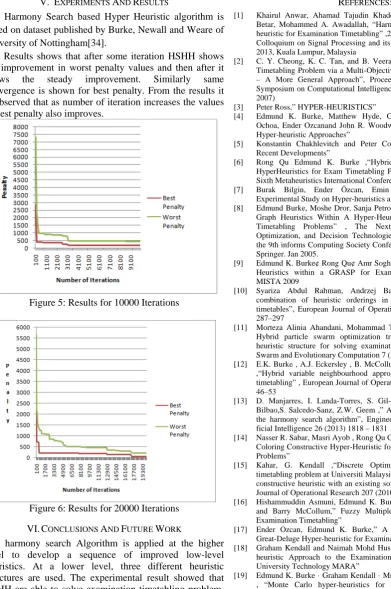
The Results shows that after some iteration HSHH shows big improvement in worst penalty values and then after it shows the steady improvement. Similarly same convergence is shown for best penalty. From the results it is observed that as number of iteration increases the values of best penalty also improves.
Figure 5: Results for 10000 Iterations
Figure 6: Results for 20000 Iterations
VI.CONCLUSIONS AND FUTURE WORK
The harmony search Algorithm is applied at the higher level to develop a sequence of improved low-level heuristics. At a lower level, three different heuristic structures are used. The experimental result showed that HSHH are able to solve examination timetabling problem. As this is an initial investigation of harmony search in hyper-heuristic framework, the results produced by HSHH in this study are not desirably comparable with the best results that have been published.
The future plan is to increase the number of low-level heuristics and include the either meta- heuristics or evolutionary heuristics like genetic algorithm to enhance the speed of convergence.
REFERENCES:
[1] Khairul Anwar, Ahamad Tajudin Khader, Mohammed Azmi
Al-Betar, Mohammed A. Awadallah, “Harmony Search-based Hyper-heuristic for Examination Timetabling” ,2013 IEEE 9th International Colloquium on Signal Processing and its Applications, 8 - 10 Mac. 2013, Kuala Lumpur, Malaysia
[2] C. Y. Cheong, K. C. Tan, and B. Veeravalli , “Solving the Exam
Timetabling Problem via a Multi-Objective Evolutionary Algorithm – A More General Approach”, Proceedings of the 2007 IEEE Symposium on Computational Intelligence in Scheduling (CI-Sched 2007)
[3] Peter Ross,” HYPER-HEURISTICS”
[4] Edmund K. Burke, Matthew Hyde, Graham Kendall, Gabriela
Ochoa, Ender Ozcanand John R. Woodward ,” A Classification of Hyper-heuristic Approaches”
[5] Konstantin Chakhlevitch and Peter Cowling ,” Hyperheuristics:
Recent Developments”
[6] Rong Qu Edmund K. Burke ,“Hybrid Variable Neighborhood
HyperHeuristics for Exam Timetabling Problems” , MIC2005: The Sixth Metaheuristics International Conference
[7] Burak Bilgin, Ender Özcan, Emin Erkan Korkmaz,” An
Experimental Study on Hyper-heuristics and Exam Timetabling”
[8] Edmund Burke, Moshe Dror, Sanja Petrovic and Rong Qu,” Hybrid
Graph Heuristics Within A Hyper-Heuristic Approach To Exam Timetabling Problems” , The Next Wave in Computing, Optimization, and Decision Technologies. Conference Volume of the 9th informs Computing Society Conference. 79-91. published by Springer. Jan 2005.
[9] Edmund K. Burke¢ Rong Qu¢ Amr Soghier,” Adaptive Selection of
Heuristics within a GRASP for Exam Timetabling Problems” MISTA 2009
[10] Syariza Abdul Rahman, Andrzej Bargiela,” Adaptive linear
combination of heuristic orderings in constructing examination timetables”, European Journal of Operational Research 232 (2014) 287–297
[11] Morteza Alinia Ahandani, Mohammad Taghi Vakil Baghmisheh,”
Hybrid particle swarm optimization transplanted into a hyper-heuristic structure for solving examination timetabling problem”, Swarm and Evolutionary Computation 7 (2012) 21–34
[12] E.K. Burke , A.J. Eckersley , B. McCollum , S. Petrovic a, R. Qua,
,“Hybrid variable neighbourhood approaches to university exam timetabling” , European Journal of Operational Research 206 (2010) 46–53
[13] D. Manjarres, I. Landa-Torres, S. Gil-Lopez, J. Del Ser, M.N.
Bilbao,S. Salcedo-Sanz, Z.W. Geem ,” A survey on applications of the harmony search algorithm”, Engineering Applications of Arti ficial Intelligence 26 (2013) 1818 – 1831
[14] Nasser R. Sabar, Masri Ayob , Rong Qu Graham Kendall, “ A Graph
Coloring Constructive Hyper-Heuristic for Examination Timetabling Problems”
[15] Kahar, G. Kendall ,“Discrete Optimization The examination
timetabling problem at Universiti Malaysia Pahang: Comparison of a constructive heuristic with an existing software solution”, European Journal of Operational Research 207 (2010) 557–565M.N.M.
[16] Hishammuddin Asmuni, Edmund K. Burke,Jonathan M. Garibaldi,
and Barry McCollum,” Fuzzy Multiple Heuristic Orderings for Examination Timetabling”
[17] Ender Ozcan, Edmund K. Burke,” A Reinforcement Learning–
Great-Deluge Hyper-heuristic for Examination Timetabling”
[18] Graham Kendall and Naimah Mohd Hussin , “Tabu Search
Hyper-heuristic Approach to the Examination Timetabling Problem at University Technology MARA”
[19] Edmund K. Burke · Graham Kendall · Mustafa Mısır · Ender Özcan
, “Monte Carlo hyper-heuristics for examination timetabling”, Springer Science+Business Media, LLC 2010
[20] Jose Fernando Oliveira, Maria Ant onia Carravilla – FEUP,
Heuristics and Local Search
[21] R. Qu,E.K.Burke,B.McCollum, L.T.G. Merlot , and S.Y. Lee ,” A
Survey of Search Methodologies and Automated Approaches for Examination Timetabling”, Computer Science Technical Report No. NOTTCS-TR-2006-4
[22] José Joaquim Moreira, A System of Automatic Construction of
Exam Timetable Using Genetic Algorithms
[24] Ariff Md Ab Malik, Masri Ayob, and Abdul Razak Hamdan , “Iterated Two-stage Multi-neighbourhood Tabu Search Approach for Examination timetabling Problem”, 2009 2nd Conference on Data Mining and Optimization 27-28 October 2009, Selangor, Malaysia 978-1
[25] Masri Ayob, Salwani Abdullah and Ariff Md Ab Malik, “A Practical
Examination Timetabling Problem at the Universiti Kebangsaan Malaysia”, IJCSNS International Journal of Computer Science and Network Security, VOL.7 No.9, September 2007
[26] Masri yob, Abdul Razak Hamdan, Salwani Abdullah, Zalinda
Othman, Mohd Zakree Ahmad Nazri, Kiftiah Abd Razak, Rohana Tan, Norashikin Baharom, Hilmiah Abd Ghafar, Rashidah Md Dali and Nasser R. Sabar ,“Intelligent Examination Timetabling Software” , Procedia Social and Behavioral Sciences 18 (2011) 600– 608
[27] Hishammudin Asmunia, Edmund K. Burkeb, Jonathan M.
Garibaldib,∗, Barry McCollumc, Andrew J. Parkesb , “An
investigation of fuzzy multiple heuristic orderings in the construction
of university examination timetables”, Computers & Operations Research 36 (2009) 981 – 1001
[28] Zong Woo Geem, “State-of-the-Art in the Structure of Harmony
Search Algorithm”
[29] A. Astolfi, “OPTIMIZATION An introduction”
[30] Dennis Weyland ,“A Rigorous Analysis of the Harmony Search
Algorithm - How the Research Community can be misled by a “novel”Methodology , International Journal of Applied Metaheuristic Computing,volume 1-2, April-June 2010, pages 50-60
[31] Osama Moh’d Alia · Rajeswari Mandava “,The variants of the
harmony search algorithm: an overview” , © Springer
Science+Business Media B.V. 2011
[32] Burak Bilgin, Ender Özcan, Emin Erkan Korkmaz,”An Experimental
Study on Hyper-heuristics and Exam Timetabling”, PATAT 2006, pp. 123–140. ISBN 80-210-3726-1.
[33] Mihej Komar, Dorde Grbic, Marko Cupic , “ Solving Exam
Timetabling Using Distributed Evolutionary Computation” , ITI
2011 33rd Int. Conf. on Information Technology Interfaces, June 27-30, 2011, Cavtat, Croatia