FlexDPDP: FlexList-based Optimized Dynamic Provable Data Possession
Ertem Esiner, Adilet Kachkeev, Samuel Braunfeld, Alptekin K¨upc¸¨u, and ¨Oznur ¨Ozkasap
Koc¸ University, Computer Science and Engineering, ˙Istanbul, Turkey
Abstract
With increasing popularity of cloud storage, efficiently proving the integrity of data stored at an untrusted server has become significant. Authenticated Skip Lists and Rank-based Authenticated Skip Lists (RBASL) have been used to provide support for provable data update operations in cloud storage. However, in a dynamic file scenario, an RBASL falls short when updates are not proportional to a fixed block size; such an update to the file, even if small, may result inO(n)block updates to the RBASL, for a file withnblocks.
To overcome this problem, we introduce FlexList: Flexible Length-Based Authenticated Skip List. FlexList translates variable-size updates toO(du
Be)insertions, removals, or modifications, whereuis the size of the update, andB is the (average) block size. We further present various optimizations on the four types of skip lists (regular, authenticated, rank-based authenticated, and FlexList). We build such a structure inO(n)time, and parallelize this operation for the first time. We compute one single proof to answer multiple (non-)membership queries and obtain efficiency gains of35%,35%and40%in terms of proof time, energy, and size, respectively. We propose a method of handling multiple updates at once, achieving efficiency gains of up to60%at the server side and90%at the client side. We also deployed our implementation of FlexDPDP (DPDP with FlexList instead of RBASL) on the PlanetLab, demonstrating that FlexDPDP performscomparable tothe most efficientstaticstorage scheme (PDP), while providing dynamic data support.
Keywords:Cloud storage, skip list, authenticated dictionary, provable data possession, data integrity.
1
Introduction
Data outsourcing has become quite popular in recent years both in the industry (e.g., Amazon S3, Dropbox, Google Drive, Apple iCloud, Microsoft OneDrive) and academia [4, 6, 18, 24, 25, 37, 51, 18, 28, 52, 19, 53]. In a cloud storage system, there are two main parties, namely a server and a client, where the client transmits her files to the cloud storage server and the server stores the files on behalf of the client. For the client to be able to trust the service provider, she should be able to verify the integrity of the data. A trustworthy brand is not sufficient for the client, since hardware/software failures or malicious third parties may also cause data loss or corruption [16]. The client should be able to efficiently and securely check the integrity of her data without downloading the entire data from the server, since that will be prohibitively costly [4].
Dynamic Provable Data Possession (DPDP) proposed in [25] extends the PDP model and provides a dynamic storage scheme. Implementation of the DPDP scheme requires an underlying authenticated data structure based on a skip list [49].
Askip list[49] is a tree-like hierarchical key-value store whose nodes are sorted according to their
keys. Authenticated skip lists are presented by [32], where skip lists and commutative hashing are employed in a data structure for authenticated dictionaries. In an authenticated skip list, each node stores a hash value calculated with the use of its associated value and the hash values of its neighboring nodes. The hash value of the root is the authentication information (meta data) that the client stores in order to verify responses from the server. To insert a new block into an authenticated skip list, one must decide on akeyfor insertion, since the skip list is sorted according to the key values. This is very useful if one, for example, inserts files into directories, since each file will have a unique name within the directory, and searching by this key is enough for general directory-related tasks. However, when one considers blocks of a file to be inserted into an authenticated skip list, the blocks do not have unique names; they haveindices. Unfortunately, in a dynamic scenario, an insertion/deletion would necessitate incrementing/decrementing the keys of all the blocks to the right of the affected block till the end of the file, resulting in unreasonable performance.
DPDP [25] employs Rank-based Authenticated Skip List(RBASL) to overcome this limitation. Instead of providing an insertionkey, theindexwhere the new block should be inserted is given. These indices are imaginary (no node stores the index information). The index information can be derived using the storedrankinformation, but ranks can easily be updated such that a block insertion/deletion doesnotpropagate to other blocks.
Theoretically, an RBASL provides dynamic updates with O(logn) complexity, for a file with n blocks, assuming the updates are multiples of the fixed block size. Unfortunately, a variable size updateleads to the propagation of changes to other blocks, making RBASL inefficient in practice. Therefore, one variable size update may affectO(n)other blocks. We discuss this in Section 4.
In this paper, we propose FlexList to overcome the problem in DPDP. In FlexList, rather than
ranks, which are indices of blocks, lengths, which are indices of bytesof data, are employed. This enables searching, inserting, removing, modifying, or challenging a specific block containing the byte at a specific index of data. Since in practice a data alteration occurs starting from a byte-index of the file, not necessarily an index of a block of the file, our DPDP with FlexList (that we call FlexDPDP) performs much faster than the original DPDP with RBASL. Even though Erway et al. [25] were the first to (informally) present the idea where the client makes updates on a range of bytes instead of blocks, we show that a naive implementation of the idea leads to insecurity in the storage system, as we show via an attack in Section 6.
We also present manyoptimizationson FlexDPDP that are observed and proposed for the first time for dynamic secure cloud storage. Our optimizations result in a dynamic cloud storage system whose efficiency is comparable to the best known static systems (PDP [4]), while still providing provable integrity for dynamically updatable data.
Our contributionsare as follows:
• We provide the first implementation of rank-based authenticated skip list and flexible length-based authenticated skip list with theoptimalnumber of links and nodes.
• We created optimized algorithms for basic operations (i.e., insertion, deletion). These optimizations are applicable to all skip list types (skip list, authenticated skip list, rank-based authenticated skip list, and FlexList).
• Our FlexList translates avariable-sized updatetoO(dBue)insertions, removals, or modifications, whereuis the size of the update, andBis the (average) block size (e.g., 2KB), while an RBASL requiresO(n)block updates in the worst case, wherenis the total number of blocks in the file.
skip lists and FlexLists. Our algorithms provide anoptimalproof, without any repeated items. The experimental results show efficiency gains of35%,35%,40%in terms of proof time, energy, and size, respectively.
• We provide a novel algorithm tobuilda FlexList from scratch inO(n)time instead ofO(nlogn)
(time forninsertions). Our algorithm assumes the original data is already sorted, which is the case when a FlexList is constructed on top of a file in secure cloud storage. Interestingly enough, our algorithm turns out to be well parallelizable even though FlexList is anauthenticated data structure where hashes generate dependenciesamong the nodes. Our parallel build algorithm achievesspeed ups of 6 and 7.7, with 8 and 12 cores, respectively.
• We provide amulti-block updatealgorithm that achieves60%efficiency gains at theserverside, compared to updating blocks independently, when the updates are on consecutive data blocks. Similarly, we achieve up to90%efficiency improvements at theclient side. Our new algorithm is applicable to not only modify, insert, and remove operations but also amixed series of update
operations.
• We deployed our FlexDPDP client-server implementation on the network testbed PlanetLab
and also tested its applicability on a real SVN deployment. The results demonstrate that our optimizations enable4times faster proof generation for consecutive updates in real life scenarios, and ourFlexDPDP performs comparable to the most efficient static storage scheme(PDP), while providing dynamic data support.
The rest of the paper is organized as follows. In Section 2, our motivation behind this study is described. Section 3 introduces definitions of skip list data structure and its variants. In Section 4, details of our FlexList proposal and optimizations are described. Then, in Section 5, details of FlexDPDP that provides FlexList-based dynamic secure cloud storage are provided. Security proof of FlexDPDP and the importance of authenticating data length values are described in Section 6. Extensive analysis results including FlexList and FlexDPDP performances, deployment on the PlanetLab distributed platform, comparison with DPDP and static cloud storage on the PlanetLab are presented in Section 7. Discussion of related work is provided in Section 8, followed by conclusions and future directions in Section 9.
2
Motivation
In order to provide provable data possession, we employ a rooted data structure namedFlexList, which is an authenticated dictionary. First, the file is divided into blocks (of some average size, e.g., 2KB), and the FlexList is constructed over these blocks. Each node of FlexList keeps a hash value that depends on its children, as well as the associatedlengthvalue (similar to arankin an RBASL). Thus, the rooted data structure creates dependency over all blocks (similar to a Merkle tree [42]). As in other authenticated dictionaries, any change in the FlexList nodes (e.g., their lengths), or associated blocks will result in a different root hash, due to the use of a collision-resistant hash function.
We then employ our FlexList in DPDP [25] (instead of the RBASL), and call the resulting scheme
FlexDPDP. The meta data kept by the client is the root hash of the FlexList. The remaining parts are
the same as the original DPDP construction of Erway et al. [25], though we show that the resulting efficiency gains cannot be neglected. We further optimize FlexDPDP for cloud storage operations, such as efficiently building a FlexList over a file during the initial upload, or proving and verifyingmultiple
data blocks simultaneously (as suggested by PDP [4]), as well as updating multiple blocks, even with
differentupdate types (i.e., even for an update that involves modifications together with insertions and deletions). With these optimizations, we show that our dynamic cloud storage scheme’s efficiency is comparable to that of the best static scheme.
Why FlexList? Erway et al. [25] showed that, making use of a new authenticated data structure,
are of a fixed size (which is the initial block size), the scheme is efficient. By observing our own SVN repository’s trace (used for over a year), we see that updates from a client are very rarely multiples of a fixed size. The SVN trace shows that the greatest common divisor of the sizes of all the commits is 1 byte. Therefore it is not possible to find a meaningful block size that is the common divisor for all updates. This shows that an update is variable sized by its nature. Therefore, a dynamic provable data possession solution should support variable block sizes.
When the updates are of variable block size, DPDP needsO(n)many updates on the data structure due to the shifting of the content. We explicitly show an example in Section 4. A simple attempt to overcome this problem is padding the blocks that are shorter than the size of the fixed block size, and using regular DPDP. Unfortunately, this hack is not an ideal solution. Firstly, padding increases the storage requirement at the server and once in a while necessitates a reconstruction of the data structure used. The more frequent the updates are, the more reconstructions are needed. Not only that, but also current cloud services where a client wants to update their data frequently require the option for the client to update a part of their data. Thus, the client needs to access a particular part of the data. If only block-wise provable access is available due to the DPDP scheme, then for the client to find her wished part of the data becomes an operation of complexityO(n), since a traverse from the start is necessary. Consider, for example, a client wishing to update her data starting from the1879thbyte. For the server to find the desired block, he needs to go over all the blocks, and count the actual data bytes without padding (see further Section 7.4).
Moreover, since the client has no clue which index is under which block, she can be cheated by the server who may send another part of the data, claiming that it indeed contains the desired byte (see Section 6). This insecurity may be tried to be solved via also authenticating the padding lengths together with the actual data lengths, but instead we propose FlexList, which provides an elegant, provably secure, and efficient way of dealing with variable-sized blocks, without any complications or storage overhead of padding.
3
Definitions
Skip Listis a probabilistic data structure presented as an alternative to balanced trees [49]. It is easy to
implement without complex balancing and restructuring operations such as those in AVL or Red-Black trees [2, 8]. A skip list keeps its nodes ordered by theirkey values. We call a leaf-level node and all nodes directly above it at the same index atower.
Figure 1: A regular skip list with the search path of the node with the key 24 highlighted. Numbers on the left represent levels. Numbers inside nodes are key values. Dashed lines indicate unnecessary links and nodes.
Figure 2: Skip list of Figure 1 without unnecessary links and nodes.
Figure 1 demonstrates a search on a skip list. The search path for the node with key24is highlighted in bold. In a basic skip list, the nodes include key,level, and data (only at the leaf level) information, andbelowandaf terlinks (e.g.,v2.below =v3 andv2.af ter= v4). To perform the search for24, we
start from the root (v1) and follow thebelow link tov2, becausev1’saf ter link leads to a node which
has a key greater than the key we are searching for (∞ > 24). Then, from v2 we follow the link l1
tov4, since the key ofv4 is smaller than (or equal to) the searched key (11 ≤ 24). In general, if the
the highlighted links until the searched node is found at the leaf level (if it does not exist, then the node with key immediately before the searched key is returned).
We observe that some of the links are never used in the skip list, such asl2, since any search operation
with key greater or equal to11will definitely follow the linkl1, and a search for a smaller key would
never advance through l2. Thus, we say links, such asl2, that are notpresent onanysearch path are
unnecessary. When we remove the unnecessary links, we observe that the non-leaf-level nodes that are left withoutaf terlinks (e.g.,v3) are also unnecessary, since they do not provide any new dependencies
in the skip list. Every time they are visited, the search will just continue following thebelow link of such a node. Although it does not change the asymptotic complexity, it is beneficial not to include them for time and space efficiency, as our experimental results confirm. An optimized version of the skip list from Figure 1 can be seen in Figure 2 with the same search path highlighted. Formally:
• Alinkisnecessaryif and only if it is on some search path.
• Anodeisnecessaryif and only if it is at the leaf level or has a necessaryaf terlink.
Assuming existence of a collision-resistant hash function family H, we randomly pick a hash function h from H and let || denote concatenation. Throughout our study we will use: hash(x1, x2, ..., xm)to meanh(x1||x2||...||xm).1
An authenticated skip list is constructed with the use of a collision-resistant hash function and
keeps a hash value at each node [33]. The hash value is calculated with the following inputs: level
andkeyof the node, and the hash values of the nodeaf ter and the nodebelow. If there is noaf ter neighbor, then a dummy value (e.g., null) is used in the hash calculation. Through the inputs to the hash function, all nodes are dependent on theiraf terandbelowneighbors. Thus, the root node is dependent on every node. Leaf nodes (at level 0) keep links to the file blocks (or to different structures e.g., files, directories, tags: anything to be kept intact). If any node of the skip list is modified, or the values linked at the leaf level nodes are modified, then this will result in a different hash of the root. Due to the collision resistance of the hash function, knowing the hash value of the root is sufficient for later integrity checking.
A rank-based authenticated skip list (RBASL) is different from an authenticated skip list by
means of how it indexes data [25]. An RBASL hasrankinformation (used in hashing, replacing thekey), meaning how many leaf-level nodes are reachable from that node. An RBASL is capable of performing all operations that an authenticated skip list can, in the cloud storage context.
4
FlexList
FlexList is anauthenticateddata structure (an example is shown in Figure 3), where each node keeps a
hashvalue calculated according to itsrank,level,the hash value of below neighbor, andthe hash value of the after neighbor, whererankis the number ofbytesthat can be reached from that node andlevel
is the height of a node in the FlexList. Each leaf level node keeps a link to thedata(a block of the file stored) that it refers to, thelengthof the data, and atagvalue calculated according to that data. Rank
values are calculated by adding the below and after neighbors’ ranks. If a node is at the leaf level, we use thelength of its dataas the below neighbor’s rank. Leaf level nodes’ hash calculation is slightly different. Asthe hash value of below neighbor, we use the associatedtag, and in addition, thelength
value is also included in the hash calculation. Note that, the root node is dependent to all (leaf level) nodes.
FlexList has sentinelnodes as the first and last nodes. Sentinel nodes have no data; hence their length values are 0 and they do not affect the rank values of the other nodes. These nodes generate no new dependencies, but are useful to make algorithms easier and more understandable.
1
Figure 3: A FlexList example. The numbers at the bottom are the lengths of the data blocks associated with the leaf level nodes. The numbers in the nodes are their ranks. The numbers at the left denote levels.
AFlexList supports variable-sized blocks, whereas an RBASL can only be used with fixed block
size (since operations by the byte-indexof the data are not possible with the rank information of an RBASL). In FlexList, instead of using the block indices as ranks as in the RBASL, we use byte indices. Thus, the information stored at each node denotes the number ofbytesof data reachable from that node. We show the advantage of this approach via an example.
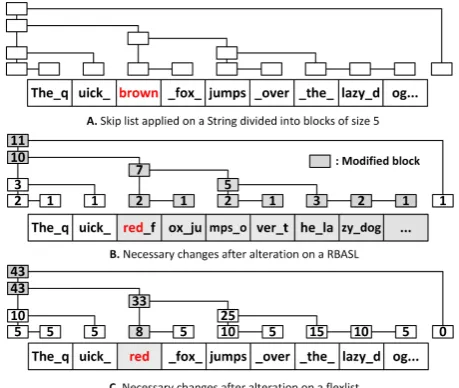
Figure 4: Skip list alterations depending on an update request.
Consider Figure 4-A that represents an outsourced file divided into blocks of fixed size. In our example, the client wants to change the file composed of the text “The quick brown fox jumps over the lazy dog...” such that “brown” becomes “red”. The client’s diff algorithm returns “[delete from index 11 to 15] and [insert “red” starting from index 11]”. Apparently, a modification to the 3rd block will occur. With a rank-based skip list, to continue functioning properly, a series of updates is required as shown in Figure 4-B, which asymptotically corresponds to O(n) alterations (assuming no padding, see Section 7.4). Therefore, for instance, an RBASL having 500000 leaf-level nodes needs an expected 250000 update operations for a single variable-sized update, such as the one in this example. Besides the modify operations and related hash calculations, this also corresponds to 250000 new tag calculations either on the server side, where
the private key (the order of the RSA group) is unknown (and thus computation is very slow), or at the client side, where all the new tags should go through the network. Furthermore, a verification process for the new blocks is also required (which means a huge proof sent by the server and verified by the client, who needs to compute an expected 375000 hash values). With our proposed FlexList, only one modification suffices, as indicated in Figure 4-C.
4.1 Preliminaries
In this section, we introduce the helper methods required to traverse the skip list, create missing nodes, delete unnecessary nodes, delete nodes, and decide on the level to insert at, to be used in the essential algorithms (search, modify, insert, remove).
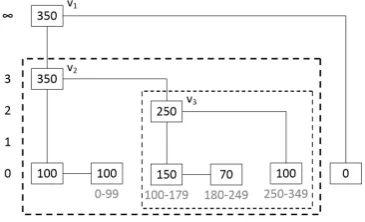
To make our FlexList algorithms easier to understand, we define the sub skip list concept. An example is illustrated in Figure 5. Let the search index be250and the current node start at the root (v1).
The search is similar to an RBASL. At each node, we compare the rank of thebelow node to see if we can reach the searched index via that node. In this example, thebelow node ofv1 isv2, who can reach 350bytes of data. Since we are searching for the index250, we continue with v2. The current node
follows itsbelowlink tov2and enters a sub skip list (big dashed rectangle).
Figure 5: A FlexList example with 2 sub skip lists indicated.
Now,v2is the root of this sub skip list and the searched
node is still at index250. We again look at thebelownode of v2. But this time it is useless for our purposes, since
it can only reach 100bytes whereas we are searching for
250. Thus, we should continue with the af ter node. In order to reach the searched node, the current node moves to v3, which is the root of another sub skip list (small dashed
rectangle).
Note that by movingaf ter, we have skipped over some data equivalent to the rank of thebelow node we skipped over. We were originally searching for index250, but now that we have skipped over100bytes of data, in this sub skip list, we continue our search with250−100 = 150. The amount reduced from the search index is equal to the difference between the rank values ofv2andv3,
which is equal to the rank ofbelowofv2. Whenever the current node follows anaf terlink, the search
index should be updated, since some data is skipped over. On the other hand, if abelowlink is followed, no data is skipped, and thus the search index stays the same. To finish the search, the current node follows theaf terlink ofv3to find the node containing the searched index.
We now present our utility functions as a preliminary to understanding the main methods. Note that all algorithms are designed to fill a stacktnthat stores nodes which may need a recalculation of the hash values if the data structure authenticated, and rank values if used in a FlexList or RBASL. All algorithms that move the current nodecnimmediately push the new current node to the stacktnas well. All these
algorithms are provided in the Appendix, together with Table 4, which shows the notation used.
canGoBelow (Algorithm A.1) and canGoAfter(Algorithm A.2) are the two methods that constitute
the decision mechanism of the traversal in the FlexList. They check if the searched index can be found following thebelow oraf ter link, respectively. There are some slight differences depending on from which other algorithm these are called. They are stated as comments in the algorithms.
nextPos(Algorithm A.3): ThenextP osmethod moves the current nodecnrepetitively until the position
desired by the calling method (search, insert, remove) is reached. There are 4 cases for nextP os depending on the caller:
• insert - moves the current node cn to the node immediately before the insertion point at the insertion level.
• loop ininsert- movescnuntil it finds the next insertion point for a new node.
• removeorsearch- moves the current nodecnuntil it finds the searched node’stower.
• loop inremove- moves the current nodecnuntil it encounters the next node to delete.
tossCoins(no pseudocode given): Probabilistically determines the level value for a new node tower. A
coin is tossed until it comes up heads. The output is the number of consecutive tails.
FlexList there are only necessary nodes, when a new node needs to be connected, this algorithm creates any missing node to make the connection.
deleteUNode(Algorithm A.5) is employed in theremoveandinsertalgorithms to delete anunnecessary
node (this occurs when a node loses its afternode, except at the leaf level) and maintain the links. It takes the previous node and current node as inputs, where the current node is unnecessary and meant to be deleted. We preserve connections between the necessary nodes after the removal of the unnecessary one. This includes the deletion of the current node if it is not at the leaf level. It sets the previous node’s af terorbelowto the current node’sbelow. As the last operation of deletion, we remove the top node from the stacktn, as its rank and hash values no longer need to be updated.
deleteNodemethod, employed in theremovealgorithm, takes two consecutive nodes, the previous node
and the current node. By settingaf terpointer of the previous node to current node’saf ter, it detaches the current node from the FlexList.
4.2 Methods of FlexList
We first describe the basic functions of FlexList such as search, modify, insert, and remove. Then, we show how to employ these functions in a secure cloud storage system. All algorithms are designed to fill a stack for the possibly affected nodes, whose rank and hash values may need re-calculation. The nodes in the stack constitute asearch path, which is the basis of aproof path.
search(Algorithm A.6) is used to find a particular index. It takes the indexias the input, and outputs
the node at indexiand the stacktnfilled with the nodes on the search path. Any value between 0 and the file size in bytes is valid to be searched. It is not possible for a valid index not to be found in a FlexList.
In the search algorithm, the current nodecnstarts at the root. The nextP osmethod movescnto the position just before the top of the tower of the searched index. Then cn is taken to the searched node’s tower and moved all the way down to the leaf level. The leaf-level node at the searched index is returned. All the nodes along the path from the root to this node are added to the stack that is returned as well.
modify(Algorithm A.7): By taking indexiand some new data as input, this algorithm first uses the
searchalgorithm to find the node that includes the data at indexi, and then updates its data. The outputs are the modified node and the stacktn filled with nodes on the search path. Afterwards, this stack is used to recalculate the hash values of the nodes along the search path, in a bottom-up fashion.
insert(Algorithm A.8) is run to add a new node to the FlexList by adding new nodes along the insertion
path. The inputs are the indexianddata. The algorithm generates a random insertionlevelby tossing coins, then creates the new node with the given data and attaches it to the indexi, along with the necessary nodes until thelevel. Note that this index should be the beginning index of an existing node, since inserting a new block inside an existing block makes no sense.2 As output, the algorithm returns the stacktnfilled with nodes on the search path of the new block.
Figure 6 demonstrates the insertion of a new node at index450withlevel4. nextP osbrings the current node to the closest node to the insertion point with level greater than or equal to the insertion level (c1 in the figure). We create any missing node at thelevel, if there was no node to connect the
new node to (in our example, m1 is created to connect n1 to). Within the while loop, during the first
iteration, nextP osadds c2, c3, and d1 to the stack, and stops atd1. Then a new node n1 is created
and inserted to level2, after m1. Insertingn1 makesd1 unnecessary, sincen1 stole its after link (i.e.,
n1.af ter=v4now, andd1.af terisnull). Thus,d1is deleted bydeleteU N ode, and removed from the
stack. Likewise, in the next iterationn2is created and inserted at level1(as below ofn1). Sincen2steals
the after link ofd2(i.e.,n2.af ter=v3now, andd2.af terisnull),d2is removed as unnecessary. Note
2
that removal ofd1 andd2 results inc3getting connected tov1 (i.e., first, whend1is removed,c3.af ter
becomesd2. Then, whend2is removed,c3.af terbecomesv1.). The last iteration insertsn3, and places
data. Since this is a FlexList, hashes and ranks of all the nodes in the stack will be recalculated (i.e., stack containsc1, m1, n1, c2, c3, n2, n3, v1, v2). Those are the only nodes whose hash and rank values
might have changed.
Figure 6: Insert at index 450, level 4 (FlexList).
remove(Algorithm A.9) is run to remove the node that starts with the byte at the indexi. As input, it
takes the indexi. The algorithm detaches the node to be removed and all other nodes above it (i.e., the tower) while preserving connections between the remaining nodes. The algorithm returns the stacktn
filled with the nodes onthe search path of the left leaf-level neighbor of the node removed.
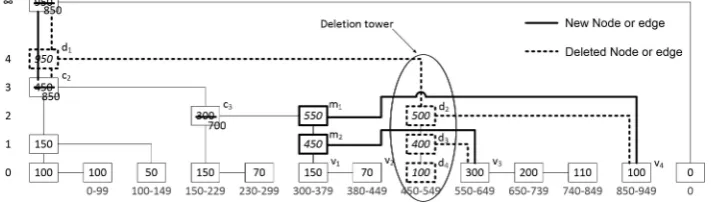
Figure 7 demonstrates removal of the node having the byte with index450. The algorithm starts at the root c1, and stops first at d1, since that node points to our deletion tower. The tower is to be
removed, and hence d1 is no longer necessary. Therefore, d1 is deleted, c1.below becomes c2, and
the search continues. Next, we go find the next node pointing to the deletion tower. This node is c3,
which is currently connected tod2. Sinced2is to be deleted, creating of a missing necessary nodem1
is required such thatm1.af ter = v4. Once m1 is created at the same level asd2 andd2 is deleted,
c3.af terbecomesm1. Continuing our search, we now stop atm1, deleted3, create a missing nodem2
at the same level asd3, such thatm2.af ter =v3. The last iteration moves the current node tov2 and
deletesd4without creating any new nodes, since we are at the leaf level. The output stack contains nodes (c1, c2, c3, m1, m2, v1, v2). Rank and hash values of those nodes could have changed, those values will
be recalculated.
Figure 7: Remove block at index 450 (FlexList).
4.3 Novel Build from Scratch Algorithm
The usual way to build a skip list (or FlexList) is to performninsertions (one for each underlying item). Such an approach will result in O(nlogn) total time complexity. But, when the underlying data is already sorted, as in the secure cloud storage scenario (where the blocks of a file are already sorted by their indices), a much more efficient algorithm can be developed.
building a FlexList from scratch inO(n) time. To the best of our knowledge, such an efficient build algorithm was not proposed before, not even for regular skip lists.
buildFlexList (Algorithm A.10) algorithm generates a FlexList over a set of sorted data in time
complexityO(n)with high probability. It has the small space complexity ofO(l)wherelis number of levels in the FlexList (i.e.,l = O(logn)with high probability). As the inputs, the algorithm takes the list of blocksB on which the FlexList will be generated, the corresponding (randomly generated) levels Land tagsT. The algorithm assumes data is already sorted. In cloud storage, the blocks of a file are already sorted according to their block indices, and thus our optimized algorithm perfectly fits our target scenario. As the output, the algorithm returns the root node of the constructed FlexList. It works from right to left and bottom to top, thus performing a single pass over the nodes.
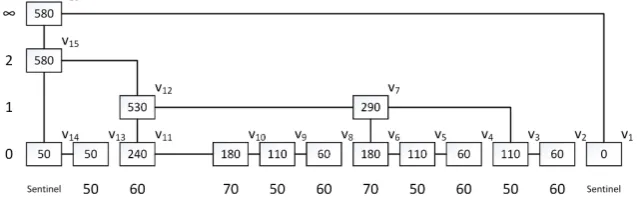
Figure 8 demonstrates an example FlexList build process where the insertion levels of blocks are 4, 0, 2, 0, 0, 0, 1, 0, 0, 1, 0, in order. Labelsvi on the nodes indicate the generation order of the nodes.
The idea of the algorithm is to build towers for each block, up to the associated level. As shown in the figure, all towers have only one link from left side to its tower head (the highest node in the tower). For example, the head of the tower composed ofv6, v7isv7, and there is only one link coming to that tower
from left, which is the link fromv12to the tower headv7. Therefore, we need to store the tower heads
in a vector, and then make necessary connections.
At a high level, the algorithm starts creating the rightmost tower first. The algorithm then remembers its tower head at the associated level. Then, the second rightmost tower is created. If there are tower heads to the right of it that it should be connected to, those connections are created. For example, when it is the turn of thev6, v7 tower, we know that it should be connected to v5 at level 0, v3 at level 1.
Once the leftmost tower is created and connected to other towers, the algorithm returns the root. During this process, the ranks and hashes of each new node are also calculated. Thus, the build algorithm not only can work for a regular skip list, but can also work for authenticated and rank-based versions, such as FlexList or RBASL, as well. Note that this build algorithm creates an optimal skip list without unnecessary nodes and links, asninsertions with our optimal insertion algorithm would have built. The full algorithm, as well as its detailed explanation using Figure 8, is provided in the Appendix.
Figure 8: buildFlexList example.
4.4 Parallel Build FlexList
However unintuitive, we can also parallelize the build process of even anauthenticateddata structure, such as FlexList. Figure 9 shows the three-core parallel construction of the FlexList (example in Figure 8). The approach consists of three steps: First, the tasks are distributed to threads and FlexLists for subsets of blocks are generated. Second, to unify them into a single FlexList, all the roots are connected together with links (c1is connected tor1, eliminatingl1, andr1 is connected tor2, eliminatingl2) and
new rank values of the modified roots (r1andc1) are calculated. Third, FlexList remove function is used
to remove the unnecessary sentinels directly below the roots of the sub-FlexLists that remain in between each part (remove indices360 =c1.rank−r2.rankand180 =c1.rank−r1.rank). In the example, the
remove operation generatesv12andv7 of Figure 8 and connects the remaining nodes to them, and rank
nodes. As a result, all the nodes of the sub-FlexLists are connected to their levels on the FlexList, and the same FlexList of Figure 8 is obtained efficiently in a parallel manner.
Figure 9: A build skip list distributed to 3 cores.
5
FlexList-based Dynamic Secure Cloud Storage
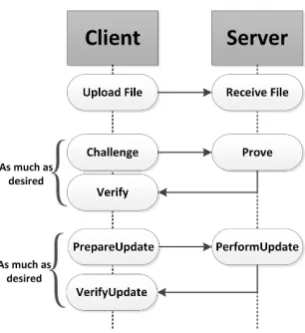
Figure 10: Client Server interactions in FlexDPDP.
In this section, we describe the application of FlexList to integrity check in secure cloud storage systems according to the DPDP model [25]. We call the resulting scheme FlexDPDP that includes the new capabilities and efficiency gains discussed in Section 4. The FlexDPDP uses homomorphic verifiable tags[5, 4, 25]: multiple tags can be combined to obtain a single tag that corresponds to a single combined block. Tags are small compared to data blocks, enabling storage in main memory. Authenticity of the skip list guarantees integrity of tags, and tags protect the integrity of the data blocks. The DPDP model has two main parties: the client and the server. The cloud server stores a file on behalf of the client. It has been shown that an RBASL can be created on the outsourced file to provide proofs of integrity as depicted in Figure 10. The following algorithms are used:
• Challengeis run by the client to request a proof of integrity for randomly selected blocks.
• P roveis run by the server in response to a challenge, to generate the proof of possession.
• V erif yis run by the client upon receipt of the proof. A return value of accept means the file is kept intact by the server.
• prepareU pdateis run by the client when she changes some part of her data. The client sends the update information to the server.
• perf ormU pdateis run by the server in response to an update request to perform the updateand
prove that the update is performed reliably.
5.1 Preliminaries
Before providing optimized proof generation and verification algorithms, we introduce essential methods used in our algorithms to determine intersection nodes, search multiple nodes, and update rank values. Table 5 in the Appendix shows the notation used in this section.
Proof nodeis the building block of a proof. It contains level, data length (if level is 0), rank, hash, and
three boolean values (rgtOrDwn, end flag, and intersection flag). Level and rank values belong to the actual node for which the proof node is generated. The hash is the hash value of the neighbor node that is not on the search path. There are two scenarios for setting hash andrgtOrDwnvalues:
1. When the search path follows the below link of the node in consideration, the hash of the corresponding proof node is set to the hash of the current node’s af ter (since that part is not on the search path) and itsrgtOrDwnvalue is set todwn(since the search path continues down). 2. When the search path follows the af ter link of the node in consideration, the hash of the corresponding proof node is set to the hash of the current node’s below (since that part is not on the search path) and itsrgtOrDwnvalue is set torgt(since the search path continues right).
isIntersection: This function is used insearchMulti(defined later) for checking whether or not a given
node is an intersection. It takes current node, the challenged indices, two indices (which will be checked for intersection, in ascending order), and the rank state (to know which sub skip list is considered). A node is anintersectionpoint of proof paths of two searched indices when the first index can be found following thebelow link and the second index is found by following theaf ter link of that node. The
isIntersectionmethod not only returns true or false according to this criteria, but also helps the proof generation by finding the next intersection in the challenge vectorC. In practice, among the two indices given to this function, the first one will be the index we are currently searching for (to create a proof), and the second one will be the index of some other challenged index. Note that this method directly returns false if there is only one challenged index, or if the first and last indices are not intersecting at the given node.
searchMulti(Algorithm A.11): This algorithm is used in thegenMultiProof algorithm (to generate a
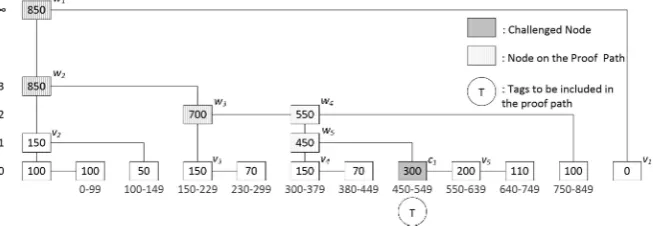
combined proof for multiple challenged indices, see Section 5.2) to generate the proof path for multiple nodes without unnecessary repetitions of the proof nodes. The idea is to search for the indices, create a proof node for every node on the search path, and note down any intersections. Figure 11, where the node at the index450is challenged, demonstrates an example of how the algorithm works. The aim is to provide the proof path for the challenged node. We assume that in the search, the current nodecn starts at the root (w1in the example). Therefore, initially the search indexiis450, the proof vectorP
and intersection stacktsare empty.
Figure 11: Proof path for challenged index 450 in a FlexList.
For w1, a proof nodepis generated using scenario (1) (see proof node description), where p.hash
is set tov1.hash andp.rgtOrDwnis set todwn. Forw2, the proof node pis created as described in
scenario (2) above, wherep.hash is set tov2.hash andp.rgtOrDwnis set torgt. The proof node for
nodec1is the challenged leaf node, and the proof node for this node is also created as in scenario (1).
Note that in the second, third, and fifth iterations of the while loop, the current node is moved to a sub skip list. Setting the end flag and collecting the data length, as well as setting the intersection flag and saving the rank state are crucial for generation of proof for multiple blocks. The full algorithm is in the Appendix.
updateRankSum: This algorithm, used in the verifyMultiProof algorithm (to verify the proof of
multiple challenged indices, see Section 5.2), is given the rank difference as input, the verify challenge vectorV, and indicesstartandend(onV). The output is a modified versionV0of the verify challenge vector. The procedure is called when there is a transition from one sub skip list to another (larger one, since verification is bottom-up and right-to-left). The method updates entries starting from indexstart to indexendby rank difference, where rank difference is the size of the larger sub skip list minus the size of the smaller sub skip list.
Tag calculation and the Block Sum: We use an RSA group Z∗N, where N =pqis the product of two
large prime numbers, andgis a high-order element in Z∗N. It is important that the server does not know p and q. The tag tof a block m is computed as t = gm modN. The block sum is computed as
M = |C|
P
i=0
aimCi whereC is the challenge vector containing block indices andai is the random value
associated with theithchallenge index. These are directly taken from the original DPDP [25].
5.2 Handling Multiple Challenges at Once
Client-server interaction in secure cloud storage (Figure 10) starts with the client pre-processing her data (creating a FlexList for the file and calculating tags for each block of the file). The client sends the random seed she used for generating the FlexList to the server along with the data, the tags, and the public key (g, N) used for computing the tags. Using the seed, the server constructs a FlexList over the blocks of data and assigns tags to leaf-level nodes. Note that the client may request the root value calculated by the server to verify that the server constructed the correct FlexList over the file. When the client checks and verifies that the hash of the root value is the same as the one she had calculated, she may safely remove her data and the FlexList. The client keeps the hash of the root of the FlexList as meta data for later use in the proof verification mechanism.
To challenge the server, the client generates two pseudo-random generator seeds, one that will generate the challenge vector C of random indices for bytes to be challenged, and another that will generate random coefficientsaito be used in the block sum [4]. The client sends these two seeds to the
server as the challenge, and keeps them for verification of the server’s response.
5.2.1 Proof Generation
genMultiProof (Algorithm A.12): Upon receipt of the random seeds from the client, the server
generates the challenge vectorCand random valuesaiaccording to the pseudo-random generators, and
runs thegenMultiProof algorithm in order to get tags, file blocks, and the proof path for the challenged indices. The algorithm searches for the leaf node of each challenged index and stores all nodes across the search path in the proof vector. However, when multiple blocks are challenged (as in PDP [4] and DPDP [25]), if we start from the root for each challenged block, there will be a lot of replicated proof nodes along these multiple search paths. In the example of Figure 12, if the proofs were generated individually for each challenged index,w1,w2, andw3 would be replicated4times (because they are
common to the proof path of each challenged index),w4 andw5 would be replicated3times (common
for all challenged ones exceptc1), andc3 would be replicated2times. To overcome this problem, we
save the state at each intersection node. For example, in Figure 12, the algorithm starts traversing from the root (w1), searching for the leftmost challenged node (c1). Next, the algorithm continues searching
instead ofw1. The proof generation forc3 will continue fromw5(the intersection node forc2 andc3),
and so on.
In our optimalproof, only one proof node is generated for each node on anyproof path. This is beneficial in terms of not only space but also time (see Section 7), and hence is much better than first generating individual proofs and then performing a replica-removing merge or applying compression. Correspondingly, the verification time of the client is also greatly reduced since she computes fewer hash values. The full algorithm and its detailed explanation using Figure 12 are in the Appendix. At the end of thegenMultiProof algorithm, the proof vector (Figure 13), the tag vector, and the block sum are sent to the client for verification.
Figure 12: Multiple blocks are challenged in a FlexList.
Figure 13: Proof vector for Figure 12 example. “I” denotes intersection, “E” denotes end, and data length is included only for end nodes.
5.2.2 Verification
verifyMultiProof(Algorithm A.13): Recall that the client keeps random seeds used for the challenge,
and generates the challenge vectorCand random valuesaiaccording to these seeds. If the server was
honest, these will contain the same values as the ones the server generated for preparing the proofs. There are two steps in the verification process: tag verification and FlexList verification.
Tag verificationis done as follows: Upon receipt of the tag vectorT and the block sumM, the client
calculatestag = |C|
Q
i=0
Tai
i mod N and accepts iff tag = gM modN. This part proves that the file
blocks match the tags sent (as in PDP [4] and DPDP [25]). Next, FlexList verification checks that the tags remain intact. Thus, together they prove file integrity.
FlexList verification involves calculation of hashes for the proof vector P (Figure 13) treated as a
stack. The calculation of hashes is done in the reverse order of the proof generation ingenMultiProof
algorithm. Therefore, the calculations are performed in the following order: c4, w6, c3, c2, w5, . . .
until the hash value for the root (the last element in the stack) is computed. Observe that to compute the hash value for w5, for example, the hash values for c3 and c2 are needed, and this reverse
(top-down) ordering always satisfies these dependencies. Note also that this top-down ordering on the stack corresponds to a bottom-up and right-to-left traverse in a FlexList, and as such, the hash calculations respect all dependencies, and no secondary pass over the proof vector is necessary. When the hash for the last proof node of the proof path is calculated (w1), it is compared with the meta data that the client
possesses. Detailed explanation is in the Appendix.
vector, which contains the start indices of the challenged nodes (150, 300, 450, and 460 in our example), is generated by the rank values included in the proof vector (in lines 11, 23, and 27 of Algorithm A.13). With the start indices and the lengths of the challenged nodes given, we check if each challenged index in Cis included in a node that the proof is generated for (as shown in line 32). For instance, we challenged index170. From the proof, we observed thatc1 starts from index150and is of length80. We check if 0 ≤170−150 <80. Such a check is performed for each challenged index and each proof node with anendmark. The algorithm is provided in the Appendix.
5.3 Handling Multiple Updates at Once
5.3.1 Proving Variable-size Multi-block Updates
We investigated the verifiable updates and inferred that the majority of the time spent is for the hash calculations in each update. When a client alters her data and sends it to the server, she generates a vector of updates (U) out of a diff algorithm, which is used to show the changes between the current and the former versions of a file.
An update information u ∈ U, includes an index i, and (if insert or modify) a block and a tag value. Furthermore, the updates on a FlexList usually consist of a series ofmodifyoperations followed by eitherinsertorremoveoperations, all to adjacent nodes. This nature of the update operations makes single updates inefficient since they keep calculating the hash values of the same nodes over and over again. To overcome this problem, we propose dividing the task into two: doing a series ofupdates
without the hash calculations, and then calculating allaffected nodes’ hash values at once, where
affected means that at least an input of the hash calculation of that node has changed. ThemultiUpdate
(Algorithm A.14) gets a FlexList and a vectorU of updates, and produces a proof vectorP, a tag vector T, a block sumM, and the new hash valuenewRootHashof the root.
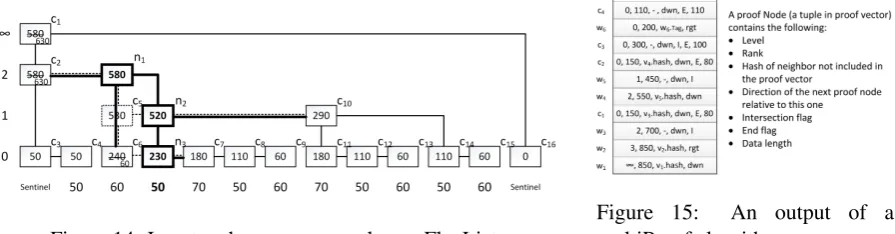
We illustrate handling multiple updates with an example. Consider a multiUpdatecalled on the FlexList of Figure 3 and a consecutive modify and insert happen to indices 50 and 110 respectively (insert level is 2). When the updates are done without hash calculations, the resulting FlexList looks like the one in Figure 14. Since the tag value of c6 has changed and a new node added between c6and
c7, all the nodes getting affected should have a hash recalculation. If we first perform the insert, we
need to calculate hashes of n3, n2, c6, n1, c2and c1. Later, when we do the modification to c6we need
to recalculate hashes of nodes c6, n1, c2 and c1. There are 6 different nodes to recalculate hashes of,
but we do 10 hash calculations. Instead, we propose performing the insert and modify operations and then calculating the necessary hash values without any wasted effort. The detailed algorithms are in the Appendix.
Figure 14: Insert and remove examples on FlexList.
Figure 15: An output of a multiProof algorithm.
5.3.2 Verifying Variable-size Multi-block Updates
consists of four parts. First,the multi proof is verifiedvia both FlexList verification and tag verification. Second, weconstruct a temporary FlexList that contains the parts necessary for the updates. Third,
wedo the updatesas they are, at the client side. The resulting temporary FlexList has the root of the
original FlexList at the server side after performing all updates correctly. Fourth and last, wecheckif
thenew rootwe calculated is the same as the one sent by the server. If they are the same, we accept and
update the meta data kept at the client.
Constructing a temporary FlexList out of a multi proof: Building a temporary FlexList is giving
the client the opportunity to use the regular FlexList methods to do the necessary changes to calculate the new root. Dummy nodesthat we use below are the nodes that have some values set and arenever
subject to recalculation.
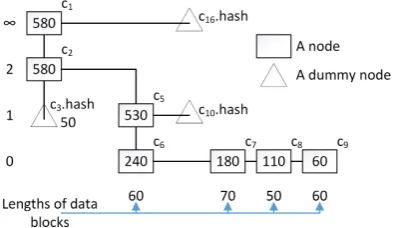
Figure 16: The temporary FlexList generated out of the proof vector in Figure 15. Note that node names are the same with Figure 3.
We explain Algorithm A.17 using the proof vector given in Figure 15. The output of the algorithm given the proof vector is the temporary FlexList in Figure 16. First, the algorithm takes the proof node for c1,
generates the root using its values and adds the dummy after, with the hash value (of c16) stored in it, and the
nodes are connected to each other depending on their attributes. The proof node for c2 is used to add node
c2 to the below of c1 and the c2’s dummy node is
connected to its below with rank value of 50, calculated as rank of c2 minus rank of c5. The next iteration sets
c5 as c2’s after and c5’s dummy node c10 is added to
c5’s after. The next step is to add c6 to the below of
c5. c6 is both an end node and an intersection node,
therefore we set its tag (from the tag vector) and its length values. Then we attach c7and calculate its length value since it is not in the proof vector generated
bygenMultiProof (but we have the necessary information: the rank of c7 and the rank of c8). Next, we
add the node for c8, and set its length value from the proof node and its tag value from the tag vector.
Last, we do the same to c9as c8. The algorithm outputs the root of the new temporary FlexList.
Verification: Recall thatU is the list of updates generated by the client. An update information
u ∈ U, includes an indexi, and if the update is an insertion or modification, a block and a tag value. The client calls verifyMultiUpdate (Algorithm A.18) with its meta data and the outputs P, T, M of
multiUpdatefrom the server. IfverifyMultiProof returns accept,buildTemporaryFlexListis called with the proof vector P. The resulting temporary FlexList is ready to handle updates. The updates are performed without the hash calculations first, and then all the necessary hashes are calculated at once. (Note that ‘without hash calculations’ doesnotmean ‘without rank calculations’. They are necessary and less time consuming.) Last, we check if the resulting hash of the root of our temporary FlexList is equal to the one sent by the server. If they are the same, we accept and update the client’s meta data.
6
Security Analysis
In this section, we prove security of FlexDPDP, and emphasize the importance of authenticating data length values. Note that within a proof vector, all nodes that are marked with the end flag E contain the length of their associated data. These values are used to check if the server indeed sent the proof of the blocks corresponding to the challenged indices. A careless implementation may not consider the authentication of the length values. To demonstrate the consequence ofnot authenticating the length values, we use Figure 12 and Figure 13 as an example.
Suppose that the client challenges the server on the indices {170, 400, 500, 690}that correspond to nodes c1, v4, c3, and c4, respectively. Assume that the server finds out that he does not possess v4
proof vector will be the one illustrated in Figure 13 with a slight change done to deceive the client. The change is done to the fourth entry from the top (the one corresponding to c2): Instead of the original
length 80, the server puts 105 as the length of c2. The verification algorithm (without authenticated
length values) at the client side will accept this fake proof as follows:
• The block sum value and the tags get verified since both are prepared using genuine tags and blocks of the actual nodes. The client cannot realize that the data of c2counted in the block sum
is not 105 bytes, but 80 bytes instead. This is because the largest challenged data (the data of c4
of length 110 in our example) hides the length of the data of c2.
• Since the proof vector contains genuine nodes (though not necessarily all the challenged ones), when the client uses verifyMultiProof algorithm on the proof vector from Figure 13, the hash check on line 32 of Algorithm A.13 will be passed.
• The client also checks that the proven nodes are the challenged ones by comparing the challenge indices with the reconstructed indices by “∀a, 0≤a≤n ,0≤Ca−Va< endnodesn−a.length”
(on line 32 of Algorithm A.13). This check will also be passed because:
– c1 is claimed to start at index 150 and contains 80 bytes, and hence includes the challenged
index 170 (verified as0<170−150<80).
– c2is claimed to start at index 300 and contains105bytes, and hence includes the challenged
index 400 (verified as0<400−300<105).
– c3is claimed to start at index 450 and contains 100 bytes, and hence includes the challenged
index 500 (verified as0<500−450<100).
– c4is claimed to start at index 640 and contains 110 bytes, and hence includes the challenged
index 690 (verified as0<690−640<110).
There are two possiblesolutions: We may either include the authenticated rank values of the right neighbors of the end nodes in the proofs, or use the length of the associated data in the hash calculation of the leaf nodes. We choose the second solution, which is authenticating the length values, since adding the neighbor node to the proof vector also adds a tag and a hash value, for each challenged node, to the communication cost.
Lemma 1. If there exists a collision resistant hash function family, FlexList is an authenticated
dictionary.
Proof. The only difference between FlexList and RBASL is the calculation of the rank values at the leaf levels. All rank values, which are used in the calculation of the start indices of the challenged nodes, are used in hash calculations as well. Therefore, bothlength andrankvalues contribute to the calculation of the hash value of the root. To deceive the client, the adversary should fake the rank or length value of at least one of the proof nodes. By Theorem 1 of [45], if the adversary sends a verifying proof vector for any node other than the challenged ones, we can break the collision resistance of the hash function, using a simple reduction. The reduction will keep a local copy of the data structure, and if the adversary manages to output a proof for something that is different from the local copy, then the reduction would output the adversary’s output together with the non-matching part in the local copy as the collision. Since previous papers on authenticated data structures provided similar proofs, we do not extend our discussion. Therefore, we conclude that FlexList protects the integrity of the tags and data lengths associated with the leaf-level nodes.
The tag verification protects the integrity of the data itself, based on the factoring assumption, as shown by DPDP [25]. Combining this with Lemma 1 concludes security of FlexDPDP.
Theorem 1. If the factoring problem is hard and a collision resistant hash function family exists, then
Proof. Consider the proof of Theorem 2 in [25]. Replacing Lemma 2 in [25] used in that proof with our Lemma 1 yields an identical challenger, and shows the validity of our theorem.
7
Performance Analysis
We developed an implementation of an optimized FlexList (on top of our optimized skip list and authenticated skip list implementations3). We then used this optimized FlexList implementation for developing FlexDPDP secure cloud storage system with multi-prove, multi-verify, and multi-update capabilities. We used C++ with the aid of theCashliblibrary [41, 15] for cryptography and the Boost Asiolibrary [13] for network programming. The local experiments were conducted on a 64-bit machine possessing 4 Intel(R) Xeon(R) CPU E5-2640 @ 2.50GHz CPU (only one core is active, except for parallel build tests), 16GB of memory and 16MB of L2 level cache, running Ubuntu 12.04 LTS. As security parameters, we used 1024-bit RSA modulus, 80-bit random numbers, and SHA-1 hash function; overall resulting in an expected security of 80-bits. All our results are the average of 10 runs. The tests include I/O access time, whereeach block of the file is kept on the hard disk drive separately, unless stated otherwise. The size of a FlexList is suitable to keep it in RAM, together with the tags but without the file blocks.
For energy efficiency tests, we used Watts up Pro meter, which measures the total energy consumption of the connected device. We conducted the tests and took their energy consumption measurements. Then, we measured the average energy cost for the idle time when no tests were taking place. The difference between these two measurements were used for the results.
In this section, our extensive analysis results of FlexList and FlexDPDP performances, deployment on the PlanetLab distributed platform, comparison with DPDP and static cloud storage on the PlanetLab are discussed.
7.1 Core FlexList Algorithm Performance
7.1.1 Unnecessary Nodes and Links Optimization
A core optimization in a FlexList is done in terms of the structure. Our optimization of removing unnecessary links and nodes results in50%fewer nodes and links on top of the leaf nodes, which are always necessary since they keep the file blocks.
1 2 3 4 5 6 7 8 9 10
x 104 0
0.2 0.4 0.6 0.8 1 1.2 1.4 1.6 1.8
2x 10 5
Number of blocks
Number of links or nodes
Optimal number of nodes Optimal number of links Standard number of nodes Standard number of links
Figure 17: The number of nodes and links used on top of leaf level nodes, before and after optimization.
Figure 17 shows the number of links and nodes used before and after optimization. The expected number of nodes in a regular skip list is2n(wherenrepresents the number of blocks): n leaf nodes and n non-leaf nodes [49]. As described in Section 3, each non-leaf node makes any left connection below its level unnecessary. Therefore, in expectation, half of the non-leaf level af ter links are unnecessary. Since there are n/2 non-leaf level unnecessary links, in expectation, this means that there are n/2 non-leaf level unnecessary nodes as well, according to the unnecessary node definition (Section 3). Hence, there are n − n/2 = n/2 non-leaf
necessary nodes. Since each necessary node has 2 links, in total there are2∗n/2 = nnecessary linksabove the leaf level. That is why there is an
3
overlap between the standard number of non-leaf nodes (n) and the optimal number of the non-leaf links (n) in Figure 17. Therefore, with this optimizationwe eliminated approximately 50%of all nodes
and linksabove the leaf level.
7.1.2 buildFlexList Performance
We presented a novel algorithm for building a FlexListefficiently. Instead of performingninsertions that would requireO(nlogn)total time, our approach only requiresO(n)time in total, assuming the underlying data is already sorted, which is the case in the cloud storage scenario. Figure 18 demonstrates the energy consumption and time ratios. The time ratio is calculated by dividing the time spent for the building the FlexList via insertion (in sorted order) by the time needed by thebuildFlexListalgorithm. The same equation is applied to the energy consumption ratio calculation. Note that even though the insertions are already in sorted order, the regular insertion algorithm cannot benefit from this fact, whereas our novel buildFlexList algorithm is the first of its kind to make us of this fact. In these energy and time ratio experiments, we do not take into account the disk access time, therefore there is no delay for I/O switching. As expected, buildFlexList algorithm logarithmically outperforms the regular insertion method. Moreover, in ourbuildFlexListalgorithm, the expensive hash calculations are performed only once for each node in the FlexList. As an example, thebuildFlexListalgorithm reduced the time to build a FlexList for afile of size 400MBwith 200000 blocksfrom 12 seconds to 2.3 seconds
and for afile of size 4GBwith 2000000 blocksfrom 128 seconds to 23 seconds.
7.1.3 Parallel buildFlexList Performance
2*10^20 2*10^3 2*10^4 2*10^5 2*10^6 0.5
1 1.5 2 2.5 3 3.5 4 4.5 5 5.5 6
Number of blocks
Ratio
Energy Ratio Time Ratio
Figure 18: Time and energy efficiency ratios of our buildFlexList algorithm against insertions.
Figure 19 shows the parallel buildFlexList
execution time as a function of the number of cores employed. The case of one core corresponds to the regularbuildFlexListfunction. From 2 cores to 24 cores, the time spent by our parallel buildFlexList function is measured. Notice the speed up where parallel build reduces the time to build a FlexList of 4 million blocks
from 240 seconds to 30 seconds on 12 cores
(including I/O time). The speedup values are reported in Figure 20 where T stands for the time taken when a single core is used, and Tpstands for
the time taken withpnumber of cores used. The more sub-tasks created, the more time is required to divide the big task into parts and to combine them. We see that a FlexList of 100000 blocks does not get improved as much, since the sub
tasks are getting smaller and the overhead of thread generation starts to surpass the gain of parallel operations. Starting from 12 cores, we observe this side effect for all sizes. For 500000 blocks (e.g., 1GB file) and larger FlexLists,speed ups of 6 and 7.7 are observed on 8 and 12 cores, respectively.
7.2 FlexDPDP Performance
7.2.1 Effect of Block Size
Figure 19: Time spent while building a FlexList from scratch.
Figure 20: Speedup values of buildFlexList function with multiple cores.
However, with extremely small block sizes, the number of nodes in the FlexList become so large that it dominates the proof generation time. Since 2KB block size worked best for various file sizes, our other tests employ 2KB blocks. These 2KBblocks are kept on the hard disk drive; on the other hand,
theFlexList nodesare much smaller andare kept in RAM. While we observed that thebuildFlexList
algorithm runs faster with bigger block sizes (since there will be fewer blocks), the creation of a FlexList happens only once. On the other hand, the proof generation algorithm runs periodically depending on the client; therefore, we chose to optimize our block size for its running time. Note that a FlexList can handle varying block sizes, yet, there is an average target block size even in a FlexList. Without such a target average size, it is possible to make a huge update efficiently once, but then later smaller updates will keep splitting that huge chunk, becoming inefficient themselves. Thus, 2KB can be interpreted as the average block size.
7.2.2 Multi-Proof Generation Performance
256 512 1024 2048 4096 8192 16384 32768 65536 131072 0
50 100 150 200 250
Block Size [Bytes]
Server Time [ms]
16 MB File 160 MB File 1600 MB File
Figure 21: Server proof generation time for 460 random challenges as a function of the block size for various file sizes.
The performance of our optimized implementation of the proof generation mechanism is evaluated in terms of communication and computation. We take into consideration the case where the client wishes to detect, with more than 99%probability, if more than 1% of her 1GB data is corrupted, by challenging 460 blocks; the same scenario employed in PDP and DPDP [4, 25]. In the experiments, we used a FlexList with 500,000 nodes, where the block size is 2KB. Figure 22 shows the ratio of the unoptimized proofs over our optimized multi-proofs in terms of
the FlexList proof size and computation, as a
function of the number of challenged nodes. The unoptimized proofs correspond to proving each
In Figure 22, the gains in a FlexDPDP proof size and computation time are also shown. With our optimizations, we observe gains of about 35% and 40% for the overall computation and
communication, respectively, corresponding to proofs being up to1.60times as fast and1.75times
as small. The whole proof consists of 213KB FlexList proof, 57KB of tags, and 2KB of block sum.
Thus, for 460 challenges as suggested by PDP [4], we obtain a decrease in totalproof size from 485KB
to 272KB, and the computation time isreduced from 19ms to 12.5msby employing ourgenMultiProof
algorithm.
Note that, we could have employed a compression algorithm (e.g., zip) on top of the unoptimized proofs to eliminate duplicates in the proof, but it does not perfectly handle the duplicates, and more importantly, our algorithm also provides efficiency gains in terms of computation (whereas computing an unoptimized proof and then compressing would require even more time at both the server and client sides). Yet, if using the bandwidth efficiently is the main goal, we suggest applying compression on top of our optimal proof.
We further tested the performance of thegenMultiProof algorithm in terms of energy efficiency. The time and energy ratios for thegenMultiProof algorithm are shown in Figure 23. We tested the algorithm for different file sizes varying from 4MB to 4GB (where the block size is 2KB, and thus the number of blocks increases with the file size). In theconstant scenario, we applied the same challenge size of 460 for all file sizes. Our results show a relative decline in the performance of thegenMultiProof as the number of blocks in the FlexList increases. Because, as the number of blocks in the FlexList grows, the number of repeated proof nodes in the proof decreases (the constant number of challenged indices are distributed further away, on average, with fewer overlapping nodes along their search paths). In the
proportionalscenario, number of challenges is determined proportional to the number of blocks in the file. 5, 46, and 460 challenges are used for 20000, 200000, and 2000000 blocks, respectively. The results show a relative incline in the performance ofgenMultiProof for the proportional number of challenges. The algorithm provides an efficiency gain in the computation time in comparison to the generating each proof individually. We also observed that the energy efficiency closely follows the computational gains.
50 100 150 200 250 300 350 400 450 0
0.5 1 1.5 2 2.5 3
Number of challenges
Ratio
Total Gain (Time) Total Gain (Size) FlexList Gain (Time) FlexList Gain (Size)
Figure 22: Performance gain graph (460 single proofs / 1 multi proof for 460 challenges).
2*10^30 2*10^4 2*10^5 2*10^6 0.25
0.5 0.75 1 1.25 1.5 1.75 2 2.25 2.5
Number of blocks
Ratio
Energy Ratio Constant Time Ratio Constant Energy Ratio Proportional Time Ratio Proportional
Figure 23: Time and energy ratios of the
genMultiProof algorithm.
7.2.3 Server-Side Multi-Update Operations
Results for the core FlexList methods (insert, remove, modify) with and without the hash calculations, for various number of blocks, are shown in Figure 24. Even with the I/O time,the operations with the
hash calculations take 10 times more than the simple operationson a 4GB file (i.e., 2000000 nodes).
The hash calculations in an update take90%of the time spent for an update operation. Therefore,doing
time and space efficiency on the verifiable update operations when the update is 20KB, and this
gain increases up to 35% with 200KB updates.
The time spent for an update at the server side for various size of updates is shown in Figure 25. Each update is an even mix ofmodify,insert, andremoveoperations. If the update locality is high, meaning the updates are on consecutive blocks (a diff operation generates several modifies to consecutive blocks followed by a series of remove if the new data is shorter than the old data, or a series of inserts otherwise), on a FlexList for a 1GB file,the server time for 300 consecutive update operations (a 600KB update)
is decreased from 53ms to 13ms.
2*10^30 2*10^4 2*10^5 2*10^6 0.025 0.05 0.075 0.1 0.125 0.15 0.175 0.2 0.225 0.25 0.275 0.3 0.325 0.35
Number of blocks
Time per operation (ms)
Modify Insert Remove Authenticated Modify Authenticated Insert Authenticated Remove
Figure 24: Time spent for an update operation in FlexList with and without hash calculations.
120 240 360 480 600
0 20 40 60
Size of the update (KB)
Time spent for an update (ms)
Multi update time (consequtive updates) Single update time (consequtive updates) Multi update time (random index updates) Single update time (random index updates)
Figure 25: Time spent on performing multi updates against series of single updates.
7.2.4 Client-Side Multi-Update Operations
120 240 360 480 600
0 20 40 60 80 100
Size of the update (KB)
Time spent for verification (ms)
Multi verify time (consequtive updates) Single verify time (consequtive updates) Multi verify time (random index updates) Single verify time (random index updates)
Figure 26: MultiVerify of an update against standard verify operations.
For the server to be able to use the multiUpdate
algorithm, the client should be able to verify multiple updates at once. Otherwise, each single update verification would require a root hash value after that specific update, and thus all hash values on the search path of the update should be re-calculated each time. Also, each update proof should include a FlexList proof alongside them. Verifying multiple updates at once not only diminishes the proof size but also provides time improvements at the client side.
Figure 26 shows that a verifyMultiUpdate
operation is faster at the client side when compared to verifying all the proofs one by one. We tested two scenarios: one is for the updates randomly distributed along the FlexList, and the other is for the updates with high locality. The