BACTERIAL FORAGING OPTIMIZATION ALGORITHM FOR NEURAL NETWORK LEARNING ENHANCEMENT
ISMAIL AHMED AL-QASEM AL-HADI
BACTERIAL FORAGING OPTIMIZATION ALGORITHM FOR NEURAL NETWORK LEARNING ENHANCEMENT
ISMAIL AHMED AL-QASEM AL-HADI
A dissertation submitted in partial fulfillment of requirements for the award of the degree of
Master of Science (Computer Science)
Faculty of Computer Science and Information Systems Universiti Teknologi Malaysia
To my beloved mother, to the spirit of my father, to my big brother Yahya , to my beloved brothers, to my beloved sisters, to my beloved wife ,
iv
ACKNOWLEDGEMENT
In the Name of Allah, Most Gracious, Most Merciful
Alhamdulillah, it is with Allah S.W.T will that finally I get to finish this dissertation. In completing this dissertation, I was contacting many people and they have contributed toward my understanding. First of all, I wish to express my sincere appreciation to my supervisor, Associate Professor Dr. Siti Zaiton Mohd Hashim for her attention and generous help throughout the length of this study. I am very thankful for her kind guidance since the first day of this study. I am also very thankful to my co-supervisor, Professor Dr. Siti Mariyam Hj Shamsuddin for her advices and motivation. Not forgotten to my evaluators, Dr. Roselina Salehuddin, Dr. Azlan Mohd Zain and Dr Erne Nazira Bazin , I am also grateful for their helpful suggestions.
A special thanks to my family members, my waif, my dearest sisters and brothers, thanks a lot for all the everlasting support, love and care along my journey of life.
ABSTRACT
vi
ABSTRAK
TABLE OF CONTENTS
CHAPTER TITLE PAGE
DECLARATION ii
DEDICATION iii
ACKNOWLEDGEMENT iv
ABSTRACT v
ABSTRAK vi
TABLE OF CONTENTS vii
LIST OF TABLES xi
LIST OF FIGURES xvii
LIST OF SYMBOLS xx
LIST OF ABBREVIATION xxi
LIST OF APPENDICES xxii
1 INTRODUCTION 1
1.1 Overview 1
1.2 Problem Background 3
1.3 Problem Statement 7
1.4 Research Aim 7
1.5 Objectives of the Research 8
1.6 Scopes of the Research 8
1.7 Contribution of Research 9
viii
2 LITERATURE REVIEW 10
2.1 Introduction 10
2.2 Artificial Neural Network 11
2.3 Genetic Algorithm 16
2.4 Particle Swarm Optimization 17 2.5 Bacterial Foraging Optimization Algorithm 20
2.5.1 Chemotaxis 21
2.5.2 Swarming 22
2.5.3 Reproduction 23
2.5.4 Elimination and Dispersal 23 2.5.5 The Similarities among BFOA, GA and PSO
Algorithms 24
2.6 Related Work 26
2.7 Summary 30
3 METHODOLOGY 31
3.1 Introduction 31
3.2 Data Preparation 32
3.2.1 Data Normalization 33
3.2.2 XOR 34
3.2.3 Balloon 34
3.2.4 Cancer 35
3.2.5 Heart 35
3.2.6 Ionosphere 36 3.3 Neural Network Architecture Definition 37
3.4 BFOANN Parameters 38
3.4.1 Chemotaxis 39
3.4.2 Swarming 40
3.4.3 Reproduction 41
3.4.4 Elimination and Dispersal 42 3.4.5 Feed-Forward Neural Network 42 3.5 BFOANN Learning Process 43
4 DESIGN AND IMPLEMENTATION 45
4.1 Introduction 45
4.2 Design of the Neural Network Architectures for
BFOANN and PSONN 46
4.2.1 Neural Network Architecture for XOR 46 4.2.2 Neural Network Architecture for Balloon 47 4.2.3 Neural Network Architecture for Cancer 48 4.2.4 Neural Network Architecture for Heart 51 4.2.5 Neural Network Architecture for Ionosphere 51 4.3 BFOA Based Neural Network 54 4.3.1 Initialization of the BFOANN 55 4.3.2 Implementation of BFOA based ANN 56
4.3.3 FeedForward Model 56
4.3.3.1 Error Calculation for Training and
Testing 57
4.3.3.2 The Calculation of Classification
Percentage for Training and Testing 59
3.3.4 Swarming Model 60
4.3.5 BFOA Model 61
4.4 Conclusion 64
5 EXPERIMENTAL RESULT 65
5.1 Introduction 65
5.2 Results on XOR Dataset 66
x
5.13 Discussion 85
5.14 Conclusion 86
6 CONCLUSION AND FUTURE WORK 87
6.1 Overview 87
6.2 Summary of Study 88
6.3 Contribution of the Study 89 6.4 Suggestion for Future Work 90
REFERENCES 91
LIST OF TABLES
TABLE NO. TITLE PAGE
1.1 A Comparison of PSO, GA, BFOA, and BP 5 2.1 The Similarities between BFOA, PSO and GA 24 2.2 Related Work on ANN Learning Enhancement 27 5.1 Results of BFOANN and PSONN on XOR dataset 66 5.2 Results of BFOANN and PSONN on Balloon dataset 68 5.3 Results of BFOANN and PSONN on Cancer dataset 70 5.4 Results of BFOANN and PSONN on Heart dataset 72 5.5 Results of BFOANN and PSONN on Ionosphere dataset 74 5.6 Validation Result of BFOANN and PSONN on XOR
Training 77
5.7 Validation Result of BFOANN and PSONN on XOR
Testing 78
5.8 Validation Result of BFOANN and PSONN on Balloon
Training 79
5.9 Validation Result of BFOANN and PSONN on Balloon
Testing 80
5.10 Validation Result of BFOANN and PSONN on Cancer
Training 81
5.11 Validation Result of BFOANN and PSONN on Cancer
Testing 81
5.12 Validation Result of BFOANN and PSONN on Heart
Training 82
5.13 Validation Result of BFOANN and PSONN on Heart
xii
5.14 Validation Result of BFOANN and PSONN on
Ionosphere Training 84
5.15 Validation Result of BFOANN and PSONN on
LIST OF FIGURES
FIGURE NO. TITLE PAGE
2.1 Artificial Neural Network Form 11
2.2 Simple architecture of ANN 12
2.3 PSONN learning process 19
2.4 Swimming, tumbling, and chemotactic behaviour of
E.coli bacteria 22
2.5 Flowchart of BFOA 24
3.1 A Framework of the study 32
3.2 BFOANN learning process 44
4.1 Neural Network Architecture for XOR 47 4.2 Neural Network Architecture for Balloon 49 4.3 Neural Network Architecture for Cancer 50 4.4 Neural Network Architecture for Heart 52 4.5 Neural Network Architecture for Ionosphere 53
4.6 The flowchart of BFOANN 54
4.7 Procedure of calculate the error of ANN 58 4.8 Procedure of calculate the classification percentage
of ANN 59
4.9 Procedure of Swarming Model 60
4.10 The flowchart of BFOA model 62
4.11 Procedure of BFOA model 63
5.1 Convergence of XOR dataset 67
xix
5.3 Convergence of Cancer dataset 71
5.4 Convergence of Heart dataset 73
5.5 Convergence of Ionosphere dataset 75 5.6 A Comparison of Classification Accuracy of
LIST OF SYMBOLS
S - Number of bacteria
P - Dimension of the search space Nc - Number of chemotactic steps Ns - Limits the length of a swim Nre - The number of reproduction steps
Ned - The number of elimination-dispersal events
xxi
LIST OF ABBREVIATIONS
ANN - Artificial Neural Network NN - Neural Network
BP - Backpropagation GA - Genetic Algorithm
PSO - Particle Swarm Optimization MLP - Multilayer Perceptron SI - Swarm Intelligence
BFOA - Bacterial Foraging Optimization Algorithm
GANN - Genetic Algorithm Backpropagation Neural Network PSONN - Particle Swarm Optimization Feedforward Neural Network BFOANN - Bacterial Foraging Optimization Algorithm Feedforward Neural Network
ELM - Extreme Learning Machine DE - Differential evolution
LIST OF APPENDICES
APPENDIX TITLE PAGE
A Normalized XOR Dataset 95
B Normalized Balloon Dataset 96
C Normalized Cancer Dataset 97
D Normalized Heart Dataset 102
1
CHAPTER 1
INTRODUCTION
1.1 Overview
The main purpose of ANN is the capacity of the network on learning from its surroundings and improves the performance of this model during the process of learning (Haza, 2006). Learning is an operation of the optimization of the neuron’s weights and biases values of ANN until a certain criterion is met. The classification of fixed input data patterns to certain outputs is the main objective of training method. There are many algorithms that are used for training a neural network such as the back propagation algorithm (BP) (Alsamdi et al., 2009), Genetic Algorithm (GA) (Khan et al., 2008) and Particle Swarm Optimization (PSO) (Haza, 2006). BP algorithm is applied to train the neural network for associative learning or supervised. Supervised learning algorithm requires direct and complete desired answers like a feedback; that mean the value of target or the planned outputs. During training, weights of the network and biases are optimized to new weights that are used to get the target value of this network. Some disadvantages of this algorithm are poor local optimal convergence and poor performance even on simple problems (Zhang and Wu, 2008).
There are Evolutionary Algorithms (EAs) that relate to learning enhancement of ANN such as Genetic Algorithm (GA) (Khan et al., 2008), Particle Swarm Optimization (PSO) (Kennedy and Eberhart, 1995a), and Artificial Fish Swarm Algorithm (Zhang et al., 2006). These algorithms are used to optimize the weights and biases of ANN to obtain the optimal performance of ANN with higher accuracy.
3
such as Adaptive Tuning of PID Controllers by BFOA for Multivariable System (Kim and Cho, 2005). This technique can also potentially produce effective solutions to very large scale problems. However, BFOA is used to solve a highly non-linear and non-convex problem which includes Optimal Power Flow solution (Tripathy et al., 2006). Based on this, BFOA is selected to be used in optimizing neural network learning.
1.2 Problem Background
Artificial Neural Network (ANN) is a resultant of a biological brain neuron that is a method to obtain patterns of data. The primary benefit of ANN is its ability to identify patterns in data, while ANN consists of interconnected nodes whose operation as a total is based on the parallel processing power of the nodes gained through their connection strengths. The main disadvantages of ANN classifier are its slow convergence, and it is often trapped at the local minima (Mashinchi, 2007).
The main goal of training ANN is to obtain a set of weights that will be optimized by an optimization algorithm. The process of training remains until an acceptable error is achieved by the best one (a particle, a chromosome, a bacterium) or computational limits are exceeded. When a process is finished, the weights are used to calculate the classification for the training patterns. The same set of weights is used to test the network by using the test patterns in order to get the test error (Al-kazemi and Mohan, 2002).
Backpropogation algorithm (BP) is the most common technique in Neural Network learning. It is used to solve many real world problems as a consequence of using the concept of Multilayer Perceptron (MLP) training and testing. The main disadvantages of BP are its relatively slow convergence rate, and it is being trapped at the local minima (Haza, 2006).
5
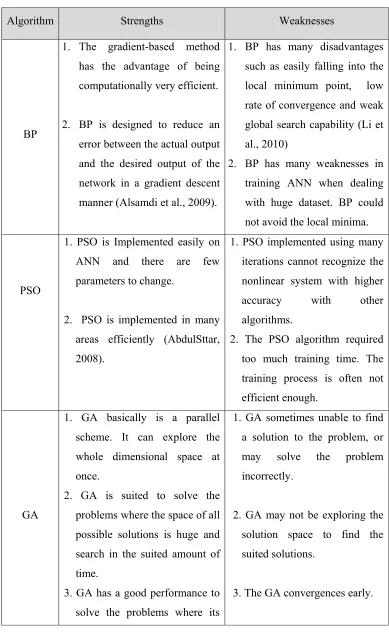
Table 1.1: A Comparison of PSO, GA, BFOA, and BP
Algorithm Strengths Weaknesses
BP
1. The gradient-based method has the advantage of being computationally very efficient.
2. BP is designed to reduce an error between the actual output and the desired output of the network in a gradient descent manner (Alsamdi et al., 2009).
1. BP has many disadvantages such as easily falling into the local minimum point, low rate of convergence and weak global search capability (Li et al., 2010)
2. BP has many weaknesses in training ANN when dealing with huge dataset. BP could not avoid the local minima.
PSO
1. PSO is Implemented easily on ANN and there are few parameters to change.
2. PSO is implemented in many areas efficiently (AbdulSttar, 2008).
1. PSO implemented using many iterations cannot recognize the nonlinear system with higher accuracy with other algorithms.
2. The PSO algorithm required too much training time. The training process is often not efficient enough.
GA
1. GA basically is a parallel scheme. It can explore the whole dimensional space at once.
2. GA is suited to solve the problems where the space of all possible solutions is huge and search in the suited amount of time.
3. GA has a good performance to solve the problems where its
1. GA sometimes unable to find a solution to the problem, or may solve the problem incorrectly.
2. GA may not be exploring the solution space to find the suited solutions.
Algorithm Strengths Weaknesses
fitness function is continuous, and it changes over time (AbdulSttar, 2008).
BFOA
1. BFOA explores the whole dimensional space of the problem, and it has strong connections between cell and cell by using the signals.
2. BFOA is easily implemented in many complex areas.
3. BFOA may be able to deal with huge data and find the best solution within a short time. 4. BFOA may be able to solve the
problem of local minima and global minima efficiently. 5. BFOA may be able to obtain
the optimum solution with high accuracy at the short time and little iteration.
1. If the number of bacteria is big then it results to more delay and complexity.
2. The reproduction phase of bacteria aims at fast convergence suitable in the static environment but it is unsuitable in the dynamic environment (Bakwad et al., 2010).
7
1.3 Problem Statement
There are many elements to be considered in Artificial Neural Network (ANN), such as the number of input, hidden and output nodes, bias, minimum error and the type of activation/transfer function. All these elements will influence the convergence of ANN learning. There are some algorithms such as PSO and GA that have been used to determine some parameters and supply the best pattern of weight in order to enhance the ANN learning.
In this study, the Swarm Intelligence technique called Bacteria Foraging Optimization Algorithm (BFOA) is applied to enhance the Feedforward Neural Network learning and evaluate the performance of BFOA on the convergence rate and the convergence speed.
The hypothesis of this research can be stated as:
How efficient is the BFOA for neural network learning enhancement compared to other optimization techniques such as PSO?
1.4 Research Aim
1.5 Objectives of the Research
In this study, there are three objectives identified:
1. To explore and implement BFOA and adapt it with neural network.
2. To propose and apply BFOA to optimize the weights and bias in neural network to enhance ANN learning.
3. To compare the results between BFOANN and PSONN in terms of convergence rate and classification accuracy percentage.
1.6 Scopes of the Research
1. The datasets used to analyze the performance of proposed method are XOR, Balloon, Cancer, Heart and Ionosphere.
9
1.7 Contribution of Research
The performance of BFOA-based neural network and PSO-based neural network is analyzed; as a result we can decide which method is better for neural network learning. This is important to identify the best technique to be used in real world application.
1.8 Organization of Report
REFERENCES
Aal-Yhia, A. H. H. and Sharieh, A. (2007). An Energy Backpropagation Algorithm. Proceedings of the World Congress on Engineering.
Abdullhamed, H. N., Shansuddin M. and Salim N. (2008). Particle Swarm Optimization for Neural Network Learning Enhancement. Jurnal Teknologi, 49(D) Dis. 2008: 13–26 © Universiti Teknologi Malaysia
AbdullSttar Ismail (2008). Differential evolution for neural networks learning enhancement. M.Sc. Thesis, University Technology of Malaysia.
Alsamdi, M. K. S., Omar, K. and Noah, S. A. (2009). Back Propagation Algorithm:The Best Algorithm Among the Multi-layer Perceptron Algorithm. University Kebangsaan Malaysia . International journal of computer science and network security.
Al-kazemi, B. and Mohan, C. K. (2002). Training feedforward neural networks using multi-phase particle swarm optimization. Syracuse University. Syracuse, NY 13244-4 100
Bakwad, K. M., Pattnaik, S. S., Sohi B. S., Devi, S., Panigrahi, B. K. and Gollapudi, S.V. (2010). Multimodal Function Optimization Using Synchronous Bacterial Foraging Optimization Technique. Electrical Engineering Department of Indian Institute of Technology, Delhi,India .IETE Journal of Research.
Beasley, D., Bull, D. and Martin, R. (1993). An Overview of Genetic Algorithms: Part1, Fundamentals. University Computing.
Bergh, V. (1999). Particle Swarm Weight Initialization In Multi-Layer Perceptron Artificial Neural Networks. Accepted for ICAI. Durban, South Africa.
92
Training. Commanding Communications Academy, Wuhan 430010, P.R. China.
Chen, H., Zhu, Y. and Hu, K. (2009). Cooperative Bacterial Foraging Optimization. Discrete Dynamics in Nature and Society, 2009 - emis.ams.org
Cho, J. H., Chun, M. G., Lee, D. J. (2007). Parameter Optimization of Extreme Learning Machine Using Bacterial Foraging Algorithm. EESRI(R-2-046), MOCIE(Ministry Of Commerce Industry and Energy.
Dang J., Brabazon A., O'Neill M. and Edelman D. (2008), Estimation of an EGARCH Volatility Option Pricing Model using a Bacteria Foraging Optimization Algorithm. Springer.
Er, M. J. and Liu, F. (2009). Genetic Algorithms for MLP Neural Network Parameters Optimization. School of Electrical and Electronic Engineering, Nanyang Technological University. Singapore 639798 , IEEE.
Fang, Y., Liu, Y., Liu, J. (2007). ANovel Simplified Foraging Optimization Algorithm for Parameter Identification of Nonlinear System Model. Proceedings of the IEEE
Freeman, J. A. (1994). Simulating Neural Networks with Mathematica. Loral Space Information Systems and University of Houston-Clear Lake. Book page 69. Fu, L. M. (1994). Neural Networks in Computer Intelligence. McGraw Hill,
NewYork. Book.
Goldberg, David E. 1989. Genetic Algorithms in Search, Optimization, and Machine Learning. Reading, MA: Addison-Wesley.
Gudise, V. G. and Venayagamoorthy, G. K.(2003). Comparison of Particle Swarm Optimization and Backpropagation as Training Algorithms for Neural Networks. University of Missouri-Rolla, USA. 0-7803-7914-4/03610. IEEE Guney, K. and Basbug, S. (2008). Interference suppression of linear antenna arrays
by amplitude-only control using a bacterial foraging algorithm. Progress In Electromagnetics Research, PIER 79, 475–497
Haque, M. T., and Kashtiban, A.M. (2005), Application of Neural Networks in Power Systems; A Review, World Academy of Science, Engineering and Technology 6
Haza Nuzly (2006). Particle swarm optimization for neural network learning enhancement. M.Sc. Thesis, University Technology of Malaysia.
Holland, John H. 1975. Adaptation in Natural and Artificial Systems. Ann Arbor, MI: University of Michigan Press. Second Edition available as Cambridge, MA: The MIT Press 1992.
Ileană I., Rotar C. and Incze A. (2004). The optimization of feed forward neural networks structure using genetic algorithms. ICTAMI, Thessaloniki, Greece Ileană I., Rotar C. and Incze A. (2004). The optimization of feed forward neural
networks structure using genetic algorithms. ICTAMI, Thessaloniki, Greece Johnson, C., Venayagamoorthy, G. K. and Palangpour, P. (2008). Hardware
Implementations of Swarming Intelligence – A Survey. IEEE Swarm Intelligence Symposium St. Louis MO USA, September 21-23.
Kennedy, J. and Eberhart R.(1995a). Particle Swarm Optimization. Produce School of Engineering and Technology Indianapolis, IN 46202-5160
Kennedy, J., Eberhart, R.C. (1995b). Particle Swarm Optimization. IEEE International Conference on Neural Networks (Perth, Australia), IEEE Service Center, Piscataway, NJ, pg. IV, pp. 1942–1948
Khan, A.U., Bandopadhyaya T.K. and Sharma S. (2008). Genetic Algorithm Based Backpropagation Neural Network Performs better than Backpropagation Neural Network in Stock Rates Prediction. IJCSNS International Journal of Computer Science and Network Security, VOL.8 No.7
Kim D.H. and Cho J.H. (2005). Adaptive Tuning of PID Controller for Multivariable System Using Bacterial Foraging Based Optimization. Hanbat National University, 16-1 San Duckmyong-Dong Yuseong-Gu, Daejeon City, Korea 305-719. Springer.
Kim D.H. and Abraham A. (2007), A Hybrid Genetic Algorithm and Bacterial Foraging Approach for Global Optimization and Robust Tuning of PID Controller with Disturbance Rejection, Studies in Computational Intelligence, Springer.
94
Long, L. N. and Gupta, A. (2005). Scalable Massively Parallel Artificial Neural Networks. American Institute of Aeronautics and Astronautics, InfoTech@Aerospace Conference.
Mashinchi, M. H. (2007). A new fuzzy back-propagation learning method based on derivation of min-max function tuned with genetic algorithms. M.Sc. Thesis. Universiti Teknologi Malaysia.
Massimo Carota (2007). Neural network approach to Problems of Static/Dynamic Classification. Ph. D. Thesis, UNIVERSITY OF ROME ,TOR VERGATA Methaprayoon K., Lee W. J., Rasmiddatta S., Liao J. R. and Ross R. J. (2007).
Multistage Artificial Neural Network Short-Term Load Forecasting Engine With Front-End Weather Forecast. IEEE TRANSACTIONS ON INDUSTRY APPLICATIONS, VOL. 43, NO. 6
Mishra, S. and Bhende, C. N. (2007). Bacterial Foraging Technique-Based Optimized Active Power Filter for Load Compensation. IEEE TRANSACTIONS ON POWER DELIVERY, VOL. 22, NO. 1
Mohamad Firdaus (2007). Enhancement of Elman Recurrent Network Learning with Particle Swarm Optimization. M.Sc. Thesis, Universiti Teknologi Malaysia. Montana, D. J. and Davis, L. (1989), Training Feedforward Neural Networks Using
Genetic Algorithms , Citeseer, Cambridge , MA 02138.
Passino, M. K. (2002). Biomimicry of bacterial foraging for distributed optimization and control. Control Systems Magazine, IEEE . The Ohio State University, 2015 Neil Avenue,Columbus, OH 43210-1272, U.S.A.
Passino, K. M. (2010). Bacterial Foraging optimization. The Ohio State University, USA. International Journal of Swarm Intelligence Research, 1(1), 1-16
Premalatha, K. and Natarajan, A. M. (2009). Hybrid PSO and GA for Global Maximization. Bannari Amman Institute of Technology, Erode, India. Int. J. Open Problems Compt. Math., Vol. 2, No. ISSN 1998-6262; Copyright © ICSRS Publication.
Shen H., Zhu Y, Zhou X., Guo H. and Chang C.(2009). Bacterial foraging optimization algorithm with particle swarm optimization strategy for global numerical optimization. GEC’09, June 12–14, 2009, Shanghai, China.Copyright 2009 ACM 978-1-60558-326-6/09/06
Snasel, V., Platos J., Kromer P., and Ouddane N. (2009). Genetic Algorithms for the Use in Combinatorial Problems . Springer.
Sumanbabu B., Mishra S.,Panigrahi B.K., and Venayagamoorthy G.K. (2007). Robust Tuning of Modern Power System Stabilizers Using Bacterial Foraging Algorithm. 1-4244-1340-0/07$25.00 c_2007 IEEE
Sultan Noman (2008), Learning Enhancement of Radial Basis Function Network with Particle Swarm Optimization. M.Sc. Thesis, Universiti Teknologi Malaysia.
Tripathy, M., Mishra, S., Lai, L. L. and Zhang, Q. P. (2006). Transmission Loss Reduction Based on FACTS and Bacteria Foraging Algorithm, Indian Institute of Technology, Delhi, India 2 Energy Systems Group, City University, London EC1V 0HB, United Kingdom
Tripathy, M. and Mishra, S. (2007). Bacteria Foraging-Based Solution to Optimize Both Real Power Loss and Voltaage Stability Limit. IEEE TRANSACTIONS ON POWER SYSTEM, VOL. 22.NO 1.
Vemuri, V. (1993). Artificial neural networks in control applications. Advances in computers.
Weiyu Yi (2005). Artificial Neural Networks.339229
Yao, X. (1993). A review of evolutionary artificial neural networks. International Journal of Intelligent Systems. 4: 203--222.
Zhang, G. P. (2000). Neural Networks for Classification: A Survey. IEEE, University, Atlanta, GA 30303 USA (e-mail: [email protected]). S 1094-6977(00)11206-4.
96