Transcribing with Annotation Graphs
Edouard Geoffrois
1, Claude Barras
2, Steven Bird
3, and Zhibiao Wu
31
DGA/CTA/GIP 2
Spoken Language Processing Group 3
LDC
16 bis av. Prieur de la Cˆote d’Or, LIMSI-CNRS, BP 133, 3615 Market Street, Suite 200,
94114 Arcueil cedex, France 91403 Orsay cedex, France Philadelphia, PA, 19104-2608, USA
[email protected] [email protected] fsb,[email protected]
Abstract
Transcriber is a tool for manual annotation of large speech files. It was originally designed for the broadcast news transcription task. The annotation file format was derived from previous formats used for this task, and many related features were hard-coded. In this paper we present a generalization of the tool based on the annotation graph formalism, and on a more modular design. This will allow us to address new tasks, while retaining Transcriber’s simple, crisp user-interface which is critical for user acceptance.
1.
Introduction
The development and refinement of speech recognition systems requires a large amount of transcribed speech data. Production of these corpora is a highly time-consuming task and requires specialized software tools. In order to support a project involving the automatic transcription and indexing of multilingual broadcast news, DGA developed “Transcriber”, a tool for manually segmenting, labeling and transcribing speech signals having extended duration (up to several hours). The first release of the tool was presented at the LREC conference in 1998 (Barras et al., 1998). In or-der to encourage the production of speech corpora and ease their sharing, it was decided to distribute the tool as free software1.
Since then, Transcriber has been extended and refined,
taking into account user feedback. New features were
added, and great care was taken to retain a user-friendly interface and interactive management of long duration sig-nals. Transcriber has been used for the production of over 100 hours of transcribed radio programs and television soundtracks in several languages, and has thus proven suit-able for large-scale production of transcribed corpora (Bar-ras et al., 2000).
However, Transcriber was geared towards a single ap-plication: the broadcast news transcription task. The in-ternal data structure was derived from the format which is most commonly used for broadcast news transcription (.typ, UTF). This data format prevented the implementa-tion of various minor yet desirable features. For example, markers which are used to indicate the beginning and the end of some annotations (e.g., to delimit a stretch of words in another language) are not logically associated, and can-not be manipulated as a single unit.
Furthermore, many features related to the format and to the application were hard-coded. Even though gener-ality was a concern, the Transcriber development effort has concentrated on efficiency for broadcast news transcription, and the interface was designed around this specific task. As a result, if the data representation needs to be changed, code has to be written again.
1http://www.etca.fr/CTA/gip/Projets/
Transcriber/
Nevertheless, there has been a demand for generaliz-ing the tool so that it can display and edit a wider range of annotation types. One example is the CHAT format used within the CHILDES research group on language acqui-sition (MacWhinney, 1995). Other extensions are needed for annotating completely new kinds of data, like multi-channel audio or video. Gracefully handling such a wider variety of formats and functions requires a more general data model.
This need for a broader coverage of annotation types is not unique to Transcriber. Many other annotation projects face the same issues. In response to this, a new general-purpose data model for linguistic annotations, called the “annotation graph” (AG), has been proposed (Bird and Liberman, 1999). In contrast with some other models, an-notation graphs are conceptually very simple, and have ex-tremely broad applicability. Recently, DGA decided to mi-grate Transcriber to the annotation graph model, and to col-laborate with LDC on the design and implementation of a new modular architecture. This paper reports these devel-opments.
2.
Transcriber features
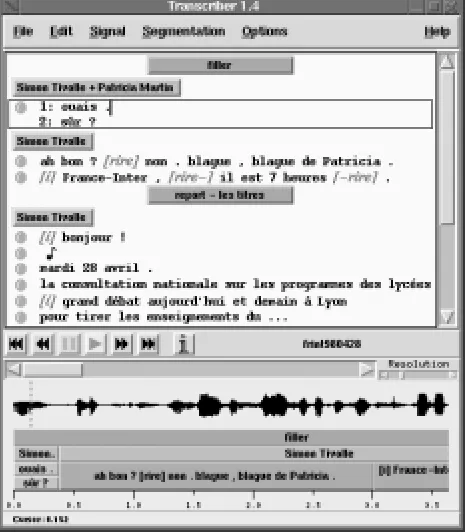
Transcriber is described more extensively in other ar-ticles (Barras et al., 1998; Barras et al., 2000) and in its reference manual (available on the web site and in the tool itself in the online help). This section provides a summary of the main features, illustrating the starting point for our migration to an AG-based Transcriber.
Figure 1: Screenshot of Transcriber user-interface.
3.
Using annotation graphs
The annotation graph model provides a general-purpose abstraction layer between physical annotation formats and graphical user interfaces. As a consequence, the connec-tions between this logical model and various physical and graphical representations can be fully modularized. New annotation formats and new user-interfaces to an annotation task can thus be implemented as pluggable components.
The annotation graph data model is composed of two low-level structures – nodes and arcs – and two high-level structures – graphs and subgraphs. A graph object is a col-lection of zero or more arcs, each specifying an identifier, a type, and some content consisting of domain-specific at-tributes and values. An arc also references a start and end node, and each node provides an optional temporal offset. This temporal offset may be qualified with a “timeline”, which is a symbolic name for a collection of signal files which are temporally co-extensive and whose times can be meaningfully compared. Node and arc identifiers may also be qualified with a user-specific namespace, to avoid collisions when multiple independent annotations are com-bined.
A recent collaboration between NIST, LDC and MITRE has produced an applications programming interface to an-notation graphs, and implementations in Java and C++ are in development. A prototype in Perl/tk has also been
pro-duced and is available online2. An even more general
model has been proposed recently3(Bird et al., 2000b). A
query language is also being developed (Bird et al., 2000a).
2http://www.ldc.upenn.edu/annotation/AG/
prototype/
3http://www.nist.gov/speech/atlas/
3.1. Interpreting Transcriber features in terms of annotation graphs
Transcriber can be generalized by incorporating anno-tation graphs as the internal data model. Many aspects of this process are quite natural and obvious. It is interesting to note that the duality of the Transcriber interface closely resembles the duality of the graph structure: the text pane represents a node-based view where one can edit the con-tent of the arcs, while its signal pane represents an arc-based view where one can modify the time of the anchored nodes. The display of the transcription in the text editor and of the segmentation under the signal can be expressed as general transformations of the annotation graphs. Note that the constraint that all arcs of a given type (orthographic transcription with markers, speaker turns or sections) are a partition of the recording has to be imposed by the inter-face, not by the data structure.
In order to prepare for the transition to AG, Transcriber features were systematically enumerated and classified ac-cording to how the transition to annotation graphs affects them.
Some features are completely independent of the anno-tation format. These incude signal management (scrolling and zooming, selecting a portion of signal, moving the cur-sor to a given position, continuous playback), interface dis-play options (fonts, colors, toggling second signal view or button bar display), and other general options (choice of language, defaults, shortcuts). There are also features which, though they interact with the AG structure, should remain outside of it. This is the case of speaker and topic databases, which were already clearly separated in the orig-inal format.
Other features depend on the annotation format, and
must be re-implemented. Some have a natural
imple-mentation in the new representation. For example, mov-ing a boundary naturally applies to a timed node; Events are linked with the orthographic transcription using shared nodes; Selecting a segment (or several) applies to the corre-sponding arcs; The consistency between cursors in the text editor and in the signal waveform can be easily checked, since the bounding time interval is defined for any arc (Bird et al., 2000a); Simultaneous speech from two speakers can be represented in various ways, and the original implemen-tation where words are labelled as associated to one of the two speakers can be seen as a particular case of the equiv-alence class mechanism of the AG; The information asso-ciated to an episode (recording date and source, primary language...), originally stored separately, can be associated to an arc spanning the whole recording.
In some cases, this natural generalization requires cer-tain types of arc to be distinguished. Indeed, some features apply to text only (spell checking, glossary, finding a word), some features apply to text and events (cut/copy/paste as in the current implementation). some to segments corre-sponding to text and event arcs (highlight segment, go to next/previous segment, pause at segment boundary during playback, insert/delete breakpoint), and some others to turn or topic arcs (next/previous turn/topic, find speaker/topic).
com-cessing the whole graph, and untouched segments should be kept. For this, the trace of the AG modifications since the last segmental display update is used. For each created arc, its membership of any existing tier must be checked; in the most general case, a user-defined boolean callback function performs the test. The character string displayed in the segment box is often the concatenation of some at-tribute value for the segment arcs. But in some cases the string cannot be deduced trivially from the attribute values (e.g., for displaying the name of a speaker instead of its id) and a user-defined callback function, if defined, will be used. Note that the display of the character string in the segment may be truncated, depending on the width of the segment on the screen at the current resolution. The seg-ment color follows the same scheme, with a default color for each tier and a user-defined function for the actual color of the segment.
3.2.5. Management of the text editor
In the text editor, one should be able to see and modify the content of the arcs. A strict ordering of the arcs needs to be defined, so that each arc can sequentially displayed in the text pane. The natural arc order is driven by node order, but a hierarchy of arc types has to be given when several arcs share the same node. Also, unanchored nodes require decisions which may depend on the application.
It will be possible to display only a subset of the graph (e.g., only sections and turns without the transcription, or only the transcription for a specific speaker or a specific channel). Display of the arc content is application spe-cific; depending on the kind of arc, it may be icons, buttons, text... Edition of the arc can be done directly in the text edi-tor, or in a pop-up menu or window when clicking on some part of the display. All this will be controlled in the stan-dard Tk text widget by user-defined callbacks. When using a generic XML editor instead (as discussed in 4.4.), the dis-play will be rather controlled by stylesheets, as defined by CSS and XSL standards.
Most often, the modifications in the text editor will be simply propagated to the graph. The opposite case (update of the text editor according to possibly external modifica-tions of the graph) is more complex and will involve spe-cific optimizations similar to the ones described in 3.2.4..
4.
Modular design
Previous discussions about Transcriber and AG demon-strated the need to have a modular, flexible design for scriber. We propose a new modular architecture for scriber. This architecture will allow us to separate Tran-scriber into several independent components. It will then be possible for developers to reuse those components or re-place one of them without the need to change other compo-nents.
4.1. Design goals
We have the following design goals in mind.
Object oriented design: The system needs to be
struc-tured into several components based on its major func-tionalities. Each component should be self-sufficient
in fulfilling its functionality. In doing so, the compo-nents will be maximally reusable.
Simple interfaces between components: The interface among components should be simple and clear. The interface should be abstract enough so that it won’t be wedded to any specific annotation task.
Easy integration with external software modules:
Given that many annotation tools exist already, it is important that our system is able to communicate with them, so that not only the file formats can be interchanged, but also the functional components can be interchanged to a certain degree.
Using XML as the interchange bridge: In order to make
configuration easy, we will use XML as the bridge to do the communication among components, as well as file format interchange. We will also explore ways to use XML to define a graphical interface so that the GUI is configurable at run time.
4.2. Architecture overview
The system is designed based on the ”Component” con-cept as used in Java Beans and Microsoft COM objects. A component is an object which fulfills a certain task, and provides interfaces so that other components can commu-nicate with it or control its behavior. The data is passed around different components through XML. The format of the data has to conform with a DTD for inter-component messages, which all components must agree on. Currently, the system is divided into three highly abstracted compo-nents. One is the Transcriber engine. This component will take care of internal data representation, management of other components, time alignment and coordinate commu-nications among them. The second one is the Transcription component. It will display and accept editing commands on the transcription. The third component is the media com-ponent. It will take care of media operations such as media file open and close, play or stop playing, etc.
A complete running system will have one Transcriber engine, but may have more than one instance of transcrip-tion components and media components. In this way, a video player and an audio player can be run at the same time. Also the same transcription can be displayed in differ-ent transcription compondiffer-ent instances for the convenience of editing and viewing.
4.3. The Transcriber Engine
a region of signal is selected, the engine will calculate the correct size and position for all transcription instances and issue an alignment command to each of them.
4.4. The transcription component
This component presents the transcript to the user. The annotation contents are defined with an XML DTD. Based on this DTD, the transcription component should be able to configure the GUI when the DTD is changed. When focus is changed in another component, this component should be able to change its focus too. As long as a component supports the Transcriber interface, the transcription com-ponent can actually be in quite different forms. The same transcription can be displayed in different views depending on the task, or the domain, or the user. Some components can be a text editor, some can be a horizontal viewer, or a generic XML editor. Transcriber developers can either build a component from scratch or write wrappers around existing editors such as Emacs or Tk Text Widget to support Transcriber interface.
4.5. The media component
This component takes care of the media files. It will be responsible for opening and closing files, displaying me-dia, playing audio or video in a certain region or speed, and changing resolution and other parameters. It will respond to requests from the Transcriber engine to do certain tasks such as align the display to the focus point, show the cur-rent focus, play the curcur-rent region, zoom in, zoom out the display, etc.
5.
Conclusion
We have presented the current developments around the Transcriber speech annotation tool. They are based on the annotation graph model and on a highly modular design. The main challenge is to generalize the tool while keep-ing backward compatibility and without degradkeep-ing its effi-ciency. Transcriber’s simple, crisp user-interface has been a critical component of its success, and we are careful to retain this property.
Using the annotation graph formalism allows many hard-coded functions to be replaced by instances of a more general, parameterized mechanism. The user-interface can be more easily customized to handle new annotation tasks, and the underlying generic data model simplifies the inter-operability with other tools. The resulting annotation tool will be extremely flexible and general, and will be openly distributed to the community.
6.
References
Claude Barras, Edouard Geoffrois, Zibiao Wu, and Mark
Liberman. 1998. Transcriber: a free tool for
seg-menting, labeling and transcribing speech. In Interna-tional Conference on Language Resources and Evalua-tion (LREC), pages 1373–1376.
Claude Barras, Edouard Geoffrois, Zibiao Wu, and Mark Liberman. 2000. Transcriber: development and use of a tool for assisting speech corpora production. Speech Communication. to appear.
Steven Bird and Mark Liberman. 1999. A
for-mal framework for linguistic annotation.
Techni-cal Report MS-CIS-99-01, Department of Computer and Information Science, University of Pennsylvania. [xxx.lanl.gov/abs/cs.CL/9903003], expanded from ver-sion presented at ICSLP-98, Sydney, revised verver-sion to appear in Speech Communication.
Steven Bird, Peter Buneman, and Wang-Chiew Tan. 2000a. Towards a query language for annotation graphs. In Pro-ceedings of the Second International Conference on Lan-guage Resources and Evaluation.
Steven Bird, David Day, John Garofolo, John Henderson, Chris Laprun, and Mark Liberman. 2000b. Atlas: A flexible and extensible architecture for linguistic anno-tation. In Proceedings of the Second International Con-ference on Language Resources and Evaluation. Brian MacWhinney. 1995. The CHILDES Project: Tools