Towards A Query Language for Annotation Graphs
Steven Bird
, Peter Buneman
yand Wang-Chiew Tan
y
Linguistic Data Consortium, University of Pennsylvania, 3615 Market Street, Philadelphia, PA 19104, USA y
Department of Computer Science, University of Pennsylvania, 200 South 33rd Street, Philadelphia, PA 19104, USA
Abstract
The multidimensional, heterogeneous, and temporal nature of speech databases raises interesting challenges for representation and query. Recently, annotation graphs have been proposed as a general-purpose representational framework for speech databases. Typical queries on annotation graphs require path expressions similar to those used in semistructured query languages. However, the underlying model is rather different from the customary graph models for semistructured data: the graph is acyclic and unrooted, and both temporal and inclusion relationships are important. We develop a query language and describe optimization techniques for an underlying relational representation.
1.
Introduction
In recent years, annotated speech databases have grown tremendously in size and complexity. In order to main-tain or access the data, one invariably has to write special purpose programs. With the introduction of a general pur-pose data model, the annotation graph (Bird and Liberman, 1999), it is possible to abstract away from idiosyncrasies of physical format. However, this does not magically solve the maintenance and access problems. In this paper, we contend that some form of query language is essential for annotation graphs, and we report our research on such a language.
Query languages for databases have two, sometimes conflicting, purposes. First they should express – as natu-rally as possible – a large number of data extraction and re-structuring tasks. Second, they should be optimizable. This means that they should be based on a few efficiently im-plemented primitives; they should also make it easy to dis-cover optimization strategies that may involve query rewrit-ing, execution planning and indexing. The relational alge-bra and its practical embodiment, SQL, are examples of such languages, however they are unsuitable for annota-tion graphs first because it is difficult (or impossible – de-pending on the version of SQL) to express many practical queries, and second because the optimizations that are nec-essary for annotation graph queries are not in the repertoire of standard relational query optimizations.
The recent development of query languages for semistructured data (Buneman et al., 1996; Quass et al., 1995; Deutsch et al., 1998) offer more natural forms of expression for annotation graphs. In particular, these languages support regular path patterns – regular expressions on the labels in the graph – to control the matching of variables in the query to vertices or edges in the graph. While regular path patterns are useful, the usual model of semistructured data, that of a labeled tree, is not appropriate for annotation graphs. In particular, it fails to capture the quasi-linear structure of these graphs, which is essential in query optimization.
After reviewing some existing languages for linguistic annotations, we present the annotation graph model, its re-lational representation, and some rere-lational queries on an-notation graphs. Then we develop a new query language for
annotation graphs that allows complex pattern matching. It is loosely based on semistructured query languages, but the syntax simplifies the problem of finding regions of the data that bound the search. Finally, we describe an optimization method that exploits the quasi-linear structure of annotation graphs.
2.
Query Languages for Annotated Speech
If linguistic annotations could be modeled as simple hi-erarchies, then existing query languages for structured text would apply (Clarke et al., 1995; Sacks-Davis et al., 1997). However, it is possible to have independent annotations of the same signal (speech or text) which chunk the data dif-ferently. As a simple example, the division of a text into sentences is usually incommensurable with its division into lines. Such structures cannot be represented using nested, balanced tags.
The fundamental problem faced by any general purpose query language for linguistic annotations is the navigation of these multiple intersecting hierarchies. In this section we consider two query languages which address this issue.
2.1. The Emu query language
The Emu speech database system [www.shlrc.mq. edu.au/emu] (Cassidy and Harrington, 1996; Cassidy and Harrington, 1999) provides tools for creation and analysis of data from annotated speech databases. Emu annotations are arranged into levels (e.g. phoneme, syllable, word), and levels are organized into hierarchies. Emu supports mul-tiple independent hierarchies, such that any specific level may participate in more than one orthogonal structure. An example is shown in Figure 1 (Cassidy and Bird, 2000).
A database of such annotations can be searched using the Emu query language. The language has primitives for sequence, hierarchy and “association”, as illustrated below.
[Phonetic=a|e|i|o|u] – matches a disjunction of items on the phonetic level
[Phonetic=vowel -> Phonetic=stop] – matches a sequence ofvowelfollowed immediately bystop.
ovlp(A, B) :- arc(A, X1, Y1, _), arc(B, X2, Y2, _), time(X1, X1t), time(X2, X2t), time(Y1, Y1t), time(Y2, Y2t), X1t Y2t, Y1t X2t
Now we can provide translations for the three queries listed above.
1. Find word arcs whose phonetic transcription contains a ’d’ and ends with a ’k’. We assume a relation path/3 which is the transitive closure of arc/4.
ans(A) :- arc(A, X, Y, word), path(X, X1, phonetic),
arc(A1, X1, X2, phonetic), label(A1, d), path(X2, X3, p),
arc(A2, X3, Y, phonetic), label(A2, k)
2. Find phonetic arcs which immediately precede a vowel that overlaps a high tone:
ans(A) :- arc(A, X, Y, phonetic),
arc(A1, Y, Y1, phonetic), label(A1, [aeiou]), arc(A2, Z, Z1, tone), label(A2, h*)
ovlp(A1, A2)
3. Find words dominating a vowel which overlaps a high tone:
ans(A) :- arc(A, _, _, word),
arc(A1, _, _, phonetic), label(A1, [aeiou]), arc(A2, _, _, tone), label(A2, h*),
s_incl(A, A1), ovlp(A1, A2)
While it is possible to give queries a first-order inter-pretation, the language is quite cumbersome, and we seek a more natural way to describe annotation graphs.
5.
Query Syntax
In this section we introduce a query syntax which pro-vides first an abbreviated notation for the queries expressed previously in datalog. Most importantly, the syntax allows us to recognize certain crucial optimizations.
5.1. Queries over arc data
The fundamental unit on which our query language is built is the arc. We form the join of the arc and label relations from Figure 5 and adopt names for our attributes. A query that finds the arc identifiers, types and labels of all edges in timelinetl1is shown below:
select ans(E,T,L)
where [id: E, type: T, label: L] <- tl1
We follow the datalog convention of using uppercase symbols for variables and lowercase symbols for constants. The notation [id: E, type: T, label: L] is used for arcs and describes a arc pattern: it is matched against the arcs in the timelinetl1and binds the variables
E,T,L for each match to the arc data in the timeline. For each such match it constructs a tuple ans(E,T,L)
in the output. Arc patterns may contain constants, e.g.
[id: E, type: word, label: L]and there is no constraint on their width. In this sense they are ”ragged” or ”semistructured” tuples.
[id: E, start: X, end: Y, type: T, name: N, xref: X, lex-id: L, annotator: SB]
Since attributes are distinguished by name rather than position, it is safe (and often convenient) to omit them when we do not need to constrain their value, or bind a variable.
To query over a collection of timelinestimit we use cascaded bindings:
select ans(E,L) where TL <- timit
[id: E, start: X, end: Y, label: L, type: word] <-TL time(Y) - time(X) < 8000
This selects the edge identifiers and labels (the names of the words) from all words in the timit corpus of a suitably short duration.
The form of this query follows a standard syntax for semistructured query languages (see (Abiteboul et al., 2000)). We shall concentrate here on the development of a syntax for patterns that specify paths and assume a standard syntax, e.g. select ans(E,L), for returning results of the query.
5.2. Path patterns
Each arc has a start and end node. We can specify two adjacent arcs by requiring the start node of one arc to be the end node of another
[id: E1, start: X, end: Y, type: T1, label: L1] <- db [id: E2, start: Y, end: Z, type: T2, label: L2] <- db
In this fashion we can specify any sequence of arcs. However we shall use an abbreviated syntax[ ... ].[ ... ] to specify the concatenation of edges, that is, the dot is an associative pattern concatenation operation. Thus the previous pair of patterns binds the same variables as the following single pattern
[id: E1, start: X, end: Y, type: T1, label: L1] . [id: E2, end: Z, type: T2, label: L2] <- db
Within edge patterns we also allow arbitrary predicates. For example: [type: T, T = word or T = ph],
[start: X, stop: Y, time(Y) - time(X) > 200]. Predicates may also use attribute names as values. For example, [type: word], [type: X, X = word],[type=word]are equivalent.
A sequence of arcs (phonemes, syllables, phrases, etc) is represented in our model using a concatenated sequence of arc patterns. To specify path patterns of arbitrary length we also allow arbitrary regular expressions on arcs. An arbitrary path of word arcs is represented by [type = word]*and an arbitrary path of word or phoneme arcs by
([type = word]|[type = phoneme])*. Care must be taken in interpreting variables inside a Kleene * or a union. The rule is that such variables must be bound elsewhere in the program. We cannot bind variables inside a union or Kleene *. Thus[type: T]*is illegal.
b
a
c
d
v
z
y
x
w
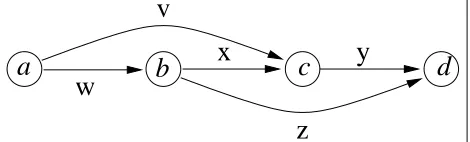
Figure 8: An Annotation Graph whose Description Re-quires Variables
denote nodes. For example,X.[type: T].Yis equiva-lent to[start: X, type: T, end: Y]. Moreover,
X.[type: word]*.YbindsXto the first node andYto the last node on a path of word arcs. Now consider the following example:
X.[type = parse, label = sentence].Y <- db (a) X.[type = word]*.[type = word, label = opera]
.[type = word]*.Y <- db
This matches the start and end node of any sequence that contains the word opera. Another possibility is shown below.
X.[type = parse, label = sentence].Y <- db (b) X’.[type = word, label = opera].Y’ <- db
time(X) <= time(X’) and time(Y’) <= time(Y)
However, (a) and (b) are not equivalent queries.
One might think, from example (a) above, that one could dispense with node variables by having a parallel composition operator. It turns out that there are many sit-uations where this is impossible. The simplest instance is shown in Figure 8.
The annotation graph in Figure 8 cannot be uniquely described using parallel and serial composition. Instead, we need a set of expressions as follows:
A.[label: W].B.[label: X].C.[label: Y].D <- db A.[label: V].C <- db
B.[label: Z].D <- db
5.3. Arbitrary predicates on arcs
The bracket notation for describing arcs can also en-close arbitrary predicates. Predicates expressing the (tem-poral) overlap or inclusion of edges are particularly useful. Example (b) above may be expressed as.
[id: E, type = parse, label = sentence] <- db [type = word, label = opera, subinterval(E)] <- db
Note that subinterval(E) can be thought of as a “method” of the edge, that is called when the pattern is matched.
5.4. Abbreviations
The preceding syntax is quite general; it has little to do with the specific conventions of linguistic data. Paths typically, though not always, follow the same type. Labels are also special. We propose the following syntactic sugar. (The proposal is tentative, all sorts of variations are possi-ble).
Given a database of arcs db, the notation db/t re-stricts the database to those arcs of type
t
. Also the no-tation :L is an abbreviation for label: l. For exam-ple,X.[:L].Y <- db/wordis shorthand forX.[label:b
a d e f
g h
i
j k
c
5 6
3 2
1 4
Figure 9: A precedence graph
L, type: word].Y <- db. Using this, example (a) becomes:
X.[:sentence].Y <- db/parse (a’) X.[]*.[:opera].[]*.Y <- db/word
5.5. Horizontal path expressions
Find words withc.*t.*(our first query)
X.[].Y <- db/word
X.[:c].[]*.[:t].[]*.Y <- db/ph
Here’s a harder case, with a variable inside the scope of a Kleene star. The predicate ovlp(E)is an “overlap” predicate.
X.[].Y <- db/word [id: E] <- db/background
X.[:c].[ovlp(E)]*.[:t].[]*.Y <- DB/ph
In this section we have paid little attention to the output of a query. From the introductory examples, it should be clear that it is straightforward to construct a set of tuples in the same sense that datalog constructs a set of tuples. It is also possible to extend the syntax to express the construc-tion and augmentaconstruc-tion of annotaconstruc-tion graphs. The details will be described elsewhere
6.
Optimization: exploiting quasi-linearity
In the previous sections we developed a query language for annotation graph data and showed how an analysis of that language might help - in many practical cases – to lead to tractable implementations. Here we show how we can exploit the “almost sequential” notion of annotation graph data to support these implementations. In particular, we will show how to use the underlying temporal order to se-lect a small fragment of the input data that will fit into main memory, bypassing many of the database optimization is-sues.
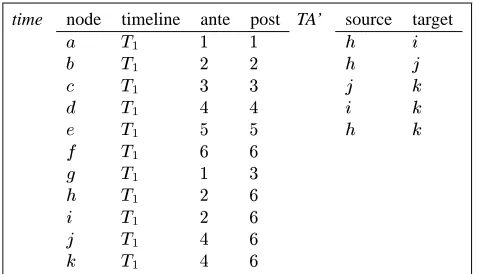
Consider the example in Figure 9. It shows a collec-tion of nodes, where nodes a-f are timed and the rest are untimed. All the untimed nodes are linked by arcs to other nodes. In order to extract those portions of the database that are needed to answer a query, we will typically need to find efficiently all arcs contained in some arc or all arcs that might overlap some arc. Such queries can be answered by computing the transitive closure
TA
of the arc relation, but this is likely to be an expensive proposition (O
(n
2 )in the number of nodes). An alternative is to store the two relations below.4The relation time contains, for every node
n
, the maximum time ante of a timed node that precedesn
4Our approach has similarities with Allen’s “reference
Conference on Speech Science and Technology. [www.shlrc.mq.edu.au/emu/].
Cassidy, Steve and Jonathan Harrington, 1999. Multi-level annotation of speech: an overview of the emu speech database management system. Manuscript.
Clarke, Charles L. A., G. V. Cormack, and F. J.
Burkowski, 1995. An algebra for structured text search and a framework for its implementation. Computer Journal, 38:43–56.
Consens, Mariano P. and Alberto O. Mendelzon, 1990. The G+/graphlog visual query system. In SIGMOD Conference.
Deutsch, Alin, Mary Fernandez, Daniela Florescu, Alon Levy, and Dan Suciu, 1998. XML-QL: A query language for XML. [www.w3.org/TR/NOTE-xml-ql/]. Florescu, D. and D. Kossmann, 1999. A performance
evaluation of alternative mapping schemes for storing XML data in a relationl database. Manuscript. Garofolo, John S., Lori F. Lamel, William M. Fisher,
Jonathon G. Fiscus, David S. Pallett, and Nancy L. Dahlgren, 1986. The DARPA TIMIT Acoustic-Phonetic Continuous Speech Corpus CDROM. NIST.
[www.ldc.upenn.edu/lol/docs/TIMIT.html]. Godfrey, J. J., E. C. Holliman, and J. McDaniel, 1992.
Switchboard: A telephone speech corpus for research and develpment. In Proceedings of the IEEE
Conference on Acoustics, Speech and Signal Processing, volume I.
[www.ldc.upenn.edu/Catalog/LDC93S7.html]. Mengel, Andreas, Ulrich Heid, Arne Fitschen, and Stefan
Evert, 1999. Specification of coding workbench: Improved query language (q4m). Technical Report MATE Deliverable D3.1, Stuttgart: Institut f¨ur Maschinelle Sprachverarbeitung.
[www.ims.uni-stuttgart.de/projekte/mate/q4m/]. Quass, D., A. Rajaraman, Y. Sagiv, J. Ullman, and
J. Widom, 1995. Querying semistructure heterogeneous information. In International Conference on Deductive and Object Oriented Databases.