74
Risk Management in Construction Industry-Materials
Nikhil Bhoir
1, Somnath Munde
2, Prasad Birajdar
3, Sagar Bharane
4, Gaurang Sangle
5Civil Engineering Department
1, 2, 3, 4, 5, U.G.Student
1, 2, 3, 4, 5Vishwakarma Institutes of Information
Technology, Pune, Maharashtra, India
Email:[email protected] 1,[email protected]2,[email protected]3
Abstract-Risk management is very popular concept in a number of businesses. For improving the performance and increase the profits many companies often establish a risk management procedure in their projects. Construction sector is widely complex and have often considerable budgets, and thus reducing risks associated with projects should be a priority for each project manager. The main purpose of this project is to identify the key risk factors in materials and material management that affect construction project. A questionnaire has been prepared incorporating of near about fifty different questions. Various construction sites were visited for questionnaire survey. The sheet of questionnaire comprises of Likert scale to measure risk factors in materials by obtaining rating on the basis of Likelihood and Impact from the Site Engineers or Project Engineers. Statistical Package for the Social Sciences (SPSS) software was used for analysis of various risk factors from
Questionnaires survey data for preventive measures or mitigation techniques for various risks on construction site.
Index Terms-Risk Management1, Materials, Likert scale, Statistical Package for the Social Sciences Software
.
1. INTRODUCTION
The Construction industry is largest economic outflow in India. According to eleventh five year plan, it is the second largest economic activity after agriculture. Every construction activity no matter what its size and complication comprises risks, which might vary in the final result on Project. Risk management is the systematic process of identifying, examining, and responding to project risk. It includes maximizing the possibility and consequences of positive events and minimizing the likelihood and consequences of contrary events to meet the project objective. The accomplishment or failure of any project depends significantly on how we recognize and deal with the risk factors which affect construction of our project. Materials management is a significant element in project management. It is crucial factor adversely affecting the performance of construction projects. Material is the main component in any of the construction projects.
In recent developments a wide range of building materials is available for the construction of civil engineering structures. The total budget of materials may be up to 60% or more of the total budget incurred in construction project dependent upon the type of project. Therefore, if the material management in
construction projects is not managed properly it will generate a major cost variance in project. The total budget of the project can be well controlled by taking remedial measures towards the cost variance befall in the project. Effective construction materials management process is a key to success of a construction project. The effective material Management is a key of Success in Construction industry.
2.1 RESEARCH IMPORTANCE
76 Engineer available during the visit at respective
project. All project recruits who were working on construction projects at the time of the survey were invited to participate in the survey. All the Valid Reponses given by the Representatives are the input or data was to be analyzed further. The hypotheses were verified using Statistical Package for the Social
Sciences (SPSS) method to analyses the data collected
from the survey. SPSS is a statistical methodology that takes a hypothesis-testing approach to the statistical analysis of a numerical data. This software allows examination the various factors affecting the project development. After analysis, result obtained from the software is identified and various mitigation and control techniques are concluded for the affecting factors obtained from SPSS.
5. ANALYSIS AND RESULTS
The figures below shows the analysis of results, the analysis was done using SPSS software in which the Response Percentage for each risk factor was obtained.
5.1 Risk in Material treatment
Fig 5.1, Risk in material treatment
From fig no 5.1, it can be interpreted that 32% respondents strongly agreed that improper material treatment causes risk in construction project. While 25% respondents agreed that improper material treatment has very high impact on construction of project.
5.2 Risk in Material Usage
Fig 5.2, Risk in Material usage
From above fig no 5.2, it can be concluded that 33% respondents strongly agreed that inadequate usage of material has very high impact on construction project. While 23% respondents agreed that improper material usage has a High impact on construction project.
5.3 Risk in Procurement Process
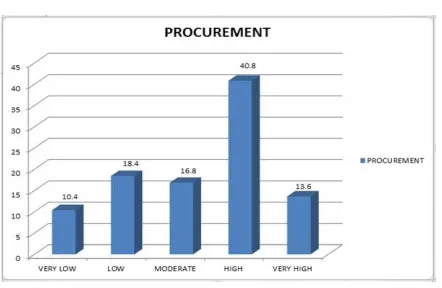
Fig 5.3, Risk in Procurement Process
From fig no 5.3, it can be concluded that 40% respondent strongly agreed that inadequate planning of procurement process causes risk in construction of project. Since it scores highest response from the survey conducted.
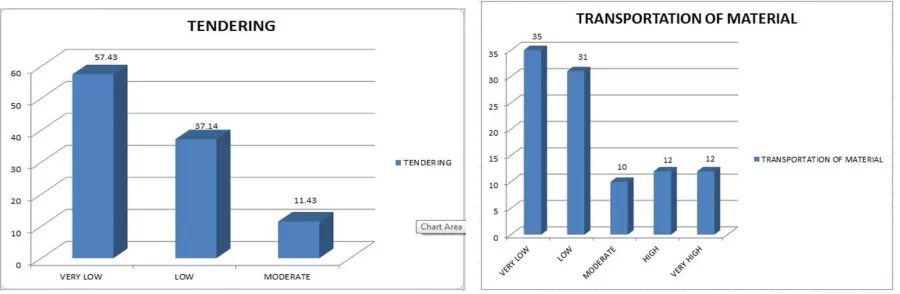
77 Fig 5.4, Risk in tendering process
From fig no 5.4, it can be interpreted that near about 57.43% of the respondent strongly agreed that tendering process causes very low Impact on construction project, while near about 37% of the respondent agreed that it is low and 11% of respondents are moderate. It can be concluded base on the respondent’s responses that there is very low impact of tendering process in construction project but it cannot be neglected.so it should be considered while planning any construction project.
5.5 Risk in Supply of Material
Fig no 5.5, Risk in Supply of Material
From above fig no 5.5, It can be concluded that near about 18% repondents agreed that the supply of material affects Construction project.while 24% repondent are moderate and 11% repondents agreed that it has very high impact on construction project. So adequate steps should be taken to minimize the risk.
5.6 Risk in Transportation of material
Fig 5.6,Risk in Transportation of material
From the above fig no 5.6, It can be interpreted that 35% repondents agreed that transportation of material has very low impact on construction project.while 12% agreed that it has very high impact on construction project.
6. Tables
Table no 1, Indicates the parameter for likert scale.
Rating
Rating wise
Likelihood
Rating wise
Impact
1
Rare
Very low
2
Occasional
Low
3
Somewhat
Frequent
Moderate
4
Frequent
High
5
Very Frequent
Very high
Table no 2, Denotes sample Questionnaire Survey.
Sr.no Description Likelihood Impact 1 Do you think
tendering process has a risk?
1 2
2 Do you think defective supply
and usage of material is risky?
5 4
3 Do you think material handling
while transportation has
a risk?
79 projects HBRC Journal(Housing and Building
National Research Center)
[6] Anna Klemetti” Risk management in construction project network” Laboratory of industrial management report 2006/2
[7] Bayu Aditya , Bambang” Risk analysis in feasibility study of building construction project” The Tenth East Asia-Pacific Conference on Structural Engineering and Constructio August 3-5, 2006, Bangkok, Thailand.
[8] Royer, P.S., 2000. Risk management: The undiscovered dimension of project management. Project Management Journal, Vol. 31, No.1, pp. 613.
[9] Raz, T., Shenhar, A.J. and Dvir, D., 2002. Risk management, project success, and technological uncertainty. R&D Management, Vol. 32, No. 2, pp. 101109.
[10] Akintoye, A.S. and MacLeod, M.J.; “Risk analysis and management in construction”; International Journal of Project Management (1997).
[11] Dr. M. J. Kolhatkar, Er. Amit Bijon Dutta,; “Study of Risk in Construction Projects”, GRA (2013).
[12] Kinnaresh Patel M.E. (C.E.M.)*,; A study on risk assessment and its management in India,; AJCE (2013).
[13] [13] Abdou, O.A. (1996) Managing Construction Risks, Journal of Architectural Engineering,2(1), 3-10.
[14] [14] Akintoye, A.S. and MacLeod, M.J. (1997) Risk Analysis and Management in Construction,
International Journal of Project Management,
15(1), 31-38.
[15] Baker, W. and Reid, H. (2005) Identifying and
Managing Risk, Frenchs Forest, N.S.W.: Pearson