Learning Morphology with Morfette
Grzegorz Chrupała,
Georgiana Dinu,
Josef van Genabith
Dublin City University Universit¨at des Saarlandes Dublin City University Dublin 9, Ireland D-66041 Saarbr¨ucken, Germany Dublin 9, Ireland [email protected] [email protected] [email protected]
Abstract
Morfette is a modular, data-driven, probabilistic system which learns to perform joint morphological tagging and lemmatization from morphologically annotated corpora. The system is composed of two learning modules which are trained to predict morphological tags and lemmas using the Maximum Entropy classifier. The third module dynamically combines the predictions of the Maximum-Entropy models and outputs a probability distribution over tag-lemma pair sequences. The lemmatization module exploits the idea of recasting lemmatization as a classification task by using class labels which encode mappings from wordforms to lemmas. Experimental evaluation results and error analysis on three morphologically rich languages show that the system achieves high accuracy with no language-specific feature engineering or additional resources.
1.
Introduction
This paper describes and evaluates theMorfettesystem for data-driven morphological analysis. Morphological analy-sis usually involves two subtasks: the assignment of mor-phological features to the wordform, and lemmatization. Many data-driven approaches to morphology involve en-coding morphological features as tags (henceforth morpho-tags), and use some sequence labeling method to assign
morpho-tag sequences to sentences. In the case of mor-phologically rich inflectional or agglutinative languages, the classification decision is often constrained by the use of a morphological lexicon, or a finite-state morphologi-cal analyzer: in such systems the data-driven component is limited to performing morphological disambiguation rather than morphological analysis itself (Hajiˇc and Hladk´a, 1998; Hajiˇc, 2000; Tufis¸, 1999; Tufis¸ and Dragomirescu, 2004; Ceaus¸u, 2006; Han and Palmer, 2004; Habash and Ram-bow, 2005; Hakkani-T¨ur et al., 2002; Yuret and T¨ure, 2006).
In an morphological disambiguation setting, lemmatization is simple: either the lexicon or the morphological analyzer already returns the correct lemma corresponding to each of the candidate analyses. The problematic cases are unknown words: most systems are able to guess the morpho-tag of an unknown word, but not the corresponding lemma. (Erjavec and Dˇzeroski, 2004) solve the problem of lemmatizing un-known words by using a two stage architecture, first sen-tences are assigned morpho-tag sequences by a POS-tagger, and then an Inductive Logic Programming system assigns lemmas to unknown wordform-tag pairs.
(Chrupała, 2006) takes a different approach to lemmati-zation. His method automatically induces lemma-classes: they correspond to theshortest edit scriptbetween reversed wordforms and the corresponding lemmas. Then a standard classifier is used to “tag” words with their lemma-classes, from which the words’ lemmas can be obtained by “exe-cuting” the edit script on the wordforms. Thus in this ap-proach lemmatization becomes quite similar to POS tag-ging or morphological tagtag-ging.
In the current study we present a modular, data-driven model which performs both morphological tagging and lemmatization, i.e. it maps a sequence of wordforms of
lengthnto the sequence of morpho-tag - lemma pairs:
M :Wn →(M ×Λ)n (1)
We use a generic, language-independent feature-set in our models and investigate how well such an approach general-izes to three morphologically rich languages.
In Section 2. we present the architecture of our model, the features used and the search algorithm. In Section 3. we present experimental evaluation results for three languages and corpora. Section 4. contains the error analysis and fi-nally Section 5. presents our conclusions and ideas for fur-ther improvements in data-driven morphological analysis.
2.
The Morfette System
2.1. ArchitectureThe Morfette system is composed of two learning mod-ules, one for morphological tagging and one for lemmati-zation, and one decoding module which searches for the best sequence of pairs of morphological tags and lemmas for an input sequence of wordforms. Both modules learn Maximum Entropy classifiers such as that described for POS tagging in (Ratnaparkhi, 1996). For the lemmatiza-tion model we use (Chrupała, 2006)’s method of inducing lemma classes.1
In his method the class assigned to a wordform - lemma pair is the corresponding shortest edit script (henceforth SES) between the two reversed strings (Myers, 1986). A SES stands for the shortest sequence of instructions (inser-tions or dele(inser-tions) which transforms a stringwinto a string
w0. For example, considering the strings w = pidieron
andw0 =pedir, the corresponding SES is{hD,i, 2i,hI,
e, 3i, hD,e, 5 i,hD,o, 7 i,hD,n, 8 i}, where a triple such as hD, i, 2 i stands for delete character i at posi-tion 2. Since one needs to abstract away from the length of words as much as possible, and since inflection affects predominantly word endings, the strings are reversed prior to the computation of SESs. In this way, pairs such as
hpidieron, pediriandhrepitieron, repetiriare correctly
po-Wordform ˆIn peret¸ii boxei erau trei orificii
Lemma ˆın perete box˘a fi trei orificiu
Morpho-tag Spsa Ncmpry Ncfsoy Vmii3p Mc-p-l Ncfp-n Gloss In the walls of the cubicle there were three orifices
Figure 1: Example of a sentence in the Romanian MULTEXT-EAST corpus
Feature notation Description
Morpho-tagging model
f0 Lowercased wordform of the focus token
sn(f0), n= 1· · ·7 Suffixes of lengthn
pn(f0), n= 1· · ·5 Prefixes of lengthn
sp(F0) Spelling pattern of the (non-lowercased) wordform
s1(m−2)⊕s1(m−1) Concatenation of the first element of the two previous morpho-tags
f−2, f−1, f1 Lowercased wordform of two previous tokens and of one following token
m−2, m−1 (Predicted) Morpho-tag of two previous tokens
l−2, l−1 (Predicted) Lemma of two previous tokens
mtrain1 Set of morpho-tags seen in training data for wordform of next token Lemmatization model
f0 Lowercased wordform of the focus token
sn(f0), n= 1· · ·7 Suffixes of lengthn
pn(f0), n= 1· · ·5 Prefixes of lengthn
m0 (Predicted) Morpho tag
sp(F0) Spelling pattern of the (non-lowercased) wordform
Table 1: Features used for the morphological tagging and lemmatization models
All words
Morpho-tagging Lemmatization Joint
Romanian 96.83 97.78 96.08
Spanish 94.33 97.84 93.83
Polish 81.87 93.29 81.19
Unseen words
Morpho-tagging Lemmatization Joint
Romanian 86.68 82.88 78.50
Spanish 74.79 89.20 71.26
Polish 61.93 76.88 59.17
Table 3: Evaluation results withSMALLtraining sets
All words
Morpho-tagging Lemmatization Joint Spanish 95.40 (+1.07) 98.52 (+0.68) 95.02 (+1.19) Polish 84.91 (+3.04) 95.55 (+2.26) 84.44 (+3.25)
Unseen words
Morpho-tagging Lemmatization Joint Spanish 75.71 (+4.22) 91.22 (+2.74) 71.84 (+3.99) Polish 65.87 (+4.33) 81.11 (+4.49) 63.16 (+4.33)
Table 4: Evaluation results with aFULLtraining set. Num-bers in brackets indicate accuracy improvement over the same model trained on theSMALLtraining set
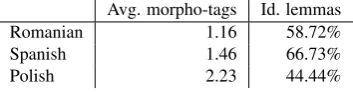
and high ambiguity. These properties are reflected in Table 5, which shows the average number of morpho-tag classes per token for each of the three languages, as well as the percentage of tokens for which the lemma is identical to the wordform.
Avg. morpho-tags Id. lemmas
Romanian 1.16 58.72%
Spanish 1.46 66.73%
Polish 2.23 44.44%
Table 5: Average morpho-tag ambiguity per token and per-centage of tokens with lemmas identical to wordforms.
For comparison we have experimented with simple alterna-tive data-driven methods for morpho-tagging and lemmati-zation. The accuracy achieved using these methods can be considered a non-trivial baseline for our joint model. The
BASELINEmodel we constructed is composed of the fol-lowing two components working in a pipeline:
• Morphological tagging: A tagger is obtained from training material using the MBT memory-based tag-ger generator (Daelemans et al., 2007).
• Lemmatization: For each wordform in the test set the morpho-tag predicted by MBT is retrieved. If the word - morpho-tag pair has been encountered in the training set, then it is assigned its predominant lemma; other-wise a lemma identical to the wordform is assigned.
f0 sp(F0) p1(f0) p2(f0) p3(f0) p4(f0) p5(f0) s1(f0) s2(f0) s3(f0) s4(f0) s5(f0) s6(f0) s7(f0)
ˆın Xx ˆı ˆın - - - n ˆın - - - -
-peret¸ii x p pe per pere peret¸ i ii t¸ii et¸ii ret¸ii eret¸ii peret¸ii
boxei x b bo box boxe boxei i ei xei oxei boxei -
-erau x e er era erau - u au rau erau - -
-trei x t tr tre trei - i ei rei trei - -
-orificii x o or ori orif orifi i ii cii icii ficii ificii
-f−2 l−2 t−2 f−1 l−1 m−1 s1(m−2)⊕s2(m−1) f+1 mtrain+1
- - - peret¸ii {Ncmpry}
- - - ˆın ˆın Spsa S boxei {}
ˆın ˆın Spsa peret¸ii perete Ncmpry S+N erau {Vmii3p}
peret¸ii perete Ncmpry boxei box˘a Ncfsoy N+N trei {Mc-p-l}
boxei box˘a Ncfsoy erau fi Vmii3p N+V -
-erau fi Vmii3p trei trei Mc-p-l V+M -
-Table 2: Features extracted for the morpho-tagging model from an example Romanian phrase: ˆIn peret¸ii boxei erau trei
orificii.
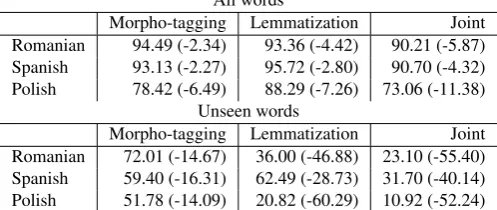
On the morpho-tagging task, MBT is used without tuning algorithm parameters; the feature set closely mimics the one employed inMorfette: for known words we use two previous morpho-tags, two previous word-forms, the fo-cus wordform, 7 suffixes and 5 prefixes of the fofo-cus word-form, one following wordform and its ambitag (set of tags it has been seen with in the training set); the same features minus the focus wordform are used for unknown words. With these settingsMBTobtains somewhat lower morpho-tagging accuracy scores compared toMorfette: over 2% loss for Spanish and Romanian and over 6% for Polish. The simple lemmatization algorithm described above per-forms quite well; nevertheless our method achieves for all languages over 60% relative error reduction rate for all words: 66.5% for Romanian, 65.4% for Spanish and 62% for Polish. As expected, aBASELINEmodel built this way shows poor performance on unseen words, in comparison toMorfette.
All words
Morpho-tagging Lemmatization Joint Romanian 94.49 (-2.34) 93.36 (-4.42) 90.21 (-5.87) Spanish 93.13 (-2.27) 95.72 (-2.80) 90.70 (-4.32) Polish 78.42 (-6.49) 88.29 (-7.26) 73.06 (-11.38)
Unseen words
Morpho-tagging Lemmatization Joint Romanian 72.01 (-14.67) 36.00 (-46.88) 23.10 (-55.40) Spanish 59.40 (-16.31) 62.49 (-28.73) 31.70 (-40.14) Polish 51.78 (-14.09) 20.82 (-60.29) 10.92 (-52.24)
Table 6: Evaluation results withBASELINEmodel with the
FULLtraining set. Numbers in brackets compare accuracy withMorfetteusing theFULLtraining set
4.
Error Analysis
We have performed detailed error analysis for morpholog-ical tagging and lemmatization for Spanish, Romanian and Polish. In this section we summarize the results of this anal-ysis and suggest possible ways of dealing with some of the common errors our systems makes.
Errors in morphological tagging and lemmatization tend to co-occur: often an incorrectly assigned morphological cat-egory triggers lemmatization which is consistent with this category but incorrect given the gold morpho-tag. We will therefore discuss the issues related to both morphological tags and lemma-class tags jointly.
Named entities A common source of errors in Spanish and Romanian is failure to detect proper names (the tagset used in Polish does not have a separate tag for proper nouns). This results in the assignment of the wrong mor-phological tags and sometimes also the wrong lemma-class. For example in Spanish certain person or place names, such asReyes orChiapashave the plural suffix but, unlike for common nouns, their correct lemma-class should not delete it. Poor performance in this area is to be expected as our fo-cus here is on learning morphological structure and not on detecting and classifying named entities. The only feature designed to capture some characteristics of those issp(F0),
the spelling pattern feature, which is clearly very rudimen-tary. In order to deal with named entities properly a dedi-cated module would be probably the best solution.
Suffix ambiguity A common phenomenon in all the three languages is suffix ambiguity, i.e. certain word endings can be indicative of more than one morphological category. In Spanish and Romanian, nouns and adjectives are difficult to distinguish based only on word endings and are sometimes mistagged and mislemmatized. This happen mostly in con-structions with adjectives preceding nouns, which are rare and marked in comparison to adjectives post-modifying the noun.
In Romanian third person singular verbs in the imperfect
tense have the same ending as nouns marked with a definite feminine article, and are also sometimes misclassified.3
Syncretism This is an especially frequent error type for Polish. Often different grammatical cases of the same lexi-cal item have the same form, i.e. feminine genitive singular
3
mascu-corpus-based morphological rule application. Machine Translation, 18(4):275–297.
M. Antonia Mart´ı, Mariona Taul´e, Llu´ıs M´arquez, and Manuel Bertran. 2007. CESS-ECE: A multilingual and multilevel annotated corpus. Available from: http://www.lsi.upc.edu/˜mbertran/cess-ece.
Eugene W. Myers. 1986. An O(ND) difference algorithm and its variations. Algorithmica, 1(1):251–266, March. Adwait Ratnaparkhi. 1996. A maximum entropy model
for part-of-speech tagging. InProceedings of the Con-ference on Empirical Methods in Natural Language Pro-cessing.
Dan Tufis¸ and Liviu Dragomirescu. 2004. Tiered Tagging Revisited. InProc. of the Fourth Intl. Conf. on Language Resources and Evaluation, LREC, pages 39–42.
Dan Tufis¸. 1999. Tiered tagging and combined language models classifiers. InTSD ’99: Proceedings of the Sec-ond International Workshop on Text, Speech and Dia-logue, pages 28–33.