Coupling an Annotated Corpus and a Morphosyntactic Lexicon
for State-of-the-Art POS Tagging with Less Human Effort
Pascal Denis and Benoît Sagot
Equipe-project ALPAGE INRIA and Université Paris 7
30, rue Château des Rentiers 75013 Paris, France {pascal.denis,benoit.sagot}@inria.fr
Abstract. This paper investigates how to best couple hand-annotated data with information extracted from an external lexical resource to improve POS tagging performance. Focusing on French tagging, we introduce a maximum entropy conditional sequence tagging system that is enriched with information extracted from a morphological resource. This system gives a97.7% accuracy on the French Treebank, an error reduction of23% (28% on unknown words) over the same tagger without lexical information. We also conduct experiments on datasets and lexicons of varying sizes in order to assess the best trade-off between annotating data vs. developing a lexicon. We find that the use of a lexicon improves the quality of the tagger at any stage of development of either resource, and that for fixed performance levels the availability of the full lexicon consistently reduces the need for supervised data by at least one half.
Keywords: Part-of-speech tagging, maximum entropy models, morphosyntactic lexicon, French, language resource development
1 Introduction
Over recent years, numerous systems for automatic part-of-speech (POS) tagging have been pro-posed for a large variety of languages. Among the best performing systems are those based on supervised machine learning techniques (see (Manning and Schütze, 1999) for an overview). For some languages like English and other European languages, these systems have reached perfor-mance that comes close to human levels. Interestingly, the majority of these systems have been built without resorting to any external lexical information sources; they instead rely on a dictio-nary that is based on the training corpus (see however (Hajiˇc, 2000)). This raises the question of whether we can still improve tagging performance by exploiting this type of resource. Arguably, a potential advantage of using an external dictionary is in a better handling of unknown words (i.e., words that are not present in the training corpus, but that may be present in the external dictio-nary). A subsequent question is how to best integrate the information from a lexical resource into a probabilistic POS tagger. In this paper, we consider two distinct scenarios: (i) using the external dictionary as constraints that restrict the set of possible tags that the tagger can choose from, and (ii) incorporating the dictionary tags as features in a probabilistic POS tagging model. Another in-teresting question is that of the relative impact of training corpora and of lexicons of various sizes. This issue is crucial to the development of POS taggers for resource-scarce languages for which it is important to determine the best trade-off between annotating data and constructing dictionaries. This paper addresses these questions through various tagging experiments carried out on French, based on our new tagging system called MElt (Maximum-Entropy Lexicon-enriched Tag-ger). An obvious motivation for working on this language is the availability of a training corpus
(namely, the French Treebank (Abeillé et al., 2003)) and a large-scale lexical resource (namely, Lefff (Sagot et al., 2006)). Additional motivation comes from the fact that there has been com-paratively little work in probabilistic POS tagging in this language. An important side contri-bution of our paper is the development of a state-of-the-art, freely distributed POS tagger for French.1 Specifically, we here adopt a maximum entropy (MaxEnt) sequential classification ap-proach. MaxEnt models remain among the best performing tagging systems for English and they are particularly easy to build and fast to train.
This paper is organized as follows. Section 2 describes the datasets and the lexical resources that were used. Section 3 presents a baseline MaxEnt tagger for French that is inspired by pre-vious work, in particular (Ratnaparkhi, 1996) and (Toutanova and Manning, 2000), that already outperforms TreeTagger (Schmid, 1994) retrained on the same data. In Section 4, we show that the performance of our MaxEnt tagger can be further improved by incorporating features extracted from a large-scale lexicon, reaching a 97.7% accuracy, which compares favorably with the best results obtained for English with a similar tagset. Finally, Section 5 evaluates the relative on ac-curacy impact of the training data and the lexicon during tagger development by varying their respective sizes.
2 Resources and tagset 2.1 Corpus
The morphosyntactically annotated corpus we used is a variant of the French TreeBank or FTB, (Abeillé et al., 2003). It differs from the original FTBin so far that all compounds that do not correspond to a syntactically regular sequence of categories have been merged into unique tokens and assigned a category corresponding to their spanning node; other compounds have been left as sequences of several tokens (Candito, p.c.). The resulting corpus has 350,931tokens in12,351 sentences.
In the originalFTB, words are split into 13main categories, themselves divided into 34 sub-categories. The version of the treebank we used was obtained by converting subcategories into a tagset consisting of 28tags, with a granularity that is intermediate between categories and sub-categories. Basically, these tags enhance main categories with information on the mood of verbs and a few other lexical features. This expanded tagset has been shown to give the best statistical parsing results for French (Crabbé and Candito, 2008).2 A sample tagged sentence from theFTB is given in Figure 1.
Cette/DET mesure/NC ,/PONCT qui/PROREL pourrait/V être/VINF appliquée/VPP dans/P les/DET prochaines/ADJ semaines/NC ,/PONCT permettrait/V d’/P économiser/VINFquelque/DET4/ADJmilliards/NCde/Pfrancs/NC./PONCT
Figure 1:Sample data fromFTBin Brown format
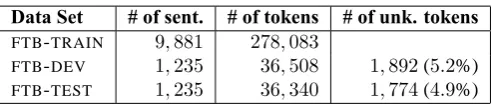
As in (Candito et al., 2009), theFTBis divided into3sections : training (80%), development (10%) and test (10%). The dataset sizes are presented in Table 1 together with the number of unknown words.
2.2 Lexicon
One of the goals of this work is to study the impact of using an external dictionary for training a tagger, in addition to the training corpus itself. We used the morphosyntactic information included in the large-coverage morphological and syntactic lexicon Lefff (Sagot et al., 2006).3
1
The MElt tagger is freely available fromhttp://gforge.inria.fr/projects/lingwb/.
2This tagset is known as T
REEBANK+ in (Crabbé and Candito, 2008), and since then as CC (Candito et al., 2009).
3
1996). In our experiments, the parameters were estimated using the Limited Memory Variable Metric Algorithm (Malouf, 2002) implemented in the Megam package.6
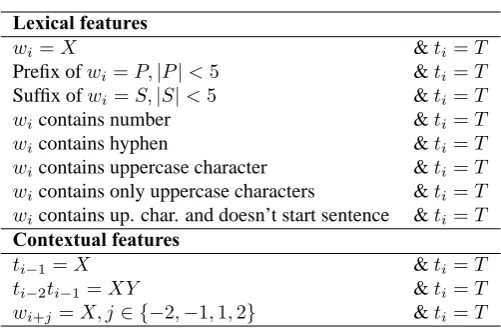
The feature templates we used for designing our French tagging model is a superset of the features used by (Ratnaparkhi, 1996) and (Toutanova and Manning, 2000) for English (these were largely language independent). These features fall into two main categories. A first set of features try to capture the lexical form of the word being tagged: these include the actual word string for the current wordwi, prefixes and suffixes (of character length4and less), as well as binary features
testing whether wi contains special characters like numbers, hyphens, and uppercase letters. A
second set of features directly model the context of the current word and tag: these include the previous tag, the concatenation of the two previous tags, as well as the surrounding word forms in a window of2tokens.
The detailed list of feature templates we used in this baseline tagger is shown in Table 2.7
Table 2:Baseline model features
Lexical features
wi=X &ti =T
Prefix ofwi=P,|P|<5 &ti =T
Suffix ofwi=S,|S|<5 &ti =T
wicontains number &ti =T
wicontains hyphen &ti =T
wicontains uppercase character &ti =T
wicontains only uppercase characters &ti =T
wicontains up. char. and doesn’t start sentence &ti =T Contextual features
ti−1=X &ti =T
ti−2ti−1=XY &ti =T
wi+j=X, j∈ {−2,−1,1,2} &ti =T
An important difference with (Ratnaparkhi, 1996) in terms of feature design is that we did not restrict the application of the prefix/suffix features to words that are rare in the training data. In our model, these features always get triggered, even for infrequent words. We found that the permanent inclusion of these features led to better performance during development, which can probably be explained by the fact that these features get better statistics and are extremely use-ful for unknown words. These features are also probably more discriminative in French than in English, since it is morphologically richer. Another difference to previous work regards smooth-ing. (Ratnaparkhi, 1996) and (Toutanova and Manning, 2000) use feature count cutoff of 10 to avoid unreliable statistics for rare features. We did not use cutoffs but instead use a regularization Gaussian prior on the weights8, which is arguably a more principled smoothing technique.9 3.3 Testing and Performance
The test procedure relies on a beam search to find the most probable tag sequence for a given sentence. That is, each sentence is decoded from left to right and we maintain for each wordwi
6
Available fromhttp://www.cs.utah.edu/~hal/megam/.
7
Recall that features in MaxEnt are functions ranging on both contexts and classes. A concrete example of one of our feature is given below:
f100(h, t) =
(
1 ifwi= "le" &t=DET 0 otherwise
8Specifically, we used a prior with precision (i.e., inverse variance) of1(which is the default in Megam); other values
were tested during development but did not yield improvements.
9
thenhighest probability tag sequence candidates up towi. For our experiments, we used a beam
size of3.10 In addition, the test procedure utilizes a tag dictionary which lists for a given word the
tags associated with this word in the training data. This drastically restricts the allowable labels that the tagger can choose from for a given word, in principle leading to fewer tagging errors and reduced tagging time.
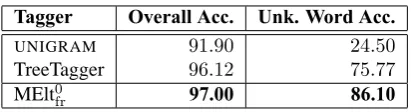
The maximum entropy tagger described above, MElt0fr, was compared against two other base-line taggers, namely: UNIGRAMand TreeTagger. UNIGRAMworks as follows: for a word seen in the training corpus, this tagger uses the most frequent tag associated with this word in the corpus; for unknown words, it uses the most frequent tag in the corpus (in this case,NC). TreeTagger is a statistical, decision tree-based POS tagger (Schmid, 1994).11 The version used for this comparison was retrained on theFTBtraining corpus. The performance results of the three taggers are given in Table 3; scores are reported in terms of accuracy over both the entire test set and the words that were not seen during training.
Table 3:Baseline tagger performance
Tagger Overall Acc. Unk. Word Acc.
UNIGRAM 91.90 24.50
TreeTagger 96.12 75.77
MElt0fr 97.00 86.10
As shown in Table 3, MElt0frachieves accuracy scores of97% overall and86.1% on unknown words.12 Our baseline tagger significantly outperforms the retrained version of TreeTagger, with an improvement of over 10% on unknown words.13 There are several possible explanations for
such a discrepancy in handling unknown words. The first one is that MaxEnt parameter estimation is less prone to data fragmentation for sparse features than Decision Tree parameter estimation due to the fact that it does not partition the training sample. A second related explanation is that TreeTagger simply misses some of the generalizations regarding lexical features due to the fact that it only includes suffixes and this only for unknown words.
4 Lexicon-enriched MaxEnt tagger
For trying to further improve MElt0fr, we investigate in this Section the impact of coupling it with an external lexical resource, and compare two ways of integrating this new information: as contraints vs. as features.
4.1 Integrating lexical information in the tagger
The most natural way to make use of the extra knowledge supplied by a lexicon is to represent it as “filtering” constraints: that is, the lexicon is used as an additional tag dictionary guiding the POS tagger, in addition to the lexicon extracted from the training corpus. Under this scenario, the tagger is forced for a given wordwto assign one of the tags associated withwin the full tag dictionary: the set of allowed tags for wis the union of the sets of its tags in the corpus and in Lefff . This approach is similar to that of (Hajiˇc, 2000), who applied it to highly inflected languages, and in particular to Czech.
In a learning-based tagging approach, there is another possibility to accommodate the extra information provided by Lefff : we can directly incorporate the tags associated by Lefff to each
10
We tried larger values (i.e.,5,10,15,20) during development, but none of these led to significant improvements.
11
Available athttp://www.ims.uni-stuttgart.de/projekte/corplex/TreeTagger/.
12The accuracy results of MElt0
fronFTB-DEVare:96.7overall and86.2on unknown words.
13
word in the form of features. Specifically, for each word, we posit a new lexical feature for each of its possible tags according to the Lefff , as well as a feature that represents the disjunction of all Lefff tags (provided there is more than one). Similarly, we can also use the Lefff to provide additional contextual features: that is, we can include Lefff tags for all the words in a window of 2tokens. Table 4 summarizes these new feature templates.
Table 4:Lexicon-based features
Lexical features
Lefff tag forwi=X &ti=T
Lefff tags forwi=X0. . . Xn &ti=T Contextual features
Lefff tag forwi+j=X, j∈ {−2,−1,1,2} &ti=T
Lefff tags forwi+j =X0. . . Xn, j∈ {−2,−1,1,2} &ti=T
Integrating the lexical information in this way has a number of potential advantages. First, features are by definition more robust to noise (in this case, to potential errors in the lexicon or simply mismatches between the corpus annotations and the lexicon categories). Furthermore, some the above features directly model the context, while the filtering constraints are entirely non contextual.
4.2 Comparative evaluation
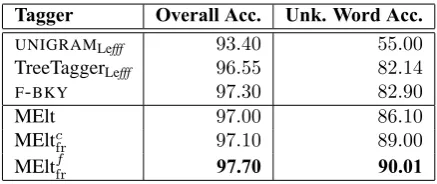
We compared the performance of the Lefff -constraints based tagger MEltcfr and Lefff -features based tagger MEltcfr to other lexicon-enriched taggers. The first of these taggers,UNIGRAMLefff,
like UNIGRAM, is a unigram model based on the training corpus, but it uses Lefff for labeling unknown words: among the possible Lefff tag for a word, this model chooses the tag that is most frequent in the training corpus (all words taken into account). Words that are unknown to both the corpus and Lefff are assigned NC. The second tagger, TreeTaggerLefff is a retrained version
of TreeTagger to which we provide Lefff as an external dictionary. Finally, we also compare our tagger to F-BKY, an instantiation of the Berkeley parser adapted for French by (Crabbé and Candito, 2008) and used as a POS tagger. The performance results for these taggers are given in Table 5.
Table 5:Lexicon-based taggers performance
Tagger Overall Acc. Unk. Word Acc. UNIGRAMLefff 93.40 55.00
TreeTaggerLefff 96.55 82.14
F-BKY 97.30 82.90
MElt 97.00 86.10
MEltcfr 97.10 89.00
MEltffr 97.70 90.01
The best tagger is MEltffr, with accuracy scores of 97.7% overall and 90.1% for unknown words. This represents significant improvements of.7% and3.9% over MElt, respectively. These scores put MEltffr above all the other taggers we have tested, including the parser-basedF-BKY, by a significant margin. To our knowledge, these scores are the best scores reported for French POS tagging.14 By contrast, MEltcfrachieves a rather limited (and statistically insignificant) per-formance gain of.1% overall but a2.9% improvement on unknown words.
14
Our explanation for these improvements is that the Lefff -based features reduce data sparseness and provide useful information on the right context: first, fewer errors on unknown words (a direct result of the use of a morphosyntactic lexicon) necessarily leads to fewer erroneous contexts for other words, and therefore to better tagging; second, the possible categories of tokens that are on the right of the current tokens are valuable pieces of information, and they are available only from the lexicon. The lower result of MEltcfrcan probably be explained by two differences: it does not benefit from this additional information about the right context, and it uses Lefff information as hard constraints, not as (soft) features.
4.3 Error analysis
In order to understand whether the97.7%accuracy of MEltffrcould still be improved, we decided to examine manually its first200errors onFTB-DEV, and classify them according to an adequate typology of errors. The resulting typology and the corresponding figures are given in Table 6.
Table 6:Manual error analysis of the 200 first errors of MEltffron the development corpus
Error type Frequency
Adjective vs. past participle 5.5%
Standard errors Errors on de, du, des 4.0%
Other errors 34%
Errors on numbers 15.5%
Errors related to named entities 27.5%
Error inFTB-DEV 8.5%
MEltffr’s result seem correct Unclear cases (both tags seem valid) 4.5%
Truncated text inFTB-DEV 0.5%
These results show that the97.7%score can still be improved. Indeed, standard named entity recognition techniques could help solve most errors related to named entities, i.e., more than one out of four errors. Moreover, simple regular patterns could allow for replacing automatically all numbers by one or several placeholder(s) both in the training and evaluation data. Indeed, preserving numbers as such inevitably leads to a sparse data problem, which prevents the training algorithm from modeling the complex task of tagging numbers — they can be determiners, nouns, adjectives or pronouns. Appropriate placeholders should significantly help the training algorithm and improve the results. Finally, no less than13.5%of MEltffr’s apparent errors are in fact related toFTB-DEV’s annotation, because of errors (9%) or unclear situations, for which both the gold tag and MEltffr’s tag seem valid.
Given these facts, we consider feasible to improve MEltffrfrom97.7%to98.5%in the future.
5 Varying training corpus and lexicon sizes 5.1 Motivations and experimental setup
The results achieved in the previous section have been made possible by the (relatively) large size of the corpus and the broad coverage of the lexicon. However, such resources are not always available for a given language, in particular for so-called under-resourced languages. Moreover, the significant improvement observed by using Lefff shows that the information contained in a morphosyntactic lexicon is worth using. The question arises to know if this lexical information is able to compensate for the lack of a large training corpus. Symmetrically, it is unclear how various lexicon sizes impact the quality of the results.
a reasonable corpus of size s. However, extracting sublexicons is less trivial. We decided to extract increasingly large sublexicons in a way that approximately simulates the development of a morphosyntactic lexicon. To achieve this goal, we used the MEltffrtagger described in the previous section to tag a large raw corpus.15We then lemmatized the corpus by assigning to each token the list of all of its possible lemmas that exhibit a category consistent with the annotation. Finally, we ranked all resulting (lemma, category) pairs w.r.t. frequency in the corpus. Extracting a sublexicon of size nthen consists in extracting all (form,tag,lemma) entries whose corresponding (lemma,
category) pair is among thelbest ranked ones.
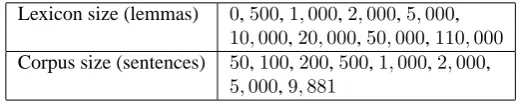
We reproduced the same experiments as those described in Section 4, but training MEltffr on various subcorpora and various sublexicons. We used 9 different lexicon sizes and 8 different corpus sizes, summed up in Table 7. For each resulting tagger, we measured the overall accuracy and the accuracy on unknown words.
Table 7:Varying training corpus and lexicon sizes: experimental setups Lexicon size (lemmas) 0,500,1,000,2,000,5,000,
10,000,20,000,50,000,110,000 Corpus size (sentences) 50,100,200,500,1,000,2,000,
5,000,9,881
5.2 Results and discussion
Before comparing the respective relevance of lexicon and corpus manual development for opti-mizing the tagger’s performance, we need to be able to quantitatively compare their development costs, i.e., times.
In (Marcus et al., 1993), the authors report a POS annotation speed that “exceeds3,000words per hour” during the development of the Penn TreeBank. This speed is reached after a1month period (with 15 annotation hours per week, i.e., approximately 60 hours) during which the POS tagger used for pre-annotation was still improving. The authors also report on a manual tagging experiment (without automatic pre-annotation); they observed an annotation speed that is around 1,300words per hour. Therefore, it is probably safe to assume that, on average, the creation of a manually validated training corpus starts at a speed that is around 1,000 words (30 sentences) per hour, and increases up to3,000words (100sentences) per hour once the corpus has reached, say, 5,000sentences.
For lexicon development, techniques such as those described in (Sagot, 2005) allow for a fast validation of automatically proposed hypothetical lemmas. Manual intervention is then limited to validation steps that take around2to3seconds per lemma, i.e., about1,500lemmas per hour.
Figure 2 compares contour lines16for two functions of corpus and lexicon sizes: tagger accu-racy and development time.17 These graphs show different things:
• during the first steps of development (less than 3 hours of manual work), the distribution of the manual work between lexicon and corpus development has no significant impact on overall tagging accuracy, but accuracy on unknown words is better when focusing more or equally on the lexicon than on the corpus;
15We used a corpus of 20 million words extracted from the L’Est Républicain journalistic corpus, freely available at
the web site of the CNRTL (http://www.cnrtl.fr/corpus/estrepublicain/).
16As computed by thebsplinemode ofgnuplot’s contour lines generation algorithm. 17
In future work, we plan on trying and demonstrating this result in practice, by developing such resources and the corresponding MEltffr tagger for an under-resourced language. We also intend to study the influence of the tagset, in particular by training taggers based on larger tagsets. This work should try and understand how to benefit as much as possible from the internal structure of tags in such tagsets (gender, number, etc.).
References
Abeillé, A., L. Clément, and F. Toussenel. 2003. Building a treebank for French. In A. Abeillé, editor, Treebanks. Kluwer, Dordrecht.
Berger, A., S. D. Pietra, and V. D. Pietra. 1996. A maximum entropy approach to natural language processing. Computational Linguistics, 22(1):39–71.
Candito, M., B. Crabbé, and D. Seddah. 2009. On statistical parsing of French with supervised and semi-supervised strategies. In Proceedings of the EACL’09 workshop on Grammatical Inference
for computational linguistics, Athens, Greece.
Crabbé, B. and M. Candito. 2008. Expériences d’analyses syntaxique statistique du français. In
Proceedings of TALN’08, Avignon, France.
Hajiˇc, J. 2000. Morphological Tagging: Data vs. Dictionaries. In Proceedings of ANLP’00, pages 94–101, Seattle, WA, USA.
Lafferty, J. D., A. McCallum, and F. C. N. Pereira. 2001. Conditional random fields: Probabilistic models for segmenting and labeling sequence data. In ICML, pages 282–289.
Malouf, R. 2002. A comparison of algorithms for maximum entropy parameter estimation. In
Proceedings of the Sixth Workshop on Natural Language Learning, pages 49–55, Taipei,
Tai-wan.
Manning, C. D. and H. Schütze. 1999. Foundations of Statistical Natural Language Processing. MIT Press, Cambridge, MA.
Marcus, M. P., M. A. Marcinkiewicz, and B. Santorini. 1993. Building a large annotated corpus of English: The Penn Treebank. Computational Linguistics, 19(2):313–330.
Ratnaparkhi, A. 1996. A maximum entropy model for part-of-speech tagging. In Proceedings of
International Conference on Empirical Methods in Natural Language Processing, pages 133–
142.
Sagot, B. 2005. Automatic acquisition of a Slovak lexicon from a raw corpus. In Lecture Notes
in Artificial Intelligence 3658, Proceedings of TSD’05, pages 156–163, Karlovy Vary, Czech
Republic. Springer-Verlag.
Sagot, B., L. Clément, É. de La Clergerie, and P. Boullier. 2006. The Lefff 2 syntactic lexicon for French: architecture, acquisition, use. In Proceedings of LREC’06, Lisbon, Portugal.
Schmid, H. 1994. Probabilistic part-of-speech tagging using decision trees. In Proceedings of
International Conference on New Methods in Language Processing, Manchester, UK.
Toutanova, K. and C. D. Manning. 2000. Enriching the knowledge sources used in a maximum entropy part-of-speech tagger. In Proceedings of International Conference on New Methods in