Resource Production of Written Forms of Sign Languages
by a User-Centered Editor, Swift (SignWriting improved fast transcriber)
Fabrizio Borgia
1-2, Claudia S. Bianchini
3-4-5, Patrice Dalle
1, Maria De Marsico
2 (1) Université “Paul Sabatier” de Toulouse (118, route de Narbonne, Toulouse)(2) Dip. Informatica - Università degli Studi “La Sapienza” di Roma (Via Salaria 113, Roma) (3) Université Paris 8 ED-CLI / CNRS-UMR7023-SFL (2, rue de la Liberté, Saint-Denis)
(4) Università degli Studidi Perugia (Piazza Morlacchi 1, Perugia) (5) CNR-ISTC-SLDS (Via Nomentana 56, Roma)
Contact person: [email protected]
Abstract
The SignWriting improved fast transcriber (SWift), presented in this paper, is an advanced editor for computer-aided writing and transcribing of any Sign Language (SL) using the SignWriting (SW). The application is an editor which allows composing and saving desired signs using the SW elementary components, called “glyphs”. These make up a sort of alphabet, which does not depend on the national Sign Language and which codes the basic components of any sign. The user is guided through a fully automated procedure making the composition process fast and intuitive. SWift pursues the goal of helping to break down the “electronic” barriers that keep deaf people away from the web, and at the same time to support linguistic research about Sign Languages features. For this reason it has been designed with a special attention to deaf user needs, and to general usability issues. The editor has been developed in a modular way, so it can be integrated everywhere the use of the SW as an alternative to written “verbal” language may be advisable.
Keyword: Sign Languages, SignWriting, Accessible editor
1.
Introduction
More or less 0.1% of the worlds population (according to the World Health Organisation), is deaf or hard of hearing. Most of the deaf use, as their favorite tongue, a Sign Language (SL)
Until 1960, SLs were considered a mimic form of communication, which could never reach the status of language. Stokoe’s works (1960) were a starting contribution toward recognizing the richness and expressiveness of SLs, and their “linguisticity”, i.e. the fact of being true languages in themselves, with very complex features, often so different as not being found in VLs. However, these works were all focused on the manual components of SL, decomposing signs in hand configuration, orientation, movement and location. By the end of the ‘90, Cuxac’s works (1996, 2000) on the iconicity in LSF (French Sign Language) added a new dimension on SL studies, focusing the attention on the non-manual components of signs. Cuxac demonstrated that most information in SL is transmitted through eye gaze, facial expressions and body movements. Those researches were then adapted to others SLs, e.g. by the Antinoro Pizzuto’s research on LIS (Italian SL) (Antinoro Pizzuto, 2008; Antinoro Pizzuto et al, 2007; Pizzuto & Rossini, 2007)
Even being true languages, SLs, similarly to many other world languages, still have not developed their own writing system. Although it is possible to use a phonetics mean of transcription - like the IPA (International Phonetic Alphabet) - for vocal languages (VL), the typological specificity of SW does not permit similar solutions (Garcia & Boutet, 2006). This has deep consequences because, despite advances in the comprehension of patterns and rules underlying SLs, the lack of a system to transcribe them still hinders their study: “That which one cannot write down, one cannot
further obstacle in providing information in easily comprehensible ways to them (Antinoro Pizzuto et al., 2010a, Garcia & Perini 2010). As a consequence, a deaf person who wants to venture into the digital world must overcome numerous and difficult barriers, just like those he faces in everyday life. As an example, while surfing through Internet, each user exploits semantic traces to judge which item or which site to choose. The problem, in the case of deaf people, is that these semantic traces are generally available (typically the text of the links) in a language that is not their native language, and in which they often have insufficient reading competence; in fact, some studies have shown (Fajardo etal., 2008) that deaf users find it difficult to devise a strategy to gather the information they need through textual traces. It is worth reminding at this point that, according to the World Health Organization, 278 million people worldwide are deaf or have hearing difficulties, and many of them use SL as their mother tongue. “The diversity of regional variations of SL constitutes a set of minority languages relatively underrepresented in the digital world. Thus, members of the deaf community usually face non-native language web sites where accessibility barriers may emerge” (Fajardo et al., 2009).
2.
SignWriting
SignWriting (SW; Sutton, 1995), which will be discussed further on and to which the SWift project is addressed, seems at present the best solution to the problem of SL representation (Bianchini et al., 2010; Bianchini, 2012, Gianfreda et al., 2009, Di Renzo et al., 2009 ). Its strength is in the ability to combine a bi-dimensional picture with a coding system which relies on highly iconic symbols, thus intuitive and easy to remember (Bianchini, 2012). In more detail, SW is a graphical framework which uses visual symbols (called glyphs) to represent configurations, movements and facial expressions making up SLs. It is part of a more complex writing system: the Sutton Movement Writing & Shorthand, devised by Valerie Sutton, an American choreographer, with the goal of providing notations to trace any body movement.
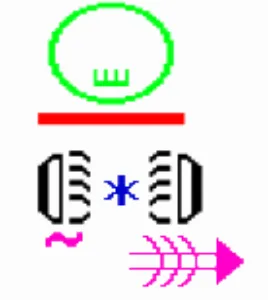
Fig. 1 shows a sign written in SW and illustrates examples of glyphs for (from top to bottom) facial expression (green), shoulders position (red), hand configuration (black), contact (blue, between the hands) and movement (pink). Usually SW is written only in black and white.
Fig. 1 – The LIS sign for “various” written using SW
One of the features that make SW very promising compared with other notations, is that it can express by itself a signed sequence, without further annotations in a written VL.
Fig. 2 - Example of SW text (source: Di Renzo et al., 2012, segment of the “Indian hat” story). The text lays
vertically, from top to bottom and left to right.
3.
SignWriting Editors
The set of glyphs may be roughly considered as an alphabet that can be used to write any SL in the world; this set makes up the International SignWriting Alphabet (ISWA1). The latter is available as an archive of more
than 35,000 images (.png), each representing a single glyph. Due to their huge number, glyphs have been coded by associating to each of them a string of decimals, with labels associated with each numeric component. Labels are used to group the glyphs according to a number of features (e.g. expressions of movements of the represented body part) to ease their handling.
Every two years, on average, ISWA evolves and integrates new glyphs: this causes a change in the coding of glyphs that create confusion between old and new versions.
A re-classification of ISWA was attempted by Bianchini (Bianchini, 2012), with the aim of improving its consistency and effectiveness. Within such re-classification, ISWA was divided in categories, families and sub-families, which contain prototypical glyphs that are “declined” according to rules without exceptions: each glyph is the unique combination of a prototype (from a category), a family and a sub-family, and an implementation of each applicable rule. This new arrangement of ISWA allows users a better understanding of the characteristics governing SW, making SW easier to learn than with the old classification.
In practice, SW is a system devised to allow deaf people as well as linguists to exploit an intuitive and easy-to-grasp written form of (any) sign language.
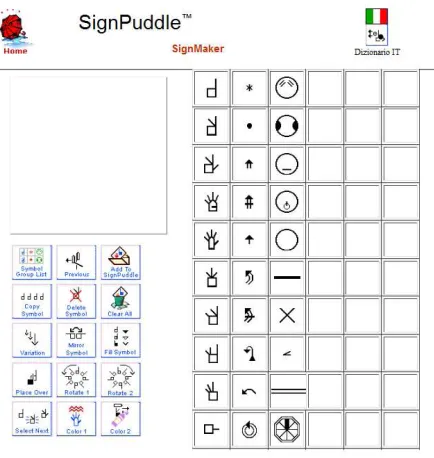
The research team of Valerie Sutton has developed SignMaker2, an application that allow writing and saving
signs using just a web browser. (Fig. 3).
1 for more information see:
<http://www.movementwriting.org/symbolbank/>
2 available at:
Fig. 3 – Home screen of SignMaker.
The expressiveness of the overall interface is quite good, some interface elements give an idea of the function to which they are associated, but all of them can be fully understood only by a small group of people: signing people with a good knowledge of SignWriting (Borgia, 2010). This way, the set of potential SignMaker users narrows.
Fig. 4 – SignMaker’s Glyph Menu: note its tree-like structure.
4.
SWift
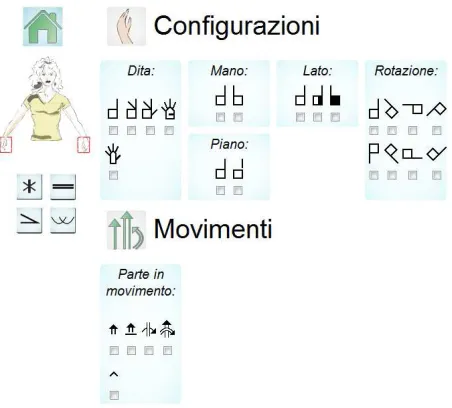
The interface of SWift appears more friendly than that of SignMaker: it minimizes the use of text labels and presents a collection of colorful and familiar icons (Fig. 5). The goal is to make the user feel comfortable and to avoid confusing her/him with a large amount of information. We realized that even a very careful redesign of the interface could not have, by itself, improved an application like the SignMaker. In fact, the redesign of the graphics should have supported a further complete redesign of the logic part of the application.
The interface of the brand-new application SWift was
designed according to some prerequisites:
• Intuitive interface: the user does not need to “learn” to use the interface, he should rather “understand” it; for this purpose, each function is presented in intuitive and familiar way.
• Minimization of information: each interface screen only presents the necessary amount of information, to avoid confusing the user.
• Evocative icons: the icons are simple, familiar and large. If their meaning is not immediately understood, mouseover-activated animations can be started.
• Minimization of text labels: the use of text labels has been limited as much as possible.
• Interface testing: each major change of the interface has been discussed with the team of ISTC-CNR, developed, and double-checked with the team itself, until the appearance of SWift was considered entirely functional to its purpose; it is to underline that the team of ISTC-CNR includes deaf researchers, therefore a true sample of the main target users.
Buttons deserved particular attention. Each one is linked to an animation that demonstrates the effect of the action it performs, in order to support an easy grasp of its function. Although the application has been designed in strict contact with deaf users, we are planning more extensive testing to better analyze its usability and usefulness.
Fig. 5 – Home screen of SWift.
Fig. 6 – Glyph Menu - Search menu for the hands.
Glyphs are chosen in sequence until the desired sign is obtained. The sign can be stored for future reference; signs are stored together with the list of their components, therefore this form of memorization allows computing statistics and studying specific patterns and rules for the composition of glyphs, a great help for linguistic research.
5.
Usability evaluation for SWift
5.1
Spatial Setting
We decided to asses SWift’s capabilities and usability choosing the well-known “Think-Aloud Protocol”, which – given our particular user community – had to be adapted in order to “fit” to deaf users: we can therefore define it a “Sign-Aloud Protocol”. Before building up the test we found out that some steps had already been taken in that way: in fact, Roberts and Fels (2005) suggested a spatial setting to perform Think-Aloud-based usability tests with deaf people, where the environment is recorded by two cameras:
• CAM1 records the participant (rear view), the computer screen and the interpreter;
• CAM2 records the participant (front view) and the investigator.
The problem of using two cameras is the need to analyze two recordings at once instead of one, and to sync the data obtained by the two different sources Furthermore, when dealing with two separate videos, it would be difficult to maintain a synoptic view of everything that happens in the environment at any given time. After all, CAM 1 is only used in one of the experiments described in Roberts and Fels (2005), to obtain additional data from the participant. Bianchini (2012) proposed a system to perform the test using a single camera, introducing the use of a projector (Fig. 7 and Fig. 8).
Fig. 7 - Spatial setting devised for SWift’s evaluation (sketch)
Fig. 8 - Spatial setting devised for SWift’s evaluation (photo)
This way, CAM1 records everything: • PARTICIPANT (front view) • INTERPRETER
• COMPUTER SCREEN (projected on the wall) • (INVESTIGATOR) (might not be necessary)
The camera oblique position (and thus the projector) with respect to the wall of the room is intended to minimize the obtrusion due to the monitor. The brightness of the room needs to be properly calibrated to allow optimal viewing of both the screen being projected on the wall and the signs produced by the participant and by the interpreter.
5.2
Test structure
The test is composed by three phases:
Antinoro Pizzuto, E., Rossini, P., Sallandre, M.A. & Wilkinson, E. (2007). La struttura del discorso segnato: dati sulla LIS, l'ASL e la LSF e nuove prospettive nel quadro di una grammatica dell'iconicità. In Atti del III Convegno nazionale sulla Lingua dei Segni (Verona, 9-11/3/2007).
Bianchini, C.S. (2012). Émergence d'un système d'écriture pour les Langues des Signes et réflexions métalinguistiques conséquentes. 2012. Thèse de Doctorat, Université de Paris VIII - Università degli Studi di Perugia.
Bianchini, C.S., Gianfreda, G., Di Renzo, A., Lucioli, T., Petitta, G., Pennacchi, B., Lamano, L. & Rossini, P. (2010) Écrire une langue sans forme écrite: réflexions sur l'écriture et la transcription de la Langue des Signes italienne (LIS). In Travaux Linguistiques du CerLiCo, 24, pp. 71-89.
Borgia, F. (2010). SWift: Sign Writing improved fast transcriber. Tesi di Laurea specialistica. Università di Roma I.
Boyes-Braem P. (2012, in press), Evolving methods for written representations of Sign Languages of the deaf. In A. Ender, A. Leemann & B. Wälchli (eds.), Methods in Contemporary Linguistics. Berlin, D: de Gruyter Mouton.
Cuxac, C. (1996). Fonctions et structures de l'iconicité des langues des signes. Thèse d’État, Université Paris V. Cuxac, C (2000). La Langue des Signes Française (LSF):
les voies de l'iconicité. Paris, FR: Ophrys.
Di Renzo, A., Gianfreda, G., Lamano, L., Lucioli, T., Pennacchi, B., Rossini, P., Bianchini, C.S., Petitta, G. & Antinoro Pizzuto, E (2009). Representation-analysis-representation: novel approaches to the study of face-to-face and written narratives in Italian Sign Language (LIS). In Actes du CILS Colloque international sur les Langues des Signes (Namur, 16-20/11/2009).
Di Renzo, A., Gianfreda, G., Lamano, L., Lucioli, T., Pennacchi, B., Rossini, P., Bianchini, C.S., Petitta, G. & Antinoro Pizzuto, E (2012). Scrivere la LIS con il SignWriting: manuale introduttivo. Roma, IT: ISTC-CNR
Fajardo, I., Arfe, B., Benedetti, P. & Altoe ́, G.M. (2008). Hyper- link format, categorization abilities and memory span as contributors to deaf users hypertext access. Journal of Deaf Studies and Deaf Education, 13(2), pp. 241–256.
Fajardo, I., Vigo, M., Salmerón, L. (2009). Technology for supporting web information search and learning in Sign Language. Interacting with Computers, 21(4), pp. 243-256,
Garcia, B. & Boutet D. (2006). Finalités et enjeux linguistiques d'une formalisation graphique de la Langue des Signes Française (LSF). Glottopol, 7, pp. 31-52.
Garcia, B. & Derycke, M. (eds.) (2010). Sourds et langues des signes: norme et variations. Langage et société, 131 (special issue).
Garcia, B. & Perini M. (2010). Normes en jeu et jeu des normes dans les deux langues en présence chez les sourds locuteurs de la langue des signes française (LSF). Langage et société, 131.
Gianfreda, G., Petitta, G., Bianchini, C.S., Di Renzo, A., Rossini, P., Lucioli, T., Pennacchi, B. & Lamano, L. (2009). Dalla modalità faccia a faccia a una lingua scritta emergente: nuove prospettive su trascrizione e scrittura della Lingua dei Segni Italiana (LIS). In C. Consani, C. Furiassi, F. Guazzelli & C. Perta (eds.), Oralità/scrittura - In memoria di Giorgio Raimondo Cardona”. Perugia, IT: Ed. Guerra, pp. 387-411. Pizzuto, E. & Rossini, P. (2006). Deixis, anafora and
highly iconic structures: cross-linguistic evidence on American (ASL), French (LSF) and Italian (LIS) signed languages. In Proccedings of TISLR 9 International Congress "Theoretical issues in Sign Language research" (Florianopolis, 6/12/2006).
Pizzuto, E., Pietrandrea, P. (2001). The notation of signed texts: open questions and indications for further research. Sign Language and Linguistics 1/2, pp. 29-43. Pizzuto, E., Rossini, P. & Russo, T. (2006). Representing signed languages in written form: questions that need to be posed. In Proceedings of LREC2006 2nd Workshop “Representation and Processing of Sign Languages: Lexicografic matters and didactic scenarios” (Genova, 25/05/2006).
Prillwitz, S., Leven, R., Zienert, H,. Hanke, T., Henning, J. (1989). Hamburg Notation System for Sign Languages: an introductory guide, HamNoSys version 2.0.. Hamburg, D: Signum Press.
Roberts, V.L., Fels, D.I. (2005). Methods for inclusion: Employing think aloud protocols in software usability studies with individuals who are deaf. International Journal of Human-Computer Studies, 64(6), pp. 489-501.
Slaughter, L., Norman, K. L., Shneiderman, B. Assessing users’ subjective satisfaction with the information system for youth services (isys). In VA Tech Proc. of Third Annual Mid-Atlantic Human Factors Conference, pages 164–170, 1995.
Stokoe, W.C. (1960). Sign language structure: an outline of the visual communication systems of the American deaf. Studies in Linguistics, 8 (occasional papers). Sutton, V. (1995). Lessons in Sign Writing: textbook &