Coreference in Spoken vs. Written Texts: a Corpus-based Analysis
Marilisa Amoia, Kerstin Kunz, Ekaterina Lapshinova-Koltunski
Department of Applied Linguistics, Saarland University
{m.amoia,k.kunz,e.lapshinova}@mx.uni-saarland.de
Abstract
This paper describes an empirical study of coreference in spoken vs. written text. We focus on the comparison of two particular text types, interviews and popular science texts, as instances of spoken and written texts since they display quite different discourse structures. We believe in fact, that the correlation of difficulties in coreference resolution and varying discourse structures requires a deeper analysis that accounts for the diversity of coreference strategies or their sub-phenomena as indicators of text type or genre. In this work, we therefore aim at defining specific parameters that classify differences in genres of spoken and written texts such as the preferred segmentation strategy, the maximal allowed distance in or the length and size of coreference chains as well as the correlation of structural and syntactic features of coreferring expressions. We argue that a characterization of such genre dependent parameters might improve the performance of current state-of-art coreference resolution technology.
Keywords:Coreference Resolution, Corpus-based analysis, Spoken Language
1. Introduction
Coreference resolution, i.e. the identification of refer-ring expressions that point to the same extralinguistic referent in a natural language discourse still remains one of the most demanding tasks in NLP. This was clearly highlighted by various coreference resolution challenges such as MUC-6 (1995), MUC-7 (1997) or ACE NIST (2004) (see (Doddington et al., 2004)) and more recently the CoNNL 2011 (see (Pradhan et al., 2011)) shared task. Interestingly, the baseline for state-of-art systems in the early MUC challenges was about 60-70% and it increased in the ACE 2004 to about 85%. The performance1significantly decreased in the CoNNL 2011 challenge, where the best system achieved 57.79%. An explanation for this decrease is not only that more complex aspects of coreference were included in the task, e.g. the integration of non-nominal reference. We presume that the extension of the dataset to spoken language genres such as broad-cast news and conversations is one major factor for low performance rates as most coreference resolution systems have been developed for processing written text input.
1These values of system performance are based on
dif-ferent metrics: MUC applies the link measure (Vilain et al., 1995), ACE a value-based metric called the ACE-value (Doddington et al., 2004) and ConLL the unweighted mean of the MUC, B_CUBED (Bagga and Baldwin, 1998) and CEAFe(Luo, 2005) measures. However, we think that the
differences are still indicative. Consider, for instance, the performance scores (59.57 and 57.79) of the CoreNLP sys-tem for the metrics MUC and ConLL respectively as re-ported in (Pradhan et al., 2011).
It is not a new issue that difficulties in coreference resolution greatly increase when spoken language is involved. There are some interesting works that pro-pose algorithms for coreference resolution in spoken language. For instance, (Eckert and Strube, 2000) ana-lyze the frequency distribution of personal and demon-strative anaphora in spontaneous speech dialogues and use dialogue act segmentation to improve pronoun res-olution. (Tetreault and Allen, 2004) apply an algo-rithm based on the Question Under Discussion tech-nique for coreference resolution of pronouns in task-oriented dialogues and (Stent and Bangalore, 2010) propose a statistical coreference system for the same domain using a stack model for representing the inten-sional discourse state.
on the comparison of two particular text types, inter-views and popular science texts, as instances of spo-ken and written texts since they display quite different discourse structures. We propose some metrics that might yield a more differentiated classification of the coreference properties in written vs. spoken language genres than has been offered by previous studies. Fur-thermore, we show that the difference in performance of a state-of art coreference extraction system run on both text genres can be explained on the basis of these differing structural properties.
2. Defining the Task: Coreference Resolution
Coreference involves a textual relation that is created between linguistic expressions. This textual relation evokes a conceptual relation of identity between dis-course referents. A coreference relation links at least two linguistic expressions: an antecedent, i.e. a lin-guistic element introducing a new discourse referent, and an anaphor (or cataphor, in the case of forward reference) pointing to the same referent again. Thus, acoreferring expressionmay either be an antecedent or an anaphor, pointing to a referent that is also men-tioned at another point in the same discourse and a
coreference chainis the set of all the coreferring ex-pressions which refer to the same antecedent. Coref-erence resolution is all about tracking the complete set of coreference chains in a text.
Most works on coreference focus on the analysis of anaphors as their specific linguistic features are con-sidered to trigger the coreference relation to the an-tecedent. In our study we provide a fine-grained clas-sification of properties of all coreferring expressions (i.e. antecedents and anaphors) along with a detailed characterization of coreference chains.
More precisely, we focus on the following aspects of coreference:
• Lexical coreference: includes all cases of nom-inal coreference to the same entity through the lexical means such as named entity (NE), head nouns in singular and plural employed as repeti-tions, synonyms, hyponyms etc. e.g. fork, spoon and cutlery in (1). Note that coreferring lexi-cal phrases may be introduced by other means of reference, such as articles and demonstrative determiners and additionally contain modifying elements, such as adjectives (see 2) or relative clauses.
(1) a. Ann put aforkand aspoonon the table.
b. But she forgot thecutleryfor her mother.
(2) a. Annis the daughter of Mary.
b. I metthis beautiful girl in the bus yes-terday.
• Pronominal coreference: includes reference by personal pronouns, demonstrative pronouns, pos-sessive pronouns and their morphological vari-ants, e.g. Mark and John in (3a), they in (3b) andtheir(3c).
(3) a. Yesterday Mark and John entered the bank around the corner.
b. They were masked and were carrying guns.
c. Theirguns were loaded.
3. Evaluation Framework
For our empirical analysis of coreference strategies in different text genres we use a corpus of written and spoken texts (see 3.1.). The corpus is annotated with the deterministic coreference resolution system pro-vided by Stanford CoreNLP (Lee et al., 2011) (see 3.2.). To describe the coreference strategies observed in the corpus, we define a number of metrics described in 3.3.
3.1. Corpus Resources
For the analysis we use a corpus of English including two text genres:
• POPSCI: includes 11 texts on popular science journals composed by experts for an educated lay audience. The written texts are prepared and monologic, hence, there is no direct contact and interaction between speech participants. The top-ics treated are content-oriented, dealing with sci-entific phenomena.
The whole corpus contains about 140000 tokens and each text file includes about 6000 tokens. The spo-ken language texts are manually preprocessed, i.e. the errors have been rewritten and the texts have been nor-malized and segmented into sentences. Furthermore, spoken language features such as fillers, corrections and repetitions are encoded by XML-tags. This spe-cific design allows for an automatic analysis with NLP techniques but still captures main characteristics of spoken language.
3.2. Coreference Annotation
The corpus is annotated with the deterministic coreference resolution system provided by Stanford CoreNLP (Lee et al., 2011). This system achieved the best performance in the CoNLL 2011 unrestricted coreference resolution task. CoreNLP implements an incremental strategy: In order to identify coreferring expressions, first the set of possible mentions (i.e. coreferring items) is identified. Then, in the next suc-cessive steps, the system tries to refine this initial set by pruning mentions which are no more consistent with the model. This is achieved by applying different sieves in sequence. Each sieve applies a deterministic model of coreference, e.g. string matching, mention similarity or pronoun resolution. The sieves are ap-plied in order from the highest to lower precision. At each step the system uses as input the results of the preceeding sieves.
The system deals with nominal and pronominal coerence but does not implement discourse-deictic ref-erence, i.e. it does not account for sentential or VP antecedents. Moreover, from the initial set of noun phrases, named entities and pronouns in the set of pos-sible mentions, those of the type listed below (among others) are pruned and are thus not accounted for by the current version of CoreNLP:
(i) adjectival forms of nations,
(ii) pleonastic-it annotations recognized by means of recurrent/general patterns, e.g.it is possible, etc.
(iii) expressions including numbers such as cardinals, percents, etc.
3.3. Metrics for Comparison
In order to characterize structural differences between texts in written and spoken genres we used the follow-ing metrics:
• Precision, percentage of rightly annotated out of all annotated coreferring expressions.
• T-length, average token length of coreferring ex-pressions.
• Chain Size, i.e. number of coreferring expres-sions in one chain.
• S-distance, average number of sentences sepa-rating coreferring expressions in the same chain.
• Parallelism, number of coreferring anaphors in one chain that exhibit the same or similar syn-tactic features as the antecedent (e.g. sentence-initial subject). Parallelism captures the similar-ity between the syntactic context of the anaphors and their antecedent, e.g.
(4) a. Ann eats many apples.
b. She likes them.
• Grammatical role preferenceof different types of coreferring expressions, e.g. coreferring pro-nouns that are realized as subjects in the sentence in which they occur or coreferring lexical phrases that appear as syntactic objects. The grammati-cal roles investigated are subject and object. In addition, coreferring expressions may appear in lower ranks of the sentence and be embedded in phrases. They are then classified as modifiers.
• Typology of coreferring expressions. We dis-tinguish lexical coreference (named entities and full lexical noun phrases) and different types of pronominal reference (personal, possessive and demonstrative pronouns).
• Morphological Features of coreferring expres-sions (singular vs. plural, 1st, 2nd or 3rd person).
4. Results
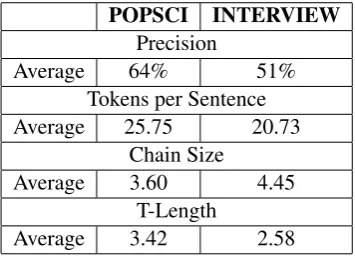
In this section, we outline the results of our prelim-inary analysis of the collected data. The values ob-served for the metrics described in section 3.3. for the written as well as for the spoken corpus are displayed in Table 1 to Table 5. The differences in the values are all statistically significant with p < 0.05 (Student’s t-Test). We start by a discussion of some general fea-tures as shown in Table 1.
In order to determine the precision of the coreference annotation, we have manually corrected 4 out of the 22 texts (2 texts from each subcorpus) that were tagged by the CoreNLP system. The estimated precision2of the recognized referring expressions in spoken (51%) vs. written texts (64%) confirms the results of pre-vious work in that automatic coreference resolution systems differ in their performance to process spoken
2As evaluation metric, we use the link-based MUC
POPSCI INTERVIEW
Precision
Average 64% 51%
Tokens per Sentence
Average 25.75 20.73
Chain Size
Average 3.60 4.45
T-Length
Average 3.42 2.58
Table 1: Comparison of Surface Features.
vs. written texts, and in that the tools perform bet-ter on written than on spoken language. We presume that these differences in performance can be correlated with the different strategies employed to realize coref-erence in written vs. spoken texts.
Indeed, we found evidence in our data that certain fac-tors might be crucial for modeling the structural di-versity of different text genres and thus might be used as a parameter for enhancing automatic reference res-olution. For instance, a comparison of the values we gathered for surface features, such as those summa-rized in Table 1, shows that written text sentences are typically longer than those uttered in spoken language (25.75 vs. 20.73). The same trend can be observed for the T-length parameter, written text coreferring ex-pressions are generally longer than the ones used in spoken language (3.42 vs. 2.58).
This tendency is further confirmed by the observation that, in written texts, lexical coreference (e.g. NE, repetitions) is preferred over pronominal coreference (cf. Table 2). On the contrary, pronominal reference clearly is the most frequent strategy in spoken gen-res. Note that Table 2 only reports the percentage of lexical and pronominal coreference. Their sum is not 100. The rest, i.e. 7.9% for the written and 10.1% for the spoken texts are coreferring expressions of the following types: adjective, adverbs, cardinals, etc. We consider these annotations as errors, as the CoreNLP system is not supposed to annotate other coreference types than nominal and pronominal.
Spoken language constrains referential elements to span shorter (6.5 sentences) textual distance (s-distance between anaphor and antecedent) if com-pared with written text (8.8 sentences in average) (cf. Table 3). However, lexical coreference seems to al-low segments of equal length in both text genres and generally might involve very long spans of text, circa 12 sentences, as compared to 2.5 sentences observed for pronominal reference. These effects might proba-bly be explained by constraints on short term memory
capacity, which manifest to a greater degree in spo-ken than in written language. As for the chain size displayed in Table 3, we find that coreference chains in the spoken texts contain more coreferring expres-sions than the written texts. This is strongly related to speaker orientation, which translates in a high number of first person pronouns, most of which are contained in one and the same coreference chain.
POPSCI INTERVIEW Lexical Coreference
Named Entity 14.1% 7.1%
Noun Phrase 48.9% 25.0%
TOT 63.0% 32.1%
Pronominal Coreference
Personal Pron 18.4% 51.1%
Possessive Pron 7.4% 5.2%
Demonstrative Pron 3.3% 1.5%
TOT 29.1% 57.8%
Table 2: Distribution and Typology of CorefType.
POPSCI INTERVIEW S-Distance
Average 8.8 6.5
Lex 11.3 12.6
Pron 2.5 2.6
This 1.5 2.3
Table 3: S-distance and CorefType
POPSCI INTERVIEW Lexical Coreference
Subj 41.13% 31.75%
Obj 24.46% 53.9%
Mod 34.41% 14.29%
Pronominal Coreference
Subj 86.08% 97.19%
Obj 11.39% 2.81%
Mod 3.0% 0.0%
Table 4: Reference Type and Grammatical Case.
typ-ically manifests in heavy usage of first and second per-son pronouns (see below). Lexical coreference strate-gies exhibit a wider range of grammatical applications in the spoken texts than pronouns as coreferring lexi-cal phrases occur as subjects, objects or as a modifiers. Quite interestingly, the highest distribution in INTER-VIEW is found for objects, followed by subjects. Yet, this can be explained by the fact that old and highly salient information in INTERVIEW is typically repre-sented by pronouns in sentence-initial subject position (see below) and that newer and less salient informa-tion realized by lexical phrases is placed in post-verbal object position. Note that many of the lexical noun phrases are made up of general nouns such aspeople, children, schools. They thus lack semantic specificity and yield a higher referential ambiguity, as compared to POPSCI. Distributions in POPSCI differ largely from INTERVIEW as most coreferring lexical noun phrases appear as subjects, and a fairly high distribu-tion is traced for modifiers. The latter is due to the fact that, in POPSCI, noun phrases generally have a high structural complexity, hence coreferring noun phrases often function as modifiers of superordinated NPs. In addition, coreferring lexical noun phrases in POP-SCI exhibit a high ontological specificity. They are often terminological expressions pointing to domain-specific referents. The lower domain-specificity and higher ambiguity/vagueness tracked in lexical phrases in IN-TERVIEW can be identified as one reason for lower precision in comparison to POPSCI. This particularly holds in cases where orthographical repetition of lex-emes is involved: IN POPSCI, repetitions of termino-logical expressions often evoke coreference (see ex-ample 5a and 5b below).
(5) a. The most sophisticated robotic spacecraft ever built, the Cassini orbiter and the at-tached Huygens probe, were poised atop the launch vehicle, ...
b. Whereas Galileo released a probe to inves-tigate Jupiter’s atmosphere, the Cassini or-biterwill sendthe Huygens probeto Titan, not Saturn.
As example 6a to 6c illustrates, repetitions of general nouns in INTERVIEW are often wrongly assigned to the same coreference chain.
(6) a. the children range from the age of about 3 which is nursery, going up to about 10 or 11 in Year 6...
b. And the childrenand myself are both notic-ing that, so...
c. It’s a nice subject and I think it’s a very essen-tial subject forthe childrennowadays, defi-nitely.
The spoken texts also display a higher number of par-allel syntactic constructions in coreference chains if compared to written texts (16% of all constructions in the spoken vs. 6% in the written). This is mainly due to, first, a higher distribution of canonical sen-tence structures and, second, a less marked position-ing of given/salient and new/less salient information in general. As a result, we found a high number of pronominal subjects occurring in sentence-initial po-sition. Hence, in spoken texts, the most frequent paral-lel syntactic constructions have the structure NP1 VP NP2 or PP, where NP1 is a subject and NP2 is an ob-ject (see e.g. example 7a and 7b), and PP an adverbial complement .
(7) a. Idid my placement at another school in Sut-ton which was lovely, a very nice school, called Westbourne actually.
b. And I did another placement at a school in Leatherhead, so I did 2 placements in my 1 year.
This type of construction is less frequent in the writ-ten discourse, where we observe more variation in the organization of syntactic constituents, and hence, less parallel constructions. This may be due to the fact that sentences generally contain more new and less highly salient information as compared to INTERVIEW. For instance, the preverbal position is often filled with more than one syntactic constituent, resulting in a PP NP VP construction or in clause NP VP (see example 8a-8c).
(8) a. However, at that timeinterferons had never been properly tested in specially designed clinical trials on large numbers of patients, because the drugs were available only in minute quantities.
b. Although many elegant studies were done and the druglooked promising it was never pos-sible to treat enough people with sufficient in-terferon to be sure of the results.
Pronouns: Morphological Types POPSCI INTERVIEW 1st per sg 5.8 % 26.9%
1st per pl 15.5 % 17.8%
3rd per sg 45.1 % 37.7%
3rd per pl 33.1 % 16.9%
2nd per 0,5 % 0.8%
Table 5: Morphology of personal and possessive pronouns.
Other frequent constructions are of the type NP VP1 VP2, where VP2 is expressed by an infinitive, or of the type NP VP PP. Note again that coreferring ex-pressions in POPSCI frequently occur as modifiers because of heavy phrase embedding (consider 7a-c). The comparison of structural diversity across spoken and written texts shows that the diversity in the spo-ken texts is not as rich as in the written ones. This can be partially explained by less variation in the type of coreferential device employed.
Additionally, the two described tables interdepend with the features indicated in Table 5: the distinct mor-phological features of coreferring personal and pos-sessive pronouns in spoken vs. written texts. There are two main contrasts to be highlighted here: First, we trace a much higher number of first person pro-nouns (most notably in singular but also in plural) in INTERVIEW than in POPSCI, which reflects the speaker centered textual function of this text type (see again example 6a/b). Note that the first person pro-nouns are often realized as sentence-initial subjects. In case of speaker turns they belong to different coref-erence chains, which is one cause for a reduced preci-sion rate. The difference in distribution of first person pronouns between the two genres goes along with the second contrast we observe: third person pronouns are less frequent in INTERVIEW than in POPSCI. One in-teresting observation not included in Table 4 is that the distribution of the neuter pronounitis much higher in the INTERVIEW corpus (90.8 % of all third person pronouns in singular and 34% of all pronouns) than in POPSCI (88 % of all third person pronouns in sin-gular and 40% of all pronouns). Our findings hereby confirm those described by (Eckert and Strube, 2000) for spoken texts. The grammatical function ofitvaries from a dummy subject and reference to (non)-nominal antecedents to vague reference to an antecedent that is not clearly defined. Consider 8, whereitin 8b and 8d are coreferring withReigate, but not 8c.
(9) a. I live in a town called calledReigate.
b. It’s between London and the countryside
which is quite nice.
c. Ittakes us about 25 minutes to get to London on the train.
d. It’s I sayit’s a town,it’s more of a village.
Vague reference also is quite frequent for usage of the third person plural form:
(10) a. So you can go and explore these places, a bit like a museum in a way. How does it work language-wise? If you, say, if you go to Rome or to Spain or whatever, is it all in English or is it how dotheydo this?
b. That’s a good question. In some areas you mighttheymight have just one language spo-ken,...
Our observations outlined above are assumed to be one reason for lower precision in INTERVIEW as compared to POPSCI.
5. Conclusions
the coreference items occur might improve corefer-ence resolution for lexical corefercorefer-ence with general nouns. We intend to extend the analysis to other spo-ken genres (e.g. presentations and conversations) and incorporate diversity among spoken language genres in order to identify parameters for a coreference algo-rithm with which systematic differences between writ-ten and spoken texts can be captured.
6. References
A. Bagga and B. Baldwin. 1998. Algorithms for scor-ing coreference chains. In Proceedings of the Lin-guistic Coreference Workshop at The First Inter-national Conference on Language Resources and Evaluation (LRECÕ98), page 563Ð566.
George Doddington, Alexis Mitchell, Mark Przy-bocki, Lance Ramshaw, Stephanie Strassel, and Ralph Weischedel. 2004. The automatic content extraction (ace) program tasks, data, and evaluation. InNIST.
Miriam Eckert and Michael Strube. 2000. Dialogue acts, synchronising units and anaphora resolution. Journal of Semantics, 17(1):51–89.
Kurt Kohn, Petra Hoffstaedter, and Johannes Wid-mann. 2009. Backbone - pedagogic corpora for content and language integrated learning. In Eurocall-2009, Valencia, Spain, September 9-12. Heeyoung Lee, Yves Peirsman, Angel Chang,
Nathanael Chambers, Mihai Surdeanu, and Dan Ju-rafsky. 2011. Stanford’s multi-pass sieve corefer-ence resolution system at the CoNLL-2011 Shared Task. InCoNLL-2011 Shared Task.
Xiaoqiang Luo. 2005. On coreference resolution per-formance metrics. InHLT/EMNLP.
MUC-6. 1995. Coreference task definition. In the Sixth Message Understanding Conference (MUC-6).
MUC-7. 1997. Coreference task definition. In the Seventh Message Understanding Conference (MUC-7).
Sameer Pradhan, Lance Ramshaw, Mitchell Marcus, Martha Palmer, Ralph Weischedel, and Nianwen Xue. 2011. Conll-2011 shared task: Modeling unre- stricted coreference in ontonotes. Inthe Fif-teenth Conference on Computational Natural Lan-guage Learning (CoNLL 2011).
Amanda J. Stent and Srinivas Bangalore. 2010. In-teraction between dialog structure and coreference resolution. InIEEE SLT 2010, Berkeley, USA. Joel Tetreault and James Allen. 2004. Dialogue
struc-ture and pronoun resolution. InDAARC’04, Azores, September 23-24.