Dual-ALU Processor for Speech Signal Processing
Gin-Der Wu and Kuei-Ting Kuo
Department of Electrical Engineering
National Chi Nan University
Puli, Taiwan, R.O. C.
Abstract
This paper proposed a low-cost dual-ALU processor for speech recognition. It does not
give an emphasis on sophistication but on low-cost solution. The dual-ALU architecture
provides parallel calculation capability. For the consideration of chip size, the area of the
second ALU is only half of the first ALU. We use hardware-software codesign method to
implement the speech recognition. The feature extraction bases on LPC-cepstrum
coefficients, and template matching employs Hidden Markov Models (HMM). The processor
is designed to process the HMM and connect with the ASIC of LPC-cepstrum.
Keywords: dual-ALU, parallel calculation, hardware-software codesign, LPC-cepstrum,
Hidden Markov Models.
1.
Introduction
The implementation of the speech recognition can be classified as software design
[1]-[3] and hardware-software codesign method [4][5]. Although the high-performance
Digital Signal Processor (DSP) can speed up the recognition time, the cost is relatively
high. The hardware-software codesign method can solve this problem [4]. We proposed
the dual-ALU architecture processor to provide the parallel calculation capability. In
addition, we utilize the ASIC of LPC-cepstrum. This ASIC of LPC-cepstrum can reduce
the computation load of processor. To reduce the area of a chip, the resource sharing
method is adopted into the design of LPC-cepstrum. In addition, since the proposed high
speed Dual-ALU processor has the parallel calculation capability, it can run more
complicated algorithm of speech recognition. For comparison, we obtain the recognition
rate by the single-ALU processor and dual-ALU processor, respectively. From the
experiments, since the dual-ALU can efficiently reduce the run time, the dual-ALU
2.
Dual-ALU Architecture Processor
The flowchart of the speech recognition system is shown in Fig. 1.
Figure 1. The flowchart of the speech recognition system
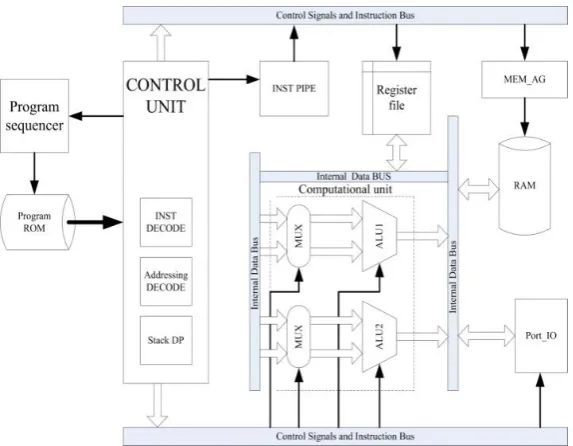
We proposed the dual-ALU DSP processor structural block diagram in Fig. 2.
Figure 2. The dual-ALU processor structural block diagram.
It can be divided into the control unit, data register file, computational unit, memory
address generator, embedded data memory and program sequencer. The computational
unit performs the numeric processing of speech recognition. These paths get data from
registers in the data register file. In addition, computational instructions provide
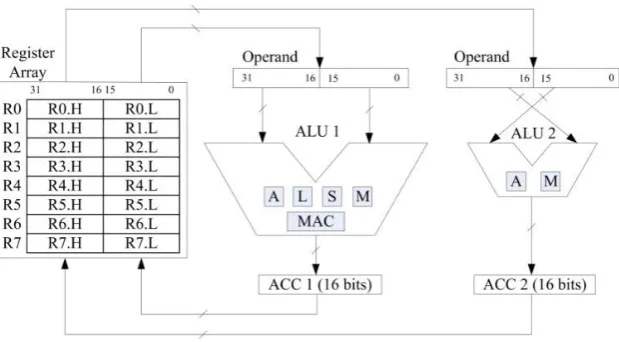
The architecture of the dual-ALU processor is shown in Fig. 3. It can operate two
instructions at the same time.
Figure 3. Dual-ALU architecture.
The first ALU (ALU1) performs arithmetic, logic, multiplication, shift, execute
multiply/add and multiply/subtract operations. The second ALU (ALU2) performs
arithmetic and multiplication operations. Data flow paths through the computational units
are arranged in parallel. The output of any computational unit may serve as the input of
any computational unit in the next instruction cycle. Data moving in and out of the
computational units goes through a register file which consists of eight registers. By
using the parallel data paths within the dual-ALU, this processor can support the parallel
computation. Hence we can use single instruction to get two operation results from the
The instruction set is the interface between the hardware and the software. The
performance of the processor depends on the instructions. The instruction set is 32-bit
formats. We define seven instruction types including Data-transfer, Boolean, Add/Sub,
Mac, Dual-ALU, Shift/Rotate, and Control.
For the considerations of testability in circuit, there are two auxiliary circuits for
DFT. First, we created Built-In-Self-Test (BIST) [6] circuit for the embedded memory of
SRAM. The BIST controller uses the test algorithm to write test patterns into embedded
memory. Then it reads each data from embedded memory in order to compare with the
test pattern. Hence we can detect any error in the embedded memory. Secondly, one scan
chain is inserted into each module of the processor by using DFT-compiler. In this part,
all sequence logic includes BIST circuits. With the scan test, the chip can be tested easily.
3.
Speech Recognition
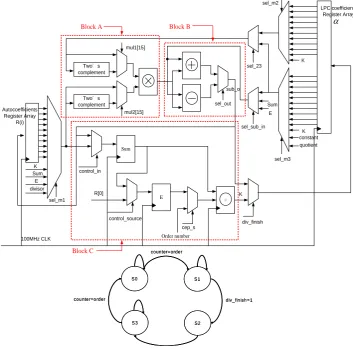
In this section, we used the ASIC hardware to implement the lpc-cepstrum
coefficient. This hardware can reduce the load of the proposed dual-ALU processor. The
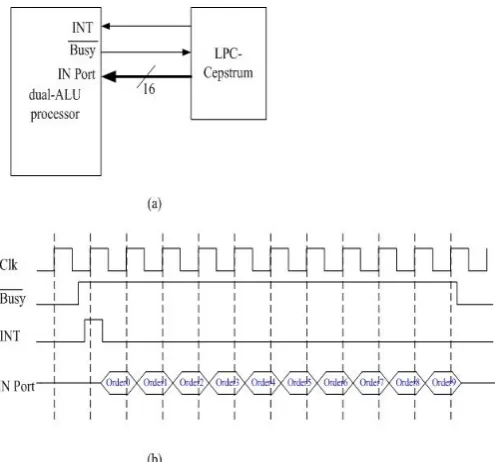
The data type in the ASIC of LPC-cepstrum is shown in Fig. 6. In Fig. 7 (a), we
build the protocol to connect the LPC-cepstrum circuit with the proposed dual-ALU
processor. Fig 7 (b) shows the waveform of this protocol. When the port of “Busy” and “INT” are “High”, the LPC-cepstrum will be sent to “IN" port of the dual-ALU processor. After receiving the 10th transmission data, the port of “Busy” becomes “Low”.
Then the dual-ALU processor begins to implement the HMM algorithm.
Figure 6. The data type in the ASIC of LPC-cepstrum.
Figure 7. (a) Structure of the dual-ALU processor connect with the ASIC of
4.
Experiments
The proposed dual-ALU structure processor is synthesized by UMC 0.18um 1P6M
standard library. The chip works correctly in both RTL and gate-level simulation. The
working frequency can reach 100MHz. The die size is 2.073 x 2.073 2
mm , and the 128-pin
CQFP package is used. The core size of the processor is 1.481 x 1.483 2
mm . The gate
counts is about 24K. For the speech recognition, the program performs 2849463 cycles
(28.5 ms) in 100MHz. Since each frame size is 240 points (30 ms), this processor can run
in real time.
We adopt chinese digit (0-9) words from 10 speakers. Everyone speaks 10 times.
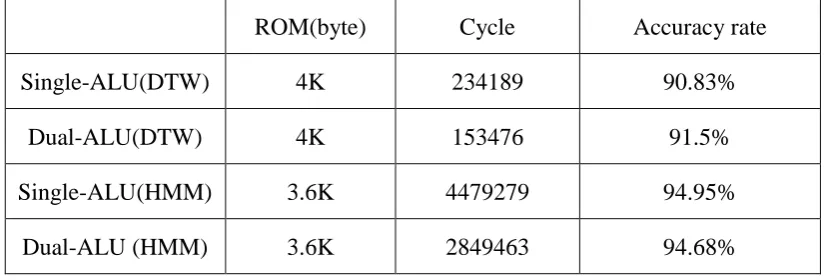
The speech signal is sampled in 8 KHz and 16-bit format. In Table 1, we obtain the
recognition rate by the single-ALU processor and dual-ALU processor, respectively. For
comparison, we use two different algorithms to implement the speech recognition. They
are Dynamic Time Warping (DTW) and Hidden Markov Models (HMM). From the
experiments, since the dual-ALU can efficiently reduce the run time, the dual-ALU
structure outperforms the single-ALU structure. In addition, HMM has higher accuracy
rate than DTW.
Table 1. Performance comparison between the single-ALU and dual-ALU processor.
ROM(byte) Cycle Accuracy rate
Single-ALU(DTW) 4K 234189 90.83%
Dual-ALU(DTW) 4K 153476 91.5%
Single-ALU(HMM) 3.6K 4479279 94.95%
5.
Conclusion
This paper proposed a low-cost dual-ALU processor for speech recognition. We use
hardware-software codesign method to implement the speech recognition. This
dual-ALU architecture provides parallel calculation capability. In addition, the area of the
second ALU is only half of the first ALU in order to reduce the chip size. The feature
extraction bases on LPC-cepstrum coefficients, and template matching employs Hidden
Markov Models (HMM). The dual-ALU processor is designed to connect with the ASIC
of LPC-cepstrum. The processor can work at 100MHz. In our experiments, since the
dual-ALU can efficiently reduce the run time, the dual-ALU structure outperforms the
single-ALU structure.
References
[1] Phadke S., Limaye R., Verma S. and Subramanian K., “On Design and Implementation of
an Embedded Automatic Speech Recognition System,” Proceedings of the 17th
International Conference on VLSI Design, pp.127-132, 2004。
[2] Shi Yuanyuan, Liu Jia and Liu Runsheng., “Single-chip speech recognition system based
on 8051 microcontroller core,” IEEE Transactions on Consumer Electronics, vol.47,
Issue: 1, pp.149-153, Feb, 2001。
[3] Heungsuk Chin, Kim J. Kown Y., Lee K. and Sang-ll Yang, “Realization of speech
recognition using DSP (digital signal processor),” Proceedings of the IEEE international
Symposium on Industrial Electronics, vol.1, pp.508-512, June, 2001。
[4] Chow K.F., Liew S.C. and Lua K.T., “Thin client front-end processor for distributed
speech recognition,” Proceedings of the International Conference on Acoustics, Speech,
and Signal Processing, vol.2, pp.29-32, April, 2003。
[5] Rajeev Krishna, Mahlke S. and Austin T., “Memory system design space exploration for
low-power, real-time speech recognition,“ International Conference on
Hardware/Software codesign and System Synthesis, pp.140-145, 2004。
[6] TurboBIST-Memory SRAM Built-In-Self-Test Generator Reference Manual, SynTest