102
Naive Regularizers for Low-Resource Neural Machine Translation
Meriem Beloucif1, Ana Valeria Gonzalez2, Marcel Bollmann2, and Anders Søgaard2 1Language Technology Group, Universität Hamburg, Hamburg, Germany
2Dpt. of Computer Science, University of Copenhagen, Copenhagen, Denmark
Abstract
Neural machine translation models have little inductive bias, which can be a disad-vantage in low-resource scenarios. They require large volumes of data and often perform poorly when limited data is avail-able. We show that using naive regular-ization methods, based on sentence length, punctuation and word frequencies, to pe-nalize translations that are very different from the input sentences, consistently im-proves the translation quality across mul-tiple low-resource languages. We ex-periment with 12 language pairs, vary-ing the trainvary-ing data size between 17k to 230k sentence pairs. Our best regularizer achieves an average increase of 1.5 BLEU score and 1.0 TER score across all the language pairs. For example, we achieve a BLEU score of 26.70 on the IWSLT15 English–Vietnamese translation task sim-ply by using relative differences in punc-tuation as a regularizer.
1 Introduction
One of the major challenges when training neu-ral networks is overfitting. Overfitting is what happens when a neural network in part memo-rizes the training data rather than learning to gen-eralize from it. To prevent this, neural machine translation (NMT) models are typically trained with an L1 or L2 penalty, dropout, momentum, or other general-purpose regularizers. General-purpose regularizers and large volumes of training data have enabled us to train flexible, expressive neural machine translation architectures that have provided a new state of the art in machine transla-tion.
For low-resource language pairs, however,
where large volumes of training data arenot avail-able, neural machine translation has come with diminishing returns (Koehn and Knowles, 2017). The general-purpose regularizers do not provide enough inductive bias to enable generalization, it seems. This is an area of active research, and other work has explored multi-task learning (Firat et al.,
2016;Dong et al.,2015), zero-shot learning ( John-son et al.,2016), and unsupervised machine trans-lation (Gehring et al., 2017) to resolve the data bottleneck. In this paper, we consider a fully com-plementary, but much simpler alternative: naive, linguistically motivated regularizers that penalize the output sentences of translation models depart-ing heavily from simple characteristics of the input sentences.
The proposed regularizers are based on three surface properties of sentences: their length (mea-sured as number of tokens), their amount of punctuation (measured as number of punctuation signs), and the frequencies of their words (as mea-sured on external corpora). While there are lan-guages that do not make use of punctuation (e.g., Lao and Thai), in general these three properties are roughly preserved across translations into most languages. If we translate a sentence such as(1), for example:
(1) That dog is a Chinook.
it is relatively safe to assume that a good trans-lation will be short, contain at most one dot, and contain at least one relatively frequent word (for dog) and at least one relatively infrequent word (forChinook). This assumption is the main mo-tivation for our work.
Two of the regularizers are derived directly from the input, without relying on any additional lin-guistic resources. This makes them adequate for low-resource settings, where the availability of lin-guistic resources can generally not assumed. Our third regularizer (frequency) only assumes access to unlabeled data. (b) We show that regulariz-ing a standard NMT architecture usregulariz-ing naive regu-larization methods consistently improves machine translation quality across multiple low-resource languages, also compared to using more standard methods such as dropout. We also show that com-bining these regularizers leads to further improve-ments. (c) Finally, we present examples and analy-sis showinghowthe more linguistically motivated regularizers we propose, help low-resource ma-chine translation.
2 Related Work
End-to-end neural machine translation is based on encoder–decoder architectures (Sutskever et al.,
2014;Cho et al.,2014;Luong et al.,2015a,2017), in which a source sentence x = (x1, x2, ..., xn)
is encoded into a vector (or a weighted average over a sequence of vectors) z = (z1, z2, ..., zn).
The hidden state representingzis then fed to the transducer (also called decoder) which generates translations, noted asy= (y1, y2, ..., ym).
Neural machine translation has achieved state-of-the-art performance for various language pairs (Luong et al., 2015a; Sennrich et al., 2015; Lu-ong and Manning,2016;Neubig, 2015;Vaswani et al.,2017), especially when trained on large vol-umes of parallel data, i.e., millions of parallel sen-tences (also called bi-sensen-tences), humanly trans-lated or validated. Such amounts of training data, however, are difficult to obtain for low-resource languages such as Slovene or Vietnamese, and in their absence, neural machine translation is known to come with diminishing returns, suffering from overfitting (Koehn and Knowles,2017).
In order to avoid overfitting, NMT models are often trained withL1orL2regularization, as well as other forms of regularization such as momen-tum training or dropout (Srivastava et al., 2014;
Wang et al., 2015; Miceli Barone et al., 2017). However, these regularization methods are very general and do not carry any language specific in-formation.
On the other hand, it has been shown that trans-fer learning approaches using out of domain data,
such as the European Parliament data1, to regu-larize the learning helps improve the translation quality (Miceli Barone et al., 2017). This ap-proach produces good results, but it is not appli-cable in low-resource settings because it requires large amounts of data in the language of interest. To the best of our knowledge, our work is the first to introduce naive, linguistically motivated regu-larization methods such as sentence length, punc-tuation and word frequency.
3 Model Description
3.1 Baseline
In order to show the impact that our regulariz-ers have on the translation quality, we use an off-the-shelf NMT system described by Luong et al. (2017) as our baseline. The model con-sists of two multi-layer recurrent neural networks (RNNs), one that encodes the source language and one that decodes onto the target language. For the encoder cell, we use a single Long Short-Term Memory (LSTM) layer (Hochreiter and Schmid-huber, 1997) and output the hidden state, which then gets passed to the decoder cell.
We train our models to minimize the cross-entropy loss and back-propagate the loss to up-date the parameters of our model. We upup-date net-work weights using Adam optimization (Kingma and Ba, 2014), which calculates the exponential moving average of the gradient and squared gradi-ent, and combines the advantages of AdaGrad and RMSProp. For the purpose of comparison, we set the dropout to 0.2, similar toLuong et al.(2015b).
3.2 Regularized NMT
To apply our new regularizers, we add each reg-ularizer to the loss function during the training of the NMT model (Luong et al.,2015a;Luong and Manning, 2016; Luong et al., 2017). Since we aim to minimize the cross-entropy loss, this means that we favor training instances which have a low penalty from the regularizers (e.g., a small length difference). Importantly, we do not use dropout in this scenario, as we want to contrast our naive, but linguistically motivated signals with a tradi-tional, but not linguistically motivated regulariza-tion method, i.e., dropout.
Furthermore, we do not explore alternative ways for adding regularizers to the loss func-tion here (other alternatives could be to have a
weighted penalty which is then tuned to find the best penalty and added to the loss function for test-ing). The main purpose of this work is to study the effect of naive linguistically motivated regu-larizers and show that they can improve translation quality; we leave it to future work to find the op-timal configuration of regularizers that maximizes the overall translation quality.
4 Naive Regularizers
4.1 Length-Based Regularizer
NMT models have shown to suffer “the curse of sentence length”, and it has been hypothesized that this is due to a lack of representation at the de-coder level (Cho et al.,2014;Pouget-Abadie et al.,
2014). Our proposed sentence-length-based regu-larizer penalizes relative differences between the input and the MT output lengths during the train-ing of the NMT model:
reglength=|l0−l1| (1) Here,l0andl1represent the input sentence and the MT output sentence lengths, respectively, as mea-sured by the number of words (not to be confused withL1 andL2 regularization methods).
Note that this regularizer is different from the word penalty feature in phrase-based machine translation (Zens and Ney,2004), which only pe-nalizes the target sentence length. The relative dif-ference between the input and the MT output sen-tence lengths is also used as a feature inMarie and Fujita(2018).
4.2 Punctuation-Based Regularizer
The punctuation-based regularizer penalizes train-ing instances whenever the amount of punctua-tion marks in the input sentence differs from the amount in the MT output sentence. It is computed as follows:
regpunct=|p0−p1| (2) Here,p0andp1is the total number of punctuation marks in the input and the MT output sentence, respectively.
Unfortunately, the only available methods to generate more efficient NMT models have in-cluded data intensive methods such as sentence alignment (Bahdanau et al., 2014). Some very early research done in alignment used simple
methodologies such as punctuation-based align-ment (Chuang et al., 2004). Our second regular-izer is based on this simple idea, as it penalizes training instances where the quantities of punctu-ation marks differ between input and MT output sentences. Example(2)is taken from the training set of the French–English translation task:
(2) IN Pas parce qu’ils sont moins bons, pas parce qu’ils sont moins travailleurs. REF And it’s not because they’re less smart,
and it’s not because they’re less diligent. OUT And . . . .
We note that the punctuation in the French input sentence matches the punctuation of the desired English reference. However, during an early train-ing step, the NMT model translates the input to a sequence containing six times the number of punc-tuation marks in the input sentence, which is ob-viously incorrect. Our punctuation regularizer fur-ther penalizes examples like this one.
4.3 Frequency-Based Regularizer
Our last regularizer is based on the distribution of word frequencies between the source and the tar-get sentences. Generally speaking, if the source sentence contains an uncommon word, we assume that its translation in the target language is also uncommon. The intuition behind this regularizer is that if the source sentence contains one uncom-mon word and three comuncom-mon words, then its ac-curate translation should contain similar word fre-quencies. The example below is extracted from the English–French translation task:
(3) IN But now there is a bold new solution to get us out of this mess.
REF Mais il exist une solution audacieuse pour nous en sortir.
OUT Mais maintenant il y a une solution pour nous en sortir.
The English sentence contains the frequent word thereand the less frequent wordbold. The French output sentence is acceptable, but it is not accu-rate since the English word bold (audacieuse in the reference translation) was omitted in the out-put. During training, the frequency regularizer pe-nalizes such cases that have a big divergence be-tween the word frequencies in the input and output sentences.
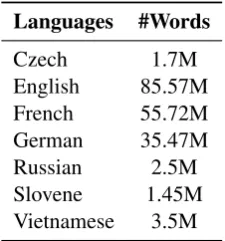
Languages #Words
Czech 1.7M
English 85.57M
French 55.72M
German 35.47M
Russian 2.5M
Slovene 1.45M Vietnamese 3.5M
Table 1: The size of the Wikipedia dumps (#words) used to calculate word frequencies for each language.
is to calculate how different the MT output sen-tence is from the source input in terms of vocab-ulary distribution. For instance, the frequency of using the wordchauve-sourisin French is almost similar to the frequency of using its English trans-lationbat in English. The same could be applied for the more frequent words such asetin French and its English translationand.
We start by computing the frequency vectors
−→
vin and −→vout, containing the frequency for every wordwi in the input and MT output sentence,
re-spectively:
−
→v =hf(w
1), . . . , f(wn)i (3)
To calculate the word frequenciesf(w)for each language, we use the Wikipedia database2 as an external resource. Table 1 contains the size of the datasets (in number of words) used to estimate these. We note that there is considerably more data for English and French than for e.g. Vietnamese (cf. Table.1); we discuss the effect that this might have on the results in Sec.6.
We interpret the resulting frequency vectors−→v as distributions, for which we now calculate the Kullback-Leibler (KL) divergence to obtain our regularization term:
regfreq=DKL(−v→in,−→vout) (4) Essentially, this regularizer penalizes transla-tions if their word frequency distributransla-tions diverge too strongly from those of the source sentence.
(4) IN It was a big lady who wore a fur around her neck
REF C’était une dame forte qui portait une fourrure autour du cou
2https://en.wikipedia.org/wiki/Wikipedia:Database
Languages Sentence Pairs
Train Development Test
Czech 122,382 480 1,327
French 232,825 890 1,210
German 206,112 888 1,080
Russian 178,165 887 1,701
Slovene 17,125 1,144 1,411
Vietnamese 133,317 1,553 1,268
Table 2: The size of the training data in sentence pairs. To test our proposed models, we experi-ment by translating to/from English for every non-English language.
OUT C’était une femme forte portant une fourrure autour du cou
Example(4)shows an input sentence and its MT output, for which we would compute the fre-quency vectors as follows:
−→
vin =hf(‘it’), f(‘was’), . . . ,f(‘neck’)i
−→
vout =hf(‘c’était’), f(‘une’), . . . ,f(‘cou’)i
5 Experiments
5.1 Data
The purpose of our experiments is to show that sig-nals such as sentence length, punctuation or word frequency help improve the translation quality of a standard neural machine translation architecture. To that effect, we experiment with 12 translation tasks, translating from English to six low-resource languages, and vice versa.
The six languages represent the following lan-guage families: Slavic, Romance, Germanic, and Austro-Asian. We further vary the size of the training data to test how our regularization meth-ods affect the quality of the MT output in differ-ent setups. Table2 contains the size of the train-ing, development and test set for every language pair. Note that the training sets vary considerably in size, from 17k sentence pairs for Slovene to al-most 233k for French.
Preprocessing The purpose of our experiments is to learn how to efficiently translate low-resource languages. For that purpose, we do not use any advanced preprocessing for any of our translation tasks except tokenization where we use the script from the Moses toolkit (Koehn et al.,2007). We also set the maximum sentence length to 70 tokens and the vocabulary size to 50k.
5.2 Training Details
We use the attention-based model described in Lu-ong et al.(2015b). Our model is composed of two LSTM layers each of which has 512-dimensional units and embeddings; we also use a mini-batch size of 128. Adding an attention mechanism in neural machine translation helps to encode rele-vant parts of the source sentence when learning the model. We propose to add additional regularizers on top of the attention-based model at each trans-lation step.
We have noticed that the convergence highly de-pends on the language pairs involved. While our baseline model is identical to the NMT model de-scribed byLuong et al. (2015b), we deviate from their training procedure by continuing the training until convergence, which for us took 15 epochs in-stead of the 12 epochs described by the authors. The convergence in our case is measured by the models having no improvements on the develop-ment set over five epochs.
Table 3shows that our baseline is +1.5 BLEU points better than the scores reported by Luong et al.(2015b). On top of that, our length-based and punctuation-based models produce a statistically significant improvement over the baseline (+0.5 BLEU points).
We train all our models automatically until con-vergence. In Table 4, we report the number of epochs it took to converge by translation task when translating to/from English. We note that except for Czech and Slovene, which converged the quickest, most of the translation tasks took be-tween 15k and 20k steps to converge.
6 Evaluation
In order to show that the naive regularizers which we propose in this paper significantly boost the translation quality, we test the machine transla-tion output using the toolkit MultEval defined in
Clark et al. (2011). In this paper, we report the results using three commonly used metrics: the
n-System BLEU
Luong et al. (2015) 23.30
Luong et al. (2017) (dropout=0.2) 25.10 Baseline (dropout=0.2) 26.43
+ Length 26.77
+ Punct 26.71
+ Frequency 26.12
+ Combined 27.13
Table 3: Baseline vs. our proposed models on the English–Vietnamese translation task, using the same dataset as Luong et al. (2015b). The sults in bold represent statistically significant re-sults compared to the baseline according to Mul-tEval (Clark et al.,2011).
Translation Task #Steps
Lang→English
Czech 12K
French 20K
German 20K
Russian 22K
Slovene 10K
Vietnamese 15K
English→Lang
Czech 12K
French 22K
German 20K
Russian 18K
Slovene 11K
Vietnamese 15K
Table 4: Number of steps it took until the models stopped improving for all the translation tasks.
gram based metrics BLEU (Papineni et al.,2002) and METEOR (Banerjee and Lavie,2005), as well as the error-rate based metric TER (Snover et al.,
2006). The evaluation metric BLEU (Papineni et al.,2002) is based onn-gram matching between the input and the output, whereas the error-rate based metric TER (Snover et al.,2006) measures how many edits are needed so that the machine translation resembles the man-made reference.
6.1 Results
System Languages
Czech French German Russian Slovene Vietnamese
EN→Lang
Baseline 14.01 32.13 22.07 12.87 5.60 26.43 Length 14.65 32.32 21.64 12.81 4.98 26.77
Punct 14.98 32.79 22.89 13.06 5.64 26.71 Frequency 14.75 33.47 22.14 13.50 1.95 26.12
Lang→EN
Baseline 21.32 31.51 24.41 15.39 8.85 24.94 Length 21.83 31.09 24.56 15.29 9.05 25.87
Punct 21.96 32.43 25.17 16.36 9.63 25.32 Frequency 21.88 32.26 24.87 15.90 9.18 24.35
(a) BLEU
EN→Lang
Baseline 17.62 51.11 40.47 16.12 26.52 11.46 Length 18.41 51.10 39.93 16.80 27.03 12.01 Punct 18.43 51.67 41.18 16.77 27.00 12.30
Frequency 18.16 52.10 40.57 16.79 26.95 12.29
Lang→EN
Baseline 24.66 31.77 27.23 20.63 16.28 28.11 Length 25.07 31.55 27.11 20.65 15.95 28.71
Punct 25.10 32.31 27.75 21.45 17.05 28.48
Frequency 25.27 32.16 27.43 20.80 16.85 27.86
(b) METEOR
EN→Lang
Baseline 62.64 49.21 57.17 70.17 77.20 54.29 Length 62.18 48.96 57.90 70.85 79.51 53.93
Punct 61.69 48.57 57.24 70.04 77.02 54.03 Frequency 62.46 48.87 57.63 69.40 87.20 54.99
Lang→EN
Baseline 57.06 46.42 53.31 63.62 72.46 53.66 Length 55.68 46.44 53.29 63.31 72.54 52.74
Punct 56.29 45.37 52.31 62.24 72.11 53.51 Frequency 57.32 45.55 52.75 62.10 75.73 54.72
(c) TER
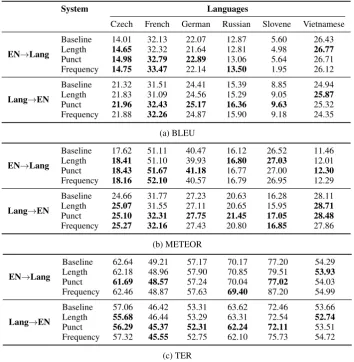
Table 5: Contrasting our three proposed models to the baseline (NMT;Luong et al., 2017) across 12 translation tasks. We evaluate all the models using BLEU, METEOR and TER. The bold values rep-resent the models that show statistically significant improvements over the baseline (p < 0.001;Clark et al.,2011). Note that for BLEU and METEOR, higher is better, while for TER, lower is better. All regularization schemes almost consistently lead to improvements, with the punctuation-based regularizer achieving the highest gains.
baseline across almost all language pairs for all models and across all metrics. We obtain statis-tically significant results for almost all translation tasks for at least one regularization method.
More specifically, the punctuation regularizer outperforms all the other models on all transla-tion tasks except for French–English and English– French. For the latter, we observe that the word frequency regularizer is better than the other sys-tems. This could be explained by the fact that the English vocabulary has many words borrowed from French, which makes the word frequency regularizer a better signal than punctuation or sen-tence length for this specific task. It also could be due to the fact that both English and French have the largest vocabulary for training the word
frequencies (cf. Table1; English has around 80M words and French has around 50M words, whereas all other languages have much less data).
transla-tion tasks, even though the vocabulary size for es-timating the word frequencies is lower for Czech. We hypothesize that this is due to the Czech train-ing set betrain-ing seven times larger than the Slovene one. We hypothesize that this is due to the fact that for Slovene we only have 17K sentence pairs for the training step; whereas for Czech, we have 122K sentence pairs, which helped control the model compared to Slovene.
One case where the punctuation regularizer suc-ceeds consistently is on the English–German and German–English translation tasks, with an error reduction of about 1 TER point. This reflects the similarity in punctuation between these languages. Although we also observe improvements using the other regularization methods, e.g. the length-based method, these are not statistically significant here as calculated by MultEval (Clark et al.,2011).
Table3shows the BLEU scores of seven differ-ent systems including the one where we combine our three regularizers on the English–Vietnamese translation task. The combined regularizer does not only produce a statistically significant im-provement of almost 1-BLEU point over the at-tention based baseline, but it also outperforms all the other regularizers achieving a BLEU score of 27.23.
7 Translation Examples
The punctuation regularizer outperforms the base-line in most cases, and all of our regularization methods show statistically significant improve-ments in at least one language. Below we present examples, extracted from the test data, of how each of the regularization methods affects the out-put in comparison to the baseline model. The pur-pose of the examples is to show how each objec-tive function in the learning component affects the performance component.
7.1 Frequency-Based Regularizer
The frequency-based regularization method penal-izes cases where the distribution of the target vo-cabulary greatly differs from the source vocabu-lary. We have noted a significant improvement for this specific regularizer when translating from French to English and vice-versa. Examples (5)
and(6)show how this regularizer is improving the translation output.
(5) IN 90 % de notre temps entourés par l’architecture .
REF That’s 90 percent of our time sur-rounded by architecture .
BASE <unk> percent of our time via archi-tecture .
FREQ<unk> percent of our time sur-roundedby architecture .
(6) IN Débloquer ce potentiel est dans
l’intérêtde chacun d’entre nous . REF Unlocking this potential is in the
inter-estof every single one of us . BASE <unk>that potential is in all of us . FREQ<unk>that potential is in theinterest
of all of us .
More precisely, entourés in French is almost as frequent assurroundedin English, which is a word that our model with frequency-based regulariza-tion translates correctly, while the baseline does not. Additionally, in Example(6), our model has a better fluency and adequacy than the baseline since it not only correctly translatesl’intérêtto in-terest, but also correctly producesof allinstead of in all, as in the baseline output.
7.2 Punctuation-Based Regularizer
The punctuation-based regularization performs best in the German–English and English–German translation tasks. This regularizer penalizes cases where the difference in the number of punctuation between the source and the target sentences is par-ticularly large. As seen in Example (7), simply introducing this bias into a translation model leads to an output which more closely matches the punc-tuation of the source and target sentences.
(7) IN Und die Antwort , glaube ich , ist ja . [ " F = T ∇ Sτ " ] . Was Sie ger-ade sehen , ist wahrscheinlich die beste Entsprechung zu E = mc2 für Intelli-genz , die ich gesehen habe .
REF And the answer , I believe , is yes . [ " F = T ∇ Sτ " ] What you’re see-ing is probably the closest equivalent to an E = mc2 for intelligence that I’ve seen .
BASE And the answer , I think , is yes . PUNCAnd the answer , I think , is yes .[" R
= T T<unk>"]What you’re looking at is probably the best<unk> <unk> <unk>of intelligence that I’ve seen .
cap-ture anything from the input except for the first part up to “. . . is yes.” Our punctuation-based model, however, manages to capture most parts of the sentence.
7.3 Length-Based Regularizer
Finally, the length-based regularization method leads to noticeable improvements in the Czech– English and English–Czech translation tasks. Ex-ample (8) shows that introducing an input sen-tence length bias led to an MT output that is much closer to the reference than the baseline. The input sentence consists of 12 tokens (including punctu-ation), the baseline output consists of 10 tokens, while our length based regularization model pre-serves the length of 12 tokens.
(8) IN V roce 2009 jsem ztratila nˇekoho , koho jsem velmi milovala .
REF In 2009 , I lost someone I loved very much .
BASE In 2009 , I lost somebody who I loved . LEN In 2009 , I lost somebody who I loved
very much .
7.4 General Improvements
The Slovene dataset is our smallest with about 17k sentence pairs for training. Despite the low amount of resources available in Slovene, we found that introducing very naive linguistic biases into our machine translation models actually leads to subtle differences that result in an output closer to the reference, not only lexically, but also seman-tically. In Example (9), we compare the output of the frequency based system against the baseline for the Slovene to English translation:
(9) IN In kaj potem ?
REF And so , what after that ? BASE And thenthen?
FREQ And then, what?
In this particular case, the frequency based regu-larization model takes care of the translation of the wordwhat, and although the wordsois not trans-lated, the overall meaning of the source is pre-served.
(10) IN Imeti moraš otroke , da preživiš . REF You need to have children to survive . BASE Well you have the kids that you
needto educate .
FREQ Youhave to have kidsto educate .
Example(10)shows another case of how the out-put of the frequency-based regularization system actually shows overall improvements in an ex-tremely low-resource language. The output of our system is semantically closer to the reference than the baseline output, up to the wordeducate. In ad-dition, the system preserves a similar length as the source sentence.
(11) IN Mi smo tu na vrhu . REF We are here on top . BASE Whatwe are at the top . FREQ We arehereat the top .
Finally, Example(11) shows a low-resource case where our system manages to make subtle changes in order to reach the correct translation, whereas the baseline system does not.
8 Conclusion
We have shown that using naive regularization methods based on sentence length, punctuation, and word frequency consistently improves the translation quality in twelve low-resource transla-tion tasks. The improvement is consistent across multiple language pairs and is not dependent on the language family. We have reported and dis-cussed examples demonstrating why and how each regularizer is improving the translation quality.
Our proposed approach shows that even naive, but linguistically motivated, regularizers help improve the translation quality when training NMT models. We believe this shows the useful-ness of using task-related regularizers for improv-ing neural models, and opens the door for future work to exploit these regularization methods in an even more efficient manner by experimenting with different ways of combining the regularizers with the loss function.
References
Dzmitry Bahdanau, Kyunghyun Cho, and Yoshua Bengio. 2014. Neural machine translation by jointly learning to align and translate. CoRR
abs/1409.0473. http://arxiv.org/abs/1409.0473.
Satanjeev Banerjee and Alon Lavie. 2005. Me-teor: An automatic metric for mt evaluation with improved correlation with human judgments.
In Proceedings of the ACL Workshop on
Intrin-sic and ExtrinIntrin-sic Evaluation Measures for
Ma-chine Translation and/or Summarization.
Fed-Proceedings of the 40th Annual Meeting of
the Association for Computational Linguistics.
https://www.aclweb.org/anthology/P02-1040.
Jean Pouget-Abadie, Dzmitry Bahdanau, Bart van Mer-riënboer, Kyunghyun Cho, and Yoshua Bengio. 2014. Overcoming the curse of sentence length for neural machine translation using automatic segmen-tation. Syntax, Semantics and Structure in Statistical
Translationpage 78.
Rico Sennrich, Barry Haddow, and Alexandra Birch. 2015. Neural machine translation of rare words with subword units. CoRR abs/1508.07909. http://arxiv.org/abs/1508.07909.
Matthew Snover, Bonnie Dorr, Richard Schwartz, Lin-nea Micciulla, and John Makhoul. 2006. A study of translation edit rate with targeted human annotation. InProceedings of the 7th Conference of the Associ-ation for Machine TranslAssoci-ation in the Americas. The Association for Machine Translation in the Ameri-cas, pages 223–231. http://mt-archive.info/AMTA-2006-Snover.pdf.
Nitish Srivastava, Geoffrey Hinton, Alex Krizhevsky, Ilya Sutskever, and Ruslan Salakhutdinov. 2014. Dropout: A simple way to prevent neural networks from overfitting. Journal of
Machine Learning Research 15:1929–1958.
http://jmlr.org/papers/v15/srivastava14a.html.
Ilya Sutskever, Oriol Vinyals, and Quoc Le. 2014. Se-quence to seSe-quence learning with neural networks. InNIPS.
Ashish Vaswani, Noam Shazeer, Niki Parmar, Jakob Uszkoreit, Llion Jones, Aidan N. Gomez, Lukasz Kaiser, and Illia Polosukhin. 2017. Atten-tion is all you need. CoRR abs/1706.03762. http://arxiv.org/abs/1706.03762.
Zhen Wang, Tingsong Jiang, Baobao Chang, and Zhi-fang Sui. 2015. Chinese semantic role labeling with bidirectional recurrent neural networks. In Proceed-ings of the 2015 Conference on Empirical
Meth-ods in Natural Language Processing. Association
for Computational Linguistics, pages 1626–1631. https://doi.org/10.18653/v1/D15-1186.
Richard Zens and Hermann Ney. 2004. Improvements in phrase-based statistical machine translation. In
Proceedings of the Human Language Technology Conference of the North American Chapter of the Association for Computational Linguistics:
HLT-NAACL 2004. Association for Computational