Do Adult Simultaneous Bilinguals
Outperform Adult Sequential Bilinguals
in Simulated Experimental
Bi-Directional Simultaneous Interpreting
Tasks?
Alison Moore
October 2018
A thesis submitted in partial fulfilment of the requirements for
the award of Doctor of Philosophy
,
School of Linguistic, Speech
and Communication Studies, The University of Dublin, Trinity
iii
Declaration
I declare that this thesis has not been submitted as an exercise for a degree at this
or any other university and is entirely my own work.
I agree to deposit this thesis in the University’s open access institutional
repository or allow the library to do so on my behalf, subject to Irish Copyright
Legislation and Trinity College Library conditions of use and acknowledgement.
__________________________________________________________
Alison Moore
v
Acknowledgements
vii
ix
Summary
This thesis sets out to explore the possibility of an intra-bilingual advantage for adult simultaneous bilinguals in simulated experimental bi-directional simultaneous interpreting (SI) tasks. Research in Interpreting Studies skirts this issue, having as its principal aims improved interpreter training or interdisciplinary theoretical analysis and modelling of the SI activity itself. Bilingualism Studies, however, offers decades of work in the areas of Second Language Acquisition (SLA) and cognition on bilingual advantage, that is, a bilingual advantage over monolinguals. Research in bilingualism has focused on bilingual children, dating from early pedagogical concerns regarding best classroom practices for integrating immigrant students into the educational system. The study of bilingualism relied heavily on comparisons with bilinguals’ monolingual counterparts, and therefore bilinguals in monolingual mode, and has established convincing arguments in cognitive terms for the existence of the bilingual advantage. Increasingly, attention has turned to interdisciplinary research on young adults, adults who have migrated by choice and adults with brain injuries and ageing issues but, again, largely in monolingual mode or in terms of regaining lost language skills or building cognitive reserves for the future.
There is a notable paucity of work, therefore, which this thesis aims to address, on non-immigrant adult bilinguals of working age, without medical conditions and not in comparison with monolinguals. A further gap exists in the direct comparison of simultaneous and sequential bilinguals with reference to a task as comprehensive as bi-directional SI. Some recent studies have begun to compare early and late bilinguals in other linguistic and cognitive settings, pointing to other factors such as usage and balance which impinge on bilingual profiles but, as yet, no research appears to have attempted a direct comparison in SI. There is increasing interest in the issue of language directionality in interpreting but, once again, no work contrasts simultaneous and sequential bilinguals.
x
is posited. Chapter 2 reviews the relevant literature, elucidating the role of age of acquisition (AoA), the defining factor in this study, and the functional relationship between the bilingual’s two languages, which lies at the heart of any investigation of how they use their languages to perform SI. It highlights the crucial importance of the individual profile of the bilingual due largely to acquisition by domain, as proposed by Grosjean. It reviews research on language
storage, access and retrieval, takes into consideration Grosjean’s insistence that understanding language mode is indispensable in any research on bilinguals and uses his Interpreting Model to clarify bilingual mode in the SI activity. Chapter 3 portrays the complexities of the SI activity, isolating its components – comprehension, processing and production - as distilled principally from the work of two leading researchers, Seleskovich and Gile, and also with reference to practical training manuals. The directionality debate is outlined and placed in the context of ongoing controversy. Chapter 4 identifies the three data collection instruments employed in the mixed-methods approach: the experimental SI task, the Think-Aloud Protocols (TAP) related to the task and the questionnaire. It details design procedures, the piloting phase and the data collection and preparation procedures and their implementation. Chapter 5 identifies the research population, presents the descriptive and inferential statistical analyses of the overall and individual bi-directional SI task scores and compares participant perceived dominance with pre- and post-task predictions on directionality with their actual scores. Chapter 6 discusses the qualitative findings of the research project. Two key themes emerged from the Think-Aloud Protocols: The Bilingual Self, with its sub-themes of bilingual identity and dominance, and the participants’ perspective on directionality; and Language Storage, Access and Retrieval, along with the roles of ageing and attrition. Chapter 7 responds to the research questions, synthesising the findings of both data sets reported in Chapters 5 and 6. It shows that more unites the simultaneous and sequential bilinguals than divides them and lists the set of factors found by both groups to impact on their language profile and therefore influence their SI performance. Chapter 8 evaluates the project’s findings and explores their relevance within a discussion of theoretical framework employed. It notes
the contributions and limitations of the research and makes some suggestions
Table of Contents
Declaration ... iii
Acknowledgements ... v
Tables and Figures ... xvii
List of Tables ... xvii
List of Figures ... xxi
List of Abbreviations ... xxiii
Chapter 1: Introduction ... 2
1.1 Rationale ... 2
1.2 Research Background ... 2
1.3 Thesis Overview ... 6
Chapter 2: Literature Review ... 10
2.1 Introduction ... 10
2.2 Investigating Bilingualism ... 10
2.3 Grosjean’s Work on Language Use and Bilingual Individuality ... 12
2.4 Age of Acquisition and a Critical Period ... 14
2.5 Balance/Dominance and Individuality ... 18
2.6 Dominance and Proficiency ... 19
2.7 The Bilingual Child and The Bilingual Advantage ... 22
2.8 Language Storage, Access and Retrieval ... 28
2.9 Grosjean and the Bilingual Language Mode ... 39
2.10 Conclusion ... 43
Chapter 3: Simultaneous Interpreting ... 45
3.1 Introduction ... 45
3.2 Interpreting Definitions ... 45
3.3 Interpreting Modes and Language Combinations ... 47
3.4 Bilinguals and Translation/Interpreting... 48
3.5 Interpretive Theory (IT) and Cognitive Processing Theory (CP) ... 50
3.6 Directionality ... 56
3.7 SI Models ... 59
3.8 Conclusion ... 61
Chapter 4: Research Methodology ... 64
4.1 Introduction ... 64
4.2 Research Questions ... 64
4.3.1 Bilingual Language Background Questionnaire... 68
4.3.2 Adapting the Simultaneous Interpreting Task ... 71
4.4 Assessment of the SI Tasks ... 75
4.4.1 Ranking Critera for the SI Task ... 77
4.4.2 Raters ... 78
4.5 SI Task Data Preparation ... 79
4.6 Piloting ... 80
4.7 Think-Aloud Protocols ... 82
4.7.1 Think-Aloud Protocols Data Preparation ... 83
4.8 Administering the Adapted SI Task ... 85
4.9 Think-Aloud Protocol Data Analysis ... 86
4.9.1 First-Cycle Coding ... 87
4.9.2 Second Cycle of Coding in Nvivo ... 89
4.10 Conclusion ... 89
Chapter 5: Quantitative Results ... 91
5.1 Introduction ... 91
5.2 Research Population ... 91
5.2.1 Recruitment and Sampling ... 93
5.3 Questionnaire Data on Participant Backgrounds ... 93
5.3.1 Gender ... 93
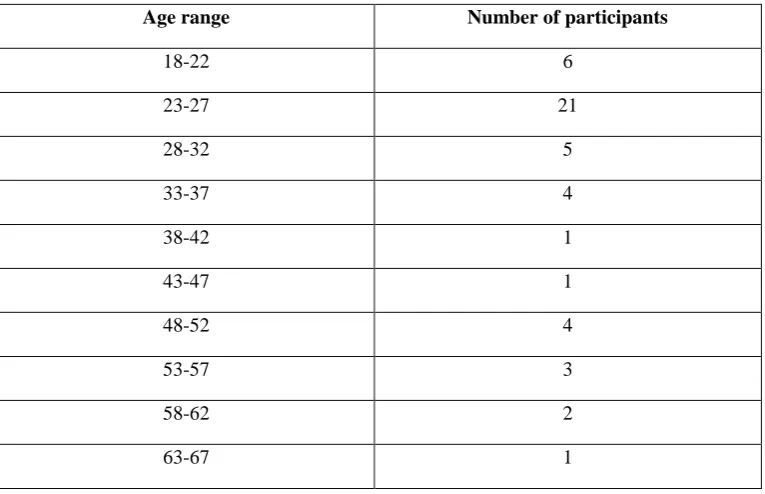
5.3.2 Age... 94
5.3.3 Place of Birth ... 94
5.3.4 Occupations ... 94
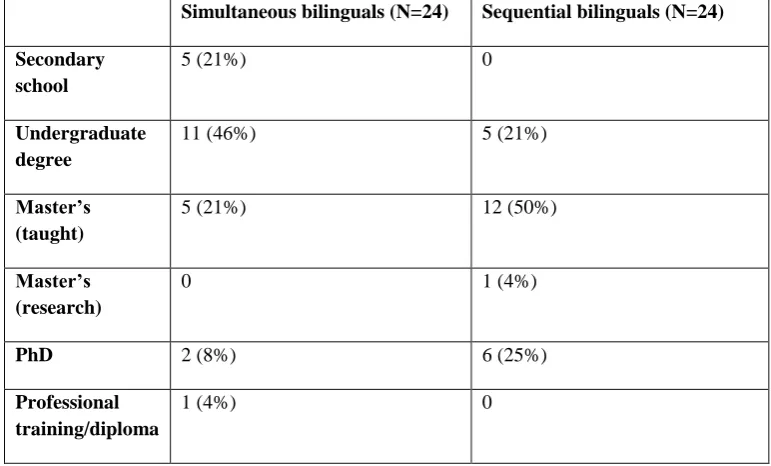
5.3.5. Education Levels ... 95
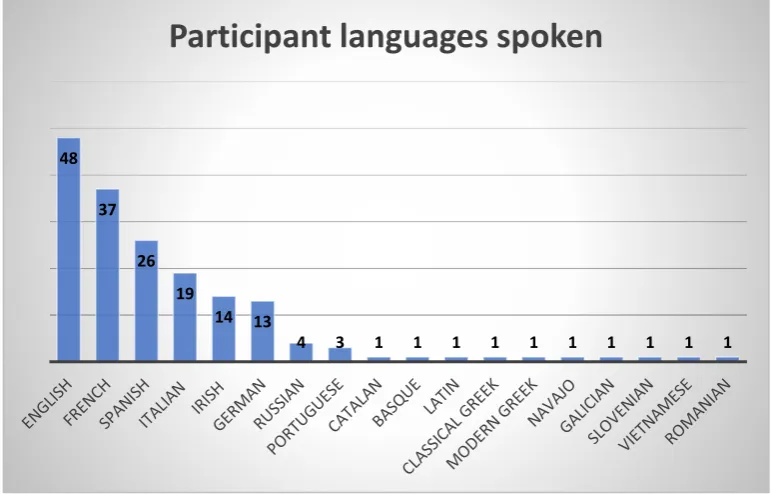
5.3.6 Order of Acquisition of Languages Spoken by Participants ... 96
5.3.6.1 Languages Spoken to and by Participants in Childhood ... 96
5.3.7 Historic Language Use ... 100
5.3.8 Historic Languages of Instruction ... 104
5.3.9 Proficiency ... 105
5.3.10 Daily Language Use ... 106
5.4 SI Task Scores: Descriptive Statistics ... 110
5.4.1 Overall Participant Rankings ... 110
5.4.2 SI Task into English ... 112
5.4.3 SI Task into FRESIT (French/Spanish/Italian) ... 114
5.5.1 Scores by Task ... 117
5.5.2 Performance in the Categories of the SI Task ... 119
5.5.2.1 Interpreting from FRESIT into English ... 119
5.5.2.2 Interpreting from English into FRESIT ... 122
5.5.3 Summary of Quantitative Findings ... 126
5.6 Comparing Perceptions of Dominance and Directionality with SI Task Results ... 127
5.6.1 Participants’ Predictions ... 127
5.6.1.1 Participant Perceived Dominance ... 134
5.6.1.2 Pre-and Post-Task Predictions Compared with Scores ... 136
5.6.2 Comparing Predictions and Performance ... 137
5.7 Conclusion ... 139
Chapter 6: Qualitative Findings ... 142
6.1 Introduction ... 142
6.2. Themes Emerging from Nvivo Coding ... 142
6.3 Key Theme 1: The Bilingual Self... 144
6.3.1 Sub-Theme 1: Degree of Bilingualism ... 144
6.3.2 Sub-Theme 2: Language Dominance ... 148
6.3.3 Sub-Theme 3: Directionality ... 157
6.3.3.1 Preference for B-to-A Interpreting ... 159
6.3.3.2 Preference for A-to-B Interpreting ... 164
6.3.4 Conclusion to Key Theme 1: The Bilingual Self ... 170
6.4 Key Theme 2: Language Storage, Access and Retrieval ... 170
6.4.1 Languages Stored Separately ... 171
6.4.2 Languages Stored Separately with Crossover ... 174
6.4.3 Languages Stored in the Same Place ... 175
6.4.4 ‘Thereness’ ... 178
6.4.5 Languages Stored According to Experience, Domain or Interlocutor ... 179
6.4.6 Other Factors Perceived to Affect SI Performance: Ageing and Attrition ... 181
6.4.7 Comparing Raw Scores with Current Age of Participants. ... 186
6.4.8 Conclusion to Key-Theme 2 ... 190
6.5 Conclusion ... 190
7.1 Introduction ... 193
7.2 Research Question 1: Do adult simultaneous bilinguals outperform adult sequential bilinguals in simulated experimental bi-directional simultaneous interpreting tasks? ... 193
7.3 Research Question 2: In which categories do adult simultaneous bilinguals outperform adult sequential bilinguals (or vice versa)? ... 195
7.4 Participant predictions regarding bi-directional tasks compared with their actual scores ... 197
7.5 Research Question 3: Are there any differences in perceptions between the simultaneous and sequential bilinguals in terms of language storage, linguistic dominance and directionality?... 198
7.6 Comparing the performance and perceptions of simultaneous and sequential bilinguals ... 200
7.7 Conclusion ... 203
Chapter 8: Conclusion... 205
8.1. Introduction ... 205
8.2 Research Framework ... 205
8.3 Contributions of this Study ... 210
8.4 Limitations ... 211
8.5 Conclusion ... 211
References ... 214
Appendices ... 230
Appendix 1: Bilingual Language Questionnaire ... 230
Appendix 2: Adapted Version of Schjoldager’s (1996) Rubric for Assessing the SI Tasks ... 244
Appendix 3: Ethics Approval ... 247
Tables and Figures
List of Tables
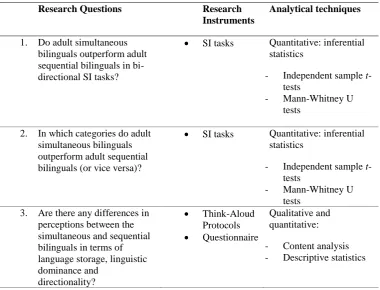
Table 1: Research questions and corresponding research instruments and data
analysis tools ... 68
Table 2: Overview of SI task topics ... 75
Table 3: Breakdown by gender (N=48) ... 94
Table 4: Participant age range... 94
Table 5: Level of education ... 96
Table 6: Languages spoken by and to participants’ siblings during childhood (N=48) ... 97
Table 7: Languages spoken by and to participants’ grandparents during childhood... 98
Table 8: Languages spoken by and to participants’ caregiver during childhood ... 99
Table 9: Languages spoken by and to participants’ parents during childhood ... 100
Table 10: Total number of months/years spent in a country where English or FRESIT are spoken ... 102
Table 11: Total number of months/years spent in a family where English or FRESIT are spoken ... 103
Table 12: Total number of months/years spent in education and/or working environment where English or FRESIT are spoken ... 104
Table 13: Main language of instruction in primary and secondary school ... 104
Table 14: English and FRESIT as a foreign/second language at primary school ... 105
Table 15: English and FRESIT as a foreign/second language at secondary school ... 105
Table 16: Rating of English and FRESIT proficiency (1 = Native-speaker or native-speaker-like proficiency, 7 = Very limited proficiency) ... 106
Table 17: Daily use of English and FRESIT with family and friends ... 107
Table 18: Frequency of English or FRESIT as language to listen to music/podcasts/radio ... 107
Table 19: Likelihood of browsing the internet in English and FRESIT ... 108
Table 20: Language usage at work ... 109
Table 21: Raw scores percentage bands for average of both tasks ... 111
Table 22: Average scores by bilingual type and task (%) ... 112
Table 23: Raw scores percentage bands for task into English ... 114
Table 24: Raw scores percentage bands for task into FRESIT ... 116
Table 25: Mean and standard deviations of overall average score on both simultaneous interpreting tasks (by bilingual type) ... 117
Table 27: Means, standard deviations and parametric test results (two samples independent t-tests) which examined the differences between the two bilingual
groups (from FRESIT into English)... 120
Table 28: Means, standard deviations and non-parametric test results (Mann-Whitney U) which examined the differences between the two bilingual groups (from FRESIT into English) ... 122
Table 29: Means, standard deviations and parametric test results (two samples independent t-tests) that examined the differences between the two bilingual groups (from English into FRESIT)... 124
Table 30: Means, standard deviations and non-parametric test results (Mann-Whitney U) that examined the differences between the two bilingual groups (from English into FRESIT) ... 126
Table 31: Perceived dominance and participant predictions for the French simultaneous bilingual group ... 129
Table 32: Perceived dominance and participant predictions for the Spanish simultaneous bilingual group ... 130
Table 33: Perceived dominance and participant predictions for the Italian simultaneous bilingual group ... 131
Table 34: Perceived dominance and participant predictions for the French sequential bilingual group ... 132
Table 35: Perceived dominance and participant predictions for the Spanish sequential bilingual group ... 133
Table 36: Perceived dominance and participant predictions for the Italian sequential bilingual group ... 134
Table 37: Pre-task predictions on directionality by non-balanced bilingual group (n=45) ... 136
Table 38: Post-task predictions on directionality by non-balanced bilingual group (n=45) ... 136
Table 39: Correct and incorrect pre-task predictions in the non-balanced group (n=42) ... 137
Table 40: Correct post-task predictions in the non-balanced group (n=42) ... 138
Table 41: Incorrect post-task predictions in the non-balanced group (n=39) . 138 Table 42: Themes emerging from first cycle of coding ... 143
Table 43: Key themes and sub-themes in this research project ... 144
Table 44: Bilingual language ability and perfectionism ... 145
Table 45: Sense of not being a true bilingual ... 146
Table 46: Nuanced balance in the self-perceived balanced bilinguals ... 147
Table 47: Current language usage: domain - home ... 149
Table 48: Current language usage: interlocutor ... 150
Table 49: Current language usage: home and/or work ... 151
Table 50: Current language usage: home or schooling ... 151
Table 51: Current language usage: greater accuracy in language of education ... 152
Table 52: Language usage: different languages for different topics ... 153
Table 53: Recency of language use ... 155
Table 55: Balanced bilinguals and directionality... 158
Table 56: Differing linguistic skill sets ... 160
Table 57: Current language use and fluency... 162
Table 58: Current linguistic versatility ... 164
Table 59: Dominance and processing ... 166
Table 60: Difficulties in both directions ... 168
Table 61: Expressions describing language storage ... 171
Table 62: Verbs describing language access ... 172
Table 63: Languages located in a specific place ... 172
Table 64: Different languages located in different places ... 173
Table 65: Separate stores and current language use ... 174
Table 66: Languages in different places with crossover ... 174
Table 67: Facility in moving between languages ... 175
Table 68: Languages stored in the same place... 176
Table 69: Languages stored in the same place and according to location/language in use ... 177
Table 70: Speaking words in a language by accident or because they fit better ... 177
Table 71: Languages just ‘there’ ... 178
Table 72: ‘Thereness’ retrieval ... 178
Table 73: Languages stored principally according to experience, domain or interlocutor ... 180
Table 74: Recent usage and retrieval ... 181
Table 75: Ageing... 182
Table 76: Attrition: simultaneous bilinguals... 185
Table 77: Attrition: sequential bilinguals ... 186
Table 78: Comparing overall order of participants ranked 1-24 by average (%) in the two SI tasks with current age ... 187
Table 79: Comparing overall order of participants ranked 25-48 by average (%) in the two SI tasks with current age ... 188
List of Figures
List of Abbreviations
AIIC International Association of Conference Interpreters
AoA Age of Acquisition
BFLA Bilingual First Language Acquisition BICS Basic Interpersonal Communicative Skills BLC Basic Language Cognition
CADCAS Computer Assisted Qualitative Data Analysis CALP Cognitive Academic Language Proficiency CP Cognitive Processing
CP Critical Period
CPM Complementarity Principle Model
FRESIT Acronym used to denote the languages other than English in this doctoral project: French, Spanish and Italian
HLC Higher Language Cognition IPA International Phonetic Alphabet IT Interpretive Theory
L1 First language
L2 Second language
SES Socio-Economic Status SI Simultaneous Interpreting SLA Second Language Acquisition
SPSS Statistical Package for the Social Sciences
Chapter 1: Introduction
1.1 Rationale
This doctoral research came about due to my interest, as a practising interpreter, in investigating misconceptions held by members of the public, agencies employing interpreters and some bilinguals themselves regarding the nature of interpreting, particularly simultaneous interpreting (SI), and precisely who is capable of carrying out the job. There is a general assumption that being raised bilingual from birth, that is being a simultaneous bilingual, is synonymous with being a good interpreter, an assumption which I have not found to be well grounded in practice. I had initially intended to devise a simultaneous interpreting task to test this assumption which could be carried out in an interpreting booth, but, as will be explained in the Research Methodology chapter, access to professional facilities proved impossible. An adapted interpreting task was created, and, because I also had a specific interest in bi-directional interpreting, that is interpreting into and out of both of the interpreter’s languages, the overall research question for this project was formulated as follows: Do adult simultaneous bilinguals outperform adult sequential bilinguals in simulated experimental bi-directional simultaneous interpreting tasks? Two further research questions were articulated. Research Question 2 refers to the performance-ranking categories within the simultaneous interpretation task designed for the project: In which categories do adult simultaneous bilinguals outperform adult sequential bilinguals (or vice versa)? Research Question 3 sought to compare the perceptions of the two participant groups: Are there any differences in perceptions between the simultaneous and sequential bilinguals in terms of language storage, linguistic dominance and directionality?
1.2 Research Background
(Mikkelson 1996; Turner 2007; Wadensjö, Dimitrova, and Nilsson 2007), and, on the other hand, on the relationship between Interpreting and its parent, Translation Studies (Baker 2011; Pöchhacker and Schlesinger 2002), on interdisciplinarity research between Linguistics and Psychology (e.g. Gile 2015), Sociology and Neuro-Imaging (e.g. Pym, Shlesinger, and Jettmarova 2006; Fabbro and Gran 1994), and on analysing and modelling the process involved in the different interpreting activities (Christoffels and De Groot 2005). Researchers in both these areas, the practical and theoretical, are agreed that the SI activity is composed of three main components: comprehension, processing and production.
It was evident that some of this research would be useful for this doctoral project but that it would first be fruitful to ground the work in the field of Bilingualism, particularly Second Language Acquisition (SLA) research and psycholinguistic research into cognitive processes (see Williams 1995). Research in adult bilingualism, however, is a relatively recent phenomenon and has evolved from original concerns regarding the bilingual education of children, largely as a result of immigration (e.g. Cummins 1981; Peal and Lambert 1962). One key approach in this area has been to compare bilingual children with their monolingual counterparts (Bialystok et al. 2004; Genesee 2009). Relatively recently, attention has turned to young adults (Seçer 2016), voluntary or involuntary migrant adults (Moyer and Rojo 2007; Opitz 2011), adults with brain injuries (Marrero, Golden, and Espe-Pfeifer 2002; Mendez et al. 1999) and ageing adults (Anderson, Saleemi, and Bialystok 2017). These adults have, again, overwhelmingly, been researched with reference to monolinguals. As a result, I found that there is a considerable gap in studies on healthy, non-immigrant adult bilinguals in what has come to be known as bilingual mode (Grosjean 2008) and not in comparison with monolinguals.
come. In setting out to compare the performance of adult simultaneous and sequential bilinguals, it is age of acquisition of the bilingual’s two languages which is set as the determining factor in quantifying findings. Those bilinguals who have acquired both their languages as young children are considered to be simultaneous bilinguals, whereas sequential bilinguals are defined as those who have learnt their languages in succession, some while their first language (L1) was also still being fully acquired (early sequentials) and some after their L1 has been firmly established (late sequentials) (Williams 1995). Simultaneous bilinguals are widely believed to be native speakers of both their languages, that is having two L1s, with highly proficient sequentials capable of reaching ‘near-native’ (Ibid.: 148) levels in their L2 but still distinctly possessing an L1 and an L2. From this perspective it is easy to appreciate the rise of the assumption that simultaneous bilinguals would therefore make better interpreters, having ‘equal’ command of both languages.
However, the literature (Grosjean 2010; McLaughlin 1978) shows first that this is an oversimplification, that a bilingual is not ‘the sum of two complete or incomplete monolinguals’ (Grosjean 2008: 13). Secondly, researchers such as Kroll, Bogulski and McClain (2012), for example, have shown that because the bilingual’s two languages come to influence each other in different ways, their
functionality differs from that of a monolingual speaker of either
language. Examining the particular functionality of the bilingual’s two
languages has become the focus of scrutiny not only in linguistics but
also in psycholinguistics and neurolinguistics, to name but two of the
collaborative disciplines attracted into the debate, for example, the
interconnection of verbal systems (Paivio and Desrochers 1980), switching
mechanisms (Costa, Santesteban, and Ivanova 2006) and language
representation and control (Abutalebi and Green 2007).Thirdly, the literature (e.g. Williams 1995) also shows that different mechanisms operate in L1s and L2s for perception and production, therefore affecting the central processing activity of SI.
and, thus, answering the principal research question necessitates broader consideration of the cognitive processes at work in the mind of the bilingual who undertakes the task and especially the psycholinguistic processes underlying the joint functioning of the bilingual’s two languages. Cognitive research in bilingualism has concerned itself with processing capacity and the relationship of the bilingual’s two languages to each other within one single mind. This raises issues of language separation, particularly language activation and suppression, along with storage, access and retrieval mechanisms and shared or separate lexical or conceptual representation. This is turn raises the issue of how the bilingual switches between his two sets when choosing to, or having to, speak in one language or the other and whether or not this constant switching over time builds up cognitive advantages – or a bilingual benefit in cognitive terms – over the monolingual speaker. Most of the research in this area over many decades has again been conducted with bilingual children (e.g. Cummins 1979; Johnson and Newport 1989) and only relatively recently has research moved on to a similar bilingual advantage in adults (e.g. Bialystok, Craik, and Luk 2008a; Connolly 2017) Although there is now work comparing early and late bilinguals in terms of executive function (Connolly 2017; Kalia, Wilbourn, and Ghio 2014) attentional control (Kapa and Colombo 2013), and in modules of language such as accent (Amengual 2017), I am not aware of any research which has specifically aimed to find a possible intra-bilingual benefit between simultaneous and sequential bilinguals in simultaneous interpreting.
Bilinguals in their normal daily life choose how to express themselves in whichever language is appropriate to the communicative setting, depending on their particular circumstances. However, interpreters, who, by definition must first be bilingual, are constrained by the particular demands of SI to convey what is said by one speaker in one language to a listener who does not understand that first language and they are therefore not free to express themselves voluntarily in the way they normally do. Grosjean (1997) draws a helpful distinction between these two personae, the ‘regular bilingual’ and the ‘interpreting bilingual’ (Ibid.: 168), which will inform to a very great degree the approach taken in this research.
interpreting into their weaker language. Weaker languages are largely under-researched in adult bilingualism (Bernardini 2017) and interpreting into one’s weaker language is debated (e.g. Gile 1995a), with the traditional position, the preference of interpreting into the dominant language, now being increasingly challenged (Gile 2005). SLA research demonstrates that ‘not only production, but also perception and comprehension is weaker in L2’ (Williams 1995: 150). Therefore, the inclusion in this research of the issue of directionality in SI, which hinges on the extent to which each of the components - comprehension, processing and production - may be impaired within a time constraint and in both directions, adds a further dimension to the investigation of an intra-bilingual advantage.
1.3 Thesis Overview
The structure of this thesis is as follows. Chapter 2 reviews the existing research on bilingualism, age of acquisition and other factors – usage, balance, dominance and proficiency – which determine the individual profiles of both simultaneous and sequential bilinguals. It proposes that bilingual individuality may be a more compelling lens through which to gauge an intra-bilingual advantagethan AoA and therefore takes as its theoretical framework Grosjean’s holistic theory and his Complementarity Principle Model (CPM) (2008). The chapter reviews research on language storage, access and retrieval, including Grosjean’s Interpreting Model (2008).
Chapter 4 presents the research methodology employed in this project, which is a mixed-methods approach with three data collection instruments: an experimental simultaneous interpretation task, Think-Aloud Protocols related to the task and a questionnaire. The first part of the chapter reviews the design of this mixed-methods approach and the piloting phase. The second part presents the data collection and data preparation procedures and their implementation. Chapter 5 presents the quantitative data collected in this study. It begins with a description of the research population as provided by the Language Background Questionnaire. It then presents the participants’ raw scores and their resulting rankings in the SI tasks. It discusses in turn the descriptive and inferential statistics used to analyse both the overall SI task scores and the individual scores in each of the evaluation categories. It then compares the participants’ pre- and post-task predictions with actual participant scores into and out of their perceived dominant language.
Chapter 6 presents the qualitative data gathered in this project. It introduces the first key theme to emerge from the Think-Aloud Protocols: The Bilingual Self, which reflects the participants’ experience of allowing their bilingualism to be tested by the SI task and any flaws in it to be exposed. It addresses participants’ statements regarding not being a ‘genuine’ bilingual, awareness of lack of balance in their two languages and the role of current usage and country of residence in their bilingual profiles. Lastly, participants enlarge on the experience of bi-directional interpreting, which further exposes their dominance in one or other of their two languages. The chapter then addresses the second key theme to emerge from the Think-Aloud Protocols: Language Storage, Access and Retrieval. Participants formulated how they, as inexperienced, untrained bilinguals, responded to a first attempt at bi-directional SI; what they found easier or more difficult than anticipated and why they thought this was the case. Language storage is discussed, along with the factors perceived to affect SI performance in general and language retrieval in particular.
highlights the importance expressed by both groups of their personal and unique individual language profile which they felt impacted directly on their SI performance. The final section lists the recurring group of factors influencing this bilingual profile.
Chapter 2: Literature Review
2.1 Introduction
This chapter sets out the theoretical framework of this doctoral research. The first section addresses the issue of definitions of bilingualism and discusses age of acquisition (AoA) in Second Language Acquisition (SLA). It highlights the importance of individual bilingual profiles and considers whether this individuality may be a more important factor in gauging advantage than AoA. Next, further factors such as usage, balance, dominance and proficiency which have a bearing on the individual bilingual profile are addressed. The following section deals with issues of language storage, access and retrieval. The last section returns to Grosjean and his work on language mode, central to the testing of bilinguals, and to his Interpreting Model which specifically envisages the mode of the simultaneous interpreter in action.
2.2 Investigating Bilingualism
choice, globalisation and improved linguistic educational opportunities have afforded greater opportunity for a rise in sequential bilingualism and facilitated the emergence of well-educated elite bilinguals, both simultaneous and sequential, capable of using and maintaining both languages at an advanced level and not necessarily having to choose between them in daily life. However, the contexts in which the bilingual’s two languages are acquired have not changed since the first empirical studies: in the home, through schooling, from exposure to the languages used in the community or in the street; and from having to or choosing to learn a second language informally or formally at a later stage in life. It may also be possible now to add online acquisition of a second language (Tudini 2010).
No single definition of bilingualism has been universally agreed upon. Beardsmore (1986: 1) notes ‘bilingualism as a concept has open-ended semantics’. Ng reminds us that bilingualism is a complex phenomenon and ‘is not as simple as it appears’ (Ng 2015). At the simplest level the bilingual is ‘a speaker of two languages’ (De Angelis 2007: 5) but with over half of the world’s population using two or more languages (Grosjean 2010), it is unrealistic to expect all bilinguals to fit into a single definition. It is more helpful in practice to shift the emphasis from the abstract concept of bilingualism to its manifestation in individual bilinguals, each as different from the next as each human being:
Whatever the circumstance, the way in which bilingualism develops, the amount of input from either of two languages, the motivation, the implications for one’s cultural identity and sense of self, indeed the entire experience of, route to, and outcome of bilingualism will be as unique to each individual bilingual as their own fingerprint. (Connolly 2017: 2)
Baker (2011) stresses that the bilingual develops a unique competence in line with their needs and as a result of the differing contexts in which their two languages are used and views each bilingual as self-defining, ‘a complete linguistic entity, an integrated whole’ (Ibid.: 12) with ‘a unique linguistic profile’ (Ibid.: 9).
2.3 Grosjean’s Work on Language Use and Bilingual Individuality
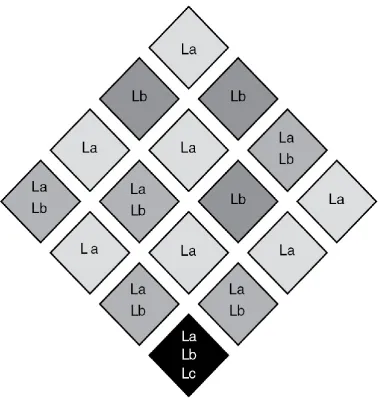
Grosjean (2008: 23) points out that ‘[b]ilinguals usually acquire and use their languages for different purposes, in different domains of life, with different people. Different aspects of life often require different languages’ and he (2010) identifies this language use as thedetermining factor of bilingual individuality. He (2008: 22-26) outlines in his Complementarity Principle Model (Figure 1 below) how different domains can determine an individual’s proficiency levels in each language and how linguistic necessity will determine a bilingual’s level of fluency, suggesting why bilinguals are rarely proficient in all domains in both languages. He posits a hypothetical bilingual profiled according to 16 possible domains of life – e.g. home, work, friends, media – represented by 16 hexagonal figures which do not interlock. A similar configuration could be drawn up for all bilinguals.
Figure 1: Grosjean’s (2008) Complementarity Principle Model
Taking into account the complementarity principle is a crucial prerequisite in interpreter training: interpreter bilinguals, unlike regular bilinguals, will have to learn to use their languages (and the underlying skills they have in them) for similar purposes, in similar domains of life, with similar people. This is something regular bilinguals do not often need to do (Ibid.: 168).
Grosjean points out that the CPM explains why the bilingual’s profile may change over time. He expands on this (Grosjean 2010) by detailing his own personal profile which shows five changes in his L1 over his seven decades as a result first of being sent to boarding school, then moving countries several times. In sum, Grosjean’s Complementarity Principle Model contributes to this research in four ways: (i) it explains why most bilinguals master some or all of their linguistic capabilities better in one of their languages than in the other due to factors such as regularity of language use, language access and attrition; (ii) it illustrates the complexity of unique individual bilingual profiles; (iii) it shows that whatever the level of mastery, the individual profile continues to change over time and according to context; and (iv) it elucidates why bilinguals may not necessarily be good interpreters.
2.4 Age of Acquisition and a Critical Period
The distinction between simultaneous and sequential bilinguals is usually defined through age of acquisition (AoA). Simultaneous childhood bilinguals are exposed to two languages from birth at the same time and are undergoing a process initially named ‘bilingual first language acquisition’ (BFLA) by Meisel (1989); ‘infant bilingualism’ (De Houwer 1990) and ‘bilingual acquisition’ (Ibid.). Sequential childhood bilingualism occurs when a child is exposed to and acquires a second language after the first. A further distinction is made between early sequential bilinguals who acquire their second language while still in the process of acquiring their first and late sequential bilinguals who acquire their second language when they have a strong foundation in the first (Hernandez and Li 2007; Kalia, Wilbourn, and Ghio 2014; McLaughlin 1978). Beardsmore (1986: 28) defines early bilingualism as ‘the acquisition of more than one language in the pre-adolescent phase of life’ and late sequential bilingualism when the first language is acquired before the age of 11.
also been determined according to important individual developments in L1
syntax, morphology, semantics and phonology (Heredia and Cieślicka 2014).
These are understood to be mastered around the age of four (Uccelli & Pan, in
Gleason and Ratner 2016; Stoel-Gammon and Menn 1997; Tager-Flusberg and
Zukowski 1997). L1 learners are deemed to master pragmatics by the age of
seven (e.g. Bryant 2013). A later cut-off age of 12-14 has also been proposed
(Johnson and Newport 1989; Polinsky 2005), although this has been criticised
(Hakuta, Bialystok, and Wiley 2003; Hernandez and Li 2007; Weber-Fox and
Neville 2001).
Where there is considerable literature on the cut-off of defining simultaneous
bilinguals, there is less on defining sequential bilinguals. Nevertheless, there is
one condition: that the L1 be reasonably well developed before the learner begins
the L2. For some, that is before the learner turns three or starts school
(McLaughlin 1978; Paradis 2010). Others have set the cut-off between the ages
of four and seven (Montrul and Potowski 2007), at age six (Schwartz,
Kozminsky, and Leikin 2009), at age seven-and-a-half (Kaushanskaya,
Blumenfeld, and Marian 2011), older than nursery age but before adolescence
(Kohnert, Bates, and Hernandez 1999) and between the ages of five and 24 (Illes
et al. 1999). According to Heredia and Cieślicka, the suggested threshold to be
considered a sequential bilingual is age four (Heredia and Cieślicka 2014).
McLaughlin’s (2013) age criterion is often used to make the distinction: children who acquire two languages simultaneously before the age of three are considered simultaneous bilinguals and children who acquire one language in infancy and another after the age of three are regarded as sequential bilinguals. Baker endorses this criterion, if somewhat more elastically - ‘after about three years of age’ (2011: 3). For the purpose of this research, therefore, the age of three will be used to mark the threshold between the simultaneous and sequential bilingual participants.
possible to achieve native-like levels in a language. Neuroplasticity is the reason this linguistic attainment cannot be reached as once the brain begins to lose plasticity with age, the ability to learn languages is also lost. Lenneberg’s (Ibid.) argument was that it is possible for those who begin learning a second language before the critical period comes to an end to acquire native-like levels but those who begin learning outside this period will need to be taught explicitly.
Much research has been carried out on the effect of age of acquisition on the ultimate attainment of an L2. There is no consensus as to whether a CP even exists and, if it does exist, when it begins and ends (De Groot 2011). Johnson and Newport’s (1989) investigation of a possible CP in SLA suggested that native-like proficiency in a second language was impossible beyond age seven, supporting a maturational account of language acquisition. However, follow-up investigations demonstrated the opposite effect (Bialystok and Hakuta 1994; Birdsong and Molis 2001). Birdsong (2005) concluded that older learners possess superior processing skills and cognitive abilities, enabling them to grasp abstract ideas and allowing them to learn a second language more quickly and efficiently than younger children. Explicit learning gives adults an advantage in the initial stages but falls short when explicit rules do not aid understanding (DeKeyser and Larson-Hall 2005). Birdsong’s (1992) study showed that the average performance of a group of near-native speakers of French was below that of the native group, but that the near-native-speaker group did include adults performing significantly better than the native speakers. Piller’s (2002)
investigation of adult L2 users of English and German who pass as native
speakers similarly highlights how high rates of achievement are often neglected
and under-reported. In his comparison of use of interrogative forms in native and
near-native French speakers, Donaldson (2016) notes that the near-natives display comparable choices and that these choices are ‘both communicatively
Marinova-Todd et al. (2000: 28) conclude that ‘age does influence language learning but primarily because it is associated with social, psychological, educational and other factors that can affect L2 proficiency, not because of any critical period that limits the possibility of language learning by adults’. The young bilinguals in studies reviewed by Marinova-Todd et al. (Ibid.) tended to perform similarly to each other but the older learners showed great variation in their language competence. In their summary of the CP debate to date, Singleton and Ryan(2004: 227) conclude that‘the idea of a critical period specifically for language development may well have had its day’. Singleton and Ryan suggest
that age factor issues may not be simply evidence of a pre-programmed CP with
regard to language learning itself but involve general decline brought about by
ageing and, more importantly for this research, other factors such as motivation,
exposure and instruction.
Fuchs and Flügge (2014: 1) review four decades of research on adult neuroplasticity and conclude that significant changes have taken place in views of how plastic the adult human brain may be. Chronic stress, for example, which was once thought to have had only negative influences, has now been found in some circumstances to enhance brain neurons. Where the brain was once viewed as an organ that was non-renewable, research into adult neurogenesis has shown that parts of the central nervous system are in fact capable of neuron-replacement (Gould et al. 1999). To date, however, it is not known to what extent neuron-replacement in the adult brain is possible. Fuchs and Flügge (2014) emphasise that there are many remaining unanswered questions and draw attention in particular to a hypothesis by Gould et al which suggests that hippocampal neurogenesis could play a critical role in learning and memory, but similar research on other adult animals did not corroborate this (Koehl and Abrous 2011). In any case their findings cannot be extrapolated to humans. Fuchs and Flügge conclude that it is widely agreed that the adult brain is ‘far from being fixed’ (Fuchs and Flügge 2014: 1) and that it is prudent to keep an open mind on the influence of neurogenesis on cognitive functions.
Birdsong (2018) draws together the threads of much of what has been discussed
in this section: like Grosjean, he underscores the role of the uniqueness of both
highlights the role of motivation, as well as LOR in an L2 environment, range
of years of study and types of education. He points to the complex interaction of
these variables with both AoA and brain plasticity.
2.5 Balance/Dominance and Individuality
Early classifications of bilinguals were based on the degree of competence or ‘proficiency’ in each language separately. These range from the minimalist end of the scale with incipient bilingualism (Diebold 1961), where those who have mastered little more than a few utterances in a second language, for example, could be classed as bilingual. Haugen’s definition (1953: 7) of ‘the point where a speaker can first produce complete meaningful utterances in the other language’ and Hall’s (1952: 14) ‘at least some knowledge and control of the grammar structure of the second language’ lie towards the middle of the scale. Bloomfield (1933: 56) envisaged that the maximalist end of the scale required a ‘native-like control of two or more languages’. A definition of native-like control in two languages is highly problematic as it assumes a degree of balance which cannot be taken for granted. Baker (2011: 8), for example, requires a balanced bilingual to be ‘approximately equally fluent in two languages across various contexts’. In practice, the so-called balanced bilingual is a ‘rare if not non-existent species’ (Baetens Beardsmore 1986: 7) due to diverse and shifting patterns of language dominance, with different domains of language use, preference, for example. One view of dominance is defined by Valdés (2003), who places bilinguals on a continuum which covers the different strengths of their two languages A and B. In the context of working with immigrant children she prefaces one presentation of her continuum thus: ‘Although absolutely equivalent abilities in two languages are theoretically possible, […] individuals seldom have access to two languages in exactly the same contexts in every domain of inter-action. […] They thus do not develop identical strengths in both languages’ (Valdés 2005: 414). Her continuum is represented as follows:
Ab Ab Ab Ab Ab AB BA Ba Ba Ba Ba Ba
language and b the new language being acquired; grandchildren or
great-grandchildren of immigrants would conversely be classed as Ba, having acquired the majority language of the country they have been born into while retaining some proficiency in the immigrant language.
Birdsong (2014: 1) defines dominance as ‘observed asymmetries of skill in, or
use of, one language over the other’, which can be determined along two
conceptually separate axes: dimensions and domains. On the dimensions axis he
places 'linguistic competence, production, and processing' (Ibid.: 2) which can be tested within the two languages to assess the intrinsic abilities of the
individual bilingual. On the domains axis he places 'situations and contexts of
language use' (Ibid.), pursuits chosen by the bilingual or environments in which they find themselves. Domains are thus the 'contexts and activities in which
various dimensions of language ability are engaged' (Ibid.: 3). This definition of the relationship between dominance and domains gives helpful pointers to the
multi-faceted nature of dominance, depending on the type of test being applied
to the bilingual participants in any particular research project. Assessing the
inherent abilities of the individual bilingual by means of testing the dimensions
of dominance as Birdsong sees them will form a central part of this research.
2.6 Dominance and Proficiency
Dominance, as seen above by Valdés, refers to the relative strengths of each of
the bilingual's languages: bilingualism may range from the rare equi-lingual,
who has two native languages, to the second-language learner, who may have
widely differing strengths in each. Dominance is measured by relative
proficiency in each language, that is, the degree of competence in the basic
language skills of reading, writing, listening and speaking. Birdsong (2014: 3),
balanced high proficiency in both languages and the other with balanced low proficiency in both languages, it becomes obvious that proficiency and dominance are also two separate constructs. For him, proficiency is a dimension of dominance in the same way as reading speed or speech rate, which can be independently assessed but do not necessarily correlate. This has implications for the assessment of the SI task, which breaks down the performance of each of the participants into 14 criteria to be applied bi-directionally. Birdsong concludes:
it should be borne in mind that a bilingual’s proficiency in the dominant language cannot be expected to be identical to that of a monolingual native speaker of that language. Because of well-understood bidirectional influences in the two languages, non-monolingual-likeness in terms of proficiency (and likewise on other assessed dimensions) is a defining characteristic of bilingualism(Ibid.: 4)
Treffers-Daller (2016: 235) has pointed to the ‘considerable amount of terminological confusion over balance and dominance’. She argues that ‘the notion of balance is problematic, both conceptually and operationally’ (Ibid.: 263) and notes the recent tendency to consider dominance as relative proficiency. She argues that there is no such thing as ‘global or generic dominance’ (Ibid.: 261), preferring to depict dominance ‘in relation to a specific
criterion, selected by the researcher’, (Ibid.: 261) where ‘dominance is
task-specific and domain-task-specific’ (Ibid.: 265):
we appreciate that it is possible to have different views of what a bilingual is but think it is reasonable to expect there to be a link between an author’s definition of bilingualism and his/her definition of language dominance. (Ibid.: 262)
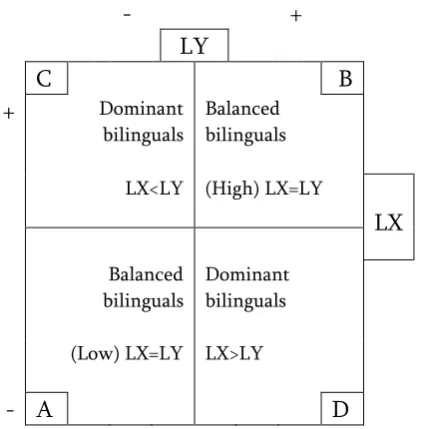
- + LY
C B
+ Dominant bilinguals
Balanced bilinguals
LX<LY (High) LX=LY
LX
Balanced bilinguals
Dominant bilinguals
(Low) LX=LY LX>LY
[image:45.595.228.439.74.289.2]- A D
Figure 2: Typology of language dominance based on language proficiency (Treffers-Daller 2016). (The X-axis represents proficiency in language X; the Y-axis represents proficiency in language Y.)
Treffers-Daller (2016) contrasts those researchers who, in their definition of bilinguals, prioritise proficiency and those who prioritise maintained usage but warns that bilingualism is a multi-dimensional construct and that both proficiency and usage are essential components of the bilingual experience. Both must, therefore, be taken into consideration. She suggests the term ‘language ability’ is to be preferred over proficiency as it is a broader construct which emphasises not just specific language skills but also communication skills such as cultural and social competence. She advises that:
Further research into language dominance could therefore concentrate on the wider range of knowledge and skills that fall under the construct of language ability, as it is likely that new insights into language dominance will emerge from such studies (Treffers-Daller 2016: 262-3)
This section has explored definitions of bilingualism and summarised the factors which make for the unique profile of each individual bilingual and which are likely to influence the performance of the participants in this study as they undertake the SI tasks: AoA, order of acquisition, balance, dominance, domains and proficiency. Particular attention has been paid to the contribution of Grosjean and his Complementarity Principle Model (2008). The next section will examine childhood bilingualism which has been the springboard for much of the current research on adult bilingualism.
2.7 The Bilingual Child and The Bilingual Advantage
Original concerns in bilingualism were pedagogical (Cummins 1981; Peal and Lambert 1962; Valdés 2003), arising from early arguments for and against bilingual education which emerged in the US and Canada with regard to their large immigrant Spanish and French communities respectively. Subsequent research in the field of psycholinguistics (Bialystok et al. 2004; Costa et al. 2009) found that, contrary to expectations, bilinguals may in fact have a cognitive advantage over their monolingual counterparts. This has become known as the bilingual advantage (Cummins 2000; Galambos and Hakuta 1988; Genesee 2009; Prior and MacWhinney 2010b).
The 1960s represented a turning point as research began taking into account the role of social status and living environment in language development (Cummins 1981; Lambert and Tucker 1972; Peal and Lambert 1962). Peal and Lambert’s (1962) ground-breaking study overturned the earlier belief that bilingualism has a negative impact on cognitive development. Findings showed that monolingual participants were outperformed by bilingual participants in a number of tests, which demonstrated for the first time that having to manage two languages may in fact result in greater cognitive flexibility in bilinguals. Peal and Lambert’s study encouraged researchers to explore the positive links between cognitive development and bilingualism. Bialystok (1986b), for example, asked five- to nine-year old monolingual and bilingual children to decide if certain sentences in English were grammatically acceptable or if they could be deemed acceptable despite having an unusual meaning (e.g. ‘Apples grow on noses’). In terms of evaluating whether sentences were grammatically correct, the results of the monolingual and bilingual children were comparable. However, when it came to recognising semantic acceptability despite unusual meanings, more correct answers were given by the bilingual children than by the monolingual children. Research on the effects of bilingualism on cognition has moved beyond linguistic tasks: findings from non-verbal tasks, like problem-solving (Bialystok 1999; Bialystok and Majumder 1998; Bialystok and Martin 2004) and mathematical/numerical tasks (e.g. Bialystok and Codd 1997) are in line with findings from verbal tasks (Bialystok and Codd 1997; Kessler and Quinn 1980, 1987), indicating that bilinguals also outperform monolinguals in these areas. A bilingual advantage has consistently been noted in problem-solving tasks involving attention control and conflict resolution (Bialystok 1986a, 1988, 2006, 2007; Bialystok et al. 2005; Bialystok, Craik, and Ryan 2006; Clarkson 2007) and bilinguals shown to outperform monolinguals in executive control and processing (Bialystok 2007, 2010; Bialystok et al. 2004; Bialystok, Craik, and Ryan 2006; Bialystok and Viswanathan 2009).
have consequently credited an increased ability to shift between mental sets to a life-time of bilingualism, for example work by Prior and Macwhinney (2010b), in which a cued-task switching test led to the finding that bilingual students were more capable of ignoring interference and activated a task set following a cue faster than monolinguals.
Houtzager et al. (2017) replicated this test on matched older adults who did not have an immigrant background. They detected a similar bilingual advantage. Seçer (2016) investigated the impact of bilingualism on executive functions in younger adults and found that Turkish-English bilinguals completed cognitive flexibility tasks faster than monolinguals. These results echo previous findings (Bialystok 2011; Bialystok and Viswanathan 2009; Engel de Abreu et al. 2012) which demonstrate that adult bilinguals perform better than monolinguals in executive function tasks when demographic variables are matched. Seçer (2016) found that bilingualism contributes to skills where an individual must shift mentally between several tasks, perhaps as a result of having to alternate between and coordinate two active languages (Bialystok 2011). Her results echo other studies (e.g. Poarch and Bialystok 2015) which highlight multitasking skills as an area in which adult bilinguals have a distinct advantage.
Research into the cognitive effects of bilingualism has yielded mixed results. In areas such as semantic and verbal fluency some research has noted the monolingual advantage over bilinguals or the negative impact of bilingualism (Gollan, Montoya, and Werner 2002; Sandoval et al. 2010). However, some studies explored monolingual and bilingual children’s awareness of arbitrary language, concluding that there was evidence of a bilingual superiority over monolinguals (Ben-Zeev 1977; Cromdal 1999; Ianco-Worrall 1972). This was also the case in studies concerning phonological awareness (Davine, Tucker, and Lambert 1971) and sentence awareness (Galambos and Goldin-Meadow 1983). Nonetheless, not all research replicated earlier findings, e.g. phonological awareness (Bialystok 1988), and, although many studies highlighted a bilingual advantage, some research reported negative effects of bilingualism in areas such as receptive vocabulary and lexical access (Bialystok, Craik, and Luk 2008a; Ivanova and Costa 2008). What is of relevance to the present doctoral thesis is that more highly proficient bilinguals outperformed lower proficiency bilinguals (Galambos and Hakuta 1988). Thus, factors which give rise to proficiency in different language areas may supersede the age of acquisition and mode of acquisition of the two languages.
Recently, de Bruin et al. (2015) challenged the magnitude of the cognitive advantage bilinguals might have over monolinguals, finding considerable evidence to support their view that there may be a ‘file-drawer’ effect: a publication bias towards studies with positive conclusions over those with null or negative conclusions. They found that studies fully supporting the bilingual advantage theory were most likely to be published, followed by those with mixed results, with studies challenging the theory least likely to be published. As Connolly (2017) points out, however, an overall analysis of publications carried out by de Bruin et al. (2015) indicates that even though a publication bias towards positive findings actually does exist, a significant bilingual advantage effect is still evident across those studies.
(Ibid: 22). Both issues are of significant relevance to this research. Even if across both languages a bilingual may have a vocabulary of equal magnitude to that of
a monolingual, the two separate lexicons are unlikely to match each other in
translation terms (Grosjean 1997), thus adding a further layer to the
asymmetrical nature of the bilingual profile with respect to the SI task. Rapid access to lexical items lies at the heart of the SI task, considered the most demanding of the interpreting modes precisely because of the speed required for retrieval of all aspects of language, but particularly lexical equivalents.
One further aspect of research on the bilingual advantage which has bearing on this thesis is the issue of thresholds in linguistic competence. Cummin’s (1976) Threshold Hypothesis (TH) posited that, in order for the beneficial cognitive aspects of bilingualism in children to be activated, a certain level of linguistic competence must first be reached in both languages. This threshold may vary according to the internal factor of cognitive development and the external language proficiency required principally for academic progress. This led Cummins to propose two thresholds: a lower threshold when the bilingual child reaches competence in one of their languages, at which point bilingualism will no longer impact cognition negatively, and a higher threshold of balanced competence in their second language, which, when reached, will have positive cognitive effects. Building on this work, Cummins (Cummins 1979; Cummins 1981) also proposed a distinction between two different types of language proficiency in children in the context of schooling: Basic Interpersonal Communicative Skills (BICS)– conversational fluency in the skills of listening and speaking – which can be acquired in about two years (Cummins 1979) and Cognitive Academic Language Proficiency (CALP) – academic language proficiency requiring higher-order thinking skills plus the ability to cope with varying academic demands in different subjects – which could take five to seven years to develop.
large majority of elements which occur infrequently. In simple terms BLC refers to the largely implicit, unconscious linguistic knowledge (e.g., phonology, phonetics, prosody, morphology, syntax, lexicon) that all L1 speakers of a given language have in common, along with the automaticity with which these types of knowledge can be processed. BLC is restricted to the frequent lexical items and grammatical structures, that is, to the lexical items and morphosyntactic structures that may occur in any communicative situation, regardless of age, literacy, or educational level. HLC is a development beyond BLC to include utterances that contain low-frequency lexical items or uncommon morphosyntactic structures, in other words an extended or more specialised type of language knowledge. Hulstijn (2015) further visualises BLC forming a ‘core’ knowledge which HLC encompasses but around which it also forms a ‘periphery’ (Ibid.: 1). These ‘peripheral’ abilities closely reflect the kind of higher language cognition necessary for the satisfactory completion of the task of SI: appropriate accurate oral communication under stress (Ibid.: 1).
In this context, Hulstijn (2015) defines a native speaker as someone who has acquired BLC and who may have acquired some or many elements of HLC. Thus, all cognitively healthy adult L1 users will perform well in BLC tasks involving two language modes – listening and speaking – but there will be noticeable individual differences in HLC tasks in all four modes of language use – listening, speaking, reading and writing. It is only the first two of these that will be tested in the SI task proposed by my research but the corollaries of his theory, which Hulstijn (2011) then continues to expand on, are highly relevant to the assessment of the participants’ SI performances: simultaneous bilinguals can reach native-speaker proficiency in more than one language as long as they have minimally acquired BLC in each; continued daily usage and practice are essential to the maintenance of BLC in both languages; late learners will usually not become as proficient as simultaneous bilinguals in pronunciation but can emulate them in HLC even if they have some deficiencies in their BLC, provided they are matched intellectually, educationally, professionally and culturally. In sum, the age-of-acquisition factor is moderated by these latter factors along with exposure and productive language usage.
advantage for both child and adult bilinguals over monolinguals as a result of their constant need to manage and switch between their two languages. A first gap has been noted, however, in research on an intra-bilingual advantage in a task such as SI which depends heavily on cognitive flexibility, attention control and switching between mental sets. Research on adult bilinguals has now extended to university students and ageing adults but a second gap has also been noted in research on the remainder of adult bilinguals over the course of their working lives. The next section addresses the research that has been carried out among brain-injured bilinguals, who, for the most part, are adult bilinguals, the increasing role of neuro-imaging and how the bilingual stores their two languages.
2.8 Language Storage, Access and Retrieval
Models of memory over many decades give the theoretical context within which the general concepts of storage and retrieval of all information are understood to lie. Early models based themselves on behaviourist theory, including linguistic models (Petri and Mishkin 1994; Skinner 1957), which emphasised scientific and objective methods. This approach concerned itself with observable stimulus-response behaviours and considered that all behaviours are learned through interaction with the environment.
working memory to be used when needed. Some LTM information is easy to recall but other memories are more difficult to access.
As the increasingly complex structure of the brain became apparent, however, an alternative model, the Levels-of-Processing Model, was proposed by Craik and Lockhart (1972), stressing the semantic processing which takes place in LTM. They posited that information is transferred to LTM through rehearsal, that is by repetition, and suggested that the level or depth at which it is processed will determine both its place in LTM and how well it will be recalled. They envisaged a continuous scale of mental processing from shallow (perceptual) to deep (semantic), whereby the deeper the level of processing, the more lasting the memory. With this model there is no real structure to memory and no distinction between STM and LTM. Stein and Bransford (1979) broadened this idea by adding that information will be more easily retrieved if the way it is accessed is similar to the way in which it was stored.
Baddeley and Hitch (1974) suggested that STM is more than a simple unitary store comprising several sub-systems, chiefly the Visuo-Spatial Sketchpad and the Phonological/Articulatory Loop, monitored and co-ordinated by the Central Executive. The Visuo-Spatial Sketchpad deals with what information looks like and how it is arranged. The Phonological Loop retains spoken information for about 1.5 to 2 seconds. Written words must be converted to spoken words to enter the phonological loop. The Articulatory Loop rehearses the spoken/acoustic information from the phonological store and also converts written material to acoustic material so that the Phonological Loop can process it.
Research on forgetting was conducted in parallel with research on retrieval. Researchers suggest that are four possible reasons for why forgetting may occur: retrieval failure when information is simply lost from memory, interference when, for example, memories compete with one another, failure to store correctly and motivated forgetting, where people deliberately try to forget things they do not wish to remember (Loftus 1980; Nickerson and Adams 1979). According to retrieval-failure theory, forgetting occurs when information is available in LTM but is not accessible. Accessibility depends in large part on retrieval cues. Forgetting is greatest when context and state are very different at encoding and retrieval: retrieval cues are absent and the likely result is cue-dependent forgetting. Miller (1956) suggested the idea of displacement in STM, that the capacity of STM is limited to 7 +/- 2 items or chunks of information after which STM is full and some old information must be displaced for new information to enter.