Tibetan Word Segmentation as Syllable Tagging
Using Conditional Random Field
⋆Huidan Liua,b
, Minghua Nuoa,b
, Longlong Maa
, Jian Wua
, and Yeping Hea
a
Institute of Software, Chinese Academy of Sciences,
No.4 South Fourth Street, Zhong Guan Cun, Haidian District, Beijing 100190, China
b
Graduate University of the Chinese Academy of Sciences, No.80 Zhongguancun East Road, Haidian District, Beijing 100190, China
{huidan, minghua, longlong, wujian, yeping}@iscas.ac.cn
Abstract. In this paper, we proposed a novel approach for Tibetan word segmentation using the conditional random field. We reformulate the segmentation as a syllable tagging problem. The approach labels each syllable with a word-internal position tag, and combines syllable(s) into words according to their tags. As there is no public available Tibetan word segmenta-tion corpus, the training corpus is generated by another segmenter which has an F-score of 96.94% on the test set. Two feature template sets namely TMPT-6 and TMPT-10 are used and compared, and the result shows that the former is better. Experiments also show that larger training set improves the performance significantly. Trained on a set of 131,903 sentences, the segmenter achieves an F-score of 95.12% on the test set of 1,000 sentences.
Keywords: Tibetan word segmentation, Tibetan, syllable tagging, CRF.
1 Introduction
During the 7th Century AD, Thume Sambota reputedly devised a script for Tibetan based on the Devanagari model. At present, Tibetan script is used to write both Tibetan language and Dzongkha (Bhutanese) language. The former is a language spoken by about 6 million people in China, India, Bhutan, Sikkim, Ladakh and Nepal, while the later is spoken by about 130,000 people in Bhutan as a national and official language.
Just like Chinese, Tibetan text is written without natural word delimiters, so word segmentation is an essential, fundamental and foremost step in Tibetan language processing. Researchers mainly use maximum matching method and some grammar rules to segment Tibetan text at present.
In this paper, we reformulate Tibetan word segmentation as a syllable tagging problem, and propose an approach using the conditional random field (CRF) for Tibetan word segmentation. The paper is organized as follows: In Section 2 we recall related work on Tibetan word segmen-tation and Chinese word segmensegmen-tation methods by character tagging. In Section 3, we simply introduce Tibetan script. We propose the approach in Section 4. Then, in Section 5 we make experiments to evaluate the segmenter, compare it with other Tibetan segmenters. Section 6 con-cludes the paper.
2 Related Work
In this section, we first recall the research history and current situation on Tibetan/Dzongkha word segmentation. We also recall research on Chinese word segmentation by character tagging which we have drawn inspiration from.
⋆The research is partially supported by National Science & Technology Major Project (No.2010ZX01036-001-002, No.2010ZX01036-001-002) and CAS Action Plan for the Development of Western China (No.KGCX2-YW-512).
Copyright 2011 by Huidan Liu, Minghua Nuo, Longlong Ma, Jian Wu, and Yeping He
2.1 Tibetan/Dzongkha Word Segmentation
Chenet al.(2003a; 2003b) proposed a method based on case auxiliary words and continuous
fea-tures to segment Tibetan text. Caizhijie (2009a; 2009b) designed and implemented the Banzhida Tibetan word segmentation system based on Chens method, using reinstallation rules to identify
Abbreviated Words. Qi (2006) proposed a three level method to segment Tibetan text. Sunet al.
(2009; 2010) researched Tibetan Automatic Segmentation Scheme and disambiguation method of
overlapping ambiguity in Tibetan word segmentation. Dolhaet al. (2007), Zhaxijiaet al. (2007),
Cairangjia (2009), Gyal and Zhujie (2009) made researches on the word categories and annotation scheme for Tibetan corpus and the part-of-speech tagging set standards.
Norbu et al. (2010) described the initial effort in segmenting the Dzongkha scripts. They
proposed an approach of Maximal Matching followed by bigram techniques. Experiment shows
that it achieves an overall accuracy of 91.5% on all 8 corpora in different domains. Chungkuet al.
(2010) described the application of probabilistic part-of-speech taggers to the Dzongkha language, and proposed a tag set containing 66 tags which is applied to annotate their Dzongkha corpus.
Models which are used in Chinese word segmentation, such as HMM, ME, CRF, need to be trained with corpus. However, there is no public available corpus for Tibetan word segmentation at present. So people mainly use maximum matching method based on dictionary in Tibetan word
segmentation(Chenet al., 2003a; Chenet al., 2003b; Caizhijie, 2009a; Caizhijie, 2009b; Sunet
al., 2009; Sunet al., 2010), accompanying with some grammar rules sometimes.
2.2 Chinese Word Segmentation by Character Tagging
Xue reformulated Chinese word segmentation as a tagging problem (Xue and Converse, 2002; Xue, 2003; Xue and Shen, 2003), which is a reform of Chinese word segmentation. The approach uses the maximum entropy tagger to label each Chinese character with a word-internal position tag, and then combines characters into word according to their tags. Ng and Low (Ng and Low,
2004; Lowet al., 2005) used the same method in their segmenter.
Penget al. (2004) first used the CRF for Chinese word segmentation by treating it as a
bi-nary decision task, such that each character is labeled either as the beginning of a word or the continuation of one.
Tsenget al. (2005) presented a Chinese word segmentation system submitted to the closed
track of Sighan bakeoff 2005. This segmenter uses a conditional random field sequence model which provides a framework to use a large number of linguistic features such as character identity, morphological and character reduplication features.
To give a comprehensive comparison of Chinese segmentation on common test corpora, two International Chinese Word Segmentation Bake-offs were held in 2003 and 2005, and there were 12 and 23 participants respectively (Sproat and Emerson, 2003; Emerson, 2005). In all of proposed methods, character based tagging method quickly rose in two Bakeoffs as a remarkable one with state-of-the-art performance. As reported by Emerson (2005), the results of Bakeoff-2005 shows a general trend to a decrease in error rates from 3.9% to 2.8% compared to the results of
Bakeoff-2003. Especially, two participants, Ng (Ng and Low, 2004; Lowet al., 2005) and Tseng (Tsenget
al., 2005) gave the best results in almost all test corpora.
Zhao (2006a; 2006b) considered both feature template selection and tag set selection, instead of feature template focused only method. They made an empirical comparison study of perfor-mance among different tag sets, and found that there is a significant perforperfor-mance difference as different tag sets are selected. Based on the proposed method, their system gave the state-of-the-art performance several years ago. They also proposed a criterion called “average weighted word length distribution” to choose tag set.
• It is tagged B if it occurs on the left boundary of a word, and forms a word with the syllable(s) on its right side.
• It is tagged M if it occurs in the middle of a word.
• It is tagged E if it occurs on the right boundary of a word, and forms a word with the
syllable(s) on its left side.
• It is tagged S if it forms a word by itself.
As presented in section 3.2, Abbreviated syllable should be broken into two parts, thus we need another two tags ES (End and Single) and SS (Single and Single):
• It is tagged ES if it comes from a multiple-syllable word and an AM.
• It is tagged SS if it comes from a single-syllable word and an AM.
Then tags for the syllable “ཁ་” in the former example are shown in the last column in Table 1.
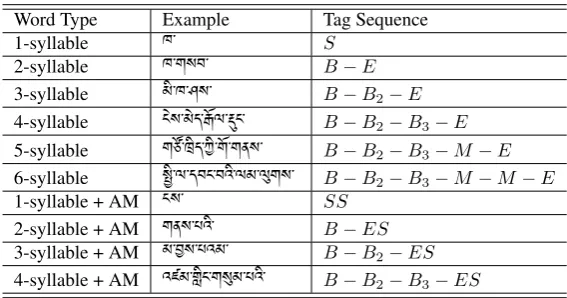
Then we can use the tags to label Tibetan word. The usage of the tags on words in different length is shown in Table 2. Using the above tags, the Tibetan sentence in (a) can be tagged as (c),
Table 2:Usage of the tag set.
Word Type Example Tag Sequence Word Type Example Tag Sequence 1-syllable ཁ་ S 1-syllable + AM ངས་ SS
2-syllable ཁ་གསབ་ B-E 2-syllable + AM གནས་པ་ B-ES 3-syllable ་ཁ་ཤས་ B-M-E 3-syllable + AM མ་ས་པའམ་ B-M-ES 4-syllable ས་ད་ལ་ང་ B-M-M-E N/A N/A N/A
and the segmentation result is in (d):
(a) ང་ས་་གས་ང་གས་་་ལ་དབང་བ་ལམ་གས་དང་ལ་བན་བ་ད་་་ན་མཐའ་འངས་ས་ད།
(b) We have always followed the principles of socialist public ownership and distribution ac-cording to work.
(c) ང་/B ས་/ES ་/B གས་/M ང་/M གས་/E ་/S ་/B ལ་/M དབང་/M བ་/M ལམ་/M གས་/E དང་/S ལ་/S བན་/S བ་/S ད་/S ་/S ་/B ན་/E མཐའ་/B འངས་/E ས་/S ད/S །/S
(d) ང་/ ས་/ ་གས་ང་གས་/ ་/ ་ལ་དབང་བ་ལམ་ གས་/ དང་/ ལ་/ བན་/ བ་/ ད་/ ་/ ་ན་/ མཐའ་འངས་/ ས་/ ད/ །/
4.2 Tag Set Selection
In the former subsection, we presented our basic idea with a tag set B, M, E, S, ES, SS. In this subsection, we will decide how many tags to use. In Chinese word segmentation, people used different tag sets as shown in Table 3.
Table 3:Definitions of different tag sets. Tag set Tags Words in tagging
2-tag B, E B, BE, BEE, ...
4-tag B, M, E, S S, BE, BM E, BM M E, ...
5-tag B, B2, M, E, S S, BE, BB2E, BB2M E, BB2M M E, ...
6-tag B, B2, B3, M, E, S S, BE, BB2E, BB2B3E, BB2B3M E, BB2B3M M E, ...
Zhaoet al.(2006b) proposed an effective method to choose the best tag set. They used a criterion
called “average weighted word length distribution” to decide the tag set. They defineLkas follow:
Lk= 1
N
K
∑
i=k
whereLkis the average weighted word length for alli≥k;Niis the word count with word length
i, andK is the maximum word length in the corpus. N is the total word count. ThenL1is the
average weighted word length of the whole corpus.
Statistics on 8 Chinese word segmentation corpora shows that the average weighted word lengths of the 8 corpora are between 1.51 and 1.71, thus they chose a 6-tag set in their sys-tem. It can represent a 5 characters context window which can contain 3 words in average:
(1.51,1.71)×3 = (4.53,5.13). Experiments show that the 6-tag set is more effective when it
acts in concert with an appropriate template(Zhaoet al., 2006a; Zhaoet al., 2006b).
Table 4:Statistical data on Tibetan corpus.
Word Length Lk Cumulative frequency Word Length Lk Cumulative frequency
1 1.5294 0.5735 4 0.1432 0.9946
2 0.9559 0.9396 5 0.0307 0.9975
3 0.2238 0.9665 6 0.0161 0.9994
Base on this method, we made statistics on Tibetan corpus, and the data are shown in Table 4. In the corpus, the average weighted word length is 1.5294, which is also in the interval of [1.51, 1.71], so the 6-tag set is also suitable to Tibetan, and it can label 99.75% words in the corpus with different tags to every syllable in each word.
Table 5:Usage of the 8-tag set. Word Type Example Tag Sequence
1-syllable ཁ་ S
2-syllable ཁ་གསབ་ B−E
3-syllable ་ཁ་ཤས་ B−B2−E
4-syllable ས་ད་ལ་ང་ B−B2−B3−E
5-syllable ག་ད་་་གནས་ B−B2−B3−M−E
6-syllable ་ལ་དབང་བ་ལམ་གས་ B−B2−B3−M−M−E
1-syllable + AM ངས་ SS
2-syllable + AM གནས་པ་ B−ES
3-syllable + AM མ་ས་པའམ་ B−B2−ES
4-syllable + AM འཛམ་ང་གམ་པ་ B−B2−B3−ES
As analysed in former subsection, we need another 2 tags ES and SS for abbreviated syllables.
Actually, it forms an 8-tag set: B,B2,B3, M, E, S, ES, SS. The usage of the 8-tag set on words
in different length is shown in Table 5. With the 8-tag set, the Tibetan sentence mentioned in the former subsection is tagged as (e):
(e) ང་/Bས་/ES་/Bགས་/B2ང་/B3གས་/E་/S་/Bལ་/B2དབང་/B3བ་/Mལམ་/Mགས་/Eདང་/Sལ་/S
བན་/Sབ་/Sད་/S་/S་/Bན་/E མཐའ་/Bའངས་/E ས་/Sད/S།/S
4.3 CRF Tagger for Tibetan
Maximum Entropy (ME) tagger was used in early character-based tagging for Chinese word
seg-mentation (Xue and Converse, 2002; Xue, 2003; Xue and Shen, 2003; Ng and Low, 2004; Lowet
al., 2005), In recent years, more and more people choose linear-chain CRF as the learning model
in their studies (Penget al., 2004; Tsenget al., 2005; Zhaoet al., 2006a; Zhaoet al., 2006b).
CRF is firstly introduced into language processing by Lafferty (2001). Penget al. (2004) first
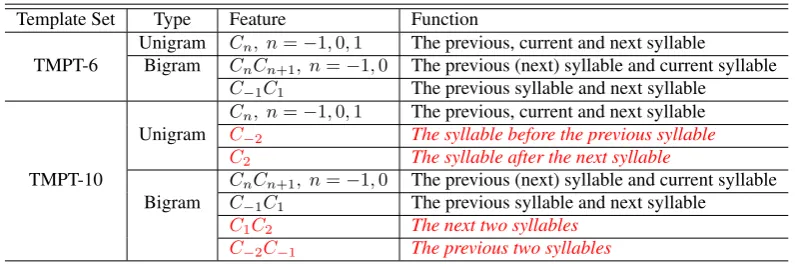
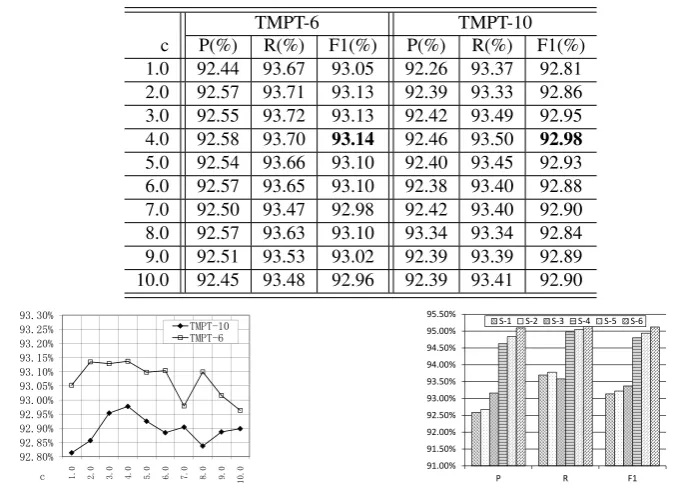
Combining methods used by Chen (2003a, 2003b), Caizhijie (2009a, 2009b) with Sun (2009, 1.0 92.44 93.67 93.05 92.26 93.37 92.81 2.0 92.57 93.71 93.13 92.39 93.33 92.86 3.0 92.55 93.72 93.13 92.42 93.49 92.95 4.0 92.58 93.70 93.14 92.46 93.50 92.98
5.0 92.54 93.66 93.10 92.40 93.45 92.93 6.0 92.57 93.65 93.10 92.38 93.40 92.88 7.0 92.50 93.47 92.98 92.42 93.40 92.90 8.0 92.57 93.63 93.10 93.34 93.34 92.84 9.0 92.51 93.53 93.02 92.39 93.39 92.89 10.0 92.45 93.48 92.96 92.39 93.41 92.90
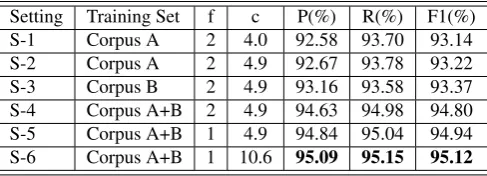
Figure 4. Withf = 2, we get the highest F-score (93.22%) atc= 4.9on Corpus A (S-2). With
the samef andc, we train the segmenter with Corpus B, and the performance improves slightly
(S-3). Then we use both Corpus A and Corpus B in the training, and get significant performance
improvement (S-4). The best performance is achieved atf= 1andc= 4.0.
Table 8:Performance of CRF-SegT with different settings. Setting Training Set f c P(%) R(%) F1(%) S-1 Corpus A 2 4.0 92.58 93.70 93.14 S-2 Corpus A 2 4.9 92.67 93.78 93.22 S-3 Corpus B 2 4.9 93.16 93.58 93.37 S-4 Corpus A+B 2 4.9 94.63 94.98 94.80 S-5 Corpus A+B 1 4.9 94.84 95.04 94.94 S-6 Corpus A+B 1 10.6 95.09 95.15 95.12
5.4 Comparison with other segmenters
We collected the test data of several Tibetan segmenters from related papers, and they are shown in Table 9. Chen and Sun evaluate their segmenters only by accuracy (Recall actually), so we can compare them only by recall. Compared with them, CRF-SegT outperforms only two of these sgementers. However, these segmenters are evaluated on different test sets, so it’s not much mean-ingful to directly compare the Recalls here. All the segmenters are using maximum-matching method based on dictionary except our CRF-SegT. All of them have inherent weakness on seg-mentation disambiguation and Out-Of-Vocabulary word identification. Our CRF-SegT doesn’t have those weakness. Considering these factors and the low quality of the training corpus, our approach is effective and acceptable though it doesn’t have the highest F-score compared with other Tibetan segmenters.
Table 9:Comparison of different Tibetan/Dzongkha segmenters. Sentence Count Word Count P(%) R(%) F1(%)
Chen 2003a N/A N/A N/A ≥0.96 N/A
Chen 2003b 500 5890 N/A 97.21 N/A
Sun 2009 435 4067 N/A 87.02 N/A
Norbu 2010 N/A 714 N/A 91.50 N/A
Our/SegT 1000 13977 96.99 96.91 96.94 Our/CRF-SegT 1000 13977 94.09 95.15 95.12
As collected by Zhao et al. (2006b), the F-scores of a state-of-art Chinese segmenter on most of 8 corpora are up to 95.3%-97.4%. Compared with them, CRF-SegT achieves a lower F-score. It mainly results from the low quality of the training corpus. As the F-score of SegT and CRF-SegT
are 0.9694 and 0.9512 respectively, it means the latter0.9512/0.9694 = 0.9812fits the former.
Thus, the CRF-SegT fits the training corpus at a percentage of 98.12%. It’s already greater than the upper bound of the interval 95.3%-97.4%, which shows that the result is acceptable.
6 Conclusion
of 131,903 sentences, the segmenter achieves an F-score of 95.12% on the test set of 1,000 sen-tences. At present, almost all Tibetan segmenters are using maximum matching method based on dictionary except the proposed one. All of them have inherent weakness on segmentation disam-biguation and Out-Of-Vocabulary word identification. The proposed approach doesn’t have those weakness. What is more, our segmenter is test on a larger test set. Considering these factors, our approach is effective and acceptable.
References
Cairangjia. 2009. Research on the Word Categories and Its Annotation Scheme for Tibetan
Corpus. Journal of Chinese Information Processing, 23(04):107-112
Caizhijie. 2009a. Identification of Abbreviated Word in Tibetan Word Segmentation. Journal of
Chinese Information Processing, 23(01):35-37.
Caizhijie. 2009b. The Design of Banzhida Tibetan word segmentation system. the 12th
Sympo-sium on Chinese Minority Information Processing.
Yuzhong Chen, Baoli Li and Shiwen Yu. 2003a. The Design and Implementation of a Tibetan
Word Segmentation System,Journal of Chinese Information Processing, 17(3): 15-20.
Yuzhong Chen, Baoli Li, Shiwen Yu and Lancuoji. 2003b. An Automatic Tibetan
Segmenta-tion Scheme Based on Case Auxiliary Words and Continuous Features, Applied Linguistics,
2003(01): 75-82.
Chungku Chungku, Jurmey Rabgay and Gertrud Faa. 2010. Building NLP Resources for
D-zongkha: A Tagset and a Tagged Corpus. Proceedings of the 8th Workshop on Asian Language
Resources. pp.103-110. Beijing, China.
Dolha, Zhaxijia, Losanglangjie and Ouzhu. 2007. The parts-of-speech and tagging set standards
of Tibetan information process. the 11th Symposium on Chinese Minority Information
Pro-cessing.
Thomas Emerson. 2005. The Second International Chinese Word Segmentation Bakeoff.
Pro-ceedings of the Fourth SIGHAN Workshop on Chinese Language Processing, pp.123-133. Jeju
Island, Korea.
Jianfeng Gao, Mu Li, Andi Wu and Chang-Ning Huang. 2005. Chinese Word Segmentation
and Named Entity Recognition: A Pragmatic Approach. Computational Linguistics, 31(4):
531-574.
Tashi Gyal and Zhujie. 2009. Research on Tibetan Segmentation Scheme for Information
Pro-cessing,Journal of Chinese Information Processing, 23(04):113-117.
John Lafferty, Andrew McCallum and Fernando Pereira. 2001. Conditional Random Fields:
Prob-abilistic Models for Segmenting and Labeling Sequence Data. Proceedings of the Eighteenth
International Conference on Machine Learning, pp.282-289.
Jin Kiat Low, Hwee Tou Ng and Wenyuan Guo. 2005. A Maximum Entropy Approach to Chinese
Word Segmentation. Proceedings of the Fourth SIGHAN Workshop on Chinese Language
Processing, pp.161-164. Jeju Island, Korea.
Hwee Tou Ng and Jin Kiat Low. 2004. Chinese part-of-speech tagging: one-at-a-time or
all-at-once? word-based or character-based. Proceedings of 2004 Conference on Empirical Methods
in Natural Language Processing, pp.277-284.
Sithiar Norbu, Pema Choejey, Tenzin Dendup, Sarmad Hussain and Ahmed Mauz. 2010.
D-zongkha Word Segmentation.Proceedings of the 8th Workshop on Asian Language Resources.
Fuchun Peng, Fangfang Feng and Andrew McCallum. 2004. Chinese Segmentation and New
Word Detection Using Conditional Random Fields. Proceedings of the 20th International
Conference on Computational Linguistics, pp.562-568. Geneva, Switzerland.
Kunyu Qi. 2006. On Tibetan Automatic Participate Research with the Aid of Information
Treat-ment. Journal of Northwest University for Nationalities (Philosophy and Social Science),
2006(04):92-97.
Richard Sproat and Thomas Emerson. 2003. The First International Chinese Word Segmentation
Bakeoff. Proceedings of the Second SIGHAN Workshop on Chinese Language Processing,
pp.133-143. Sapporo, Japan.
Yuan Sun, Luosangqiangba, Rui Yang and Xiaobing Zhao. 2009. Design of a Tibetan Automatic
Segmentation Scheme,the 12th Symposium on Chinese Minority Information Processing.
Yuan Sun, Xiaodong Yan, Xiaobing Zhao and Guosheng Yang. 2010. A resolution of overlapping
ambiguity in Tibetan word segmentation. Proceedings of the 3rd International Conference on
Computer Science and Information Technology, pp.222-225.
Huihsin Tseng, Pichuan Chang, Galen Andrew, Daniel Jurafsky and Christopher Manning. 2005.
A Conditional Random Field Word Segmenter for Sighan Bakeoff 2005. Proceedings of the
Fourth SIGHAN Workshop on Chinese Language Processing, pp.168-171. Jeju Island, Korea.
Hanna M. Wallach. 2004. Conditional Random Fields: An Introduction. Technical Report
MS-CIS-04-21. Department of Computer and Information Science, University of Pennsylvania,
Kun Wang, Chengqing Zong and Keh-Yih Su. 2009. Which is more suitable for Chinese word
segmentation, the generative model or the discriminative one? Proceedings of the 23th Pacific
Asia Conference on Language, Information and Computation, pp.827-834, Hong Kong, China.
Nianwen Xue and Susan P. Converse. 2002. Combining classifiers for Chinese word
segmenta-tion.Proceedings of the First SIGHAN Workshop on Chinese Language Processing, pp.63-70.
Taipei, Taiwan.
Nianwen Xue and Libin Shen. 2003. Chinese Word Segmentation as LMR Tagging.
Proceed-ings of the Second SIGHAN Workshop on Chinese Language Processing, in conjunction with
ACL03, pp.176-179. Sapporo, Japan.
Nianwen Xue. 2003. Chinese word segmentation as character tagging. Computational Linguistics
and Chinese Language Processing. 8(1): 29-48.
Ruiqiang Zhang, Genichiro Kikui and Eiichiro Sumita. 2006. Subword-based Tagging for
Confidence-dependent Chinese Word Segmentation. Proceedings of the joint conference of
the International Committee on Computational Linguistics and the Association for
Computa-tional Linguistics, pp.961-968, Sydney, Australia.
Yue Zhang and Stephen Clark. 2007. Chinese Segmentation with a Word-Based Perceptron
Algorithm. Proceedings of the 45th Annual Meeting of the Association for Computational
Linguistics, pp.840-847, Prague, Czech Republic.
Hai Zhao, Chang-Ning Huang and Mu Li. 2006a. An Improved Chinese Word Segmentation
Sys-tem with Conditional Random Field. Proceedings of the Fifth SIGHAN Workshop on Chinese
Language Processing, pp.108-117. Sidney,Australia.
Hai Zhao, Changning Huang, Mu Li and Baoliang Lu. 2006b. Effective tag set selection in
Chinese word segmentation via conditional random field modeling. Proceedings of the 20th
Pacific Asia Conference on Language, Information and Computation, pp.87-94 Wuhan, China.
Zhaxijia, Dolha, Losanglangjie and Ouzhu. 2007. The theoretical explanation on “the
parts-of-speech and tagging set standards of Tibetan information process”. the 11th Symposium on