ISSN 2286-4822 www.euacademic.org
Impact Factor: 3.1 (UIF) DRJI Value: 5.9 (B+)
Status of Drop out in Elementary Education: A
Micro Level Study
ANGSHUMITA CHAKRABORTY Assistant Professor in Geography Mahishadal Girls’ College Purba Medinipur District West Bengal
Abstract:
Key words: Universalisation, elementary education, drop out, wastage, free and compulsory education
Introduction:
In the pre-independence and post-independence period, the Government of India laid emphasis on Universalisation of Elementary Education (UEE). But compulsory and free education legislation has not brought equality in enrolment and completion at primary as well as upper primary level. Because many students drop out before the completion of the elementary stage due to poor economic condition. The constitution of India (1950) laid down under the Directive Principles of State Policy (Article 45), that “the State shall endeavour to provide within a period of 10 years from the commencement of their Constitution for the free and compulsory education of all children until they complete the age of 14 years.” But in reality achieving universal elementary education has become a myth as drop out problem is causing the wastage of time, money and effort.
2007-8, it poses a serious challenge to the success of SSA, which has Universalization of elementary education as an important objective (India Human Development Report, 2011). As per the official records, 30% children dropout at an early stage without completing the first five years of schooling and 50% children drop out during the period of eight years of compulsory schooling (Reddy and Sinha, 2008). Mehta (1977) has blamed on poverty, poor economic condition, failure in the examination, parental and children apathy towards education as causes of wastage and stagnation. He also pointed out that socio-economic condition of students always interacts with the educational factors resulting into the wastage and stagnation. Not frequently the parents in India employ “children in some form of labour as soon as they are old enough to be employed. Sometimes the employment is outside the family; but in a large majority of cases, the employment is in the family itself and the child is asked to do some work that will save the employment of outside labour (e.g., cattle- tending) or is asked to do some work (e.g., taking care of a younger child) which will enable the parents themselves to go out for work” (Chickermane, 1962; cited in Sharma and Shapra, 1967). According to Sattar (1984) economic and social condition of the family is the single most crucial variable affecting drop-out and drop-out is greatest, of children from poor and deprived sections of society.
Objectives and Study Area:
Discussion:
Drop Out Pattern:
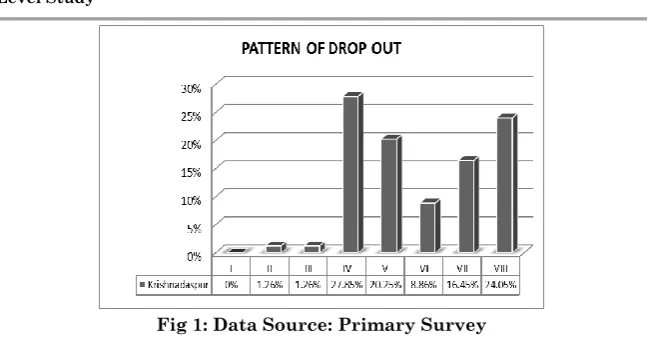
Bhatty (1998) reported that labour driven drop out rates are more likely to be low in the early grades and to increase significantly with increasing ages when children become more productive. Human Development Report of South Twenty Four Parganas District (2009) reveals that a Cohort study has been done on 97061 upper primary students of 751 upper primary schools in the different blocks and municipalities of South 24 Parganas district which exposed that though drop out is a severe problem at both the primary and upper primary level but it increases with higher stages of education.
Fig 1: Data Source: Primary Survey
Reasons of Drop Out:
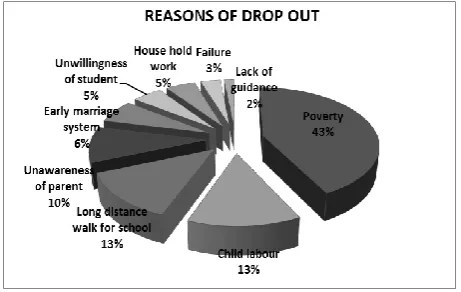
factors; external and internal though external factors are dominating in that area.
Fig 2: Data Source: Primary Survey
External Causes
1. Poverty: Poor economic condition of the parent act as major reason (43% respondent) behind drop out. Though some of the parents can send their children to school but when they get chances to get extra incoming opportunity they just engage their children either in work or household work.
2. Earning: Some students have been found as child labour (13% respondent). They work as agricultural laborer in agricultural field or outside; fish or crab collector from estuaries and creeks etc.; and even as jari worker, jewellery worker as paid labour.
4. Illiteracy of Parents: Most of the parents of the students are illiterate. Though some of them want their child to be educated. But others do not find any logic to send their children to school as it will not bring about any meaningful changes to their life. On the otherhand the child of the first learner family do not get any help from their parents for study which again tends to grow their disinterest in study and turns them into drop out. In the view of Govinda et al (2008) improving retention rates and the learning progress of these children is critical to breaking the inter-generational cycle of illiteracy and poverty.
5. Social Custom: Low level of education of parents,
tradition of early marriage of girls (especially greater in case of minority people than others) create obstacle towards the education of girl child. Some parents even don’t want to send their girl child to co-educational school. All these result into event of early drop out. 6. House Hold Work: Some of the students especially girls
are being engaged in various household core like cooking, sibling care, cattle management, bringing water, washing utensils etc. and stop going to school when their parents become engaged in different ways for earning.
Internal Causes
due to lack of classroom, sufficient teacher. As a result some classrooms become overcrowded and classes run even in the school verandah. There is dearth of proper sitting arrangement also. Students sit on the bare floor and even in some schools teacher does not have any table or chair. It has also been found that some of the classes do not have any blackboard.
2. Ineffective Method of Teaching: The teaching learning process cannot become successful due to the prevalent defective teaching method. Pressure of more students on one teacher, lack of teaching learning material, teaching aids, lack of in-service training to untrained teachers make the method of teaching unfruitful.
3. Recruitment of Teachers: Qualified no doubt but unwilling teachers are appointed in this noble profession. As a result absenteeism, indifference of the teachers hampers the teaching process. Sometimes the distance between home and school becomes troublesome. On the other hand the inhospitable condition compels the teacher to have daily journey from home to school and school to home. Some of the teachers come to school after scheduled time and leave school before exact time. Absenteeism as well as reduction in school hours hampers the teaching learning process.
Conclusion:
People of this studied village suffer to meet their basic demand for sustainable living. Their sufferings are being aggravated through the attack of different natural hazard due to climate change. In this situation having no other alternatives they are compelled to withdraw their offspring from school for grabbing the extra earning opportunity. Alternative income generating activities should be introduced so that the helpless parents can be engaged in other occupation in time of crisis and don’t have to seek help from their children to sustain their family. Self help group can increase the female work participation rate and reduce the economic insecurity of any family. More stipends or scholarships have to be given to needy as well as meritorious students. On the one hand Remedial coaching should be introduced to provide guidance to child of first learner family and on the other hand Informal schooling should be initiated for returning back of the dropped out to continue their study again especially who are in the age group of 6-14 years. School infrastructure has to be improved to provide sufficient room, girls’ toilet, teachers’ toilet, teachers’ accommodation etc. so that proper pupil teacher ratio can be maintained and teachers coming from cities can stay near school. Parent teacher meeting is needed at regular interval to discuss the real problems behind drop out. School vacations should be adjusted to the local need to check the child labour issue. Last but not the least is the adoption of demand based strategies along with different measures like institutional, pedagogical etc. to combat the drop out problem.
REFERENCES:
Government of West Bengal, Chapter 05, pp. 94-142,
(Online) available at
wbplan.gov.in/HumanDev/DHDR/24%20pgsSouth/Chapt er%2005.pdf, (accessed on 13.07.12).
Bhatty, K. 1998. “Educational Deprivation India: A survey of Field Investigations.” Economic and Political Weekly 33 (27, 28): 1731-1740 and 1858 – 1869.
Das, A. 2007. “How Far have We Come in Sarva Siksha Abhiyan?” Economic and political Weekly XLII(1): 21-23. Government of India. 2011. India Human Development Report.
Planning Commission, New Delhi, Oxford, 179-207. Govinda, R. and M. Bandyopadhyay. 2008. Access to elementary
education in India: Country Analytical Review. National University of Educational Planning and Administration (NUEPE), New Delhi, Research commissioned by the Consortium for Research on Educational Access, Transition and Equity (CREATE), University of Sussex, UK, July, pp. 1-90, (Online) available at sro.sussex.ac.uk/1871/1/India_CAR.pdf, (accessed on 25.01.13).
Mehta, P. 1977. “Socio-Psychological Interventions for Universalizing Education.” Vikalpa 2(1): 59-70, (Online) available at www.idocshare.com/.../socio-psychological-interventions-for univers..., (accessed on 30.12.11). Reddy, A. N. and Sinha, S. 2008. School Dropouts or Pushouts?
Overcoming Barriers for the Right to Education. National University of Educational Planning and Administration (NUEPE), New Delhi, Create Pathways to Access, Research Monograph No. 40, Research commissioned by the Consortium for Research on Educational Access, Transition and Equity (CREATE),University of Sussex, U K, July, pp.1-31,
(Online) available at
Roy, C. 2011. “A study on the dropout problem of primary education in Uttar Dinajpur, West Bengal, India.” Presented in a UGC-Sponsored National Level Seminar on “Right to Education: An Accelerator of Social Transformation and Economic Development”, organized by Department of Economics, Kaliyaganj College during 18th and 19th November, Munich Personal RePEc
Archive, Paper No. 40319, posted 31. July 2012 13:46 UTC, pp. 1-14, (Online) available at mpra.ub.uni-muenchen.de/.../A_Study_on_the_Dropout_Problem_in..., (accessed on 24.03.13).
Sattar, E. 1984. The Drop out Problem in Primary Education, UNESCO Regional Office for Education in Asia and the Pacific, Bangkok, pp. 1-28.