Available online: https://edupediapublications.org/journals/index.php/IJR/ P a g e | 2905
COMPARATIVE ANALYSIS AND STUDY OF
HIGH STRENGTH CONCRETE AND COST
EFFECTIVENESS
DARLA GNANESWAR KUMAR
#1,
T S D PHANINDRANATH
# 2,
P. LAVANYA
# 3#1
M.Tech Scholar,Department Of
Structural Engineering(Civil)
,
Chaitanya Engineering College
,
Kommadi, Visakhapatnam -530 041.
#2
Asst.Prof, Department of
Structural Engineering(Civil)
,
JNTUV, AP, India.
#3
Asst.Prof, Department of
Structural Engineering(Civil)
,
Sai Ganapathi College of Engineering
, AP, India.
ABSTRACT
Co n crete is one kind of a composite material that is formed of fine and rough or harsh in texture bonded together with one kind of cement paste to get harden over time. There are various types of concretes used for constructing walls like lime-based concrete which forms by portland cement and some of them are formed by hydraulic cements like calcium aluminate cements. Although there are various types of composite materials, one among the most commonly used composite is asphalt concrete, mostly used for constructing the road surfaces formed by a material like bitumen. The main role of concrete is development of infrastructure i.e. for buildings and highways. If we look at the other side of
the concrete usage, cost plays a vital role in choosing the best and accurate composition. In order to achieve the efficient mixture, there was a high strength concrete which is formed by a fresh water to give smooth states. In this paper we mainly focus on effective utilization of mineral admixture i.e. replacing fly in the place of cement & also adding a super plasticizer CONPLAST SP 430 as Mineral Admixture to obtained High Strength Concrete. By using the fly-ash in the composition we can able to reduce a lot of excess water usage during the construction.
Key Words:
Available online: https://edupediapublications.org/journals/index.php/IJR/ P a g e | 2906
1. INTRODUCTION
As we all know that concrete has been a major material for providing a stable and reliable infrastructure for constructing buildings, walls or floors. Concrete with compressive strengths of 20-40N/mm² have been traditionally used in construction projects. With the demand for more sophisticated structural forms along with deterioration, long term poor performance of a conventional concrete led to accelerated research for development of concrete which would score on all the aspects that a new material is evaluated upon i.e. workability, durability, affordability and thus enable the construction of sustainable and economic buildings with an extra ordinary slim designs besides providing material that will have long term better performance and reduced maintenance.
Fig ure.1. Represents the Differen ce b etween Traditional and High Strength Concrete (HSC)
The development of High Strength Concrete has been a great breakthrough in Concrete Technology. High strength concrete (HSC) may be defined as concrete with a specified characteristic cube strength between 40 and 100 N/mm2, although higher strengths
have been achieved and used. Strength levels of 80 to 100 N/mm2 and even higher are being
used for both precast and in-situ works. From the above figure 1, we can clearly find out the differences between the traditional and high strength concrete, where the traditional concrete contains cement along with water. In that we can find the capillary pores inside the concrete. But if we look into the high strength concrete, we can find cement, water along with additional substance like silica fume. By using this silica fume inside the concrete, there will be no presence of capillary pores seen inside the concrete.
2. BACKGROUND WORK
In this section we will find the background work that was analyzed and studied in order to implement this current proposed project. This section will describe the work that is related to the study the cost effectiveness of designing structures with High Performance Concrete by giving a cost comparison between concrete M20 and M60 using a concrete mix achieved in the laboratory. Also here we can see the several researches that were done on the primitive concrete types. Now let us discuss about those in detail as follows:
Available online: https://edupediapublications.org/journals/index.php/IJR/ P a g e | 2907
Some of the earlier researches on the effectiveness in designing of structures like high rise buildings with High Strength Concrete are as follows:
a) J.HEGGER (Aachen University of Technology, Institute of Concrete Structures, 52056 Aachen, Germany) studied the economical and constructional advantages of High Strength Concrete for a 186 m high rise building in Frankfurt, Germany concluded that, for columns designed for 20KN with 85MPa concrete more than 50% of the reinforcement can be saved when compared to 45MPa concrete.Inspite of the approximately 60% higher concrete cost the total cost of the building can be reduced by about 15%. b) According to a study by M ORENO, the
use of 41MPa compressive strength concrete in the lower columns of a 23-storey commercial building requires a 865 mm2 column whereas the use of 83MPa
concrete allows a reduction in column size to 610 mm2.In addition to the reduction in
the initial cost, a smaller column size results in less intrusion in the lower stories of commercial space and, thereby more rentable floor space. Also studies have been conducted regarding the method for obtaining HSC as regards to the constituents required, mix design parameters, effect of various chemical and mineral admixtures on the strength of concrete. Whilst a number of studies have considered the development of a rational or standardizes method of concrete mix for HSC no widely accepted method is currently available.
3. A NOVEL PROPOSED STUDY OF HIGH STRENGTH CONCRETE A ND
COST EFFECTIVENESS
In this section, we mainly describe the proposed Hig h Streng th Co n crete an d Co s t Effectiven es s for High Strength Concrete is based on the water-binder ratio.
A ) PRELIM INA RY KNOW LEDGE
The use of Fly-ash as a partial replacement of cement on the Workability and compressive strength of High-strength concrete will be investigated. The mixing procedure for the High-strength concrete will be as per IS 10262-2009 & IS 456-2000.The experimental work planned in this investigation consisted of mix proportioning of M60 grade High-strength concrete with Fly ash as cementations material. The methodology adopted for the experimental work includes
1) Mix proportioning for High-strength concrete to achieve desired early initial strength without segregation and bleeding using chemical admixture.
2) Fly ash as cementatious material will be used, in different dosages to study the flow ability and strength of the mix proportion.
Available online: https://edupediapublications.org/journals/index.php/IJR/ P a g e | 2908
4) Compressive strength test will be conducted to determine the strength characteristics of High-strength concrete.
5) Finally the strength results are compared at 3days, 7 days and 28 days for the precast mix with different dosages of Fly-ash.
B) M A TERIA L PROPERTIES
The materials used for the experimental programmed are cement, river sand, coarse aggregate, fly ash, super plasticizer and water were locally available at the institute vide the construction agencies working in the institute. The succeeding subsections describes in detail about the materials used.
i) CEM ENT
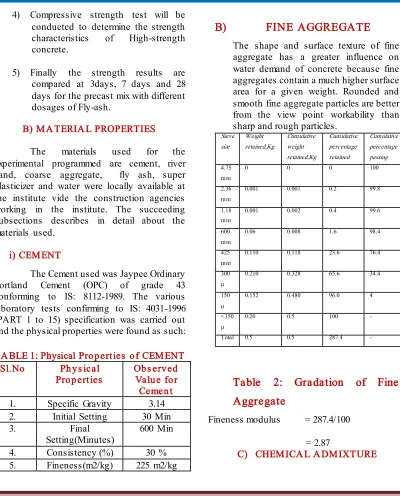
The Cement used was Jaypee Ordinary Portland Cement (OPC) of grade 43 conforming to IS: 8112-1989. The various laboratory tests confirming to IS: 4031-1996 (PART 1 to 15) specification was carried out and the physical properties were found as such:
TA BLE 1: Physical Pro p erties o f CEM ENT Sl.No Ph y s ical
Pro p erties
Ob s erv ed Valu e fo r Cemen t 1. Specific Gravity 3.14 2. Initial Setting 30 Min
3. Final
Setting(Minutes)
600 Min 4. Consistency (%) 30 % 5. Fineness(m2/kg) 225 m2/kg
B)
FINE AGGREGATE
The shape and surface texture of fine aggregate has a greater influence on water demand of concrete because fine aggregates contain a much higher surface area for a given weight. Rounded and smooth fine aggregate particles are better from the view point workability than sharp and rough particles.
Table 2: Gradation of Fine
Aggregate
Fineness modulus = 287.4/100 = 2.87
C) CHEM ICA L A DM IXTURE Sieve size Weight retained,Kg Cumulative weight retained,Kg Cumulative percentage retained Cumulative percentage passing 4.75 mm
0 0 0 100
2.36 mm
0.001 0.001 0.2 99.8
1.18 mm
0.001 0.002 0.4 99.6
600 mm
0.06 0.008 1.6 98.4
425 mm
0.110 0.118 23.6 76.4
300 µ
0.210 0.328 65.6 34.4
150 µ
0.152 0.480 96.0 4
<150 µ
0.20 0.5 100 -
Available online: https://edupediapublications.org/journals/index.php/IJR/ P a g e | 2909
The main component that is required for achieving the HSC is Water-Cement ratio. As water reductions and is seen in content the strength of water content increases the strength considerably. This can be achieved by using water reducing admixture or super plasticizer. The use of super plasticizer generally reduces the amount of water required by 15%-40%.Super plasticizers are usually the chemical compounds like Sulphonated Melamine Formaldehyde(SMF),Sulphonated Naphthalene Formaldehyde(SNF) and Modified Lignosulphonates.
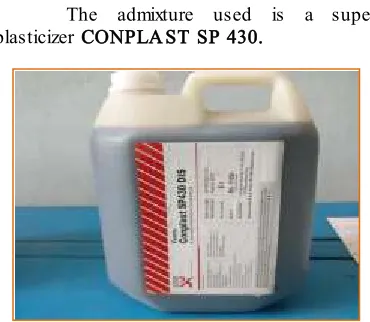
The admixture used is a super plasticizer CONPLA ST SP 430.
Fig u re 2. Rep res en ts th e Samp le o f CONPLA ST SP 430
DESCRIPTION A BOUT THE CONPLA ST SP 430:
CONPLAST SP 430 is supplied as a brown liquid instantly dispersible in water. It has been specially formulated to give high range water reductions upto 25% without loss
of workability or to produce high quality concrete of reduced permeability.
4. RATE OR COST ANALYSIS OF
M-60 GRADE CONCRETE
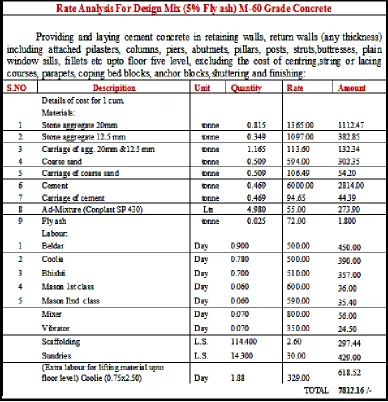
Here we can see the rate analysis of M-60 Grade Concrete which is formed by various factors. Now let us discuss about that
in detail.Rate analysis or coast analysis is the estimation of total expenditure or the rates of the individual items used in the construction project. It also gives an idea of total quantity of material and the total coast of the project. The Purpose of Analysis of Rates is as follows.
From the below table 2 and 3 it can be seen that for M60 grade concrete mix the total cost of materials used is 7985.22/- and that of M60 Fly ash induced concrete is 7812.16/- respectively which is less with a difference of 173.06/- rupees. Therefore it can be concluded that usage of fly ash in concrete is recommended as it results in cost-effective concrete.
5. EVALUATION RESULTS
Available online: https://edupediapublications.org/journals/index.php/IJR/ P a g e | 2910
0 50 100 150
0% 5% 7% 10%
Sl um p in m m
% of Fly Ash
Slump(mm)
Slump(mm)
WORKABILITY TEST RESULTS:
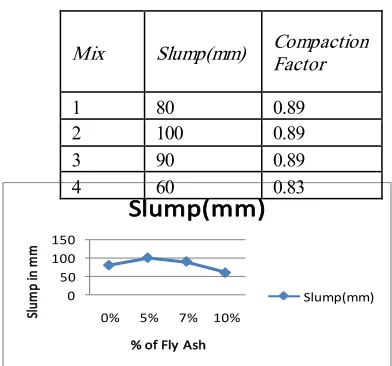
Workability is defined as the ease with which concrete can be mixed, placed, consolidated and finished. A concrete is said to be workable if it is easily transported, placed, compacted and finished without any segregation. The results of the slump & Compaction Factor tests are presented in table 6 and comparative study with varying percentage of quarry dust is shown graphically. 6.1. W ORKA BILITY:
ANALYSIS OF RESULTS
Grap h 1.Rep res en ts th e Grap h in d icates % of FLY-ASH v s SLUM P Valu es
Grap h 2.Rep res en ts th e Grap h
in d icates % o f FLY-A SH (VS)
COM PA CTION FA CTOR
Grap h 3.Rep res en ts th e Grap h
in d icates % o f FLY-A SH (VS)
COM PRESSIVE STRENGTH
TABLE 3.Rate Analysis for Design Mix M-60 Grade Concrete
Mix Slump(mm) Compaction Factor
1 80 0.89
2 100 0.89
3 90 0.89
4 60 0.83
0 10 20 30 40 50 60 70
0% 5% 7% 10%
co m p res si ve str en gth tes t( M p a )
% of FLY ASH
COMPRESSIVE STRENGTH
Available online: https://edupediapublications.org/journals/index.php/IJR/ P a g e | 2912
Available online: https://edupediapublications.org/journals/index.php/IJR/ P a g e | 2913
SOME OF THE EXPERMENTAL PHOTOGRAPHS
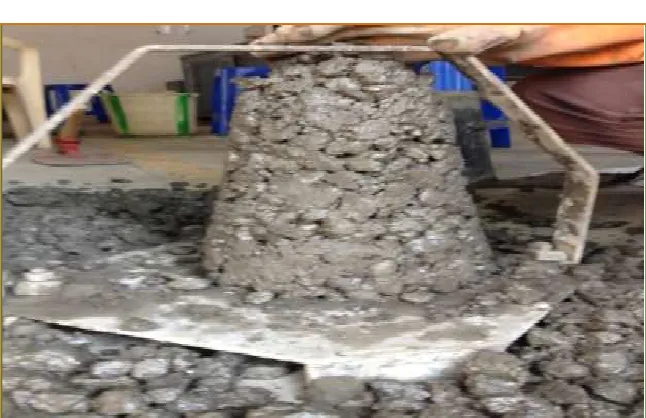
Fig ure 3 . Represents the Slu mp co n e fo r Trial mix co n tain in g 0% fly as h an d 1.0% SP 430
Available online: https://edupediapublications.org/journals/index.php/IJR/ P a g e | 2914
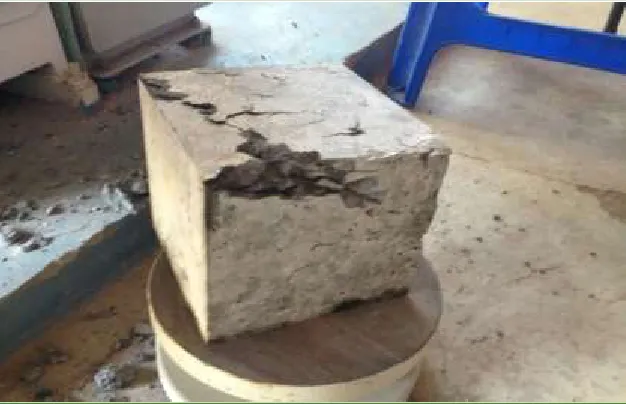
Fig ure 5.Represents the Co n crete s p ecimen o f g rad e M 60 with 5% fly as h an d 1.0% SP430
COMPRESSIVE STRENGTHS
The specimens were tested for compressive strength on compression testing machine provided with two steel bearings applied without shock and is increased continuously at a rate 140/cm2/min (approx) until the specimen breaks. The measured
compressive strength is calculated by dividing the maximum compressive load by the cross -section area calculated from the mean dimension of the specimen is clearly seen in the table 5.
Tab le 5.Represents the Compressive Stren g th Tes t Res u lts
M ix n o % A s h Fly
Co mp res s iv e s tren g th (M p a)
3d ay s 7d ay s 28d ay s
1 0 26.72 43.49 57.94
2 5 29.80 40.36 60.66
3 7 23.29 41.37 58.90
4 1
Available online: https://edupediapublications.org/journals/index.php/IJR/ P a g e | 2915
6. CONCLUSION
In this paper, we for the first time From the present investigation and limited observations reported, on the effect of partial replacement of cement with Fly Ash in High Strength Concrete mixes, following conclusion like the compressive strengths of concrete may vary with the change in percentage of fly-ash. Also the value of slump is increased with the decrease in the content.
7. REFERENCES
[1].J.HEGGER (Aachen University of Technology, Institute of Concrete Structures, 52056 Aachen, Germany) studied the economical and constructional advantages of High Strength Concrete .
[2] .MORENO In addition to the reduction in the initial cost, a smaller column size results in less intrusion in the lower stories of commercial space and, thereby more rentable floor space.
[3]. AbdulWahab, B.DeanKumar, M.Bhaskar, S.Vijaya Kumar, B.L.P.Swamy (IJSER, Volume 4, Issue 5, May 2013) studied the mechanical properties of High Strength Concrete
[4]. ERNTROY AND SHACKLOCK have done many experimental investigations and indicated that in HSC mixes, workability, type and maximum size of aggregate and strength
requirement influence the selection of water-cement ratio.
[5]. Hegger, J, “High-strength concrete for a 186 m high office building in Frankfurt, Germany.” Engineering Structures, Vol. 18, No. 11, (1996): pp. 850-854.
[6]. Moreno, J,“High-Performance Concrete: Economic Considerations.” Concrete International, Vol. 20, No. 3, Mar.
[7]. Bhanjaa, S, Sengupta, B, “Modified water–cement ratio law for silica fume concretes.”Cement and Concrete Research. 33 (2003) p.447–450.
[8]. Maiti, S C, Agarwal, Raj K, and Rajeeb Kumar,“Concrete mix proportioning.”The Indian Concrete Journal , December 2006 ,p 23-26.
[9]. Henry H.C. Wong and Albert K.H. Kwan “Packing Density: A Key Concept for Mix Design of High Performance Concrete”.
Available online: https://edupediapublications.org/journals/index.php/IJR/ P a g e | 2916
8. ABOUT THE AUTHORS
DARLA GNANESWAR KUMAR
is currently pursuing his 2 years M.Tech in Department of CIVIL Engineering withStructural Engineering as Branch
Specialization at Chaitanya Engineering College, Kommadi,Visakhapatnam, AP, India. His area of interest includes Structures.
T S D PHANINDRANATH
is currentlyworking as an Assistant Professor in
Department of Structural
Engineering(Civil),JNTUV, AP, India. He has
almost 2 years of teaching experience.His research interest includes seismic zone.
P. LAVANYA
is currently working as an Assistant Professor in Department of StructuralEngineering(Civil) at Sai Ganapathi College of
Engineering College, AP, India.She has more
than 3 years of teaching experience.Her Research interest includes Structures .