March 2018
Available online: https://edupediapublications.org/journals/index.php/IJR/ P a g e | 729
Personalized Poi Travel Recommendation System from Social Networks
G.SANDEEP, Assistant Professor
Dept of CSE,
ABSTRACT: Travel based recommendation and journey planning are challenging tasks because of various interest preferences
and trip restrictions such as limitation of time, source and destination points for each tourist. Large amount of data can be collected from the Internet and travel guides, but these resources normally recommend individual Point of Interest (POI) that is considered to be familiar, but they do not provide sufficient information to the interest preference of the users or hold to their trip constraints. In addition, the huge volume of information makes it a challenge for every tourist to pay attention to a potential set of POIs to make a visit in any unknown city. After the tourist discovers an acceptable set of POIs to go to, it’ll take abundant time and energy for him/her to make a brief outline of the suitable duration of the visit at every POI and the order in which to visit the POIs. To sort out these problems, an author topic collaborative filtering (ATCF) algorithm is suggested for personalized tours. This method suggests that the POIs are optimized to the users’ interest preferences and POI popularity. Hence, this method is elaborately explained here for tour recommendation problem based on similar user and similar city prediction, which considers user tags. It extends our method to provide personalized suggestions based on user geo co-ordinates points. In the first instance, the multiple users’ location histories are modeled using tree-based hierarchical graph (TBHG). Based on TBHG, HITS approach is developed in order to gather the interest level of a selected place and a user’s travel expertise (knowledge). Finally, HI TS-based collaborative filtering technique is used to obtain GPS based personalized recommendation system. And for image based search similar images with the tag information are retrieved for the query image users have.
Keywords— City prediction, GPS trajectories, Place of interest Travel Recommendation, User preferences.
I. INTRODUCTION
In modern days, the rapid growth of cities has paved way for the development of a huge number of points of interest (POIs), e.g., stores, theatres, restaurants and residence that enliven and entertain the people, providing us with more choices of living experience than before. People routinely explore the city and neighborhood in their daily life and decide where to go based on their personal interests and the various choices of POIs. At the same time, making an efficient and effective decision among the large number of POI choices becomes an annoying problem for the user. To facilitate the user’s exploration and decision making, POI recommendation has been introduced by location-based services. However, such recommendation models are commonly based on the preference of most of the users on POIs, which ignore the user’s personal preference. When compared to the places visited that are best suited to the user’s interest, those places visited that are against the user’s interest could bring bitter exploration experience in a situation when the user travels to a new place.
Hence, the personalized POI recommendation is absolutely necessary in order to help the users filter out venues that are uninteresting according to their own taste, reduce the displeasing experience, and save their time in decision making. Collaborative filtering (CF) and Content-based (CB) are the most commonly used methods of personalized travel recommendation.CF, which is otherwise
referred to as social filtering, filters information by using the recommendations of other people.
The Recommender systems are being usually applied in many fields, like e-commerce, etc., to provide various products, important services and useful information to many customers. Collaborative filtering is considered to be the most successful approach. The contents it recommends to the current customers are mainly based on the past transactions and feedback of the various customers. However, it is not easy to distinguish the similar interests between customers because of the sparseness problem. The sparseness problem is caused by the insufficient number of transactions and feedback data, which limited the usage of the collaborative filtering method. Besides collaborative filtering, content based filtering is yet another important class of recommenders systems. T
March 2018
Available online: https://edupediapublications.org/journals/index.php/IJR/ P a g e | 730
restrictions. While the CF systems do not explicitly incorporate feature information, the content-based systems do not incorporate the necessary and preferred information which is alike across the individuals.
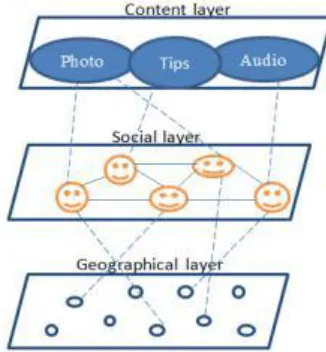
When compared with other online social networks that have the user activities interacting with the virtual world, Location Based Social Networks (LBSNs) reflect the user’s geographical action in the real world, where the online world and the real world intersect; therefore, connecting the gap between the real world and the virtual world. The network provides challenges for researchers to investigate the users’ changing behavior for the point of interest recommendation in spatial, temporal, social and content aspects. The POI recommenders systems have a main role in LBSNs since they can not only meet the users’ personalized preferences for visiting new places, but also help LBSNs to enhance revenues by providing the users with intelligent location services, such as location-aware advertisements which is illustrated in fig 1.
Figure1. Location-Based Social Networks
The advanced GPS-enabled devices allow the people to record their location histories. They achieve this with GPS traces, which suggest the behavior of the people and what all they prefer related to travel. We have performed two different types of travel recommendations by mining GPS traces of multiple users:
1. A generic one that recommends the user with the most interesting locations in a given spatial region.
2. A personalized recommendation that provides the user with suitable locations that matches his travel preferences. To achieve the first recommendation, we develop multiple users’ location histories using a tree-based hierarchical graph (TBHG). We propose the HITS-based model to satisfy the user’s interest on visiting a particular location. In our personalized recommendation, we first study and understand the correlation between the locations.
Then we convert and incorporate this correlation into a collaborative filtering-based model. This predicts the user’s interests in an unvisited location based on his location histories and that of others. Next the other type of
recommendation is based on images (i.e.) the user can search similar images with the query image. This recommendation will retrieve all similar images with the associated information.
II. POI RECOMMENDATION USING ATCF
The rapidly growing of Social networks provides an outsized quantity of knowledge that allows the services based on point of interest. In this approach, a study of latest POI recommendation drawback to predict the users’ current cities is to be suggested. The challenge is tough to learn the user’s ordered information and provide personalized recommendation model. So implementation of Author Topic Modeling approach carries the personalized travel recommendation system that is the extended version of LDA technique. This system collects the knowledge of the author and therefore the cities. Through ATM, both the category and the user’s travel preferences are mined by modifying the latent model simultaneously. The ATM chiefly consists of two steps such as probabilistic generative model and Bayesian estimation model. Through ATM, we can determine the probabilities of every word to different topics. We also get author topic matrix for all the users. Then represent each POI as one point in a latent space. We assume that the Euclidean distance between the points of interests in the latent space reflects the transition probability. The larger the gap, the lower the strength of transitions. With all POIs embedded in a latent space, our model estimates the sensible transition probabilities of POIs. It is additionally attainable to assign meaningful possibilities to those unobserved transitions and it is shown in figure 2.Figure 2: ATCF framework
March 2018
Available online: https://edupediapublications.org/journals/index.php/IJR/ P a g e | 731
famous people, popular things or events that interest much. Such services are used for social networking like being in touch with friends, relatives and colleagues. Micro blogging sites publish certain platforms to create and take content from sets of users with overlapping and various interests. Example: A case study in Twitter
User 1: Charles User 2: Robin
Charles follows Robin because of the latter’s posts about travel experience. But Robin also uses Twitter for sharing political views and cricket news with friends. Currently Charles has limited tools to filter cricket and political content from Charles. Twitter, however, assumes that Charles wants to read every post shared by other people. Similarly, Charles also has a limited set of options to identify new people to follow. He will be able to view the list of users in the social graph (e.g. those followed by Robin), Otherwise Charles can search by keyword and then browse the returned tweets’ posters. This remains very difficult to find people like Robin.
The textual information to predict user experience may be difficult if proper language is not used.
III.
PROPOSED SYSTEM
A. Search by Location
The latest GPS enabled devices allow the individual to as certain their location histories with GPS records, which means human behaviour and preferences based on travel. In this paper, two sorts of travel recommendations are given by casting off multiple users’ GPS traces. The first kind recommends the user with prime fascinating locations and travel sequences in an exceedingly given geospatial region. The second may be a personalized recommendation that offers the user with locations matching her/his travel preference. To model multiple user location history, tree-based hierarchical graph (TBHG) is employed. Tree tree-based hierarchy is constructed by collecting multiple GPS logs and cluster them using ―density based clustering‖ so that similar points will come under same cluster. The algorithm behind this technique is seen below Input: Multiple users GPS logs, r
(radius), minpt (minimum number of point in cluster) Output: Clusters
Start with a point (GPS log), let it be the centre
Extract neighbourhood of this point (i.e.) points with distance r.
If sufficient neighbourhood, form a cluster or else consider as noise
The distance between two points is calculated as Distance (p, c) =sqrt ((px k -cx n ) 2 + (py k -cy n ) 2 ) Where c is the centre, p is the point to be compared, px, py is the latitude and longitude of p, cx, cy be the latitude and longitude of centre point. Based on tree based hierarchical
graph, hypertext induced topic (HITS) search model is developed. This is a search-query dependent ranking algorithm for information retrieval and predicts various levels of location and knowledge about travel experiences. When the user enters a probe query, in the first instance, the HITS method lists out the relevant pages returned by a probe engine and then it brings out two sorts of rankings for the enlarged set of pages. Those rankings are called authority ranking and hub ranking.
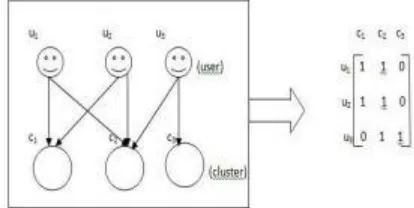
In the expanded set, HITS assigns them an authority score (location that’s visited by most variety of user is given higher authority score) and a hub score (user who have visited most variety of places is given higher hub score). There are two links that are discussed—in-links and out-links. An authority is a page with a number of inlinks, and a hub is a page with a number of out-links. The main idea of HITS is that it will have good hub points to many good authorities, and a good authority is referred to a number of good hubs. Thus, both authorities and hubs have a mutual reinforcement relationship. To be very precise, the authority score of a page is the sum of the hub scores of the pages pointed to it and its hub score is the integration of authority scores of the pages pointed to it. The authority and hub scores of every page can be calculated by using a power iteration method. According to the query topic, the main strength of HITS is ranking pages, which may provide more relevant authority and hub pages. Finally implement CF approach to construct matrix based users, cities and GPS co-ordinate points. This is represented as shown in figure 3.
Figure 3: Mapping of user to cluster
This model contains two factors. The first one is the interest of a location which depends upon number of users visiting this location and the travel experiences of these users. The location interest is represented as Location interest= ∑ Lij k And users experience is represented as hub score H k = hij k ; 1≤i≤L; 1≤j≤C Where c is the cluster and l is the level in tree graph. The second factor is that the users’ travel experiences and the location interests have a mutual reinforcement relationship.
B. Search by Image
March 2018
Available online: https://edupediapublications.org/journals/index.php/IJR/ P a g e | 732
metadata such as keywords, tags or description associated with the image. Content refers to colors, texture or any other information that can be derived from the image. CBIR use query technique which involves an example image that it will then base its search upon. A pre-existing image can be used by the user to search. The result images should all share common elements with the provided example. The average of colour layout and edge histogram descriptor for all images is found and stored in the database. Calculate the distance of query image with that of images in the database using Euclidian distance H1 = Average histogram (image1) H2 = Average histogram (image2) Distance = sqrt [(sum(H1-H2) 2 )] Examining images based on the colors is one of the commonly used methods because it does not depend on image size or orientation. Thus it will retrieve similar image with the tag information associated with it.
C. Architecture
Figure shows the architecture diagram of our system, which is composed of the following two parts; search by location, search by image.
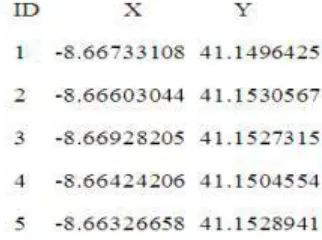
application with Google API travel sequences is used which is based on ATCF and HITS approaches, including our methods and some baselines. As the subjects are familiar with this region, we are more likely to find out common ground truths shared by them. For location based recommendation, GPS logs of multiple users is taken as the input. It contains three fields. Each point is represented by an ID, an X coordinate (longitude), and a Y coordinate (latitude) with one point per line.
Figure 4: Architecture of our system
Search by location: Given multiple users’ GPS logs, we build a tree based hierarchical graph in off-line.
With the TBHG, we propose a hyper text induced topic search based inference model to estimate users’ travel experiences and location interests in a given region. Finally, the most experienced users X, top interesting locations M within the specified region can be suggested to the users. Search by image: The user enters the search query in the system; from this image CEDD descriptor is extracted. This system uses image database in which indices contain the descriptor value for all images. Thus the images with most similar value are extracted with the tag information.
IV. EXPERIMENTAL RESULTS
The experiment illustrates the framework of the evaluation, in which we respectively explore the effectiveness of the location and the travel sequence recommendation by performing the user study. In this study, .NET based
V. CONCLUSION
In this paper, using the GPS trajectories generated by multiple users, we mined interesting locations and classical travel sequences within a given geospatial region. Such information can help us understand the correlation between the users and the locations, and enable travel recommendation as well as mobile tourist guidance. In this work, we consider an individual’s visit to a location as a link from the individual to the location, and weight these links in terms of the users’ travel experiences in various regions. A HITS-based model is proposed to infer the user’s travel experience and the interest of a location considering the following two aspects. One is the mutual reinforcement relationship between the location interest and the user travel experience. The other is that the user travel experience as well as the location interest is region-related. Later, we detected the classical travel sequences in a destined region using the location interests and the users’ travel experiences. Finally similar images with the tag information are retrieved for the query image users have.
REFERENCES
March 2018
Available online: https://edupediapublications.org/journals/index.php/IJR/ P a g e | 733
[2] J. Bao, Y. Zheng, and M. F. Mokbel, ―Location-based and preference aware recommendation using sparse geo-social networking data,‖ in Proc. 20th Int. Conf. Adv. Geographic Inf. Syst., 2012, pp. 199–208.
[3] D. M. Blei, A. Y. Ng, and M. I. Jordan, ―Latent Dirichlet allocation,‖J. Mach. Learn. Res., vol. 3, pp. 993– 1022, 2003.
[4] A. Cheng, Y. Chen, Y. Huang, W. Hsu, and H. Liao, ―Personalized travel recommendation by mining people attributes from community contributed photos,‖ in Proc. 19th ACM Int. Conf. Multimedia, 2011,pp. 83–92.
[5] M. Clements, P. Serdyukov, A. de Vries, and M. Reinders, ―Using flickr geo-tags to predict user travel behaviour,‖ in Proc. 33rd Int. ACMSIGIR Conf. Res. Develop. Inf. Retrieval, 2010, pp. 851– 852.
[6] H. Feng and X. Qian, ―Mining user-contributed photos for personalized product recommendation,‖ Neurocomput., vol. 129, pp. 409–420,2014.
[7] Y. Gao, J. Tang, R. Hong, Q. Dai, T. Chua, and R. Jain, ―W2go: A travel guidance system by automatic landmark ranking,‖ in Proc. Int.Conf. Multimedia, 2010, pp. 123–132. [8] H. Huang and G. Gartner, ―Using trajectories for collaborative filtering–based poi recommendation,‖ Int. J. Data Mining, Model., Manage., vol. 6, no. 4, pp. 333–346, 2014.
[9] S. Jiang, X. Qian, J. Shen, and T. Mei, ―Travel recommendation via author topic model based collaborative filtering,‖ in Proc. 21st Int. Conf.,MMM 2015, Sydney, N.S.W., Australia, 2015, pp. 392– 402.
[10] S. Jiang, X. Qian, Y. Xue, F. Li, and X. Hou, ―Generating representative images for landmark by discovering high frequency shooting locations from community-contributed photos,‖ in Proc. IEEE Int.
Conf.Multimedia Expo Workshops, Jul. 2013, pp. 1–6. [11] H. Kori, S. Hattori, T. Tezuka, and K. Tanaka, ―Automatic generation of multimedia tour guide from local blogs,‖ Adv. Multimedia Model., vol. 4351, no. 1, pp. 690–
699, 2006.
[12] R. Krestel, P. Fankhauser, and W. Nejdl, ―Latent Dirichlet allocation for tag recommendation,‖ in Proc. 3rd ACMConf. Recommender Syst., 2009, pp. 61–68.
[13] T. Kurashima, T. Iwata, G. Irie, and K. Fujimura, ―Travel route recommendation using geo-tags in photo sharing sites,‖ in Proc. 19th ACM Int. Conf. Inf. Knowl. Manage., 2010, pp. 579–588.
[14] T. Kurashima, T. Tezuka, and K. Tanaka, ―Mining and visualizing local experiences from blog entries,‖ in Database and Expert System Applications. New York, NY, USA: Springer, 2006, pp. 213–222.
[15] J. Li, X. Qian, Y. Y. Tang, L. Yang, and T. Mei, ―GPS estimation for places of interest from social users’ uploaded photos,‖ IEEE Trans.Multimedia, vol. 15, no. 8, pp. 2058–2071, Dec. 2013.
[16] Q. Liu, E. Chen, H. Xiong, C. H. Ding, and J. Chen, ―Enhancing collaborative filtering by user interest
expansion via personalized ranking,‖ IEEE Trans. Cybern., vol. 42, no. 1, pp. 218–233, Feb. 2012.
[17] X. Liu, X. Qian, D. Lu, X. Hou, and L. Wang, ―Personalized tag recommendation for Flickr users,‖ in IEEE Int. Conf. Multimedia Expo, Jul. 2014, pp. 1–6.
[18] D. G. Lowe, ―Object recognition from local scale-invariant features,‖ in Proc. 7th Int. Conf. Comput. Vis., 1999, vol. 2, pp. 1150–1157.
[19] Shuhui Jiang, Xueming Qian, ―Author Topic Model-Based Collaborative Filtering for Personalized POI
Recommendations‖, IEEE Transactions on multimedia, vol. 17, no. 6, June 2015