STABILITY OF
THE
SUPPRESSOR ELEMENT I N T W O h!lUTATOR SYSTEMS A T THE A , LOCUS IN MAIZE1M. G . NEUFFER
Department of Field Crops, University of Missouri, Columbia
Received November 1, 1965
HE widely accepted hypothesis for the mechanism of induction of mutability at specific loci by the two-element mutator systems found in corn is that proposed by MCCLINTOCK (1950) and adopted by BRINK (1958, 1964) and
PETERSON ( 1 960). The hypothesis provides that a controlling element called an operator” (MCCLINTOCK 1961) moves adjacent to the gene site ( A l , for ex- ample) under the influence of a second element ( A c or Spm)
,
called a “mutator” or “regulator.” The operator suppresses the action of the adjoining structural gene, resulting in a recessive phenotype ( a ) . This phenotype continues until the operator loses its ability to suppress gene action, through the mutator causing the operator either to “turn off’ or to move away from the site. In either case some- thing like normal gene function is restored, producing lineages of cells which express various degrees of A phenotype depending on the system involved, hence the mutable gene designation ( a m ) .In the absence of the mutator, the operator element is viewed as permanently in position at the gene site in the “on” state. In this state it suppresses the gene, causing a stable recessive phenotype, which remains unchanged as long as the mutator is absent. When by appropriate crosses the mutator is returned, the operator is again subject to being “turned off’’ or is removed and the gene thus is restored to some degree of normal function. During all of these changes and through many replications the structural gene apparently remains the same. This hypothesis is a useful one; it fits most of the known facts about two unit- systems, but it is difficult to test.
Similar reasoning has developed in the formulation of the episome concept (JACOB and WOLLMAN 1959;
JACOB
and MONOD 1961), where more firm bio- chemical evidences are available to support the hypothesis of the addition of an element. For lack of these kinds of evidence for the systems in maize, other tests more reasonably applied to this organism are desirable.If the suppressor element hypothesis is correct, that is, if am is actually A with a separable controlling element suppressing its action, one would expect that the element so easily placed or removed by its mutator could be dislodged, inactivated, or destroyed in the absence of the mutator. Such an even? would result in the restoration of gene action, a n event which ought not to be reversible within the strain since the culture would be free of the mutator factor.
“
This work supported in part by National Science Foundation Grant #24204. Contnbubon from the Missoun Agn- cultural Experiment Station. Journal senes Number 2910
542 M. G. NEUFFER
Another prediction that might be made if a'" is a structural gene plus a con- trolling element is that, since both must be reproduced at each cell division, errors in replication would be expected to occur such that one or both would be missing from some cell lineages. The loss of the controlling element alone would permit the freed structural gene to function.
To test whether the operator might be dislodged, three destructive or muta- genic agents (X rays, ultraviolet light, and ethyl methanesulfonate) may be applied to cultures carrying known mutable loci but lacking their respective mutators. All three of these agents are effective in producing chromosome breaks and gross aberrations in corn. Ultraviolet light and ethyl methanesulfonate
(EMS) were chosen because they also cause discrete changes on the genic level (NUFFER 1957; NEUFFER and FICSOR 1963). X rays, which yield only gross changes in corn, were included for comparison.
A test for spontaneous errors in replication may be accomplished by producing seeds that are homozygous am. d t . These colorless seeds may then be examined for colored dots which represent reversions to A .
MATERIALS A N D METHODS
The mutator systems used in this investigation were studied through their activities at the A ,
(anthocyanin) locus on chromosome 3. The U" Dt system used in experiment 1 consisted of a highly mutable recessive allele al*% (no anthocyanin) and the mutator factor Dt (dotted) located
on chromosome 9. Dotted causes alm to change to A , producing sectors of purple or red pigment in the aleurone layer and in those plant tissues when anthocyanin pigments normally develop. The mutable allele f o r this system is designated simply as Q" and the system as the Dt system.
The am-Spm system, designated S p m by MCCLINTOCK (1961), used in experiment 2 consisted of a mutable allele (a*') and its mutator factor S p m (suppressor of mutability). When S p m is present, the phenotype of am-' kernels is colorless with full colored dots. When it is absent the expression is dilute color with no dots. A recessive allele (ua) which is stable in the presence of either Dt of S p m was used in experiment 2. Also the marker sh, (shrunken endosperm) which is 0.25 map units distal to A , was used to distinguish between the alleles where progeny test confirmations were required. In experiment 3 the stock used was made heterozygous for alleles representing the two systems (am and @ - I ) so as to test both simultaneously and for yg, (yellow
green seedling) for the purpose of determining frequencies of chromosome breakage. The yg,
locus is near the end of the short arm of chromosome 9.
The treatments used were as follows: In experiments 1 and 2 mature pollen of the indicated genotype was subjected to either lOOOr of unfiltered X rays (150 kv 9 ma) or to a 30 second bilateral exposure to two Westinghouse (WL 782H) sterilamp tubes at a distance of 4 inches (Numm 1957) and crossed immediately on the proper ear stock. Pollen for control pollinations was handled in the same manner but not subjected to treatment. In experiment 3 seeds with embryos of the genotype dm am-', spm spm, dt dt, Y g , y g , were treated with ethyl methane- sulfonate by soaking for 8 hours in a 0 . 0 7 5 ~ aqueous solution, washing with water and then planting i n soil. Distilled water was used for soaking of seed for the X-ray treatment (1000r applied following soaking) and for the control. No treatment was used in experiment 4.
RESULTS
MAIZE MUTATOR SYSTEMS 543
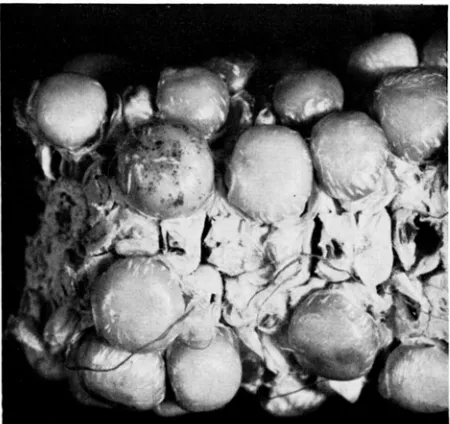
FIGURE l.--Sevcri>l colorlcss scwls frorii thr cross a”’ dt X a”’ dt, (Exprriment 1) including one with several sectors of dotted tissue. The pollen was treated with ultraviolet light. The streaks
of white are due to a diseased condition of the ear.
zygous a” dt plants was crossed on an am d t ear stock. The resulting ears produced all colorless seeds which were examined for large colored sectors and for dots. Seeds from the control and X-ray treatment and all but three from the ultraviolet light treatment were completely devoid of typical anthocyanin pigment. Several seeds from both groups had a flush of red color, but these proved to be germless, repeating a well known phenomenon in maize in which germlessness is associated with nongenetic coloration of otherwise colorless seeds. The
three
truly excep- tional seeds included one with a single tiny dot, one with several dots, and one with several sectors of dotted tissue which covered a large portion of the seed surface (Figure 1). None of the three (Table 1), except possibly the one-dotTABLE 1
Frequency of reversion to A (colored sectors) and of induction of mutator (groups of colored dots, either on a colorless seed of am dt or in a colorless sector on a dilute seed of am-1 spm)
resulting from treatment of am pollen in the absence of the mutator element
se+ Reversion Mutator Losses Genotype Treatment examined to A induced of am
Experiment i
am, dt X ray 7694 0 0 . .
uv
2868 0 3 . .control 2128 0 0 . .
am-*, spm X ray 5528 0 1 69
W 1958 0 2 153
control 3024 0 0 11
544 M. G . NEUFFER
case, should be considered as simple reversions to A but instead as induction of new Dt factors which then cause reversion. If the treatment destroyed the sup- pressor element in one of the chromatids of the pro-endosperm nucleus of the pollen grain, a half-seed sector should result (on the average). This sector would be solid rather than composed of dots. If, on the other hand, a new Dt factor were induced, a sector would arise having continuing reversions to A which would appear as dots. A seed with one dot could be either a n extreme deviation from a half-seed sector involving a newly arisen A or more likely, a single dot in a larger half-seed sector involving a newly induced Dt. The material in the experiment with aml s p m is better suited for distinguishing between the above possibilities, as the borders of the induced mutator sector are clearly defined. The possibility of delayed events resulting from either a multistranded treated chro- mosome or from subsequent chromosome breakage is not ruled out but is con- sidered of little consequence in interpreting these results.
The second experiment was designed to test the mutator systems for which the suppressor element hypothesis was developed. The Spm system was used because it is especially suited for distinguishing between loss of the structural gene, loss of the suppressor, and induction of a new mutator. The mutable allele in this system (am-l) gives a colorless seed with colored dots when Spm is pres- ent and dilute colored seed with no dots when it is absent. The same treatments used in the first experiment were applied to pollen from plants of the genotype an'-l-Sh,/as-sh,, spm spm, dt dt. This pollen was crossed on the same am-Sh, dt
ear stock producing ears with nonshrunken seed that are expected to be half dilute (a"-I/a" a"') and half colorless (a8/am am) but all free of mutator-induced dots.
The seeds were examined for various sectorial changes. Sectors observed here provide valid data because the chromosomes of mature pollen grains are already effectively doubled for the next division. A single strand may be affected by discrete treatment to produce a half-seed sector; the dilute seeds could show colorless sectors (loss of the structural gene), full colored sectors (loss of the suppressor)
,
or colorless sectors with colored dots (induction of a new Spm).
The colorless seeds could express colored or dotted sectors. Colored sectors on colorless seeds are not expected since the as allele present in the pollen parent is stable in all known situations. Sectors of dots might occur if a new Dt were induced that would then activate the responding am allele of the ear parent.The initial plan to examine the dilute seeds for colored sectors, colorless sectors without dots, and colorless sectors with dots was accomplished, but the planned examination of colorless seeds for sectors of dots was impossible because of the high frequency of apparent colorless seeds with dilute "recovery" spots, a com- mon phenomenon ( STADLER 1939) presumably resulting from abortive deletion of the bearing chromosome segment. An extreme case is seen in the left hand seed of Figure 2.
The data from this experiment are summarized in the bottom half of Table 1.
MAIZE MUTATOR SYSTEMS 545
FIGURE &.-Two exceptional sretls from the cross n”’-sh/n”’-sh, df dt spm spm x a”’-’-Sh/ad-sh dt dt, spm spm, (Experiment 2 ) showing (left) a colorless seed with many dilute recovery spots and (right) a dilute colored seed with a colorless sector within which are included many Spm- type dots. The pollen was treated with X rays.
in Figure 2, right hand seed. This kernel shows the dilute-colored background with a colorless sector bearing typical a”’-, S p m dots. Table 1 also includes a typical number of fractional losses of the a”+’ bearing segment (colorless sectors with no dots).
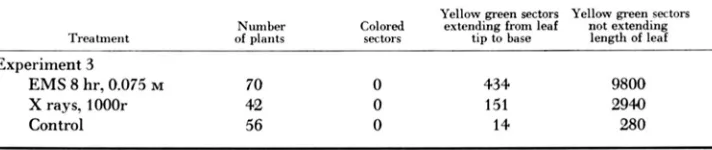
The third experiment was devised to test the action of the chemical mutagen ethyl methanesulfonate. Seeds with embryos of the genotype am/a’”-’, s p m spm, dt dt, Yge yg2 were treated with EMS or X rays for comparison and planted. The material was made heterozygous for yellow green to provide an indicator of the frequency of loss of Y g or of mutation to y g . The treated and control seedlings were observed for purple sectors through maturity. The supporting genotype (A, B PI R‘) with provides a weakly colored plant on which purple sectors of A, tissue would easily be seen. The frequency of yellow green sectors (loss of Y g ) was noted for comparison, and a final count was made a t flowering. The data are summarized in Table 2. No purple sectors were seen on the 168 plants examined, but many yellow green sectors were seen on the treated plants, dem- onstrating that the mutagen treatments were effective.
It should be pointed out that not all yellow green sectors produced by EMS
TABLE 2
Comparison of ihe frequency of reversion to A (colored leaf and sheath sectors) and losses of Yg, (yellow-green leaf and sheath sectors) in planis grown from seeds of am-l/am, dt dt,
spm spm, Yg/yg ireaied with ethyl methanesulfonate and X rays
Yellow green sectors Yellow green secton Number Colored extending from leaf not extending Treatment of plants sectors tip to base length of leaf
Experiment 3
EMS 8 hr, 0.075 M 70 0 434 9800
X rays, 10001- 42 0 151 2940
546 M. G . NEUFFER
treatment represent chromosome breakage and loss or gene mutation but that a considerable number may be due to irreversible changes in the chloroplasts brought about by EMS. This is deduced from the observation (unpublished) that
EMS treated seeds that are homozygous for Yg produce seedlings with more yellow green sectors than expected when calculated on the basis that the fre- quency of expressed losses of Yg in the homozygote should be equal to the square of the frequency of expressed losses in the heterozygote since only simultaneous losses of both dominant alleles in the homozygote should produce a genetically yellow green sector. However, even if chloroplast changes account for as many as half of the sectors, the data in Table 2 represent a sizable frequency of segmental losses from the treated chromosome and provide an adequate indication of treat- ment effectiveness.
The fourth experiment designed to determine the frequency of spontaneous copying errors in the replication of the suppressor element was accomplished by examining 5600 colorless seeds of am am a"', d t dt dt endosperm genotype for colored dots four cells in size or larger (the safe limit of visibility to the unaided eye). Since each seed had an average of 60,000 observable cells on the surface examined, each with three susceptible am alleles, and since dots four cells or larger in size are clearly discernible, each seed represents 60,000 X 3
+
4 or 45,000 chances for the occurrence of a replication error that would cause a visible colored dot to occur. Examination of 5600 seeds represents observation of 252,000,000 chances for loss of the Dt-responding suppressor element.NO
dots were found on the seeds examined.DISCUSSION
MAIZE MUTATOR SYSTEMS 547
occur by distortion of the structural gene so that activity is lost and a recessive mutant is produced, or by loss of the gene or a small segment of the chromosome with the same result, or by chromosome breakage with loss of one or more genes and with possible associated lethality. The first two possibilities would produce recessive mutants at the A, locus which would not be distinguishable in these experiments from am without its mutator. The third possibility would produce losses due to chromosome breakage that could not be distinguished from radiation and chemically induced breaks. Separation of gene and suppressor also might occur through normal crossing over. In the systems studied here this has not been round (NEUFFER 1965), but in some other related systems (MCCLINTOCK 1965) the suppressor has been found to separate by crossing over.
Although the occurrence of separation by crossing over is evidence for an ele- ment being present that is spatially removed from the structural gene it is con- ceivable that any given mutator system may involve a closely linked two-unit system, one supporting unit of which may be removable by crossing over leaving the second unit present but inactive. Consequently the occurrence of separation by crossing over (or, if it occurred, by mutagenic agents) cannot be considered proof of the presence of a suppressor element. Absence of separation on the other hand. is contrary to prediction for the controlling element hypothesis.
It is possible to devise other schemes (NUFFER 1962) for explaining the results obtained. The most attractive of these involves a structure with a missing part instead of a n added element. When a configuration is inactivated by removal of a part, the only way to restore activity is to replace the part. This is a very specific kind of step which requires specific nonrandom action. To apply this idea to the mutator system, it may be assumed that each gene has a key configuration which is essential for its function but is not a part of its code. If the mutator is capable of removing that key (perhaps to a new site), the gene then becomes nonfunctional but is still able to replicate properly even i n the absence of the mutator. Function is restored only when the mutator restores the original key or replaces it with a similar one from another site. If the key is drawn from another site, this action may produce a new site of mutability that is also responsive to the action of the mutator. The restored functional gene may have a different efficiency of action because the key material substituted was different from the original. The speci- ficity of the mutator resides in its being limited to certain kinds of keys o r to certain ways of removal. Hence Dt cannot replace the key removed by S p m
and vice versa.
The postulation of a key configuration satisfies many of the known facts about mutator systems but requires that there be in the nucleus a supply of key mater- ial; otherwise, once it is removed and lost by segregation, the key material would be impossible for the mutator to replace. The source may be other genes, a con- stant source like heterochromatin, or the mutator itself.
548 M . G . NEUFFER
mutator induction previously known were brought about by chromosome break- age caused by the breakage-fusion-bridge cycle (MCCLINTOCK 1950, 1951a, b)
,
and since chromosome breakage is a common result of both ultraviolet light and X-ray treatment, the facts reinforce the conclusion that chromosome breakage is the mechanism by which new mutators arise.There are other significant indications from these results. For example, the relatively low frequency of
Dt
and Spm cases as compared to the high number of breaks in a single chromosome arm (last two columns, Table 1) indicates that breakage in a few very specific areas is required for induction of new mutator elements, rather than breakage in various locations or in large areas such as those occupied by heterochromatin. Similarly, the fact that ultraviolet light, which is known to be more discrete in its action and less efficient than X rays in producing chromosome breaks (NUFFER
195 7 ) , produced significantly more cases of mutator induction than X rays, which are gross in action, suggests that the sites for induction of mutator action are physically small and probably limited in number.SUMMARY
Cultures carrying both
Dt-
and Spm-responding mutable A , alleles, but lack- ing the mutators, were treated with ultraviolet light, X rays, and ethyl methane- sulfonate in a n effort to induce reversion of the mutable alleles to A . The results were negative, but several cases of induction ofDt
and Spm were found. These appear to result from chromosome breakage at a limited number of sites.-Sim- ilar cultures were examined for spontaneous reversion to A , which would indicate copying errors in the suppressor element. No cases were found in 252 x IO6 chances.-The remarkable stability observed in this material poses some ques- tions about the suppressor element hypothesis. The induction of newDt
and Spm activity reinforces the conclusion that chromosome breakage is the mecha- nism for their origin and the greater efficiency of ultraviolet in this induction suggests that the sites of origin ofDt
and Spm are physically small and probably limited in number.LITERATURE CITED
BRINK, R. A., 1958 A stable somatic mutation to colorless from variegated pericarp in maize. Genetics 43: 435-447. - 1964 Genetic repression in multicellular organisms. Am. Naturalist 98: 193-211.
JACOB, F., and J. MONOD, 1961 On the regulation of gene activity. Cold Spring Harbor Symp. Quant. Biol. 26: 193-211.
JACOB, F., and E. WOLLMAN, 1959 Lysogeny. pp. 319-352. The Viruses. Edited by Academic Press, New York.
MAIZE MUTATOR SYSTEMS 549
NEUFFER, M. G., 1965
NEUFFER, M. G., and G. FICSOR. 1963
NUFFER, M. G., 1957
Crossing over in heterozygotes carrying different mutable alleles at the
A , locus in maize. Genetics 52: 521-528.
Mutagenic action of ethyl methanesulfonate in maize. Science 139: 12!361297.
Additional evidence on the effect of X-ray and ultraviolet radiation on mutation in maize. Genetics 42: 273-282. - 1961 Mutation studies a t the A , locus in maize. I. A mutable allele controlled by Dt. Genetics 46: 625-640. - 1962 Con- sideration of the suppressor element hypothesis for mutable loci. Genetics 47: 973-974. PETERSON, P. A., 1960 The pale green mutable system in maize. Genetics 45: 115-133. STADLER, I,. J., 1939 Genetic studies with ultraviolet radiation. Proc. 7th Intern. Congr. Genet.