ABSTRACT
KUTTAPPA, SANCHITH. XPath Hardware Accelerator. (Under the direction of Dr. Yannis Viniotis).
eXtensible Markup Language (XML) and XML Path Language (XPath) are
increasing in importance significantly. XML has become the language for
structuring, storing and sending information between diverse sources, thus,
becoming the language of choice for data exchange and data storage. XML is
independent of software, hardware and applications, proving to be extremely
versatile and flexible. XML and XPath implement a non-trivial grammar. Parsing
this grammar proves to be a high overhead for the CPU. This thesis presents
hardware offload architecture; the XPath Offload Engine (XPOE) which
essentially offloads the XPath string functions along with encoding-to and
decoding-from UTF-8, which burn up a large number of CPU cycles. An analysis
has been done which shows a reduction in the CPU overhead by as much as
88%.
XPATH HARDWARE ACCELERATOR
by
SANCHITH KUTTAPPA
A thesis submitted to the Graduate Faculty of North Carolina State University
in partial fulfillment of the requirements for the Degree of
Master of Science
COMPUTER ENGINEERING
Raleigh, North Carolina
2007
Approved By:
___________________ __________________
Dr. Gregory Byrd Dr. Mihail Sichitiu
ii
BIOGRAPHY
Sanchith Kuttappa was born in Bangalore, India in July 1980. She graduated
from Visveswaraiah Technological University, India, with a Bachelors degree in
Electronics and Telecommunications Engineering in June 2002. After
undergraduate studies, she worked with Infosys Technologies Ltd., Bangalore,
for two years. In August 2004, she joined North Carolina State University as a
graduate student in the Computer Engineering program. In Summer and Fall of
2005, she interned at Qualcomm Inc., RTP in the Processor Design Group. In
Summer of 2006, she interned at Ericsson IPI, Raleigh in the Dataplane Group.
While working towards the Masters degree, she worked on her thesis under the
iii
ACKNOWLEDGEMENTS
I sincerely thank my advisor, Dr.Yannis Viniotis for his invaluable guidance and
support through my graduate studies. I am grateful to him for providing me with
the opportunity and encouraging me in pursuing my interests. I thank him for his
constant support, encouragement and patience.
I am very grateful to Dr. Gregory Byrd, Dr. Paul Franzon and Dr. Mihail Sichitiu
for agreeing to be on my thesis committee and for the valuable feedback
regarding the thesis document.
I’d like to mention my family, who were always encouraging and supportive at
all times. I would also like to mention Nitesh and all my friends, without whose
iv
Table of Contents
Page
List of Figures ...vii
List of Tables...viii
1 Introduction and Literature Review ... 1
1.1 Importance of XML/XPath………. ... 1
1.1.1 What is XML?... ... 1
1.1.2 Strengths of XML……… ... 2
1.1.3 Real world examples of XML……… ... 3
1.1.4 Importance of XPath……….. ... 4
1.2 Current Implementations of XML/XPath... 5
1.2.1 Architecture of an XML Processor... 5
1.2.2 Architecture of XPath ... 7
1.2.3 Examples of XPath Implementation ... 9
1.3 Maximizing performance via hardware offload... 12
1.3.1 Issues with software processing... 12
1.3.2 Current approaches to challenges faced... 13
1.3.3 Industry examples ... 14
1.3.4 XPath Offload Engine... 15
1.4 Thesis organization... 16
2 XPath... 17
2.1 Introduction – XPath/XQuery ... 17
2.1.1 XPath Design Aspects ... 18
2.2 XPath Grammar and its complexity... 18
2.2.1 Lexical Analysis... 19
2.3 XPath Expressions and Functions ... 20
2.3.1 XPath Expression and Function format... 20
v
2.3.3 XPath String Functions ... 23
2.4 Requirements for parsing XPath expressions/functions... 26
3 Processor overhead savings analysis ... 27
3.1 Software approach to XPath function implementation ... 27
3.2 High level block diagram for hardware offload ... 30
3.3 Processor savings analysis... 33
3.3.1 Savings analysis for UTF-8 Encoding and Decoding ... 33
3.3.2 Savings analysis for each of the string functions ... 37
4 Design Architecture... 53
4.1 Introduction ... 53
4.2 Block diagram and explanation ... 54
4.2.1 Read Input Memory... 55
4.2.2 Read Main Memory... 56
4.2.3 Function Execute ... 57
4.2.4 Output Memory Write ... 59
4.3 Design Pipeline ... 60
5 Design Module Description... 62
5.1 Introduction ... 62
5.2 Module Read Input Memory... 62
5.2.1 Pin interface ... 63
5.2.2 Architecture ... 64
5.3 Module Read Main Memory ... 65
5.3.1 Pin interface ... 65
5.3.2 Architecture ... 67
5.4 Module Function Execute... 69
5.4.1 Pin interface ... 69
5.4.2 Architecture ... 71
5.5 Module Output Memory Write ... 72
5.5.1 Pin interface ... 72
5.5.2 Architecture ... 74
5.6 Controller ... 75
6 Verification and Additional Design Details ... 78
6.1 Test environment description ... 78
vi
6.2.1 Module Packet Generator ... 80
6.2.2 Module Reader ... 81
6.3 Verification Test Plan ... 83
6.3.1 Feature tests ... 84
6.4 Test results summary... 84
6.5 Additional Design Details ... 85
7 Future Work and Conclusion ... 86
7.1 Feature Additions... 86
7.2 Verification ... 87
7.3 FPGA implementation and Architecture optimizations ... 88
7.3.1 Area optimizations... 88
7.3.2 Timing optimizations ... 88
7.4 Conclusion ... 89
vii
List of Figures
Page
1.1 Generic Software Stack for XML Processing... 5
1.2 Schematic of a typical XML Parser... 7
3.1 High level block diagram showing system level interaction... 31
3.2 Plot of fraction of XPath functions offloaded onto hardware to the savings achieved... 51
3.3 Plot of fraction of XPath functions offloaded onto hardware to the speedup achieved... 52
4.1 Block Diagram of XPOE... 54
4.2 Read Input Memory Implementation Diagram... 55
4.3 Read Main Memory Implementation Diagram ... 57
4.4 Function Execute Implementation Diagram ... 58
4.5 Memory Write Implementation Diagram... 60
5.1 Interface waveform for Input Memory ... 64
5.2 Internal counters and Read Main Memory interface timing... 65
5.3 Timing relation with Main Memory ... 68
5.4 Timing relation with Read Input Memory Interface... 68
5.5 Internal counters and Function Execute Interface timing ... 69
5.6 Timing relation with Read Main Memory Interface ... 71
5.7 Internal counters and Memory Write interface timing... 72
5.8 Timing relation with Function Execute Interface ... 74
5.9 Internal counters and output interface... 75
5.10 Flowchart for XPOE ... 76
5.11 State Machine Diagram ... 77
6.1 Block diagram of testbench... 79
viii
List of Tables
Page
3.1 Format of the different octet types in UTF-8 encoding ... 28
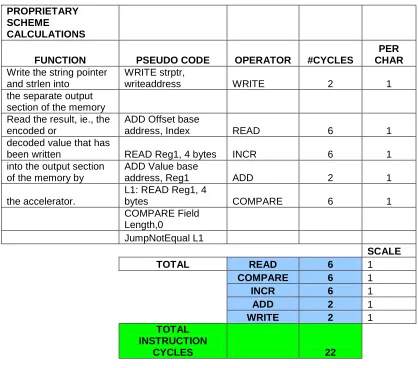
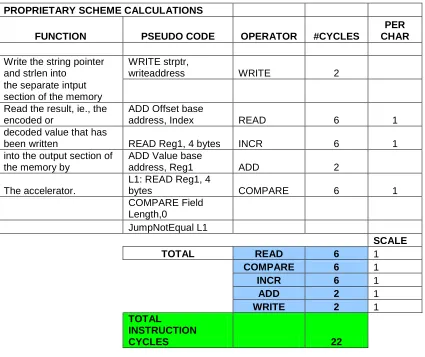
3.2 Cycles required for an all-software approach for encoding function... 34
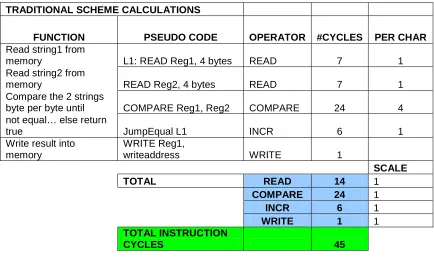
3.3 Cycles required for an all-software approach for decoding function... 35
3.4 Cycles required for a hardware-offloaded approach ... 36
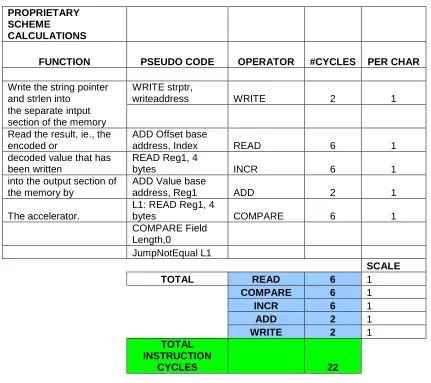
3.5 Cycles required for an all-software approach: codepoints-to-string ... 38
3.6 Cycles required for a hardware-offloaded approach: codepoints-to-string . 39 3.7 Cycles required for an all-software approach: string-to-codepoints ... 40
3.8 Cycles required for a hardware-offloaded approach: string-to-codepoints . 41 3.9 Cycles required for an all-software approach: codepoint-equal ... 42
3.10 Cycles required for a hardware-offloaded approach: codepoint-equal ... 43
3.11 Cycles required for an all-software approach: substring ... 44
3.12 Cycles required for a hardware-offloaded approach: substring... 45
3.13 Cycles required for an all-software approach: starts-with and ends-with ... 46
3.14 Cycles required for a hardware-offloaded approach: starts-with and ends- With... 47
3.15 Cycles required for an all-software approach: substring-before and substring-after ... 48
3.16 Cycles required for a hardware-offloaded approach: substring-before and substring-after ... 49
3.17 Comparison of the savings achieved for each of the functions ... 49
3.18 Comparison of fraction of string functions to the savings achieved... 50
3.19 Comparison of fraction of string functions to the speedup achieved ... 51
5.1 Interface with the system ... 63
5.2 Interface with the input section of the memory... 63
5.3 Interface with the Read Main Memory module... 63
5.4 Interface with the system ... 66
5.5 Interface with the Read Input Memory module... 66
5.6 Interface with the Main Memory module ... 66
5.7 Interface with the Function Execute module ... 67
5.8 Interface with the system ... 69
ix
5.10 Interface with the Memory Write module... 70
5.11 Interface with the system ... 72
5.12 Interface with the Function Execute module ... 73
5.13 Output Interface of the Memory Write module ... 73
6.1 Interface with the system ... 80
6.2 Interface with the DUT ... 80
6.3 Interface with the system ... 81
6.4 Interface with the DUT ... 81
6.5 Feature tests ... 84
1
Chapter 1
Introduction and Literature
Review
This chapter provides the motivation and the main concepts behind XML,
XPath, XQuery and hardware offloading.
1.1 Importance of XML/XPath
The following sections will talk about XML, XPath and their growing versatility
and importance in the real world.
1.1.1 What is XML?
XML (eXtensible Markup Language) is a markup language much like HTML.
However, XML was not designed to do anything it was only created to structure,
store and to send information. XML is designed to describe data and to focus on
what data is. According to the W3C Recommendation [1], XML describes a class
2
computer programs which process them. XML documents are made up of
storage units which contain either parsed or unparsed data, and these units are
called entities. Parsed data is made up of characters, some of which form
character data, and some of which form markup. Markup encodes a description
of the document's storage layout and logical structure.
XML documents use a self-describing and simple syntax, like the example
below which is a note to John from Sarah, stored as XML:
<note>
<to>John</to>
<from>Sarah</from>
<heading>Reminder</heading>
<body>Don’t forget, meeting’s changed to 9:00am!</body>
</note>
The note has a header and a message body. It also has sender and receiver
information. But still, this XML document does not DO anything. It is just pure
information wrapped in XML tags. Someone must write a piece of software to
send, receive or display it [1]. XML tags are not predefined; the author defines his
own tags and his own document structure. The basic syntax for one element in
XML is: <name attribute="value">content</name>
1.1.2 Strengths of XML
The following points emphasize the strengths of XML and show why XML is
going to be everywhere [1].
1. One of the most time-consuming challenges for developers has been to
exchange data between computer systems and databases that contain
data in incompatible formats over the Internet. Converting the data to XML
can greatly reduce this complexity and create data that can be read by
3
2. XML is going to be the main language for exchanging financial information
between businesses over the Internet. A lot of interesting B2B applications
are under development.
3. XML provides a software- and hardware-independent way of sharing data,
as XML data is stored in plain text format. It also makes it easier to
expand or upgrade a system to new operating systems, servers,
applications, and new browsers.
4. XML can also be used to store data in files or in databases. Applications
can be written to store and retrieve information from the store, and generic
applications can be used to display the data.
5. Since XML is independent of hardware, software and application, data can
be made available to other than only standard HTML browsers. Data can
be made available to all kinds of "reading machines" (agents), and it is
easier to make your data available for blind people, or people with other
disabilities.
6. XML can be used to create new languages. The Wireless Markup
Language (WML), used to markup Internet applications for handheld
devices like mobile phones, is written in XML.
1.1.3 Real world examples of XML
The following paragraphs talk about XML’s versatility and flexibility in the real
world. There are a large number of applications that use XML and the rapid
increase in these numbers is shown by examples from the IT/Software industry
and the Telecom industry.
In the IT industry we see that the processing of XML documents has entered
the mainstream of software application development. System and software
configuration files, UI specifications and many office documents (such as
spreadsheets, presentations, etc.) are being specified as XML. This is in addition
4
used for enterprise application integration and financial interactions such as B2B
transactions [4]. Hence, as XML is being used more and more as a common tool
for all data manipulation and data transmission, XML will be extremely important
to the future of the Web.
The increase in the number of applications based on XML messages and
documents and the increased importance of XML processing is felt most
significantly in the telecommunications industry with its ever expanding
communications demand. XML is a powerful tool for describing service definition,
activation, provisioning, and billing in next-generation communications
infrastructure. It is also the technology of choice for related data interchange
activities. Some of the applications and areas that XML is being used in are VoIP
(Voice over IP) and its associated protocol SIP (Session Initiation Protocol),
NOTIFY- SUBSCRIBE applications, videoconferencing and network games.
1.1.4 Importance of XPath
As increasing amounts of information are stored, exchanged, and presented
using XML, the ability to intelligently query XML data sources becomes
increasingly important. One of the great strengths of XML is its flexibility in
representing many different kinds of information from diverse sources. To exploit
this flexibility, an XML query language must provide features for retrieving and
interpreting information from these diverse sources [2].
XPath 2.0/XQuery 1.0 (XML Path Language/XML Query Language) are
designed to be flexible enough to query a broad spectrum of XML information
sources, including both databases and documents. XPath makes it possible to
refer to individual parts of an XML document and provides random access to
XML data for other technologies. XPath 2.0/Xquery 1.0 operates on the abstract,
logical structure (data model) of an XML document, rather than its surface
syntax. XPath is an expression language for addressing portions of an XML
document, or for computing values (strings, numbers, or boolean values) based
5
representation of the XML document, and provides the ability to navigate around
the tree, selecting nodes by a variety of criteria [1].
The utility of XPath suggests that its role in the repertoire of XML processing
may well expand greatly in the future. Therefore we see that as XPath is
fundamental to a lot of advanced XML usage, for example, sophisticated XSLT
transformations, the importance of XPath is linked to the importance of XML.
1.2 Current Implementations of XML/XPath
This section elaborates on the essential components that make up XML and
XPath and how they are processed.
1.2.1 Architecture of an XML Processor
The W3C Recommendation defines an XML Processor as a software module
which reads XML documents and provides access to their content and structure.
This processing work is done on behalf of another module called the application
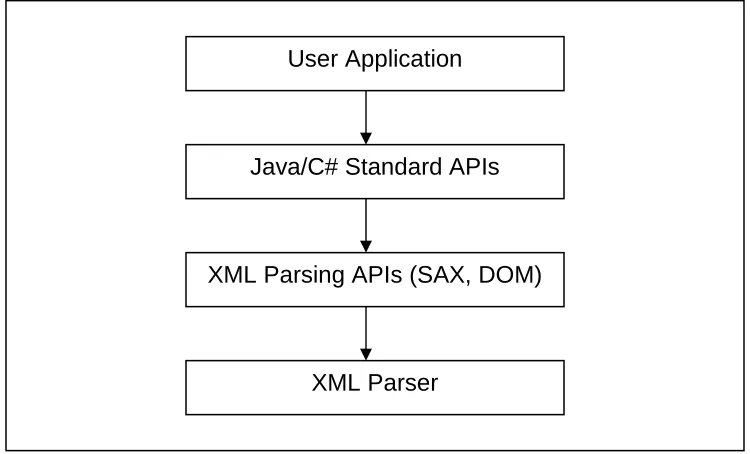
[1]. Figure 1.1 shows the software stack for XML processing in detail [4].
Figure 1.1: Generic Software Stack for XML Processing User Application
Java/C# Standard APIs
XML Parsing APIs (SAX, DOM)
6
To manipulate an XML document, you need an XML parser. The parser loads
the document into your computer's memory. Once the document is loaded, its
data can be manipulated by treating the XML document as a tree. The following
points describe in detail the function of the different modules of the parser and
thus show why XML parsing forms the most CPU intensive section of the
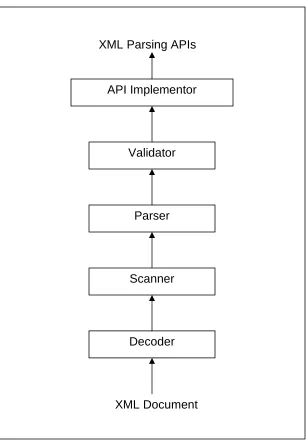
software stack. Figure 1.2 depicts the architecture of a typical XML Parser. Its
architecture is composed of five individual modules [4].
1. Decoder: This module reads in UTF-8 or UTF-16 (UTF representation is
defined in section 3.1) characters from the input stream and converts them
to the character format of the host programming language. In addition, this
module makes sure that the inputs characters are part of a valid XML
character set.
2. Scanner:This classifies the characters in the XML input stream to locate
(namespace qualified) element and attribute names, element content,
attribute values and the like. In essence this implements the lexical
analyzer corresponding to the XML grammar that searches for characters
such as <, >, =, :, etc., to tokenize the XML document.
3. Parser: This is the module that checks for well-formedness of an XML
document. Well-formedness requires that the begin- and end-element tags
are properly nested and matched. This requires the implementation of a
stack that contains all the begin-element names that have been seen so
far but that have not been matched by a corresponding end-element tag.
4. Validator: Validation is an optional part of XML processing. It is often
required that an XML document conform to a particular XML schema
(schema defines the XML document structure and its legal building blocks)
particularly in cases involving transactions between untrusted parties.
5. API Implementor: This layer provides the interface that is required by the
calling application. In most cases, the same underlying parsing engine can
be used to do the tokenization, well-formedness checking and validation
while the API implementor can be customized to generate events, build a
7
Figure 1.2: Schematic of a typical XML Parser
1.2.2 Architecture of XPath
The following are the main points the define XPath:
• XPath is a syntax for defining parts of an XML document. • XPath uses path expressions to navigate in XML documents. • XPath contains a library of standard functions.
• XPath is a W3C Standard.
Decoder Scanner Parser Validator API Implementor
8
XPath is a language for finding information in an XML document. XPath is used
to navigate through elements and attributes in an XML document, and thus its
primary purpose is addressing parts of an XML document. In support of this it
provides basic facilities for manipulation of strings, numbers and booleans.
XQuery is built on XPath expressions. Compact, non-XML syntax is used to
facilitate use of XPath within URIs and XML attribute values. XPath operates on
the abstract, logical structure of an XML document, rather than its surface syntax.
XPath gets its name from its use of a path notation as in URLs for navigating
through the hierarchical structure of an XML document [2].
XPath includes over 100 built-in functions. There are functions for string values,
numeric values, date and time comparison, node and QName manipulation,
sequence manipulation, Boolean values, and more. XPath uses path expressions
to select nodes or node-sets in an XML document. The node is selected by
following a path or steps. In XPath, there are seven kinds of nodes: element,
attribute, text, namespace, processing-instruction, comment, and document
(root) nodes. XPath models XML documents as trees of nodes. The root of the
tree is called the document node (or root node). The primary syntactic construct
in XPath is the expression. An expression is evaluated to yield an object, which
has one of the following four basic types [2]:
• node-set (an unordered collection of nodes without duplicates)
• boolean (true or false)
• number (a floating-point number)
• string (a sequence of characters)
Expression evaluation occurs with respect to a context. The context consists of:
• a node (the context node)
• a pair of non-zero positive integers (the context position and the context size)
• a set of variable bindings
• a function library
• the set of namespace declarations in scope for the expression
One important kind of expression is a location path, which selects a set of
9
a location path is the node-set containing the nodes selected by the location
path. Location paths can recursively contain expressions that are used to filter
sets of nodes. A location path can be absolute or relative, and in both cases it
consists of one or more steps, each separated by a slash [2]:
• An absolute location path: /step/step/...
• A relative location path: step/step/...
Each step is evaluated against the nodes in the current node-set. A step consists
of:
• an axis (defines the tree-relationship between the selected nodes and the
current node)
• a node-test (identifies a node within an axis)
• zero or more predicates (to further refine the selected node-set)
The syntax for a location step is: axisname::nodetest[predicate]
An axis defines a node-set relative to the current node. A predicate filters a
node-set with respect to an axis to produce a new node-set. For each node in the
node-set to be filtered, the PredicateExpr is evaluated with that node as the
context node, with the number of nodes in the node-set as the context size, and
with the proximity position of the node in the node-set with respect to the axis as
the context position; if PredicateExpr evaluates to true for that node, the node is
included in the new node-set; otherwise, it is not included.
1.2.3 Examples of XPath Implementation
We will use the following XML document to illustrate the concepts discussed so
far:
<?xml version="1.0" encoding="ISO-8859-1"?>
<bookstore>
<book>
<title lang="eng">Harry Potter</title> <price>29.99</price>
10 <book>
<title lang="eng">Learning XML</title> <price>39.95</price>
</book>
</bookstore>
Example of nodes in the XML document above: • <bookstore> (document node) • <price>29.99</price> (element node) • lang="eng" (attribute node)
Some path expressions with and without predicates and the result of the
expressions:
Path Expression Result
bookstore Selects all the child nodes of the bookstore element
/bookstore Selects the root element bookstore
bookstore/book Selects all book elements that are children of
bookstore
//book Selects all book elements no matter where they are in
the document
/bookstore/book[last()-1] Selects the last but one book element that is the child
of the bookstore element
//book[position()<=3] Selects the first three book elements
//title[@lang='eng'] Selects all the title elements that have an attribute
named lang with a value of 'eng'
/bookstore/book[price>35.00]/title Selects all the title elements of the book elements of
the bookstore element that have a price element with
a value greater than 35.00
Another example of how a function can be implemented can be shown by taking
11
• fn:string-join($arg1 as string, $arg2 as string) returns a string
This function will return a string created by concatenating the members of the
$arg1 sequence using $arg2 as a separator.
Assume an XML document:
<doc>
<chap>
<section>
</section>
</chap>
</doc>
With the <section> as the context node, the expression:
• fn:string-join(for $n in ancestor-or-self::* return name($n), '/')
• returns " doc/chap/section "
Later sections will show how string-join and various such functions are offloaded
onto hardware.
We can take the example of the Microsoft XML parser to show how the above
XPath examples are implemented in software. Microsoft's software includes
integrated XPath support. Developers can load XML into a tree structure, and
then query the structure with XPath to extract the data they are after. The
software loads the XML document and then the selectNodes() function is used to
select nodes from the XML document:
xmlDoc.load("books.xml") // loads the XML doc “books.xml”
xmlDoc.selectNodes(path expression) // selects/filters nodes based on the
path expression
• xmlDoc.selectNodes("/bookstore/book") - selects all the book nodes under the bookstore element.
12
• xmlDoc.selectNodes("/bookstore/book/price/text()") - selects the text from all the price nodes.
• xmlDoc.selectNodes("/bookstore/book[price>35]/price") - selects all the price nodes with a price higher than 35.
1.3 Maximizing performance via hardware offload
1.3.1 Issues with software processing of XML/XPath
The two main issues with the software processing of XML and why XML
processing is CPU intensive are:
1. The emphasis on human readability of XML documents (where the nature
or number of tags is not fixed).
2. The use of UTF representation of data.
XML processing typically involves the use of an off-the-shelf parser program
that has to perform lexical analysis, tokenization and character integrity checks
on the XML stream. In addition it has to convert UTF characters to Unicode,
verify well-formedness of the document and optionally validate against an XML
Schema or Document Type Definition (DTD). Finally there is the stage that may
construct a tree, perform transformations, bind to Java or C# objects and call in
to the application program. All this consumes a fair amount of CPU cycles such
that most of the time taken in a service-oriented application is spent in parsing
XML [4]. The exchange of XML messages and the querying of XML documents
and databases using XPath/XQuery are going to become equally commonplace
and will also burn up a large number of CPU cycles. Thus, XML parsing and
querying is a severe bottleneck in XML processing and manipulation of XML
documents and databases.
A solution which eases this bottleneck is to transfer some aspects of XML
13
this approach, there is a definite increase in performance as the hardware would
process data much faster than software. The more tasks that are offloaded, the
faster the data processing becomes.
The next section talks about the work being done in this area and about
available XML Accelerators that offload XML parsing and some basic XML
processing onto hardware. Further sections also exemplify hardware offloading
by citing some industry proven techniques.
1.3.2 Current approaches to challenges faced
There have been several different special purpose XML accelerators from
companies such as DataPower (IBM), Tarari and Sarvega (Intel) to alleviate the
problems faced by a purely software approach to XML processing. These have
typically concentrated on narrow processing problems [4].
Some examples of XML accelerators in the industry:
• Tarari Hardware XML Processor
• Datapower XA35 XML Accelerator
• Sarvega XML Content Router
• Reactivity 400 Series of XML enables networking products.
There were two main groups of engineers that worked on tackling the issues
faced with XML processing:
1. One group focused on large volumes of XML transformations - created
specialized software or ASICs that performed transformations up to 100 times
faster than basic software solutions.
2. The second group focused on high-speed XML processing and security –
created highly optimized applications that secured and integrated XML across
many use cases.
Alternative terminology that describe more specific functionality of XML
14
• XML Accelerators - are devices that typically use custom hardware or software built on standards-based hardware to accelerate processing. The
hardware typically provides a performance boost between 10 and 100 times
in the number of messages per second that can be processed.
• XML Security Gateways – (also known as XML firewalls) are devices that support the WS-Security standards. These appliances typically offload
encryption and decryption to specialized hardware devices.
• XML Enabled Networking – is an abstraction layer that exists alongside the traditional IP network. This layer addresses the security, incompatibility and
latency issues encumbering XML messages, web-services and
service-oriented architectures (SOA).
• Integration Appliance – (also known as application routers) are devices that are designed to make the integration of computer systems easier.
1.3.3 Industry examples
Through industry examples this section elaborates on how hardware offloading
has resulted in performance enhancements. The examples cited are TCP/IP and
Encryption/Decryption algorithms.
• TCP/IP Offload Engine (TOE)
TCP/IP processing speeds have not kept up with rapid growth in processor
speeds. Processor speeds have increased from 60MHz to 3GHz. However, the
rate of increase in the case of TCP/IP has not been in parallel with the scaling
of the CPU clock speed. TCP/IP is memory intensive; hence memory and I/O
subsystems become limiting factors. A significant amount of software is
required to implement the various features of TCP/IP. TCP/IP processing
involves a great deal of memory for storing connection state information.
Hence, TCP/IP in software incurs a large overhead and involves significant
15
Despite all efforts to increase TCP/IP performance via software modifications,
the performance benefits that result fall behind the improvement achieved by
hardware offloading. Terminator [7], a TCP offload engine developed by
Chelsio Communications, Inc. highlights the advantages of TCP hardware
offloading. During performance evaluation, the throughput achieved with offload
was found to be almost four times than that without offload.
• Encryption / Decryption Algorithms
Secure Socket Layer (SSL) handshakes require extensive compute resource.
Security algorithms for encryption and decryption impose a significant
performance penalty while protecting data traveling over the Internet. SSL is
known to slow down an application or Web site considerably. The time required
to establish a session and then encrypt and decrypt the data, degrades
performance as all of it heavily use processor cycles.
To combat the high computational cost of the RSA public-key encryption
algorithm several companies have developed offload devices that use
encryption offload hardware to accelerate processing, such as, RSA-offload
only devices, Hardware Security Modules and Internet Hardware Devices.
IBM designers have responded to the problems of security and
responsiveness through the use of cryptographic accelerator hardware. This
accelerator offloads encryption/decryption tasks from the central processor.
1.3.4 XPath Offload Engine (XPOE)
XPath is used extensively by XML parsing software and its importance has
been elaborated on in Section 1.1. As seen in previous sections several aspects
of XML processing such as XML parsing have been offloaded onto hardware and
have proven successfully the great increase in performance and the increased
CPU cycles savings. We have also seen how hardware offloading boosts
processing speed in TCP and Security algorithms. In anticipation of the growing
16
a good idea to make advancements which would allow for faster processing of
XPath. I chose to focus on those aspects of XPath2.0 that form the basic building
blocks of an XPath expression and thus essentially XQuery1.0. These form the
most common subset of the XPath processing problem: that of XPath functions.
How many XPath functions to offload is a complexity-performance tradeoff. If
we offload all the functions, the complexity increases but so does the
performance. To demonstrate the benefits of hardware offloading it is proposed
to offload XPath string functions which involve encoding-to and decoding-from
UTF-8 representation onto hardware. Chapter 3 demonstrates why these
functions were chosen and through detailed analysis shows how such a limited
offload can reduce CPU utilization significantly.
1.4 Thesis organization
The organization of the rest of the thesis is described. Chapter 2 and its
subsections introduce XPath and its components, expression formats and
function types. Chapter 3 presents an analysis which describes the potential
reduction in CPU utilization via hardware offload. Chapter 4 presents the
architecture of the hardware which would be doing the offloaded processing.
Chapter 5 presents a detailed description of all the modules involved in the
design. Chapter 6 explains the software simulation and verification and also
includes additional design features. Chapter 7 completes the thesis by identifying
17
Chapter 2
XPath
This chapter briefly describes the structure of XPath expressions and functions
and explains its components.
2.1 Introduction
XPath became a W3C Recommendation 16 November 1999. XPath was
designed to be used by the XML-based style sheet language for transforming
XML documents into other formats, by the XML-based language that is used to
create hyperlinks in XML documents and other XML parsing software. XPath is a
language for finding information in an XML document, and is used to navigate
through elements and attributes in an XML document [2]. A detailed description
18
2.1.1 XPath Design Aspects
Two important design aspects of XPath are that it is functional and that it is
typed. These two aspects play an important role in XPath Semantics [2].
1. XPath is a functional language. XPath is built from expressions, rather than
statements. Every construct in the language is an expression and expressions
can be composed arbitrarily. The result of one expression can be used as the
input to any other expression, as long as the type of the result of the former
expression is compatible with the input type of the latter expression with which it
is composed. Expressions can be composed of functions in various forms. As
mentioned in section 1.2.2 XPath includes over 100 built-in functions, such as
functions for string values, numeric values, date and time comparison, node and
QName manipulation, sequence manipulation, boolean values, and more [2].
When such functions are used as part of path expressions, the nodes or
node-sets in an XML document that are selected by the expression will depend on the
result returned by the functions.
2. XPath is a typed language. XPath supports static type analysis. Static type
analysis infers the output type of an expression based on the type of its input
expressions. In addition to inferring the type of an expression for the user, static
typing allows early detection of type errors, and can be used as the basis for
certain classes of optimization.
The semantics and grammar of XPath is discussed in further sections.
2.2 XPath Grammar and its complexity
Grammar can be defined as a set of rules by which a language can be
constructed, essentially the syntax. It can be thought of as a tool that defines the
form or structure of the language enabling accurate interpretation by all users.
Parsing is the process of analyzing a sequence of tokens in order to determine
19
usually conducted in two stages, first identifying the meaningful tokens in the
input, and then building a tree from those tokens. Parsing too follows the same
set of rules that make up the grammar.
The grammar of XPath uses the Extended Backus-Naur Form (EBNF) notation
[12]. The version of Unicode that is used to construct expressions is
implementation defined. It follows the UTF-8 or UTF-16 charset. The UTF-8
charset is the same as ASCII for 00-7F and hence UTF-8 charset is assumed for
this implementation. Sections 2.2.1 discusses the reasons why XPath grammar
could be considered as significantly complex to parse.
2.2.1 Lexical analysis
From a lexical perspective, the following points contribute to the complexity of
XPath grammar [2]:
1. Path Expression Syntax
Path expressions are composed of a node name, followed by a forward slash
(“/”) to represent hierarchy, followed by another node name and so on till the
desired level of hierarchy has been reached. The parser needs to be able to
track the forward slash delimiters. The characters till the forward slash need to
be buffered separately, as they form one node name and the characters after
the forward slash form the next node name and are to be buffered separately.
2. Variable String Lengths
As the string length is not limited, this places a requirement on the parser that
it should be able to buffer several characters at a stretch. The need for this
buffer is eliminated in the XPOE by writing these characters directly into
20
3. Variable Number of Input Arguments
The number of input arguments to some XPath functions is not limited and
hence poses a similar problem as that of the variable string length.
4. Depth of Hierarchy
The depth of hierarchy contained in a path expression is not limited.
Sometimes the hierarchy can get really deep. This leads to buffering problems
and cumbersome parsing.
2.3 XPath Expressions and Functions
As explained in section 1.2.2 the primary syntactic construct in XPath is the
expression. An expression is evaluated to yield an object, which has one of the
following four basic types; node-set, boolean, number or string. Expression
evaluation occurs with respect to a context, for example, a node (the context
node), a pair of non-zero positive integers (the context position and the context
size), a function library, etc. The function library consists of a mapping from
function names to functions. Each function takes zero or more arguments and
returns a single result.
2.3.1 XPath Expression and Function Format
One important kind of expression is a location path. A location path selects a
set of nodes relative to the context node. The result of evaluating an expression
that is a location path is the node-set containing the nodes selected by the
location path. Location paths can recursively contain expressions that are used
to filter sets of nodes. Using the example of location paths we will see how
functions can be used as part of expressions:
21
The last function returns a number equal to the context size from the
expression evaluation context.
• /child::doc/child::chapter[position()=5]/child::section[position()=2] selects the second section of the fifth chapter of the doc document
element.
The position function returns a number equal to the context position from
the expression evaluation context.
• child::para[attribute::type='warning'][position()=5] selects the fifth para child of the context node that has a type attribute with value warning
• child::chapter[child::title='Introduction'] selects the chapter children of the context node that have one or more title children with string-value
equal to Introduction.
A location step has three parts:
1. An axis, which specifies the tree relationship between the nodes selected by
the location step and the context node,
2. A node test, which specifies the node type and expanded-name of the nodes
selected by the location step, and
3. Zero or more predicates, which use arbitrary expressions to further refine the
set of nodes selected by the location step.
The syntax for a location step is the axis name and node test separated by a
double colon, followed by zero or more expressions each in square brackets. For
example, in child::para[position()=1], child is the name of the axis, para is the
node test and [position()=1] is a predicate. The node-set selected by the location
step is the node-set that results from generating an initial node-set from the axis
and node-test, and then filtering that node-set by each of the predicates in turn.
The initial node-set is filtered by the first predicate to generate a new node-set;
this new node-set is then filtered using the second predicate, and so on. The final
node-set is the node-set selected by the location step. The axis affects how the
expression in each predicate is evaluated and so the semantics of a predicate is
22
A predicate filters a set with respect to an axis to produce a new
node-set. For each node in the node-set to be filtered, the predicate expression is
evaluated with that node as the context node, with the number of nodes in the
node-set as the context size, and with the proximity position of the node in the
node-set with respect to the axis as the context position; if predicate expression
evaluates to true for that node, the node is included in the new node-set;
otherwise, it is not included.
A function call expression is evaluated by using the function name to identify a
function in the expression evaluation context function library, evaluating each of
the arguments, converting each argument to the type required by the function,
and finally calling the function, passing it the converted arguments. It is an error if
the number of arguments is wrong or if an argument cannot be converted to the
required type. The result of the function call expression is the result returned by
the function.
Another example of how a function can be implemented was shown in section
1.2.3 and is reiterated here for clarity:
• fn:string-join($arg1 as string, $arg2 as string) returns a string
This function will return a string created by concatenating the members of the
$arg1 sequence using $arg2 as a separator.
2.3.2 XPath Function Types
XPath implementations contain a function library that includes functions used to
evaluate expressions. Each function in the function library is specified using a
function prototype, which gives the return type, the name of the function, and the
type of the arguments. The function library includes the following types of built-in
functions that are required for XPath2.0/Xquery1.0.
• Functions on Numeric Values
• Functions on Strings
• Functions on Boolean Values
23 • Accessor Functions
• Error and Trace Functions
• Functions for anyURI
• Functions related to QNames
• Functions on Nodes
• Functions on Sequences
• Context Functions
2.3.3 XPath String Functions
In this implementation we concentrate on offloading the string functions onto
hardware. Chapter 3 will present the motivation for offloading string functions
onto hardware and an analysis of the processor overhead savings that was
achieved by offloading specific string functions. The following paragraphs will talk
briefly about the string functions that were chosen to be offloaded.
• fn:codepoints-to-string(int,int,...)
Returns a string from a sequence of code points
Example: codepoints-to-string(84, 104, 233, 114, 232, 115, 101)
Result: 'Thérèse'
Each of the input arguments to this function is an integer, which can have any
value from 0 to 2097151 in decimal or from 0x000000 to 0x1FFFFF in hex. This
function takes each one of the input arguments and encodes them to their
respective char UTF-8 notation. These encoded characters will then together
form the result string represented in UTF-8. Only character numbers between
0x000000 to 0x1FFFFF (21 bits) can be represented in UTF-8 hence the
restriction on the range of the input numbers. Sections 3.3.1 and 3.3.2 will further
illustrate this concept and show the significant savings that can be achieved by
24 • fn:string-to-codepoints(string)
Returns a sequence of code points from a string
Example: string-to-codepoints("Thérèse")
Result: 84, 104, 233, 114, 232, 115, 101
The input argument to the above function is a string in UTF-8 character
representation. Each character of the input string is decoded from UTF-8 to give
its equivalent character number. "Character number", also known as "code point"
or “code position" is used to mean a non-negative integer that represents a
character in some encoding. The result is a sequence of character numbers
representing the individual characters of the input string, decoded from their
UTF-8 representation to character numbers. Sections 3.3.1 and 3.3.2
demonstrate that string functions that involve encoding to and decoding form
UTF-8 character representation benefit from significant CPU cycles savings.
• fn:codepoint-equal(comp1,comp2)
Returns true if the value of comp1 is equal to the value of comp2
The input arguments to this function are strings. The two strings are compared
byte for byte. If there is a mismatch false is returned else true.
• fn:compare(comp1,comp2)
Returns -1 if comp1 is less than comp2, 0 if comp1 is equal to comp2, or 1 if
comp1 is greater than comp2
Although the compare function seems similar to the codepoint-equal function
above, the difference is that instead of returning just a True or False
corresponding to a match or mismatch, in case of a mismatch the two strings are
compared to check which string is greater. In such cases the two strings are
compared code-point to code-point based on a specified collation rule.
A collation is a specification of the manner in which character strings are
compared and, by extension, ordered. When values whose type is string is
compared (or, equivalently, sorted), the comparisons are inherently performed
25
values). Collations can indicate that two different code points are, in fact, equal
for comparison purposes (e.g., "v" and "w" are considered equivalent in
Swedish). Strings can be compared codepoint-by-codepoint or in a linguistically
appropriate manner, as defined by the collation.
When the Unicode code point collation is used, this simply involves determining
whether arg1 contains a contiguous sequence of characters whose code points
are the same, one for one, with the code points of the characters in arg2. All
collations support the capability of deciding whether two strings are considered
equal, and if not, which of the strings should be regarded as preceding the other
as required in functions such as compare().
• fn:substring(string,start,len); fn:substring(string,start)
Returns the substring from the start position to the specified length. Index of the
first character is 1. If length is omitted it returns the substring from the start
position to the end
Example: substring('Beatles',1,4)
Result: 'Beat'
Example: substring('Beatles',2)
Result: 'eatles'
This function takes in a string in UTF-8 representation and start and length
numbers are arguments. Although the string does not need to be decoded to
return a substring, we however need to identify character boundaries as each
character can be anywhere from one to four bytes. Identifying the number of
octets per character will allow us to locate the character at the start index, and
the substring starting at this index up to the length number of characters will be
the result string of the function.
• fn:translate(string1,string2,string3)
Converts string1 by replacing the characters in string2 with the characters in
26
Example: translate('12:30','0123','abcd')
Result: 'bc:da'
The translate function also requires that the UTF-8 characters be decoded to
their code points to be able to find all the instances of occurrence of characters of
string2 in string1 and then replace each one of these with each corresponding
character from string3. As this function involves decoding three input strings it
benefits greatly from the CPU cycles savings achieved through offloading the
decoding/encoding functions onto hardware as shown in sections 3.3.1 and
3.3.2. In functions that involve character counting such as substring, string-length
and translate functions, what is counted is the number of XML characters in the
string (or equivalently, the number of Unicode code points).
2.4 Requirements for parsing XPath Functions
An XPath string function essentially consists of a function call through the
function name, a set of input arguments of a particular type and a return value of
set of values of a corresponding type. Based on the XPath string functions, the
following requirements apply.
• Pre-compile and pre-load XPath expressions
• When an appropriate XPath function that can be offloaded is identified by the compiler, the pointer to each input argument (located in main memory)
along with corresponding argument lengths is written into the input section
of the memory. Once this is done an opcode corresponding to the particular
function, and an interrupt signal asking the accelerator to take over are
issued by the CPU to the XPOE.
• UTF-8 character set will be used for character representation
27
Chapter 3
Processor overhead savings
analysis
This chapter briefly discusses the drawbacks of XPath function implementation
in software. It then presents an analysis which demonstrates how offloading
specific XPath functions onto hardware will allow us to achieve significant
processor cycle savings.
3.1 Software approach to XPath function implementation
This section elaborates on why XPath functions and hence XPath expressions
are considered to be CPU intensive. XPath functions form part of path
expressions that are used to filter required XML nodes or XML data from an XML
document or database. We have seen the structure of XPath expressions in
Chapter 2. Therefore, as XPath functions take XML data as arguments, the
software implementation of these functions and expressions are a cumbersome
28
1. Use of UTF representation of data.
XML uses UTF-8 or UTF-16 for representation of data and hence XPath and
XQuery work on data that is represented in UTF. UTF or Unicode Transformation
Format is a variable-length character encoding for Unicode. Unicode is an
industry standard designed to allow text and symbols from all of the writing
systems of the world to be consistently represented and manipulated by
computers. UTF is able to represent any universal character in the Unicode
standard, yet the initial encoding of byte codes and character assignments for
UTF-8 is consistent with ASCII.
UTF-8 uses one to four bytes per character, depending on the Unicode symbol.
Only one byte is needed to encode the 128 US-ASCII characters (Unicode range
U+0000 to U+007F). Two bytes are needed for Latin letters with diacritics and for
characters from Greek, Cyrillic, Armenian, Hebrew, Arabic, Syriac and Thaana
alphabets (Unicode range U+0080 to U+07FF). Three bytes are needed for the
rest of the Basic Multilingual Plane and four bytes are needed for characters in
other planes of Unicode.
The table below summarizes the format of these different octet types. The letter
x indicates bits available for encoding bits of the character number.
Table 3.1: Format of the different octet types in UTF-8 encoding
Num of free | Char. number range | UTF-8 octet sequence
bits | (hexadecimal) | (binary)
---+---+--- | |
7 | 0000 0000-0000 007F | 0xxxxxxx
(5+6)=11 | 0000 0080-0000 07FF | 110xxxxx 10xxxxxx
(4+6+6)=16 | 0000 0800-0000 FFFF | 1110xxxx 10xxxxxx 10xxxxxx
29
Examples
• The character sequence U+0041 U+2262 U+0391 U+002E "A<NOT IDENTICAL TO><ALPHA>." is encoded in UTF-8 as follows:
--+---+---+---
41 E2 89 A2 CE 91 2E
--+---+---+---
• The character sequence U+D55C U+AD6D U+C5B4 (Korean "hangugeo", meaning "the Korean language") is encoded in UTF-8 as follows:
---+---+---
ED 95 9C EA B5 AD EC 96 B4
---+---+---
• The character sequence U+65E5 U+672C U+8A9E (Japanese "nihongo", meaning "the Japanese language") is encoded in UTF-8 as follows:
---+---+---
E6 97 A5 E6 9C AC E8 AA 9E
---+---+---
2. Variable string lengths
The arguments to the string functions are of variable string length. As each
string can have an extremely small or an extremely large number of characters,
this poses a problem for the parser when it comes to buffering so many
characters at a stretch.
3. Variable number of arguments
The arguments to the string functions are variable in number. Although some
string functions have a fixed number of arguments other functions can have a
variable number of arguments, making it difficult for the parser to optimize each
function.
Section 3.2 elaborates on the high level block diagram of the XPath Offload
30
3.2 High level Block diagram for hardware offload
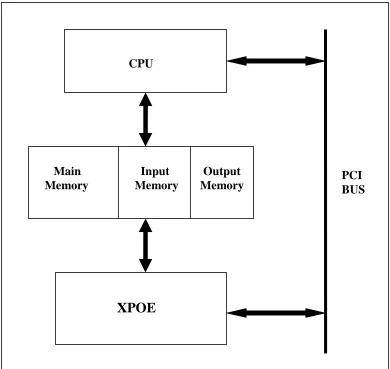
The high level block diagram which shows the interaction between the CPU,
the memory and the XPOE is shown in Figure 3.1.
1. Memory
The memory is shared between the CPU and the XPOE. It is implemented as a
32-bit memory. The motivation behind choosing a 32-bit data width is the fact
that UTF-8 uses a maximum of 4 bytes to represent each character.
The memory is divided into 3 distinct sections. Different information is stored at
pre-decided memory locations. The first section is the main memory section that
is read and written to by the CPU and can only be read by the XPOE. The
remaining part of the memory outside of the main memory is divided into the
input and output section of the memory.
As mentioned in section 2.4 when an appropriate XPath function that can be
offloaded is identified by the compiler, the pointer to each input argument
(located in main memory) along with corresponding argument lengths is written
into the input section of the memory. The result or the output of the function
execution is written into the output section of the memory by the XPOE. The
result string will be stored at a predefined location in the output section of the
memory. A counter is run while this result value is being stored. Once the entire
value is stored, the value of the counter serves as the length of the result string.
The pointer to the result and the length of the result are stored at the start of the
output section.
When control returns to the CPU, the software can then easily use the string
pointer which points to the start of the result string along with its length to obtain
the result value. The CPU is aware of all these addresses and thus knows where
to store the pointers to the input arguments and where to read the result from. An
31
Figure 3.1: High level block diagram showing system level interaction
2. XPOE
The XPOE is made up of 5 main modules. Each one is mentioned below with a
brief description. A detailed description of the behavior and functionality of the
XPOE and its modules is given in chapters 4 and 5.
• Read Input Memory
This module is the interface between the input section of the memory and the
rest of the XPOE. When the XPOE is interrupted by the CPU with a start signal
the read input memory module will interpret the opcode received from the CPU
CPU
Main
Memory
Input Memory
Output Memory
XPOE
32
and appropriately read the required number of bytes from the input section of the
memory.
• Read Main Memory
This module receives the bytes read from the input memory and based on the
opcode interprets the bytes read. It identifies the string pointers and using these
pointers it reads the input arguments to the function from the appropriate location
in main memory word by word.
• Function Execute
This module implements the execution of the actual XPath function based on
the opcode that is passed to the XPOE by the CPU. It operates on the character
data passed to it from the main memory. The output of the operation on each
input word is then delivered to be written to the output memory.
• Memory Write Module
This module writes the result of the function execution into the output section of
the memory. Once that is done a ‘complete’ signal goes high and wakes up the
CPU, which will then read the result from the predefined location of the output
section of memory.
• Controller
This module implements the Finite State Machine (FSM). When the start
interrupt goes high the FSM enables the read input module. Based on signals
from the read main memory, function execute and memory write modules the
FSM will enable the appropriate modules. When the complete signal goes high
33
3.3 Processor savings analysis
3.3.1 Encode-to and Decode-from UTF-8 representation
The analysis starts by showing the CPU cycles savings that is incurred in
encoding-to and decoding-from UTF-8 character representation. XPath functions
take XML data as arguments. As seen in section 3.1 one of the main reasons
that XPath functions are CPU intensive is the UTF representation of XML
character data. UTF-8 character representation is assumed for this
implementation. A majority of the XPath string functions involve encoding-to or
decoding-from UTF-8 representation to some extent or the other. Thus, we can
infer that by offloading the encoding and decoding operations onto hardware a
significant amount of CPU cycles can be saved by the majority of the XPath
string functions. The following tables will elaborate on the encoding and decoding
operations and present an analysis on the number of CPU cycles involved with
the help of pseudo-code. An example input is used for analysis purposes. The
input contains 6 character numbers in the case of encode or a string with a string
length of 6 in the case of decode. The number of bytes/octets per character is
taken as 3 for this example. The analysis will then compare the CPU utilization
involved in the encoding-to and decoding-from UTF-8 representation of this
example input for the following two methods:
1) Complete software approach
The software reads the arguments and implements the encoding-to and
34
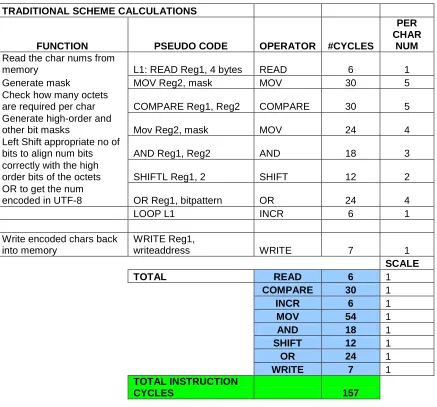
• Encoding a character number to a UTF-8 character
1. Determine the number of octets required from the char number.
2. Then, prepare the high order bits of the octets.
3. Finally, fill in the appropriate bits from the bits of the character number,
expressed in binary.
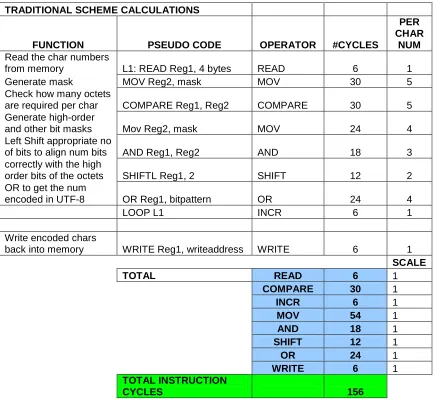
Table 3.2: Cycles required for an all-software approach for encoding function
TRADITIONAL SCHEME CALCULATIONS
FUNCTION PSEUDO CODE OPERATOR #CYCLES
PER CHAR
NUM
Read the char numbers
from memory L1: READ Reg1, 4 bytes READ 6 1
Generate mask MOV Reg2, mask MOV 30 5
Check how many octets
are required per char COMPARE Reg1, Reg2 COMPARE 30 5 Generate high-order
and other bit masks Mov Reg2, mask MOV 24 4
Left Shift appropriate no
of bits to align num bits AND Reg1, Reg2 AND 18 3 correctly with the high
order bits of the octets SHIFTL Reg1, 2 SHIFT 12 2 OR to get the num
encoded in UTF-8 OR Reg1, bitpattern OR 24 4
LOOP L1 INCR 6 1
Write encoded chars
back into memory WRITE Reg1, writeaddress WRITE 6 1
SCALE
TOTAL READ 6 1
COMPARE 30 1
INCR 6 1
MOV 54 1
AND 18 1
SHIFT 12 1
OR 24 1
WRITE 6 1
TOTAL INSTRUCTION
35
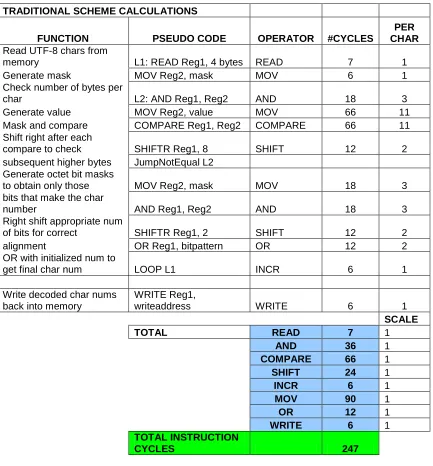
• Decoding a UTF-8 character to a character number 1. Initialize a number and set its bits to one.
2. Determine how many bits are used to represent the character, that is,
which bits encode the character.
3. Finally, distribute the bits from the sequence to the initialized number, form
the lower order bits, proceeding to the left. This number will now equal the
character number.
Table 3.3: Cycles required for an all-software approach for decoding function
TRADITIONAL SCHEME CALCULATIONS
FUNCTION PSEUDO CODE OPERATOR #CYCLES
PER CHAR
Read UTF-8 char from
memory L1: READ Reg1, 4 bytes READ 6 1
Generate mask MOV Reg2, mask MOV 6 1
Check number of bytes
per char L2: AND Reg1, Reg2 AND 18 3
Generate value MOV Reg2, value MOV 66 11
Mask and compare COMPARE Reg1, Reg2 COMPARE 66 11 Shift right after each
compare to check SHIFTR Reg1, 8 SHIFT 12 2
subsequent higher
bytes JumpNotEqual L2
Generate octet bit masks to obtain only
those L3: MOV Reg2, mask MOV 18 3
bits that make the char
number AND Reg1, Reg2 AND 18 3
Right shift appropriate
num of bits for correct SHIFTR Reg1, 2 SHIFT 12 2
Alignment OR Reg1, bitpattern OR 12 2
OR with initialized num
to get final char num LOOP L1 INCR 6 1
Write decoded char nums back into memory
WRITE Reg1,
writeaddress WRITE 6 1
SCALE
TOTAL READ 6 1
AND 36 1
COMPARE 66 1
SHIFT 24 1
INCR 6 1
MOV 90 1
OR 12 1
WRITE 6 1
TOTAL INSTRUCTION