C
HAP
T
E
R
18
FIELD-EXPEDIENT
DIRECTION
FINDING
.
In a survival situation, you will be extremely fortunate if you happen to have a map and compass.
If
you do havethese two pieces of equipment, you will most likely be able
to move toward help. If you are not proficient in using
a map and compass, you must take the steps to gain
this skill.
There are several methods by which you can determine
direction by using the sun and the stars. Thesemethods,
however, will give you only a general direction. You can
come up with a more nearly true direction
if
you know theterrain of the territory or country.
.
knowledge of the terrain together with using the methods explained below will let you come up with fairly true direc-tions to help you navigate.
USING
THE SUN
AND
SHADOWS
The earth's relationship to the sun can help you to determine direction on earth. The sun always rises in the east ana sets in the west, but not exactly due east or due west. There is also some seasonal variation. In the northern hemisphere, the sun will be due south when at its highest point in the sky, or when an object casts no appreciable shadow. ill the southern hemisphere, this same noonday sun will mark due north. In the northern hemisphere, shadows will move clockwise. Shadows will move counterclockwise in the southern hemisp'here. With practice, you can use shadows to determine both direction ana time of day. The shadow meth-ods used for direction finding are the shadow-tip ana watch methmeth-ods.
Shadow-Tip
Methods
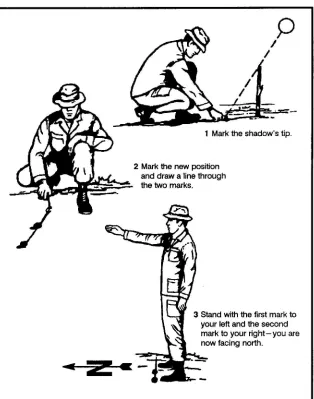
In the first shadow-tip' method, find a straight stick
1
meter long, and a level spot free of brush on which the stick will cast a definite shadow. This method is simple and accurate and consists of four steps:Step 1. Place the stick or branch into the ground at a level spot
where it will east a distinctive shadow. Mark the shadow's tip with a stone, twig, or other means. This first shadow mark is always
west
-everywhere
on earth.
Step2. Wait
10to 15
minutes until the shadow tip moves a few centimeters. Mark the shadow tip's new position in the same way as the first.Step 3. Draw a straight line through the two marks
to
obtain an approximate east-west line.Step 4. Stand with the first mark (west) to your left and the second
mark to your right-you are now facing north. This fact is true everywhere on eartl1.
.
midday, the shadow will shrink and disappear. In the afternoon, it will lengthen again and at the point where it touches the are, make a second mark. Draw a line througn the two marks to get an accurate east-west line (see Figure 18-1).
P
I I
/ /
~
~-1Mark the shadow's tip.
2 Mark the new position and draw a line through the two marks.
3 Stand with the first mark to your left and the second
mark to your right-you are
now facing north.
~
Z
--l
.
The Watch Method
You can also determine direction using a common or analog watch-one that has hands. The direction will be accurate if you are usmg true local time, without any changes for daylight savings hme. RememBer, the fur-ther you are from the equator, ilie more accurate this method will be. If y'ou only have a digital watch, you can overcome this obstacle. Quickly
draw a watch on a circle of paper with the correct time on it and use it to determine your direction at that time.
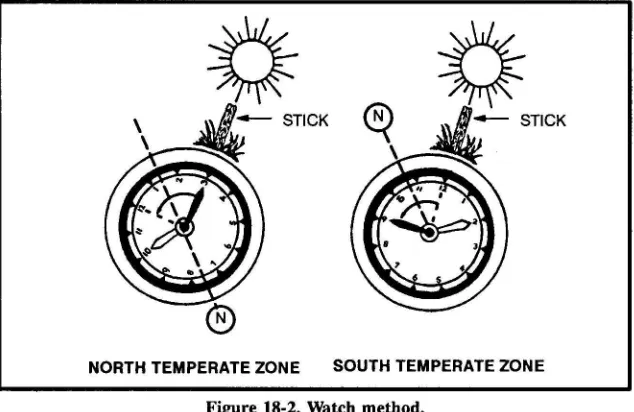
In the northern hemis2here, hold the watch horizontal and point the hour hand at the sun. Bisect the angle between the hour hand and the
12 o'clock mark to get the north-south line (Figure 18-2). If there is any doubt as to which end of the line is north, remember that the sun rises in the east, sets in the west, and is due south at noon. The sun is in the east before noon and in the west after noon.
Note: If your watch is set on daylight savings time, use the midway point between the hour hand and 1 0 clock to determine the north-south line.
In the southern hemisphere, point the watch's 12 o'clock mark toward the sun and a mid20int halfWaybetween 12 and the hour hand will give you the north-south line (Figure 18-2).
NORTH TEMPERATE ZONE
0<
\
Figure 18-2. Watch method.
.
USING THE MOON
Because
the moon has no light of its own, we can only see it when it
reflects the sun's light. As it orbits the earth on its 28-day circuit, the shape of the reflected light varies according to its position. We say there is a new moon or no moon when it is on tIle opposite side of the earth from the sun. Then, as it moves away from the earth's shadow, it begins to reflect light from its right side ana waxes to become a full moon De-fore waning, or losing shape, to appear as a sliver on the left side. You can use this informatlOn to identity direction.If the moon rises before the sun has set, the illuminated side will be the west. If the moon rises after midnight, the illuminated side will be the east. This obvious discovery proviaes us with a rough east-west reference during the night.
USING THE STARS
Your location in the Northern or Southern Hemisphere determines which constellation you use to determine your north or south direction.
The Northern Sky
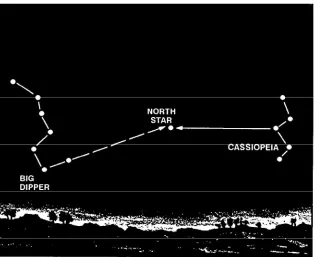
The main constellations to learn are the Ursa Major, also known as the Big Dipper or the Plow, and Cassiopeia (Figure 18-3).Neither of these constellations ever sets. They are always visible on a clear night. Use them to locate Polaris, also known as the polestar or the North Star. The North Star forms part of the Little Dipper handle and can be con-fused with the Big Dipper. Prevent confuslOnby using both the Big Dipper and CasslOpem together. The Big Dipper and Cassiopeia are always directly opposite each. other and rotate counterclockwise around Polaris, with Polaris in the center. The Big Dipper is a seven star con-stellation in the shape of a dipper. The two stars forming the outer lip of this dipper are tne "pointer stars" because they point to the North Star. Menfally draw a rme from the outer bottom star to the outer top star of the Big Dipper's bucket. Extend this line about five times the distance between tne pointer stars. You will find the North Star along this line.
.
After
locating the North Star, locate the North Pole or true north by drawing an imaginary line directly to the earth.The Southern Sky
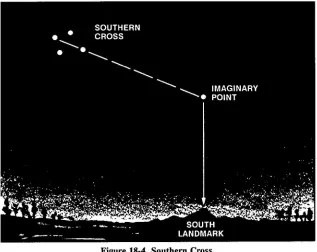
Because there is no star bright enough to be easily recognized near the south celestial pole, a constellation known as the Southern Cross is used
as a signpost to the South (Figure 18-4). The Southern Cross or Crux
has five stars. Its four brightest stars form a cross that tilts to one side. The two stars that make up the cross's long axis are the pointer stars. To determine south, imagme a distance five times the dIstance between These stars and the point where this imaginary line ends is in the general direction of south. Look down to the horizon from this imaginary point and select a landmark to steer by. In a static survival situation, y.ou can fix.this location in daylight if you drive stakes in the ground at night to pomt the way.
~ NORTH
\
\
STAR'
.
,-
.-A'.--.
\
''-
\
.--
.
."
~
.'-BIG DIPPER
>~~~~
-~;J~~.,. ,",. ,,,,,;,'. ",;,~:,"",
~
,:,-",~.;:,,:,"/"d""
'.~,"--~""
~~~t~~~.
. , -"'" ~~~~1 ~ . - . . ' . . . . ". ":~..",.",.,,
.
-..
"-"'-' ,",' ". -"'.'~""~":'. ..-" .. ,"~..;--:._- -:;. .' :-::'-::~
.
MAKING
IMPROVISED
COMPASSES
You can construct improvised compasses using a piece of ferrous metal that can be needle shaped or a flat double-edged razor blade and a piece of nonmetallic string or long hair from which to suspend it. You can magnetize or polarize the metal by slowly stroking i1in one direction on a piece of silk or carefully through your hair using deliberate strokes. You can also polarize metarby stroking it repeatedly at one end with a magnet. Always rub in one direction only. If y.ouhave a battery and some electric wire, you can polarize the metal electrically. The wire should be insulated. If not insulated, wrap the metal object in a single, thin strip of paper to prevent contact. The battery must be a minimum of 2 volts. Form a coil with the electric wire and touch its ends to the battery's terminals. Repeatedly insert one end of the metal object in
and out of the coil. The needle will become an electromagnet. When suspended from a piece of nonmetallic string, or floated on a small piece of wood in water, it will align itself with a north-south line.
.
You can construct a more elaborate improvised compass using a sewing needle or thin metallic object, a nonmetallic container (for example, a plastic dip' container), its lid with the center cut out and waterproofed, and the silver tip from a pen. To construct this compass, take an ordi-nary sewing needle and Break in half. One half will form your direction pointer ana the other will act as the pivot point. Push the portion used as the pivot point through the bottom center of your container; this por-tion should De flush on the bottom and not interfere with the lid. Attach the center of the other portion (the pointer) of the needle on the pen's silver tip usin~ glue,.tree sap, ~r me1t~dplastic. Magnetize one end of the pomter ana rest it on the pivot pomt.
OTHER MEANS
OF DETERMINING
DIRECTION
The old saying about using moss on a tree to indicate north is not accurate because moss grows completely around some trees. Actually, growth is more lush on the side 01the tree facing the south in the Northern Hemisphere and vice versa in the Southern Hemisphere. If there are several felled trees around for comparison, look at the stumps. Growth is more vigorous on the side toward the equator and the tree growth rings will Be more widely spaced. On the other hand, the tree growth rings will be closer together on the side toward the poles.
Wind direction may be helpful in some instances where there are pre-vailing directions and you Knowwhat they are.
C
HAP
T
E
R
19
SIGNALING
TECHNIQUES
One of your first concerns when you find yourself in a sur-vival situation is to communicate with your friends or al-lies. Generally, communication is the giving and receiving of information. As a survivor, you must get your rescuer's attention first, and second, send a message your rescuer understands. Some attention-getters are man-made geo-metric patterns such as straight lines, circles, triangles, or
X's displayed in uninhabited areas; a large fire or flash of
light; a large, bright object moving slowly; or contrast, whether from color or shadows. The type of signal used will depend on your environment and the enemy situation.
APPLICATION
.
can create. On the other hand, you will have to be more discreet in combat situations. You do not want to signal and attract the enemy. Pick an area that is visible from the air, but ensure there are hiding places nearby. Try to have a hill or other object between the signal site and the enemy to mask your signal from the enemy. Perform a tnorough recon-naissance of the area to ensure there are no enemy forces nearby.
Whatever signaling technique or device you plan to use, know how to use it and be ready to put it into operatlOn on short notice. If possible, avoid using si~als or signaling techniques that can physically endanger
you. Keep
m
mind that signals to yourfriends
may alert the enemy of your presence and location. Before signaling, carefully weigh your rescuechancesby
friends
against the danger of capture by the enemy.A radio is rrobably the surest and quickest way to let others know where you are ana to let you receive their messages. Become familiar with the radi~s in your unit. Learn how to operate them and how to send and receive messages.
You will find descriptions of other signaling techniques, devices, and articles you can use. Learn how to use them. Think of ways in which you can adapt or change them for different environments. Practice using these signaling techniques, devices, and articles before you need them. Planned', prearranged signaling techniques may improve your chance of rescue.
MEANS FOR SIGNALING
There are two main ways to get attention or to communicate- visual and audio. The means you use will depend on your situation and the material you have available. Whatever the means, always have visual and audio signals ready for use.
Visual Signals
These signals are materials or equipment you use to make your presence
known to rescuers.
Fire
.
straight line with about 25 meters between the fires. Build them as soon as time and the situation permit and protect them until you need them. If you are alone, maintainmg three fires may be difficult. If so, maintain one signal fire.
When constructing signal fires, consider your geographic location. If in a jungle, find a natural clearing or the edge of a stream where y.ou can buila fires that the jungle follage will not hide. You may even have to clear an area. If in a snow-covered area, y.ou may have to clear the ground of snow or make a platform on which to build the fire so that melting snow will not extinguish it.
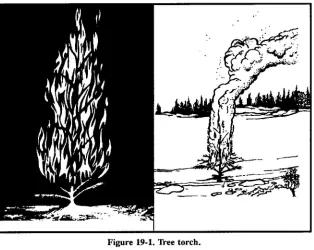
A burning tree (tree torch) is another way to attract attention (Figure 19-1).You can set pitch-bearing trees afire, even when green. You
can get other types of trees to bum
qy placing dry wood in the lower
branches and 19p.itingit so that the flames flare up and ignite the foliage. Before the pnmary tree is consumed, cut and ada more small green trees to the fire to produce more smoke. Always select an isolated tree so that you do not start a forest fire and endanger yourself.
.
Smoke
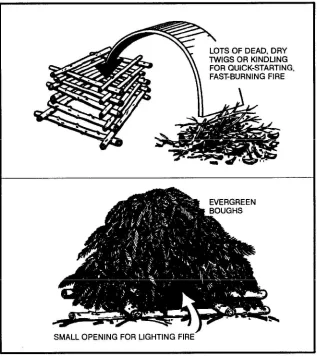
During daylight, build a smoke generator and use smoke to gain atten-tion (Figure 19-2). The internaatten-tional distress signal is three columns of smoKe.Try to create a color of smoke that contrasts with the back-ground; darK smoke against a light background and vice versa. If you p'ractically smother a rarge fire with green leaves, moss, or a little water, the fire will produce white smoke. If you add rubber or oil-soaked rags to a fire, you will get black smoke.
...
~
-~
.
.
-.,
-
I.1,-. \", ',,:' ;,'"
..
'-~/' ,.'- ~':I
~.
".,. \~ -,
'i, ,.".~', ,...,'.\~',I' ,:\', I) ~.;:
'~'" '.- .I'\"~'~ I ..
'-I , ,
\
,.~~,'~..:~~
""~{1~,~
")~'-~~""~. .-::- - ..
""'"
SMALL OPENING FOR LIGHTING FIRE
.
In a desert environment, smoke hangs
closeto the ground, but a pilot
can spot it in open desert terrain.Smoke signals are effective only on comparatively calm, clear days. High winds, ram, or snow disperse smoke, lessening its chances of being seen.
Smoke Grenades
If you have smoke grenades with you, use them in the same p'attern as described for fires. Keep them dry so that they will work when you need them. Take care not to ignite the vegetation in the area when you use them.
Pen Flares
These flares are part of an aviator's survival vest. The device consists of a pen-shaped gun with a flare attached by a nylon cord. When fired, the pen flare sounds like a pistol shot and fires the flare about 150 meters high. It is about 3 centimeters in diameter.
To have
the penflare ready for immediateuse, take it out of its
wrap-per, attach tIi.eflare, leave the ~n uncocked, and wear it on a cord or chain around your neck. Be ready to fire it in front of search aircraft and be ready with a secondary signal. Also, be ready to take cover in case the pilot mistakes the flare for enemy fire.
Tracer Ammunition
You may use rifle or pistol tracer ammunition to si~al search aircraft. Do not fire the ammunition in front of the aircraft. As with pen flares, be ready to take cover if the pilot mistakes your tracers for enemy fire.
Star Clusters
Red is the international distress color; therefore, use a red star cluster whenever possible. Any color, however, will let your rescuers know where you are. Star clusters reach a height of 200 to 215 meters, burn an average of 6 to 10 seconds, and descend at a rate of 14 meters
per
second.Star Parachute Flares
These flares reach
a height of 200to 215meters and descend at a rate
of
2.1 meters per second.The
M126 (red) burns about 50 seconds and.
MiITors or Shiny Objects
On a sunny day, a mirror is your best signaling device. If you don't have a mirror, polish your canteen cup, your lJelt buckle, or a similar object that will reflect the sun's rays. Direct the flashes in one area so that they are secure from enemy observation. Practice using a mirror or shiny object for signaling now; do not wait until you need it.1Cyou have an MK-3 signar mirror, follow the instructions on its back (Figure 19-3).
Wear the signal mirror on a cord or chain around your neck so that it is ready for immediate use. However, be sure the glass side is against your body so that it will not flash; the enemy can see the flash.
~
.
...i~..~
~
~
-@
HOW TO USE THE MK-3 SIGNAL MIRROR
1 Reflect sunlight from mirror onto a nearby surface (raft. hand, etc.). 2 Slowly bring up to eye level and look through sighting hole. You
will ~AA ~ hrinht..,.. ~nnt nr linht Thi~ i~ thA ~im inrli~~tnr ~ -, "::II"'"
I''''''' .." "'''''''''''''''''''''''.
3 Hold mirror near the eye and slowly turn and manipulate it so that the bright spot of light is on the target.
4 In friendly areas where only rescue by friendly forces is anticipated,
free use of the mirror is recommended. Even though no aircraft or ships are in sight, continue to sweep the horizon. Mirror flashes may be seen for many miles. even in hazy
0
weather. In hostile areas, the signal mirror mustbe used as an aimed signal only.
/.--~
,~...,..,.,...
,,\ .,.'
.
CAUTION
Do not flash a signal mirror rapidly because a pilot may mistake the flashes for enemy fire. lIo not direct tne beam in the aircraft's cockpit for more than a few seconds as it may blind the pilot.
Haze, ground fog, and mirages may make it hard for a pilot to spot sig-nals from a flasnmg object. So, if possible, get to the highest pomt in your area when signaling. If you can't determine the aircraft's location, Rash your signal in the direction of the aircraft noise.
Note: Pilots have reported seeing mirror flashes up to 160 kilometers away under ideal conditions.
Figures
19-4and 19-5 show methods of aiming a signal mirror for
signaling.
Flashlight or Strobe Light
At night you can use a flashlight or a strobe light to send an 50S to an aircra1t. When using a strobe 1ight; take care to prevent the pilot from mistaking it for incoming ground rire. The strobe light flashes 60 times per minute. Some strobe hghts have infrared covers and lenses. Blue Rash collimators are also available for strobe lights.
~
"
.... ........
"
.... ........ ...
" "
...,
...
" "
Q:
I I I I.
VS-17 Panel
During daylight you can use a VS-17 panel to signal. Place the orange side up as it is easier to see from the air than the violet side. Flashing the panel will make it easier for the aircrew to spot. You can use any bright orange or violet cloth as a substitute for the VS-17.
Clothing
Spreading clothing on the ground or in the top of a tree is another way to sign-al. Select articles wnose color will contrast with the natural sur-roundi!1gs. Arrange them i~ a large geometric pattern to make them more hl<ely to attract attentlOn.
Natural Material
If you lack other means, you can use natural materials to form a symbol or message that can be seen from the air. Build mounds that cast shad-ows; you can use brush, foliage of any type, rocks, or snow blocks.
In snow-covered areas, tramp the snow to form letters or sy'mbols and fill the depression with contrasting material (twigs or branches). In sand, use Doulders, vegetation, or seaweed to form a sy'mbol or message. In brush-covered areas, cut out patterns in the vegetation or sear the ground. In tundra, dig trenches or turn the sod upside down.
In any terrain, use contrasting materials that will make the symbols visible to the aircrews.
.
Sea Dye Markers
All Army aircraft involved in operations near or over water will normally carry a water survival kit that contains sea dye markers. If you are in a water survival situation, use sea dye markers during daylight to indicate your location. These spots of dye stay conspicuous 10r about 3 hours, ex-cept in very rough seas. Use tnem only if you are in a friendly area. Keep the markers wrapped until you are ready to use them. Use them only when you hear or sight an aircraft. Sea dye markers are also very effec-tive on snow-coverea ground; use them to write distress code letters.
Audio
SignalsRadios, whistles, and gunshots are some of the methods you can use to signal your presence to rescuers.
Radio Equipment
The ANjPRC-90 survival radio is a part of the Army aviator's survival vest. The ANjPRC-112 will eventually replace the ANjPRC-90. Both radios can transmit either tone or voice. Any other type of Army radio can do the same. The ranges of the different radios vary depending on the altitude of the receiving aircraft, terrain, vegetation density, weather, battery strength, type of raaio, and interference. To obtain maximum performance from radios, use the following procedures:
.
Try to transmit only in clear, unobstructed terrain. Since radios are line-of-sight communications devices, any terrain between the radio and the receiver will block the signal..
Keep the antenna at right angles to the rescuing aircraft. There is no signal from the tip of tne antenna..
If the radio has tone capability, place it upright on a flat, elevated surface so that you can perform other survival tasks..
Never let the antenna touch your clothing, body, foliage, or the ground. Such contact greatly reduces the range of the signal..
Conserve battery power. Turn the radio off when you are not using it. Do not transmif or receive constantly. In hostile territory, keep trans-missions short to avoid enemy radio direction finding..
Whistles
Whistles provide an excellent way for close up signaling. In some documented cases, they have been heard up to 1.6 kilometers away. Manufactured whistles have more range than a human whistle.
Gunshots
In some situations you can use firearms for signaling. Three shots fired at distinct intervals usually indicate a distress sl~al. Do not use this te~hnique in enemy territory. The enemy will surely come to mvestigate shots.
CODES AND SIGNALS
Now that you know how to let people know where you are, you need to know how to give them more information. It is easier to form one sym-bol than to spell out an entire message. Therefore, learn the codes and symbols thaf all aircraft pilots unders1and.
SOS
You can use lights or flags to send an 50S-three dots, three dashes, three dots. The 50S is the internationally recognized distress signal in radio Morse code. A dot is a short, sharp pulse; a dash is a longer pulse. Keep repeating the si~al. When using Rags, hold flags on the 1eft side for aasnes ana on the right side for dots.
Ground-to-Air
Emergency Code
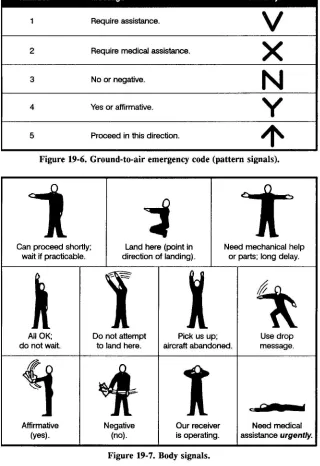
This code (Figure 19-6) is actually five definite, meaningful symbols. Make these symbols a minimum of 1 meter wide and b meters long. If you make them larger, keep the same 1:6 ratio. Ensure the signal
con-trasts greatly with the ground it is on. Place it in an open area easily spottea from the air.
Body
Signals
When an aircraft is close enou[h for the pilot to see you clearly, use body movements or positions (rigure 19-7) to convey a message.
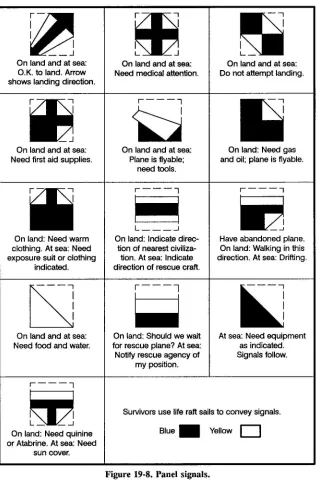
Panel Signals
Number Message Code symbol
1 Require assistance.
V
2 Require medical assistance.
X
3 No or negative.
N
4 Yes or affirmative.
y
5 Proceed in this direction.
l'
1
~T
Can proceed shortly; Land here (point in Need mechanicalhelp
wait if practicable. direction of landing). or parts; long delay.
A
1
X
~AllOK; Do not attempt Pick us up; Use drop do not wait. to land here. aircraft abandoned. message.
.
Figure 19-6.Ground-to-air emergency code (pattern signals).
'j
~ t
,..-
.J
Affirmative (yes).
Negative (no).
Our receiver is operating.
Need medical assistance urgently.
~~~:
--J L -..Jon land and at sea: On land and at sea: On land and at sea: O.K. to land. Arrow Need medical attention. Do not attempt landing. shows landing direction.
~r---l
~~_..J
On land and at sea: On land and at sea: On land: Need gas
Need first aid supplies. Plane is flyable; and oil; plane is flyable.
need tools.
iii
r---l
r----,
~~L___...J
On land: Need warm On land: Indicate direc- Haveabandoned plane.
clothing. At sea: Need tion of nearest civiliza- On land: Walking in this exposure suit or clothing tion. At sea: Indicate direction. At sea: Drifting.
indicated. direction of rescue craft.
N
r---l~~On
land and at sea: On land: Should we wait At sea: Need equipment
Need food and water. for rescue plane? At sea: as indicated.
Notify rescue agency of Signals follow.
my position.
r---l
~Survivorsuse liferaft sailsto convey signals.
On land: Need quinine Blue. Yellow
D
or Atabrine. At sea: Needsun cover.
.
.
Aircraft Acknowledgments
Once the pilot of a fixed-win.?;aircraft has sighted you, he will normally indicate he has seen you by trying low, movmg the plane, and flashing lights as shown in Figure 19-9. Ire ready to relay other messages to tne
MESSAGE RECEIVED AND UNDERSTOOD
Aircraft will indicate that ground signals have been seen and understood
by-Day or moonlight: Rocking from side to side.
-. -. -. -. -.
Night: Making green flashes with signal lamp.
MESSAGE RECEIVED BUT NOT UNDERSTOOD
Aircraft will indicate that ground signals have been seen but not understood
by-..-/
Day or night: Making a complete right hand circle.
- - - -
Night: Making red flashes with signal lamp..
pilot once he acknowledges that he received and understood your first message. Use a radio, if possible, to relay further messages. If no radio is available, use the codes covered in the previous paragraphs.
AIRCRAFT VECTORING
PROCEDURES
If you can contact a friendly aircraft with a radio, wide the pilot to your location. Use the following general format to guiae the pilof:
.
Mayday, Mayday..
Callsign (ifany).
.
Name..
Location..
Number of survivors..
Available landing sites..
Any remarks such as medical aid or other specific types of helpneeded immediately.
C
HAP
T
E
R
20
SURVIV
AL
MOVEMENT
IN
HOSTILE
AREAS
The "rescue at any cost" philosophy of previous con-flicts is not likely to be possible in future concon-flicts. Our potential adversaries have made great progress in air de-fense measures and radio direction finding (RDF)
.
familiar
with all the possible types of recovery, their
related problems, and their responsibilities to the
recov-ery effort. Preparation and training can improve the
chances of success.
PHASES OF PLANNING
Preparation is a requirement for all missions. When planning,_you must consider how to avoid capture and return to your unit. Contin-gency plans must be prepared
m
conjunction with unit standing oper-ating procedures (SOPs). Courses of action you or your unit will take mus1 also be considered.Contingency Plan of Action (CPA)
Intelligence sections can help prepare personnel for contingency actions through information supplied
m
area studies, SERF (survival,
evasion, resistance, and escape) contingency guides, threat briefings, current intelligence reports, and current contact and authentication procedures. Pre-mission preparation includes the completion of a CPA. The study and research needed to develop the CPA will make you aware of the current situation in your misslOn area. Y our CPA will let recovery forces know your probable actions should you have to move to aVOld capture.
Start preraring even before pre-mission planning. Many parts of the CpA are SQP tor yo~r uni~. ~nclude the CPA in your training. Plan-nmg starts m your dally trammg.
The CPA is your entire plan for your return to friendly control. It consists of five paragrapns written in the oreration order format. You can take most ot paragraph 1, Situation, with you on the mission. Appendix
H
contains the CPA format. It also indicates what portion of tlte CPA you can take with you.A comprehensive CPA is a valuable asset to the soldier trapped behind enemy lines who must try to avoid capture. To complete raragrarh 1, know
l
Our unit's assigned area or concentrate on.
include newspapers, magazines, country or area handbooks, area studies, television, radio, persons famihar with the area, and libraries.
Closed sources may include area studies, area assessments,
SERE
contingency guides, various classified field manuals, and intelligence reports.
Prepare your CPA in three phases. During your normal training, Rrepare paragraph 1, Situation. Prepare paragraphs 2, 3, 4, and J Ciurmg your pre-mission planning. After deployment into an area, c.ontinually update your CPA based on miSSlOnchanges and intel-hgence updafes.
The CPA is a g1!ide.You may add or delete certain portions based on the mission. The CPA may be a recovery force's only means of determining your location and intentions after you start to move. It is an essential tool for your survival and return to friendly control.
Standing Operating Procedures
Unit SOPs are valuable tools your unit has that will heiR your planning. When faced with a dangerous situation requiring immeaiate action, it is not the time to discuss options; it is the time to act. Many of the tech-niques used during small unit movement can be carried over to fit requirements for moving and returning to friendly control. Items from the SOP should include, but are not limited
to-.
Movement team size (three to four persons per team)..
Team communications (technical and nontechnical)..
Essential equipment..
Actions at danger areas..
Signaling techniques..
Immediate action drills..
Linkup procedures..
Helicopter recovery devices and procedures..
Security procedures during movement and at hide sites..
Rally points..
Notification to Move
and Avoid Capture
An isolated unit has several general courses of action it can take to avoid the capture of the group or individuals. These courses of action are not courses the commander can choose instead of his origi-nal mission. He cannot arbitrarily abandon the assigned mission. Rather, he may adopt these courses of action after completing his mission when ltis unit cannot complete its assigned mission (Because of combat power losses) or when he receives orders to extract his unit from its current position. If such actions are not possible, the com-mander may deClde to have the unit try to move to avoid capture and return to fnendly control. In either case, as long as there is communi-cati~~ with higher headquarters, that headquarters will make the deClslOn.
If the unit commander loses contact with higher headquarters, he must make the decision to move or wait. He bases his aecision on many factors, including the mission, rations and ammunition on hand, casualties, the chance of relief by friendly forces, and the tactical situation. The commander of an isolated unit faces other questions. What course of action will inflict maximum damage on the enemy? What course of action will assist in completing the higher headquar-ters' overall mission?
Movement teams conduct the execution portion of the plan when notified
by
higher headquarters or, if there is no contact with higher headquarters, when the highest ranking survivor decides that the situatlOn requires the unit to try to escape capture or destruction. Movement team leaders receive their notification through prebriefed signals. Once the signal to try to avoid cap.ture is given, it must be passed rapidly to an personnel. Notify higher headquarters, if possible. If unable to commUnicate with higher headquarters, leaders must recognize that organized resistance has ended, and that organizational control has ceased. Command and control is now at the movement team or individual level and is returned to higher organizational control only after reaching friendly lines.EXECUTION
.
members rally and actually begin their movement. Tentatively select the initial movement point durmg your planning phase through a map recon. Once on the ground, the team verifies tfiis location or selects a better one. All team members must know its location. The initial movement point should be easy to locate and occupy for a minimum amount of time.
Oncethe teamhas ralliedat the initialmovementpoint,it
must-.
Givefirst aid.
.
Inventory its equipment (decide what to abandon, destroy, or takealong).
.
Apply camouflage..
Make sure everyone knows the tentative hide locations..
Ensure everyone knows the primary and alternate routes and rallypoints en route to the hide locations.
.
Always maintain security..
Split the team into smaller elements. The ideal element should havetwo to three members; however, it could include more depending on team equipment and experience.
The movement portion of returning to friendly control is the most dangerous as you are now most vu1nerable. It is usually better to move at nighf because of the concealment darkness offers. Exceptions to such movement would be when moving through hazardous terrain or dense vegetation (for example, jungle or mountainous terrain). When moving, avoid the following even if it takes more time and energy to bypass:
.
Obstacles and barriers..
Roads and trails..
Inhabited areas..
Waterwaysand bridges..
Natural lines of drift..
Man-made structures..
All civilian and military personneL.
detect people before they detect you. Make frequent listening halts. In
dayligfit, 6bserve
a
section of your route before you move along it. The distance you travel before you hide will depend on the enemy situa-tion, your health, the terram, the availability of cover and concealment for hiding, and the amount of darkness left.Once you have moved into the area in which you want to hide (hide area), select
a
hide site. Keep the following formula in mind when selecting a hide site: BLISS.B - Blends in with the surroundings. L - Low in silhouette.
I - Irregular in shape. S -
Small
in size. S - Secluded.Avoid the use of existing buildings or shelters. Usually, your best Qption will be to crawl into the tfiickest ve?;.etation you can find. Construct any type of shelter within the hiae area only in cold wea-ther and desert environments. If you build
a
shelter, follow the BLISS formula.Hide Site Activities
After you have located your hide site, do not move straight into it. Use a button hook or other deceptive technique to move to a position outside of the hide site. Conduct
a
listening halt before mov-mg individually into the hide site. Be careful not to disturb or cut any vegetation. Once you have occupied the hide site, limit your activi-ties to maintaining security, resting, camouflaging, and planning your next moves.Maintain your security through visual scanning and listening. Upon detection of the enemy, the security personnel alert all personnel, even if the team's plan is to stay hidden and not move upon sighting the enemy. Take tnis action so that everyone is aware of the danger and ready to react.
If any team member leaves the team, give him a five-point contingency
.
It is extremely important to stay healthy and alert when trying to avoid capture. Tak~ every opportunity to rest, but do not sacrifice security. Rotate secunty so that all mem'bers of your movement team can rest. Treat all injunes, no matter how minor. Loss of your health will mean loss of your ability to continue to avoid capture.
Camouflage is an important aspect of both moving and securing a hide site. Always use a buddy system to ensure that camouflage is complete. Ensure that team members blend with the hide site. Use natural or man-made materials. If you add any additional cam-~uflaK~ material to the hide site, do not cut vegetation in the immeoiate area.
Plan your next actions while at the hide site. Start your planning process immediately upon occupying the hide site. Inform all team members of their current location and designate an alternate hide site location. Once this is done, start plannmg for the team's next movement.
Planning the team's movement begins with a map recon. Choose the next hide area first. Then choose a primary and an alternate route to the hide area. In choosing the routes, do not use straight lines. Use one or two radical changes in direction. Pick the routes that offer the best cover and concealment, the fewest obstacles, and the least likelihood of contact with humans. There should be loca-tions along the route where the team can get water. To aid team navi-gation, use azimuths, distances, checkpoints or steering marks, and corridors. Plan rally points and rendezvous points at intervals along the route.
Other planning considerations may fall under what the team already has in the team SOP. Examples are immediate action drills, actions on sighting the enemy, and hand-and-arm signals.
Once planning is complete, ensure everyone knows and memorizes the entire plan. TIle team members should know the distances and azi-muths for the entire route to the next hide area. They should study the map and know the various terrain they will be moving across so that they can move without using the map.
.
site to those discussed above. Once in the hide site, restrict all move-ment to less than 45 centimeters above the ground. Do not build fires or prepare food. Smoke and food odors will reveal your location. Before leaving the hide site, sterilize it to prevent tracking.
Hole-Up Areas
After moving and hiding for several days, usually three or four, you or the movement team will have to move into a hole-up area. This is an area where you can rest, recuperate, and get and prepare food. Choose an area near a water source. You then have a place to get water, to place fishing devices, and to trap game. Since waterways are a line of communication, locate your hiae site well away from the water.
The hole-up area should offer plenty of cover and concealment for movement m and around the area. Always maintain security while in the hole-up area. Always man the hole-up area. Actions in the 'hole-up area are the same as in nide site, except that you can move away from the hole-up area to get and prepare food. Actions in the hole-up area
include-.
Selecting and occupying the next hide site (remember you are stillin a dangerous situation; this is not a friendly area).
.
Reconnoitering the area for resources and potential concealedmovement routes to the alternate hide site.
.
Gathering food (nuts, berries, vegetables). When moving aroundthe area for food, maintain secunty and avoid leaving tracks or other stgns. When setting traps and snares, keep them well-camoufTagedand in areas wnere people are not likely to discover them. Remember, the local popuration sometimes heavily travels trails near water sources.
.
Getting water from sources within the hide area. Be careful not toleave tracks of si~s along the banks of water sources when getting water. Moving on hard rocks or logs along the banks to get water will reduce the signs you leave.
.
Setting clandestine fishing devices, such as stakeouts, below the surface of the water to avoid detection..
after each use. Be careful that smoke and light from the fire does not compromise the hole-up area.
While in the hole-up area, security is still your primary concern. Designate team members to perform speClfic tasks. To limit movement around the area, you may have a two-man team perform more than one task. For example, tne team getting water could also set the fishing devices. Do not occupy the hole-up area longer than
72
hours.RETURN TO
FRIENDLY
CONTROL
Establishing contact with friendly lines or patrols is the most crucial part of movement and return to friendly control. All your patience, planning, and hardships will be in vain if you do not exercise caution when contacting frienaly frontline forces. "Friendly patrols have killed personnel operating benind enemy lines because they did not make contact properly. Most of the casualties could have oeen avoided if caution had been exercised and a few simple procedures followed. The normal tendency is to throw caution fo tl1e winds when in sight of friendly forces. You must overcome this tendency and understand that linkup is a very sensitive situation.
Border Crossings
If you have made your way to a friendly or neutral country, use the following procedures to cross the border and link up with friendly forces on the ollier side:
.
Occupy a hide site on the near side of the border and send a team out to reconnoiter the potential crossing site..
Surveil the crossing site for at least24
hours, depending on the enemy situation..
Make a sketch of the site, taking note of terrain, obstacles, gt!ard routines and rotations, and any sensor devices or trip wires. Once the recon is complete, the team moves to the hide site, briefs the rest of the team, and plans to cross the border at night..
.
Depending on the size of your movement team, have two mensur-veil the potential linkup site with friendly forces until satisfied that the personnel are indeed friendly.
.
Make contact with the friendly' forces during daylight. Personnel chosen to make contact should be unarmed, have no equipment, and have positive identification readily available. The person who actually makes the linkup should be someone who looKsleast like the enemy..
During the actual contact, have only' one p,erson make the contact.The otner person provides the security ana observes the linkup area from a safe distance. The observer should be far enough away so that he can warn the rest of the movement team if something goes wrong.
.
Wait until the party he is contacting looks in his direction so that he does not surpnse the contact. He stands up from behind cover, with hands overhead and states that he is an American. After this, he follows any instructions given him. He avoids answering any tactical questions and does not give any indication that there are other team members..
Reveal that there are other personnel with him only after verifyinghis identity and satisfying himself he has made contact with friendry forces.
Language problems or difficulties confirming identities may arise. The movement team should maintain security, be patient, and nave a con-tingency plan.
Note: If you are moving t~ a neutral country, you are surrendering to that power and become a aetamed person.
Linkup at the FEBA/FLOT
If caught
between friendly and enemy forces and there is heavy fight-ing in the area, you may' Chooseto hide and let the friendly lines pass over you. If overrun by friendly forces, you may try to link up from their rear during daylight hours. If overrun by enemy forces, you may move further to the enemy rear, try to move to the forward edge ofthe battle area
(FEBA)/
forward line of own troops (FLOT)durmg a
lull in the fightmg, or move to another area along the front.
.
contact. Frontline personnel are more likely to shoot first and ask
questions later, especially in areas of heary fighting. You should be near or behind cover before trying to maKe contact.
Linkup With Friendly Patrols
If friendly lines are a circular perimeter or an isolated camp, for exam-ple, any direction you approac1l from will be considered enemy territo-ry. You do not have the option of moving behind the lines and trying to link up. This move makes the linkup extremely dangerous. Orie option you have is to place the perimeter under observation and wait for a fnendly patrol to move ou1 in your direction, providing a chance for a linkup. You may also occupy' a position outside of the perimeter and call out to get the attention of the friendly forces. Idealry, display anything that is white while making contact. [f nothing else is avail-able, use any article of clothing. The idea is to draw attention while staying behmd cover. Once you have drawn attention to your signal and called out, follow instructions given to you.
Be constantly on the alert for friendly patrols because these provide a means for return to friendly control. rind a concealed position that allows you maximum visual coverage of the area. Try to memorize every terrain feature so that, if necessary, you can infiltrate to friendly positions under the cover of darkness. Remember, trying to infiltrate
m darkness is extremely dangerous.
Because of the missions of combat and recon patrols and where they are operating, making contact can be dangerous. If you decide not to make contact, you can observe their route and approach friendly lines at about the same location. Such observation will enable you to avoid mines and booby traps.
Once you have spotted a patrol, remain in position and, if possible, allow the patrol to move toward you. When the patrol is 25 to 50 meters from your position, signal them and call out a greeting that is clearly and unmistakably of American origin.
.
It is crucial, at the time of contact, that there is enough light for the patrol to identify you as an American.
C
HAP
T
E
R
21
CAMOUFLAGE
In a survival situation, especially in a hostile environment, you may find it necessary to camouflage yourself, your equipment, and your movement. It may mean the differ-ence between survival and capture by the enemy. Camou-flage and movement techniques, such as stalking, will also
help you get animals or game for food using primitive
weapons and skills.
PERSONAL CAMOUFLAGE
When camouflaging yourself, consider
that
certain shapes are particular.
equipment. Blend in wit0 the surrounding colors and simulate the
texture of your surroundmgs.
Shape and Outline
Change the outline of weapons and equipment by tying vegetation or strip,s of cloth onto them. Make sure the added camouflage does not hinaer the equipment's operation. When hiding, cover yourself and your equipment witl1 leaves, grass, or other local debris. Conceal any signal-ing devices you have prepared, but keep them ready for use.
Color and Texture
Each area of the world and each climatic condition (arctic/winter, temperate/jungle, or SWalrrp/ desert) has color patterns and textures that are natural for that area. While color is self-explanatory, texture defines the surface characteristics of something when looking at it. For example, surface textures may be smooth, rough, rocky, leafy, or many-other pos-sible combinations. 'Use color and texture together to camouflage your-self effectively. It makes little sense to cover youryour-self with deaa, brown vegetation in the middle of a large grassy fiefd. Similarly, it would be useless to calnouflage yourself with green grass in the middle of a desert or rocky area.
To hide and camouflage movement in any specific area of the world, you must take on the color and texture of tne immediate surroundings. Use natural or man-made materials to camouflage yourself. Camouflage
paint, charcoal from burned paper
or wood,
mud, grass, leaves, stripsof cloth or burlap, pine bouglts, and camouflaged uniforms are a few examples.
Cover all areas of exposed skin, including face, hands, neck, and ears. Use camouflage paint, charcoal, or mud to camouflage yourself. Cover with a darker color areas that stick out more and catChmore light (fore-head, nose, cheekbones, chin, and ears). Cover other areas, padicularly recessed or shaded areas (around the eyes and under the chm), with lighter colors. Be sure to use an irregular pattern. Attach vegetation
from the
area or strips
ofcloth
of the proper color to clothing and equipment. If you use vegetation, replace it as it wilts. As you movethrough an
area, be alert to the color changesand modifyyour
Area Method
Temperate deciduous forest Blotches Coniferous forest Broad slash
Jungle Broad slash
Desert Slash
Arctic Blotches
Grass or open area Slash
.
Figure 21-1 gives a general idea of how to apply camouflage for various
areas and chmates. Use appropriate colors for your surroundings. The
blotches or slashes will herp to simulate texture.
Shine
As skin gets oily, it becomes shiny. Equipment with worn off paint is also shiny. Even painted objects, if smooth, may shine. Glass objects such as mirrors, glasses, binoculars, and telescopes shine. You must cover these glass objects when not in use. Anything that shines auto-matically attracts attention and will give away your location.
Whenever possible, wash oily skin and reapply-camouflage. Skin oil will wash off camouflage, so reapply it frequentry. If you must wear glasses, camouflage them 13yapplying a thin layer of dust to the outside of the lenses. This layer of dust will reduce the reflection of light. Cover shiny spots on equipment by painting, covering with mud, or wrapping with cloth or tape. Pay particular attention to covering boot eyelets, buckles on equipment, watches and jewelry, zippers, and uniform insi~ia. Carry a si~ar mirror in its designed pouch or in a pocket with the mirror por-tion facing your body.
Shadow
When hiding or traveling, stay in the deepest part of the shadows. The outer edges of the shadows are lighter and the deeper parts are darker. Remember, if you are in an area where there is plenty of vegetation, keep as much vegetation between you and a potentiaf enemy as possible.
.
Thisactionwillmakeit
very hard for the enemy to see you as thevegetation will partially mask you from his view. Forcing an enemy to looKthrough many layers of masking vegetation will fatigue his eyes very quicklY.
When traveling, especially in built-up areas at night, be aware of where you cast your Shadow. It may extend out around the comer of a building and J;ive away your position. Also, if you are in a dark shadow and there is a light source to one side, an enemy on the other side can see your silhouette against the light.
Movement
Movement, especially fast movement, attracts attention. If at all possi-~le, ~void .movement in the pr~sence of an enemy. If capture appears immment m your present 10catlOnand you must move, move away slow-ly, making as little noise as possible. By moving slowly in a survival situa-tion, you aecrease the chance of detection ana conserve energy that you may need for long-term survival or long-distance evasion.
When moving past obstacles, avoid going over them. If you must climb over an obstacre, keep your body level with its top to avoid silhouetting yourself. Do not silhouette yourself against the sKylinewhen crossing hills or ridges. When you are moving, you will have difficulty detecting the movement of others. Stop frequently, listen, and look around slowly to detect signs of hostile movement.
Noise
Noise attracts attention, especially if there is a sequence of loud noises
such as several snapping twigs.
If
possible,avoid makingany noise at all.
Slow down your pace as mucn as necessary to avoid maKing noise when moving around or away from possible threats.
Use background noises to cover the noise of your movement. Sounds of aircraft, trucks, generators, stronJ; winds, and people talking will cover some or all the sounds producedlJy your movement. Rain will mask a lot of move~ent noise, but it also reduces your ability to detect potential
enemy nOlse.
Scent
.
and your clothes without using soap. This washing method removes soap and body odors. Avoiding strong smelling foods, such as garlic, helps reduce body odors. Do not use tobacco products, candy, gum, or cosmetics.
You can use aromatic herbs or plants to wash yourself and your clothing, to rub on your body and clothing, or to chew on to camouflage your breath. Pine needles, mint, or any similar aromatic TJlant will-help
cam-ouflage your scent from both ammals and humans. Standing in smoke from a tire can help mask your scent from animals. While animals are afraid of fresh smoKe from a fire, older smoke scents are normal smells after forest fires and do not scare them.
While traveling, use your sense of smell to help you find or avoid humans. Pay attention to smells associated wHh humans, such as fire, cigarettes, gasoline, oil, soap, and food. Such smells may alert you to their presence long before you can see or hear them, depending on wind speed and direction. Note the wind's direction and, when possible, approach fron: or skirt around on the downwind side when nearing humans or ammals.
METHODS OF STALKING
Sometimes you need to move, undetected, to or from a location. You need more than just camouflage to make these moves successfully. The ability to stalk or move without making any sudden quick movement or loud noise is essential to avoiding detection.
You must practice stalking if it is to be effective. Use the following tech-niques when practicing.
Upright
Stalking
Take steps about half your normal stride when stalking in the upright position. Such strides help you to maintain your balance. You snou1d be ableto stop at any
.
your foot, place your heel down, followed by your toes. Then gradually shift your weignt forward to the front foot. 11ft the back foot to about knee height and start the process over again.
Keep your hands and arms close to your body and avoid waving them about or hitting vegetation. When moving in a crouch, you gain extra support by placing your hands on your knees. One step usually takes 1 mmute to comp1ete, but the time it takes will depend on the situation.
Crawling
Crawl on your hands and knees when the vegetation is too low to allow you to walk upright without being seen. Move one limb at a time and be
sure to set it down softly, feeling for any,thing that may snap and make noise. Be careful that your toes and heels do not catcn on vegetation.
Prone Staking
To stalk in the prone position, you do a low, modified p'ush-up on your hands and toes, moving yourself forward slightly, and then lowering y'ourself again slowly. Avoid dragging and scrap,ing along the ground as this makes excessive noise and leaves large trails for trackers to follow.
Animal Stalking
Before stalking an animal, select the best route. If the animal is moving, you will need an intercepting route. Pick a route that puts objects be-tween you and the animal to conceal your movement from it. By, posi-tioning yourself in this way, you will be able to move faster, until you pass tnat object. Some objects, such as large rocks and trees, may totally conceal you, and others, such as small bushes and grass, may only par-tially' conceal you. Pick the route that offers the best concealment and requires the least amount of effort.
C
HAP
T
E
R
22
CONTACT
WITH
PEOPLE
Some of the best and most frequently given advice, when dealing with local peoples, is for the survivor to accept, respect, and adapt to their ways. Thus, "when in Rome, do as the Romans do." This is excellent advice, but there are several considerations involved in putting this advice into practice.
CONTACT WITH LOCAL PEOPLE
.
standards of behavior that its members consider proper and acceptable but mayor may not conform to your idea of what is proper. No matter who these people are, you can eXp'ect they will have raws, social and economic values, and political ana religious beliefs that may be radically different from yours. Before deploying into your area of operations, study these different cultural aspects. Prior study and preparation will help you make or avoid contact if you have to deal with the local population.
People will be friendly, unfriendly, or they will choose to ignore you. Their attitude may be unknown. If the people are known to be friendly, try to keep them friendly through your courtesy and respect for their religion,
r
olitics, social customs, habits, and all other aspects of theirculture. I the people are known to be enemies or are unknowns, make every effort to avoid any contact and leave no sign of your presence. A basic knowledge of the aaily habits of the local people will be essential
in this attempt. If after careful observation you determine that an un-known peopre are friendly, you may contact them if you absolutely need their help.
Usually, you have little to fear and much to gain from cautious and re-spectfUl contact with local people of friendly or neutral countries. If you become familiar with the local customs, display common decency" ana most important, show respect for their cusfoms, you should be able to avoid trouble and possibly gain needed help. To make contact, wait until only one person is near and, if possible, let that person make the initial approach. Most people will be willing to help a survivor who appears to be in need. However, local political attitudes, instruction, or propaganda
efforts may change the attitudes of otherwise friendly people. Con-versely, in unfriendly countries, many people, especialry in remote areas, may feel animosity toward their politicians and may be more friendly toward a survivor.
.
THE SURVIVOR'S BEHAVIOR
Use salt, tobacco, silver money, and similar items discreetly when trad-ing with local people. Paper money is well-known worldwide. Do not overpay; it may lead to embarrassment and even danj!;er.Always treat peop1e with respect. Do not bully them or laugh at tnem.
Using sign lan~age or acting out needs or questions can be very effec-tive. Many people are used to such language and communicate using nonverbal Sign1anguage. Try'to learn a few words and phrases of the local language in and around your potential area of operations. Trying to speak someone's language is one of the best ways to show respect lor his culture. Since EngliSh is widely used, some of the local people may understand a few words of English.
Some areas may be taboo. They range from religious or sacred places to diseased or danger areas. In some areas, certain animals must not be killed. Learn the rules and follow them. Watch and learn as much as possible. Such actions will help to strengthen relations and provide new knowledge and skills that may be very lIDportant later. SeeRadvice on local hazards and find out from friendly people where the hostile people are. Always remember that people frequently insist that other peoples are hostile, simply because they do not understand different cultures and distant peoples. The people they can usually trust are their immediate
neighbors-much the same as in our own neighborhood.
Frequently, local people, like ourselves, will suffer from contagious dis-eases. Build a separate shelter, if possible, and avoid physical contact without giving tne imp'ression of doing so. Personally prepare your food and drink, if you can do so without giVing offense. Frequently, the local people will accept the use of "personal or religious custom" as an expla-nahon for isolatlOnistbehavior.
Barter, or trading, is common in more primitive societies. Hard coin is usually good, wnether for its exchange value or as jewelry or trinkets. In isolated areas, matches, tobacco, salt, razor blades, empty containers, or cloth may be worth more than any form of money.
Be very cautious when touching people. Many people consider "touch-ing" taooo and such actions may be dangerous. Avoid sexual contact.
.
they offer and .share it equally with all present. Eat in the same way they eat and, most nnportant, try to eat all they offer.
If you make any promises, keep them. Respect personal property and local customs and manners, even if they seem odd. Make some kind of payment for food, supplies, and so forth. Respect privacy. Do not enter a house unless invited.
CHANGES TO
POLITICAL
ALLEGIANCE
In today's world of fast-paced international politics, political attitudes and commitments within nations are subject to rapid change. The popu-lation of many countries, especially politically hostile coun1ries, musf not be considered friendly just oecause they do not demonstrate open