Survey on Application Framework for
Software Defined Network
Sumit M. Jadhav1, Prof. U. H. Wanaskar2
P.G. Student, Department of Computer Engineering, Padmabhushan Vasantdada Patil Institute of Technology,
University of Pune, India
Assistant Professor, Department of Computer Engineering, Padmabhushan Vasantdada Patil Institute of
Technology, University of Pune, India
ABSTRACT: As a promising platform for implementing various applications, a wireless sensor and actor network (WSAN) consists of many sensor and actor nodes that can cooperatively handle complex tasks. However, many issues, including nodes' mobility, the heterogeneity of capacity, topology, and energy consumption, may bring severe challenges to efficient WSAN operation. Currently, the software defined network (SDN) appears as a novel approach that is effective to manage and optimize networks in a programmable and centralized pattern. This paper studies the application framework and relevant methods for applying the SDN approach in a WSAN, with the objective of improving network's efficiency and scalability. The details of the framework include a three-layer structure, the relevant system entities, the enhanced protocol stack, and the programmable message types for cooperative communication and task execution among WSAN nodes. Based on this framework, this paper explores the relevant challenges and mechanisms for effective system management from many aspects, including mobility, energy saving, reliability maintenance, and topology construction. This paper also proposes an optimization method for scheduling decomposed tasks to relevant nodes, with an example implemented by the genetic algorithm. Next, this paper demonstrates the typical application scenarios, including military, industry, transportation, and environmental disaster monitoring. Moreover, an indoor application scenario and an outdoor application scenario are presented to demonstrate the application of the SDN-assisted communication handoff.
KEYWORDS:Software defined network, wireless sensor and actor network, scalability, network management, task scheduling and protocol stack.
I. INTRODUCTION
Wireless sensor and actor networks (WSANs) [1], [2] consist of a large number of sensor nodes and actor nodes. A WSAN can not only gather real-time information from the outside environment but also actively give responses to the environment for realizing complex tasks or applications. Thus, a WSAN is potentially valuable for applications in many fields, including transportation, industry, military, medical care and environmental protection [3]. Commonly, there exist three basic cooperative communication patterns for the nodes in a WSAN, including sensor to sensor (SS), sensor to actor (SA), and actor to actor (AA) [4], [5]. The SA communication emphasizes the selection of a practical path for packets transmission between sensors and actors, and the key lies in the selection of the proper sensor set and actor set. The AA communication emphasizes the decision of the nodes' actions and their procedures, and the key lies in properly arranging actors for task execution. These task oriented communication patterns have many performance requirements [6], including: 1) Real-time action;
2) Low energy consumption;
3) The selection of proper nodes for eliminating redundant messages and executions [7]; 4) The correct order of tasks execution;
The nodes in WSAN operate in a distributed way, making it difficult to control the sensing objects, patterns, and the starting time for cooperative communication in a global view. The nodes can also lead to frequent communication conflicts that may cause high energy consumption, low reliability, and large delays [9]. In addition, the nodes' dynamic behaviours, including joining and quitting, are difficult to discern by other nodes. Moreover, it is difficult for all nodes to obtain a synchronized update of their states and functions [10]. These issues lead to worse scalability of network scale and performance.
The software defined network (SDN) [11], [12] stems from Clean Slate's project in Stanford University. Based on the idea of multi-layering, SDN separates the two functions of forwarding control and data transmission that are originally integrated in one node. In the control plane, the logically centralized and programmable SDN controller holds the information of global network, making it convenient for researchers and operators to manage the network and deploy new protocols. In addition, in the data plane, nodes implement only simple functions of packets forwarding, enabling the whole network to easily handle the increasing amount oftraffic flow. There exist open and unified interactive interfaces between the two planes. The SDN controller can send unified forwarding rules to the nodes in the data plane through these interfaces, and these nodes simply handle task requests according to the relevant rules. As a result, SDN can exert effective control on the communication infrastructures and reduce the processing load of the forwarding nodes.In addition, with a programmable interface for function development, SDN can provide compatibility to traditional network and achieve real-time update and optimization for the network.
By applying the SDN approach to WSAN, we can achieve the optimal control and scheduling for the whole process of cooperative communication and task execution by relevant nodes, thereby improving efficiency/reliability and decreasing energy consumption in the WSAN. Moreover, the SDN controller can provide many functions for controlling mobile WSAN nodes and add new functions based on the open programming interface; thus, SDN can improve the scalability of WSAN, both in scale and in function.
Currently, as few works exist on this topic, this paper explores the framework and methods for optimizing WSAN with SDN. The main contributions of this work are as follows.
1) For exploiting the merits of SDN to address the above challenges in WSAN, we propose an SDN-supported WSAN framework and describe the relevant details for implementation of the framework, including entities, protocol stack and the message type definition.
2) Based on the above framework, we explore the challenges and corresponding measures for optimizing system management from many aspects, including mobility, energy, reliability, and topology. We also design a task-driven scheduling strategy based on the Genetic Algorithm for different performance optimization
objectives.
3) We propose the typical application scenarios and future technical challenges based on the above framework. We also present an indoor application scenario for video on demand service and an outdoor application scenario for monitoring water-quality, and apply the SDN control to achieve smart handoff of the forwarding nodes. The results show that the framework can effectively control the handoff process for the mobile client to connect to a new relay node.
II. RELATED WORK
In [12], authors proposed a framework with a number of sensor nodes and a base station, where sensor nodes act as a simple forwarders and are excluded from routing decision making process. Sensor nodes forward or drop packets according to the rules implemented in their flow tables. The selected routes are calculated at the controller based on application specific criteria. According to the proposed framework in [12], controller uses location information of all sensor nodes in order to select the routes. The controller monitors sensor network by receiving messages containing information on number of hops and link quality and then uses the acquired information to create flow table entries for the nodes.
on sensor nodes’ addressing scheme, being IP-based or non-IP-based, which also affects the design of SOF channel. It also proposes solutions to reduce signaling overhead due to the use of in-band SOF channel.
IMPERIA [14] is a central management architecture for large-scale WSNs that considers one or multiple clusters depending on the size and topology of the network. Each cluster has a base station node that is associated with the Gateway node, where the Gateway manages sensor nodes in the cluster, and collects the data generated by sensors. The process of selecting Gateways for each cluster is handled by a global controller, where communicates with clients using the open publish/subscribe messaging middleware MQTT-S. The concept of IMPERIA is similar to SDN architecture, while this concept was ignored in the implementation.
SDN-WISE [15] is another SDN-based solution for WSNs in that a sink node acts as a gateway between sensor nodes and the controller. It supports data aggregation and radio duty cycling that allows periodic radio turn off for energy efficient purpose. It implements a stateful approach by encoding different features in the data structure, such as WISE state array, accepted IDs, and WISE flow table. The main limitation with SDN-WISE is the necessity of collecting data and interacting with the controller through a same node, which is the sink node. This provides higher amount of collision at routes collecting data and control messages that are using same channel bandwidth.
III.EXISTING SYSTEM
Currently, there are only a few research works in the literature on applying the SDN approach in a wireless sensor network (WSN). Luo et al. [13] took a radical, yet backward and peer compatible, approach to tackle the problems inherent to WSN, proposed a Software-Defined architecture for WSN, and addressed the key technical challenges for its core component, i.e., Sensor Open Flow. This work represented the first effort that synergized the software-defined networking and WSN.
For intelligent system management in WSN, De Gante et al. [14] designed a general framework of the software defined wireless sensor networks. In this work, the SDN controller was implemented in the base station. Further, De Gante et al. [14] discussed some important issues to be handled in the future, including the synchronization of the network states, the necessity of the distributed controller, the security of the central controller and the applicability of Open flow.
Qin et al. [16] implemented a software defined approach in the environment of Internet of Things (IoT). This approach was meant to provide present service grades for different IoT tasks in a heterogeneous environment. Further, the SDN controller, as shown in Fig. 1, was built based on a reactive middleware, i.e., the Multi network Information Architecture (MINA) that realized a close loop of ``observe, analysis, and adaptation''. The SDN controller can schedule different flows based on different task grades and heterogeneous Ad hoc paths, and improve the utilization of the service resources in IoT based on a modified intelligent algorithm. The relevant prototype system had been applied in automatic driving, smart grids, and electronic tolls.
Disadvantages of Existing System:
Increase the energy consumption. Decrease the network lifetime
Existing protocols did not address the opportunistic routing.
IV.PROPOSED SYSTEM
The proposed system provides the application framework and relevant methods for applying the SDN approach in a WSAN, with the objective of improving network's efficiency and scalability. The details of the framework include a three-layer structure, the relevant system entities, the enhanced protocol stack, and the programmable message types for cooperative communication and task execution among WSAN nodes. Based on this framework, this paper explores the relevant challenges and mechanisms for effective system management from many aspects, including mobility, energy saving, reliability maintenance, and topology construction.
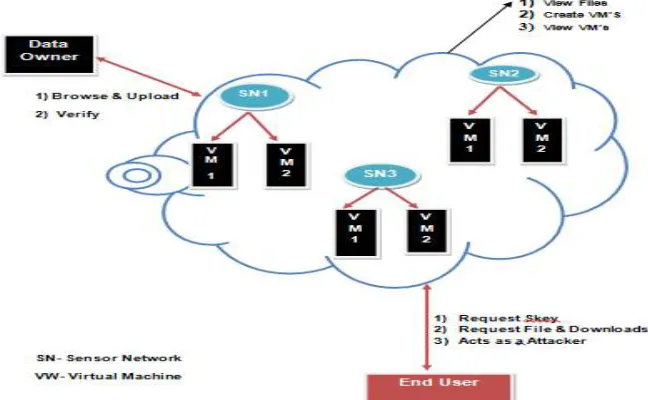
scheduling. 1) The cooperative utilization of resources, i.e., the efficient utilization of energy and communication capacity for a robust WSAN. 2) The cooperative task allocation addresses task description, decomposition, allocation, scheduling and execution. 3) The cooperative information processing addresses the data fusion by sensor nodes for reducing the communication cost.
Fig 1. Architecture of the system
V. ADVANTAGES OF THE PROPOSED SYSTEM
1. Increase the network lifetime 2. Decrease the energy consumption 3. Real-time action
4. Low energy consumption
5. The selection of proper nodes for eliminating redundant.
VI.CONCLUSION AND FUTURE WORK
The software defined network (SDN) appears as a novel approach that is effective to manage and optimize networks in a programmable and centralized pattern. This also provides the application framework and relevant methods for applying the SDN approach in a WSAN, with the objective of improving network's efficiency and scalability. The project proposes an optimization method for scheduling decomposed tasks to relevant nodes, with an example implemented by the genetic algorithm. The system can be applied to scenarios such as military, industry, transportation, and environmental disaster monitoring. Moreover, an indoor application scenario and an outdoor application scenario are presented to demonstrate the application of the SDN-assisted communication handoff.
REFERENCES
[1] Jianguo Zhou, Hao Jiang, Jing Wu, Lihua Wu and Wenxiang Li, “SDN-Based Application Framework for Wireless Sensor and Actor Networks.”,IEEE Access,vol 4,2016.
[2] C. Zhu, L. Shu, T. Hara, L. Wang, S. Nishio, and L. T. Yang, ``A survey on communication and data management issues in mobile sensor networks,'' Wireless Commun. Mobile Comput., vol. 14, no. 1, pp. 19_36, Jan. 2014.
[4] N. Sabri, S. A. Aljunid, M. S. Salim, R. Kamaruddin, R. B. Ahmad, and M. F. Malek, ``Cognitive wireless sensor actor network: An agricultural perspective,'' Int. J. Innov. Comput., Inf. Control, vol. 10, no. 2, pp. 631_658, Apr. 2014.
[5] M. Erol-Kantarci and H. T. Mouftah, ``Wireless multimedia sensor and actor networks for the next generation power grid,'' Ad Hoc Netw., vol. 9, no. 4, pp. 542_551, Jun. 2011.
[6] I. Al-Anbagi, M. Erol-Kantarci, and H. T. Mouftah, ``Priority- and delayaware medium access for wireless sensor networks in the smart grid,''
IEEE Syst. J., vol. 8, no. 2, pp. 608_618, Jun. 2014.
[7] C. Zhu, L. T. Yang, L. Shu, V. C. M. Leung, T. Hara, and S. Nishio, ``Insights of top-k query in duty-cycled wireless sensor networks,'' IEEE Trans. Ind. Electron., vol. 62, no. 2, pp. 1317_1328, Feb. 2015.
[8] C. Zhu, L. T. Yang, L. Shu, V. C. M. Leung, J. J. P. C. Rodrigues, and L. Wang, ``Sleep scheduling for geographic routing in duty-cycled mobile sensor networks,'' IEEE Trans. Ind. Electron., vol. 61, no. 11,
pp. 6346_6355, Nov. 2014.
[9] C. Zhu, X. Li, V. C. M. Leung, X. Hu, and L. T. Yang, ``Job scheduling for cloud computing integrated with wireless sensor network,'' in Proc. 6th IEEE Int. Conf. Cloud Comput. Technol. Sci., Dec. 2014, pp. 62_69.
[10] K. Wang, Y. Shao, L. Shu, G. Han, and C. Zhu, ``LDPA: A local data processing architecture in ambient assisted living communications,'' IEEE Commun. Mag., vol. 53, no. 1, pp. 56_63, Jan. 2015.
[11] L. Shu, L. Wang, J. Niu, C. Zhu, and M. Mukherjee, ``Releasing network isolation problem in group-based industrial wireless sensor networks,''
IEEE Syst. J., to be published.
[12] B. A. A. Nunes, M. Mendonca, X.-N. Nguyen, K. Obraczka, and T. Turletti, ``A survey of software-de_ned networking: Past, present, and future of programmable networks,'' IEEE Commun. Surveys Tuts., vol. 16, no. 3,
pp. 1617_1634, Sep. 2014.