An Application of Knowledge Sharing with
Social Network and Search Engine
Sushma B U1, Sushmitha A2, Yeshaswini K3, Pavithra4, Dr G.S.S Rao5
8th semester B. E, Dept. of Information Science and Engineering, Jnana Vikas Institute of Technology, Bidadi,
Karnataka, India1,2,3
Asst. Professor, Dept. of Information Science and Engineering, Jnana Vikas Institute of Technology, Bidadi,
Karnataka, India4
Professor and HOD, Dept. of Information Science and Engineering, Jnana Vikas Institute of Technology, Bidadi,
Karnataka, India5
ABSTRACT: A college social networking project where students may create their account and make their profile online. But for staff and placement officer they have to consult to their administrator. Student may create their profile through online using respective data including profile image and resume. After creating a profile the students may login to the system then they can access and discus with their staff members through social networking platforms. Any user may also post their status online and to may check each other’s status and they are dependable to comment on others posts and discuss on the topic. Search engines are mostly used web applications for searching any related content and display the useful websites on the top of the list .a search is provided where they will be able to search on any discussions, events, placements, seminars, projects etc within short span of time. It will be productive to keep them connected and share learned knowledge.
KEYWORDS: Knowledge sharing, social networking, search engine
I. INTRODUCTION
Knowledge sharing is an activity through which knowledge (namely, information, skills, or expertise) is exchanged among people, friends, families, communities or organizations.Organizations have recognized that knowledge constitutes a valuable intangible asset for creating and sustaining competitive advantages.Knowledge sharing activities are generally supported by knowledge management systems. In collaborative environments, members may try to acquire similar information on the Web in order to gain knowledge in one domain. It will be productive to get them connected and share learned knowledge.
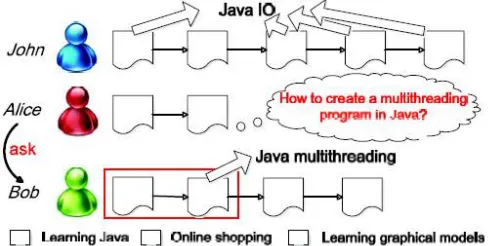
An illustrative toy example is given in Figure 1. One can use “tcpdump” to intercept a sequence of Web surfing activities (IP packets) for each member. The scene is, Alice starts to surf the Web and wants to learn how to develop a Java multithreading program, which has already been studied by Bob (red rectangle). In this case, it might be a good idea to consult Bob, rather than studying by herself.
The results are based on the principle of collaborative filtering on which the ideas of ranking the web pages are dependent for educational files. There are basically 3 stages in search. The first step in creating a search engine is to develop a way to collect the data and this is called crawling. This stage is followed by indexing where the crawled data are stored in databases. The final step is returning a ranked list of documents
II. LITERATURE SURVEY
Guiying Zhuet.al. [1], Strategy and Analysis of Main Problems in College Documents Management. Found college file management cannot freshly adapt to the requirements and development of modern economy mode. Aaron et. al.[2], Managing the Next Generation of College and University Archives, Records, and Special Collections. Impact of knowledge management in financial terms, such as cost reductions, customer satisfaction, and speed to market.
Brentet.al. [3], Leading in Tough Times Workbook: Case Studies for Higher Education Leaders. More use of case studies, live projects, business problems simulations etc would be highly useful.
We explored the degree to which high school seniors who will be attending college in the fall of 2009 areusing social networking sites (SNS) such as Face book, MySpace, Xanga, Friendster or other such sites in their college search and for other purposes. From online survey this fall, 89 percent of the 960 students who completed the survey indicated that they had visited social networking sites recently. Among the nearly 90 percent who use SNS, 84 percent of those students reported having a personal page or profile on one or more of these sites. Of the nearly universal number of students who indicated they visited social networking sites, four out of five also indicated that they had a personal page or profile. We asked students with profile pages to indicate the sites on which they posted their own page or profile, checking all that applied. Face book and MySpace are, by far, the social networking sites of choice, with 79 percent of students who use SNS indicating that they had a personal page or profile on Face book and 69 percent on MySpace, compared to 9 percent on Xanga, 7 percent on Hi5, and 1 percent on Friendster
We also explored how often these college-bound students visit social networking sites and how much time they spend on these sites. We first asked students how often they typically visit SNS, giving them a range of responses from less frequently (once a month or less) to more frequently (five or more times a day). Some 70 percent of students who reported using SNS visit one or more of these sites at least once a day and 32 percent visit SNS three or more times a day.
We wanted to gauge the extent to which social networking sites factor into and influence students' college search and selection. So we asked all students whether they had used social networking sites such as Face book, MySpace, or other sites to gather information or impressions about colleges they were considering. Only 18 percent reported they had.
III. SYSTEM ARCHITECTURE
Fig2: System Architecture
A. General Features
For Students:
Students can make easy communications with staffs and placements officers within short span of time. Students will be updated with new thoughts and views.
It will be easy for staff to convey a message to all the students with in short span of time.
For Faculties:
Even student can maintain their resume in their profile itself which will be helpful for a placement officer to recognize the quality of a student.
Students and staff will be able to keep good bonding and be connected through it. Helpful for better and easy placements.
Saving valuable time by providing search engine and college social networking site. .
B. Knowledge Mangement System (KMS)
Maintain a Service Knowledge Management System (SKMS) to provide controlled access to knowledge, information and data that is appropriate for each audience. It Gather, analyze, store, share, use and maintain knowledge, information and data throughout the service provider organization. There is no permission given for the user to edit the profile of the other usersEquations
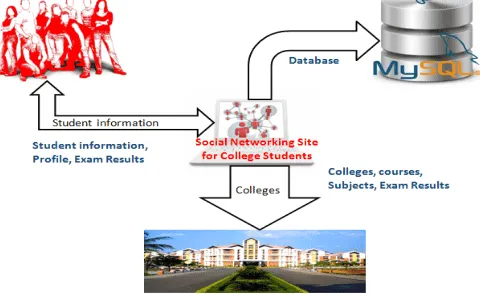
Knowledge sharing is an activity through which knowledge (namely information, skills) is exchanged among people, friends, families, communities, organisations. Knowledge sharing system consists of student’s details and college. Student should provide their information to the system. This system provides to create the student profile details and their results. The system will add staff members and add courses to the college. College will add subjects and display the exam results to the knowledge sharing system.
Social network web sites have become influential factors in how students communicate. In order to examine this phenomenon, HERI added a new item to the “time diary” section of the CIRP Your First College Year (YFCY) survey asking students how much time they typically spent each week on online social networking sites such as MySpace and Facebook.
Almost every first-year student, 94 percent, spent at least some time on social networking websites in a typical week. As Figure 4 shows, the majority of students (almost 60 percent) spent between one and five hours on online social network websites in a typical week during their first college year. Nine percent reported that they spent more than ten hours a week on them.
Fig 4: majority students spent 1-5 hrs on online social network
In comparison to other activities (Figure 5), time spent on online social networking was less than academic pursuits (such as classes and homework) and “live” socializing. Students spent the most time attending class and labs (91 percent reported spending six or more hours a week in class), socializing with friends (75 percent reported spending six or more hours a week doing this) and studying/homework (62 percent reported spending six or more hours a week studying). Far fewer (21 percent) spent six or more hours per week on social networking sites. Further, approximately the same proportion of first-year students reported spending more than six hours a week partying (22 percent) and/or watching TV (19 percent).
Fig 5: majority hours students spent
Students of different racial/ethnic backgrounds tended to report spending similar amounts of time on social networking sites, although African-American students were somewhat more likely than students of other race/ethnicities to spend six or more hours per week on such sites (29 percent, compared to 20 percent-22 percent).
Paradoxically, students who spent more time per week on online social network sites did not seem to spend less time on any other activity, as Table 1 shows. (At least they are not doing so on any other activity asked about on the YFCY. It might be that we are not capturing data on whatever activity is displaced by social networking.) Students who reported spending more time on online social networking sites than their peers tended to spend about the same amount of time in class and doing homework as these peers, and more time on real-life social activities, such as partying or socializing with friends
IV. PROPOSED SYSTEM
The main purpose of creating Campus Networking Site is for meeting worldwide college students and sharing knowledge, education related information etc. It contains standard social network content, like profiles, pictures, email and groups, and video sharing, articles, etc. Student can create a profile, browse locations worldwide, share and collect knowledge, education related tutorials, etc.
Fig 6: College Social network with search engine
Fig 7: proposed search engine system
Search Engines are mostly used web applications for searching any related content and display most useful websites on top of the list. A search engine is provided where they will able to search on any discussions, events, placements, seminars, projects, etc. within short span of time. The idea of ranking web pages by following recommendation techniques for educational files is based on the principle of Collaborative filtering.
V. CONCLUSION
This project aims to share perspectives, ideas, experience and information; to ensure that these are available in the right place at the right time to enable informed decisions; and to improve efficiency by reducing the need to rediscover knowledge. This project endeavors to make a social network for college with student login, administrator login, placement officer login and staff login. The administrator has the most authority. This account may be handle by principal or other senior member. Student will be able to create their account by themselves while others have to consult it to their administrator. This website notifies student about various college events, placement opportunities etc. Whenever a new event or notification is posted students are automatically notified of it by a notification. There will be no direct communication between student to student, but each staff and placement officers will be in dependable to communicate with others using message or other facilities .whatever discussion will be there including events, projects, seminars, competition etc can be search by any users in a search engine provide by us.
Further this application will be enhanced to add more features, so that users can take the advantage of the provided facilities in their education. We are trying to fix some of the bugs in the websites and are trying to make more secure the sites. we are also trying to enhancement the facility of video call so that students can get online educations. To improve the communication style in more modern way.
REFERENCES
[1] K. Blog, L.Azzopardi, and M. de Rijeka. Formal models for expert finding in enterprise corpora.
[2] M.J.Beal, Z.Ghaharamani, and C.E.Rasmussen. The infinite hidden Markova model
[3] M.Belkin and P.Nihongi. Laplacian Eigen maps and spectral techniques for embedding and clustering