Smart Employee Manager System
Patil Akshay1, Deshmukh Gauri2, Dange Jyoti3, Bhatevar Reshma4, Prof. N. V. Kurhade5
B. E Student, Department of Computer Engineering, SPCOE, Otur, India 1,2,3,4
Assistant Professor, Department of Computer Engineering, SPCOE, Otur, India 5
ABSTRACT: Biometric security is advantageous as every individual has unique traits that cannot be forged, stolen or
lost. That is, it is directly connected to a person because they make use of an individual’s unique feature for identification and authentication.
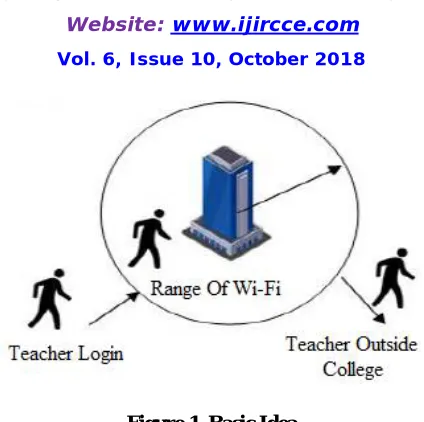
Time and Attendance System provides many benefits to organizations, Offices, Colleges. It enables an employer to have full control of all employees working hours. It helps control labour costs by reducing over-payments, which are often caused by transcription error, interpretation error and intentional error. Manual processes are also eliminated as well as the staff needed to maintain them. It is often difficult to comply with labour regulation, but a time and attendance system is invaluable for ensuring compliance with labour regulations regarding proof of attendance. We implement Indoor Mapping Based Smart Attendance System. In our system every college has a specific location, which is determine by the Wi-Fi. The location of an staff can be determined by Wi-Fi technology using smart device. If the location of staff and the location of college is same, then it should be said that, the staff is in the college, When staff goes outside after marking attendance then the notification is send to server by using indoor mapping technique. This system use location as a proof of attendance and proposed a new time and attendance system based on location.
I. INTRODUCTION
Today, several institutions of higher learning areusing access cards as access control measure to gain access to their institutions and facilities.
Security in general term can be considered as the provision of information integrity, confidentiality and available [1]. Security has become a great concern to individual, organizations and the government as they tend to find a better way to protect their information and valuable assets.
Though, these cards are simple and convenient in terms of usage, they offer the lowest security strength as they are often prone to lost, theft, forget and clone. If compromised, valuable information and asset can be stolen or destroyed. However, every institutional security goal is to protect the students, staff, information and assets. Thus, to strengthen the security level, institutions should provide security measure that is difficult if not impossible to compromise.
Figure 1. Basic Idea
This paper therefore, proposes an approach to reinforce the security in universities using biometric authentication.
Biometric system is an automated method of recognizing a person based on his physiological and behavioral characteristic. It is a system that verifies human identities through characteristics such as fingerprints, faces, retinal pattern, palm, etc. This technology is being used in several applications such as access control for high security, credit card usage verification, and employee identification.
We designed and implemented a system prototype called Institutional Biometric Authentication System (IBAS) to provide security to students, staff and assets. Additionally, IBAS is generic and can be used to manage attendance, prevent impersonation and other valuable benefits.
Biometric security is advantageous as every individual has unique traits that cannot be forged, stolen or lost [2]. That is, it is directly connected to a person because they make use of an individual’s unique feature for identification and authentication.
Biometric data are efficient access control measures and they are a key element in digital forensic analysis today. Biometric authentication verifies both the identity and the authority of a party and prevents unauthorized access to information or assets. Its operation is twofold: enrolment and authentication or verification.
Many numbers of colleges use biometric machine to mark the attendance which is time consuming when there is more number of staff, biometric machine does not work efficiently in all whether and it has a purchase cost. We implement android application which will overcome most of these limitations.
We develop an android application which can be used to mark attendance in college by staff instead of using biometric machine. This application uses a mobile device hence it can be easily tracked and the continuous surveillance can be maintained on each staff person who has logged in to the system.
Goals and Objectives:
II. MOTIVATION AND PROBLEM STATEMENT
Motivation:
The motivation to develop this project is to solve some problems that are currently occurring in every colleges/universities. Our system purpose is to improve the current paper-based traditional attendance management system that is still in use by many colleges and universities. From the observation, most of the problems found are normally caused by the use of traditional attendance system in these colleges and universities. Therefore, a fingerprint-based student attendance management system will be developed in order to solve these problems. The system is believed will be needed in order to improve the ways the colleges/universities in managing their student’s attendance. Since most of the colleges/universities still using the traditional attendance system, so, a bold assumption is made which most of the problems faced by these
Problem Statement:
Biometric system is a technique that has been used for many years; The use of this system to monitor the attendance of staffs has revealed itself very successful as it increases the staff accountability and boosts the workers toward good professional conduct.
We designed and implemented a system prototype called Institutional Location Based Biometric Authentication System (IBAS) to provide security to staff, college administration and assets. Additionally, IBAS is generic and can be used to manage attendance, prevent impersonation and other valuable benefits. User authentication is one of the major factors in the proposed system which is done by biometric authentication.
III. RELATED WORK
A literature review can be refers to as a review of current system that the researcher had done previously and the review of the system that will be developed. Literature review also focuses on the knowledge and ideas established on a topic as well as their strengths and weaknesses. Nowadays, technology is getting better and better to replacing the traditional system to speed up the process by introducing the computerized system. There are few types of attendance system that had been introduced nowadays in school, college, and university.
Traditional staff’s attendance is taken manually, done by using attendance sheets given to an officer, in charge of monitoring the staffs’ work place attendance and the time they spent on their particular assignments[3]. Unfortunately this practice is revealed to be ineffective as personnel often find their way around it.
Resulting in an inaccurately and efficient attendance record keeping from the administration, lectures and other staffs are often paid for time they did not spend on duty. Resulting in bad professional behavior and financial lost.
This reduces the need of pen and paper based manual attendance tracking system [6]. Following this thought, we have proposed a smart location based time and attendance tracking system which is implemented on android mobile application on smartphone reducing the need of additional biometric scanner device [7]. The location of an organization has a specific location, which can be determine by the GPS. Each employee’s location can be determined by the GPS using smartphone. This location is defined as a key of time and attendance tracking in our system.
In the article paper of “RFID Based Attendance Management System” (Microtronics Technologies, 2013), it had known that the attendance is needed to be taken in several places like school, college, university, and workplaces. This article paper main objectives had concerned about to replace the old traditional attendance system technology with Radio Frequency Identification (RFID) technology [8]. It is carry out to overcome some existing problems occur in the traditional attendance system. In the article paper, it also mentioned that the RFID system is developed and is suitable to take the attendance of the students as well as employees. There are two modules introduced in the article which includes reader module and RFID module. In details, each student/employee must have a valid RFID card of RFID tags with them in order to communicate with the RFID reader placed on their workplace/school.
IV. PROPOSED WORK
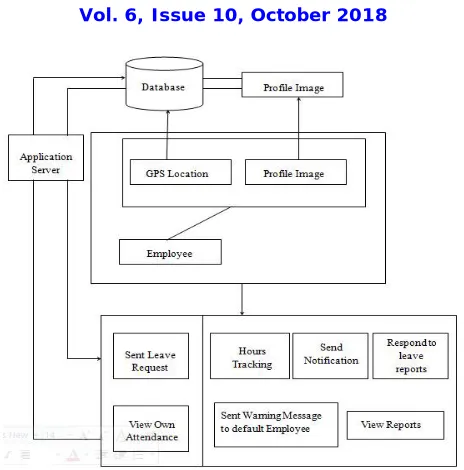
The proposed system provides a solution to manual attendance taking problem. This system is a location based smart time and attendance tracking system based on the concept of web services which is implemented as an android mobile application.
A unique user ID and location (WiFi coordinate) was associated with the application. A time and attendance software was installed on workstation for process the data receive from user mobile and store the information (time, entry and leaving) to the Database.
The user has to install the respective APK files developed for them on their android devices. At first it is important to save the college coordinates by entering the latitude, longitude and radius of area. User has to save the IP (internet protocol) address of the office internet. At the same time one user can save their information through the info menus of the App.
This location based time and attendance tracking system locates your position and logs your login and logout time. As the staff enters his workplace area, the system connects to the office internet and sends the staff id and local time to the server. Then the server gets the local time and stores the information in a database. Again when staff leaves the office area, the system notifies the office server that the staff is leaving.
This system employs four hardware and software components, described as follows. The smart phone is built-in with a WiFi receiver, which can receive radio signals from satellites, respectively.
Google maps API (Application Programming Interface) is used here for finding personal meaningful location; based on the GPS readings, the application can perform geo-locationing to estimate the current location of the user [9].
Figure 2. System Architecture
V. DATA FLOW DIAGRAM
VI. CONCLUSION
VII. FUTURE SCOPE
After successful implementation of these modules we can also add one module for payment calculation. This module can trace the working hours and using that it can calculate the monthly salary of the employee.
VIII. ACKNOWLEDGEMENT
I would like to present very special thanks to my project guide who had guide me since the beginning of Paper Writing. Thanks to him for provide guidance, advice, and useful feedback either in documentation parts or technical parts. Besides that, my thanks also go to my friends who keep on encouraging me while I facing problem.
REFERENCES
[1]. Mohammad Salah Uddin, Member, IACSIT, S. M. Allayear, N. C. Das, and F. A. Talukder, “A Location Based Time and Attendance System”,
International Journal of Computer Theory and Engineering, Vol. 6, No. 1, February 2014.
[2]. Shermin Sultana, Asma Enayet1 and Ishrat Jahan Mouri, “A Smart, Location Based Time And Attendance Tracking System Using Android Application”, International Journal of Computer Science, Engineering and Information Technology (IJCSEIT), Vol. 5, No. 1, February 2015. [3]. Akinduyite, C., Adetunmbi, A., Olabode, O. & Ibidunmoye, E., "Fingerprint-Based Attendance Management System", Journal of Computer Sciences and Applications, vol. 1, no. 5, pp. 100-105, 2013.
[4]. Siraj A.S, Joseph, “R.R.: Characteristic trade-offs in designing large-scale biometric-based identity management systems.” Journal of Network and Computer Applications 33 (2010) 342–351.
[5]. Rishabh, M. et al., “Student Attendance System Based on Fingerprint Recognition and One-to-Many Matching”, Available at: <http://ethesis.nitrkl.ac.in/2214/1/thesis.pdf> [Accessed 17 July 2014].
[6]. Shoewu, O. and O.A. Idowu, “Development of Attendance Management System using Biometrics, Pacific Journal of Science and Technology”,
2012.
[7].Android Developers blog: http://android-developers.blogspot.com/ accessed at 15th January.
[8]. Yamazaki, Dongju Li, Isshiki, Kunieda, “RFID-based algorithm for fingerprint authentication on smartphone” In Proceedings of the IEEE Information and Communication Technology for Embedded Systems (ICICTES), 2015.
[9] Khan, Qureshi, Qadeer, “Anti-theft application for android based devices”, In Proceedings of the IEEE Advance Computing Conference (IACC), pp.365 – 369, 2014.
[10]. Weizhi Meng, Wong, Furnell, Jianying, “Surveying the Development of Biometric User Authentication on Mobile Phones” Communications Surveys & Tutorials, IEEE, pp. 1268 –1293, 2014.