ABSTRACT
WILLIAMS, STELFANIE SHERRELL. The Experiences of Older Adult Dislocated Workers in Community College Non-credit Workforce Training Programs. (Under the direction of Dr. Tuere Bowles.)
The purpose of this qualitative study was to explore the experiences of older adult dislocated workers who participated in community college non-credit workforce training programs. The research questions guiding the study were: a) what are the experiences of older adult dislocated workers who attend community college non-credit workforce training?, b) how do older adult dislocated workers, who attend non-credit workforce training, navigate the community college contexts?, 3) what facilitates the learning and development of older adult dislocated workers who attend community college non-credit workforce training?, and 4) what hinders the learning and development of older adult dislocated workers who attend community college non-credit workforce training? The study utilized an interpretive narrative approach, guided by hermeneutics.
From the findings, four conclusions emerged regarding the experiences of older adult dislocated workers in community college non-credit workforce training. These conclusions were: a) older adult dislocated workers experience community college non-credit training as workforce development rather than adult education, b) older adult dislocated workers obtain significant academic advising from outside of the community college contexts, c) part-time instructors, who maintain a connection to their professions, facilitate the learning and development of older adult dislocated workers, and d) outdated models of community college non-credit workforce training hinder the learning and development of older adult dislocated workers.
Based on the findings, I recommended further research that examines three areas: a) the experiences of older adult dislocated workers in other contexts, b) the roles of part-time faculty in non-credit training, and c) the delivery of non-credit workforce training programs. As well, I offered three recommendations for practice: a) early interventions provided by community colleges for older adult dislocated workers in non-credit
workforce training, b) the development of educational pathways for older adult dislocated workers to continue education, and c) improved coordination between workforce
by
Stelfanie Sherrell Williams
A dissertation submitted to the Graduate Faculty of North Carolina State University
in partial fulfillment of the requirements for the Degree of
Doctor of Education
Adult and Community College Education
Raleigh, North Carolina 2011
APPROVED BY:
_______________________________ ______________________________
Tuere Bowles, PhD Paul Bitting, PhD
Chair of Advisory Committee
_______________________________ ______________________________
ii
DEDICATION
iii BIOGRAPHY
I was born in Manhattan New York, but spent most of my formative years in North Carolina. I grew up with my parents, Benjamin and Shirley, and my sister Elizabeth in central North Carolina. I attended high school at The Asheville School in Asheville, North Carolina. From there, I earned a dual baccalaureate in Public Policy and Spanish from Duke University, and later a Master in Project Management degree from Western Carolina University. Working in rural health and journalism, before making education my life‘s work, initiated my concern with poverty and quality of life issues.
iv
ACKNOWLEDGEMENTS
I would like to begin by acknowledging the older adult dislocated workers who participated in this study. Your stories inspired my life and my career.
As well, I would like to acknowledge the professors who guided me through the process. In particular, I am grateful for the support of my advisor Dr. Tuere Bowles, who encouraged, facilitated, and guided my doctoral studies and dissertation project. Your commitment and support remind me why I entered the field of education. In addition, I greatly appreciate the members of my dissertation committee whose wisdom and expertise assisted me: Dr. Paul Bitting, Dr. Pooneh Lari, and Dr. Pamela Martin.
v
TABLE OF CONTENTS
LIST OF TABLES vii
PREFACE 1
CHAPTER ONE: INTRODUCTION 3
Statement of the Problem 8
Purpose of the Study 9
Conceptual Framework 11
Significance 12
Limitations of the Study 14
Definitions of Terms 16
CHAPTER TWO: REVIEW OF THE LITERATURE 18
Dislocated Workers as Adult Learners 19
Adult Development 21
Adult Learning 25
Adult Student Development 28
Workforce Development, From History to Public Policy 32
Workforce Development Mission of Community Colleges 35
Chapter Summary 39
CHAPTER THREE: METHODOLOGY 41
Design of the Study 42
Sample Selection 44
Data Collection 46
Data Analysis 50
Ensuring Validity and Reliability 54
Researcher Bias 57
Ethical Considerations 58
Chapter Summary 59
CHAPTER FOUR: FINDINGS 61
Participants 62
Findings 78
Chapter Summary 130
CHAPTER FIVE: SUMMARY, CONCLUSIONS, IMPLICATIONS, AND RECOMMENDATIONS 132
Summary of the Study 132
Conclusions 135
Implications for Theory and Practice 156
Recommendations for Research and Practice 161
Chapter Summary 164
REFERENCES 167
APPENDICES 199
Appendix A. Materials for Identifying Participants 200
Appendix B. Informational and Consent Forms 204
vi
Appendix D. Interview Guide, Observation Protocol, and Documents Review
Guide 212
vii
LIST OF TABLES
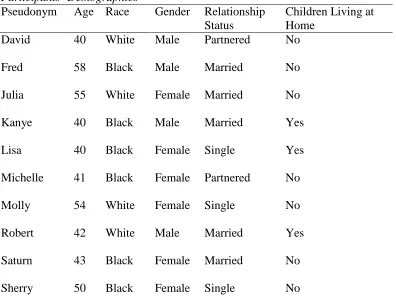
Table 1: Participants‘ Demographics 63
1 PREFACE
On January 26, 2011, President of the United States Barack Obama, in his State of the Union speech, declared the world a different place. He described a global economy that has changed our understandings of education and the workforce as we know it. His words follow and clearly illuminate the social context shaping the lives of nearly two million older adult dislocated workers, such as the ones who participated in the following research study:
Many people watching tonight can probably remember a time when finding a good job meant showing up at a nearby factory or a business downtown. You didn't always need a degree, and your competition was pretty much limited to your neighbors. If you worked hard, chances are you'd have a job for life, with a decent paycheck, good benefits, and the occasional promotion. Maybe you'd even have the pride of seeing your kids work at the same company.
That world has changed. And for many, the change has been painful. I've seen it in the shuttered windows of once booming factories, and the vacant storefronts of once busy Main Streets. I've heard it in the frustrations of Americans who've seen their paychecks dwindle or their jobs disappear – proud men and women who feel like the rules have been changed in the middle of the game.
2 wherever there's an internet connection.
Meanwhile, nations like China and India realized that with some changes of their own, they could compete in this new world. And so they started educating their children earlier and longer, with greater emphasis on math and science. They're investing in research and new technologies. Just recently, China became home to the world's largest private solar research facility, and the world's fastest computer. So yes, the world has changed. The competition for jobs is real. But this shouldn't discourage us. It should challenge us. Remember – for all the hits we've taken these last few years, for all the naysayers predicting our decline, America still has the largest, most prosperous economy in the world. No workers are more
productive than ours. No country has more successful companies, or grants more patents to inventors and entrepreneurs. We are home to the world's best colleges and universities, where more students come to study than any other place on Earth (White House Office of the Secretary, 2011).
3
CHAPTER ONE Introduction
By year-end 2008, more than 10% of unemployed workers were over age fifty-five, and this represented a 58% increase for this group from the prior year (Rix, 2009). As workers live and work longer, and the economy has become more global, older workers increasingly are displaced. Between 2005 and 2007, one-fourth of all long-tenured workers who became dislocated were older adults (Levine, 2010). By 2009, 1.9 million adults fifty-five and older were unemployed. For those adults at least age forty, relative displacement rates have increased each decade since the 1980s (Rodriguez & Zavodny, 2003).
Increases in older worker dislocation reflect both demographic shifts and an emerging global economy such that dislocated workers age forty and older face dim prospects for reemployment that matches their prior skills (Levine, 2010). In 2010, older adult workers comprised 31% of the labor force as compared to 11% in 1995 (Johnson & Mommaerts, 2011). But while the older available labor force expanded, United States‘ jobs shrinked. Between December 2007 and February 2009, 8.4 million jobs were loss (Katz, 2010). The largest sector of job loss was manufacturing, representing 23% of dislocations, followed by wholesale and retail trades (Levine, 2010).
4
community colleges attract older adult dislocated workers seeking training for
reemployment. Sixty-four percent of all non-traditional higher education students attend community colleges (Levin, 2005). Community colleges maintain an open door
philosophy and provide opportunities to underserved populations (McCabe, 1997). Older adult dislocated workers are attracted to established institutional characteristics including convenience, flexibility, and affordability (Cohen & Brawer, 2003).
From inception, community colleges have been connected to workforce
development. The institutions were established to respond to the need for trained workers as the nations industries expanded, and many began as industrial training centers (Cohen & Brawer, 2003). Throughout the years, public policy has served to strengthen the connection between dislocated workers and community colleges (Grubb, Badway, Bell, & Bragg, 1997). The most prominent legislation affecting dislocated workers, the Workforce Investment Act (1998), provides financial assistance to students retraining at community colleges. As well, the American Recovery and Reinvestment Act of 2009 provided for increased funding to community colleges and dislocated workers seeking to upgrade skills including $200 million in competitive grants for colleges, increased Pell Grant financial aid funding for students, over $40 billion to be used by states on education, and $3.95 million in job training assistance (Brumbach, Conner, & Van Nostran, 2009).
5
workforce programs include short-term occupational training as well as job-readiness or employability courses, and may also include occupational assessments, continuing education, vocational certifications, or any number of educational activities that provide skills for work (Pennington & Williams, 2004). Older adult dislocated workers are motivated to return to the workforce swiftly because they have an expected shorter term to generate earnings coupled with other barriers to reemployment. Older workers face long term unemployment as compared to their younger counterparts (Rix, 2009). As Zippay (2001) indicates ―prolonged unemployment and underemployment are most severe among older individuals‖ (103). Older adult dislocated workers also face loss of job-specific skills value or human capital gained over time (Farber, 1997), loss of tenure (Farber, 1997), lack of technological skills (Friedberg, 2001), and more competition from an available younger workforce (Farber, 2003). Older adult dislocated workers view community college non-credit workforce training as a way to mediate these
disadvantages and to obtain reemployment (Heidkamp & Van Horn, 2008).
6
college enrollment surges. Community colleges have always responded to the changing needs of the workforce and community (Cohen & Brawer, 2003).
To remain relevant in a dynamic world, community colleges perpetuate
partnerships within their communities. Community colleges have formed partnerships with universities and high schools and most recently with business and industry (Vaughn, 1999). As college-level education became more significant to employers, community colleges broadened their programs to include two-year vocational degrees that prepare students for work, two-year associate degrees that provide transfer credit to universities, high school concurrent enrollment options, as well as baccalaureate-level and online education (Levin, 2007a). Community colleges also offer enrichment, avocational, and other programs that serve community interests (Cohen & Brawer, 2003). Based on a global economy, and fueled by the recession that began in 2007, community colleges are engaged heavily in non-credit workforce training.
The global economy requires workers to continuously and rapidly upgrade their skills, and these needs are best matched by community college non-credit workforce training programs which can be customized to local needs and delivered swiftly (Giloth, 2004). Workforce changes occur more frequently as corporations streamline and
outsource as a result of globalization (Friedman, 2005). Community colleges too have become more entrepreneurial, seeking out support of and responding to corporate influence (Roueche & Jones, 2003). As a result of corporate influence, Levin (2000) argues community colleges produce rather than develop students:
7
emphasis on education and more on training, less emphasis upon
community social needs and more on the economic needs of business and industry, less upon individual development and more upon workforce preparation and retraining. (pp. 3-4)
In the global world, workforce training at community colleges equates to economic development (Conner, 2005; Roche, 2001). More than half of all states specify a direct role for community colleges in economic development (Van Noy et al., 2008).
Consequently, some researchers claim that contemporary workforce development diverges from learning for its own sake to a business model of community college education that accounts for multiple stakeholders (Slaughter & Rhoads, 2004). Public policies, political influence, and media attention to retraining have served to fund and perpetuate the notion of learning explicitly for the purposes of work.
Critics argue that the interests of politics and businesses compete with those of students. But by serving various stakeholders, community colleges build alliances that sustain their roles in higher education (Dougherty & Townsend, 2006). On a national level, the American Association of Community Colleges established a Center for
Workforce and Economic Development with the expressed mission to ―build community college capacity to align priorities, strategies, and resources with those of workforce and economic development partners‖ (AACC, 2009, para. 2). Community colleges are
industry-8
recognized, post-secondary credentials emerging from the expansion of non-credit activities or programs.
This cultural shift has promoted community college non-credit workforce training as an avenue for older adult dislocated workers to gain employment (Van Noy et al., 2008). Yet, the return on investment in training for older adult dislocated workers is questionable (Wirtz, 2005). Older adult dislocated workers face wages losses of up to 19% or more (Johnson & Kawachi, 2007). In addition, researchers note that older adult dislocated workers face particular issues not ascribed to traditional students such as depression (Gallo et al., 2000), financial constraints (Couch, 1998), chronic health problems (Kessler, House, & Turner, 1987), and mental health issues (Warr & Jackson, 1985). Limited research exists regarding the how these factors impact older adult dislocated workers as they navigate community college non-credit workforce training programs. To be sure, older dislocated workers enter community college programs as a way to address unemployment, but we know very little about their actual experiences (Beeghley, 2007).
Statement of the Problem
9
and how they navigate the community college context as students in training programs. Furthermore, non-credit training programs are often ―overlooked within
institutional research‖ (―Faces of the Future,‖ 2009, para. 1). While non-credit workforce programs have outpaced growth of credit programs (Van Noy et al., 2008), non-credit programs and participants are minimized within the extant literature. In their study of non-credit workforce training, Van Noy and others explain: ―data on the specific characteristics of non-credit workforce education students are limited‖ (p. 9). Data specific to older adult dislocated workers in non-credit training does not exist within the literature.
Though dislocated workers are minimized within the literature, there is limited available scholarly research on older adult learners that indicates older students may engage college differently than traditional age-students. Regarding older students Kerka (1995a) asserts that ―they participate more in community life than campus life, and they have stronger ties to career culture than academic culture‖ (para. 8). Yet, further research is needed to understand the storied experiences of older adult dislocated workers in community college training programs.
Purpose of the Study
10
combined with an increasingly aging workforce, spawned a growing population of older adult dislocated workers in community colleges. This study explores how older adult dislocated workers, ages 40 and older in community college retraining programs, make meaning of their experiences. Specifically, the research focuses on how these older adult dislocated adults find their way as community college students. The questions guiding this study were:
1) What are the experiences of older adult dislocated workers who attend community college non-credit workforce training?
2) How do older adult dislocated workers, who attend non-credit workforce training programs, navigate the community college context?
3) What facilitates the learning and development of older adult dislocated workers who attend community college non-credit workforce training programs?
4) What hinders the learning and development of older adult dislocated workers who attend community college non-credit workforce training?
Utilizing narratives within an interpretive framework, this study seeks to
understand the experiences of older adult dislocated workers as non-credit students and how they navigate their community college contexts once enrolled in non-credit
11 Conceptual Framework
This research is concerned with understanding the experiences of selected older adult dislocated workers as students. This study relies on an interpretive narrative framework (McQueen & Zimmerman, 2006). Thus, an interpretive approach is used to interpret the narrated experiences of individuals. The interpretivist paradigm is
appropriate for this study because this research explores how participants interpret and make meaning of their experiences (Grix, 2004). Interpretivist research assumes that reality is socially constructed, and as such, understandings of the storied lives of
participants emerge from interaction between the researchers and participants (McQueen & Zimmerman, 2006).
The particular interpretive framework of this study draws from hermeneutic tradition. Hermeneutics represents a range of practices involving interpretation. Traditionally, hermeneutics involved the analysis and interpretation of texts (Prasad, 2005). However, in its contemporary usage within qualitative research, hermeneutic philosophy may guide the interpretation of the meaning of any enduring cultural object beyond text including stories told (Dilthey, 1976). Ricoeur (1984) likewise asserted that human action and experience might also be considered as text. The model of the
hermeneutic circle characterizes the process of co-construction in an interpretive narrative. The hermeneutic circle, as used within an interpretive narrative study, is a dialectal process of engaging the individual participants‘ stories as well as the larger social contexts, back and forth, until an understanding emerges (Crotty, 2003).
12
engaging in interpretation, particularly when new understandings are sought. Thus, a hermeneutic approach to interpretivism fits well with studies that draw on more than one body of theory (Williamson, 2006). As there is no specific body of literature that
examines the experiences of older adult dislocated workers in community colleges, this study uses a multidisciplinary approach that is informed by a range of fields that are relevant to dislocated workers in community colleges including adult education, adult learning, student development, and workforce development. Through an interpretivist lens, this study seeks to explore the experiences of dislocated workers in non-credit training, how they navigate the community college contexts, and what facilitates or hinders their experiences.
Significance
Older adult dislocated workers increasingly enter non-credit workforce training, yet their experiences are minimized within the literature (Van Noy et al., 2008). In 1995, the community college non-credit student population was only 90% of the total credit student population. Yet by 1999 non-credit enrollment exceeded credit student
13
workers. More research is needed…‖ (p. 14). To this end, this research seeks to explore the experiences of older adult dislocated workers in community college non-credit workforce training programs in order to expand theoretical and practical understandings about older adult dislocated workers participating in non-credit training.
First, this study aims at expanding the theoretical understanding of older adult dislocated workers. Ortiz (1995) describes the challenges faced by dislocated workers in community college programs, but does not account for those who participate in non-credit programs:
Their age may make them feel as if they should know how to manage the community college environment, but their break in formal education may leave them feeling more disconnected from the college culture and
environment. Their sense of identity may be deeply shaken when they take on the role of student, or more seriously by the loss of employment. (p. 67)
Ortiz and other researchers (Astin 1984; Tinto, 1993) recommend student support services as a way to mediate these challenges. But while college support services may mediate some challenges for credit students, dislocated workers participating in non-credit training typically do not receive the advising and student services available to credit students (Grubb, 1999), and non-credit students represent disadvantaged backgrounds at a much higher rate than credit students and typically reflect
14 workforce training programs.
Secondly, this study has practical significance for the following stakeholders: adult educators, community college practitioners, social and human service agencies, policy-makers, and individuals facing job loss. Adult educators may gain additional understandings to inform their practice of instructing older dislocated workers. Community college staff and faculty may gain new perspectives on serving these
students. Social and support services agencies as well may obtain new knowledge of how to support older dislocated workers. This study may be beneficial to policy-makers in terms of understanding and valuing the needs and experiences of older dislocated workers in retraining programs. Various public policy address issues related to dislocated workers and workforce development and there is insufficient qualitative data on which to base these policies. This study seeks to provide new and richer understandings for those who serve older adult dislocated workers, but for dislocated workers as well who may find some interest or value in the stories of other older adult dislocated workers.
Limitations of the Study
15
the larger social context, the research remains grounded by the narrative focus on the participants‘ experience of the larger social context. This leads to the second limitation, which is that interpretive narratives do not explicitly engage institutional or discursive structures that impact individuals. Interpretive narratives are concerned with interpreting a slice of storied, humanistic experience in-depth, unlike other forms of qualitative inquiry such as ethnography and phenomenology that may examine the breadth of issues. Thirdly, interpretivist narrative research is limited by the fact that individuals do not readily reflect. Interpretive narrative studies engage participants in reflection, and reflection is not inherent. Finally, because the stories are interpreted between the participants and the researchers, narratives are a social manifestation that may evolve (Scott & Morrison, 2006).
16
may change with time (Clandinin & Connelly, 2000). Definitions of Terms
Adult learner. A learner in an educational institution who is at least twenty-five years-of-age (Kim, 2002).
Dislocated worker. This study relies upon the definition of dislocation as presented by the Workforce Investment Act and commonly understood in the workforce development arena. According to this understanding, a dislocated worker is an individual who has been terminated or laid off, or has received a notice of termination or layoff, from employment as a result of any permanent closure of, or any substantial layoff at, a plant, facility, or enterprise (Workforce Investment Act, 1998).
Economic development. This study embraces the use of term economic
development as put forth by Blakely. In this way, economic development is the process of creating wealth through human and intellectual capital (Blakely, 1997).
Non-credit training. Non-credit training is popularly defined within the field of education as courses or activities carrying no academic credit toward a degree, diploma, certification, or other formal academic award at the institution, often includes workforce training (Van Noy et al., 2008).
Older adult learner. This study refers to an older adult learner as an individual who is participating in an educational activity and is at least age forty (Chen, Kim, Moon, & Merriam, 2008).
17 Employment Act, 1967).
18
CHAPTER TWO Review of Literature
As Americans work longer and are displaced from employment at higher rates, community colleges training programs incur subsequent enrollment surges of older adult dislocated workers (Biemiller, 2009; Bushong, 2009). Four out of five of the students enrolled in community colleges seek to upgrade skills to reenter the workforce
(VanDerLinden, 2002). At community colleges, adult learners comprise 45% of students (US Department of Education, 2004). This study focuses on exploring the experiences of older adult dislocated workers in non-credit training. The research questions guiding this study were:
1) What are the experiences of older adult dislocated workers who attend community college non-credit workforce training?
2) How do older adult dislocated workers, who attend non-credit workforce training programs, navigate the community college context?
3) What facilitates the learning and development of older adult dislocated workers who attend community college non-credit workforce training programs?
4) What hinders the learning and development of older adult dislocated workers who attend community college non-credit workforce training?
19
(p. 4). Research, specific to the experiences of older adult dislocated workers who are community college students does not exist within the available literature. Therefore, this chapter reviews other scholarly bodies of literature that are relevant to older adult dislocated workers in community college non-credit workforce training programs. Included in this review are dislocated worker data and descriptions, adult development and adult learning theories, workforce development programs, and the role and mission of community colleges in workforce training.
Dislocated Workers as Adult Learners
Workers, who are learners, are primarily defined within the scope of workforce literature (Solomon, 2005). Solomon characterizes the learner-worker as ―the learner who is a student in an educational institution and one who is the subject of various educational pedagogies….their learning in some way relates to their current or anticipated
professional or workplace practices‖ (p. 2). Therefore, in describing an older adult dislocated worker who participates in training, it is useful to examine the descriptions of workers within the workforce development literature.
In workforce development literature, a dislocated worker is one who is involuntarily terminated from employment by no cause of his or her own due to
20
older, while the United States Department of Labor and the Census Bureau refer to older workers as those who are at least fifty five (Heidkamp & Van Horn, 2008). Still,
retirement norms would depict an older worker as those beyond sixty-five (Pitt-Catsouphes & Smyer, 2006). Acknowledging that the determination of older worker status is fluid depending on time and situation, Munk (1999) offers a description of the older worker impacted by a global economy: ―In the new economy, the skills that came with experience count for less and less. Suddenly forty is starting to look and feel old‖ (p. 37). Therefore, the age at which one is considered an older worker has to do with social and historical context as well as the particular concerns faced by individuals during their career (Pitt-Catsouphes & Smyer, 2006).
Defining and older adult learner is equally challenging. Characterizations of older adult learners within adult education literature reflect the history of the field as well as the particular issues faced by adults as non-traditional students. In the 1970s,
nontraditional became the term of choice for adult learners and any new groups to the collegiate sphere (Kim, 2002). This included blacks, Hispanics, females, and adult students. Today, non-traditional is still used to refer to older adult learners because their needs and experiences are viewed as different from traditional-age students, and because the nature of adulthood itself is variously understood.
21
general (Ortiz, 1995). The American Association of Community Colleges categorizes community college demography as twenty-one and younger, twenty-one to thirty-nine, and forty and older (AACC, 2010), thus broadly characterizing the community college older adult learner as at least forty years old.
Although there is no canonic definition of older adult dislocated workers or older adult learners, qualitative research within the social sciences often discusses adulthood in terms of development.
Adult Development
22
sixty-five and involves a time of reflection and coming to terms with life and death (Gross, 1987).
Cognitive theories of adult development. From a cognitive standpoint, Jean Piaget provided additional knowledge about how adults develop with his theory of cognitive development. This theory posits four stages of mental development:
sensorimotor, preoperational, concrete operational, and formal operational (Piaget, 1983). Children experience these stages in route to adulthood, and there are three principles that are maintained during each stage: organization, adaptation, and equilibration. According to Piaget, learners develop schemes as they progressively organize new information. When information is gathered, learners adapt it through two modes, assimilation and accommodation. Assimilation is the taking-in of new information, while accommodation involves change prior knowledge to account for new information. Finally equilibration involves the learner finding a balance between assimilated and accommodated knowledge and between their individuality and society (Flavell, 1996).
In the pattern of Piaget, Lawrence Kohlberg envisaged adult development as cognitive. Kohlberg‘s model describes moral development and asserts that moral
23
doing good acts and involving others. By the third level, post-conventional morality, adults base morality on human rights and universal principles (Crain, 1985). However, Kohlberg also assumed that stages unfolded the same regardless of culture or context and that development, although it may be influenced by social activity, is a cognitive process.
Adult development has been portrayed in phases also. Stages imply a step-wise, sequential configuration of development, whereas phases indicate that an individual may be at different levels of maturity or understanding in different areas of life. Phases also allows for the influences of emotions, culture, status, power, and society. ―To be able to reason—that is, to assess evidence, make predictions, judge arguments, recognize causality, and decide on actions where no choice is evident—is often presumed to be a mark of adulthood‖ (Brookfield, 2005, p. 56). In phase-based adulthood, individuals may demonstrate adult qualities in some areas but not others. For example, one might be an ―adult‖ as a supervisor who leads within the workplace and yet be child-like in their interactions at home. The view of development in phases supports the idea of development as influenced by social interactions.
24
experiences. Culture, gender, class, and other contextual factors can shape how and what people know and thus their course of development. Dewey understands education to be life-long and mediated by context and identity.
Levinson, on the other hand, focuses attention on the social nature of and influences on development. Levinson‘s life structure model emphasizes the impact of family, work, personal, and social commitments on adult development (Levinson, 1986). While Levinson outlines six stages of adulthood from adulthood transition to late
adulthood, the significance of his research relates to his ideas of stable periods and transition periods. During the stable period an adult makes life choices; during a
transition period an adult undergoes change. One may go through stability and transition during different phases of adulthood (Sugarman, 2001).
25 Adult Learning
Within the field of adult education, learning is viewed as a catalyst for
development, and an individual that is continuing to learn is continuing to develop. Adult education emerged with influences from philosophers and educators such as John Dewey. Dewey (1916) defines education as ―reconstruction or reorganization of experience which adds to the meaning of experience and which increases one‘s ability to direct the course of subsequent experience‖ (p. 74). His comments uphold that learning, and therefore knowledge, is empirical—gained from experience, and is instrumental in providing opportunity for change in one‘s life. Dewey further asserted that learning is optimized when ―pursued under conditions where the realization of the activity rather than merely the external product is the aim‖ (p. 297). Thus, adult education is viewed as centered on the unique needs of adults and on a dialectic educational relationship.
Learning as a cognitive process. The decisive shift in adult learning has been greatly influenced by the model of andragogy, proposed by Malcolm Knowles (Knowles, 1980). Andragogy, as opposed to pedagogy, describes the ways in which adults learn. Andragogy is based on four assumptions: adults are self-directed, adults possess personal histories and prior knowledge, 3) motivation occurs when learning is socially relevant to adults and 4) adult learners are interested in learning for problem-solving (Merriam, 2001).
Like Knowles, Kolb presents learning as a process. Kolb provides four elements of the process to include concrete experiences, reflective observations, abstract
26
defined by Kolb, is the process of knowledge creation through experience. The strength of the model included its focus on the experiential nature of learning and the inclusion of reflection. Yet, critics of Kolb claim the model views learning as straightforward, purely cognitive, and neglects outside influences such as hegemony on the learning process (Jarvis, 1987).
Learning as a social experience. Viewing learning as dialectical, Jarvis (1987) contends that learning is not simply a cognitive process, but a social experience. Jarvis‘ model portrays the complex nature of learning that situates the learner within a context. The outcome of learning, according to Jarvis, is to be a more experienced individual, but a situation could leave one unchanged or even harmed as a result. Jarvis proposed that a situation could result in non-learning, non-reflective learning, or reflective learning. Within non-learning, an individual may act on presumption, non-consideration, or rejection of the experience. In non-reflective learning, the individual can demonstrate pre-consciousness, practice, or memorization. Pre-conciousness learning is that which occurs when one is not actively engaged. Practice includes mimicry and imitation, whereas memorization is reproduction of what is taught. In the reflective, and deepest, level of learning exists contemplation, reflection, and experimentation. An individual might think about a subject, or could go further to reflect on learning about a subject. Experimentation occurs out of curiosity and as individuals seek to ways in which to understand.
27
adults learn within experience. The theory of situated cognition puts forth that learning is tied to authentic activity. In this way, adult learners must be active participants in
learning that reflects how the knowledge applied in real life. Situated cognition does include embodied ways of knowing that acknowledge spiritual and somatic experiences, but Kolb‘ research draws a direct connection between experience and transformation, but transformative learning as theory was fully realized by Jack Mezirow. Mezirow put forth learning as a mode to transformation or becoming critically aware of one‘s own
assumptions and those of others (Mezirow, 1997). At the center of transformative learning is perspective transformation. Mezirow indicates that when an individual undergoes disorienting dilemma, the experience can lead to critical reflection that
changes one‘s worldview. Mezirow‘s work brought together adult development and adult learning: ―I do not believe in adult stages of development or that adult development is different from adult learning…I believe that adult learners are at different phases in their movement toward achieving an emancipatory understanding‖ (Mezirow, 1998, p. 67).
28 practice (Ortiz, 1995).
Adult Student Development
Community college student services are geared to traditional students who continue along a step-wise educational pathway (Ortiz, 1995). Older adult students, on the other hand, typically have breaks in education, established personal and professional commitments outside of college including family, partners, financial obligations, and civic duties (Donaldson & Graham, 1999). Kasworm (2005) found that adult students in community college may face anxiety due to their age and incorporation with younger students. Adult students also judge themselves through beliefs of age appropriate expectations and ideal student images (Kasworm).
Barriers. When adult students are also dislocated workers, they can face other barriers to success: ―they participate more in community life than campus life, and they have stronger ties to career culture than academic culture‖ (Kerka, 1995, para. 8). Add to that the stress of job loss and identity shift for dislocated workers that may induce
29 commitments, and life issues (Farber, 1997).
Community colleges typically have high attrition rates across the board. For their adult learners, risk for attrition is greater (Pascarella & Terenzini, 1991). The National Center for Educational Statistics (2004) identified seven risk factors for attrition; Adult learners at community colleges exhibit these characteristics more often than traditional students: 1) delayed post-secondary enrollment, 2) high school drop-out or GED
graduate, 3) part-time college enrollment, 4) financial independence, 5) dependents other than a spouse, 6) single parent status, and 7) full-time employment. Adult learners bring life circumstances into their roles as students including finances, family responsibilities, and issues of work, or in the case of dislocated workers, job loss. Researchers find that dislocated workers may deal with issues of depression (Gallo, Bradley, Siegel, Kasl 2000); financial constraints (Couch, 1998); chronic health problems (Kessler, House, & Turner, 1987); and mental health issues (Warr & Jackson, 1985). Dislocated workers deal with a convergence of complex issues impacting their lives.
30
Extending Astin‘s theory of involvement, Tinto (1993) suggests that since adult students bring different experiences and their life circumstances into college, institutions should form communities for these students. He offers an interactionalist model that emphasizes meeting students‘ needs in a natural setting. In essence, community colleges must engage adult learners academically and socially.
The academic nucleus. For many adult students with time constraints, the nucleus of activity is the classroom. Therefore, some researchers contend community colleges are best served to meet the student there and to provide support services through the academic departments (Tinto, 1997). Because the classroom experience is so critical for adult learners, other researchers have suggested centering student support services within academic departments (Rendon & Taylor, 1990). Chickering and Reisser (1993) stress that by ―scaling down the environment‖ and positioning activities within the students‘ natural settings, such as academic departments, adult students may gain increased autonomy and feel more comfortable as a student.
31
adult learner completion: 1) prior experience and personal biography, 2) psychosocial and value orientations, 3) cognition, 4) the connecting classroom, 5) the life-world
environment, and 6) outcomes. College student support services act to mediate the challenges faced by adult learners by understanding these six factors as impacting their student life.
Student support services can come in three key forms identified by House (1981). These are instrumental support, informational support, and appraisal support.
Instrumental support involves tangible mechanisms such as financial aid, while
information support includes advising and information. Appraisal support recognizes the value of praise and encouragement for adult learners. Still, despite all interventions, the Community College Survey of Student Engagement (Community College Survey of Student Engagement, 2005) determined that for high risk students even the most engaging institutions may find student persistence evermore challenging.
Persistence. Simmons (1995) studied dislocated workers specifically. The
32
technological skills necessary for reemployment, and 4) short-term, rapid training programs that provide utility to the students.
Other studies (Sorey & Duggan 2008; Seftor & Turner, 2002) highlight finances as a critical issue in student persistence. Research connects the availability of financial aid and funding for support of expenses associated with education to the completion rates of students in training programs. Chiefly, for non-traditional students such as dislocated workers who no longer have work income, financial issues are significant (Choitz & Widom, 2003).
Workforce Development, From History to Public Policy
Public funding is a significant source of support for community college workforce training and other workforce development programs (Cohen & Brawer, 2003). Modern public policy that promotes workforce training derives from a series of historical legislation established to fund and advance workforce development (McCabe, 1997).
33
lack of support for training (McCabe, 1997). The program was viewed by critics as providing employment to individuals who were not prepared for work. Thus by 1940, the Works Projects Administration changed focus to vocational training and education, leading to the recognition of workforce training, rather than job creation alone, as pivotal to workforce and economic development.
What followed would be a series of legislation aimed directly at broad workforce training. The Manpower Development and Training Act of 1963 was a program that provided training for workers who were displaced from their jobs because of new technologies (McCabe, 1997). It was complemented by the Vocational Education Act of 1963 and the Adult Education Act of 1966, both of which supported educational
institutions as providers of training. In 1972, President Nixon authorized the
Comprehensive Employment and Training Act (CETA) that provided training to work in public service.
34 individuals.
By the 1980s, public policy specifically connected workforce training and community colleges. The Carl D. Perkins Act of 1984, reenacted in 1998 and 2006, served to encourage and fund community college vocational education programs. The act established direct linkages for high schools curricula to connect with community college vocational programs. The 2006 version of the act replaced the terminology vocational education with ―career and technical education‖ (Meeder, 2008). The School to Work Opportunity Act of 1994, similarly, proposed skills training for school-aged youth in order for them to gain career-oriented skills necessary to enter the workforce (Paris, 1994).
In 1998, the single largest workforce development legislation emerged. The Workforce Investment Act (WIA) would replace JTPA. Serving more than six million participants annually, WIA provides an array of employment services to dislocated workers and disadvantaged adults and youth (Workforce Investment Act, 1998). The services provided include: employment placement services, labor market and related information, funding for training to improve skills, and case management. As a part of the Workforce Investment Act, states were mandated to provide one-stop services
35
Workforce Development Mission of Community Colleges
The role of community colleges in workforce development is one that has existed from the beginning, but expanded as a result of economic changes, workforce
development public policy, and later as a result of corporate and private interests. In the establishment of community colleges, Cohen and Brawer (2003) note, ―most prominent was the need for trained workers to operate the nation‘s expanding industries‖ (p. 1). Community colleges increased workforce development following World War II. With the onset of veterans from the war, unemployed workers seeking new skills, and a rapid expansion of high school graduates, community colleges focused attention to vocational education and workforce training. Present-day community colleges are described as the ―center of the workforce development universe‖ as they have solidified their role as the only form of public education specifically geared at preparing the vocational workforce (Forde, 2002, p. 32).
36
Practical examples include customized training, industrial training, contract-based instruction, pre-employment training, skills assessments, job placement, and job retraining; as well as activities that extend beyond education to include faculty job-shadowing partnerships with industries, facilitation of workforce and corporate forums, separate databases and facilities focused on economic development, and partnerships with other community agencies involved in workforce development (Pennington & Williams, 2004). Community colleges provide programs that are developed to meet learners‘ needs for training. Proponents of workforce development for learners conclude that it results in increased capacity for workers and can be a way out of unemployment or poverty (Alssid, Gruber, Jenkins, Mazzeo, Roberts, Stanbuck-Stroud, 2002). Still others view community college workforce development as driven by political and corporate interests.
Political influence. Just over half of all states legislate a direct role for
community colleges in economic development (Van Noy et al., 2008). State and local governments utilize community college workforce training to lure industries to their areas, and federal government views local workforce development as maintaining the United States‘ global competitiveness (Dougherty & Townsend, 2006). The American Association of Community Colleges endorsed the role of community colleges in economic development and established a Center for Workforce and Economic
37
training in the new economy equates to economic development, and community colleges have adopted their roles in promoting local economic development (Conner, 2005; Roche 2001).
Corporate Influence. Local economic development ultimately favors businesses and industries (Blakely, 1997). Corporations seek to cut costs by outsourcing training to community colleges.
As government funding no longer meets the demand and funding needs of community colleges, institutions have embarked on corporate resources. Cohen and Brawer (2003) explain ―When colleges were small, they made modest demands on public funds. Few people outside of the institutions cared where the colleges‘ money came from or how they spent it‖ (p. 141). Yet, modern community colleges must rely upon
corporate and private funds to generate revenue in non-credit training. For this, corporations elicit robust influence on the mission of community colleges. As Levin (2000) describes it:
By the twenty-first century, the mission of the community college had less emphasis on education and more on training, less emphasis upon community social needs and more on the economic needs of business and industry, less upon individual development and more upon workforce preparation and retraining (pp. 3-4).
38
restrictive, they more easily accommodate the rapidly changing nature of business. Non-credit community college workforce development. Non-credit workforce training programs provide continuing education, occupational certifications, or
employability skills. The coursework typically awards continuing education units (CEUs) or industry-recognized credentials. As they do not require accreditation, the training programs can be developed and delivered quickly and be customized. Non-credit programs generally have flexible schedules and convenient locations for students (Van Noy et al., 2008).
Non-credit workforce programs also present challenges. These occupational programs cost much more and can tap college resources greater than liberal academic classes (Dougherty & Townsend, 2006). In addition, occupational students represent disadvantage backgrounds at a much higher rate than academic track students (Bailey & Morest, 2003) and typically experience non-traditional enrollment patterns. Non-credit students are the most economically challenged of all occupational students and non-credit certificate attainment ultimately results in lower socio-economic attainment across the career span of the student (Dougherty, 1994).
Training utility and outcomes for dislocated workers. Workforce training is ―an investment in which upfront costs are incurred to obtain future benefits‖ (Jacobson, LaConde, & Sullivan, 2005, p. 60). Yet, the economic outcomes for dislocated workers who participate in non-credit workforce training are discouraging. Heidkamp & Van Horn (2008) found that dislocated workers may struggle to find employment after
39
are faced with seeking new jobs in vastly different employment sectors that do not compensate for their prior skills, tenure, or previous salaries. The likelihood is that, after retraining, dislocated workers will obtain employment that pays significantly less than employment prior to retraining, including wage losses of up to 19% (Johnson & Kawachi, 2007). Heckman (2000) asserts that ―adults past a certain age…obtain poor returns to skill investment‖ (p. 39). This is not a positive indicator for dislocated workers who tend to be older adults. Furthermore, short-term certifications, as opposed to degree credentials, ultimately result in lower socio-economic attainment across the career span of the student (Dougherty, 1994). Yet, despite research that indicates negative
employment prospects, researchers project that enrollment in non-credit community college training will expand as adults live and work longer and face higher rates of workforce displacement in the new economy (Wiener, 2007).
Chapter Summary
This study seeks to explore the experiences of older adult dislocated workers who participate in community college non-credit workforce training programs. Because of the convergence of work and education that influences the experiences of older adult
dislocated workers (Solomon, 2005), this literature review examines the literature within the fields of adult education and workforce development.
40
learning, and student development; followed by literature concerning workforce development history, public policy, and the role within community college missions.
41
CHAPTER THREE Methodology
This chapter serves to describe the design of this qualitative study. This study utilized narrative inquiry from an interpretive perspective. The purpose of this study was to explore the experiences of older adult dislocated workers in non-credit workforce training programs at community colleges. In particular, this research delved into how older adult dislocated workers make sense of and give meaning to their experiences as students. Through a qualitative methodology, the research explored the following research questions:
1) What are the experiences of older adult dislocated workers who attend community college non-credit workforce training?
2) How do older adult dislocated workers, who attend non-credit workforce training programs, navigate the community college context?
3) What facilitates the learning and development of older adult dislocated workers who attend community college non-credit workforce training programs?
4) What hinders the learning and development of older adult dislocated workers who attend community college non-credit workforce training?
42 Design of the Study
Martin (1980) indicates that research problems are worthwhile if there is little research that exists about the topic or if the research has not been applied sufficiently. Further, Howe and Eisenhardt (1990) assert that research questions should drive the design and methodology selected. In this research study, questions not previously addressed within the literature regarding the experiences of older adult dislocated workers were best explored through qualitative methods that allowed for study of the complexities within their experiences as students (Creswell, 2003). Qualitative research allowed for subjective and contextual elements of participants‘ stories to emerge
(Merriam, 1998).
Qualitative research design aims at understanding the meaning of human action (Schwandt, 2007). This qualitative study was grounded in the constructivist view that reality is multidimensional and socially-constructed (Creswell, 2003). The study sought to illicit accounts of older adult dislocated workers navigating community college
contexts amidst the background of a new economy. As a qualitative researcher, my intent in exploring the experiences of older adult dislocated workers was to maintain the
participants‘ perspectives as central to the research in order to gather richly descriptive data as I co-constructed their narratives (Merriam, 2002).
43
have been dislocated (Wirtz, 2005). Narratives allowed for the preservation of particularity within their experiences (Reisman, 1993).
Narrative inquiry. The research I performed endeavored to understand the lived experiences of older adult dislocated workers who participated in community college non-credit workforce training programs. Narrative inquiry was a way of ―getting at‖ those experiences (Clandinin & Connelly, 2000). Narratives have been described variously as a sequence of events that tells a significant story (Denzin, 1989), human activity of structuring experiences (Kramp, 2004), or a process of inquiry about storied lives (Clandinin & Connelly, 2000). As such, narrative methodology acknowledges the processes of investigation, analysis, and composition. Narrative research seeks to explore the human experience in such a way as to capture essence of the experience, and narrative research studies are presented in a form that makes those experiences salient (Kramp, 2004).
Interpretive narratives. Narratives generally are situated in a theoretical or
conceptual framework such as interpretivism (Creswell, 2003). Narrative methods
particularly suit an interpretivist framework as narratives themselves are a natural process of interpreting lived experience (McQueen & Zimmerman, 2006). Telling stories is a process of meaning-making (Merriam, 2002). This research engaged the stories of older adult dislocated workers, serving as co-constructors with me, the researcher, as I
44 Sample Selection
Qualitative research supposes a purposive sampling process. Morse and Field (1995) purport that the participants should have special knowledge related to the research questions posed. Miles and Huberman (1994) add that establishing key criteria is a manner of obtaining a purposive sampling. With this in mind, participants selected for this study were identified based on relevant criteria as key informants able to address the motivations, perspectives, and experiences of older adult dislocated workers participating in non-credit workforce training. The four key criteria involved in participant selection were:
Age: the participant was least forty years of age
Employment: the participant was dislocated from work without cause Education: the participant did not possess a college degree
Enrollment: the participant attended non-credit workforce training in 2010 Criterion sampling. The first criterion for the study was that a participant was at least forty-years-old. As there is no concise understanding of older adulthood within scholarly literature, this study relied upon definitions from sources related to the identity of older adult dislocated workers as workers and students. Specifically, I referred to student demographic data described by the American Association of Community
Colleges that classify students that are ages forty and older as a category (AACC, 2010), older adult education literature which broadly defines older adulthood as no less than forty (Chen, Kim, Moon, & Merriam, 2008), and national policy within the Age
45 older (Pitt-Catsouphes & Smyer, 2006).
The second criterion was a participant must have been dislocated from
employment. The Workforce Investment Act (1998) describes a dislocated worker as having been involuntarily terminated from employment by no cause of his or her own due to downsizing, outsourcing, or closure of a company. For this study, it was essential to establish this criterion of dislocation to differentiate the participants‘ experiences from other forms of unemployment such as voluntary, retirement, or termination by cause, in order that themes may be drawn around the particular experiences of dislocation.
The third criterion was that participants in this study must not have possessed a college degree prior to participating in non-credit training. Friedel (2008) finds that older adults without college degrees are those most likely to be displaced. As well, this
criterion was necessary such that themes could be drawn around the experience of
navigating the community college context for individuals without prior long-term college engagement. Individuals with college degrees may have been more prepared to navigate the community college context.
46
information with staff and students. Nine of ten participants selected to participate in this study were nominated from community college staff, one participant was encouraged to participate by a community advocate who became familiar with the study. I contacted the students who were nominated by community college staff, while the participant, who was informed by a community advocate, contacted me to participate in the study. Research data regarding the experiences of the selected participants was collected through
participant demographic forms, semi-structured interviews, observations, and reviews of documents.
Data Collection
Qualitative researchers use inductive data collection methods that are appropriate for understanding meaning in context (Merriam, 1998). The particular data collection methods employed by qualitative researchers depend on the theoretical underpinnings of the study (Crotty, 2006). Interviews, observations, and reviews of documents are three qualitative data collection methods that are consistent with interpretative narrative frameworks and thus were utilized in this study (Creswell, 2007).
47
program taken [Appendix C]. Participant demographic forms served to provide background to the individual narratives and catalyzed conversation between the participants and me at the onset of interviews.
Semi-structured interviews. A primary data collection method in qualitative research is interviews (Bogden & Bilkin, 1992), and this study used semi-structured interviews as the principal data collection method. Semi-structured interviews allowed me to probe the choices, feelings, and experiences of participants in story form (Morse & Field, 1995). The semi-structured interviews relied on the use of a guide [Appendix D] Nine of the primary interviews occurred in-person, while one occurred via telephone. As well, I followed-up with participants to offer them opportunity to review transcripts and to clarify any responses necessary from the primary interview. The primary interviews each lasted between one to two hours, with seventeen total hours of interviews.
48
As narrative research promotes the use of naturalistic settings, the interviews occurred at locations selected by each of the participants (Denzin, 1989). Seven
interviews occurred at community colleges, one at a participant‘s home, one at a home of an associate of the interviewee, and one by telephone, all at times convenient to the participants. Participants also selected pseudonyms that were used throughout the
interviews. Following each session, interviews were delivered to be transcribed verbatim by a transcriptionist, and all research materials were stored securely in a locking file cabinet. Interviews and all aspects of the study followed North Carolina State University research protocol. Further additional discussion on protocol is provided in the section on ethical considerations.
Observations. In addition to interviews, participant observations informed the study. Observations are a key characteristic of qualitative research that, in this study, provided data on non-verbal communication, settings, and social factors relevant to the narratives (Scott & Morrison, 2006). During the research, observations involved
listening, watching, and documenting the actions and behaviors of the participants in the study, the environment and any pertinent surroundings, as well as my perceptions and feelings as a researcher.
49
journal also provided a place to record my thoughts, experiences, and actions throughout the research study (Hatch, 2002). My field notes were composed using an observation protocol [Appendix D]. Observation protocol guides in documenting salient aspects of the environment and interactions and can facilitate the analysis of data (Merriam, 1988). The field notes and collected observations provided unspoken data that enhanced the construction of narratives.
50 Data Analysis
In order to gain useful knowledge from qualitative data, it must be analyzed. Marshall and Rossman (1999) describe data analysis as the processes involved in organizing, considering and interpreting the data. In qualitative research, the instrument of choice is the human (Lincoln & Guba, 1985). As a result, in interpretive narrative studies, the researcher and participants are involved in co-construction. The participants told their stories from which I constructed narratives that interpreted their experiences as older adult dislocated workers.
Within narrative research, narrative analysis is the predominant method of data analysis (Reissman, 1993). Narrative analysis involves the use of narratives to understand how individuals make-meaning of their experiences and perceive their identities
51
involved structural analysis as well as thematic analysis. I examined the structures of the participants‘ stories, the people or characters involved, how their experiences played out in words, the descriptions selected to convey their experiences, as well as those aspects that were absent from their chronicles. Third, interactional analysis was particularly important to this interpretive narrative study. Because of the dialogical nature of this interpretive narrative research study, interactional analysis involved the co-construction of narratives that included the accounts of the participants as interpreted by the
researcher. As the researcher, I probed and asked questions of the data throughout the study to gain a fuller understanding of the participants‘ experiences (Hatch, 2002). In this way, the hermeneutic circle, detailed below, was the tool of interactional analysis.
Fourth, Reissman offers performative analysis which related well to my analysis of observations and other non-spoken elements of the narratives. Specifically, using the hermeneutic circle, I analyzed the narratives within the broader social contexts and implications. Further explanation follows regarding each of the specific techniques that were employed.
Narrative profiles. One manner of analyzing narratives is through the use of
52
disorderly array of little, local stories, and struggles with their own irreconcilable truths‖ (p. 106). The narrative profiles within this study are not to be viewed as overarching meta-narratives that follow generic scripts, but rather subjective bricolage that reflects what is like to be an older adult dislocated worker negotiating the context of community college non-credit training.
Coding. Coding is another appropriate method of analyzing qualitative data (Schwandt, 2007). This narrative study utilized coding to develop themes and subthemes regarding the experiences of older adult dislocated workers. A key to effective coding was to maintain organization and multiple copies of data. Since interviews comprised a significant segment of the data, I listened to the recordings of the interviews multiple times, read the transcripts several times, and analyzed iteratively throughout the research study (Agar, 1980). The interviews and other data were analyzed inductively (Bogden & Biklen, 1992).
53
Theme identification involved locating repition, linguistic connectors, as well as metaphors and analogies used by participants (Ryan & Bernard, 2003). Using word processing software, I color coded themes and tracked themes and changes on the documents. I searched for in vivo or indigenous themes by key words and cultural concepts (Lakoff & Johnson, 1993). I printed multiple copies of the transcripts and compiled captions by themes. Through several reviews, I searched for similarities and differences within each theme, convergences and divergences within themes, as well as missing data (Ryan & Bernard). The themes were scrutinized for subthemes or significant nuances that were embedded within the major themes (Patton, 2002).
54 Ensuring Validity and Reliability
Issues of validity and reliability are of central concern to qualitative research (Kramp, 2005). This study employed three techniques to ensure validity: prolonged engagement, verification, and triangulation; as well as three methods to be sure the research is reliable: rick, thick description, audit trails, and reflexivity.
Validity. Validity involves how congruent a researcher‘s findings are to reality (Morse, Barrett, Mayan, Olsen, Spiers, 1995). Within constructivist study such as narratives, researchers understand that reality is fluid, socially constructed, and based on perspective (Crotty, 2006). Narrative research is not performed in search of a truth, but seeks only to portray the retold, subjective experiences. Therefore, validity in interpretive narrative research concerns internal validity (Morse et al.). Three key methods for
establishing internal validity within the current study were intense engagement, verification, and triangulation.
Prolonged engagement. Qualitative research is an iterative process by which