Two Architectures for Parallel Processing of Huge Amounts of Text
Mathijs Kattenberg,♦Zuhaitz Beloki,♠Aitor Soroa,♠ Xabier Artola,♠Antske Fokkens,♣Paul Huygen♣and Kees Verstoep♣ ♦SURFsara, Science Park 140, 1098 XG Amsterdam
♠IXA NLP Group, University of the Basque county, 649 Posta kutxa, 20080 Donostia ♣The Network Institute, Vrije Universiteit, Boelelaan 1105, 1081 HV Amsterdam,
[email protected],{zuhaitz.beloki,a.soroa,xabier.artola}@ehu.es {antske.fokkens,p.e.m.huijgen,c.verstoep}@vu.nl
Abstract
This paper presents two alternative NLP architectures to analyze massive amounts of documents, using parallel processing. The two architectures focus on different processing scenarios, namely batch-processing and streaming processing. The batch-processing scenario aims at optimizing the overall throughput of the system, i.e., minimizing the overall time spent on processing all documents. The streaming architecture aims to minimize the time to process real-time incoming documents and is therefore especially suitable for live feeds. The paper presents experiments with both architectures, and reports the overall gain when they are used for batch as well as for streaming processing. All the software described in the paper is publicly available under free licenses.
Keywords:Parallel processing, big data, system architecture
1. Introduction
The amount of textual information available to us to-day is enormous and is increasing by the to-day. Current technologies can analyze these texts at a very detailed level, but NLP analyses are time-consuming. We dis-tinguish two issues that need to be dealt with when monitoring textual data that is both abundant and con-stantly updated. First, the problem of dealing with large amounts of data. Second, the problem of being able to respond immediately when new information comes in.
This paper introduces two architectures that make use of parallel processing to address these issues. Depend-ing on the requirements and quantity of the data this can be done in different ways. Extremely large quan-tities of data that do not require instant analysis can be processed following a batchparadigm, where an en-tire batch of documents is processed in one go. How-ever, if immediate updates of new information is re-quired, focus lies on a quick turn-out per document.
Streamingcomputing (Cherniack et al., 2003) expects documents to arrive at any moment, and aims at re-ducing the elapsed time needed to process one sin-gle document. The two architectures we present each tackle one of these scenarios. The batch processing ar-chitecture provides a general setup for NLP pipelines that can be used for processing large quantities of documents distributing jobs over various nodes. The streaming architecture can deal with live feeds using parallellization to optimize processing time per docu-ment.
We illustrate the idea behind the architectures through
the NewsReader1 use case, where linguistic analyses are used to form a “history recorder” of the news pub-lished around a certain topic. This paper is structured as follows. In Section 2., we describe the background of this work. This is followed by a presentation of the NLP modules we use in Section 3. Sections 4. and 5. introduce the Hadoop architecture for batch processing and the Storm architecture for live stream-ing, respectively. This is followed by the conclusion in Section 6.
2. Background and related work
Everyday, around 2 million news articles from thou-sands of sources are published and this number is in-creasing.2 Keeping track of all this information, or even a subset of information about a specific domain, is unfeasible without technological support.
NewsReader (Vossen et al., 2014) aims to provide such support by performing detailed linguistic anal-yses identifying what happened towhom, when and
where in large amounts of data in four languages, namely, English, Spanish, Italian and Dutch. The ex-tracted information is stored as structured data in RDF (to be specific, as Event-Centric Knowledge Graphs (Rospocher et al., 2016)) so that information special-ists can carry out precise search over the data. Vossen et al. (2014) explain how NewsReader functions as ahistory recorder: keeping track and storing
every-1
http://www.newsreader-project.eu
2These numbers are based on an estimate by
thing that has happened and relating new publications to what is already known from this track record. Keeping information specialists informed with the lat-est news, while also allowing them to find connections with events from the past requires efficient process-ing of already available and incomprocess-ing information. As such, we distinguish two scenarios. The first scenario is the batch processing scenario, where we need to optimize the processing of large amounts of data. This is necessary when initiating the history recorder with news from the past decade or even updating it with all news that was published on a specific day. The second scenario focuses on keeping users up to date with the most recent relevant changes. In this scenario, a new relevant article is published and this incoming article should be analyzed as quickly as possible. Thislive streamingscenario focuses on optimizing processing time for a single document.
The batch processing approach makes use of the Apache Hadoop software library3 for implementing scalable processing of large collections of data. The Apache Hadoop framework and cluster architecture simplify many issues in parallel computing and al-low for scalable and efficient data storage. Apache Hadoop offers a distributed file system and simple pro-gramming model that, when used correctly, leads to applications that scale almost linearly with data size, are resilient to machine failures and require little hu-man administration and configuration.
While Apache Hadoop offers great libraries for devel-oping parallel applications, it is less trivial to run an existing regular binary let alone a workflow or pipeline of several related modules. For this use case appli-cations are often run via Hadoop Streaming.4 The Hadoop streaming approach requires applications to communicate via standard input and output streams and this makes it difficult to signal failures and de-velop robust pipelines. We avoid this short-coming of Hadoop Streaming by implementing an application using the Cascading5software library. This allows us to leverage the benefits of parallel computing using Hadoop but still support a flexible modular pipeline. The details of this approach will be discussed in Sec-tion 4.
The live streaming computing approach presented in Section 5. relies on the Apache Storm framework6 for implementing scalable processing of data streams.
3https://hadoop.apache.org/ 4
http://hadoop.apache.org/ docs/current/hadoop-streaming/ HadoopStreaming.html
5http://www.cascading.org 6https://storm.apache.org/
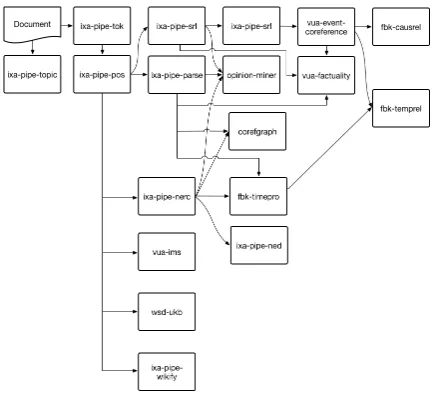
Figure 1: Overview of NLP modules
Storm is a framework for streaming computing whose aim is to implement highly-scalable and parallel pro-cessing of data streams. The system presented in Ar-tola et al. (2014) uses Storm to integrate and orches-trate an NLP pipeline comprised by many modules, but it does so following a batch processing paradigm. The streaming approach presented here is an extension of Artola et al. (2014) to deal with streaming scenar-ios.
3. A pipeline for event recognition
The frameworks we present here are independent of the exact NLP modules that are used in the pipeline. The only requirement posed to the modules is that of using the NLP Annotation Format (Fokkens et al., 2014, NAF) for representing linguistic annotations when using the Storm architecture. The Hadoop setup can in principle work with any setup that uses a com-patible representation to communicate between mod-ules.
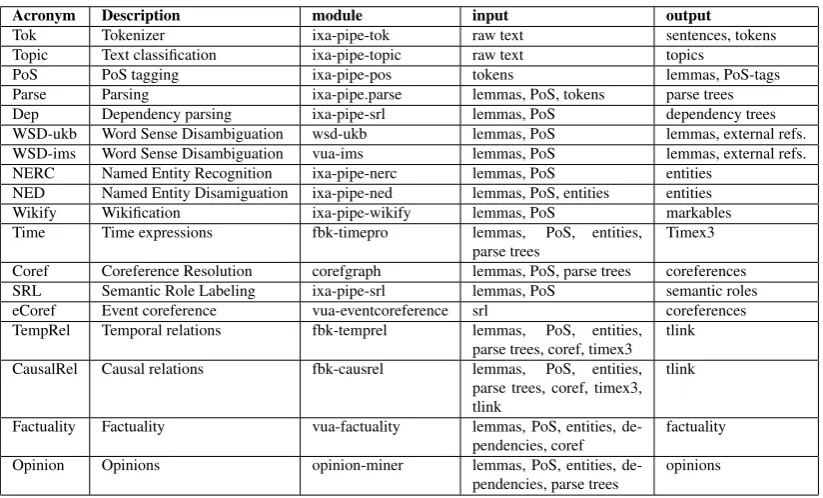
Table 1 shows the NLP modules used in our experi-ments, including the type of information they produce and consume. Theinputandoutputcolumns of the ta-ble indicate the information the module requires and the information the module provides, respectively.7 This information can be used to group the modules on the basis of compatible settings and sequential de-pendencies for processing texts.
One of the main benefits of grouping the modules based on requirements is that modules that are placed in the same group can be executed in parallel, a fact
7These requirements are specified by means of NAF
Acronym Description module input output
Tok Tokenizer ixa-pipe-tok raw text sentences, tokens Topic Text classification ixa-pipe-topic raw text topics
PoS PoS tagging ixa-pipe-pos tokens lemmas, PoS-tags Parse Parsing ixa-pipe.parse lemmas, PoS, tokens parse trees Dep Dependency parsing ixa-pipe-srl lemmas, PoS dependency trees WSD-ukb Word Sense Disambiguation wsd-ukb lemmas, PoS lemmas, external refs. WSD-ims Word Sense Disambiguation vua-ims lemmas, PoS lemmas, external refs. NERC Named Entity Recognition ixa-pipe-nerc lemmas, PoS entities
NED Named Entity Disamiguation ixa-pipe-ned lemmas, PoS, entities entities Wikify Wikification ixa-pipe-wikify lemmas, PoS markables Time Time expressions fbk-timepro lemmas, PoS, entities,
parse trees
Timex3
Coref Coreference Resolution corefgraph lemmas, PoS, parse trees coreferences SRL Semantic Role Labeling ixa-pipe-srl lemmas, PoS semantic roles eCoref Event coreference vua-eventcoreference srl coreferences TempRel Temporal relations fbk-temprel lemmas, PoS, entities,
parse trees, coref, timex3 tlink
CausalRel Causal relations fbk-causrel lemmas, PoS, entities, parse trees, coref, timex3, tlink
tlink
Factuality Factuality vua-factuality lemmas, PoS, entities, de-pendencies, coref
factuality
Opinion Opinions opinion-miner lemmas, PoS, entities, de-pendencies, parse trees
opinions
Table 1: NewsReader modules for English and their properties
that we exploit in our experiments on streaming pro-cessing (see Section 5.). For instance, once the PoS module has identified the Lemmas and PoS-tags, all modules consuming lemmas and PoS annotations can be run in parallel. In our pipeline, this includes the Parse, NERC, Dep, and WSD modules. The NERC is a requisite for some modules, such as the NED, Time and Coref. The Time and Coref modules both also use the output of the Parse module. These modules can thus be placed in the same group and run in parallel as well.
Figure 1 provides a full overview of the NLP modules used in our experiments. The arrows indicate depen-dencies between modules.8 A description and relevant references of a previous version of the modules can be found in Agerri et al. (2015).
4. Batch processing with Hadoop
The first architecture we describe aims at optimiz-ing processoptimiz-ing time for a large set of documents. It maintains a basic setup where complete documents are passed through the entire pipeline applying individ-ual NLP modules in a fixed order. We first describe Hadoop and the Cascading approach we use. This is followed by the main results of our latest processing
8This pipeline performs NLP analyses on English.
Sim-ilar pipelines for Dutch, Spanish and Italian have been de-veloped in NewsReader. We use the English pipeline in our experiments, because it is the most complex of the four.
task and a discussion about further optimizations.9
4.1. Hadoop
The Hadoop (White, 2009) framework is designed to distribute processing of very large datasets across clusters of machines. Hadoop can partition data and computation allowing users to create simple programs that can scale from a single server to thousands of servers. Moreover, it is robust and fault tolerant and can run on commodity hardware.
The APIs are implemented in Java and there is no ex-tensive support to run normal binaries. This can make it challenging to directly support some applications. An example is the NLP pipeline we use that consists of modules programmed in various languages. The next subsection describes how we address this challenge.
4.2. Cascading
The large variety of our NLP modules with differ-ent requiremdiffer-ents made it non-trivial to place into the MapReduce framework (Dean and Ghemawat, 2008), Hadoop’s programming model, without a complete rewrite of all modules. We address this challenge by implementing a Hadoop application using the higher-level Cascading library. Cascading is designed to sup-port complex workflows on Hadoop without needing to implement many individual jobs and implement many low-level map and reduce functions. Using Cas-cading we define functions on a flow of data (tuples).
9The basic architecture has previously been described
This flow is then translated to one or many MapRe-duce jobs.
For the Newsreader NLP pipeline we defined a data flow consisting of tuples with a document identifier, document NAF XML text and a supporting field indi-cating whether a NAF document was processed suc-cessfully. The tuples in this data flow are first stored on the Hadoop distributed file system (HDFS) using a custom application. During job execution tuples are read from HDFS and supplied as input to many func-tion applicafunc-tions in parallel. The funcfunc-tions take a tuple as input, run a process calling an NLP module and col-lect the output of this sub-process. Several functions applications in sequence form the NLP pipeline. Due to the nature of the NLP pipeline, both input and out-put tuples have the same fields: most functions modify only the NAF content.
Our implementation thus ‘wraps’ NLP modules in functions that create a local process for each step in the pipeline. This process receives a path to the NLP mod-ule code which has been distributed using Hadoop’s distributed cache. In addition, a path to a local scratch directory and NAF input are provided (either via stan-dard in or via a file path). Our application can integrate any module that can be called from the command-line taking standard input, a path to the module itself and a path to a temporal or scratch directory and produces a NAF document (either via standard out or via a file path). Error handling of the modules is done by mon-itoring the output streams of the process running the module and by making use of time outs.
Our Cascading application runs the Newsreader pipeline during the map phase of MapReduce. The many map tasks each execute the pipeline in paral-lel on input documents read from HDFS. One map task may apply the pipeline to one or many docu-ments. This decision is determined by how data is partitioned on HDFS. This allows parallel execution of the pipeline on many documents and makes use of data locality as much as possible.
4.3. Scaling and Evaluation
We used the Cascading architecture to process nearly 2.5 million news articles on the Hadoop cluster of SURFsara.10 We obtained news articles spanning 11 years of financial news about the car industry from LexisNexis. We ran initial tests investigating the cor-relation between document length and processing time and observed that processing time increases linearly. This is not surprising given that most modules in our pipeline work on a sentence level. In this set of ar-ticles from the same subdomain, writing style is not
10https://www.surfsara.nl
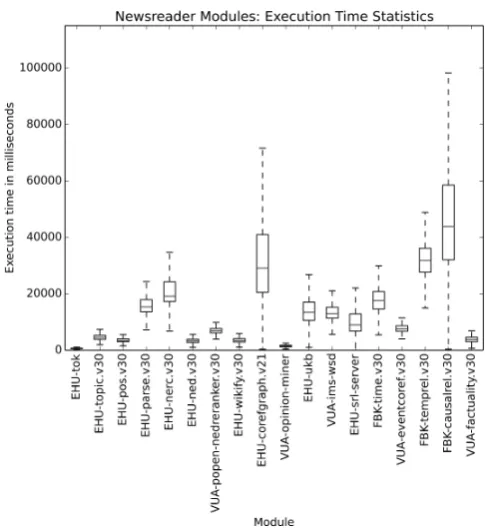
Figure 2: Newsreader Modules: execution time statis-tics
likely to vary excessively and longer documents will thus typically contain more sentences of similar length and style as shorter documents. We selected the 40% of the articles that consisted of 1,000 - 4,000 charac-ters, because this covers the typical news article length resulting in the 2.5 million articles mentioned above. The total process was divided in 225 jobs resulting in approximately 45 million NLP processing tasks (where one task corresponds to the execution of a sin-gle module). Figure 2 provides a boxplot of the exe-cution time of the 45 million NLP processing tasks. The average processing time was 4.4 minutes per doc-ument. Overall, it took 198,134 core hours (a sin-gle CPU core would take 198,134 hours to process the data) to process the entire dataset. The SURF-sara cluster consists of 170 nodes, 1,400 cores and 2 petabytes of data storage. This means that, in case of full capacity, 141.5 hours would be needed to process the full dataset with an average of approximately 17.7 thousand documents per hour.11
The source code to the newsreader-hadoop Cascading application is available under a Apache 2.0 license and can be found on GitHub12. In addition to the applica-tion source a full distribuapplica-tion including all NLP mod-ules is available as download from the GitHub site.
11Hadoop at SURFsara is shared among other users. In
practice, we processed around 4,000 documents per hour.
12https://github.com/sara-nl/
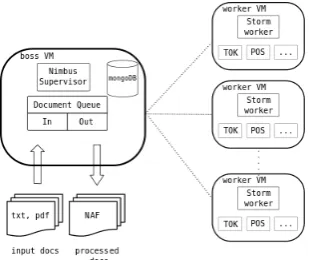
Figure 3: Streaming computing architecture
5. Streaming processing with Storm
Streaming processing deals with scenarios where doc-uments may arrive at any time and have to be pro-cessed as fast as possible. In batch processing all the cluster nodes are busy processing a large set of doc-uments, whereas in a streaming processing scenario resources may be idle, waiting for documents to ar-rive. Therefore, streaming computing focuses on max-imizing resource usage for each document minmax-imizing document latency. In our approach, we minimize doc-ument latency by running the pipeline modules for one document in parallel.
5.1. A distributed architecture for streaming processing
We implement the streaming architecture using virtual machines (VMs). Virtualization is a widespread prac-tice that increases the server utilization and addresses the variety of dependencies and installation require-ments. All the required software and the NLP mod-ules are installed into VMs and can be deployed into a cluster of nodes. We distinguish two types of VMs in the distributed architecture:
• There is one boss VM which is the main entry point and receives the documents to be analyzed.
• There are manyworkernodes performing the ac-tual processing. Instances of NLP modules are deployed among worker nodes, and the execution is performed in parallel.
Figure 3 shows the main architecture for streaming processing. Documents arrive to the boss node and are stored in a queue, which streamlines the document flow and avoids overloading the system. Documents enter the processing chain as soon as there is a worker node ready to accept them. Once entered, they are an-alyzed using all available resources, that is, the NLP modules of the processing chain are executed in par-allel using different worker nodes, whenever possible.
TheNimbuscomponent in the boss node orchestrates the processing flow and performs the necessary load balancing between the machines in the cluster. The boss node also contains a MongoDB database where partially annotated documents are stored. When the processing chain finishes, the resulting documents are removed from the MongoDB database, stored into an output queue and sent to a central database, where new information is merged with the information rep-resented so far.
Inside the worker nodes, each NLP module is wrapped inside a Stormbolt, which performs several tasks. The bolt receives the document identifier as a tuple, and it queries the MongoDB database to retrieve the infor-mation pieces needed by the particular module. For example, the coreference module requires terms, con-stituent trees and named entities to create the corefer-ence chains, and thus the bolt node retrieves only these layers and not retrieve any additional layers (such as dependency trees, factuality or semantic roles) of the NAF document from the database. When the module finishes, the bolt node updates the database to insert the new annotations, and passes the document identi-fier to the next stage in the processing chain.
We describe the topology in a declarative way, speci-fying the type of information each NLP module pro-duces and consumes. This leads to a precise definition of the pre- and post-requisites of the modules, which is used to automatically decide the module execution order, including modules that are executed in parallel if there is no dependency between them. Figure 1 pre-sented in Section 3. shows the topology used in our experiments.
Most NLP modules are standalone programs, but some work following a client/server architecture. Servers typically consume many resources making it inefficient to use many instances. To overcome this limitation, the system allows creating specialized worker nodes that only execute some specific tasks. The NED module server requires 8GB of RAM and is deployed into a dedicated worker node used exclu-sively for NED. Using a custom scheduler inside Nim-buswe guarantee that Storm will send the NED tuples to the dedicated worker, and that this worker will only perform this particular task.
5.2. Experiments and evaluation
param-Proc. Elapsed Idle Latency time time (doc/sent/token) 290,276 148,156 7,558 148.60/4.18/0.17
Table 2: Streaming processing in seconds of 1000 doc-uments.
eter, which sets the average number of events per unit of time. In our experiments we set the rate param-eter to 1,000 documents within a time frame of 40 hours. The documents contained 35,480 sentences and872,393tokens.
We created a cluster comprising one boss node (1CPU, 6GM RAM), one dedicated worker node for NED (1CPU, 10GB), and 7 worker nodes for the rest of the modules (2 CPU, 8GB). Table 2 shows the results of the processing. Processing time indicates the time spent when serial processing is used. The elapsed time indicates time when using parallel processing. La-tency is the average time needed to process one docu-ment/sentence/word.
Processing the documents in a serial fashion would re-quire circa 80 days, each document taking 290 sec-onds in average. Parallel processing drops this latency to 148.6 seconds, a gain of 50%. Looking at Figure 1 one would expect higher gains because there are up to 6 modules running in parallel. The reason for not obtaining a maximum latency lies in the imbalance among the modules’ processing times. Some modules need much more time to complete their task acting as bottlenecks that hurt the overall performance.
Scripts for creating a fully working streaming cluster are publicly available and can be distributed freely.13
6. Conclusion and future work
We presented two architectures for batch and stream-ing scenarios. The architectures serve two different but complementary purposes: batch processing allows dealing with massive amounts of documents in one go; streaming processing allows dealing with the continu-ous flow of new information.
The Hadoop based batch approach was used to ef-ficiently process a very large quantity of documents (2,498,633), with an overall latency of 4.4 minutes per document providing a potential of processing al-most 18 thousand documents per hour. The stream-ing architecture based on Storm allows droppstream-ing the overall document latency by half, which allows quick consumption of new documents into the system. The parallel execution of unrelated modules within a pipeline application could be explored for batch
pro-13https://github.com/ixa-ehu/
vmc-from-scratch
cessing with Hadoop. This might reduce pipeline ex-ecution time, but would go against the ideas behind the MapReduce programming model and complicate resource allocation. Another point worth examining is finding the sweet spot of documents processed per map task. One map task executes the NLP pipeline for one or many documents depending on how data is stored on HDFS. Scheduling these tasks incurs over-head but many mappers improve cluster throughput which for multi-tenant clusters is preferred. Finally, the pipeline definition could be improved to support more flexible workflow definitions and better error handling.
As mentioned in Section 5., the optimization by par-allellization of modules is not as high as might be as-pected due to certain tools forming a bottleneck. One possible way of decreasing the overall latency is to run such demanding modules on stronger nodes in the cluster.14 We hope to investigate this option in future work.
7. Acknowledgements
We would like to thank the reviewers for their feed-back which helped to improve this paper. Remain-ing errors are our own. This research was funded by European Union’s 7th Framework Programme via the NewsReader project (ICT-316404). This work was carried out on the Dutch national e-infrastructure with the support of SURF Cooperative.
8. Bibliographical References
Agerri, R., Aldabe, I., Beloki, Z., Laparra, E., de La-calle, M. L., Rigau, G., Soroa, A., Fokkens, A., Izquierdo, R., van Erp, M., Vossen, P., Girardi, C., and Minard, A.-L. (2015). Event detection, version 2. Technical report, NewsReader Project.
Artola, X., Beloki, Z., and Soroa, A. (2014). A stream computing approach towards scalable nlp. In Nico-letta Calzolari (Conference Chair), et al., editors,
Proceedings of the Ninth International Conference on Language Resources and Evaluation (LREC’14), Reykjavik, Iceland, may. European Language Re-sources Association (ELRA).
Cherniack, M., Balakrishnan, H., Balazinska, M., Car-ney, D., Cetintemel, U., Xing, Y., and Zdonik, S. (2003). Scalable Distributed Stream Processing. In
CIDR 2003 - First Biennial Conference on Innova-tive Data Systems Research, Asilomar, CA, January. Dean, J. and Ghemawat, S. (2008). MapReduce: sim-plified data processing on large clusters. Communi-cations of the ACM, 51(1):107–113.
Fokkens, A., Soroa, A., Beloki, Z., Ockeloen, N., Rigau, G., van Hage, W. R., and Vossen, P. (2014). NAF and GAF: Linking linguistic annotations. In
Proceedings of the 10th Joint ACL – ISO Workshop on Interoperable Semantic Annotation.
Rospocher, M., van Erp, M., Vossen, P., Fokkens, A., Aldabe, I., Rigau, G., Soroa, A., Ploeger, T., and Bogaard, T. (2016). Building event-centric knowl-edge graphs from news. Journal of Web Semantics. Vossen, P., Rigau, G., Serafini, L., Stouten, P., Irving, F., and Hage, W. R. V. (2014). Newsreader: record-ing history from daily news streams. In Proceed-ings of the 9th Language Resources and Evaluation Conference (LREC2014), Reykjavik, Iceland, May 26-31.