Analyzing Preprocessing Settings for Urdu
Single-document Extractive Summarization
Muhammad Humayoun
1, Hwanjo Yu
21IRIT (Institut de Recherche en Informatique de Toulouse), Universit´e Paul Sabatier, Toulouse, France
2Department of Computer Science & Engineering, Pohang University of Science and Technology (POSTECH), South Korea
[email protected], [email protected]
Abstract
Preprocessing is a preliminary step in many fields including IR and NLP. The effect of basic preprocessing settings on English for text summarization is well-studied. However, there is no such effort found for the Urdu language (with the best of our knowledge). In this study, we analyze the effect of basic preprocessing settings for single-document text summarization for Urdu, on a benchmark corpus using various experiments. The analysis is performed using thestate-of-the-artalgorithms for extractive summarization and the effect of stopword removal, lemmatization, and stemming is analyzed. Results showed that these pre-processing settings improve the results.
Keywords:automatic text summarization, single-document summarization, extraction based summarization, benchmark experi-ments, preprocessing
1.
Introduction
Urdu is an Indo-Aryan language, which is widely spoken1. Urdu script is an extended version of Perso-Arabic script. Similar to the other Perso-Arabic scripts, it is written right to left, in a complex, cursive-style writing systems. Urdu inherits a lot of vocabulary from Arabic, Persian and the native languages of South Asia (Humayoun et al., 2007). Due to this influence, Urdu has a complex morphology. In terms of syntax, it has a relatively free word order (Sub-ject Ob(Sub-ject Verb). Despite spoken by millions of people, Urdu is an under-resourced language in terms of available computational resources.
1.1.
Automatic Text Summarization
Generally, automatic text summarization addresses the is-sue of generating shortened information from a single doc-ument (or multiple docdoc-uments written on the same topic). Usually, this shortened text is significantly less than the original text(s) but never more than half of the original text(s) in general (Radev et al., 2002). Two main ap-proaches used for automatic text summarization are ab-straction based andextraction based. Abstraction based approach extracts key points presented in different sen-tences and constructs a coherent summary from the original text by eliminating insignificant details. This requires solv-ing hard questions such as semantic representation, infer-ence, natural language generation, etc. (Radev et al., 2002). In contrast, extraction based technique for summarization is relatively straight forward. It relies on identifying most important sentences from the original document and as-sign them weights (based on their importance). Summary is then formed using topnsentences using these weights. The value of n depends on the length of required sum-mary. These selected sentences are kept intact as units even when some of their parts may not contain most important
1
Urdu has more than 100 million speakers, according to Eth-nologue:www.ethnologue.com/language/urdLast vis-ited: 06-03-2016
information. For extraction based technique, several un-supervised methods have been suggested over the years. Some classic examples are (Luhn, 1958) and (Baxendale, 1958; Edmundson, 1969) that use word frequency and sen-tence position respectively. TextRank (Mihalcea and Tarau, 2004) and LexRank (Erkan and Radev, 2004) are among the famous and widely-used graph-based algorithms(Leite et al., 2007). We have used both of them in this work for the evaluation of pre-processing settings (Section 2.). To the best of our knowledge, there are only two studies for text summarization on Urdu (Burney et al., 2012; Patel et al., 2007). Both studies consider structural and statistical factors only. However, none of them analyze the effect of pre-processing settings.
Summarization algorithms are generally language-independent. However, customized pre-processing work, which is language dependent, is always required (Leite et al., 2007; Torres-Moreno, 2012a; Torres-Moreno, 2014) especially for morphologically rich languages (Nuzumlal and ¨Ozg¨ur, 2014; Eryi˘git et al., 2008). Examples of such pre-processing work could be identifying proper word boundary and sentence boundary. In addition, language-dependent resources such as stemmers, the lists of stopwords, lemmatizers, etc, may also be required to improve the quality of a generated summary. Therefore, analyzing pre-processing settings for Urdu, which is indeed morphologically rich, is an important research question that this paper tries to answer. These settings are discussed in Section 3..
1.2.
Contribution
We have performed three benchmark experiments (Sec-tion 4.). First, we analyze the effect of four different stopword lists. Second, we analyze the effect of lemma-tization (including rule-based and fixed-length stemming techniques). Third, we observe the effect of stopwords and lemmatization together. The experiments are run on
summariza-tion (Secsummariza-tion 2.).
Urdu words cannot always be separated by spaces (Durrani and Hussain, 2010). Urdu Summary Corpus recognizes this problem and provides two versions of the same document collection; properly segmented and space segmented. This allowed us to measure the effect of proper word boundary identification for Urdu text summarization for all experi-ments (Section 4.1.1.). For evaluation, we used ROUGE (Lin, 2004) thede factostandard (Section 2.). The details of evaluation and results are given in Section 4.. Finally, Section 5. concludes the paper.
2.
Background
2.1.
Urdu Summary Corpus
Urdu Summary Corpus (Humayoun et al., 2016) is used in this study which is a benchmark corpus for single-document summarization2. It provides 50 articles and their corresponding human-written summaries (abstracts) cover-ing various domains. More precisely, Urdu Summary Cor-pus consists of 1) fifty Urdu articles that were collected from various sources, and normalized, 2) fifty abstractive single-document summaries, (3) fifty part-of-speech tagged articles, 4) fifty morphologically analyzed articles, (5) fifty lemmatized articles, and (6) fifty stemmed articles. In ad-dition, the basic NLP software tools such as, a normaliz-ing utility, POS tagger, morphological analyzer, lemmatizer and stemmer are also provided.
2.2.
Algorithms
The algorithms used in this study are (1) Degree Central-ity (2) LexRank (3) Continuous LexRank (4) TextRank and (5) Baseline: Lead-based. The first three are proposed by (Erkan and Radev, 2004) and the fourth algorithm is pro-posed by (Mihalcea and Tarau, 2004). As a baseline, Lead-based method is used in which simply firstnsentences are selected from the document as a summary.
2.3.
Evaluation Methodology
For summary evaluation, ROUGE (Lin, 2004) has shown high correlation in content match with human evaluation (Liu and Liu, 2008). To calculate the similarity between two documents ROUGE provides five evaluation metrics. N-gram Co-Occurrence Statistics with Recall (ROUGE-N)(Lin and Hovy, 2003) and F13measure of Longest Com-mon Subsequence (ROUGE-L) (Lin and Och, 2004) are among them, and, we have used both of them for the evalu-ation in this study.
3.
Pre-processing Settings
3.1.
Lists of Stopwords
Stopwords are the frequent words in a language which only serve as syntactic function (Baeza-Yates and Rebiero-Neto, 2003). They are usually meaningless and belong to closed classes (Lo et al., 2005). We have prepared three lists of stopwords (in addition to an existing list) for the experi-ments.
2It is publicly available at https://github.com/
humsha/USCorpus.
3
The harmonic mean of precision and recall.
• The first list is taken from (Burney et al., 2012). It contains 519 words.
• The second list is built by calculating the term fre-quency (Kenney and Keeping, 1962; Lo et al., 2005), on a large Urdu corpus (Jawaid et al., 2014). Nouns and Named entities are not included. It contains 500 words.
• Some studies stress the use of customized stopword lists that should be extracted from the domain corpus of the task in hand (Lo et al., 2005; Blanchard, 2007). Therefore, the third list is built by calculating the term frequency on the documents of Urdu summary Corpus (Humayoun et al., 2016). Nouns and Named entities are not included. It also contains 500 words.
• The fourth list contains only closed classes and has 195 words. The list is generated from the open source resources of Urdu morphology4 (Humayoun et al., 2007).We built it using the open-source resources of Urdu morphology (Humayoun et al., 2007).
It is important to note that in all these stopword lists, words are separate on white-spaces.
3.2.
Lemmatization and Stemming
We evaluated the effect of lemmatization and stemming (rule-based and fixed-length stemming). Urdu Summary Corpus provides lemmatized and stemmed articles pro-duced by Urdu Morphological Analyzer (Humayoun et al., 2007) and Assas-Band stemmer (a rule-based Urdu Stem-mer) (Akram et al., 2009) respectively. The coverage of lemmatization on Urdu Summary corpus is reported to be 64.5% on space segmented corpus and 65.2% in properly segmented corpus(Humayoun et al., 2016). For stemming, we do not find any statistics in Urdu Summary Corpus. However, Assas-Band seem to do considerable number of mistakes in stemming as suggested by the results in exper-iments 2 and 3 (Section 4.2. and 4.3. respectively).
3.2.1. Fixed-Length Stemming
It is a crude chopping, in which, the firstnletters are kept and the rest are discarded. For instance, in the case of lengthn = 1(FIX1), we keep only the first letter5. FIX1
is called ultra-stemming and it is shown that it may im-prove the quality of generated summaries(Torres-Moreno, 2012b). Concretely, we used the following two versions for the experiments:
1. FIXn: Keeps firstnletters. Words having the length less than n are kept intact. This may have over-stemming effect i.e. data sparseness problem (or noise).
2. SFIXn: Keeps firstnletters. Words having the length less than nare discarded. This way we ensure that some of the noise is discarded. Definitely, we may lose some valuable information as well.
4
Available at http://www.lama.univ-savoie.fr/ ˜humayoun/UrduMorph/
5For example, in FIX
1stemming, surface forms such as “run”,
0.476
PS-Baseline SS-Baseline PS-Avg. SS-Avg.
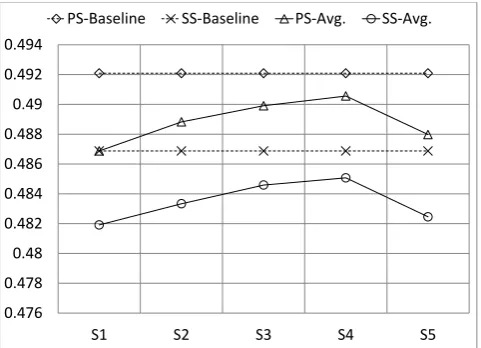
Figure 1: Experiment 1 – average results for both versions.
PS: Properly Segmented, SS: Space Segmented. Correlation be-tween them is99%.
Skon x-axis, stands for preprocessing settingk, e.g., S1 is the first preprocessing setting.
Similarity score is on y-axis. Though the variation in results is small but cannot be neglected; see 4..
4.
Experimental Setup and Results
Every Human-Written (HW) summary is compared with the corresponding Machine-Written (MW) summary pro-duced by an algorithm. Since we have five algorithms, we have five comparisons for each summary. This similarity comparison is performed by taking the average of ROUGE-N and ROUGE-L. For ROUGE-ROUGE-N, an average of unigram, bigram and trigram is used. Because of this setup, the eval-uation metrics is quite strict in our opinion. Thus, even smaller variation in the results cannot be neglected. The similarity comparison is performed for all summaries and average is computed for the results in subsequent sections. Similarity scores are between 0 and 1.
4.1.
Experiment 1: Effect of stopword Removal
only
In this experiment, we measure the effect of stopwords re-moval on both versions of the Urdu summary corpus with the following preprocessing settings:
• S1: Raw – all tokens present, i.e., stopwords are not removed
• S2, S3, S4, S5: First, second, third, and fourth stop-word list applied respectively
Scores for both versions of the corpus are computed for pre-processing settings S1 to S5. Figure 1, shows the average scores.
It is clear that the removal of stopwords improves results. We get best results for S4. This suggests that applying a domain specific stopword list gives best results (as sug-gested by many studies including (Lo et al., 2005; Blan-chard, 2007)). However, a stopword list computed from a
large balanced corpus also improves the results as shown in the preprocessing setting S3 – the second best.
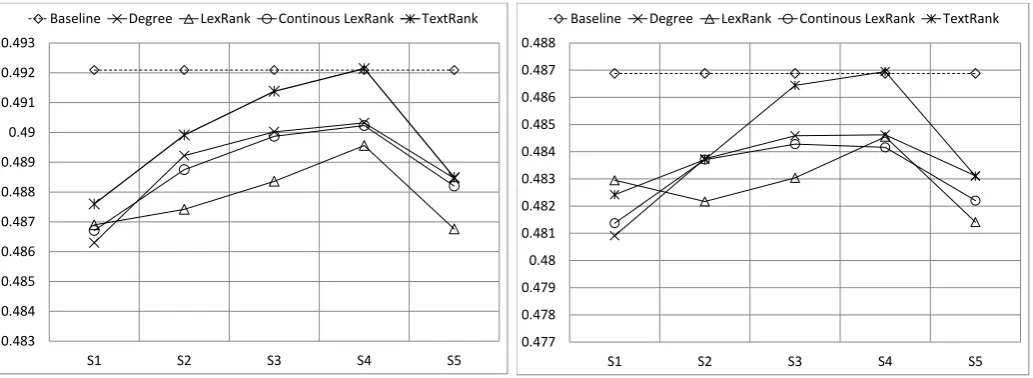
Figure 2a shows the results for properly segmented corpus for each algorithm. TextRank outperforms in all prepro-cessing settings. However, no algorithm outperform the PS-baseline.
Figure 2b shows the results for space segmented corpus, having somewhat similar trends. For instance, TextRank is performing better for S3, S4 and S5. Again, no algorithm outperform the SS-baseline.
4.1.1. Effect of Word Segmentation
Effect of word segmentation in all experiments (including Experiment 2 and 3 mentioned in forthcoming sections) is given in Table 1. It suggests that proper word segmentation has the positive effect in experiment 1 with an average score
0.07. In contrast, proper word segmentation has a negligi-ble effect for Experiment 2 and 3. From these results, it may be concluded that proper word segmentation improves the summarization results marginally.
However, it is worth note that the resources (stopwords lists, lemmatizer, and stemmer) are built on space seg-mented words. Therefore, it may be inferred that if the re-sources are built on properly-segmented words, we might have better results for PS summary corpus.
E1-Avg E2-Avg E3-Avg Average Properly segmented 0.56 0.49 0.49 0.51 Space segmented 0.49 0.49 0.49 0.49 Difference 0.07 -0.0006 0.00004 0.023
Table 1: Word Segmentation Effect for all Experiments E1:Experiment 1, E2:Experiment 2 and E3:Experiment 3
4.2.
Experiment 2: Effect of Lemmatization and
Stemming
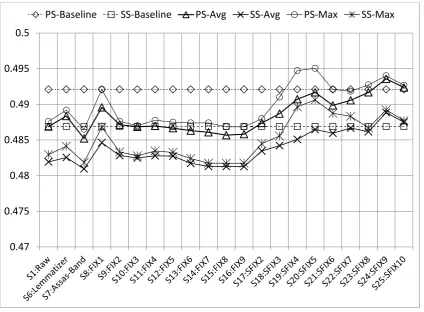
In this experiment, we measure the effect of lemmatiza-tion and stemming on both versions of the summary corpus. Note that stopwords are not removed. Figure 3 shows the average results for both versions and compare them with the corresponding baselines. Pre-processing setting S1 (i.e. no preprocessing setting applied) is added for comparison. The figure suggests that the results for both versions corre-late well with each other.
Humayoun’s Lemmatizer (i.e. preprocessing setting S6) has positive effect if it is compared with the results when no preprocessing settings applied (i.e. S1). These results has outperformed the stemmer Assas-Band (i.e. S7) and different versions of the fixed length stemming (S9 to S17). It is worth noting that the Humayoun’s lemmatizer has only 65% coverage on Urdu Summary Corpus. We argue that if the lemmatizer has more coverage, the results have been improved6.
The results for the stemmer Assas-Band (i.e. S7) are worst for both versions of the corpus. This seem to suggest that the stemmer is doing many mistakes in stemming. This opinion is based on the observation that even applying no
6However, improvement with 100% coverage needs to be
0.483 0.484 0.485 0.486 0.487 0.488 0.489 0.49 0.491 0.492 0.493
S1 S2 S3 S4 S5
Baseline Degree LexRank Continous LexRank TextRank
(a) Properly Segmented Summary Corpus
0.477 0.478 0.479 0.48 0.481 0.482 0.483 0.484 0.485 0.486 0.487 0.488
S1 S2 S3 S4 S5
Baseline Degree LexRank Continous LexRank TextRank
(b) Space Segmented Summary Corpus
Figure 2: Results of Experiment 1
preprocessing (i.e. S1) is doing better than the Assas-Band stemmer.
The preprocessing setting S8 (i.e. fixed length stemming with length 1 – Fix1) improves results, and, it scores best
in Fix1to Fix9range. The trend of decreasing score in Fix1
to Fix9, suggests that we may have similar results for Fix10
similar to the Assas-Band stemmer (i.e. S7). The possible reason for the similar results may be that, probably, both have the same level of inconsistent over-stemming, causing data sparseness problem. In contrast, Fix1 seem to have
consistent over-stemming, which reduces sparseness.
The most prominent result is from the preprocessing set-tings S24 (i.e. SFix9stemming) for average. It outperforms
the whole experimental settings including corresponding baselines for PS and SS corpus respectively.
When taking maximum value among algorithms (i.e. PS-Max and SS-PS-Max in Figure 3), preprocessing setting S19 (SFix4) and S20 (SFix5) outperforms. It is worth noting
that in Experiment 1, none of the pre-processing settings outperformed the baselines. This demonstrates that proper lemmatization or stemming may have more positive effect than stopword removal.
Figure 4a and Figure 4b show the results for PS and SS versions respectively. It is worth noting that the TextRank algorithm outperforms others for preprocessing setting S19 (i.e. SFIX4), S20 (i.e. SFIX5) and S24 (i.e. SFIX9) for both
versions. It indicates that for a resource-poor language like Urdu, summarization quality may be improved with fixed-length stemming (which is easy to implement).
4.3.
Experiment 3: Combined Effect of
Stopword removal and Lemmatization &
Stemming
We measured the combined effect of stopword removal and stemming in this experiment. In Experiment 1, we observed
that the pre-processing setting S3 has outperformed7. Thus, in this experiment, first, we remove the stopwords using this customized stopwords list (of the preprocessing setting S3), and then, apply the stemming approaches of Experiment 2. Figure 5 shows the average results for both versions and compare them with the corresponding baselines. The pre-processing settings S1 and S3 are also shown for a compar-ison. Average results for Experiment 2 are also displayed for an easy comparison. In experiment 2, the last prepro-cessing setting was S25. Thus, the preproprepro-cessing settings starts from S26 in this experiment.
For the combined effect of stopwords removal and applying Humayoun’s Lemmatizer in preprocessing setting S26, the average results are slightly improved for both PS and SS versions of the corpus.
In the case of the combined effect of stopwords removal and Assas-Band stemming in preprocessing setting S27, the av-erage results improve significantly as compared to the pre-processing setting S7 (i.e. when Assas-Band stemming was applied but stopwords were not removed) of Experiment 2. This may be affected by the fact that stopwords removal leaves fewer words, which as a result, reduces sparseness caused by the incorrect stemming. The same phenomena seem to happen for the preprocessing settings S29 to S34, i.e., results improve significantly.
Results also improve for the preprocessing setting S37 (i.e. SFix2+stopword removal) and S38 (i.e. SFix3+stopword
removal). However, from preprocessing setting S39 (i.e. SFix4+stopword removal) to S44 (i.e. SFix9+stopword
re-moval), we get mixed results; sometimes slight improve-ment and sometimes not. It is probably because SFix itself reduces the sparseness in model space and at some point it stops improving. On average, S44 (i.e. SFIX9+stopword
removal) and S24 (i.e. SFIX9of experiment 2) outperform
7
0.47
0.475
0.48
0.485
0.49
0.495
0.5
PS-Baseline
SS-Baseline
PS-Avg
SS-Avg
PS-Max
SS-Max
Figure 3: Experiment 2: average results for both versions. PS: Properly Segmented, SS: Space Segmented, Avg: average result of algorithms, Max: maximum value for a preprocessing setting among the algorithms
0.478 0.48 0.482 0.484 0.486 0.488 0.49 0.492 0.494 0.496
Degree LexRank Cont. LexRank TextRank Baseline
(a) Properly Segmented Summary Corpus
0.474 0.476 0.478 0.48 0.482 0.484 0.486 0.488 0.49 0.492
Degree LexRank Cont. LexRank TextRank Baseline
(b) Space Segmented Summary Corpus
Figure 4: Results of Experiment 2
all preprocessing settings (S1 to S45) equally.
Figure 6a and Figure 6b show the results for PS and SS versions respectively. The combined effect of stopwords removal and special fixed-length stemming with length 5
0.48
0.494
PS-Baseline
SS-Baseline
E3-PS-Avg
E3-SS-Avg
E2-PS-Avg
E2-SS-Avg
Figure 5: Experiment 3: Average Results for both versions compared with Experiment 2.E2: Experiment 2, E3: Experiment 3, Sw-3: customized stopwords list from preprocessing setting S3, S26:Lemmatizer+Sw-3: preprocessing setting number 26 in which stopwords are removed in addition to applying lemmatization
0.48
Degree LexRank Cont. LexRank TextRank Baseline
(a) Properly Segmented Summary Corpus
0.474
Degree LexRank Cont. LexRank TextRank Baseline
(b) Space Segmented Summary Corpus
5.
Conclusion
This paper reports an analysis of various pre-processing set-tings for single-document text summarization for the Urdu language on a freely available benchmark summary cor-pus (Humayoun et al., 2016). We used state-of-the-art al-gorithms in these experiments. It seems that the results are marginally different from each other. However, we take the average of two evaluation measures ROUGE-N8 and ROUGE-L, and thus, even smaller variation in results can-not be neglected (in our opinion).
The results suggest that applying proper word segmenta-tion improves the results if stemming is not applied. How-ever, if stemming is already planned (with or without stop-words removal) then stop-words can be tokenized on spaces to get the same results. This seems promising in the sense that currently applying proper word segmentation is not triv-ial due to the lack of readily available word segmentation software for Urdu. We observed that applying stopword lists alone improve results on both versions of the corpus. Among three stopwords lists, the maximum improvement is achieved when a customized list is used.
For lemmatization and stemming, we observed the limi-tations of existing resources. It is observed that incorrect stemming done by the Assas-Band stemmer and limited coverage of the Humayoun’s lemmatizer undermines the results. Thus, these resources must be improved. In con-trast, some versions of the fixed-length stemming, such as SFix9, has performed best for all the algorithms on
aver-age. Fixed-length stemming is easy to implement. So it is a positive indicator for the under-resourced language such as Urdu. We observed that the effect of stemming is more significant than the stopwords removal. Finally, stemming and stopword removal together improves the results even further for many stemming approaches.
6.
Bibliographical References
Akram, Q.-u.-A., Naseer, A., and Hussain, S., (2009).
Proceedings of the 7th Workshop on Asian Lan-guage Resources (ALR7), chapter Assas-band, an Affix-Exception-List Based Urdu Stemmer, pages 40–47. As-sociation for Computational Linguistics.
Baeza-Yates, R. and Rebiero-Neto, B. (2003). Modern In-formation Retrieval. Addison Wesley, London, England. Baxendale, P. B. (1958). Machine-made index for techni-cal literature: An experiment. IBM Journal of Research and Development, 2(4):354–361, October.
Blanchard, A. (2007). Understanding and customizing stopword lists for enhanced patent mapping. World Patent Information, 29(4):308–316.
Burney, A., Sami, B., Mahmood, N., Abbas, Z., and Rizwan, K. (2012). Urdu text summarizer using sen-tence weight algorithm for word processors. Interna-tional Journal of Computer Applications, 46(19), May. ISSN: 0975 - 8887.
Durrani, N. and Hussain, S. (2010). Urdu word segmenta-tion. InHuman Language Technologies: Conference of
8For ROUGE-N, an average of unigram, bigram and trigram is
used.
the North American Chapter of the Association of Com-putational Linguistics, Proceedings, June 2-4, 2010, Los Angeles, California, USA, pages 528–536.
Edmundson, H. P. (1969). New methods in automatic ex-tracting. Journal of ACM, 16(2):264–285, April. Erkan, G. and Radev, D. R. (2004). Lexrank: Graph-based
lexical centrality as salience in text summarization. Jour-nal of Artificial intelligence research (JAIR), 22(1):457– 479.
Eryi˘git, G., Nivre, J., and Oflazer, K. (2008). Depen-dency parsing of Turkish. Computational Linguistics, 34(3):357–389.
Humayoun, M., Hammarstr¨om, H., and Ranta, A. (2007). Urdu morphology, orthography and lexicon extraction.
CAASL-2: The Second Workshop on Computational Ap-proaches to Arabic Script-based Languages, LSA Lin-guistic Institute. Stanford University, California, USA.,
pages 21–22. http://www.lama.univ-savoie.
fr/˜humayoun/UrduMorph/.
Humayoun, M., Nawab, R. M. A., Uzair, M., Aslam, S., and Farzand, O. (2016). Urdu summary corpus. Sub-mitted at LREC 2016. Publicly available at https: //github.com/humsha/USCorpus.
Jawaid, B., Kamran, A., and Bojar, O. (2014). A tagged corpus and a tagger for urdu. In Nicoletta Calzo-lari (Conference Chair), et al., editors,Proceedings of the Ninth International Conference on Language Resources and Evaluation (LREC’14), Reykjavik, Iceland, May. European Language Resources Association (ELRA). Kenney, J. F. and Keeping, E. S. (1962). Mathematics of
Statistics, Part 1. Princeton, NJ: Van Nostrand Rein-hold., 3rd edition.
Leite, D. S., Rino, L. H. M., Pardo, T. A. S., Gracas, M., and Nunes, V. (2007). Extractive automatic summariza-tion: Does more linguistic knowledge make a differ-ence? In C. Biemann, et al., editors,Proceedings of the HLT/NAACL Workshop on TextGraphs-2: Graph-Based Algorithms for Natural Language Processing, pages 17– 24, Rochester, NY, USA. ACL.
Lin, C.-Y. and Hovy, E. (2003). Automatic evaluation of summaries using n-gram co-occurrence statistics. In
Proceedings of the 2003 Conference of the North Ameri-can Chapter of the Association for Computational Lin-guistics on Human Language Technology - Volume 1, NAACL ’03, pages 71–78, Stroudsburg, PA, USA. As-sociation for Computational Linguistics.
Lin, C.-Y. and Och, F. J. (2004). Automatic evaluation of machine translation quality using longest common subsequence and skip-bigram statistics. InProceedings of the 42nd Meeting of the Association for
Computa-tional Linguistics (ACL’04), Main Volume, pages 605– 612, Barcelona, Spain, July.
Lin, C.-Y. (2004). Rouge: A package for automatic evaluation of summaries. In Stan Szpakowicz Marie-Francine Moens, editor, Text Summarization Branches Out: Proceedings of the ACL-04 Workshop, pages 74– 81, Barcelona, Spain, July. Association for Computa-tional Linguistics.
human evaluation of extractive meeting summaries. In
Proceedings of the 46thAnnual Meeting of the Associa-tion for ComputaAssocia-tional Linguistics on Human Language Technologies: Short Papers, HLT-Short ’08, pages 201– 204, Stroudsburg, PA, USA. Association for Computa-tional Linguistics.
Lo, R. T., He, B., and Ounis, I. (2005). Automatically building a stopword list for an information retrieval system. Journal of Digital Information Management (JDIM), 3(1):3–8.
Luhn, H. P. (1958). The automatic creation of literature abstracts. IBM Journal of Research and Development, 2(2):159–165, April.
Mihalcea, R. and Tarau, P. (2004). Textrank: Bringing or-der into texts. In Dekang Lin et al., editors,Proceedings of EMNLP 2004, pages 404–411, Barcelona, Spain, July. Association for Computational Linguistics.
Nuzumlal, M. Y. and ¨Ozg¨ur, A. (2014). Analyzing stem-ming approaches for turkish multi-document summariza-tion. InProceedings of the 2014 Conference on Empiri-cal Methods in Natural Language Processing (EMNLP), pages 702–706, Doha, Qatar, October. Association for Computational Linguistics.
Patel, A., Siddiqui, T., and Tiwary, U. S. (2007). A lan-guage independent approach to multilingual text sum-marization. InLarge Scale Semantic Access to Content (Text, Image, Video, and Sound), RIAO ’07, pages 123– 132, Paris, France.
Radev, D. R., Hovy, E., and McKeown, K. (2002). Intro-duction to the special issue on summarization. Compu-tational Linguistics, 28(4):399–408, December.
Robertson, S. (2004). Understanding inverse document frequency: On theoretical arguments for idf. Journal of Documentation, 60(5):503–520.
Torres-Moreno, J. (2012a). Artex is another text summa-rizer. CoRR, abs/1210.3312.
Torres-Moreno, J. (2012b). Beyond stemming and lemma-tization: Ultra-stemming to improve automatic text summarization. ACM Computing Research Repository (CoRR), abs/1209.3126.
Torres-Moreno, J. (2014). Three statistical summarizers at CLEF-INEX 2013 Tweet contextualization track. In