Urdu Summary Corpus
Muhammad Humayoun1, Rao Muhammad Adeel Nawab2, Muhammad Uzair2, Saba Aslam2, Omer Farzand2
1IRIT (Institut de Recherche en Informatique de Toulouse), Universit´e Paul Sabatier, Toulouse, France 2Department of Computer Science, COMSATS Institute of Information Technology, Lahore, Pakistan
[email protected], [email protected], [email protected], saba [email protected], [email protected]
Abstract
Language resources, such as corpora, are important for various natural language processing tasks. Urdu has millions of speakers around the world but it is under-resourced in terms of standard evaluation resources. This paper reports the construction of a benchmark corpus for Urdu summaries (abstracts) to facilitate the development and evaluation of single document summarization systems for Urdu language. In Urdu, space does not always mark word boundary. Therefore, we created two versions of the same corpus. In the first version, words are separated by space. In contrast, proper word boundaries are manually tagged in the second version. We further apply normalization, part-of-speech tagging, morphological analysis, lemmatization, and stemming for the articles and their summaries in both versions. In order to apply these annotations, we re-implemented some NLP tools for Urdu. We provide Urdu Summary Corpus, all these annotations and the needed software tools (as open-source) for researchers to run experiments and to evaluate their work including but not limited to single-document summarization task.
Keywords:benchmark corpus, abstracts, automatic text summarization, single-document summarization
1.
Introduction
Urdu is an Indo-Aryan language, widely spoken in South Asia. It is also spoken all over the world due to the large South Asian Diaspora. Urdu has more than 100 million speakers1. It is written in a modified Perso-Arabic script
from right to left. It requires specific rendering to be viewed properly. Normally, it is written in Nastalique, a highly complex writing system that is cursive and context-sensitive.
Urdu has a complex morphology that inherits grammatical forms and vocabulary from Arabic, Persian, and native lan-guages of South Asia (Humayoun et al., 2007). There is no capitalization in Urdu. This makes identifying proper nouns, titles, acronyms, and abbreviations a difficult task. Diacritics (vowels) are hardly present in the text and words are guessed with the help of the context of surrounding words. In terms of syntax, it has a free word order (Sub-ject Ob(Sub-ject Verb). Despite spoken by millions of people, Urdu is an under-resourced language. A sentence illustrat-ing Urdu is given below:
- ÿï
f
àAK. P ú×ñ¯ ú» àAJ»AK ðXP
@
Urdu is the national language of Pakistan.
The availability of benchmark corpora plays an important role in the development of tools and techniques for var-ious NLP tasks. For automatic text summarization, the shared tasks offered by Document Understanding Confer-ence (DUC)2 and Text Analysis Conference (TAC)3
pro-vide different sets of good quality benchmark corpora mainly for English. These corpora consist of single and
1
According to Ethnologue: www.ethnologue.com/ language/urdLast visited: 04-03-2016
2
DUC: www-nlpir.nist.gov/projects/duc/ Last visited: 04-03-2016
3TAC: http://www.nist.gov/tac/Last visited:
04-03-2016
multi-document summaries written by humans. These sum-maries are abstractive as well as extractive4. These sets of
benchmark corpora have been used for the development and evaluation of summarization systems (mainly for English) and results are published regularly.
Unfortunately, unavailability of standard evaluation re-sources (in general) is one of the main hinders for doing research in the Urdu language. As a first step, this work develops a benchmark Urdu summary corpus. It contains 50 articles and their corresponding abstractive summaries covering various domains. These are human-written single-document abstracts. There is only one summary for an ar-ticle.
Urdu is one of the languages that suffers from word seg-mentation problem, i.e., space does not always identify the word boundary (Durrani and Hussain, 2010). Therefore, we produced two versions of the corpus. In the first ver-sion, words are separated by space; whereas in the second version, proper word boundaries are manually tagged. This may allow researchers to measure the effect of word seg-mentation on summarization task as well as on other lan-guage processing tasks for Urdu.
Automatic summarization can be further improved by pre-processing work, such as normalization of text, part-of-speech tagging, morphological analysis, lemmatization and stemming (Leite et al., 2007; Moreno, 2012; Torres-Moreno, 2014; Nuzumlal and ¨Ozg¨ur, 2014; Eryi˘git et al., 2008). Therefore, we further apply the needed software tools and provide the annotated output corpus freely. We also provide the source code of these software tools in one package. Note that such pre-processing tools are scarce for Urdu. In addition, these tools sometimes require fine-tuning or re-implementing because of the occasional
up-4DUC-2002 is the last version of DUC that included the
dates (if any at all). Therefore, we think that providing such utilities are beneficial for researchers working on Urdu (see Section 3. for details). More precisely, Urdu Summary Cor-pus consists of:
• Fifty Urdu articles (and their summaries) that are nor-malized
• Fifty abstractive single-document summaries (one for each article)
• Fifty part-of-speech tagged articles
• Fifty morphologically analyzed articles
• Fifty lemmatized articles
• Fifty stemmed articles
Whereas, the accompanying software package consists of:
• A normalizing utility
• A POS tagger
• A table-lookup based morphological analyzer and lemmatizer
• A stemmer which is self-implemented from Assas-Band stemmer (Akram et al., 2009)
Urdu Summary Corpus and the source-code of the tools are made freely available here5. Details of articles and summary sizes, article sources, peer evaluation scores for human-written abstractive summaries are given in Ap-pendix (§6.).
2.
Summary Corpus Creation
Fifty articles for Urdu Summary Corpus (USC) were col-lected from various online sources mainly news portals and blogs. The sources were chosen based on the following merits:
1. They contain real text as written by the native speak-ers.
2. Authors of different backgrounds have written the text.
3. Getting permission from authors to re-distribute the texts was easy as compared to print media.
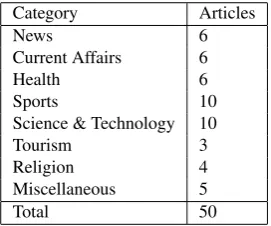
We tried to make the document collection balanced with the inclusion of diverse categories (see Table 1).
In general, an abstractive summary should completely con-vey the meaning of an original text. According to (New-fields, 2001), “A summary is to express the main ideas of the original text using reported speech. Summary contains the essential points, but it does not contain writer’s own point of view about the original text.”
For the summary writing, a group of volunteers was se-lected. They were native speakers of Urdu, either (1) aca-demicians teaching Urdu in colleges, or, (2) university stu-dents that have an interest in Urdu literature.
5https://github.com/humsha/USCorpus/
Category Articles
News 6
Current Affairs 6
Health 6
Sports 10
Science & Technology 10
Tourism 3
Religion 4
Miscellaneous 5
Total 50
Table 1: Categories of the articles used in Urdu Summary Corpus
For summary writing, we did not pose any size restriction for human-written summaries6. We asked the writers to produce good summaries; doesn’t matter if a summary is large, medium or small in size. However, the summary must not exceed half the size of an article.
In addition, we asked the writers to follow three basic steps:
1. After reading a text, identify the key phrases.
2. Paraphrase these key phrases at a sentence-level if needed.
3. Add sequential markers in between, if needed, to cre-ate a proper flow.
These steps are influenced by the six editing operations in human abstracting, which are: sentence reduction, sentence combination, syntactic transformation, lexical paraphras-ing, generalization & specification, and reordering (Stein-berger and Jeˇzek, 2012).
2.1.
Quality of Human Written Summaries
Each summary was evaluated by five peer contributors on a scale of 1 to 5. The scale values were represented as, 1: very bad summary, 2: poor summary, 3: adequate sum-mary, 4: good sumsum-mary, 5: excellent summary. As sug-gested by (Steinberger and Jeˇzek, 2012), we asked peer contributors to consider the following aspects when assign-ing score:1. Is the summary grammatical?
2. Is the summary non-redundant?
3. Is the summary free from references such as anaphora?
4. Is the summary coherent and properly structured?
The average scores given by peer contributors range from
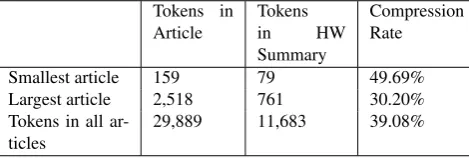
3.8 to 4.8. Statistics of articles and Human-Written ab-stracts are shown in Table 2. For more details, see Ap-pendix (§6.).
3.
Preprocessing Challenges
3.1.
Normalization of Urdu Text for Summary
Corpus
As already mentioned, Urdu script is an extension of Per-sian and Arabic script. Because of this, some characters got
6As it turns out, not restricting the size of the summaries makes
Tokens in Article
Tokens
in HW
Summary
Compression Rate
Smallest article 159 79 49.69% Largest article 2,518 761 30.20% Tokens in all
ar-ticles
29,889 11,683 39.08%
Table 2: Statistics of Articles and Human-Written (HW) Summaries. Tokenization is performed on space.
assigned multiple Unicode for these similar scripts, result-ing in orthographic variations. For example, unlike Arabic, characters like
¸
(kaaf) can never be written as¼
in Urdu. In addition, some characters jointly form a compound char-acter and all such charchar-acters usually got assigned their unique Unicode. For example,@
(alif-madd) can be written with: (1) two characters (unicode: 0627+0653) and (2) with one character (Unicode: 0622) (Gulzar, 2007). The Uni-code Normalization standard (Davis and Whistler, 2014) defines four normalization forms; Normalization Form C (NFC) is one of them. We used it for the normalization of Urdu text for summary corpus as suggested by (Gulzar, 2007). Diacritic marks present in the collection were also removed in this step.3.2.
Word Segmentation for Urdu Summary
Corpus
Urdu alphabet could be separated into two groups: join-ers and non-joinjoin-ers. Joinjoin-ers join together with neighboring characters if space is not inserted between them. In con-trast, non-joiners are not affected by the neighboring char-acters and maintain their shape. There are two types of word segmentation issues: (1) space insertion and (2) space deletion. Urdu faces both of them.
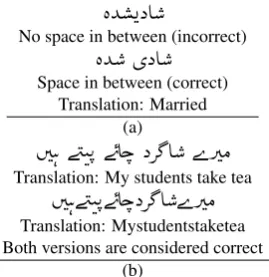
Space insertion problem is caused when an Urdu word con-tains multiple morphemes. If a morpheme ends with a joiner, it joins together with the first character of the next morpheme. Therefore, writer has to insert a space to retain proper shape of the morphemes; see (a) in Figure 1. In con-trast, space omission problem is caused due to non-joiners. If a word ends with a non-joiner the shape of morphemes remain intact whether space is inserted between them or not. Therefore, writers generally do not insert spaces. See (b) in Figure 1.
How severe is word segmentation problem in Urdu? This question is answered by a small study of Urdu words (Dur-rani and Hussain, 2010). On a corpus of 5000 words, it is found that 52.84% words needed corrections to properly segment the text7. With regards to Urdu Summary
Cor-pus, we did not perform such experiment. However, we found the token difference of 9.8% between both versions, as shown in Table 3.
Lastly, Urdu speakers tend to disagree whether compound words are one word or more (Durrani and Hussain, 2010). Therefore, we do not mark compound words as single words. To be precise, compound words with the following
718.72% words suffering space omission problem and 34.12%
words suffering space insertion problem.
Space segmented words 6,074 Properly Segmented words 5,478 Difference 596 (9.8%)
Table 3: Token difference of two versions of Urdu Sum-mary Corpus
patterns are marked as two words. (1) X-e-Y, called ezafe (Butt et al., 2008) (e.g.
ÈA
g
H
Pñ
, Eng: situation), (2)X-Y (e.g.
IJk HAK.
, Eng: talk), and (3) X-X, (e.g.éÂk. éÂk.
, Eng: on multiple places). Compound words with X-o-Y pattern are marked as three words, e.g.IJ
¯A«ðQ
g
(Q g
,ð
andIJ
¯A«
; Eng: being fine).3.3.
POS tagging
A stand-alone tagger for Urdu is reported in (Jawaid et al., 2014), with a reported accuracy of 88.74%, though the tool is not available publicly. This tagger extends the work of (Jawaid and Bojar, 2012) which uses an existing tag-ger, morphological analyzer, and shallow parser together. A voting scheme is further employed to disambiguate be-tween these different tools. A large tagged corpus of Urdu is released publicly by (Jawaid et al., 2014). We used a large fragment of this tagged corpus to train a model on
Stanford POS tagger8to automatically tag Urdu summary
corpus9.
3.4.
Morphological Analysis and Lemmatization
A lemmatizer converts inflected surface forms of a word to its lemma or root form. Whereas, a morphological analyzer gives more details such as word class, number, gender, etc, in addition to lemma. We used Urdu Morphological Ana-lyzer (Humayoun et al., 2007) for both tasks. In this open-source tool, words are built through lexical functions. The lexical functions are coded manually with respect to the in-flection tables of nouns, verbs, adjectives, etc. These lexi-cal functions are then connected with the lexicon which is built semi-automatically, and further, manually checked for mistakes. Therefore, there seem to be less possibility of a word to be incorrectly analyzed (and lemmatized) with this tool if it is present in the lexicon. The lexicon contains5,000 words, capable of handling 140,000 word forms. The statistics on Urdu Summary Corpus are shown in Ta-ble 4.
Urdu Morphological Analyzer is built in Haskell (Marlow, 2010) (using Functional Morphology Toolkit (Forsberg and Ranta, 2004)), but it is not updated from a long time. There-fore, it is not possible to compile it due to the use of obso-lete libraries. Fortunately, the analyzer provides full-form lexicon in text format. We built a table-lookup based ana-lyzer and lemmatizer from it.
3.5.
Stemming
A stemmer produces a truncated form for all inflected sur-face forms of a word. Assas-band (Akram et al., 2009) is
8
http://nlp.stanford.edu/software/tagger.shtml
9
èY
XA
No space in between (incorrect)
èY
øXA
Space in between (correct) Translation: Married
(a)
áïf ÿ
JK ÿ
Ag XQÃ A þQÓ
Translation: My students take tea
áïfÿ
JKÿ
AgXQÃ A þQÓ
Translation: Mystudentstaketea Both versions are considered correct
(b)
Figure 1: Examples of Space Insertion Problem (a) and Space Omission Problem (b)
Surface forms Words analyzed Coverage SS Corpus 42,075 27,118 64.5% PS Corpus 41,947 27,350 65.2%
Table 4: Statistics of Morphological Analysis (and lemma-tization) for Urdu Summary Corpus. (Space segmented: SS, Properly Segmented: PS)
a rule based Urdu stemmer. It is available publicly in two forms: A web-based tool and a desktop tool. However, both versions restrict the input to be only one word (manually entered) at a time, making it impossible to use it for a longer text. Therefore, we re-implemented the stemmer and tested it on selected inputs in comparison with the publicly avail-able web-based tool, to ensure the correctness. As a final step, stemming is applied on the articles.
4.
Conclusion
Urdu Summary Corpus is a pioneering effort, including 50 articles, corresponding annotated text, and corresponding abstractive summaries to foster the work in Urdu NLP. In order to achieve this, we also re-implemented many NLP related software tools. We provide two versions of the cor-pus: (1) properly segmented and (2) space segmented. This may allow researchers to measure the effect of proper word segmentation on the language processing of Urdu. The benchmark corpus is small yet pioneering effort in the con-text of Urdu and it is distributed freely. In future, we plan to increase the corpus size by adding more articles. Cur-rently, there is only one abstractive summary per article. In future, we also plan to increase the number of summaries per article.
5.
Bibliographical References
Akram, Q.-u.-A., Naseer, A., and Hussain, S., (2009).
Proceedings of the 7th Workshop on Asian
Lan-guage Resources (ALR7), chapter Assas-band, an
Affix-Exception-List Based Urdu Stemmer, pages 40–47. As-sociation for Computational Linguistics.
Butt, M., Sulger, S., Butt, M., and (editors, T. H. K. (2008). Urdu ezafe and the morphology-syntax interface. InIn
Proceedings of LFG08. CSLI Publications.
Davis, M. and Whistler, K. (2014). Unicode normaliza-tion forms, unicode standard annex #15. Technical re-port, The Unicode Consortium, June.
Durrani, N. and Hussain, S. (2010). Urdu word segmenta-tion. InHuman Language Technologies: Conference of the North American Chapter of the Association of Com-putational Linguistics, Proceedings, June 2-4, 2010, Los Angeles, California, USA, pages 528–536.
Eryi˘git, G., Nivre, J., and Oflazer, K. (2008). Depen-dency parsing of Turkish. Computational Linguistics, 34(3):357–389.
Forsberg, M. and Ranta, A. (2004). Functional mor-phology. In Proceedings of the Ninth ACM SIGPLAN International Conference of Functional Programming,
ICFP’04, pages 213–223. ACM.
Gulzar, A. (2007). Urdu normalization utility v1.0. Technical report, Center for Language Engineer-ing, Al-kwarzimi Institute of Computer Science (KICS), University of Engineering, Lahore, Pakistan. www.cle.org.pk/software/langproc/urdunormalization.htm.
Humayoun, M., Hammarstr¨om, H., and Ranta, A. (2007). Urdu morphology, orthography and lexicon extraction.
CAASL-2: The Second Workshop on Computational Ap-proaches to Arabic Script-based Languages, LSA Lin-guistic Institute. Stanford University, California, USA., pages 21–22. http://www.lama.univ-savoie.fr/ humay-oun/UrduMorph/.
Jawaid, B. and Bojar, O. (2012). Tagger voting for urdu.
InProceedings of the 3rd Workshop on South and
South-east Asian Natural Language Processing, pages 135–
144, Mumbai, India, December. COLING 2012. Jawaid, B., Kamran, A., and Bojar, O. (2014). A tagged
corpus and a tagger for urdu. In Nicoletta Calzo-lari, et al., editors, Proceedings of the Ninth Interna-tional Conference on Language Resources and
Evalua-tion (LREC’14), Reykjavik, Iceland. European Language
Resources Association (ELRA).
Leite, D. S., Rino, L. H. M., Pardo, T. A. S., Gracas, M., and Nunes, V. (2007). Extractive automatic summariza-tion: Does more linguistic knowledge make a differ-ence? In C. Biemann, et al., editors,Proceedings of the HLT/NAACL Workshop on TextGraphs-2: Graph-Based
Algorithms for Natural Language Processing, pages 17–
24, Rochester, NY, USA. ACL.
Marlow, S. (2010). Haskell 2010: language and libraries. Technical report, http://www.haskell.org.
Newfields, T. (2001). Teaching summarizing skills: Some practical hints. ELJ Journal., 2(2):1 – 7. www.tnewfields.info/Articles/sum.htm.
Nuzumlal, M. Y. and ¨Ozg¨ur, A. (2014). Analyzing stem-ming approaches for turkish multi-document summariza-tion. InProceedings of the 2014 Conference on
Empiri-cal Methods in Natural Language Processing (EMNLP),
pages 702–706, Doha, Qatar.
Steinberger, J. and Jeˇzek, K. (2012). Evaluation mea-sures for text summarization. Computing and Informat-ics, 28(2):251–275.
Torres-Moreno, J. (2012). Artex is another text summa-rizer. CoRR, abs/1210.3312.
Working Notes for CLEF 2014 Conference, Sheffield,
UK, September 15-18, 2014., pages 565–573.
6.
Appendix
Article Name R1 R2 R3 R4 R5 Avg Tokens in Article Tokens in Abstracts Compression
1 Current Affairs 1 4 5 4 4 5 4.4 236 110 46.6
2 Current Affairs 2 4 5 4 5 3 4.2 841 179 21.3
3 Current Affairs 3 4 5 4 4 4 4.2 361 137 38
4 Current Affairs 4 5 4 4 4 4 4.2 256 129 50.4
5 Current Affairs 5 4 4 4 3 5 4 336 205 61
6 Current Affairs 6 5 4 4 5 5 4.6 312 101 32.4
7 Health 1 4 4 4 4 4 4 477 261 54.7
8 Health 2 4 5 4 5 4 4.4 547 206 37.7
9 Health 3 4 5 4 5 3 4.2 474 201 42.4
10 Health 4 3 4 4 5 5 4.2 307 138 45
11 Health 5 4 5 4 4 3 4 1319 475 36
12 Health 6 4 5 4 4 3 4 288 131 45.5
13 History 1 3 4 4 5 4 4 1047 428 40.9
14 News 1 4 4 4 4 3 3.8 537 300 55.9
15 News 2 4 4 4 4 4 4 914 389 42.6
16 News 3 4 5 4 4 3 4 441 186 42.2
17 News 4 4 4 4 5 4 4.2 629 238 37.8
18 News 5 4 4 3 4 4 3.8 496 235 47.4
19 News 6 4 2 4 5 5 4 178 80 44.9
20 Pakistan 4 5 4 4 5 4.4 760 247 32.5
21 Politics 1 3 5 4 4 5 4.2 550 171 31.1
22 Religion 2 5 5 4 3 5 4.4 367 157 42.8
23 Religion 4 5 5 4 4 4 4.4 743 313 42.1
24 Religion 5 5 5 4 4 3 4.2 517 195 37.7
25 Religion 6 5 5 3 4 5 4.4 796 270 33.9
26 Science&IT 1 4 4 4 4 3 3.8 338 217 64.2
27 Science&IT 2 5 5 4 4 5 4.6 988 313 31.7
28 Sports 1 4 5 4 5 4 4.4 494 164 33.2
29 Sports 2 4 4 4 4 4 4 394 185 47
30 Sports 3 5 4 4 4 4 4.2 726 342 47.1
31 Sports 4 4 4 4 4 3 3.8 1026 383 37.3
32 Sports 5 3 4 3 4 5 3.8 419 151 36
33 Sports 6 4 4 4 4 3 3.8 454 177 39
34 Sports 7 4 4 4 4 4 4 301 138 45.8
35 Sports 8 4 5 4 4 4 4.2 686 254 37
36 Sports 9 4 4 4 4 3 3.8 975 322 33
37 Sports 10 5 5 4 4 4 4.4 456 227 49.8
38 Technology 1 5 4 4 4 5 4.4 655 256 39.1
39 Technology 2 5 5 4 4 4 4.4 353 166 47
40 Technology 3 5 5 4 3 5 4.4 1337 353 26.4
41 Technology 5 3 3 4 5 5 4 346 146 42.2
42 Technology 6 5 5 4 5 5 4.8 318 120 37.7
43 Technology 7 4 5 4 4 4 4.2 744 326 43.8
44 Technology 8 5 4 4 4 4 4.2 216 118 54.6
45 Technology 9 4 5 4 5 5 4.6 189 103 54.5
46 Technology 10 5 4 5 4 3 4.2 234 129 55.1
47 Technology 11 4 4 4 4 5 4.2 159 79 49.7
48 Tourism 1 5 4 4 3 3 3.8 525 282 53.7
49 Tourism 2 5 5 4 4 4 4.4 991 351 35.4