R E S E A R C H
Open Access
Joint rate control and power allocation
for low-latency reliable D2D-based relay
network
Yahui Wang
1, Yanhua He
1, Chen Xu
1, Zhenyu Zhou
1*, Shahid Mumtaz
2, Jonathan Rodriguez
2,3and Haris Pervaiz
4Abstract
Emerging 5G applications impose stringent requirements on network latency and reliability. In this work, we propose a low-latency reliable device-to-device (D2D) relay network framework to improve the cell coverage and user satisfaction. Particularly, we develop a cross-layer low-complexity resource allocation algorithm, which jointly
optimizes the rate control and power allocation from a long-term perspective. The long-term optimization problem is transformed into a series of short-term subproblems by using Lyapunov optimization, and the objective function is separated into two independent subproblems related to rate control in network layer and power allocation in physical layer. Next, the Karush-Kuhn-Tucher (KKT) conditions and alternating direction method of multipliers (ADMM) algorithm are employed to solve the rate control subproblem and power allocation subproblem, respectively. Finally, simulation results demonstrate that the proposed algorithm can reach 99.9% of the optimal satisfaction of D2D pairs with lower average network delay compared to the baseline algorithm. Furthermore, the convergence time of the ADMM-based power allocation algorithm is only about 1.7% of that by using the CVX toolbox.
Keywords: D2D-based relay network, Rate control, Power allocation, Lyapunov optimization, ADMM algorithm, Low-latency and reliability
1 Introduction
With the explosive growth of mobile applications, it is predicted that approximately 50 billion devices will inter-connect to the network by 2020 [1,2]. Cell-edge devices are likely to experience poor quality of service (QoS) and quality of experience (QoE) due to the long distance and time-varying channel states between devices and the base station (BS). Device-to-device (D2D)-based relay commu-nication, as a key technology of 5G, can improve data transmission and network coverage by assisting users with inferior channel conditions via multi-hop transmis-sions. Specifically, the transmitters (TXs) of D2D pairs can act as relay nodes to reduce the transmission distance and conditions. improve the channel The required data of D2D receivers (RXs) is transmitted from the BS to
*Correspondence:[email protected]
1The State Key Laboratory of Alternate Electrical Power System with Renewable Energy Sources, School of Electrical and Electronic Engineering, North China Electric Power University, Beijing, China
Full list of author information is available at the end of the article
the nearby TXs, which is stored in the queue buffers of TXs before being transmitted to RXs. Compared to con-ventional multi-hop relay network, the D2D-based relay network can be deployed underlying conventional cellular networks, which enables centralized resource manage-ment and coordination.
However, despite the advantages described above, the widespread deployment of D2D-based relay network still faces some challenges.
Firstly, there lacks a cross-layer resource allocation scheme to guarantee the reliability of network opera-tion as well as to satisfy the low-latency requirements of applications. Since both the arrival rate of required data at TXs and channel conditions among D2D pairs are varying over time, there requires a joint optimiza-tion of the rate control in network layer and transmission rate in physical layer. Traditional schemes, which only consider the optimization of the physical-layer transmis-sion rate while ignoring the arrival rate in network layer, will result in the data imbalance between the arrival rate
and the transmission rate. The data imbalance will cause queue backlog and packet drop at TXs due to the lim-ited queue buffering capability of TXs, which leads to intolerable latency and network unreliability.
Second, there lacks an effective online resource alloca-tion scheme which optimizes the network performance from a long-term perspective. Conventional short-term optimization cannot satisfy the long-term optimization objective and constraints, which will lead to severe performance degradation since resources are only allo-cated based on instantaneous states and constraints. In addition, it is difficult to obtain accurate future infor-mation in practical applications due to the casuality constraint.
Last but not least, the computational complexity of tra-ditional resource allocation algorithms increase dynami-cally as the number of D2D pairs increases. The reason is that numerous optimization variables in the network are coupled with each other, e.g., the constraint of sum rate and sum power consumption, which leads to prohibitive computational complexity. On the other hand, the opti-mization problem with coupled constraints is carried out in a time slot basis, which further increases computational complexity.
In this paper, to solve the abovementioned challenges, we propose a cross-layer online joint resource allocation algorithm to optimize the long-term satisfaction of D2D pairs while maintaining network reliability and reduce transmission delay. The main contributions of this work are summarized as follows:
1. We transform the long-term joint rate control and power allocation problem into a series of short-term optimization problems by using Lyapunov
optimization [3]. At each time slot, the cross-layer joint optimization problem can be decomposed into two separate subproblems and solved independently. The proposed scheme guarantees aO(V1),O(V) tradeoff between queue stability and D2D pair satisfaction.
2. The power allocation problem has high
computational complexity due to the coupling of optimization variables among different D2D pairs. To provide a tractable solution, we developed an alternating direction method of multipliers (ADMM)-based low-complexity power allocation scheme, which decomposes the large problem into a series of smaller subproblems and coordinates the solutions of these subproblems to find the solution of the original problem.
3. Simulation results demonstrate that the proposed joint optimization scheme can converge quickly and approximate the optimal solution. Moreover, we analyze the tradeoff between satisfaction of D2D
pairs and network delay, which proves that significant performance can be improved by the proposed algorithm.
The remaining parts of this paper are organized as fol-lows. Section2 describes the related works. Section3.1 introduces the power allocation model, the queue backlog model and satisfaction model. The problem formulation is presented in Section 3.2. The online joint rate con-trol and power allocation algorithm based on Lyapunov optimization and ADMM and the performance analysis of the proposed algorithm are described in Sections3.3 and3.4, respectively. Simulation results are presented in
Section4. The conclusion and future works are
summa-rized in Section5.
2 Related works
Due to the advantages of D2D-based relay network such as enlarging cell coverage, reducing network delay and enhancing network reliability, it has aroused widespread concern in both academia and industry. A multi-dimensional optimization algorithm was proposed to solve a content distribution problem in multi-hop D2D relay networks [4], which can effectively reduce the aver-age delay in the network. In [5], Zhou et al. studied the D2D communication underlying cellular networks and proposed a joint channel selection and power allocation optimization algorithm to improve the energy efficiency subject to various QoS constraints. In [6], Dang et al. proposed a full-duplex based D2D multi-hop commu-nication framework, where the data forwarded between D2D transmitters and receivers are assisted by using mul-tiple relays. However, these works mainly focus on the optimization of short-term network performance, e.g., instantaneous network capacity, energy efficiency, and transmission latency, while ignoring the optimization of time-average performance.
HCRANs subject to individual front-haul capacity as well as multiple interference constraints to sense queue and proposed an online resource allocation algorithm based on Lyapunov optimization. However, when optimizing the performance of the overall network, the computa-tional complexity increases dramatically with the number of devices due to the coupling of optimization variables and constraints across devices.
ADMM algorithm can solve some specific convex optimization problems with a much lower complexity, because both the primal and dual variables are updated in an alternative direction to increase the convergence speed [12]. It employs a decomposition-coordination procedure, in which the global optimization problem is firstly decom-posed into numerous small subproblems, and then the solutions to these subproblems are calculated, updated, and coordinated to find a solution to the global problem. ADMM has been widely adopted in addressing large-scale optimization problems in various application scenarios. In [13], Li et al. decoupled the power constraint and objec-tive function by employing ADMM and proposed a robust design of transceiver multi-cell distributed antenna
net-work with numerous remote radio heads. In [14], Ling
et al. proposed a weighted ADMM algorithm to solve the consensus optimization problem in decentralized net-works, which is able to minimize the communication cost of optimization. In [15], Chen et al. combined the ADMM algorithm with the convex-concave procedure
to reduce the complexity and improve system perfor-mance for large-scale multi-group multicast beamforming problems.
Different from the abovementioned works, we propose a long-term cross-layer joint optimization of rate control and power allocation scheme for D2D relay networks by combining Lyapunov optimization and ADMM. Various constraints of network reliability, transmission delay, and power consumption have been taken into consideration. The difference between [10] and our work is that instead of solving the large-scale network optimization problem directly, we develop a low-complexity power allocation algorithm based on ADMM.
The proposed algorithm is not constrained to D2D-relay networks. It can be extended to solve similar joint rate control and power allocation problems in different appli-cation scenarios such as task offloading [8] and energy harvesting [16].
3 Theoretical method 3.1 System model
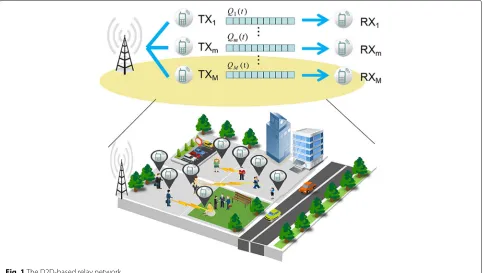
In the traditional cellular network, the QoS of some cell-edge devices cannot be well satisfied due to the long dis-tance and time-varying channel gain between the devices and BS. Thus, D2D relay networks can be utilized to enhance cell coverage via a two-hop communication man-ner. As shown in Fig.1, we consider a D2D-based relay network in a single cell, which consists of one BS andM
D2D pairs. In this work, we assume that the relay selection has been finished, which has been studied in many papers [17,18] so that it is left out of consideration in this work. That is, there exists a one-to-one mapping between D2D TXs and D2D RXs. The BS operates in a time-slotted man-ner and collects the queue state information (QSI) and channel state information (CSI) at each time slot [19]. The set of time slots is defined asT = {0,· · ·,t,· · ·,T−1}. Taking the D2D pairmas an example, the data requested by the RX is firstly transmitted from the BS to the TX. The TX maintains a queue temporarily to store the arrival data, which is then delivered to the RX. At each time slot, assume thatAm(t)Mbits of data arrive at the TX of D2D
pairmfrom the BS, which is assumed to be independently and identically distributed (i.i.d.) over time slots with the maximum arrival rate Am,max. In addition, assume that
Dm(t) Mbits of data depart from the TX of D2D pairm
in each time slot, which is related to the channel state and transmission power between the D2D pairs.
3.1.1 Power allocation model
D2D-based relay communication can be divided into in-band communication (also known as LTE direct) and out-band communication. In-out-band D2D communication can be further classified into the categories of underlay and
overlay D2D communication [20]. In the circumstances
of in-band overlay D2D-based relay network, the D2D communication occupies the licensed spectrum owned by the cellular operators. The cellular operators are able to employ complex interference mitigation techniques to provide higher satisfaction for D2D pairs compared to the use of unlicensed spectrum [21]. Hence, we assume that the transmission data at TXs is transmitted to the RXs through a series of orthogonal channels in the LTE direct system [22], which means there is no interference among D2D pairs. The transmission rate of D2D pairmis expressed as:
whereBm(t)represents the channel bandwidth allocated
to the D2D pairm,pm(t)is the transmission power of D2D
pairm,hm(t)is the channel gain of D2D pairm, andσ02is
the power of additive white Gaussian noise. Without loss of generality, assume thathm(t)is i.i.d. over time slots, and
takes values in a finite state space. Moreover,hm(t)keeps
constant during one time slot but varies across different time slots.
In order to reduce the power consumption of the net-work, the long-term time-average power consumption for arbitrary D2D pairmis defined as:
0≤ lim
and instantaneous transmission power for each time slott is defined as:
wherePm,aveandPmaxare the time-average and
instan-taneous power consumption constraints, respectively.
3.1.2 Queue backlog model and satisfaction model
Due to the fact that the requested data cannot be trans-mitted instantaneously to the RX, it has to be stored at the queue of the TX temporarily. The queue backlogs at the TXs are denoted asQ(t)= { Q1(t),· · ·,Qm(t),· · ·,QM(t)}
at each time slot t, which are determined by the arrival rate and the transmission rate. Hence, the dynamic queue consists of the arrival data and the departure data. The data arrival process of the queue is determined by the rate control policy, which affects the amount of data enters into the queue and the satisfaction of D2D pairs. The data departure process of the queue is determined by the power allocation policy, which affects the amount of data leaves the queue and the network latency and stability. Thus the queue Qm(t) at TX of D2D pairm evolves in
accordance with the following expression:
Qm(t+1)=max{Qm(t)−Dm(t), 0} +Am(t). (4)
There exists no data overflow if the long-term average transmission data of the queue is larger than or equal to the long-term average arrival data of the queue. Thus, the queueQm(t)is mean rate stable [23] if
lim
T→∞
E{|Qm(T)|}
T =0. (5)
Equation (5) implies that the data in the stable network should be transmitted within finite delay and the stability of the network is guaranteed if the queue length is finite.
In addition, we define the satisfaction of D2D pairmas a nondecreasing concave function [10,24]:
Sm(Am(t))=γmlog2(Am(t)), (6)
whereγmis a predefined parameter related to the service
of RX in D2D pairm. The logarithmic function indicates that the marginal increment of the satisfaction declines gradually withAm(t).
3.2 Problem formulation
P1: max
where C1 represents that the arrival rate cannot exceed
the maximum tolerance rate of TX.C2∼C4are the
non-negative transmission power, instantaneous transmission power, and time-average transmission power constraints, respectively. C5 denotes the queue stability constraint
in Eq. (5).
Next, we propose a cross-layer online optimization
algo-rithm to solveP1 based on the Lyapunov optimization
algorithm and ADMM algorithm.
3.3 Joint rate control and power allocation optimization
In this section, we firstly transform the long-term time-average optimization objective into a series of online sub-problems by using the Lyapunov optimization. Then, we describe the detailed procedures of cross-layer joint opti-mization problem of rate control and power allocation.
3.3.1 Problem transformation
It is noticed that there exist long-term constraints in orig-inal problemP1. To handle the long-term time-average
power consumption constraint, C4 can be transformed
into queue stability constraint by employing virtual
queue [25]. The virtual queue is defined as Z(t) =
{Z1(t),· · ·,Zm(t),· · ·,ZM(t)}, and Zm(t) evolves as
fol-lows:
Zm(t+1)=max{Zm(t)−Pm,ave, 0} +pm(t), (8)
It is worth noting that there is no actual queue data in queue Zm(t), which is only proposed to satisfy
constraintC4.
Theorem 1If virtual queue Zm(t)is mean rate stable,
then C4holds automatically.
ProofThe detailed proof can be found in [10].
According to Theorem1,P1can be rewritten as:
P2: max length in the network. Define the Lyapunov function as a measure of total queue length at each time slott:
L((t))= 1
At each time slot, the conditional Lyapunov drift is expressed as:
((t))=E{L((t+1))−L((t))|(t)}, (11)
At each time slot, it can be observed that the Lyapunov function is able to control Lyapunov drift’s ultimate value by adjusting the final queue length. According to the Lit-tle’s Theorem [26], the average delay is proportional to the average queue length, which is expressed as:
Dnet =
where Dnet is the time-average delay, which can be
adjusted by minimizing Lyapunov drift.
To minimize the network delay and maximize the long-term time-average satisfaction of all D2D pairs, the drift-minus-reward term is defined as:
((t))−VE
whereV is a non-negative control parameter that is cho-sen to affect the relative performance of the network delay and satisfaction of D2D pairs, i.e., the tradeoff between “network delay minimization” and “satisfaction maximiza-tion of D2D pairs”.
((t))−VE
where C is a positive constant which satisfies:
C≥ 1
ProofThe detailed proof can be found in Appendix1.
According to the principle of Lyapunov optimization,
P2 can be transformed into optimizing the
drift-minus-reward with the constraintsC1 ∼ C3. The second term
of the right hand side (RHS) in (14) involves only the rate control variables{Am(t)}, while the third and the fourth
term of the RHS in (14) involves only the power alloca-tion variables {pm(t)}. Therefore, P2 can be decoupled
into two independent rate control subproblem and power allocation subproblem.
3.3.3 Rate control
The rate control subproblem can be formulated as:
P3: min
The second-order derivative ofP3is greater than zero, which indicates that it is a convex function with respect to{Am(t)}and can be solved by KKT conditions [27]. The
whereλis the Lagrange multiplier.
The first-order conditions of (17) with respect toAm(t)
constraintλ≥0 and complementary slackness constraint
λ(Am(t)−Am,max)=0, the optimal rate is given by:
It is noticed that the optimal rate is inversely pro-portional to the queue length Qm(t). Thus the online
algorithm can adjust the arrival rate based on the queue length.
3.3.4 ADMM-based power allocation algorithm
The power allocation subproblem is expressed as:
P4: min
It can be proved thatP4is a convex function regarding to pm(t) by calculating the corresponding second-order
derivative. However, the calculating time by using tool-box to solve the optimization objective is very large due to the coupled power variables and the dynamically increas-ing of D2D pairs. Hence, we develop a low complexity ADMM-based power allocation algorithm to solve the problemP4.
The ADMM algorithm is simple but powerful to research distributed convex optimization problems, which had been successfully applied in many aspects, i.e., statistical learning problems, time-series analysis and scheduling [28]. In general, the diverse application domains are characterized with the large-scale problems, high-dimensional data processing and distributed collec-tion of large scale data in stochastic process [29]. The basic produces of ADMM algorithm is to alternatively update primal variables and dual variables in an iterative man-ner [12]. It is beneficial to find the optimal solution with low computational complexity by using decomposition-coordination procedure.
In order to obtain the optimal solution, we rewrite the power variables into p1 = {p1,p2,· · ·,pn} and p2 =
{pn+1,pn+2,· · ·,pM}. Then letx=p1andz=p2.
There-fore, we can transform P4 into the following ADMM
format [30]:
P5: min
x,z f(x)+g(z)
wherex∈ Rn×1,z ∈R(M−n)×1,J∈ R1×n,K∈ R1×(M−n),
There exist two basic forms of the ADMM algorithm, such as the unscaled form and the scaled form [16]. For the sake of simplicity, the scaled ADMM algorithm is employed in this paper. The augmented Lagrangian ofP5
is expressed as:
whereρ > 0 represents the penalty parameter, which is
related to the convergence speed of ADMM algorithm.β
is the vector form of the Lagrange multipliers.
The ADMM algorithm in scaled form consists of the following iterations regarding to the primal variables and Lagrange multipliers: whereidenotes the index of iteration.
Next, based on the analysis of optimality conditions [31], the primal residual is expressed as:
r[i+1]=Jx[i+1]+Kz[i+1]−c, (28)
and the dual residual is expressed as:
s[i+1]=ρJTK(z[i+1]−z[i]). (29)
Therefore, the reasonable termination criteria satisfies:
r[i]2≤ priands[i]2≤ dual. (30)
Algorithm 1ADMM-based power allocation algorithm
1: Initialize:M,i,x,z,ρ, pri, and dual.
8: Calculate the termination criteria:
9: r[i+1]2=Jx[i+1]+Kz[i+1]−c2;
10: s[i+1]2=ρJTK(z[i+1]−z[i])2;
11: Updatei→i+1;
12: end while
13: end for
where pri > 0 and dual > 0 denote feasibility toler-ances with respect to primal conditions and dual condi-tions. Consequently, the ADMM-based power allocation algorithm is summarized in Algorithm1.
3.4 Performance analysis
In this subsection, we analyze the performance of Lya-punov optimization algorithm and ADMM algorithm, respectively.
3.4.1 Performance of Lyapunov optimization algorithm
Due to the fact that all physical quantities cannot be infinitely large in the practical network, we consider that the arrival rate, transmission rate, power consump-tion, and satisfaction of D2D pairs are all bounded, i.e.,
E{Am(t)} ≤ θ,E{Dm(t)} ≤ θ, E{pm(t)} ≤ θ, Smin ≤ E{Sm(Am(t))} ≤ Smax, whereθ,SminandSmaxare finite
non-negative constants.
Assume that there is at least one feasible solution to
problem P1 which satisfies constraints C1 ∼ C5 and
the bounded values mentioned above. For arbitrary small positive real numberε andζ, the following expressions hold [32]: sponding resulting values, andSoptdenotes the theoretical
optimal value.
Table 1Parameter table
Parameters Value
Cell radius 300 m
D2D pairs 4
Subchannels 4
Time slot 100
Pmax 0.8 W
ρ 5
σ2
0 −114 dbm
γ1toγ4 0.1, 0.2, 0.3, 0.4
P1,avetoP4,ave 0.1, 0.2, 0.3, 0.4 W
BandwidthB1toB4 2,2,2,2 MHZ
Control parameterV 300−700
Arrival rateAm,max 10 Mbits
For arbitrary V ≥ 0, the following properties correspond-ing to the proposed algorithm hold:
1. Qm(t)andZm(t)are mean rate stable, which
guarantee the constraintC6.
2. The time-average satisfaction of D2D pairs satisfies:
lim
T→∞
1 T
T−1
t=0
E{Sm(Am(t))} ≥Sopt−
C
V (34)
3. The time-average queue length satisfies:
lim
T→∞
1 T
T−1
t=0
M
m=1
E{Qm(t)} ≤
C+V(Smax−Sopt) ε
(35)
a
ProofThe detailed proof can be found in Appendix2.
Based on the above analysis, we conclude that the pro-posed rate control and power allocation algorithm can sat-isfy the queue stability constraint and achieve the trade-off between network delay and satisfaction of D2D pairs by adjusting parameterV.
3.4.2 Convergence of ADMM algorithm
The objective function ofP5is closed, proper, and con-vex, and the Lagrangian L0(x,z,β) has a saddle point.
Thus, the iterations satisfy the following convergence properties.
Theorem 4The residual convergence, objective conver-gence and dual variable converconver-gence are expressed as follows:
1. Residual convergence: The primal and dual residuals converge to 0 asi→ ∞, which implies that the iterations approach feasibility.
2. Objective convergence: The objective function ofP5 eventually converges to the optimal value under the stopping criterion asi→ ∞.
3. Dual variable convergence: The dual variable
β[i+1]converges to dual optimal value asi→ ∞.
ProofThe detailed proof can be found in [33].
a
4 Results and discussion
In this section, we verify the system performance of the proposed algorithm through simulation results. Assume
that there are M = 4 D2D pairs for data transmission
in each time slot, and the corresponding number of sub-channels is set as 4. Detailed parameters are summarized in Table1[10,34,35].
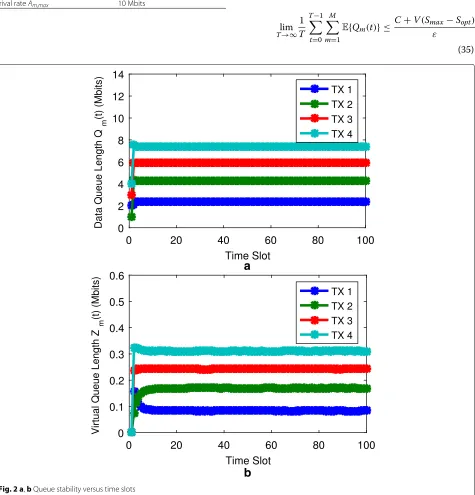
Figure 2 shows the queue length of the data queue
Qm(t) and the virtual power queue Zm(t) versus time
slots, respectively. It can be observed that both the data queue and the virtual queue are bounded after a period of time, which guarantees the stability of network. The phe-nomenon can be well explained by the first property in
Theorem3.
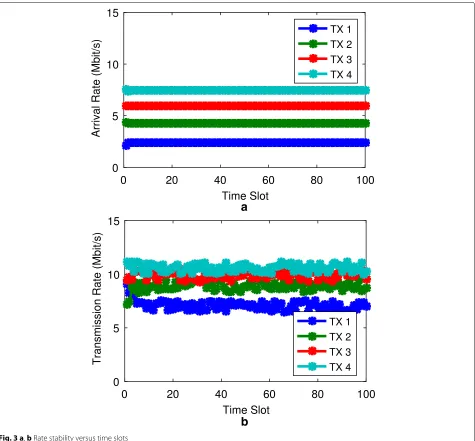
Figure 3 shows the transmission rate and arrival
rate versus time slots, respectively. It can be observed that both the transmission rate and arrival rate are
stable, which guarantees the long-term time-averaged power constraint. In addition, the fluctuation of arrival
rate in Fig. 3a is smaller than that of transmission
rate in Fig. 3b. The reason is that the arrival rate
is only related to the stable queues Q(t) and Z(t),
while the transmission rate is not only related to the
stable queues Q(t) and Z(t), but also related to the
transmission power and channel gain, which is vary-ing across time slots. Therefore, the transmission rate remains stable over a larger range of values compared with the arrival rate.
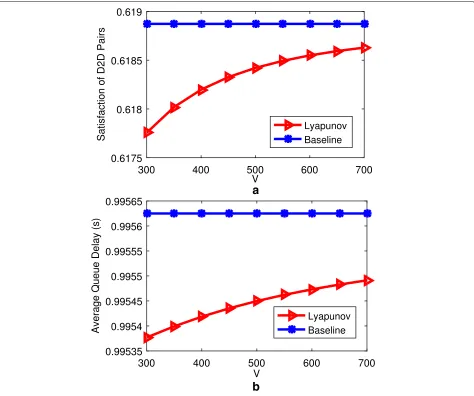
Figure 4 shows the satisfaction of D2D pairs and the
average network delay versus the control parameter V, respectively. It can be observed that the satisfaction of D2D pairs and the average network delay increase
as V increases. The reason is consistent with the
sec-ond and third properties of Theorem 3. Furthermore,
a
a
b
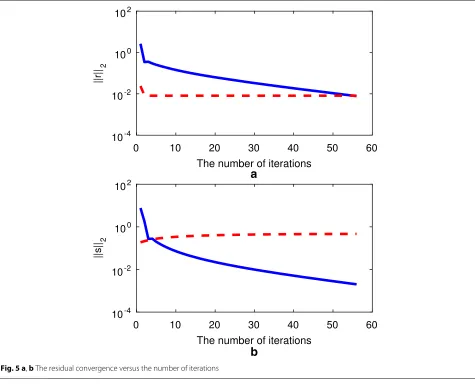
Fig. 5 a,bThe residual convergence versus the number of iterationsthe snapshot based algorithm [10] is denoted as the baseline algorithm to maximize instantaneous satisfaction of all D2D pairs for the purpose of compari-son. Typically, the baseline algorithm only considers the service demands of users in short-term while ignoring the power constraint and stability of the network in long-term. It can be observed that the proposed algorithm can approximate to 99.9% of the optimal satisfaction of D2D pairs with lower average network delay. The rea-son is that the proposed algorithm can simultaneously optimize the arrival rate in network layer and the power allocation in physical layer from a global long-term
perspective. Figure 5 shows the residual convergence
of the ADMM algorithm versus the number of itera-tions. The stopping criterion constraints pri and dual
are represented by the dotted lines in Fig. 5a and b,
respectively. It can be observed that the stopping cri-terion can be satisfied after 57 iterations in Fig. 5a and 4 iterations in Fig. 5b. The iterations will stop if and only if both the primal residual and the dual residual conditions are satisfied simultaneously, i.e., after 57 iterations, which is consistent with the first property of
Theorem4.
Figure 6 shows the the optimal convergence of the
ADMM algorithm versus the number of iterations. It shows the convergence of objective function, which demonstrates that the proposed algorithm can obtain the optimal solution of the objective function, i.e., 8.75. The reason can be explained by the second property of Theorem4. In addition, the dual variables will converge after multiple iterations due to the derivation from the pri-mal variables, which is consistent with the third property of Theorem4.
Table 2 shows the simulation analysis by using CVX
toolbox approach and ADMM-based power allocation algorithm. On one hand, it can be observed that the convergence time of ADMM-based power allo-cation algorithm requires 0.021236 seconds, which is only about 1.7% of the convergence time by using the CVX toolbox approach. Due to the fast convergence of the ADMM algorithm, the ADMM-based power allo-cation algorithm can get the optimal solution with lower computational complexity within error tolerance at each time slot. On the other hand, 4 TXs share the
Table 2Comparison of algorithm complexity
1 Term CVX toolbox ADMM algorithm
Calculating time 1.232408 s 0.021236 s Power allocation p1=0.090546 p1=0.082289
p2=0.171437 p2=0.168075 p3=0.237371 p3=0.241891 p4=0.300646 p4=0.315196
total power of 0.8 W at each time slot, which proves the feasibility of the proposed power allocation algo-rithm. The table shows that the power allocation var-ied with the channel states and the service demands of different TXs.
5 Conclusion
In this paper, we propose the D2D-based relay frame-work to improve the reliability and reduce delay of the network. Based on the Lyapunov optimization, the cross-layer joint optimization problem is separated into two independent rate control subproblem and power alloca-tion subproblem, which can be solved by using KKT con-ditions and ADMM algorithm, respectively. The tradeoff between network delay minimization and satisfaction maximization of D2D pairs with [O(V1),O(V)] can be obtained by the proposed algorithm, which has been veri-fied by the simulation results.
In the future work, we will improve the performance of the network while considering device mobility from a long-term perspective. Furthermore, we will study how to combine Lyapunov optimization and ADMM algo-rithm with big data or machine learning to deal with high complexity problems.
Appendix
Appendix 1: Proof of Theorem2
According to(max{Q−b, 0}+A)2≤Q2+b2+A2+2Q(A− b), where Q, b and A are non-negative real numbers, we obtain the following expression:
Appendix 1: Proof of Theorem3
In order to minimize the RHS of (14) with constraints C1∼C3, we obtain the following expression:
((t))−VE the following expression satisfys:
((t))−VE
By applying the rules of iterated expectation and tele-scoping sums, we obtain:
E{L((t))} −E{L((0))} −V
rearrange terms and we obtain:
V
Similarly, by rearranging terms, (40) can be rewritten as:
ε
According to the definition of Lyapunov function, taking expectation and rearranging terms yield:
M We obtain the following expression by plugging (43) into (40) and rearranging terms:
M
which proves the stability of queues by changing the order of taking expectation and limit. QueueQm(t)is mean rate
stable according to (5), thusC5 can be satisfied. Similar
proof can be applied toZm(t)with slight modification.
Abbreviations
ADMM : Alternating direction method of multipliers; BS : Base station; CSI : Channel state information; D2D : Device-to-device; i.i.d. : Independent and identical distribution; KKT : Karush-Kuhn-Tucher; QoE : Quality of experience; QoS : Quality of service; QSI : Queue state information; RHS : Right side hand; RX : D2D receiver; TX : D2D transmitter
Acknowledgements
Thanks to Professor Liangrui Tang of North China Electric Power University for his guidance of this research.
Funding
This work was partially supported by the National Natural Science Foundation of China (NSFC) under grant number 61601181; the Fundamental Research Funds for the Central Universities under grant number 2017MS001.
Availability of data and materials Not applicable.
Authors’ contributions
YW wrote the manuscript and made a part of simulations. YH gave some suggestions and made a part of simulations. ZZ proposed the idea and revised this paper. All authors took an active role in the writing process of the document, and read and approved the final manuscript.
Competing interests
The authors declare that they have no competing interests.
Publisher’s Note
Springer Nature remains neutral with regard to jurisdictional claims in published maps and institutional affiliations.
Author details
1The State Key Laboratory of Alternate Electrical Power System with
North China Electric Power University, Beijing, China.2The Institute of
Telecommunications, 3810-193 Aveiro, Portugal.3The University of South
Wales, Pontypridd CF37 1DL, UK.4SCC, Lancaster University, Pontypridd,UK.
Received: 8 December 2018 Accepted: 28 March 2019
References
1. Z. Zhou, H. Liao, B. Gu, K. M. S. Huq, S. Mumtaz, J. Rodriguez, Robust mobile crowd sensing: when deep learning meets edge computing. IEEE Netw.32(4), 54–60 (2018)
2. Z. Zhou, H. Yu, C. Xu, Y. Zhang, S. Mumtaz, J. Rodriguez, Dependable content distribution in D2D-based cooperative vehicular networks: a big data-integrated coalition game approach. IEEE Trans. Ind. Informat.19(3), 953–964 (2018)
3. M. Sheng, Y. Li, X. Wang, J. Li, Y. Shi, Energy efficiency and delay tradeoff in device-to-device communications underlaying cellular networks. IEEE J. Sel. Areas Commun.34(1), 92–106 (2016)
4. C. Xu, J. Feng, Z. Zhou, J. Wu, C. Perera, Cross-layer optimization for cooperative content distribution in multihop device-to-device networks. IEEE Internet Things J.99, 1–1 (2017)
5. Z. Zhou, M. Dong, K. Ota, G. Wang, L. T. Yang, Energy-efficient matching for resource allocation in D2D enabled cellular networks. IEEE Internet Things J.3(3), 428–438 (2016)
6. S. Dang, G. Chen, J. P. Coon, Multicarrier relay selection for full-duplex relay-assisted OFDM D2D systems. IEEE Trans. Veh. Technol.67(8), 7204–7218 (2018)
7. L. Pu, X. Chen, J. Xu, X. Fu, D2D fogging: An energy-efficient and incentive-aware task offloading framework via network-assisted D2D collaboration. IEEE J. Sel. Areas Commun.34(12), 3887–3901 (2016) 8. L. Chen, S. Zhou, J. Xu, Computation peer offloading for
energy-constrained mobile edge computing in small-cell networks. IEEE/ACM Trans. Netw.26(4), 1619–1632 (2018)
9. Y. Guo, Q. Yang, J. Liu, K. S. Kwak, Cross-layer rate control and resource allocation in spectrum-sharing OFDMA small-cell networks with delay constraints. IEEE Trans. Veh. Technol.66(5), 4133–4147 (2017) 10. Y. Guo, Q. Yang, K. S. Kwak, Quality-oriented rate control and resource
allocation in time-varying OFDMA networks. IEEE Trans. Veh. Technol. 66(3), 2324–2338 (2017)
11. M. Peng, Y. Yu, H. Xiang, H. V. Poor, Energy-efficient resource allocation optimization for multimedia heterogeneous cloud radio access networks. IEEE Trans. Multimedia.18(5), 879–892 (2016)
12. C. Liang, F. R. Yu, H. Yao, Z. Han, Virtual resource allocation in
information-centric wireless networks with virtualization. IEEE Trans. Veh. Technol.65(12), 9902–9914 (2016)
13. N. Li, Z. Fei, C. Xing, D. Zhu, M. Lei, Robust low-complexity MMSE precoding algorithm for cloud radio access networks. IEEE Commun. Lett. 18(5), 773–776 (2014)
14. Q. Ling, Y. Liu, W. Shi, Z. Tian, Weighted ADMM for fast decentralized network optimization. IEEE Trans. Signal Process.64(22), 5930–5942 (2016) 15. E. Chen, M. Tao, ADMM-based fast algorithm for multi-group multicast
beamforming in large-scale wireless systems. IEEE Trans. Commun.65(6), 2685–2698 (2016)
16. G. Zhang, Y. Chen, Z. Shen, L. Wang, Distributed energy management for multi-user mobile-edge computing systems with energy harvesting devices and QoS constraints. IEEE Internet Things J., 1–1 (2018) 17. Z. Zhou, F. Xiong, C. Xu, Y. He, S. Mumtaz, Energy-efficient vehicular
heterogeneous networks for green cities. IEEE Trans. Ind. Informat.14(4), 1522–1531 (2018)
18. C. Xu, J. Feng, B. Huang, Z. Zhou, S. Mumtaz, J. Rodriguez, Joint relay selection and resource allocation for energy-efficient D2D cooperative communications using matching theory. Appl. Sci.7(5), 491–515 (2017) 19. J. Liu, Q. Yang, S. G, Congestion avoidance and load balancing in content
placement and request redirection for mobile CDN. IEEE/ACM Trans. Netw.26(2), 851–863 (2018)
20. A. Asadi, Q. Wang, V. Mancuso, A survey on device-to-device communication in cellular networks. Commun. Surveys Tuts.16(4), 1801–1819 (2014)
21. H. Kim, J. Na, E. Cho, inProceedings of the International Conference on Information Networking 2014. Resource allocation policy to avoid interference between cellular and D2D links/ and D2D links in mobile networks (IEEE, Phuket, 2014), pp. 588–591
22. P. Mach, Z. Becvar, T. Vanek, In-band device-to-device communication in OFDMA cellular networks: A survey and challenges. Commun. Surveys Tuts.17(4), 1885–1922 (2015)
23. M. J. Neely,Stochastic Network Optimization with Application to Communication and Queueing Systems. (Morgan and Claypool, San Rafael, 2010)
24. M. Chen, S. S. M. Ponec, J. Li, P. A. Chou, Utility maximization in peer-to-peer systems with applications to video conferencing. IEEE/ACM Trans. Netw.20(6), 1681–1694 (2012)
25. W. Bao, H. Chen, Y. Li, B. Vucetic, Joint rate control and power allocation for non-orthogonal multiple access systems. IEEE J. Sel. Areas Commun. 35(12), 2798–2811 (2017)
26. D. Bertsekas, R. Gallager,Data Networks. (Prentice hall, NJ,USA, 1987) 27. L. Duan, T. Kubo, K. Sugiyama, J. Huang, T. Hasegawa, J. Walrand,
Motivating smartphone collaboration in data acquisition and distributed computing. IEEE Trans. Mobile Comput.13(10), 2320–2333 (2014) 28. C. Lu, J. Feng, S. Yan, Z. Lin, A unified alternating direction method of
multipliers by majorization minimization. IEEE Trans. Pattern Anal. Mach. Intell.40(3), 527–541 (2018)
29. Y. Li, G. Shi, W. Yin, L. Liu, Z. Han, A distributed ADMM approach with decomposition-coordination for mobile data offloading. IEEE Trans. Veh. Technol.67(3), 2514–2530 (2018)
30. Y. Wang, L. Wu, S. Wang, A fully-decentralized consensus-based ADMM approach for DC-OPF with demand response. IEEE Trans. Smart Grid.8(6), 2637–2647 (2017)
31. G. Chen, Q. Yang, An ADMM-based distributed algorithm for economic dispatch in islanded microgrids. IEEE Trans. Ind. Informat.14(9), 3892–3903 (2018)
32. L. Georgiadis, M. J. Neely, L. Tassiulas, Resource allocation and cross-layer control in wireless networks. J. Found. Trends Netw.1(1), 1–144 (2006) 33. S. Boyd, N. Parikh, E. Chu, B. Peleato, J. Eckstein, Distributed optimization
and statistical learning via the alternating direction method of multipliers. Found. Trends Mach. Learn.3(1), 1–122 (2011)
34. Z. Zhou, J. Feng, B. Gu, B. Ai, S. Mumtaz, J. Rodriguez, M. Guizani, When mobile crowd sensing meets UAV: Energy-efficient task assignment and route planning. IEEE Trans. Commun.66(11), 5526–5538 (2018) 35. Z. Zhou, K. Ota, M. Dong, C. Xu, Energy-efficient matching for resource