An Enhanced-NQCA Combined Metrics Based
Clustering Algorithm for MANETs
Anjana Rani Sikdar1, Deepak Kumar Xaxa2
1,2Computer Sc. and Engg. ,MATS University
Raipur, India
Abstract - There are the various researches that developed
clustering algorithm in order to improve the Quality of Services in Mobile ad-hoc networks. In this paper it is attempted to demonstrate the effectiveness of Enhanced-Node Quality based clustering algorithm in MANETs. The Enhanced-NQCA combined metrics based technique uses distinct node’s quality like degree, range mobility etc. for cluster head election process which diminish the probability of re-clustering and enhance the Quality of Services. The mobile nodes in MANETs dynamically change their topology and hence require an efficient mechanism to communicate with each other. There are numerous clustering algorithms for MANET environment categorized as mobility aware, load balancing clustering, energy proficient approach, combined metrics based clustering etc. Combined Metrics based clustering algorithms are preferred as more efficient in clustering as compared with the other clustering algorithms.
This paper is focused on node fidelity and mobic nature of mobile nodes and using these two node’s quality an algorithm is developed as Enhanced-NQCA algorithm which is a combined metrics based approach. Results shows that Enhanced-NQCA performs better result as compared to Weight based clustering algorithm (WCA) and Node Quality based Clustering algorithm (NQCA).
Keywords—Node Quality; Mobile Ad hoc Networks;Clustering; Quality of Sevices(QoS); Combined Metrics based Clustering Algorithm,Quality of Clustering(QoC).
I.INTRODUCTION
In excess of the decades, the use of personal communication devices like mobile phones, personal digital assistants (PDAs) and mobile computers, laptops have taken an exponential growth. The wireless interfaces enable the devices to interconnect directly with each other in a decentralized way and self-organize into “Ad Hoc Networks” with the help of cluster [1].
Nowadays clustering of mobile nodes becomes an important issue in all kind of wireless network. Clustering means a way to reconfigure all nodes into small virtual groups according to their regional locality and is defined as Cluster Head (CH) and cluster members that are gritty with the same statute Every clustering algorithm consists of two mechanisms: cluster configuration and cluster maintenance [2][22].
There are several mechanisms of clusters which are: Cluster Head, Cluster Members, and cluster Gateway.
Cluster head is a local controller, performing intra-cluster transmission arrangement, data forwarding, cluster
members are those ordinary nodes which are neither cluster head nor have any inter cluster associations, N on-cluster head node with inter-on-cluster associations access neighboring clusters, forward information between clusters, when non-cluster head nodes with inter-cluster associations access wants to communicate with other neighbor cluster, this is done by Cluster gateway. In mobile ad hoc network, where the topology changes habitually, selection of finest number of cluster heads is a NP-hard problem [3].
The basic requirement for Clustering is for dealing with the maintenance of mobile ad hoc networks is by partitioning the network into clusters. In this way it allows rapid connection and also better routing and topology administration of mobile ad hoc networks. It must be comprehensible though that a clustering technique is not a routing protocol.
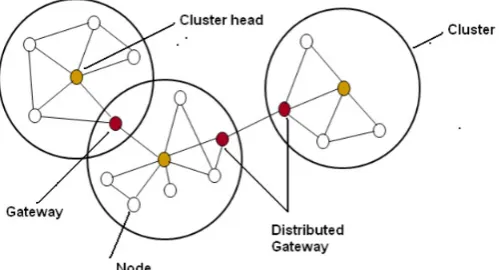
Fig 1 shows, the communication among different cluster with the help of cluster components. If there is extensive distance among clusters which wants to communicate CH consumes too much energy loss over the transmit data as compared to the cluster member (CM), which affects different QoS parameters like stability, reliability, throughput etc. This causes re-clustering and increases the probability of re-clustering. So clustering concept improves the QoS as compared to the traditional methods.
described result and comparative analysis and last one Section 6 defined Conclusion.
II.CLUSTERING IN MANETS
Cluster based structure, which is a typical synonym of the hierarchical structure in network topology, has become well-liked since last few decades to improve the routing efficiency in a dynamic network. This process deals with the development of a VCB, where the cluster heads map to the base stations in cellular architecture.
Clustering in MANET can be defined as the virtual partitioning of the dynamic nodes into a range of groups. Groups of the nodes are made with respect to their nearness to other nodes. Two nodes are said to be neighbour of each other when both of them lie within their transmission range and set up a bidirectional link between them. Clusters in MANET can be categorised as overlapping clusters or non-overlapping clusters as is shown in figure 1. The small circles represent the wireless nodes in the network. The lines unification the nodes symbolize the connection Figure 1: Overlapping and non-overlapping clusters connectivity among them. Cluster control structure forms the virtual backbone of communication where cluster heads are the communication hot spots.
The cluster head works as the local coordinator for its member nodes and does the resource management among them similar to a base station of cellular architecture. These cluster heads are answerable for inter cluster and intra-cluster communication. Inter cluster communication is made possible through the gateway nodes. A gateway node is a node that machinery as the common or distributed access point for two cluster heads. When a node lies surrounded by the transmission range of two cluster heads and supports inter cluster communication, it is called the ordinary gateway for two equivalent clusters.
The clustering schemes of MANETs can be classified according to different criteria. For example, depending on whether a special mobile node with extra functions, named a cluster-head, is required for a cluster, clustering protocols can be classified as cluster-head based clustering and non-cluster head based clustering or based on Hop distance between source to destination.
According to this clustering scheme can be classified as following-
DS-based clustering: Discover a (weakly) connected
dominating set to diminish the number of nodes participating in route search or routing table maintenance[7][8].
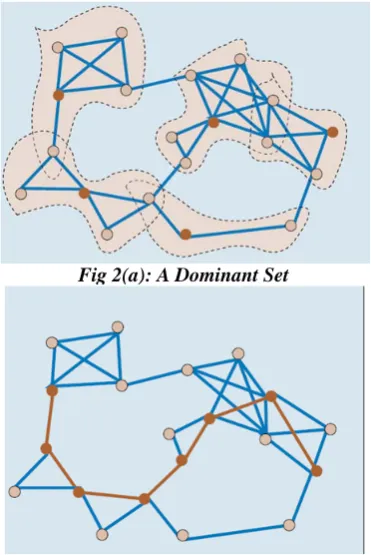
The main disadvantage of DS based clustering is local cluster head re-election may cause a ripple effect of re-clustering globally, and cause large communication overhead for the maintenance. Fig 2 (a) shows the Dominant Set and fig 2(b) shows a connected dominant set.
Fig 2(a): A Dominant Set
Fig 2(b): A connected Dominant Set
.
Low-maintenance clustering: Providing a cluster
infrastructure for upper layer applications with minimized clustering-related maintenance cost [6][10]. A number of low-maintenance clustering algorithms are Passive Cluster algorithm, Least Cluster change, 3-hop between adjacent cluster-head etc.
The primary disadvantage of Low maintenance based clustering algorithm is time complexity for those algorithms are difficult to determine. In the worst case, the number of rounds for completing the cluster formation procedure is equal to the number of clusters, which indicates that only one cluster-head is decided in each round.
Mobility-aware clustering: Such kind of algorithm
utilizes mobile node‘s mobility behavior for cluster construction and maintenance and assigning mobile nodes with low relative speed to the same cluster to tighten the connection in such a cluster [5][13]. A number of of the algorithm which belongs to mobility aware clustering is MOBIC, Distributed Dynamic Clustering Algorithm etc. The main annoyance of this type of clustering is it may forms overlapping structure and ripple affect too [23][24].
Energy-efficient clustering: A MANET should strive
to reduce its energy consumption greedily in order to prolong the network existence. Avoiding not inevitable energy consumption or balancing energy consumption for mobile nodes in order to prolong the lifetime of mobile terminals and a network. Some of the energy efficient algorithms are IDLBC, Wu’s Algorithm, Ryu’s algorithm etc [4][19].
Load-balancing clustering: Load-balancing
clustering algorithms suppose that there is an optimum number of mobile nodes that a cluster can handle, especially in a cluster-head-based MANET. Distributing the workload of a network more evenly into clusters by limiting the number of mobile nodes in each cluster in a defined range. Different Load Balancing clustering algorithms are AMC, DLBC etc.[11][18].
Combined-metrics-based clustering: Combined
Metrics based clustering usually consider multiple metrics such as node degree, cluster size etc. especially in cluster head decisions. With the consideration of more parameters, cluster heads can be more properly chosen without giving bias to mobile nodes with specific attribute. This approach is considered to be the best if working in clustering environment [12][17][21].
III.PROBLEM IDENTIFICATION
A lot of competitive research is going for solving the Cluster-head determination and betterment of QoS in MANETs. The challenges in this field are to design an effective clustering algorithm. Combined Metrics based clustering typically consider various metrics such as node degree, cluster size etc. especially in cluster head decisions. With the contemplation of supplementary parameters, cluster heads can be more appropriately chosen without giving bias to mobile nodes with specific attribute.
1. Node Fidelity
By node neighborhood fidelity, we mean the ability of neighbors to conserve their neighborhood as long as possible for a parent node. Actually, the neighbors can be positioned at different distances from their parent node. As this distance increases, the parent node neighborhood fidelity decreases and farther nodes are likely to leave the parent range zone at any time [12]. In the base paper, selection of neighbor node is only based upon the distance of that node to the parent node only. If the node will move from one location to another after taking the distance then
the Node neighborhood fidelity decreases because no behavior of nodes is taken into account.
2. Speed Variance Factor/ Mobility of Node
In MANET, speed is a primary factor of any node which is mandatory to be considered [9]. Taking the node which is more likely to move from one location to another as neighbor node will increases the probability of re-clustering. So speed of node must be taken into consideration.
To overcome from the above mentioned problem a novel combined metrics based clustering algorithm is developed named as Enhanced Node Quality based clustering algorithm.
IV. METHODOLOGY
4.1 Enhanced - Node Quality based Clustering Algorithm (E - NQCA)
The Enhanced-NQCA combined metrics based algorithm uses diverse node quality like degree, range mobility, load etc. for cluster head determination process which diminish the probability of re-clustering and enhance the Quality of Services.
4.1.1E - NQCA models
In E - NQCA (Node Quality based Clustered Algorithm), we propose four new models in clustering algorithms: Node priority and range zone aggregation models, Mobility Prediction model and Combined Indicator.
4.1.1.1Node Priority Aggregation Model
In WCA (Weighted Clustering based Algorithm) edge and isolated nodes can be selected as CHs. Actually, edge and remote nodes should be considered as undesirable CHs. The Enhanced - NQCA contribution is to rise above these inefficiencies detected in WCA and other similar clustering algorithms. Strong nodes are superior candidates and should be given first priority during the CH determination process. Therefore, we assign selection priorities to the nodes based on their degree in this order: priority of strong node>priority of weak node> priority of edge node and we set our node priority aggregation model. For this rationale, we set up the node type indicator (ntype), which is calculated as follows:
Ntype (Vi) = deg(Vi) ≥ 3 SN
deg (Vi) = 2 WN
deg (Vi) = 1 BN
Eq. (4.1) 4.1.1.2 Range Zone Aggregation Model
exaggerated, which decreases its chance to be selected as a CH. Motivated by these observations, Enhanced-NQCA virtually divide the transmission range of a parent node into three virtual zones situated within a circle with radius
r: excellent, intermediate and risked zones.
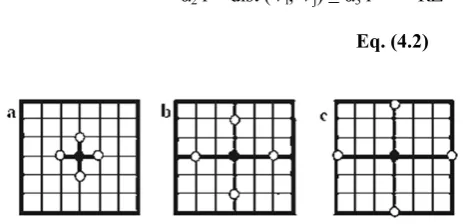
The first two zones contain trusted neighbors whose neighborhood is guaranteed for a well-defined period. However, the other neighbor nodes, which are situated in the risked zone, are considered as topologically inauspicious (untrusted) nodes because they can be assumed to leave the partition earlier than trusted nodes. In the direction of giving higher priority to trusted nodes and less priority to untrusted nodes during the CH selection processes, we introduce the following range indicator (rind):
rind (Vi, Vj) = dist (Vi, Vj) ≤α1 r EZ
α1 r < dist (Vi, Vj) ≤α2 r IZ
α2 r < dist (Vi, Vj) ≤α3 r RZ
Eq. (4.2)
Fig 4.1: Node Zone (a) Excellent Zone (b) Intermediate Zone (c) Risked Zone
Where α1, α2, α3 are input user coefficients. Fig. 4.1 (a), (b) and (c) depict these types of zones within a transmission range of radius r and virtually divided into three parts.
Each cluster have cluster member with one cluster head for each cluster.
4.1.1.3 Mobility Prediction Indicator:
The algorithm uses mobility based metric as cluster configuration basic and calculation of weights of the nodes in the network. To compute the relative motion of a node with respect to its neighbours, the algorithm have proposed to use the ratio of two consecutive signal strengths received by a node. Thus the relative mobility metric which is denoted as:
Myrel(X) = 10log10 RxPrnewX→Y Eq. (4.3)
RxProldX→Y
at a node Y with respect to X, gives either a positive or negative value depending on the value of the numerator. Here RxPr is the received signal power received from node X. When (RxPnewr X → Y ) > (RxPold r X → Y ) the result gives a positive value indicating that both the nodes are approaching each other. Similarly, when (RxPnew r X → Y ) < (RxPold r X → Y ) the logarithm of the ratio gives a negative value indicating that the nodes are moving away from each other[5][16].
Thus, a node having N number of neighbors will have N such values of Mrel Y . The aggregate local mobility My of a node Y is calculated by taking the
variance of the entire set of relative mobilities. That is, My
= var(Mrel Y (X1),Mrel Y (X2), ...,Mrel Y (Xl)) where the variance is taken with respect to 0. The motivation behind calculating the variance of relative mobility metric with respect to each neighbor is that, a lower value of My
indicates Y to be less mobile with respect to its neighbours. Hence, choosing a relatively low mobile node to act as a cluster head yields a better cluster stability [14][15].
4.1.1.4 Node combined indicator model:
Provoked by our previous models, we tried to assure a property which is based on the coexistence of above models. That is, we should select the CH having the utmost degree; having the utmost faithful neighbors situated in the excellent or in the intermediary zones and has less mobility factor.
The product of the three indicators assures their coexistence, which yields to the new node combined indicator:
Comind (Vi) = ntype (Vi) x rind (Vi ,Vj) xMy (Vi)
Eq. (4.4)
Next, we take profit of this interesting common indicator, to reformulate many new clustering formulas. Here ntype(Vi) is node type i.e. degree of the node, rind(Vi, Vj)
range indicator i.e. distance from the parent node and My
(Vi) is mobility of node Vi.
4.1.2 Quality of Clustering
The parameters assuring the "Quality of Clustering" (QoC). By QoC we mean the idea that cluster characteristics can be deliberate, enhanced, and, to some extent, guaranteed in advance. The objective of QoC is to provide assurance on the ability of a cluster to deliver predictable results. The node degree is a very important parameter which is used in many weighted clustering algorithms formulas.
Based on our proposed node combined indicator, we introduce a new measure which is "the node quality" and is calculated as follows:
ndq (Vi) = comind (Vi) x Deg (Vi)
Eq. (4.5) 4.1.2.1 Environmental distance
The distance between parent and neighbor nodes Vi and Vj respectively, is calculated without taken into
consideration the neighborhood fidelity. To rise above this inefficiency, and to assistance from common indicator, we introduce a new measure which is "the environmental distance". It takes into consideration the zone where the neighbor node Vi is situated and is calculated as follows:
envdist (Vi, Vj) = comind (Vi) x dist (Vi , Vj)
Here, envdist is environmental distance from node Vi to node Vj, comind is combined indicator
calculated using Eq. 4.4 and dist(Vi, Vj) distance from
node Vi to Vj. We are motivated to calculate the total
environmental distance from a parent node Vi to all the set
of its neighbors (n = |г (Vi)|) which are direct linked to it
(situated within its transmission range (RVi)):
ZD(Vi) = ∑nj=1 envdist (Vi, Vj)
Eq. (4.6)
Here ZD(Vi) is total environmental distance from parent
4.1.2.2 Clustering stability heightening
Despite the node mobility in MANETs, the cluster structure should be kept as stable as possible. Or else, frequent cluster change or re-clustering adversely affects the performance of radio resource allocation and scheduling protocols. By stability, we mean that the cluster structure remains unaffected for a given reasonable time period. Consequently, we set our stability factor for each node Vi as follows:
STF(Vi) = ZD(Vi)/ ndq (Vi) Eq. (4.7)
In Enhanced-NQCA algorithm, the neighbor nodes with higher STF(Vi) are considered good candidates to be
selected as CHs. The stability of the clustered topology can be achieved by reducing significantly on the number of clusters formed and the number of re-affiliations under different scenarios [20].
4.1.2.3 Load balancing clustering scheme
A system can contain high-density clusters and very low-density clusters. In such scenarios the high-density CH will be overwhelmed with processing and communication load, and will consume its energy quickly, while the low density CH will sit idle wasting precious time. Since we assume that all nodes are identical and produce data at the same rate, to balance load in the system we have to balance the number of nodes in a cluster and the communication energy required per CH. For this purpose, we calculate the relative dissemination degree, which imitates the relative deviation of the number of neighbors in a current setting from that ideal.
β (Vi) = |δ - ndq (Vi) |/ ndq (Vi) Eq. (4.8)
Where δ≤ 2ln (n) , is a constraint on the number of nodes that a CH can grip ideally N= |(V)|.
4.1.2.4 Energy consumption
Enhanced-NQCA evaluates the energy consumption. For this purpose, for every node Vi, it
compute the sum of the distances D (Vi), with its
neighbors N= ( | г (Vi) | ), as:
D (Vi) = ∑nj=1 dis (Vi, Vj) Eq. (4.9)
4.1.2.5. Remaining Battery energy
We have identified a faintness in WCA. It consists in computing the cumulative time during which a node acts as a CH. This cannot guarantee a good assessment of energy consumption since data communication consumes a large amount of energy and varies greatly from node to node. Consequently, we espouse a more simplified method. Each mobile node can effortlessly estimate its remaining battery energy RBF (Vi).
In view of that, a node with longer remaining battery lifetime is a better choice for a CH.
4.1.2.6. Sleep Time of Node:
It calculates the sleep time of each node. Sleep time is calculated as
St (X) = Ft + Rt + It
Eq. (4.10)
Here, Ft is time Forwarded time, Rt is receiving time and It
is Ideal time of node.
4.1.2.7. Combined Weight:
In E - NQCA algorithm, the preference of the CHs is based on the weight associated to each node: the smaller the weight of a node, the better that node is for the role of CH.
W (Vi) = W1 ZD(Vi) + W2 RBF (Vi) + W3
STF(Vi) + W4 β (Vi) + W5 (St) Eq. (4.11)
4.1.3 Enhanced – NQCA Algorithm: Input: G (V,E), Neighbor
Output: Set of Cluster-heads For each node ViƐ G
Begin
Evaluate relative Dissemination Degree (4.1). Evaluate Node Range (4.2).
Evaluate Relative Velocity of each node (4.3). Calculate Combines Indicator (4.4).
Calculate Node Quality (4.5).
Evaluate Quality of Clustering Parameter. Calculate Environmental Distance (4.6). Calculate Stability Factor (4.7).
Calculate Load balancing (4.8).
Calculate Energy Consumption (4.9). Calculate Sleeping time of node (4.10). Calculate W (Vi) using 4.11.
CW <- W (Vi): End
Sort CW in increasing order While CW is not empty.
Begin
Vi <- CW; CH <- Vi
Delete node Vi from CW;
all г (Vi) from CW
If (My = -Ve Value) x,y Location of Node; Calculate W (Vi);
End
V. ANALYSIS AND RESULTS
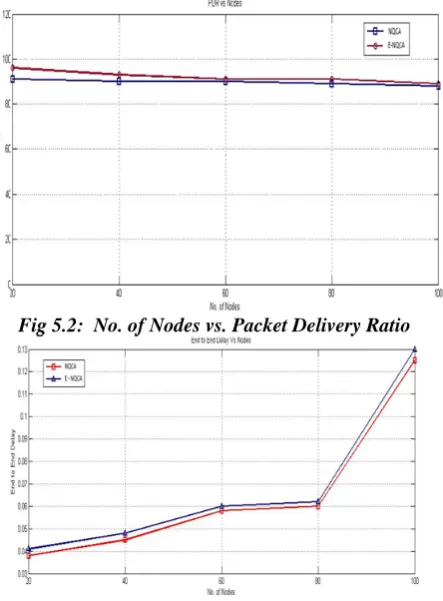
1. Calculation of different parameter for calculating combined weight for nodes shown in figure 5.1. 2. The graph for no. of nodes vs. packet delivery
ration shown in fig 5.2
Fig 5.1: Calculation of Node quality parameters for combine weight calculation of node.
Fig 5.2: No. of Nodes vs. Packet Delivery Ratio
Fig 5.3: No. of Nodes vs. End to End Delay
V. CONCLUSION
The conclusion of this paper can be encapsulated as follows:
The Enhanced-NQCA algorithm is compared with WCA and NQCA. Both algorithms are tested and analyzed in terms of end to end delay and packet delivery ratio comparatively. The result of the experiment shows that the Enhanced – NQCA gives better result than WCA and NQCA. In second set of experiment, QoC (Quality of Clustering) is calculated. Using those QoC, combined weight of different node is evaluated which choose best node as cluster head and decreases the probability of re-clustering. On comparing the above two experiments, it is found that QoS of MANETs is improve.
REFERENCES
[1] C. E. Perkins. Ad Hoc Networking. Addison Wesley, 2000.
[2] Wojciech Bednarczyk, Piotr Gajewski1. An Enhanced Algorithm for MANET Clustering Based on Weighted Parameters. Universal Journal of Communications and Network 2013; 1(3): 88-94. [2]
www.itrainonline.org/.../04_en_mmtk_wireless_basic-infrastructuretopology_slides.pdf.
[3] M. R. Garey and D. S. Johnson. Computers and Intractability: A guide to the theory of NP-completeness. Freeman, San Francisco. [4] J. Wu et al., “On Calculating Power-Aware Connected Dominating
Sets for Efficient Routing in Ad Hoc Wireless Networks,” J. Commun. and Networks, vol. 4, no. 1, Mar. 2002,pp. 59–70. [5] . Basu, N. Khan, and T. D. C. Little, “A Mobility Based Metric for
clustering in Mobile Ad Hoc Networks,” in Proc. IEEE ICDCSW’01,Apr. 2001, pp. 413–18.
[6] C. R. Lin and M. Gerla. Adaptive clustering for mobile wireless networks. IEEE Journal on Selected Areas in Communications, 15(7):1265–1275.
[7] J. Wu and H. L. Li, “On Calculating Connected Dominating Set for Efficient Routing in Ad Hoc Wireless Networks,” Proc. 3rd Int’l. Wksp. Discrete Algorithms and Methods for Mobile Comp. and Commun., pp. 7–14.
[8] Y.-Z. P. Chen and A. L. Liestman, “Approximating Minimum Size Weakly-Connected Dominating Sets for Clustering Mobile Ad Hoc Networks,” in Proc. 3rd ACM Int’l. Symp. Mobile Ad Hoc Net. & Comp., June 2002, pp. 165–72.
[9] Yuxin Chen, Sanjay Shakkottai and Jeffrey G. Andrews, “On the Role of Mobility for Multi-message Gossip”, IEEE TRANSACTIONS ON INFORMATION THEORY VOL:59 NO:6 YEAR 2013.
[10] W. D. Yang and G. Z. Zhang. A weight- based clustering algorithm for mobile ad hoc network. In Proceedings of 3rd International Conference on wireless and mobile communications (ICWMC ’07), page 3, Guadeloupe, March 2007.
[11] Supreet Kaur ,Varsha Kumari, “ Efficient Clustering with Proposed Load Balancing Technique for MANET” preceding of International Journal of Computer Applications (0975 – 8887) Volume 111 – No 13, February 2015.
[12] Mohamed Aissa, Abdelfettah Belghith, “A node quality based clustering algorithm in wireless mobile Ad Hoc networks” ,
Proceedings of ELSEVIER 5th International Conference on Ambient Systems, Networks and Technologies (ANT-2014). [13] A. B. McDonald and T. F. Znati, “Design and Performance of a
Distributed Dynamic Clustering Algorithm for Ad-Hoc Networks,” in Proc. 34th Annual Simulation Symp., Apr. 2001, pp. 27–35. [14] Editor in Chief, J.D. Gibson, “The Mobile communication
Handbook” CRC Press INC.
[15] C. – C. Chiang, H.- K. Wu. W., Liu, M. Gerla “Routing in Clusterhead multihop, Mobile Wireless Network with fading channel”, proceeding of SICON.
[16] S.Basagni. Distributed clustering for ad hoc networks. In Proceedings of International symposium on parallel architectures, algorithms and networks, pages 310–315.
[17] M. Chatterjee, S. K. Das, and D. Turgut. WCA: a weighted clustering algorithm for mobile Ad Hoc networks. Cluster Computing 5 2002; 193-204.
[18] A. D. Amis and R. Prakash, “Load-Balancing Clusters in Wireless Ad Hoc Networks,” in Proc. 3rd IEEE ASSET’00, Mar. 2000, pp. 25–32.
[19] J.-H. Ryu, S. Song, and D.-H. Cho, “New Clustering Schemes for Energy Conservation in Two-Tiered Mobile Ad-Hoc Networks,” in Proc. IEEE ICC’01, vo1. 3, June 2001, pp. 862–66.
[20] Mohamed Amine Abid and Abdelfettah Belghith, "Stability routing with constrained path length for improved routability in dynamic MANETs", The International Journal of Personnal and Ubiquitous Computing, Springer, April 12, 2011.
[21] M. Chatterjee, S. K. Das, and D. Turgut, “An On-Demand Weighted Clustering Algorithm (WCA) for Ad hoc Networks,” in Proc. IEEE Globecom’00, 2000, pp. 1697–701.
[22] V.Preetha, Dr.K.Chitra. Clustering & Cluster Head Selection Techniques in Mobile Adhoc Networks, proceedings of International Journal of Innovative Research in Computer and Communication Engineering, Vol. 2, Issue 7, July 2014.
[23] R. Ghosh and S. Basagni, “Limiting the impact of mobility on ad hoc clustering,” in Proceedings of the 2nd ACM International Workshop on Performance Evaluation of Wireless Ad Hoc, Sensor, and Ubiquitous Networks (PE-WASUN '05), pp. 197–204, Montreal, Canada, October 2005.