Indifferentiability Results and Proofs for Some Popular
Cryptographic Constructions
Jaiganesh Balasundaram
∗July 15, 2014
Abstract
The notion of indifferentiability, which is a stronger version of the classic notion of indistinguishability, was introduced by Maurer et al. in [MRH03]. Indifferentiability, among other things, gives us a way of “securely replacing” a random oracle of one type by a random oracle of a different type. Most indifferentiability proofs in the literature are very complicated, which makes them difficult to verify and in some cases, has even resulted in them being erroneous [CPS08]. In this paper, we use a simple yet rigorous proof technique for proving indifferentiability theorems. This technique is a generalization of the indistinguishability proof technique used by Bernstein in [Ber05] to prove the security of the Cipher Block Chaining (CBC) construction. We use this technique to prove the indifferentiability result for a very simple construction which processes just two blocks of input. This construction can be viewed as bearing close resemblance to the so called Sponge construction [BDPVA11a], on which the winner of SHA-3 competition [BDPVA11b] is based. Also as a warm up, we prove the indistinguishability result for this construction using the coupling argument from probability theory. We also prove the non-indifferentiability result for the CBC construction and some of its standard variants, and survey the indifferentiability and non-indifferentiability results for the Merkle-Damg˚ard (MD) construction, some of its standard variants, and the Feistel construction, from the literature.
1
Introduction
Arandom oracle of a certain type, is a large object, chosen uniformly at random from a class of objects of that type. An example of a random oracle is a functionf :{0,1}n → {0,1}n chosen uniformly at random from the set of all functions mapping {0,1}n to {0,1}n, and that can be queried as an oracle by an algo-rithm. Bellare and Rogaway, in [BR93], developed the “random oracle methodology”. In this methodology, all the parties, including the adversary have access to a random oracle, and the security of a cryptosystem is proved in this setting. This can be viewed as the proof of security of the cryptosystem in the “ideal world”. However, there are no random oracles in the real world, and hence while implementing the cryptosystem in the real world, the random oracle is replaced by an “appropriately chosen” concrete function, like the SHA-2 hash function (they stress that the cryptosystem should be “independent” of the concrete function which replaces the random oracle) and hope that the cryptosystem is secure in the real world. They claim that this method, when properly carried out, leads to secure and efficient protocols. In fact, several widely used cryptosystems that have been proven secure in the random oracle model (for example, the RSAES-OAEP encryption scheme which is a part of the PKCS #1 specification [JK03], is based on the OAEP scheme originally introduced by Bellare et al. in [BR95], and versions of which have been proven secure in the random oracle model [Sho01] [FOPS04]), and instantiated with a good hash function in the real world, have resisted attacks in the real world.
∗University of Toronto. Email:
However, Canettiet al., in [CGH04], showed that there exists a cryptosystem (albeit an unnatural one) that is secure in the random oracle model, but has no secure implementation in the real world. So, one should be very cautious in using the random oracle model because security of a cryptosystem in the random oracle model does not necessarily imply the security of the cryptosystem in the real world.
However, let us consider a different problem: the problem1 of “securely replacing” a random oracle of one
type by a random oracle of a different type. For example, say the problem of securely replacing a random oracle which takes inputs of arbitrary length by a random oracle which takes inputs of fixed length. By “securely replace”, we mean the obvious thing: if a cryptosystem is secure in the random oracle model in which the random oracle is of one type (say arbitrary input length random oracle), then the cryptosystem is secure in the random oracle model in which the random oracle is of another type (say fixed input length random oracle). The notion ofindifferentiability, introduced by Maurer at al. in [MRH03], gives you a way of rigorously defining this.
Since the notion of indifferentiability is a stronger version of the classic concept of indistinguishability, we first give an overview of indistinguishability before giving the high level idea of indifferentiability. We give rigorous definitions for both these notions in the next section.
The concept of indistinguishability was first rigorously defined by Blum and Micali in [BM84]. A crypto-graphic constructionC, that takes as input a random member (usually a large object) from a class of objects of a certain type (chosen according to a certain distribution), as an oracle, and outputs an object (that is usually large) of a certain type that can be queried by an algorithm as an oracle (so, effectively it has as input an oracle of a certain type, and outputs an oracle of a certain type), is said to be indistinguishable from ideally distributed version of the object it outputs (which is usually a random member from a class of objects of that type, chosen according to a certain distribution), if no distinguisher, which when given an oracle which is either the object output by the constructionCor the ideally distributed version of the object output by C, and is allowed to interactively query the oracle, can “significantly” tell the difference. There are different flavours of indistinguishability depending on the running time we allow for the distinguisher and the number of queries we allow it to make to the oracle. The flavour that we will be considering here is what we term “bounded oracle indistinguishability”, where we allow the running time of the distinguisher to be unbounded, but it is only allowed to make a bounded number of queries to the oracle. Consider the following popular Cipher Block Chaining (CBC) construction.
Definition 1.1. Let f be a function such that, f :{0,1}n → {0,1}n for every n∈
Z+. For everyn∈Z+,
define CBCf : {0,1}2n→ {0,1}n as follows
CBCf(xy) =f(f(x)⊕y)
wherex, y∈ {0,1}n.
It is a well known result [BKR00] [Ber05] thatCBCf, for a uniform randomf, is indistinguishable from a uniform random functionF mapping{0,1}2nto{0,1}n. However, note that in this model, the distinguisher does not have access to the functionf. Is this model strong enough for all scenarios? Consider the following real world example. Cryptographic hash constructions like the MD5, SHA1 and SHA2 are usually iterations (using a suitable method) over an underlying compression function that is publicly available. Say that our goal is to prove that a cryptographic hash function, when modelled as iterating over a uniform random compression function (a compression function chosen uniformly at random from the set of all compression functions of its type), appears to be uniformly distributed 2. In this scenario, it makes sense to allow the
1Of course, this problem is only interesting if you have considerable faith in the random oracle model.
2One might ask the question “What does this type of modelling accomplish?”, as the publicly available compression functions
adversary to have oracle access to the uniform random compression function, since in the real world, the compression function is publicly available to all the parties, including the adversary. So the indistinguisha-bility model is not a strong enough model for this scenario, since the distinguisher is not allowed to query the uniform random compression function.
The indifferentiability model solves this problem. Let us informally define indifferentiability using the above CBC example. The constructionCBCf (for a uniform randomf) is said to beindifferentiable from a uni-form randomF mapping{0,1}2n to{0,1}n, if there exists an “efficient” simulator algorithmS, that having oracle access to F, tries to simulatef in response to a bounded number of queries made to it, such that, no distinguisher, which when given a pair of oracles, which is either CBCf, f (for a uniform random f), orF, SF (for a uniform randomF), and is allowed to interactively query both the oracles, can significantly tell the difference. By an “efficient” simulator, we mean that the simulator has bounded running time (in particular, it makes bounded number of oracle queries toF). Again, there are different flavours of indiffer-entiability depending on the running time we allow for the distinguisher and the number of queries we allow it to make to the oracles. The flavour that we will be considering here is what we term “bounded oracle indifferentiability”, where we allow the running time of the distinguisher to be unbounded, but it is only allowed to make a bounded number of queries to the oracles.
This paper primarily deals with indifferentiability results and indifferentiability proofs for some popular cryptographic constructions.
1.1
A Note on the Adversaries
Since the adversaries that we consider are distinguishing algorithms that are allowed to have unbounded running time, it sufficient to consider only the deterministic distinguishers. This is because, if there is a probabilistic distinguisher that does well, then we can fix the randomness and get a deterministic distinguisher that does as well as the probabilistic distinguisher.
1.2
Motivation for Good Security Proofs
Security proofs form an integral part of cryptography. In addition to being correct and rigorous, it helps if a security proof is easy to understand3, as it helps the readers to verify the proofs and hence making them less
error-prone. As an example, let us consider the different proofs available for the above CBC construction in the literature. Though it was folklore that the construction is secure, the first rigorous treatment was given by Bellareet al. in [BKR00]. Though the construction and the security notion (indistinguishability) were quite simple, the proof was enormously complicated. Maurer, in [Mau02], provided a simpler proof of indistinguishability for this construction, using the framework for proving indistinguishability theorems that he introduced in the same paper. Bellare et al. further simplified the proof in [BR06] using their so called “Code-based game-playing Framework”. In [Ber05], Bernstein gave a very short and elegant, albeit less intuitive proof of security for the same construction. This proof is the simplest rigorous proof of the construction we have seen in the literature so far.
Indifferentiability proofs are infamous for being highly complicated [CPS08][HKT10]. One might argue that, since indifferentiability is a stronger notion than indistinguishability, it is not wrong to expect that the indifferentiability proof of a construction to be at least as complicated as (and in most cases strictly more
there is a problem with the iteration method. However, if we have that the cryptographic hash function (when modelled as iterating over a uniform random compression function) appears to be uniformly distributed, then this doesn’t tell us much about the real world version of this hash function, since the real world compression function is certainly not a uniform random function, and can have some bad properties which this model fails to capture. We conclude that we do not have a very good answer for this question, and agree that the motivation here is not very concrete.
3Of course, a proof being easy to understand is a very subjective thing, as it depends on many factors like the cryptographic
complicated than) its corresponding indistinguishability proof. While this is indeed true, the intricacy of many of these proofs have made them difficult to understand and review, and in some cases, resulted in them being erroneous. For example, Coronet al. in [CPS08] showed that a 6 round Feistel construction involving six independent uniform random functions mapping{0,1}n to {0,1}n resulted in a permutation (together with its inverse) mapping {0,1}2n to {0,1}2n that was indifferentiable from a uniform random permuta-tion (together with its inverse) mapping {0,1}2n to {0,1}2n. The proof was quite complicated. However, Holensteinet al. in [HKT10] gave a simple distinguishability attack which invalidated the whole proof of [CPS08]. In [HKT10], they prove a similar theorem for a 14 round Feistel construction, which is again quite complicated, but is believed to be true. The point is, an erroneous proof was thought to be correct by (most of) the community for almost 2 years! One wouldn’t be entirely wrong if they were to attribute this to the intricacy of the proof that made spotting the error much harder.
This motivates us to ask the following question: Is there a simple yet rigorous proof technique for proving indifferentiability theorems that makes the proofs easy to understand and verify? One of the central goals of this paper is to take steps towards resolving this question.
1.3
Our Contribution
As stated above, one of the main contributions of this paper is to use a proof technique for the indifferentia-bility setting, which builds on the work of Bernstein in [Ber05] and Vaudenay in [Vau03] which were in the indistinguishability setting. The technique we use also bears resemblance to the proofs of Maurer in [Mau02] and Bellare in [BR06] which were again, in the indistinguishability setting. More particularly, consider the following construction which resembles the CBC construction.
Definition 1.2. Let f be a function such that, for every positive even integern,f :{0,1}n→ {0,1}n. For
every positive even integern, define If :{0,1}n→ {0,1}n as follows
If(xy) =f(f(x0n/2)⊕y0n/2)
wherex, y∈ {0,1}n/2.
This construction can also be viewed as closely resembling the Sponge Construction [BDPVA11a] on which the recent winner [BDPVA11b] of the SHA-3 competition is based. We describe the proof technique in detail via the proof of the indifferentiability of the constructionIf (for a uniform random f), from a uni-form random function F :{0,1}n → {0,1}n (chosen independently of f). That is, informally speaking, we give an efficient simulator algorithm S that has oracle access to F and tries to simulate f (in response to a polynomial number of queries made to it), such that no distinguisher that makes a polynomial number of queries to a pair of oracles that is either (If, f) or (F, SF), can distinguish between them, except with negligible probability. Though there are proofs of more complicated versions of this construction (which we will talk about in Section 8) in the literature, to the best of our knowledge, we have not come across a proof of this particular construction, and hence this proof can be considered as one of our contributions in this paper. Also, we find most of these proofs in the literature to be confusing, missing a few vital steps, or a combination of both, and hence they are difficult to understand.
Since we will be closely following Bernstein’s technique and adapting it to the indifferentiability setting, we first give an overview of his technique before presenting a brief outline of the technique we use. We present a more detailed outline of the technique we use and an indifferentiability proof of the above construction using this technique in Section 7. Bernstein in [Ber05], shows thatCBCf, for a uniform randomf, is indis-tinguishable from a uniform random functionF :{0,1}2n → {0,1}n. The outline is as follows. Let games
G1 and G2 correspond toD interacting with distributionsF andCBCf respectively. For each i∈ {1,2},
letpibe the probability thatD accepts in GameGi. We want to show that|p2−p1|is close to 0. Bernstein
than equal to the (1−) times the probability (over the choice ofF) that we get the given answer sequence for the given query sequence in GameG1. Then, he uses this theorem to give a fairly straightforward proof
that|p2−p1| ≤(Theorem 3.1 in [Ber05]).
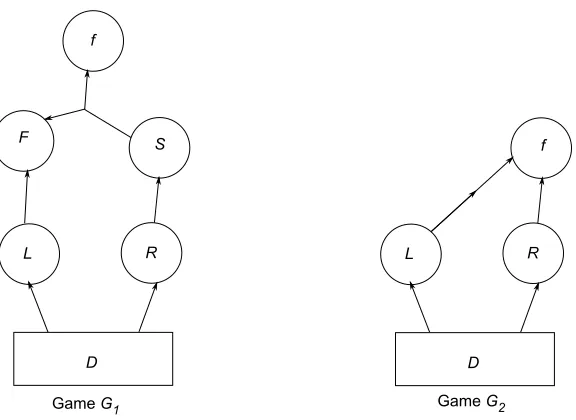
We would like to see if we can directly use this technique in proving indifferentiability of the constructionIf (for a uniform randomf), from a uniform random functionF :{0,1}n → {0,1}n. LetSF be the simulator that we will define in Algorithm 1 of Section 7. Let gamesG1andG2correspond toDinteracting with
distri-butions (F, SF) and (If, f) respectively. For eachi∈ {1,2}, letp
ibe the probability thatDaccepts in Game
Gi. We want to show that|p2−p1|is close to 0. Following Bernstein, let us fix the query-answer sequence.
If we can prove that for each fixed query-answer sequence, the probability (over the choice off) that we get the given answer sequence for the given query sequence in GameG2is greater than equal to the (1−) times
the probability (over the choice ofF) that we get the given answer sequence for the given query sequence in GameG1, then we can use Theorem 3.1 of [Ber05] to prove that|p2−p1| ≤and we will be done. However,
in Section 7, we will give a counter-example proving that is indeed not the case. More specifically, we will exhibit a query-answer sequence that happens with a positive probability in GameG1 and zero probability
in GameG2. For this query-answer sequence, it is clear that the probability (over the choice off) that we
get the given answer sequence for the given query sequence in GameG2 is less than (1−) times the
prob-ability (over the choice ofF) that we get the given answer sequence for the given query sequence in GameG1
So, we will rule out such query-answer sequences (that happen with a positive probability in GameG1 and
zero probability in GameG2), and prove that for everyD, probability thatDcauses a ruled out query-answer
sequence in GameG1is small, say1 (where1 is a function of the number of queries we allowD to make).
Now, for each query-answer sequence that have not been ruled out, we will prove that the probability (over the choice off) that we get the given answer sequence for the given query sequence in GameG2 is greater
than equal to the (1−) times the probability (over the choice ofF) that we get the given answer sequence for the given query sequence in GameG1. Using these two results, we will extend Theorem 3.1 of [Ber05] to
prove that|p2−p1| ≤+1. Summarizing the approach,
1. Define a notion of “ruled out query-answer sequences”. This notion will include query-answer sequences that occur with zero probability in Game G2 but with some positive probability in GameG1, but also
some other query-answer sequences (that we include for convenience, see Section 7 for more details).
2. For everyD, prove that the probability (over the choice ofF) thatDcauses a ruled out query-answer sequence to occur in Game G1 is small, say1.
3. Prove that for all fixed query-answer sequences that have not been ruled out, the probability (over the choice off) that we get the given answer sequence for the given query sequence in Game 2 is greater than or equal to (1−) times the probability (over the choice of F) that we get the given answer sequence for the given query sequence in Game 1.
4. Use (2) and (3) to prove that|p2−p1| ≤+1.
So, Steps 1 and 2 are a new addition compared to the original proof of [Ber05]. Step 4 is an extension of Theorem 3.1 of [Ber05]. Also, for proving Step 3, we will be using a more intuitive Bayesian approach, as opposed to the counting argument of [Ber05].
Of course, proving the indifferentiability of If (for a uniform random f) is just a starting step, since the construction processes only two blocks of input. The fact that the output length of the construction equals the input length of the construction makes this indifferentiability proof more of a curiosity than anything else, since the construction by itself doesn’t seem very useful in practice. We aim to extend this technique to get the indifferentiability proofs of more general constructions (such as the one similar to the construction
Definition 1.3. Let f be a function such that, for every positive even integern,f :{0,1}n→ {0,1}n. For
every positive even integern, define I0f : ({0,1}n/2)∗→ {0,1}n recursively as follows.
I0f() = 0n
I0f(xy) =f(I0f(x)⊕y0n/2)
wherex∈({0,1}n/2)∗,y∈ {0,1}n/2 and is the empty string.
We would like to use the above proof technique to prove thatI0f (for a uniform randomf) is indifferentiable from a uniform random functionF : ({0,1}n/2)∗→ {0,1}n. As we had stated earlier, though this construc-tion resembles the sponge construcconstruc-tion on which much work has been done, to the best of our knowledge we have not yet found an indifferentiability proof for this particular construction (or even for the simpler caseIf which processes only two blocks of input). People have proved indifferentiability results for much more complicated versions of this construction, like the construction which is similar toI0f, but some bits are truncated from the output [BDPVA08]. People have also given the proof for a technically stronger indif-ferentiability theorem for this version, where the uniform random function is replaced by a uniform random permutation together with its inverse (technically stronger in the sense that, the simulator in that proof simulates both the permutation and its inverse) [BDPVA08][AMP12]. We briefly talk about the indifferen-tiability results of constructions like these, in Section 8. Specifically, we prove that the constructionIp, for a uniform random permutationp(together with its inverse), is not indifferentiable from a uniform random func-tionF:{0,1}n→ {0,1}n, and one of the ways of making the construction work (that is, slightly modifying the construction to getting an indifferentiability theorem out of it) is to drop some bits from the output ofIp.
Also, as a warm up before presenting the indifferentiability proof ofIf using this technique, we present the proof of indistinguishabulity ofIf (for a uniform randomf) from a uniform random functionF :{0,1}n→
{0,1}n. Though this construction is similar to the CBC construction, it turns out that we can get an indis-tinguishability proof that is much simpler and more intuitive than the technique Bernstein uses in [Ber05] for the indistinguishability proof of the CBC construction. The trick we use here is calledcoupling [Lin92] [Tho00], from probability theory. The high level idea is as follows. Using the conventions we used before, let gamesG1 andG2 correspond toDinteracting with distributionsF andIf respectively. For eachi∈ {1,2},
letpi be the probability thatD accepts in GameGi. We want to show that|p2−p1|is close to 0. That is,
we would like to show that with high probability, the outcomes (that is, the answers to the queries thatD
makes) of both the games are identically distributed. To argue this, we couple the games by running both the games together withcommon randomness and argue that with high probability, the outcome of both the games (when run with common randomness) are identical.
We also provide negative results regarding the indifferentiability of the Cipher Block Chaining construction
CBCf (for a uniform randomf) and some standard variants of the CBC construction.
In the beginning of the paper, we also survey some results regarding the indifferentiability of the Merkle-Damgard (MD) construction and the Feistel construction.
After completing most of this work, we learned that a proof technique similar to the one we use in this paper, had previously been used in the indifferentiability proof of a variant of the MD construction in [CN08a].
1.4
Related Work
As we mentioned earlier, the technique we use for proving indifferenitability theorems is an extension of the technique used by Bernstein in [Ber05] to prove the security of the CBC construction in the indistinguisha-bility setting. The technique we use also bears resemblance to the technique used by Vaudney in [Vau03], Maurer in [Mau02] and Bellare et al. in [BR06], all in the indistinguishability setting. The construction
indifferentiability proofs for the different versions of sponge construction appear in [BDPVA08], by the same authors. Andreevaet al. generalized the sponge construction and proved the indifferentiability results for the same in [AMP12]. The indifferentiability results for the MD construction and some of its standard variants that we survey in this paper, are from [CDMP05]. The indifferentiability results for the Feistel construction that we survey in this paper are from [CPS08],[HKT10] and [MPS12]. The instances of the use of coupling arguments in cryptography that we could find were, for the analysis of RC4 cipher by Mironov in [Mir02], and for the analysis of Feistel networks by Morriset al. in [MRS09] and Hoanget al. in [HR10].
1.5
Organization of the Paper
The paper is organized as follows. In Section 2, we present some notations and definitions that we will be using in the rest of the paper. In Section 3, we present some negative results regarding the indifferentiability of CBC construction and some of its standard variants. In Section 4, we survey some results from the literature regarding the indifferentiability of the MD construction and some of its standard variants. In Section 5, we survey some results from the literature regarding the indifferentiability of the Feistel construction. In Section 6, we present the proof of indistinguishability of the constructionIf (for a uniform randomf), from a uniform random functionF :{0,1}n → {0,1}n (chosen independently off), using coupling. Our main result is in Section 7, where we give a more detailed outline of the technique we use for proving indifferentiability theorems and present the proof of indifferentiability of the constructionIf (for a uniform randomf), from a uniform random function F : {0,1}n → {0,1}n using the technique. In Section 8, we investigate the indifferentiability of construction Ip, for a uniform random permutationp(together with its inverse), from a uniform random function F :{0,1}n → {0,1}n. We conclude and present further directions for research in Section 9.
2
Preliminaries
2.1
Notations
• Ndenotes the set of all natural numbers andZ+ denotes the set of all positive integers. • For every m, n∈Z+,Fnmdenotes the set of all functions mapping{0,1}n to{0,1}m
• For everyn∈Z+,
Pndenotes the set of all permutations (together with their inverses) mapping{0,1}n to {0,1}n.
• For any distributionD, the notationd←D denotes randomly choosing a memberdaccording to the distributionD.
2.2
Indistinguishability
In this subsection, we give a meta-definition of indistinguishability. Since this is just a meta-definition, we will be intentionally vague about the types of some objects here. We will be more explicit as to what these types are, when we use this definition to state indistinguishability theorems about constructions, in the upcoming sections.
LetF ={Fn}n∈Z+ and G={Gn}n∈Z+ be two families of distributions parametrized byn. In each family,
Definition 2.1 (Indistinguishability). A deterministic construction C with oracle access to a distribution family F is said to be indistinguishable from a distribution family G if {Cnf | f ← F } is bounded oracle
indistinguishable from{g| g← G}.
By “bounded oracle indistinguishable” we mean that, for every bounded oracle distinguisher D (we will shortly say what we mean by a bounded oracle distinguisher), the following holds. D is given 1n and an oracle of type G with parameter n, which is either Cf
n (for a random member f from Fn) or a random membergfromGn. LetP r[DC
f
n(1n) = 1] denote the probability (over the choice off) thatDaccepts if the oracle wasCf
n andP r[Dg(1n) = 1] denote the probability (over the choice ofg) thatD accepts if the oracle wasg. Then, for every cand sufficiently large n, we have that
|Pr[DCnf(1n) = 1]−Pr[Dg(1n) = 1]| ≤ 1
nc
By bounded oracle distinguisher, we mean that we do not care about the running time of the distinguisher and we only care that it makes a bounded number of queries to the oracle, that is, the total number of queries made by the distinguisher to the oracle is a polynomial inn.
We present an example here. Recall the CBC construction which we defined in the previous section. Using the above meta-definition, we will be stating the theorem that CBCf (for a uniform randomf :{0,1}n →
{0,1}n) is indistinguishable from a uniform random F : {0,1}2n → {0,1}n. We won’t be proving this theorem since it is a well known result, as discussed in the previous section.
Theorem 2.2. LetXn be the uniform distribution on the setF2nn and letYn be the uniform distribution on
the setFnn, for every positive integer n. LetX ={Xn} andY={Yn}. Then, the constructionCBC having
oracle access to the distribution familyY is indistinguishable from the distribution family X.
2.3
Indifferentiability
In this subsection, we give a meta-definition of indifferentiability. Since this is just a meta-definition, we will be intentionally vague about the types of some objects here. We will be more explicit as to what these types are, when we use this definition to state indifferentiability theorems about constructions, in the upcoming sections.
LetF ={Fn}n∈Z+ and G={Gn}n∈Z+ be two families of distributions parametrized byn. In each family,
for each n, the distribution is over functions or a tuple of functions having as domain and range a set of strings (the length of which depends on n). Let C be a deterministic construction that has as input the parametern and a random member f from Fn as an oracle, and outputs an oracleCnf ∈ Gn that can be queried by an algorithm. A “simulator” is a probabilistic algorithm that has as input the parameter n
and a random member g from Gn as an oracle, and outputs an oracle Sng ∈Fn that can be queried by an algorithm. We define what it means for the constructionC with oracle access to the distribution family F
to be indifferentiable from the distribution familyG.
Definition 2.3 (Indifferentiability). A deterministic construction C with oracle access to a distribution family F is said to be indifferentiable from a distribution family G if there exists a probabilistic, effi-cient, oracle simualtor algorithm S such that, {(Cf
n, f)|f ← F } is bounded oracle indistinguishable from
{(g, Sg
n)|g← G}.
By “bounded oracle indistinguishable” we mean that, for every bounded oracle distinguisherD, the following holds. D is given 1n, an oracle of typeG with parametern(let’s call it the Left oracleL) and an oracle of typeF with parametern(let’s call it the Right oracleR), where the pair of oraclesL, R, is eitherCf
n, f (for a random memberf from Fn) org, Sng (for a random memberg from Gn). LetP r[DC
f
n,f(1n) = 1] denote the probability (over the choice off) thatDaccepts if the oracles wereCf
n, f andP r[Dg,S g
the probability (over the choice ofg and the random choices made by the simulator) thatD accepts if the oracles wereg, Sng. Then, for every cand sufficiently largen, we have that
|Pr[DCfn,f(1n) = 1]−Pr[Dg,Sng(1n) = 1]| ≤ 1
nc
By bounded oracle distinguisher, we mean that we do not care about the running time of the distinguisher and we only care that it makes a bounded number of queries to the oracles, that is, the total number of queries made by the distinguisher to the oracles is a polynomial inn.
We used the term “efficient” while describing the simulatorS. By this we mean that the simulatorS runs in time polynomial innand the number of queries made to it (and in particular, makes a polynomial number of queries tog).
We present an example here, again using the CBC construction. Using the above meta-definition, we will be stating the theorem thatCBCf (for a uniform randomf) isnot indifferentiable from a uniform random
F :{0,1}2n→ {0,1}n. We will be proving this in Section 3, by defining a distinguisherDwhich distinguishes (CBCf, f) and (F, SF) with overwhelming probability for any efficient simulatorS.
Theorem 2.4. LetXn be the uniform distribution on the setF2nn and letYn be the uniform distribution on
the set Fnn, for everyn ∈Z+. Let X ={Xn} and Y = {Yn}. Then, the construction CBC having oracle
access to the distribution family Y is not indifferentiable from the distribution familyX.
Remark 2.5. Note that this proof of “non-indifferentiability” will be stronger than what Definition 2.3 requires. That is, the definition says, to prove non-indifferentiability it is sufficient to show for any efficient simulator there exists a distinguisher, whereas we will be showing there exists a distinguisher for any efficient simulator.
2.4
Sequential Indifferentiability
Sequential indifferentiability is a weaker form of indifferentiability, introduced by Mandalet al. in [MPS12]. In sequential indifferentiability, we consider a restricted class of distinguishers, called the sequential dis-tinguishers, which can only make queries (to the oracles it is provided with) in a specific order. More particularly, a sequential distinguisher D can first query the Right oracle as it wants and then query the Left oracle as it wants. But once it starts querying the Left oracle, it cannot query the Right oracle again. So the definition for sequential indifferentiability is similar to the definition of indifferentiability provided in the previous subsection, with this additional restriction.
It is easy to see that indifferentiability implies sequential indifferentiability, but the other direction is not necessarily true (as proved in [MPS12]).
We present an example here, again using the CBC construction. We will be stating the theorem thatCBCf (for a uniform randomf) isnot sequentially indifferentiable from a uniform randomF :{0,1}2n→ {0,1}n. We won’t be proving this explicitly but it will be easy to see that the distinguisher we provide for the proof of non-indifferentiability of CBC in Section 3, is actually a sequential distintinguisher.
Theorem 2.6. LetXn be the uniform distribution on the setF2nn and letYn be the uniform distribution on
the set Fn
n, for everyn ∈Z+. Let X ={Xn} and Y = {Yn}. Then, the construction CBC having oracle
3
Indifferentiability Results for the CBC Construction and Some
of its Standard Variants
In this section, we present some non-indifferentiability results for the well known Cipher Block Chaining (CBC) construction and some of its standard variants.
3.1
CBC construction processing 2 blocks of input
We first restate the definition of the CBC construction processing two blocks of input.
Definition 3.1. Let f be a function such that, f :{0,1}n → {0,1}n for every n∈
Z+. For everyn∈Z+,
define CBCf : {0,1}2n→ {0,1}n as follows
CBCf(xy) =f(f(x)⊕y)
wherex, y∈ {0,1}n.
We will prove that CBCf (for a uniform randomf) does not give you indifferentiability from a uniform random function F mapping {0,1}2n to {0,1}n, by giving a very simple attack. We restate the theorem from the previous section.
Theorem 3.2. LetXn be the uniform distribution on the setF2nn and letYn be the uniform distribution on
the setFnn, for every positive integer n. LetX ={Xn} andY={Yn}. Then, the constructionCBC having
oracle access to the distribution familyY is not indifferentiable from the distribution familyX.
Proof. Fixn. Here we define a distinguisherDwhich distinguishes (CBCf, f) and (F, SF) with overwhelm-ing probability for any efficient simulatorS, where f is a uniform random function from {0,1}n to{0,1}n andF is a uniform random function from{0,1}2n to{0,1}n. D has access to oraclesX :{0,1}2n→ {0,1}n andY :{0,1}n→ {0,1}n, which are either (CBCf, f) or (F, SF). D works as follows,
1. Choose arbitraryn-bit stringsa, bsuch that a6=b.
2. Letα←Y(a) andβ←Y(b).
3. Letγ←X(aα) andδ←X(bβ).
4. Ifγ=δaccept, else reject.
It is clear that D accepts (CBCf, f) with probability 1. This is because for any f the following holds.
α=f(a); β =f(b). γ =CBCf(aα) =f(f(a)⊕α) = f(0n). δ =CBCf(bβ) = f(f(b)⊕α) =f(0n) =γ. Also,D accepts (F, SF) with probability at most q2
2n, for any simulatorS that makes at most 2qqueries to
F. This is because of the following reason. The simulator knowsa, b and has to come up with α, β such that F(aα) =F(bβ) wherea6=b, by making at most 2qqueries toF (say that it makes at most q queries whose first half isaand at mostq queries whose first half isb). It is easy to see that for a uniform random functionF, this happens with probability at most q2n2. Hence, we have that for anyS that makes at most 2q queries toF,
|Pr[DCBCf,f(1n) = 1]−Pr[DF,SF(1n) = 1]| ≥1−q
2
2n
3.2
CBC construction processing inputs of length that are multiples of
n
Consider the following construction, which is the CBC construction processing inputs of length that are multiples ofn.
Definition 3.3. Let f be a function such that, for everyn∈Z+,f :{0,1}n → {0,1}n. For everyn∈Z+,
define CBC0f: ({0,1}n)∗→ {0,1}n recursively as follows.
CBC0f() = 0n
CBC0f(m1m2) =f(CBC0f(m1)⊕m2)
wherem1∈({0,1}n)∗,m2∈ {0,1}n and is the empty string.
It is a well known result thatCBC0f (for a uniform randomf) does not give us indistinguishability from a uniform random function mapping ({0,1}n)∗to{0,1}n (and hence, it doesn’t give us indifferentiability too). However, there are three popular fixes for this construction in the literature, to make the indistinguishability theorem go through. We would like to see if any of these fixes would make the indifferentiability theorem go through for this construction. However, the answer is a negative one as for each of the fixes, we can come up with a distinguisher that is similar to the one in the previous subsection.
3.2.1 Variant 1: Prefix-free encoding
The first fix that makes the indistinguishability theorem go through is making sure that the inputs toCBC0f
are not prefixes of each other. We first define what we mean by a prefix-free encoding. We use the definition (and example) from [CDMP05].
Definition 3.4 (Prefix-free encoding). Let nbe a positive integer. A prefix-free encoding over{0,1}n is an
injective functionp:{0,1}∗→({0,1}n)∗ such that for everyx, y∈ {0,1}∗ wherex6=y,p(x) is not a prefix of p(y).
In practice, we wantpto be an easy to compute function. Now, we define a particular prefix-free encoding
p1which will serve as an example, and also be used in a theorem shortly.
Definition 3.5. For every positive integer n, define enc:{0,1}∗→({0,1}n)∗ as follows.
enc(m) =m10x
wherem∈ {0,1}∗ andx≥0 is the least number of zeroes such that|enc(m)|is divisible by n. For sufficiently large positive integers n, definep1:{0,1}∗→({0,1}n)∗ as follows.
p1(m) =κ enc(m)
wherem∈ {0,1}∗ andκis then−bit binary encoding of |enc(m)| n
4.
Definition 3.6. Letf be a function such that, for everyn∈Z+,f :{0,1}n → {0,1}n. Letpbe a prefix free
encoding over {0,1}n, for every n∈
Z+. For every n∈Z+ define pref ixF reeCBCf,p : {0,1}∗ → {0,1}n
as follows
pref ixF reeCBCf,p(m) =CBC0f(p(m))
wherem∈ {0,1}∗.
4Technically, it should be |enc(m)| n mod 2
Petranket al. in [PR00] proved that for any prefix-free encodingp, the constructionpref ixF reeCBCf,p(for a uniform random f) is indistinguishable from a uniform random function mapping {0,1}∗ to {0,1}n, by extending the proofs in [BKR00]. In [GR10], Gorbunovet al. provided an alternate proof for this theorem, by extending the proofs from [Ber05]. In [BPR05], Bellareet al. gave another different proof for this theo-rem, using the so called “Code-based game-playing Framework” and obtained a better quantitative result.
However, it is easy to see that the indifferentiability version of this theorem is not true. That is, there exists a prefix-free encodingpsuch thatpref ixF reeCBCf,p (for a uniform randomf) is not indifferentiable from a uniform random function mapping{0,1}∗ to {0,1}n. The particular prefix-free encoding we consider is
p1. The distinguisher (let’s call it D0) for the proof of this theorem is very similar to the distinguisher D
we presented in the previous subsection for the constructionCBCf. D0 has access to oraclesX :{0,1}∗→
{0,1}nandY :{0,1}n→ {0,1}n, which are either (pref ixF reeCBCf,p1, f) or (F, SF). D0 works as follows.
1. Choose arbitraryn-bit stringsa, bsuch that a6=b.
2. Lett←Y(3) (where 3 is then-bit binary encoding of 3).
3. Letα←Y(t⊕a) andβ ←Y(t⊕b).
4. Letγ←X(aα) andδ←X(bβ).
5. Ifγ=δaccept, else reject.
It is easy to see thatD0 acceptspref ixF reeCBCf,p1, f with probability 1. This is because
γ=pref ixF reeCBCf,p1(aα) =CBC0f(p
1(aα)) =CBC0f(3 a α10n−1) =f(f(0n)⊕10n−1)
(sinceα=f(f(3)⊕a)) and
δ=pref ixF reeCBCf,p1(bβ) =CBC0f(p
1(bβ)) =CBC0f(3b β 10n−1) =f(f(0n)⊕10n−1)
(sinceβ =f(f(3)⊕b)).
Again, whenD0 is queryingF, SF, the simulator knowsa, band has to come up withα, βsuch thatF(aα) =
F(bβ) wherea6=band a simulator making polynomial number of queries to a uniform randomF cannot do this except with negligible probability. We skip the details here, and present just the theorem.
Theorem 3.7. LetXn be the uniform distribution on the set of all functions mapping{0,1}∗ to{0,1}n and
let Yn be the uniform distribution on the set Fnn, for every n∈Z+. Let X ={Xn} and Y ={Yn}. Then,
the constructionpref ixF reeCBCp1 having oracle access to the distribution family Y is not indifferentiable from the distribution family X.
We expect that this theorem is not true for any prefix-free encoding. This is because, we can achieve indifferentiability for CBC0f (for a uniform random f) when we apply it to a very simple encoding that is not even prefix-free (but is injective). The encoding is as follows. Recall the construction I0f that we introduced in the first section (that is the generalization of theIf). We give an equivalent definition ofI0f here: asCBC0f applied to a particular encoding.
Definition 3.8. For every positive even integer n, define the encodinge: ({0,1}n/2)∗ →({0,1}n)∗ recur-sively as follows,
e() = e(xy) =e(x)y0n/2
wherex∈({0,1}n/2)∗,y∈ {0,1}n/2 and is the empty string.
Let f be a function such that, for every positive even integer n,f : {0,1}n → {0,1}n. For every positive
even integer n, defineI0f : ({0,1}n/2)∗→ {0,1}n as follows.
I0f(m) =CBC0f(e(m))
We expect that the indifferentiability result holds forI0f (for a uniform random f), though we will only be proving the indifferentiability result forIf (for a uniform randomf). As stated in the first section, proving the indifferentiability result forI0f (for a uniform randomf) is one of our future goals.
3.2.2 Variant 2: Applying a uniform random function, chosen independently of f, to the output ofCBC0f
The second fix that makes the indistinguishability theorem go through, is to apply a uniform random function (let’s call it g), chosen independently of f, to the output of CBC0f. This construction was introduced in [PR00] as a variant of the CBC construction, that processes inputs of arbitrary length (no prefix-free restriction).
Definition 3.9. Let f, g be functions such that, for every n ∈ Z+, f, g : {0,1}n → {0,1}n. For every
n∈Z+, define doubleCBCf,g: ({0,1}n)∗→ {0,1}n as follows.
doubleCBCf,g(m) =g(CBC0f(m))
wherem∈({0,1}n)∗.
Petrank et al. in [PR00] proved that, the construction doubleCBCf,g (for f, g chosen independently and uniformly at random) is indistinguishable from a uniform random function mapping ({0,1}n)∗ to {0,1}n, by extending the proofs in [BKR00].
However, it is easy to see that the indifferentiability version of this theorem is not true. That is,doubleCBCf,g
(for f, g chosen independently and uniformly at random) is not indifferentiable from a uniform random function mapping ({0,1}n)∗ to {0,1}n. Again the distinguisher for the proof of this non-differentiability theorem is very similar to the distinguisherD we presented in the previous subsection for the construction
CBCf and the analysis is quite similar too (the simulator’s job, while trying to simulate g, is to come up withα, βsuch thatF(aα) =F(bβ) wherea6=band a simulator making polynomial number of queries to a uniform randomF cannot do this except with negligible probability). We skip the details, and present just the theorem.
Theorem 3.10. Let Xn be a uniform distribution on the set of all functions mapping({0,1}n)∗ to{0,1}n
and let Yn be a uniform distribution on the set of all 2-tuples of functions where each function maps{0,1}n
to {0,1}n, for every n ∈
Z+. Let X ={Xn} and Y = {Yn}. Then, the construction doubleCBC having
oracle access to the distribution familyY is not indifferentiable from the distribution familyX.
3.2.3 Variant 3: The Truncated CBC construction
The final fix we see here is truncating a certain amount of bits (saybn/2cbits) from the output ofCBC0f.
Definition 3.11. Let f be a function such that, for every n∈Z+ such thatn >1, f :{0,1}n → {0,1}n.
For everyn∈Z+ such thatn >1, definetrCBCf : ({0,1}n)∗→ {0,1}dn/2e as follows
trCBCf(m) =firstdn/2ebits of CBC0f(m)
wherem∈({0,1}n)∗.
It is a well known result that the constructiontrCBCf (for uniform randomf) is indistinguishable from a uniform random function mapping ({0,1}n)∗to{0,1}dn/2e. However, the constructiontrCBCf (for uniform randomf) is not indifferentiable from a uniform random function mapping ({0,1}n)∗ to{0,1}dn/2e. Since
Theorem 3.12. Let Xn be the uniform distribution on the set of all functions mapping ({0,1}n)∗ to
{0,1}dn/2e and let Y
n be the uniform distribution on the set Fnn, for every n ∈ Z+ such that n > 1. Let
X ={Xn} andY ={Yn}. Then, the construction trCBC having oracle access to the distribution family Y
is not indifferentiable from the distribution familyX.
Remark 3.13. Note that it doesn’t matter how many bits we drop from the output ofCBCf (bn/2cwas
an arbitrary number). The attack would still go through if say we dropk bits, for any 0< k < n, from the output ofCBCf.
Remark 3.14. Note that the distinguisher we described in the proof of Theorem 3.2 is a sequential distin-guisher. So, the CBC construction and its variants we described above, do not even satisfy the weaker form of indifferentiability, namely, sequential indifferentiability.
4
Indifferentiability Results for the MD Construction and Some
of its Standard Variants
In this section, we present the indifferentiability results for the MD (Merkle-Damgard) construction and some of its standard variants. All the results stated in this section are from [CDMP05]. We restate the results using our notations and definitions. We won’t be proving any of the results and suggest the reader to peruse the original paper for the proofs.
4.1
MD construction processing 2 blocks of input
We first give the definition of the MD construction processing 2 blocks of input.
Definition 4.1. Let f be a function such that, for every n∈Z+,f :{0,1}n× {0,1}n→ {0,1}n. For every
n∈Z+, define M Df :{0,1}2n→ {0,1}n as follows
M Df(xy) =f(f(0n,(x)),(y))
wherex, y∈ {0,1}n.
Theorem 4.2. LetXn be the uniform distribution on the setF2nn and letYn be the uniform distribution on
the set of all functions mapping{0,1}n× {0,1}n to{0,1}n, for everyn∈
Z+. LetX ={Xn}andY={Yn}.
Then, the construction M D having oracle access to the distribution family Y is indifferentiable from the distribution familyX.
4.2
MD construction processing inputs of length that are multiples of
n
We now define the more general MD construction which processes inputs of length that are multiples ofn.
Definition 4.3. Let f be a function such that, for every n∈Z+,f :{0,1}n× {0,1}n→ {0,1}n. For every
n∈Z+, define M D0f : ({0,1}n)∗→ {0,1}n recursively as follows.
M D0f() = 0n
M D0f(m1m2) =f(M D0f(m1), m2)
wherem1∈({0,1}n)∗,m2∈ {0,1}n and is the empty string.
Theorem 4.4. Let Xn be the uniform distribution on the set of all functions mapping({0,1}n)∗ to{0,1}n
and let Yn be the uniform distribution on the set of all functions mapping {0,1}n× {0,1}n to{0,1}n, for
every n ∈ Z+. Let X = {Xn} and Y = {Yn}. Then, the construction M D0 having oracle access to the
distribution familyY is indistinguishable from the distribution family X.
However, Coronet al. in [CDMP05], via a simple attack showed thatM D0f, for a uniform randomf, is not indifferentiable from a uniform random function mapping ({0,1}n)∗ to{0,1}n. Formally,
Theorem 4.5. Let Xn be the uniform distribution on the set of all functions mapping({0,1}n)∗ to{0,1}n
and let Yn be the uniform distribution on the set of all functions mapping {0,1}n× {0,1}n to{0,1}n, for
every n ∈ Z+. Let X = {Xn} and Y = {Yn}. Then, the construction M D0 having oracle access to the
distribution familyY is not indifferentiable from the distribution familyX.
Coronet al. suggested a few ways of modifying the above construction so that the indifferentiability theorem goes through for the modified construction. We present a few of their fixes here.
4.2.1 Fix 1: Prefix-free encoding
One way of making the construction work is to ensure that the messages to the M D0f construction are prefix-free. So, one could employ a suitable prefix free encoding (such as the one presented in the previous section) to the messages before they are processed by the M D0f construction. Coron et al. were able to prove the indifferentiability theorem for such a prefix-free MD construction.
Definition 4.6. Letf be a function such that, for everyn∈Z+,f :{0,1}n× {0,1}n→ {0,1}n. Letpbe a
prefix-free encoding over{0,1}n, for everyn∈
Z+. For everyn∈Z+, definepref ixF reeM Df,p:{0,1}∗→ {0,1}n as follows
pref ixF reeM Df,p(m) =M D0f(p(m))
wherem∈ {0,1}∗.
Theorem 4.7. LetXn be the uniform distribution on the set of all functions mapping{0,1}∗ to{0,1}n and
letYn be the uniform distribution on the set of all functions mapping {0,1}n× {0,1}n to{0,1}n, for every
n∈Z+. Let X ={X
n} andY ={Yn}. Then, for every p, the constructionpref ixF reeM Dp having oracle
access to the distribution family Y is indifferentiable from the distribution family X.
4.2.2 Fix 2: Applying a uniform random function, chosen independently fromf, to the output of theM D0f
Another way of fixing theM D0f is to apply a random function chosen independently fromf to the output of theM D0f construction.
Definition 4.8. Let f, g be functions such that, for every n∈ Z+, let f, g : {0,1}n → {0,1}n. For every
n∈Z+, define doubleM Df,g: ({0,1}n)∗→ {0,1}n as follows.
doubleM Df,g(m) =g(M D0f(m))
wherem∈({0,1}n)∗.
Theorem 4.9. Let Xn be the uniform distribution on the set of all functions mapping({0,1}n)∗ to{0,1}n
and letYn be the uniform distribution on the set of all 2-tuples of functions where each function maps{0,1}n
to{0,1}n, for everyn∈
Z+. LetX ={Xn}andY={Yn}. Then, the constructiondoubleM Dhaving oracle
4.2.3 Fix 3: The Truncated MD construction
The final fix that we will be presenting here is to drop a fraction (saybn/2c) bits from from output of the constructionM D0f.
Definition 4.10. Let f be a function such that, for every n∈Z+ such thatn >1, f :{0,1}n → {0,1}n.
For everyn∈Z+ such thatn >1, definetrM Df : ({0,1}n)∗→ {0,1}dn/2e as follows
trM Df(m) =firstdn/2ebits of M D0f(m)
wherem∈({0,1}n)∗.
Theorem 4.11. Let Xn be the uniform distribution on the set of all functions mapping ({0,1}n)∗ to
{0,1}dn/2e and let Y
n be the uniform distribution on the set Fnn, for every n ∈ Z+ such that n > 1. Let
X ={Xn} and Y ={Yn}. Then, the construction trM D having oracle access to the distribution family Y
is indifferentiable from the distribution family X.
Coronet al. observed that this construction is not very useful when the output ofM D0f is small (say 128 bits, which is case for the MD5 hash function). This is because, when you drop half the number of bits from the output (say drop 64 bits for a function with 128 bit output), you are left with a function that outputs too few bits to be secure and useful, when used in various protocols. In subsequent work, Maureret al. [MT07] combined the fixes 1 and 3 to get a “truncated prefix-free MD construction” and got a better quantitative indifferentiability result out of it.
5
Indifferentiability Results for the Feistel Construction
In this section, we survey some indifferentiability results for the Feistel Construction, which we define below.
Definition 5.1. Let f be a function such that, f :{0,1}n → {0,1}n for every n∈
Z+. For everyn∈Z+,
define Gf, G−f1:{0,1}2n → {0,1}2n (whereG−f1 is the inverse of Gf) as follows
Gf(LR) =R(L⊕f(R))
G−f1(ST) = (T⊕f(S))S
whereL, R, S, T ∈ {0,1}n
We now define what we mean by ani−round Feistel network.
Definition 5.2. For every i ∈ Z+, let Fi = {f1, ...., fi} be an i− tuple of functions, where for every j, 1 ≤ j ≤i, fj : {0,1}n → {0,1}n, for every n. For every i ∈Z+, for every n ∈ Z+, define Φi,Fi,Φ
−1
i,Fi :
{0,1}2n → {0,1}2n (whereΦ−1
i,Fi is the inverse of Φi,Fi) as follows
Φi,Fi(LR) =Gfi(....(Gf2(Gf1(LR)))....)
Φ−i,F1
i(ST) =G −1
f1 (....(G −1
fi−1(G −1
fi (ST)))....) whereL, R, S, T ∈ {0,1}n
Luby and Rackoff, in their paper [LR88], showed that the 4-round Feistel network Φ4,F4,Φ −1
4,F4, for a uniform random F4, where each function maps {0,1}n to {0,1}n (by uniform random F4, we refer to a
4-tuple of functions chosen uniformly at random from all possible 4-tuples of functions), is indistinguishable from a uniform random permutation, together with its inverse, mapping{0,1}2n to{0,1}2n.
However, Coronet al., in [CPS08], showed that even the 5-round Feistel network Φ5,F5,Φ −1
5,F5, for a uniform random F5 (where each function maps {0,1}n to {0,1}n), is not indifferentiable from a uniform random
Theorem 5.3. Let Xn be the uniform distribution on the set P2n and let Yn be the uniform distribution
on the set of all 5-tuples of functions where each function maps {0,1}n to {0,1}n, for everyn ∈
Z+. Let X ={Xn}andY={Yn}. Then, the 5-round Feistel networkΦ5,Φ−51 having oracle access to the distribution
familyY is not indifferentiable from the distribution familyX.
To prove the theorem, they gave a distinguisherDand claimed thatDthat distinguished between ((Φ5,F5,Φ −1 5,F5), F5) and ((P, P−1), SP,P−1) with overwhelming probability for any efficient simulatorS, whereF
5 is a uniform
random 5-tuple of functions (where each function maps {0,1}n to {0,1}n), (P, P−1) is a uniform random
permutation and its inverse, mapping{0,1}2n to{0,1}2n. However, we have found a minor technical flaw in this proof which makes their claim incorrect. We refer the reader to the appendix for a detailed explanation the flaw and the suggested fix.
Mandal et al., in [MPS12], showed that the 6-round Feistel network Φ6,F6,Φ −1
6,F6, for a uniform random
F6 (where each function maps {0,1}n to {0,1}n), is sequentially indifferentiable from a uniform random
permutation, together with its inverse, mapping{0,1}2nto{0,1}2n. We restate the theorem here, using our notations and definitions.
Theorem 5.4. Let Xn be the uniform distribution on the set P2n and let Yn be the uniform distribution
on the set of all 6-tuples of functions where each function maps {0,1}n to {0,1}n, for everyn ∈
Z+. Let X ={Xn}andY={Yn}. Then, the 6-round Feistel networkΦ6,Φ−61 having oracle access to the distribution
familyY is sequentially indifferentiable from the distribution familyX.
Coron et al., in [CPS08], showed that the 6-round Feistel network Φ6,F6,Φ −1
6,F6, for a uniform random F6 (where each function maps {0,1}n to {0,1}n), is indifferentiable from a uniform random permutation, to-gether with its inverse, mapping {0,1}2n to {0,1}2n. However, this was shown to be false in [HKT10] by Holenstein et al, where they gave a distinguisher D that distinguished between ((Φ6,F6,Φ
−1
6,F6), F6) and ((P, P−1), SP,P−1) with overwhelming probability, whereF6is a uniform random 6-tuple of functions (where
each function maps{0,1}n to{0,1}n), (P, P−1) is a uniform random permuation and its inverse, mapping
{0,1}2n to{0,1}2n and SP,P−1
is the simulator defined in [CPS08].
Holensteinet al., in [HKT10], showed that the 14-round Feistel network Φ14,F14,Φ −1
14,F14, for a uniform random
F14 (where each function maps{0,1}n to {0,1}n), is indifferentiable from a uniform random permutation,
together with its inverse, mapping {0,1}2n to {0,1}2n. We restate the theorem here, using our notations and definitions.
Theorem 5.5. Let Xn be the uniform distribution on the set P2n and let Yn be the uniform distribution
on the set of all 14-tuples of functions where each function maps {0,1}n to {0,1}n, for every n ∈
Z+.
Let X = {Xn} and Y = {Yn}. Then, the 14-round Feistel network Φ14,Φ−141 having oracle access to the
distribution familyY is indifferentiable from the distribution family X.
Remark 5.6. Note that the distinguisher of [HKT10] does not prove that the 6-round Feistel network, for a uniform randomF6 (where each function maps{0,1}n to {0,1}n), is not indifferentiable from a uniform
random permutation, together with its inverse, mapping{0,1}2n to{0,1}2n. It just shows that the simulator
of [CPS08] is incorrect. Currently it is not known if the i−round Feistel Network (for a uniform random
Fi) for eachi,6≤i≤13is indifferentiable from a uniform random permutation, together with its inverse,
mapping{0,1}2n to{0,1}2n.
6
Indistinguishability Proof of
I
f, for a Uniform Random
f
Consider the following construction (which we introduced in the first section and restate it here).
Definition 6.1. Let f be a function such that, for every positive even integern,f :{0,1}n→ {0,1}n. For
every positive even integern, define If :{0,1}n→ {0,1}n as follows
If(xy) =f(f(x0n/2)⊕y0n/2)
wherex, y∈ {0,1}n/2.
This construction closely resembles the sponge construction [BDPVA11a], on which the winner of SHA-3 competition [BDPVA11b] is based. Our main goal is to give an easy to understand indifferentiability proof for this construction using a simple and rigorous technique. But first, we give an indistinguishability proof for this construction. Since this construction also resembles CBC, one would expect that the easiest way to prove the indistinguishability result for this construction, is using the technique that Bernstein uses to prove the security of CBC in [Ber05]. However, it turns out that we can get a much simpler and more intuitive proof, using a technique called coupling [Lin92][Tho00] from probability theory.
We now proceed to use coupling to prove that the construction If, for a uniform random a f, is indistin-guishable from a uniform random functionF :{0,1}n→ {0,1}n.
We only consider distinguishers that make exactly q queries to an oracle that is either If or F. It is not difficult to see that this can be assumed without loss of generality. We fix n to be a sufficiently large positive even integer andqto be a polynomial in n. Now we proceed to prove the following theorem which would directly imply the main indistinguishability theorem (which we will be stating after the proof of this theorem).
Theorem 6.2. Let f, F be functions chosen independently and uniformly at random from all functions mapping{0,1}n to{0,1}n . Let the construction If be as defined before. Then for any distinguisher D that
makesq queries to an oracle that is eitherIf orF, we have that
|Pr[DIf(1n) = 1]−Pr[DF(1n) = 1]| ≤ 1
2
q(q+ 1) 2n/2
Proof. We fixD. Without loss of generality, we can assume that the distinguisherD is deterministic and never repeats a query.
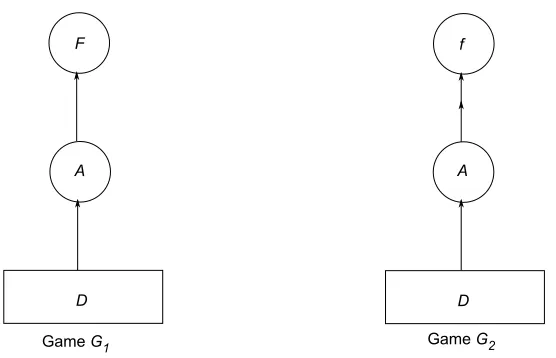
We define GamesG1, G2(Figure 1) such that they correspond toDinteracting with the distributionsF and
If respectively. For the sake of clarity, we introduce an oracleAin each game such that D only queries A in each game, andAqueries eitherF or computesIf by making two queries tof, depending on the game. We choosef, F independently and uniformly at random from all functions mapping{0,1}n to {0,1}n and run GamesG1 andG2 usingf, F as follows.
• GameG1. In GameG1, onithqueryuv(where 1≤i≤qandu, v ∈ {0,1}n/2) toA byD,Areturns
F(uv).
• Game G2. In Game G2, on theith queryuv (where 1 ≤i ≤q and u, v ∈ {0,1}n/2) toA by D, A
computesIf(uv) by making two queries to f and returns the result.
In bothG1andG2, we abuse the notationA(uv) to refer to two things. When we say queryA(uv), we refer
to a queryuv made byD to A, and whenA(uv) is preceded or followed by an assignment or ⊕operation, we refer to the result of a queryuv made by D to A. Also, the notation Aj(uv) (where 1≤j ≤q) refers to the jth queryuv made by D or the output of thejth query uv made by D, depending on the sense in which it is used. Hereu, v∈ {0,1}n/2. Also in GameG
D D f
Game G1 Game G2
A A
F
Figure 1: Illustrations representing GamesG1 andG2. In GameG2, the double arrow from Atof denotes
that, on each query made toAbyD,A makes two queries tof.
When we say queryf(uv), we refer to a queryuv made tof, and whenf(uv) is preceded or followed by an assignment or⊕operation, we refer to the the result of a queryuvmade tof. Hereu, v∈ {0,1}n/2.
For each i ∈ {1,2}, let pi be the probability that D accepts in Game Gi (The probability p1 is over the
choice ofF and the probabilityp2 is over the choice off). We would like to show to show that|p2−p1|is
small, that is, at most 1 2
q(q+1) 2n/2 .
The intuition is as follows. In the Game G1 where D queries A, and Aqueries F, the queries made to F
are answered randomly. In the Game G2 where D queries A, and A computes If, on a query uv (where
u, v∈ {0,1}n/2) toA,Amakes two queries tofand returns the result of the second queryf(f(u0n/2)⊕v0n/2).
Now, as long as the query f(f(u0n/2)⊕v0n/2) is a query that has not been made to f before, the result
of the query will be a value chosen uniformly at random. We will argue that with high probability, this is indeed the case and hence say that with high probability, the outcomes (that is, the answer to the queries thatD makes) of both the games are distributed identically.
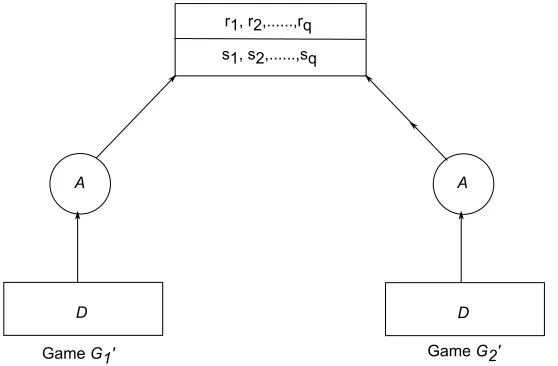
Here is a rigorous way to argue this. Wecouple the games by running both the games together using com-mon randomness (Figure 2) and argue that with high probability, the outcomes of the coupled games are identical. This is a well known technique from probability theory, called coupling [Lin92][Tho00]. Consider the following experiment.
BEGIN EXPERIMENT
• Initialization-Choose 2qstringsr1, r2, ..., rq, s1, s2, ..., sq randomly from{0,1}n. For everyi, 1≤i≤
q, letsi=s1is2i where|s1i|=|s2i|=n/2.
• We run the Game G1 using the the 2q strings as follows. On theith queryuv (where 1≤i≤q and
u, v ∈ {0,1}n/2) by A, we return ri. Let us call this (slightly) modified game asG0
1. Let p01 be the