JOURNIU OF
MNGE MNYKEMENT
TABLE OF CONTENTS:
Vol. 26, No. 3, May 1973
Published bimonthly-January, March, May,July, September, November--by the Society for Range Management 2120 South Birch Street Denver, CQlorado 80222 Copyright @ 1973 by the Society for Range Management
ARTICLES 161
165 171 Managing Editor
FRANCIS T. COLBERT 2120 South Birch Street Denver, Colo. 80222
175
Editor
ELBERT H. REID
179 624 South Shields Street
Fort Collins, Colo. 80521 185
Book Review Editor
DONALD N. HYDER 189
Agricultural Research Service Colorado State University
Fort Collins, Colo. 80521 193
Copy Editor
PATRICIA G. SMITH 198
2120 South Birch Street Denver, Colo. 80222
200 Editorial Board
1971-73
C. KENNETH PEARSE, Laguna Hills, Calif SYLVESTER SMOLIAK, Lethbridge, Albta. ELVIS R. BEATY, Athens, Ga.
DON DWY ER, Logan, Utah 1972-74
204
207
LOWELL K. HALLS, Nacogdoches, Tex. ROBERT L. ROSS, Bozeman, Mont.
G. W. TOMANEK, Hays, Kan. HENRY A. WRIGHT, Lubbock,Tex. 1973-75
DWIGHT R. CABLE, Tucson, Ariz.
JOHN P. WORKMAN, Logan, Utah e
RUSSELL J. LORENZ, Mandan, N. D. LEWIS L. YAR LETT, Portland, Ore.
210
212
21%”
_1 by Clayton L. Hanson, H. G. Heinemann, A. R. Kuhlman, and J. W. Neuberger
219 Reproductive Success of Squirreltail in Medusahead Infested Ranges by M. Hironaka and Brian W. Sindelar
INDIVIDUAL SUBSCRIPTION is by membership in the Society for Range Management.
LIBRARY or other INSTITUTIONAL SUBSCRIP- TIONS, on a calendar year basis, are $15.00 postpaid to all countries. Payments from outside the United States should be remitted in US dollars by international money order or draft on a New York bank.
CHANGE OF ADDRESS notices should be sent to the Managing Editor, 2120 S. Birch St., Denver, CO 80222, no later than the first day of the month of issue. Copies lost due to a change of address cannot be replaced unless adequate notice is given. To assure uninterrupted ser- vice, provide your local postmaster with a Change of Address Order (POD Form 35751, indicating thereon to guarantee forwarding postage for second-class mail. BUSINESS CORRESPONDENCE, concerning subscrip- tions, advertising, reprints, back issues, and related matters, should be addressed to the Managing Editor, 2120 S. Birch St., Denver, CO 80222.
EDITORIAL CORRESPONDENCE, concerning manu- scripts or other editorial matters, should be addressed to the Editor, 624 S. Shields St., Fort Collins, CO 80521. INSTRUCTIONS FOR AUTHORS appear each year in the March issue; copies of these instructions are available from the editor.
222 Response of Lehmann Lovegrass to Time of Fertilizer Application by Bahe Billy J. L. Stroehlein, and P. R. Ogden
225 Russian-Thistle (Salsola) Species in Western United States by Janice C. Beatley 227 Effects of Leaf-Footed Bugs on Mesquite Reproduction by D. N. Ueckert TECHNICAL NOTES
230 Stoloniferous Blue Grama by J. Stubbendieck, John L. Launchbaugh, Donald F. Burzlaff, and Wayne G. McCully
231 Seed Size Affects Germination of True Mountainmahogany by J. R. Piatt
MANAGEMENT NOTES
233 A Modification of the Slanting Deer Fence by Harold E. Messner, Donald R. Dietz, and E. Chester Garrett
VIEWPOINT
235 Future of Range Management: A Student’s View by Paul Nyren BOOK REVIEWS
236 Plants for Sheep in Australia: A Review of Pasture, Browse and Fodder Crop
Research (Leigh and Noble); Poisonous Plants of the Midwest and Their Effects
on Livestock (Evers and Link).
SECOND CLASS POSTAGE paid at Denver, Colorado.
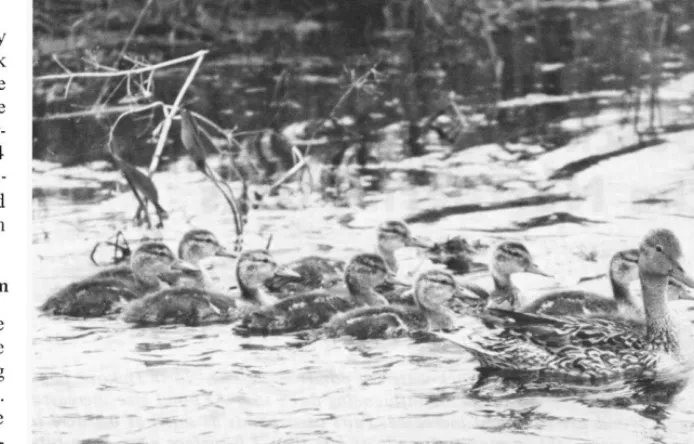
COVER: Stock Ponds in the North Dakota Badlands Used by Livestock and Waterfowl (see article
Survey of Professional Attitudes toward Range Science Education and Training by C. R. Kienast and C. J. Scifres
Responses of Semidesert Grasses to Seasonal Rest by S. Clark Martin
Simulated Grazing Management Systems in Relation to Shrub Growth Responses by E. Earl Willard and Cyrus M. McKell
Optimizing the Calf Mix on Range Lands with Linear Programming by Bruce M. Woodworth
Waterfowl Production on Stock-Watering Ponds in the Northern Plains by John T. Lokemoen
Effects of Range Burning on Kansas Flint Hills Soil by Clenton E. Owensby and John Bruce Wyrill, III
Brush Eradicating, Basin Pitting, and Seeding Machine for Arid to Semiarid Rangeland by George H. Abernathy and Carlton H. Herbel
Rootplowing and Seeding Arid Rangelands in the Southwest by Carlton H. Herbel, George H. Abernathy, Clyde C. Yarbrough, and David K. Gardner
Germination of Range Plant Seeds after Long Periods of Uncontrolled Storage by A. C. Hull, Jr.
Mountain Meadow Improvement through Seeding by Richard E. Eckert, Jr., Allen D. Bruner, Gerard J. Klomp, and Fredrick F. Peterson
Growth and Survival of Perennial Tropical Grasses in North Georgia by E. R. Beaty, Albert E. Smith, and Edward E. Worley
Effect of Plant Moisture Stress on Carbohydrate and Nitrogen Content of Big Sagebrush by Stephen J. Dina and Lionel G. Klikoff
Efficiency of Water Use and Associated Characteristics of Lehmann Lovegrass by L. Neal Wright and A. K. Dobrenz
Prairie Sandreed (Calamouilfa Zongifolia): Water Infiltration and Use by J. Kristian Aase and J. Ross Wight
Survey
of Professional
Attitudes
toward
Range
Science
Education
and Training
C. R. KIENAST AND C. J. SCIFRES
Highlight: Questionnaires relative to range science education and training were com- pleted by about 120 professionals in the discipline. Respondents were in general agree- ment that coursework in the social sciences should receive more emphasis in range curricula. Most respondents also stressed the ever-increasing need for development and refinement of communicative skills. Natural resource use, planning, and management was most frequently cited as an important future problem facing range workers. Expertise in public relations also rated high as a future need for rangemen. The majority of the respondents indicated that training undergraduates as land resource managers should be emphasized instead of utilizing curricula dominated by ‘Strictly scientific aspects. ” Most respondents were optimistic concerning future employment possibilities for range majors with indications that future graduates might be in increas- ing demand for certain areas of industry and business.
This survey was stimulated by the theme of the Society for Range Manage- ment’s 1972 meeting: “Range Resources and Society’s Needs-A Look Ahead to the 21 st Century.” The motive for such a theme is obvious. As do dedicated profes- sionals in any discipline, range profes- sionals are asking questions such as: Does our work fill the intended need? Are we working in the most fruitful direction? What changes in direction should we take to most effectively meet future needs? Are we adequately educating and training the rangemen of the future?
As Hervey (1964) stated, “What is being said today about range managers is a response to their effectiveness as they
At the time of writing the article, the
authors were student and associate professor,
respectively, Department of Range Science,
Texas A&M University, College Station. Kienast
Presently is a graduate assistant, Utah State
University , Logan.
The authors are grateful to Dr. C. L.
Leinweber, Dr. M. M. Kothmann, Mr. James
Bluntzer, and Mr. David Polk, Jr., for their
helpful criticism in developing this manuscript.
The encouragement of many who suggested
formal publication of these results after their
presentation to the Society in Washington, D.C.,
is also acknowledged.
Manuscript received April 24, 1972.
presently perform their duties with the benefit of yesterday’s university training.” Hervey recognized the need for our dis- cipline to respond to perpetual change in the objectives of society. This need has been amplified in the last 5 years with intense public interest in the fate of natur- al resources.
There is no dependable, analytical method for accurately forecasting educa- tional needs to meet future professional challenges. However, predictive informa- tion can be assembled in a qualitative manner by utilizing expert opinion. Ob- jectives of this survey were to seek pro- fessional opinion regarding (a) important attributes of range graduates seeking em- ployment, (b) work experience which augments formal training in range science, (c) coursework background considered most desirable in range education pro- grams, and (d) future problems and needs to consider in range curricula. The res- pondents also were asked their opinion as to future job opportunities for range sci- ence graduates.
Materials and Methods
A form consisting of 11 basic questions JOURNAL OF RANGE MANAGEMENT 26(3), May 1973
was sent to Soil Conservation Service (SCS), university and college, Bureau of Land Management (BLM), Forest Service (FS), and ranch management personnel. Questions in the survey included: (1) re- lative importance of selected personal and academic characteristics in employing a range science graduate, (2) importance of work experience to the undergraduate range major, (3) the role of research in undergraduate training, (4) opinions as to areas of important coursework, present deficiencies and any suggested educational changes, (5) future management problems for rangemen, and (6) areas of work which will probably utilize range graduates and an opinion as to future employment potential.
About 130 questionnaires were mailed with over a 90% response. The forms were identified only as to the respondent’s present source of employment. The low- est number (13) were received from ranchers.
Questionnaires were grouped for sum- mary according to employer of the respon- dent. However, respondents were asked to answer only on the basis of their personal philosophy. Questionnaires were sent to central administrative offices of agencies. Recipients who did not wish to participate were requested to pass the form to an interested person in the same organiza- tion. The questions were of three basic types. In the first type, respondents were asked to rank several factors in order of importance. Respondents listed important factors or attributes in answer to a specif- ic request in the second type of question. The third type of question requested
discussion of an issue.
presented as a percentage of the total Table 1. Responses (%) of professional workers relative to attributes considered most important number of responses for each question. for range science majors seeking employment.
Results and Discussion
Results are discussed from an inte- grated viewpoint that resulted from dis- cussion by undergraduate range science students and university professors. Several upperclassmen and professors in addition to the authors analyzed and debated the responses to each question.
Attributes of Candidates for Employment
Attributes
Grades Work experience General background Applicant’s age Nature of coursework Personal recommendations Personal appearance Impression during interview College or university attended
scs Univ. BLM FS Ranchers Avg
13 25 20 27 20
16 5 10 18
::
16
8 4 0 5 8 5
3 0 0 0 0 <l
30 27 40 32 9 28
14 23 20 9 0 13
5 5 0 0 8 4
8 11 10 9 25 13
3 0 0 0 0 <l
Most surveyed (except ranchers) felt that nature of coursework should be the primary attribute considered in selecting a potential employee from among range science majors (Table 1). This, of course, reflects the basic need of the college student for exposure to sound subject matter. Although other attributes of the graduate may be highly desirable, his coursework background must adequately prepare him to meet job requirements. Range science graduates need a unique background developed to deal with a basic natural resource. Therefore, it is very important that university personnel continue to take special care in develop- ing and monitoring educational programs. Proper advice and direction may be deci- sive in utilization of electives for neces- sary breadth and strength in the student’s program.
Table 2. Responses ($6) of professional workers relative to type of experience felt to be most important to range science majors seeking employment.
Type of experience scs Univ. BLM FS Ranchers Avg
General
Practical (such as ranching) Summer training (as with
federal agency)
Research technician (part-time) Extension Service technician
(part-time)
6 0 0 0 23 6
33 20 10 20 38 24
48 41 50 40 31 42
11 26 20 30 0 17
2 13 20 10 8 11
Table 3. Responses (7%) from professional workers toward the value of undergraduates’ partici- pating in research projects.
Opinion scs Univ. BLM FS Ranchers Avg
Research beneficial 62 84 80 100 57 77
Research not beneficial 21 16 0 0 29 13
Depends on type of research 17 0 20 0 14 10
Only ranchers rated work experience as the most important criterion in select- ing an employee (Table 1). This can be attributed partly to their broad job re- quirements and to a, basic belief that work experience best qualifies an individ- ual for ranch management. Nature of coursework and grades were important to ranchers but only as indicators of technical aptitude for coping with practi- cal problems.
tween two equallyqualified potential employees. As with grades, it is assumed that extremes would have a direct affect on an employer’s decision. General back- ground and college or university attended were usually considered least important by respondents.
Undoubtedly, an employer’s judgment is usually not based on any single attri- bute but on overall qualifications of the candidate. However, these responses do indicate relative importance of attributes most often considered by employers.
important work experience for range science majors (Table 2). Ranchers, how- ever, considered practical ranching ex- perience and summer training almost equally important. Obviously, maximum involvement in the ranching operation during the formative stages of his career is desirable for a potential ranch manager.
SCS personnel ranked grades fourth, behind nature of coursework, personal recommendations, and work experience as important attributes for potential em- ployees (Table 1). This response was interpreted as indicating relative academic performance: that the difference between an A and a strong B student would not weigh heavily if coursework was sound. Conceivably, a broad, sound, subject- matter base would be more important than an unblemished transcript of less- desirable courses.
Work Experience
Only ranchers ranked impression dur- ing interview in the top three attributes for employment (Table 1). Differences in personal appearance were apparently con- sidered important only in deciding be-
Application of classroom principles may be facilitated by furnishing the range science student with practical work experience. Lehman (1966) felt that “the emphasis should be on the principles of the basic sciences, and less on technical elaborations.” However, the impact of basic knowledge is best realized when students practice its direct application. While attaining practical experience, the student may be exposed to practicing professionals and an array of viewpoints. Most respondents indicated that sum- mer training programs afforded the most
Most respondents felt that exposure to research programs, such as summer work with an agricultural experiment station, was beneficial (Table 3) if (a) research was of such a nature that the student could associate the results with a practical range management situation, (b) the stu- dent functioned directly in the research rather than performed only menial tasks, and if (c) association with the research was not conducive to narrowing the stu- dent’s point of view. Most respondents felt the present role of research in student training should be maintained. SCS res- pondents indicated that graduates should be able to interpret research results. Respondents generally indicated that re- search experience would be best spent examining broad-range problems rather than in emphasizing specific points of concern.
Table 4. Responses (%) of professional workers relative to the most important areas of course- work for proper preparation of range science students.
Coursework scs Univ. BLM FS Ranchers Avg
Agricultural engineering 0 0 7 0 8 3
Agrostology 8 4 0 0 0 2
Animal science 13 13 0 0 17 9
Biological science 9 12 12 4 0 7
Ecology 24 25 19 28 0 19
Economics and business 4 5 0 0 25 7
Genetics 0 0 0 0 8 2
General management 4 0 0 18 0 4
Mathematics 0 4 0 9 0 3
Plant science 1 4 6 5 0 3
Range management 13 9 6 5 17 10
General resource management 0 4 0 0 8 2
Social science and communication 16 13 38 13 9 18
Soils 8 7 6 0 8 6
Statistics 0 0 0 18 0 4
Wildlife management 0 0 6 0 0 1
Table 5. Most important management problems (%) facing range sciences in the next decade.
Problem areas scs Univ. BLM FS Ranchers Avg
Adjusting to change 11 4 0 6 10 6
Basic ecology 5 2 8 6 0 4
Brush control 3 4 0 0 10 3
Chemical usage 0 0 0 0 5 1
Business and economics 12 6 0 6 15 8
Environmental understanding 12 19 25 32 10 20
Genetics of range plants 0 0 0 0 5 1
Plant-soil relations 5 0 0 0 0 1
Public relations 8 17 8 0 10 9
Natural resource use,
planning, and management 39 44 34 50 30 39
Surface mining 0 0 8 0 0 2
Watershed management 5 0 17 0 5 5
0 thers 0 4 0 0 0 1
Coursework and Formal Training
As Box (1964) stated, “The range pro- fession must act to see that all students who call themselves rangemen have train- ing acceptable to the profession.” Descrip- tions of coursework considered important by professionals should be helpful in developing range science curricula. Guide- lines published by Sampson (1954) reflec- ted the classical approach to range educa- tion. Several areas he emphasized are reflected in the 1971 survey.
Respondents were in general agreement concerning the need for expanding course- work in the social sciences and communi-
cation (Table 4). Emphasis on communi- cative skills probably indicates the ever- increasing role of range workers in dealing with rather broad segments of society. This basic need, communicating with clientele, was emphasized by Dyksterhuis (195 3). Deficiencies in communication were also noted by Tisdale (1956) and
Hervey (1964). Yet, communications courses are now an integral part of most range curricula. Perhaps a new approach should be considered. Instead of risking over-emphasis of social and communica-
tive skills to range students and possibly reducing their time for developing a strong technical base, perhaps an effort should be made to educate society more
effectively concerning our basic natural resource-rangeland .I Then too, effective communication is an art usually refined through personal and professional maturity and experience.
Traditionally, ranchers have felt that rangemen should receive more general training in range management (Weaver, 1953). Ranchers in this survey considered economics and business of primary impor- tance (Table 4). Hervey (1964) suggested incorporation of business courses into range curricula some 7 years ago. Ranchers considered animal science and range man- agement the second most important areas of coursework (Table 4). Most ranchers pointed out in this survey that the average range graduate is usually well grounded in range management and animal science.
‘This argument was posed by a journal reviewer
during final stages of manuscript preparation.
It was suggested that perhaps courses in re-
source management should be offered by the
public school system. In the opinion of the
authors, the suggestion has considerable merit.
JOURNAL OF RANGE MANAGEMENT 26(3), Mw 1973
They indicated that agricultural engineer- ing, genetics, soils and general resource management are also important areas of coursework.
FS respondents indicated a need for more coursework in statistics and general management in range curricula (Table 4). A review of current offerings in several university catalogs indicated that statistics is required of undergraduates in a few range departments. However, biometry is probably included in vegetation evalua- tion courses taught in most range curricula.
Respondents were also asked to list present areas of deficiency in range curric- ula. FS and university personnel felt that ecology was one area of deficiency among range majors. Some suggested replacing a portion of current plant ecology courses with animal and general ecology courses. In four university curricula surveyed, requirements in ecology ranged from 7 to 13 hours. The university with highest requirements listed 10 hours in general ecology and 3 hours in formal study of range ecosystems. Most other universities stressed plant ecology. FS personnel indi- cated that range science students were deficient in proper use of resources re- lated to rangeland. The only area of science indicated as deficient by SCS respondents was a basic understanding of soils.
Future Problems Facing Range Workers Natural resource use, planning, and management were frequently cited as the most important future problems for range workers (Table 5). Understanding of en- vironmental problems occurred second most frequently as an important future concern.
Many respondents felt that adjusting to continual and rapid change might be critical for contemporary range profes- sionals. Range science graduates must be familiar with new techniques and methods as they are reported to assure their rapid and effective implementation.
Table 6. Response (%) of professional workers concerning areas of future emphasis necessary to respondents from industry is a definite
meet requirements for range scientists. weakness of this survey.
Areas of future emphasis scs Univ. BLM FS Ranchers Avg
Multiple-use, long-range planning
including urban interest 20 27 18 46 0 22
Basic training in business and
economics 7 10 9 0 0 5
Flexibility and broadening
of training base 6 7 9 9 0 6
Training as land and range
resource managers instead
of as scientists 44 27 37 9 75 38
Soils and range hydrology 10 0 0 0 0 2
Ecosystem management and
basic ecology 10 0 27 0 0 8
Practical summer training
for students 3 3 0 0 0 1
Environmental problems 0 23 0 18 0 8
Systems analysis and modeling 0 3 0 18 0 4
Livestock production efficiency 0 0 0 0 25 5
In the opinion of the respondents, fewer range science graduates will be needed for research and teaching in the immediate future (Table 7). Further, the ranching industry may utilize more range science graduates as ranching operations are consolidated into larger units. How- ever, ranching will probably continue to provide a minor outlet, relative to num- bers, for employment of range graduates.
Most respondents were optimistic a- bout the future availability of jobs for range science graduates. None felt avail- ability of jobs would decrease, and the majority of BLM (83%) and FS (71%) respondents predicted an increase in job opportunities. About half of SCS and university respondents felt that employ- ment possibilities will increase in the next few years. All replies concerning future availability of jobs were apparently based on the state of the economy. University, BLM, and FS respondents predicted that more range science majors would be needed to fill future jobs in land-use planning and general manage- ment (Table 7). SCS participants indicated a continuing need for graduates in govern- mental agency work.
procedures for proper rangeland manage- ment . Hervey (1964) indicated “. . . a need for top-notch range management ‘salesmen’ who know what they are talk- ing about .” Present survey results indicate that such a need has not diminished. Hervey (1964) questioned: “Are we grad- uating technicians who are without train- ing in administration and public rela- tions?” and issued “. . . a plea for in- clusion in the curriculum of carefully selected courses that will teach the poten- tial range manager how to sell his ideas and how to administer his program.” A quick scan of range curricula of four major universities showed three without required coursework in sociology and the remaining one with 11 undergraduate hours required in sociology and human- ities. Evidently, Dr. Hervey’s and Dr. Dyksterhuis’ original points, in view of the results of this survey, should be re- stated even more emphatically.
Future Roles of Range Professionals Areas usually indicated for future em- phasis were (a) training as land resource
Table 7. Responses (%) of professional future range science graduates.
workers relative to potential areas of employment managers with less emphasis on “strictly scientific aspects” and (b) capabilities in multiple-use of natural resources inte- grated with long-range planning, including urban interests (Table 6). These two areas comprised over 50% of the responses re- gardless of source. Dyksterhuis (1953) analyzed range education as having “. . . quite generally the objective of develop- ing scientists rather than artisans, arti- ficers, or artists.” The expressed need for more general practitioners in range was indicated from responses to our survey. Hervey (1964) suggested two plans at the Master of Science level for range science. One without thesis requirements was designed to develop the broadly-trained resource manager.
Employment Potential
Most respondents felt that employment opportunities with private industry such as real estate, banking, and counseling services will increase for range graduates (Table 7). This same trend was indicated by Box (1964) 8 years ago. The lack of
Area
scs
Univ. BLM FS Ranchers AvgEnvironmental and
related agencies
Governmental agencies
Land-use planning and
general management
Private industry (real estate,
banking, etc.)
Range-related foreign
assignments Ranching Research Teaching
10 3 8 0 0 4
37 34 34 18 30 31
27 45 42 46 20 36
12 9 8 9 20 12
0 0 0 9 10 4
7 3 8 18 20 11
2 3 0 0 0 1
5 3 0 0 0 2
As pointed out by Hervey (1964), the impression left by today’s range managers and scientists reflects on yesterday’s uni- versity training. Papers written by range workers in the last decade indicating training and educational needs are, in most cases, germane to today’s curricula needs. The present survey poses more questions than it answers. However, these results may provide some insight for range educators to formulate more effec- tive teaching and training programs regard- less of present concepts and direction.
Literature Cited
Box, T. W. 1964. Trends in range management
education, J. Range Manage. 5:237-241.
Dyksterhuis, E. J. 1953. Some notes and quotes
on range education. J. Range Manage.
6:295-298.
Hervey, D. F. 1964. The challenge of the future
as viewed by educators in range schools. J.
Range Manage. 17:119-121.
Lehman, A. 1966. A technical education isn’t
enough. J. Range Manage. 19:171-172.
Sampson, A. W. 1954. The education of range
managers. J. Range Manage. 7:207-212.
Tisdale, E. W. 1956. Range management educa-
tion. II. College training in range manage-
ment. J. Range Manage. 9:218-219.
Weaver, G. E. 1953. Range education from the
rancher’s viewpoint. J. Range Manage.
6:307-308.
Responses
Semidesert
Grasses
to Seasonal
Rest
S. CLARK MARTIN
Highlight: Perennialgrasses on semidesert range in southern Arizona increased more
in 8 years under spring-summer (March-October) reef 2 years our of 3 than under
continuous yearlong grazing 01 any of 13 other rest schedules. A three-pasture grazing
pastern that orovides sorim-mmmer x~t 2 years in 3 is being rested on the Santa Rita
Most semidesert grassland and grass- shrub ranges in the southwest are grazed yearlong. Many, if not most, of these ranges produce less forage than they could. Continuous yearlong grazing, even at moderate intensity, creates zones of heavy use around water. But systems of rotation and deferment have not always been successful either. Too often, the start toward recovery during a rest period is nullified by the effects of accelerated forage removal when the range is again grazed. The question is-when, how long, and how often should a range be rested?
Several schedules of grazing and rest were evaluated on semidesert grass-shrub cattle range. The study was conducted from July 1, 1962, to October 31, 1969, on the Santa Rita Experimental Range near Tucson, Ariz. Rest, as used in this paper, is protection from cattle grazing. From the standpoint of plant growth, a year in southern Arizona consists of three rather distinct 4.month periods: summer, winter, and spring. Summer (July-October) includes the summer rainy season and the relatively dry early fall. Warm-season perennial grasses make almost all of their annual growth, mature, and set seed during this period. Winter (November-February) is the dormant period for warm-season perennial grasses.
Above-average winter precipitation may wet the soil to a depth of 2 ft or more; the rate of evaporation is low enough that moisture from successive storms accum- ulates in the soil. Winter annuals germi- nate during this period but make little top growth until temperatures rise late in February or in March. Spring (March- June) begins with a period of early growth initiated largely on accumulated winter moisture. Spring rains, if any, usually end by mid-April. Herbaceous plants are dormant due to drought from mid-May through June.
Study Methods
The experiment included 15 rest- grazing schedules applied to plots 20 ft square (Table 1). Schedules were assigned at random and were replicated three times in each of three 45.plot blocks. Grazing was excluded during rest periods by movable wire exclosures. Replications of the schedules were started on suc- cessive years to even out possible climatic effects.
Influences other than cattle grazing were eliminated insofar as possible. Shrubs were removed or killed so they would not compete with grasses for
moisture or nutrients or interfere mech- anically with grazing on the study plots. Velvet mesquites (Prosopis julif7om bar. velutinn) were killed with diesel oil. Bur- roweeds (Aplopappus tenuisecfus) be- tween plots on the study area were grubbed; those on study plots were pulled by hand. Cactus and other shrubs that would interfere with grazing were re- moved with as little disturbance as pos- sible. Rodents and ants were poisoned as needed.
Plots were not placed on areas subject to runoff or on cattle trails. Short drift fences were erected to divert the cattle when new trails began to develop across plots.
The basic data consisted of (1) density (plants per ft*) by species of perennial grasses and perennial forbs, (2) herbage production (lb/acre) of annual and per- ennial grasses, and (3) ocular estimates of utilization (percentage of herbage re- moved) on perennial grasses. Densities by species were recorded each year on the same 2 by 10 ft sample area within each 20 by 20 ft treatment plot. Herbage production and utilization were estimated each year on the same 1 by 9.6 ft (9.6 ft’) sample area within each treatment plot. The relation between estimated and actual herbage yields on temporary plots 9.6 ft* was used to adjust ocular esti- mates on the permanent samples. Density and utilization were measured around July 1 each year; herbage production was recorded around November 1.
The most common perennial forbs were leatherweed croton (Croton corym-
Rest frequency
Season rested 1 year in 3 2 years in 3 3 years in 4 Every yea
Summer (July-October) x x x
Winter (Now”ber-February) x x x x
Spring (March-June) x x x
Spring-summer (March-October) x x
Yearlong (July-June, x x
Table 2. Seasonal rainfall (inches) and yields (lb/acre, air dry) of annual and perennial grass herbage.
Rainfall Herbage production
Year
Nov.- June- Annual Perennial Jan. Sept. grasses grasses Total
1962 4.62 4.65 22
1963 2.75 7.69 488
1964 3.58 11.45 138
1965 1.98 4.80 32
1966 7.63 9.52 141
1967 .76 9.53 224
1968 6.13 5.30 32
1969 2.27 10.71 156
Average 3.72 7.96 154 72 226
27 49
21 509 43 181
57 89
82 223 171 395 99 131 72 228
bulosus) and evolvulus (EuoZvuZus
arizonicus). Common perennial grasses were Santa Rita threeawn (Aristida
glabrata), tall threeawns (A. hamulosa
and A. ternipes), and Rothrock grama (Bou teloua ro throckii). Species groupings used in the analysis were perennial grasses other than Rothrock grama, total per- ennial grasses, and total forbs. Rothrock grama was treated separately because it is short-lived and changes more from year to year than other perennial grasses do.
1.0 in the final 2 years. Densities of most perennial grasses changed from year to year regardless of grazing treatment.
Adjusted means from the analysis of covariance showed that total perennial grass herbage production (1968-69 aver- age) was greatest on plots that had been rested March-October 2 years out of 3 (Table 3). The effects of grazing sched- ules on total perennial grass density were
The response of perennial grasses to rest is evident in density changes with time. Densities of perennial grasses other than Rothrock grama increased under all treatments (Fig. 1). Density increases under 4-month rest periods generally were little if any greater than under yearlong grazing, however. For example, perennial grass density on plots rested in the same season 1 or 2 years out of 3 increased no more than under yearlong grazing regardless of season. Rest 3
Data for all years were combined in analyses of variance. Means for the last two measurements (1968 and 1969) were also subjected to analysis of covariance, using means for the first two measure- ments (1962 and 1963) as the covariant. Relative rates of change were evaluated by regression.
1.0
Summer rest
0.8
Results
Rainfall and herbage production varied greatly from year to year (Table 2). Herbage yields of perennial grasses were more closely associated with the sum of current and past summer rainfall than with rainfall during any of several other periods, but none of the rainfall-herbage production regressions were significant at the 95% level. Herbage yields of annual grasses, however, were negatively related (r = -0.78) to rainfall during the pre- ceding June-January.
0.6
0.4
0.2
0.0
- \g 0.8
% 0.6
r
Winter rest
Every year A
c .-
g 0.4
2
0.2
Changes in Densityand Herbage Production
0.0
Average yields of grasses did not change significantly with time during the study period. Annual grasses decreased slightly under all grazing schedules (r = -0.08 to -0.30) but perennial grasses increased quite strongly (r = 0.39 to 0.84). Perennial grass production (average for all treatments) was over three times as great at the end of the study (1968-69 average) as at the start (1962-63 average).
0.6 7 Spring rest
0.4 -
1962
63
64
65
66
67
68
69
The average density of perennial grasses increased from 0.2 plant per ft2 during the first 2 years of the study to
Fig. 1. Density changes for perennial grasses other than Rothrock grama under rest in summer. winter, and spring: A, I year in 3; B, 2 years in 3; C, 3 years in 4; and D, continuous yearlong grazing.
166 JOURNAL OF RANGE MANAGEMENT 26(3), May 1973
less clear cut. Although spring-summer rest 2 years out of 3 did result in the highest total perennial grass density, spring rest 1 year in 3, spring-summer rest
Table 3. Density (no./ft2) and herbage production (lb/acre, air dry) of perennial grasses. (Adjusted 1968459 means from analyses of covariance; 1962-63 means used as covariant.)’
Density of perennial grasses
Rest period Frequency
Other than
Rothrock grama All
Summer Winter
Spring Spring-summer Yearlong Summer Winter Spring Spring-summer Yearlong Summer Winter Spring Winter None
113 113 l/3 113 l/3 213 213 213 213 213 314 314 314 414
0.60bc 0.95b
0.53bc 0.85b
0.6Obc 1.31ab
0.78bc 1.15ab
0.75bc 1.20ab
0.27~ 0.87b
0.4oc 0.61b
0.47c 0.60b
1.36a 1.80a
1.02ab 1.30ab
0.63bc 1.19ab
0.38~ 0.66b
0.51bc 0.82b
0.43c 0.69b
0.49bc 0.7Ob
Herbage production
all perennial grasses
72b 88b 78b 1Olb 88b 55b 45b 53b 226a 132b 106b 61b 75b 66b 64b
’ Numbers in the same column followed by different letters are significantly different at 95% level.
springs, or 3 or 4 winters, out of 4 did not help either. Summer rest 3 years out of 4, which resulted in a more rapid density increase than did yearlong graz- ing, was the single exception.
The 2-year-in-3 schedule provides a ready comparison between rest periods. Spring-summer rest produced the greatest increases in perennial grass density (Fig. 2). Increases in density of perennial grasses under yearlong and spring-summer rest were small at first but became more pronounced as the study progressed.
Spring-summer and yearlong rest 2 years out of 3 were both superior to
yearlong grazing, and gains under year- long or spring-summer rest 1 year out of 3 likewise showed upward trends. Differ- ences among the latter three schedules were not significant. We cannot explain why grasses responded more strongly to spring-summer than to yearlong rest on the 2-year-in-3 schedule. Perhaps winter grazing between the two spring-summer periods may increase seedling establish- ment by trampling seed into the soil or by removing standing herbage that might prevent establishment of seedlings that require strong light.
All species exhibited sharp year-to-
-
0.5
0.0
1962
63
64
65
66
67
68
69
Fig. 2. Density changes for perennial grasses other than Rothrock grama on range rested 2 years
out of 3 for the periods A, March-June; B, July-October; C, November-February; D, March- October; E, yearlong; and F, continuously grazed yearlong.
year changes in density. Grass density and yield, which were low in 1962, improved on most plots during the study period. Year-to-year changes by some species were affected by rest, others were not.
Santa R ita threeawn
Santa Rita threeawn, the most abun- dant perennial grass, increased most on plots under spring-summer or yearlong rest 2 ye&s out of 3 (Fig. 3). Summer protection 3 years out of 4 also helped. These protection schedules enabled Santa Rita threeawn to maintain increased den- sity even under adverse conditions at the end of the study.
Yearlong and spring-summer rest 2 years out of 3 also increased herbage production of Santa Rita threeawn, even though yields were lower in 1968 and 1969 than at their high point in 1967. Final yields for ranges rested yearlong 2 years out of 3 were about twice as great as on range grazed yearlong; those rested in spring and summer 2 years out of 3 produced five times as much Santa Rita threeawn as did plots grazed yearlong.
Rothrock grama
The second most abundant perennial grass on the site was Rothrock grama. This prolific-seeding, short-lived species behaves somewhat as an annual. The density of Rothrock grama was very low in 1962, and it fluctuated greatly from year to year (Fig. 3). Rest 2 years out of
SANTA RITA THREEAWN t-4 A ,’
ROTHROCK GRAMA
n
Fig. 3. Density changes for Santa Rita three- awn and Rothrock gramu under A, rest March- October 2 years out of 3; B, rest year&g 2 years out of 3; and C, continuous yearlong grazing.
3, whether for a full year or for 8 months, was of no apparent benefit. By 1969 the density and yield of Rothrock grama were down almost to the original 1WZl.
Tall threeawns
Density and yield of tall threeawns increased more under spring-summer rest 2 years out of 3 than under yearlong grazing, but differences among other schedules were negligible.
Annual grasses and perennial forbs
Yields of annual grasses fluctuated very sharply from year to year and were not affected by protection schedules (Fig. 4).
The final density of all perennial forbs was higher under spring-summer rest 2 years in 3 than under any other schedule, but the average rate of increase in density during the 8.year period did not differ significantly among treatments. The most abundant perennial forbs were Arizona evolvulus and leatherweed croton. Evolvulus, a palatable perennial forb, responded as did perennial grasses. Graz- ing schedules had no discernible effect on density changes in croton which, unlike evolvulus, is quite unpalatable. It seems reasonable that the palatable species responded to rest schedules but the un- palatable species did not.
Utilization
Average utilization of perennial grasses during the study period was heavy. For most species, utilization at the end of June usually exceeded 60% on plots that had been grazed since March 1. Because all plots were near water, one original concern was that cattle might graze off the accumulated herbage from rested plots very quickly after the exclosures were removed. Actually, the ungrazed
herbage on plots that were opened to grazing in November after summer rest still stood out conspicuously 6 weeks later (Fig. S), and utilization did not approach that of the surrounding range until May or June. Apparently, utilization was retarded by allowing vegetation to mature before grazing started.
Average utilization of perennial grasses at the end of June for all treatments and years was over 70% on plots that had been grazed continuously for the preceding 12 months or that had been rested in winter only. Use on plots that had been rested in summer then grazed in winter and spring averaged 61%. Use on plots grazed in summer and winter and then rested in the spring was 52%; use on plots grazed only in winter was 22%. Apparent use as observed at the end of June was reduced most by spring rest and least by rest in winter.
Each year of the 3.year cycles that provided spring-summer rest 2 years out of 3 had a different grazing sequence for the 12month period ending June 30. There were three sequences: grazed dur- ing winter and spring, grazed in winter only, and grazed during summer and threeawn and Rothrockgrama was highest in years when grazed both in winter and spring and lowest when grazed only in winter (Table 4). Thus utilization was cyclic, with heavy, light, and moderate levels on successive years.
Table 4. Effect of gazing schedule on utilh tion (%) recorded at the end of June on Santa Rita threeawn and Rothrock grama.
Utilization June 30
Santa Rita Rothrock Seasons grazed threeawn grama
Winter and spring 65 60
Wi”kI 15 13
Summer and winter 33 45
Average 38 39
Discussion
Average increases in density of peren- nial grasses verify that there were rela- tively few large differences among treat- ments (Table 5). The range in treatment means in 1962 (0.06 - 0.29) however, was less than 20% as great as in 1969 (0.18 1.32). The greatest gains were made under spring-summer rest 2 years out of 3, and the second best under yearlong rest 2 years out of 3 (Fig. 2). Summer rest 3 years out of 4 finished high also; but plots under this treatment
had the greatest initial density (0.28), while those rested yearlong 2 years out of 3 started second from the lowest (0.07). Summer rest 3 years in 4 increased grass density not quite three times, but year- long rest 2 years in 3 increased grass density over 11 times.
The percentage of time study plots were ungrazed ranged from 0 on check plots to 67 for plots rested yearlong two years out of three. Densities of grasses other than Rothrock grama increased under all treatments. In general, single- season treatments that rested the range from 11% to 33% of the time increased density little if any more than no rest at all (T’ = 0.01) (Fig. 6).
Strengths and Limitations of Results These results were obtained on small
cl
$gge density p&we densityn
Table 5. Initial (1962) and final (1969) densities (no./ft2) for perennial grasses other than Rothrock grama.
Season Year rested measured
Frequency of rest
1 year in 3 2 years in 3 3 years in 4 All years Aver age
None 1962
1969 Increase Nov.-Feb. 1962
1969 Increase
.lO .06 .09
.33 .18 .20
.23 .12 .ll
Mar.-Jun. 1962 .lO .13 .ll
1969 .43 .40 .36
Increase .33 .27 .25
Jul.-Oct. 1962 .lO .19 .28
1969 .40 .24 .82
Increase .30 .05 .54
.12 .32 .20
.29 .14 .52 .31 .23 .17
.ll .40 .29
.22 .49 .27
Mar.-Oct. 1962 .13 .16 .14
1969 .59 1.32 .96
Increase .46 1.16 .82
Y earlong 1962 .12 .07 .lO
1969 .60 .79 .70
Increase .48 .72 .60
plots where the timing of grazing was not natural. Another limitation was that the study was conducted on range in poor condition, where the bulk of the forage was produced by increaser or invader species. For some applications this rnay be an advantage, however, because range in poor condition often has not improved under grazing systems that were acceptable to the rancher. Finally, the results were obtained without control of grazing intensity, and utilization during grazed periods was frequently high. This too is encouraging, because occasional heavy use is difficult to avoid.
Results of this study support the view that little benefit is gained by resting the range for only part of the normal grazing period. For example, it does not seem likely that any of the five specific systems that failed at Woodward, Okla. (Mcllvain and Shoop, 1969) would work under our semidesert conditions. Nor would 4 month’s rest out of 16 as advocated by Merrill (1969) be expected to help much on the Santa Rita.
Heady (1961) concluded that yearlong grazing at reasonable stocking rates was the best way to manage California annual range. Likewise, this study showed that none of the rest schedules improved production of annual grasses or of Roth- rock grama, a short-lived perennial. Still, yearlong grazing is not recommended for semidesert range because ranges that support only Rothrock grama and an- nuals can only be rated as in poor condition. Heady’s view that yearlong grazing amounts to partial deferment
every year if grazing is proper, conflicts with those of Ellison (1960) and of Hormay and Talbot (1961), who con- cluded that selective grazing could not be avoided under continuous grazing. Re- sults of this study would seem to support the latter views. Since rest less than 33% of the time was not helpful, results in this study also would seem to support Hormay’s (1970) recommendation that up to 40% or more of the range should be rested each year.
Ellison (1956) also suggested that if an engineer must use a safety factor of at least four in designing a bridge, a range manager, because his data are more var- iable, should use safety factors at least as large. Perhaps spring-summer rest 2 years out of 3 will provide a reasonable safety factor if forage consumption in a grazing period is limited to 50-60% of the herb- age on only one-third of the range.
The importance of fitting a rest sched- ule to the needs of the plants is evident in past results on the Santa Rita. Rest each year May-October or November-April, for example, was more detrimental to peren- nial grasses than was continuous yearlong grazing (Martin, 1970). Both schedules rested the range about half the time. Rest May-October was the least desirable, probably because forage removal during the spring was twice as rapid as under yearlong grazing. In another study, range rested alternate years during the summer growing season (about 12% of the time) improved no faster than did ranges that were grazed yearlong at comparable intensities.
JOURNAL OF RANGE MANAGEMENT 26(3), May 1973
Past results from the Santa Rita show that the impact of weather on short-term vegetation changes is often greater than the influence of management. Results in this study also indicate that forage stands will improve in favorable growing seasons and decline in drought under almost any grazing schedule. Thus, weather effects often override treatment effects, and an adequate test of a grazing system should include good and bad as well as average growing seasons.
A Proposed Grazing System
Can a feasible grazing system be based on the findings of this study? Spring- summer rest 2 years out of 3 was the best schedule by a wide margin. The essential features of a three-pasture system based on this result might be: (1) the number of cattle will be the total that would be carried on the three pastures if all were grazed yearlong, (2) the stocking rate will be the same each year, (3) only one pasture will be grazed at a time, and (4) in the event of severe forage scarcity, cattle may be moved ahead of schedule to avoid livestock losses or damage to the range, and the rest schedule will be resumed when forage production im- proves. The normal schedule would provide spring-summer rest and winter rest 2 years out of 3 (Table 6).
Table 6. Scheduled “graze” and “rest” periods for a 3-year cycle in a three-pasture system that provides spring-summer and winter rest 2 years out of 3.
Pasture
Year Season 1 2 3
1st Spring-summer Graze Rest Rest Winter Rest Rest Graze 2nd Spring-summer Rest Graze Rest
Winter Graze Rest Rest 3rd Spring-summer Rest Rest Graze
Winter Rest Graze Rest
ment should be especially great on areas where cattle concentrate, as near water.
Concentrated winter grazing after spring- summer rest may aid grass reproduction by planting seed by trampling, as Hormay (1970) suggests, or by removing old growth that might interfere with seedling establishment. Spring-summer rest follow- ing concentrated winter grazing should give seedlings of forage plants a chance to become firmly established before they are grazed. Spring-summer grazing 1 year in
3, even if heavy, is not expected to be seriously harmful because occasional heavy utilization did not prevent im- provement of grass stands on study plots.
If the system produces dense, vigorous stands of perennial grasses that fully occupy the site, forage production will be increased and the establishment of such undesirable shrubs as mesquite and bur- roweed will be reduced. Reseeding, shrub control, or other range improvements can be timed to take advantage of the rest schedule. Increased herbage production together with scheduled rest periods should provide opportunities for more effective use of prescribed burning for vegetation’control.
Total stocking will be the same as if each unit were properly grazed year-long and will be the average number of cattle required to consume 40% of the perennial grass herbage production during the past
10 years. Thus, the rate of forage con- sumption will be approximately tripled during grazed periods. Utilization usually will not be excessive, however, because the scheduled grazing period on each forage crop will be only l/3 as long as under yearlong grazing. Under spring- summer grazing, for example, cattle will feed mainly on last year’s ungrazed carry- over from March until summer growth begins in July, and on current summer growth for the remainder of the period. Forage consumption July-October, although about three times as fast as under yearlong grazing, should not be much greater than yearlong grazing with one-third as many cattle.
In my opinion, this schedule will benefit livestock. The quality of forage available March-June will depend on the amount of spring growth, but usually will be low. Old herbage is better than no herbage, however, and it can be supple- mented as needed to overcome specific nutritional deficiencies. Relatively heavy grazing March-June will remove much of the accumulated dead herbage. Summer- grown grass, therefore, will be relatively free of dead material. It should be rela-
170
tively palatable and nutritious, and cattle should make acceptable gains. Higher stocking rates in summer will increase the percentage of plants that are grazed each day, thereby keeping more plants in a vegetative state, and more nutritious, for a longer period.
Current forage production should be ample for the animals during most sum- mer growing seasons. This assumption is based on the fact that 90% of the perennial grass forage is produced during the summer growth period, which aver- ages about 9 weeks (Culley, 1943). Even at the higher stocking rates of this sys- tem, forage growth during the average summer will be greater than the rate of consumption. Thus the anticipated advan- tages for cattle are (1) ample carryover herbage during the March-June period when forage is most often scarce, and (2) improved forage quality during the summer growing season and early fall- the only time when cattle consistently make rapid gains.
For the rancher, one advantage is that all the cattle will be in one pasture instead of three. Fewer waters and fences will have to be watched, and less travel by truck or horse will be needed to care for the animals. Even if March 1 is too early for branding, the effort required to move the herd from the winter unit to the spring-summer unit will be more than offset by reducing the number of pastures to be rounded up by two-thirds. The fall move would be made at normal roundup time.
Summary and Conclusions
Fifteen schedules of rest and grazing, which ranged from continuous yearlong grazing to yearlong rest 2 years out of 3, were evaluated on semidesert range from 1962 to 1969. Three 4-month rest per- iods: spring (March-June), summer (July- October), and winter (November- February) were defined. Protection in each season was applied (a) 1 year in 3, (b) 2 years in 3, and (c) 3 years in 4, to plots 20 ft square. Longer protection periods, spring-summer (March-October) and yearlong, were applied 1 year in 3, and 2 years in 3. In addition, one set of plots was protected every winter and two sets, the controls, were grazed continuously.
Of the 15 schedules tested, spring- summer rest 2 years out of 3 produced the greatest improvement in perennial grasses.
The density and herbage yield of Santa Rita threeawn and perennial grasses other
than Rothrock grama generally increased from 1962 to 1969 on both rested and grazed plots.
Density and yield of Rothrock grama and yields of annual grasses fluctuated greatly from year to year and were not affected by rest schedules.
Winter rest did not increase density or yield of perennial grasses other than Rothrock grama no matter how fre- quently applied.
Spring rest did not increase yields or density of perennial grasses other than Rothrock grama when applied 1 or 2 years in 3, or 3 years in 4.
Summer rest 1 or 2 years in 3 did not consistently increase density or yield of perennial grasses other than Rothrock grama, but summer rest 3 years out of 4 was beneficial.
Yearlong rest either 1 or 2 years out of 3 improved the density of Santa Rita threeawn, and yearlong rest 2 years out of 3 produced the second greatest density gains for grasses other than Rothrock grama.
A three-pasture grazing system based on the findings of this study (Table 6) is being pilot tested on the Santa Rita Experimental Range. It is anticipated that this system will benefit not only the range but the livestock and the rancher as well.
Literature Cited
Culley, Matt J. 1943. Grass grows in summer or
not at all. Amer. Hereford J. 34(9): 8,lO.
Ellison, Lincoln. 1956. Grazing standards in
range management. New Zealand Grassl.
Assoc. Proc. Eighteenth Con. Canterbury
Agr. Col. Lincoln, Nov. 27 to 29, 1956.
Ellison, Lincoln. 1960. Influence of grazing on
plant succession of rangelands. Bot. Rev.
26(1):1-77.
Heady, Harold F. 1961. Continuous vs. special-
ized grazing systems: A review and applica-
tion to the California annual type. J. Range
Manage. 14:182-193.
Hormay, A. L. 1970. Principles of rest-rotation
grazing and multiple-use land management.
U.S. Dep. Agr., Forest Serv. Training Text
4 (2200), 26 p.
Hormay, A. L., and M. W. Talbot. 1961.
Rest-rotation grazing...A new management
system for perennial bunchgrass ranges. U.S.
Dep. Agr. Prod. Res. Rep. 51,43 p.
McIlvain, E. H., and M. C. Shoop. 1969.
Grazing systems in the southern Great
Plains. A&t. 22nd Ann. Meeting, Amer.
Sot. of Range Manage., Calgary, Alberta,
Canada, Feb. 10-13, 1959. p. 21-22.
Martin, S. Clark. 1970. Vegetation changes on
semi-desert range during 10 years of sum-
mer, winter, and yearlong grazing by cattle.
XI Int. Grassl. Congr. Proc. 11: 23-26.
Merrill, Leo B. 1969. Grazing systems in the
Edwards Plateau of Texas. Abst. 22nd
Annu. Meeting, Amer. Sot. of Range Man-
age., Calgary, Alberta, Canada, Feb. 10-13,
1969. p. 22-23.