Internet of Things (IOT) – What, Why, How,
Present & Its Challenges
Dr. S. DHINAKARAN
Associate Professor, Dept. of Computer Science, Rathinam College of Arts & Science, Coimbatore.
Abstract: -
The Internet of Things is referred as Machine to Machine communication (M2M) or Internet of Objects or Internet of Everything (IoE). It is one of the growing field of research activities and it will rule the entire world in the future, because it acts as a solution provider to all the fields like engineering, healthcare, security and even personally. IoT refers to the connection of all the objects that we use every day through the network are combined together through the Internet, which provides a very good experience.It is the combination (embedded) of hardware and software, so this technology will be adopted in all the areas in the world, it may be technology based or non-technology based. So we must aware of the fundamental concepts, technologies and applications of Internet of Things. Simply it means, from any time, any place connectivity for anyone, we will now have connectivity for anything. Through this paper, we can achieve to learn about the basic information, needs, and necessity of Internet of Things, and also to know the present situation and also analyse the growth in the future.
Keywords: - Internet, things, objects, sensors, data, connected, devices etc.
1. INTRODUCTION
Today sensors are all over. We underestimate it, yet there are sensors in our vehicles, in our advanced mobile phones, in
industrial facilities controlling CO2 outflows, and even in the ground observing soil conditions in vineyards. While it appears that sensors have been around for some time, inquire about on remote sensor systems (WSNs) began back in the 1980s, and it is just since 2001 that WSNs created an expanded enthusiasm from mechanical and look into points of view. This is because of the accessibility of cheap, low fueled scaled down parts like processors, radios and sensors that were regularly coordinated on a solitary chip.
Through combining existing WSN applications as a major aspect of the framework, potential new applications can be identified and created to meet future innovation and market patterns. For example WSN innovation applications for brilliant matrix, keen water, savvy transportation frameworks, and shrewd home produce gigantic measures of information, and this information can fill some needs.
The possibility of internet of things (IoT) was introduced in parallel to WSNs. The term internet of things was formulated by Kevin Ashton in 1999 [1] and represents to exceptionally identifiable objects and their virtual portrayals in a "internet based" structure. These articles can be anything from expansive structures, mechanical plants, planes, autos, machines, any sort of merchandise, specific parts of a bigger framework to individuals, creatures and plants and even specific body parts of them. While IoT does not
accept a specific correspondence innovation, remote correspondence advancements will assume a noteworthy part, and specifically, WSNs will multiply numerous applications and numerous ventures. The little, rough, cheap and low controlled WSN sensors will bring the IoT to even the littlest items introduced in any sort of condition, at sensible expenses. Incorporation of these items into IoT will be a noteworthy development of WSNs.
The future Internet, composed as a "Internet of Things" is anticipated to be "an overall system of interconnected questions extraordinarily addressable, in view of standard correspondence conventions" [1]. Recognized by a remarkable address, any question including PCs, sensors, RFID labels or smart phones will have the capacity to powerfully join the system, team up and coordinate proficiently to accomplish distinctive assignments. Counting WSNs in such a situation will open new points of view. Covering a wide application field, WSNs can assume a vital part by gathering encompassing setting and condition data. Be that as it may, sending WSNs designed to get to the Internet raises novel difficulties, which should be handled before exploiting the many advantages of such incorporation.
1.1. History of IoT
Machines sending data to and from some focal system may seem like some sci-fi plot gadget, particularly back in the pre-Internet time when such stuff didn't exist by any stretch of the imagination. Be that as it may, now that the Internet is in a general sense taking control of relatively every part of your life whether you completely recognize it or not, what was at one time a pipe dream has transformed into a reality all on account of IoT or the Internet of Things. For you to better comprehend what precisely the Internet of Things is and how it's changed today, you would need to find
out about its history and how it has reformed the way you and every other person is living right at this point.
The Internet of Things, as an idea, wasn't authoritatively named until 1999. One of the main examples of an Internet of Things is from the mid 1980s, and was a Coca Cola machine, situated at the Carnegie Melon University. Local software engineers would associate by Internet to the refrigerated machine, and verify whether there was a drink accessible, and in the event that it was frosty, before making the outing.
The term Internet of Things is 16 years of age. Be that as it may, the genuine thought of associated gadgets had been around longer, in any event since the 70s. In those days, the thought was frequently called "implanted internet" or "unavoidable processing". In any case, the real term "Internet of Things" was instituted by Kevin Ashton in 1999 amid his work at Procter and Gamble. Ashton who was working in supply chain advancement, needed to draw in senior administration's regard for another energizing innovation called RFID. Since the internet was the most sweltering new pattern in 1999 and on the grounds that it some way or another seemed well and good, he called his introduction "Internet of Things".
The idea of IoT began to increase some familiarity in the late spring of 2010. Data released that Google's StreetView benefit had made 360 degree pictures as well as put away huge amounts of information of individuals' Wifi systems. Individuals were debating whether this was the begin of another Google system to list the web as well as record the physical world.
That year, the Chinese government declared it would make the Internet of Things a vital need in their Five-Year-Plan. In 2011, Gartner, the statistical surveying organization that designed the well known "buildup cycle for rising innovations"
incorporated another developing wonder on their rundown: "The Internet of Things".
The following year the subject of Europe's greatest Internet gathering LeWeb was the "Internet of Things". In the meantime famous tech-centered magazines like Forbes, Fast Company, and Wired beginning utilizing IoT as their vocabulary to portray the marvel.
In October of 2013, IDC distributed a report expressing that the Internet of Things would be a $8.9 trillion market in 2020. The term Internet of Things achieved mass market mindfulness when in January 2014 Google declared to purchase Nest for $3.2bn. In the meantime the Consumer Electronics Show (CES) in Las Vegas was held under the subject of IoT.
2.
NEED OF INTERNET OF THINGS
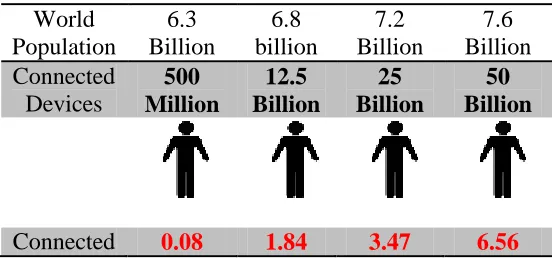
We have now reached a complex environment in the evolution of the Internet. By 2020, experts estimate that 20 to 50 billion devices will be connected to the Internet - one-third of them are computers, smart phones and tablets. The remaining two - thirds of devices, terminals, home appliances, thermostats, televisions, vehicles, manufacturing machines, urban infrastructure and many "things" traditionally added to the Internet enabled.
3.1. Why IoT is Important?
Create links to daily objects and devices for all types of networks, e.g. the company intranets, peer-to-peer networks and even the internet of the world. For this reason, its development is of great importance in the telecommunications industry. It challenges existing structures within established companies, and creates the basis for new opportunities and business models.
Internet of Things builds revolutionary success of mobile and internet networks by expanding networks of the world's networks. This is
done by using key technological techniques. This report includes radio frequency identification (RFID), wireless sensor technologies, smart technologies and nanotechnology. The 'expanded' Internet can detect and track the actual position of the attached things. The developments of the miniaturization are technically everywhere. The networks and their merchandise are increasingly clever by developments in "Smart Technologies".
While the Things Internet is a relatively new view, its processing techniques are sometimes round, and each other's relative is isolated. In the middle of the last century RFID was invented and the products using nanotechnology were on the market for more than a decade. The effect of the mixture of such technologies cannot be underestimated. Thus, by finding the current telecom state, it is worth to examine the potential possible future of the industry's entire website.
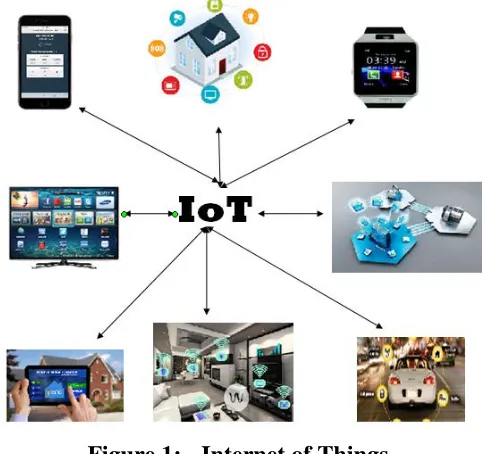
Figure 1: - Internet of Things
Currently "Internet of Things" is not a second Internet - rather than a network of devices connected to the Internet network that every day uses to upload and upload photos, connect with friends, and connect with friends. This is a product
network that is connected to the Internet, so that they can connect their own IP addresses, even simultaneously to integrate simple tasks
3. HOW IoT WORK
Technology has had a great impact on our lives. The Internet with large network groups and connected devices makes the surrounding objects smart and smart. Wearable devices attached to the Internet are now very common. Together with them, the word "Internet of Things" is gradually becoming popular. Creating efficient communication between each and every ingenuity process and the way it leads to a better world. Such smart technologies are integrated into various devices to help improve the quality of our lives and make it more convenient.
Internet objects refers to the idea of being connected to a network, which provides an IP address for the Internet connection, causing interaction between these devices and related Internet connected computers. These Internet-enabled devices can be found on any devices such as Internet devices, vehicles, buildings and other organisms and lifeless objects. This allows products to send and receive data with electronic, data, software and sensors, allowing them to confirm real-time connections between them. This technology helps with direct synchronization and real-time monitoring and control of the physical objects of these systems using computer-based systems.
IoT concludes the concept of Cyber-Business Systems which includes smart technologies such as smart homes, smart offices, and smart traffic and grid facilities. The Internet for smart cities is always a challenging topic and creates confidence for the best and smartest world.
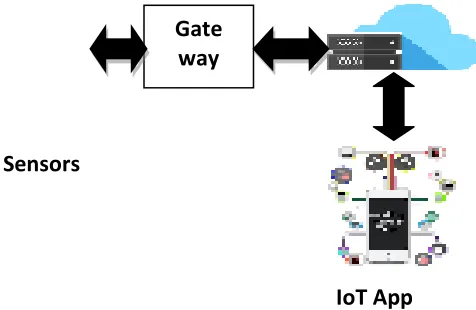
Figure 2: -IoT Components
IoT (Internet of Things) is a technical concept and / or structure for integrating existing technologies.
1) Sensors/Devices
First, the sensors or devices collect data from their surroundings. It may be as simple as complicated as a temperature reading or a full video feed. I use "sensors / devices," because multiple sensors can be bundled together or sensors can be part of a device rather than feel things out. For example, your phone is a device that has multiple sensors (like the camera, accelerator, GPS), but your phone is not a sensor.
However, whether this is a complete sensor or a complete device, this first step is to collect data from the environment.
2) Connectivity
Next, that data is sent to the cloud, but there is a way to get there! Clouds can also connect the sensors / devices with different methods such as cellular, satellite, WiFi, Bluetooth, low-power wide networks (LPWAN), or directly connecting to the Internet via Ethernet.
Each option has transmissions between power consumption, range, and bandwidth. Choosing any link option comes down to excellent
Gate way
Sensors
Cloud Server
IoT App
IOT usage, but they all carry out the same task: receiving cloud data.
3) Data Processing
Once the data cloud is available, the software performs some kind of processing. It is easy to check the temperature reading within the acceptable range. Or it may be very difficult, such as using computer views on the computer.
What happens if the temperature is too high or when you enter your home? The user comes in.
4) User Interface
Next, the information will be useful for the end user in some use. This may be an alert for the user (email, text, notification). For example, text warning when the company's cold storage is too high.
Also, there may be an interface that allows a user to verify the computer as a precaution. For example, a user must check their home video feeds via a phone application or a web browser.
5) IPv6
IP addresses for the full IoT environment are vertebrates. The Internet is only concerned about IP addresses
To help better understand the IoT environmental functions; Let's take a look at the IoT in Home Automation:
The temperature installed in the room will be synchronized with the Sensor Network gateway. The gateway helps connect the temperature sensor network (s) to the Internet through the cloud infrastructure.
The cloud / server contains the superficial logs on how device ID, device's current state, device last accessed, how many times the device was accessed, and how many times was accessed.
The connection with the cloud is activated using web services such as RESTful.
Users like you are communicating with the cloud (and the homes installed on our homes) by mobile application. A request will be sent to the cloud with authentication and device information. Authentication is built to ensure Internet security.
The cloud device identifies the device with
the help of ID and sends related
requests to
the appropriate sensor networkusing the lines.
Then, read the current temperature in the temperature sensor room and send the answer back to the cloud.
The cloud identifies the specified user with the data and pushes the requested data for use. So the user will directly get information directly on his screen
4. CHALLENGES OF IOT
Network development is not the main issue when developing the Internet of Things devices within a laboratory. Only some devices supported by the server, the connection is too short and free of charge. But the same IoT usage is a totally different ball game, with thousands of or millions of users accessing the world at the same time.
Unfortunately, the Internet is not just a network, but many suggestions, such as mobile towers, connectivity, firewalls, and proxy servers, can cause problems.
There are seven challenges on the website of things that we need to deal with today:
i) Security
Security is an important issue for the Internet, and it is probably the most important challenge for IoT. When the number of connected devices increases, the number of possibilities for exploitation of infections by less formatted devices
reveals the user's data steal, especially if the data streams are inadequate protection.
Networks are connected to many Internet networks and internets are harmed by a significant number of security holes, which provide malicious actors with lots of attack vectors and vulnerabilities. The most important change in security comes from the fact that our lives are more intense.
ii) Privacy
IoT creates unique challenges for privacy, many existing data beyond privacy issues. Most of these are integrated into our environments without emotional use.
Possibly, the Internet of Things receives information about those who use it. Smart phones may already be monitored, but smart devices provide survey information with the output of smart devices, and manufacturers can harvest information about user habits. In addition, many IoT displays involve device use and data collection activities with international or global intent to cross social and cultural boundaries.
iii) Energy (Power)
IOT devices are generally expected to be accessed by other devices at all times. This means that the device consumes the power or at least its contact module power when it is not in use for its primary function. While not in use, most devices enter the standby state, which uses substantially less energy.
So power consumption is one of the ridiculous challenges in IoT. Energy saving is the major fact to success the implementation of IoT in all aspects.
iv) Standards
The lack of documented or sustainable best practices has had a huge impact on the devices that
go beyond the development of their development and capacity. As a result of lack of standard, you can implement inappropriate behavior by IoT devices. Without proper standards to guide and organize the manufacturers, developers can design products that can operate in any blockbuster lines regardless of their impact.
When you add difficulties to building and managing IoT devices, the future requirement of methods, interfaces, configuration tools and thinking design with the IPv6 adoption is essential.
v) Regulation
There are no specific laws covering various layers of IoT worldwide. The range of devices connected to each other raises many security issues.
A problem depends on whether current account laws can expand their hands for devices connected to the Internet at all times, as there are complex responsibilities for such devices.
The broader purpose of IoT challenges will not be private to industrialized countries. In fact, IoT has a substantial promise of providing social and economic benefits for emerging and developing economies.
vi) Development
IoT brings new opportunities; At the same time, it adds several layers of complexity. Such new ecosystems will add a new dimension to policy makers in emerging economies that will create a new map for concerns regarding IoT regulation control.
Nothing in these challenges is a reason to resist the resistance of the Internet. Not necessarily. Since smart devices are not able to participate today, today's unexpected challenges may emerge.
However, over the past few decades, we have seen massive revolutions that produce
everything from personal computer to smart phone. If we can evaluate the challenges we have seen in previous revolutions, we can reduce the IoT's appearance. If we do not have anything else, we can be prepared to face challenges that we do not expect.
5. IoT NOW AND FUTURE
In the minds of the world's business executives, Internet of Things (IoT) has hit an infiltration point. The real world examples of what can be achieved can show many strong gains in IoT markets. From here up to 2019 the story is clear: IoT moves well from good.
This is the view of the majority of 3,100 tax-of-business and IT specialists we have discussed as part of our international IoT account. Sometimes we find that surprise, always knowledge, IoT has a bright future, but there are road blocks ahead. The IoT's expectations are sky-high, but the study finds that IoT practices have surpassed their expectations. In fact, 88 percent said they are already coming back to financial investment. IoT is good for business performance, innovation, and profits.
These results are that IoT goes beyond industry development - it begins to live up to its potential. Kevin Ashton, 'Making Sense of IoT', 'The Internet of Things' is the creation of sensors connected to the Internet and by creating open and temporary connections, by creating free connections, sharing data and unpopular applications, Become human's nervous system.
World Population
6.3 Billion
6.8 billion
7.2 Billion
7.6 Billion Connected
Devices
500 Million
12.5 Billion
25 Billion
50 Billion
Connected 0.08 1.84 3.47 6.56
Devices Per Person
Year 2003 2010 2015 2020
Figure 3: - Current & Future status of IoT
The global organizations are using IoT today.
1. Using ‘smart workplaces’ to boost productivity and efficiency
Seven in ten (72 percent) enterprise organizations have introduced IoT devices and sensors into the workplace—from air conditioning and lighting systems (56 percent) to personal mobile devices (51 percent).
2. Industrial sector looking to IoT to reduce risk and downtime
With a 62 percent adoption rate, leaders of industrial organizations reported using IoT devices such as chemical sensors (62 percent) and picking systems (46 percent) to reduce operational risk and address downtime.
3. Healthcare increases innovation and reduces costs through IoT
Six in ten healthcare organizations are already using IoT, with patient monitors (64 percent) and X-ray/imaging devices (41 percent) among the main devices connected to the network.
4. Retailers are building IoT services to enhance the customer experience
Just under half (49 percent) of global retailers have deployed IoT technology, and a large number of those (56 percent) are allowing personal mobile devices to access the network in order to create new and engaging retail experiences.
5. Governments are saving costs with IoT, creating smart cities
At 42 percent, governments are further behind in their adoption of IoT. In fact over a third (35 percent) of IT decision makers within government bodies claimed their leaders had little
or no understanding of IoT - double the global average.
6. CONCLUSION
Like other milestones in technology, the Internet of Things enables us to measure what could not be measured before. For companies this means additional information for high resolution management of industry and business processes. In this paper, the basic IoT factors, components and challenges are analyzed. The status of Indian growth towards IoT is discussed. Using this information, everyone easily understands the concept of Internet of Things and its functions, challenges and usages.
In future, to be focus on the basic need and the backbone of IoT is to be analyzed, that is, all the IoT components and network lifetime is purely based on the Energy source. So Energy harvesting techniques and methodologies are to be concentrated in future
7. REFERENCES
[1]. D. Evans, “The Internet of Things—How the Next Evolution of the Internet Is Changing Everything”, CISCO White Paper,
April 2011, online at
http://www.cisco.com/web/about/ac79/docs/ innov/IoT_IBSG_0411FINAL.pdf
[2] A. Gluhak, S. Krco, M. Nati, D. Pfisterer, N. Mitton, T. Razafindralambo, A survey on facilities for experimental Internet of Things research, IEEE Communications Magazine 49 (2011) 58–67.
[3] Zanella, A.; Bui, N.; Castellani, A.; Vangelista, L.; Zorzi, M. Internet of things for smart cities. IEEE Internet Things J. 2014, 1, 22–32.
[4] E. Borgia, “The internet of things vision: Key features, applications and open issues,”
Comput. Commun., vol. 54, pp. 1–31, 2014.
[5] C. Perera, A. Zaslavsky, P. Christen, and D. Georgakopoulos, “Context Aware Computing for The Internet of Things: A Survey” IEEE Communications Surveys & Tutorials, 2013, pp. 1-41.
[6] M. Palattella, N. Accettura, X. Vilajosana, T. Watteyne, L. Grieco, G. Boggia, and M. Dohler, "Standardized protocol stack for the internet of (important) things," Proceedings of IEEE, 2012, pp. 1-18.
[7] O. Vermesan, P. Friess,and A. Furness, The Internet of Things 2012, By New Horizons,
2012. [Online]. Available:
http://www.internet-of-things-research.eu/pdf/ IERC_Cluster_ Book_2012_WEB.pdf
[8] Li Da Zu” Internet of Things in Industries: A Survey” IEEE Transactions on Industrial Informatics, vol. 10, no. 4, November 2014 [9] S.d.t. Kelly, n.k. Suryadevara and S.C.
Mukhopadhyay Towards the Implementation of IoT for Environmental
Condition Monitoring in Homes,IEEE Paper 2013
[10] Agrawal, Sarita, and Manik Lal Das. "Internet of Things—A paradigm shift of future Internet applications." In Engineering (NUiCONE), 2011 Nirma University International Conference on, pp.1-7. IEEE, 2011.
[11] Liu, Yuxi, and Guohui Zhou. "Key technologies and applications of internet of things." In Intelligent Computation Technology and Automation (ICICTA), 2012 Fifth International Conference on, pp. 197- 200. IEEE, 2012.
[12] Chen, Xian-Yi, and Zhi-Gang Jin. "Research on key technology and applications for internet of things." Physics Procedia 33, pp. 561-566, 2011.
[13] Pallavi Sethi, Smruti and R. Sarangi "Internet of Things: Architectures, Protocols, and Applications Internet of Things: Architectures, Protocols, and Applications", Journal of Electrical and ComputerEngineering.
Volume 2017 (2017), Article ID 9324035, [14] Taniya Patra and Mohammad Sarosh.
"Internet of Things – An Indian Outlook”, IIT, Bengaluru, 2015.
[15] S. Ramachandran, “Innovative Use Cases for the Adoption of Internet of Things in India Manufacturing" IDC Manufacturing Insights, May 2015.
[16] Enzo Baccarelli, Paola G. Vinueza Naranjo, Michele Scarpiniti, Mohammad Shojafar, and Jemal H. Abawajy, "Fog Of Everything: Energy-Efficient Networked Computing Architectures, Research Challenges, And A Case Study", IEEE Access, May 2017. [17] Cristina Alcaraz, Pablo Najera, JavierLopez,
Rodrigo Roman, “Wireless Sensor Networks and the Internet of Things: Do We Need a Complete Integration?”, International Workshop on the Security of the Internet of Things (SecIoT10), pp. xxxx, 2010.