Contents lists available atSciVerse ScienceDirect
Computers and Mathematics with Applications
journal homepage:www.elsevier.com/locate/camwaShort-term scheduling of cascade reservoirs using an immune
algorithm-based particle swarm optimization
Xiang Fu
a,∗, Anqiang Li
b, Liping Wang
c, Changming Ji
caState Key Laboratory of Water Resource and Hydropower Engineering Science, Wuhan University, Wuhan 430072, China bChangjiang Institute of Survey, Planning, Design and Research, Changjiang Water Resources Commission, Wuhan 430072, China cRenewable Energy Institute, North China Electric Power University, Beijing 102206, China
a r t i c l e i n f o
Article history:
Received 17 September 2009 Received in revised form 13 April 2011 Accepted 13 July 2011
Keywords:
Cascade reservoirs Short-term operations
Immune algorithm-based particle swarm optimization
a b s t r a c t
This paper presents a new approach for short-term hydropower scheduling of reservoirs using an immune algorithm-based particle swarm optimization (IA-PSO). IA-PSO is employed by coupling the immune information processing mechanism with the particle swarm optimization algorithm in order to achieve a better global solution with less computational effort. With the IA-PSO technique, the hydro-electrical optimization model of reservoirs is formulated as a high-dimensional, dynamic, nonlinear and stochastic global optimization problem of a multi-reservoir hydropower system. The purpose of the proposed methodology is to maximize total hydropower production. Here it is applied to a reservoir system on the Qingjiang River, in the Yangtze watershed, that consists of two reservoirs. The results are compared with the results obtained through conventional operation method, the dynamic programming and the standard PSO algorithm. From the comparative results, it is found that the IA-PSO approach provides the most globally optimum solution at a faster convergence speed.
©2011 Elsevier Ltd. All rights reserved.
1. Introduction
Hydroelectricity is a clean and renewable energy whose quantity depends on the volume of water flow and the amount of head created by the water reservoir. In cascade reservoirs, the reservoir water level of a downstream plant is influenced by the generation of the upstream plant. Therefore, hydropower scheduling is a complicated nonlinear dynamical optimization problem that includes nonlinear flows, nonlinear dynamical hydraulic heads and the interactional relationships of nonlinear input and output variables. The objective is to obtain the optimal utilization of the hydro resources available for maximum hydroelectric generation given a set of starting conditions and many complex constraints in the hydropower system.
To solve the problem of scheduling optimal hydropower, several hydropower optimization techniques have been de-veloped. These techniques can be classified into two main categories: (1) Mathematical programming techniques, which are applied to quantitative information with well-structured algorithmic processes, such as Network Flow Optimization [1–4], linear programming [5,6], Stochastic Linear Programming [7], Nonlinear Programming [8,9] and Dynamic Program-ming [10,11] etc. (2) These heuristic programming techniques, which are employed with both quantitative and qualitative information in this paper, based on rules-of-thumb, personal experience or various analogies, such as genetic algo-rithms [12–14], artificial neural networks [15–17], particle swarm optimization [18,19] and an improved algorithm [20,21] and so on.
∗Corresponding author.
E-mail addresses:[email protected](X. Fu),[email protected](A. Li),[email protected](L. Wang),[email protected](C. Ji). 0898-1221/$ – see front matter©2011 Elsevier Ltd. All rights reserved.
Several improved PSO have been proposed for solving these problems, such as incorporating PSO with new the stretching function [24], Gaussian mutation [25], sub-swarm [26] and so on. Incorporating these new methods cannot guarantee the stability of the algorithm within a global optimization solution nor can they accelerate the speed of convergence in the evening of evolution; therefore, a robust technique is needed to handle the scheduling of reservoirs in a hydropower system. As a result, an immune algorithm-based particle swarm optimization is presented by integrating a special concentration selection mechanism and an immune vaccination with PSO [20]. This method possesses a better ability to search the global optimum solution and accelerate the convergence speed more than the original PSO algorithm. Meanwhile, The IA-PSO approach has been successfully applied in load distribution among cascade hydropower stations, however, the results of the application of IA-PSO to the short-term scheduling of cascade hydropower plants have not yet been reported.
This paper develops an IA-PSO method for the short-term hydropower scheduling of cascade plants in order to obtain optimal hydropower generation on a global level. The efficiency and robustness of the proposed method is demonstrated via comparison of its applied PSO techniques performance in two cascade reservoirs located at the tributary of the upper Yangtze River basin.
2. Hydroelectric operation optimization model
The Hydroelectric operation optimization model can be generalized as follows. 2.1. Objective function
The aim of hydropower operations is to maximize total hydroelectric generation by making the best use of hydro resources over a certain scheduling duration. The Objective function can be equivalently expressed as
F=
max n−
t=1 m−
i=1 Ni,t1t Ni,t=
η
Hi,tRi,t (1)whereF denotes hydropower generation of hydro units over a scheduling periodn;mis the total number of cascaded hydropower plants under consideration;Ni,t is the power corresponding to plantiduring periodt, which is the decision
variable of the model;1tis the short time interval;Hi,tis the hydraulic head of plantiduring periodt;Ri,tis the release
passing turbines of the hydropower plantiduring periodt;
η
represents the power coefficient. 2.2. Constraints•
Power constraints of stationsThe power constraints of stations are expressed as
Ni,tmin
≤
Ni,t≤
Ni,tmax i=
1,
2, . . . ,
m;
t=
1,
2, . . . ,
n (2)whereNi,tminandNi,tmaxare the upper limits and lower limits of power for plantiduring periodtrespectively.
•
Reservoir continuityThe reservoir continuity of mass can be described by the following finite difference formulas
Vi,t+1
=
Vi,t+
η(
Ii,t−
Qi,t)
Vi+1,t+1
=
Vi+1,t+
η(
It+1,t−
Qi+1,t)
Ii+1,t
=
IQi+1,t+
Qi,t−τii
=
1,
2, . . . ,
m;
t=
1,
2, . . . ,
n (3)whereVi,t is the initial storage volume of reservoiriat the beginning of periodt;Ii,t is the inflow into reservoiriduring
periodt;
η
is the conversion coefficient for unit;IQi+1,tis the interzone inflow into reservoiri+
1 during periodt;Qi,tis theoutflow from reservoiriduring periodt, which includes the power release and spillway release;
τ
iis the flow routing timefrom reservoirito downstream reservoiri
+
1.•
Physical limitationsPhysical limitations on the water level of reservoirs are given by
Li,tmin
≤
Li,t≤
Li,tmax i=
1,
2, . . . ,
m;
t=
1,
2, . . . ,
n (4)Fig. 1. Sketch map for particles of a hydropower plant.
The initial and final reservoir water level are given by
Li,0
=
Li,begin Li,n=
Li,end i=
1,
2, . . . ,
m (5)whereLi,begin
,
Li,endare the initial and final water levels of reservoirirespectively.The outflow limits are given by
Qi,tmin
≤
Qi,t≤
Qi,tmax i=
1,
2, . . . ,
m;
t=
1,
2, . . . ,
n (6)whereQi,tminandQi,tmaxare the minimum and maximum outflow of reservoiriduring periodt. 3. IA-PSO algorithm for hydropower scheduling
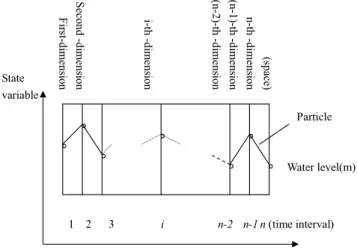
Short-term optimal scheduling of cascade hydropower plants is a dynamic, multi-stage sequential decision-making process. Therefore, the key to the application of the PSO algorithm is to achieve a multi-stage continuous optimization. As the particle swarm gets the optimal solution through the multi-dimensional space flight, the time dimension of optimal scheduling will be assumed as the space dimension for the particle swarm. Assuming the total scheduling period isnfor reservoirs, we can determine thatnis the space dimension for the particle swarm. The optimal scheduling of thenperiod for reservoirs translates into the optimal location of then-dimensional space for particles. Consequently, a multi-stage process of scheduling can be carried out by calculation in the space dimension order. The track of particles in then-dimensional space (such as the water level of a reservoir) for any hydropower plant is equivalent to the trajectory used in dynamic programming (as shown inFig. 1)
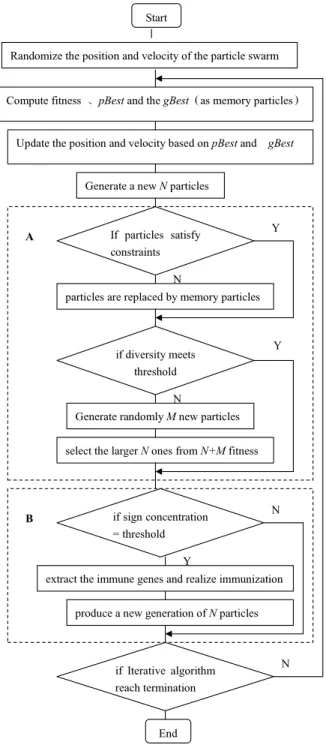
The immune algorithm-based particle swarm optimization (IA-PSO) was proposed by combining the immune informa-tion processing mechanism with an original particle swarm optimal algorithm, which with its special concentrainforma-tion selecinforma-tion mechanism and immune vaccination [20], improves the ability to seek a globally excellent result and increases convergence speed.Fig. 2shows the flowchart of IA-PSO algorithm for hydropower scheduling. Compared with the PSO algorithm, the IA-PSO algorithm has three main parts. The part outside the dashed boxesAandBcan run independently to control the iter-ative process of conventional optimization algorithms described by following Steps 1–2. PartAshows the immune memory and self-adjustment to realize the diversity of the population stated by following Steps 3–5. PartBcarries out vaccination to improve the convergence of algorithm depicted by following Steps 6–7. The steps of the flowchart are as follows:
Step 1: Randomly generateNparticles satisfying the constraints Eqs.(2)–(6), and initialize the position and velocity of these particles.
Step 2: Utilize the objective function Eq.(1)as a function of particle fitness. Calculate fitness of the particle for a position in then-dimensional space. Adjust the speed of the particle according to the current fitness value and the gap among the individually best position (pBest) and the globally best position (gBest), and then adjust its position to form a new particle. The new velocity and position are respectively given by [20]:
ν
j i,t(
k+
1)
=
w
×
ν
j i,t(
k)
+
C1×
Rand()
×
(
x pbest i,t−
x j i,t(
k))
+
C2×
Rand()
×
(
x gbest i,t−
x j i,t(
k))
(7) xji,t(
k+
1)
=
xji,t(
k)
+
v
ij,t(
k+
1)
i=
1,
2, . . . ,
m;
t=
1,
2, . . . ,
n (8) wherew
is an inertial factor;C1andC2are learning factors; Rand()
is a random number between 0 and 1;xpbesti,t andxgbest i,t are,
Fig. 2. Flowchart of IA-PSO algorithm.
respectively thek-th iteration and
(
k+
1)
-th iteration position ofj-th particle for plantiat time stept;ν
ij,t(
k)
andν
ij,t(
k+
1)
are respectively thek-th iteration and(
k+
1)
-th iteration velocity a ofj-th particle for plantiat time stept.Step 3: Check the new particles generated by Step 2. If a particle does not satisfy the constraints Eqs.(2)–(6), particles will be replaced by memory particles, namely, the globally best particles.
Step 4: Check whether the diversity of the population is greater than the threshold
ξ
, if so, divert to Step 6; if not, go to Step 5 to implement immune regulation to prevent the algorithm of ‘‘precocious’’ phenomenon. The relative diversity of the populationξ(
k)
is defined by the formulaξ(
k)
=
div(
k)
div
(
k)
=
1 Nmn N−
j=1 m−
i=1 n−
t=1
(
xji,t(
k)
−
xgbesti,t(
k))
(
bi,t−
ai,t)
2 (10) wherebi,t andai,t are respectively the upper limit and lower limit of the power corresponding to plantiduring periodt;div
(
0)
and div(
k)
are respectively diversity of the population at initiation andk-th iteration.Step 5: Generate randomlyMnew particles that meet the constraints Eqs.(2)–(6)again based on theNnew particles and compute the probability of selection of particlejaccording to the consistency of particlej. Then the values for the probability of selection forN
+
Mparticles are ordered decreasingly and the topNparticles are selected as the next-generation of evolution. The probability of selection of particlejcan be expressed as [20]:P
(
Xj)
=
1 D(Xj) N+M∑
j=1 1 D(Xj) j=
1,
2, . . . , (
N+
M)
(11) D(
Xj)
=
1 N+M∑
J=1|
f(
Xj)
−
f(
XJ)
|
j=
1,
2, . . . , (
N+
M)
(12)whereD
(
Xj)
is the consistency of particlej;P(
Xj)
is the probability of selected particlej.Step 6: Check whether the sign concentration of the particle is equal to the threshold concentration, and if so, extract the immune genes and realize immunization, and then produce a new generation of particles. The sign concentration can be respectively expressed as:
pl
(
xi,t)
=
1 N N−
j=1 al (13)wherealis integer 0 or 1, which can be determined by
al
=
1 g
(
xji,t)
=
ζ
l0 elsewise (14)
whereg
(
xji,t)
is a symbol and is given byg
(
xji,t)
=
ζ
1 Ni,tmin≤
xij,t<
Ni,t,1ζ
2 Ni,t,1≤
xji,t<
Ni,t,2· · ·
· · ·
ζ
L Ni,t,L−1≤
xji,t≤
Ni,tmax (15)where
ζ
l(
l=
1,
2. . . ,
L)
is a symbol of power interval;Ni,tminandNi,tmaxare respectively the minimum and maximal powerof planti;Ni,t,l
(
l=
1,
2. . . ,
L−
1)
is thel-th discrete power for plantiat time stept.Step 7: Judge whether the Iterative algorithm has reached termination, if it has, then stop; repeat Steps 2–6 accordingly. In this paper we present a dual termination criterion that secure a certain number of iterations while reaching the given objective function error between current best fitness value and the previous best one.
4. Application
The methodology described previously is applied to the cascade reservoirs in the QingJiang River basin. The cascade reservoirs in this study comprise of the Geheyan reservoir and the Gaobazhou reservoir which are located on the downstream reaches of the Qingjiang River. The Qingjiang River winds its way from west to east with a total length of 425 km and has a watershed area of 17 000 km2, joining the Yangtze River in the city of Zhicheng, Hubei province.
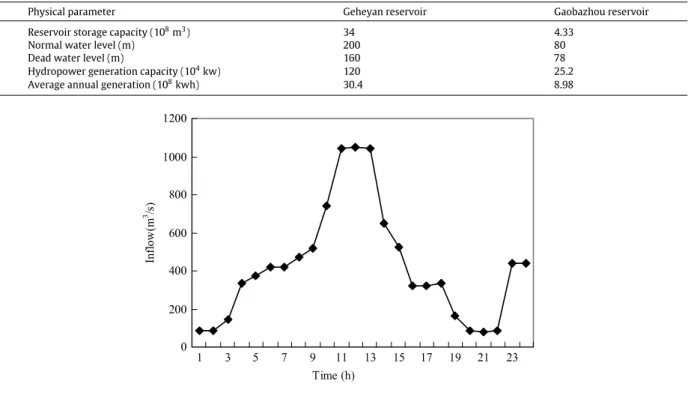
The Geheyan reservoir is primarily for hydropower generation, flood control and navigation. The Gaobazhou reservoir lies in the downstream of Geheyan reservoir with a 50 km distance and also plays an important role in hydropower generation and navigation. The two reservoirs were constructed in 1994 and 2000 respectively. The two hydropower plants corresponding to the two reservoirs belong to the Qingjiang Hydropower Corporation of Hubei Province. The main physical parameters of the reservoirs are given inTable 1.
The inflow into the cascade reservoirs is shown inFig. 3. The time of stream routing from the Geheyan reservoir to the Gaobazhou reservoir is 2 h. The time step for the scheduling calculation is 1 h and the total number of time steps is 24 respectively, which means that the model is run for a day with hourly time steps with 48 decision variables.
To evaluate the performance of the proposed IA-PSO, the parameters used are set as follows: The total number of the particle swarm is 25, which are achieved by making some tries. It is also found from trial that the solution is led to local
Dead water level (m) 160 78
Hydropower generation capacity (104kw) 120 25.2
Average annual generation (108kwh) 30.4 8.98
Fig. 3. Inflow hydrograph for cascading plants.
Table 2
The results of the operation with three methods: (1) the conventional operation method; (2) the dynamic programming; (3) the IA-PSO. Hydropower plants Generation with method (1) (mwh) Generation with method (2) (mwh) Generation with method (3) (mwh)
Hydropower rate increased compared between method (3) and (1) (%)
Hydropower rate increased compared between method (3) and (2) (%)
Geheyan plant 9310.66 9807.32 9810.53 5.369 0.033
Gaobazhou plant 3469.84 3586.97 3587.789 3.399 0.023
Total 12780.5 13394.29 13398.319 4.834 0.030
convergence with a total number less than 15 while the computing efficiency wasn’t significantly improved with over a number of 25 particles. The learning factors are both 2.0 [27]. The threshold for diversity of the population is 0.4. Results show that the evolution of the population stabilized in the vicinity of this value and the diversity of the population need to strengthen through self-regulating. The threshold of concentration for immune extraction is 0.6.
The optimal hydropower generation for the Geheyan and Gaobazhou hydropower plant is obtained by using the algorithm described previously.
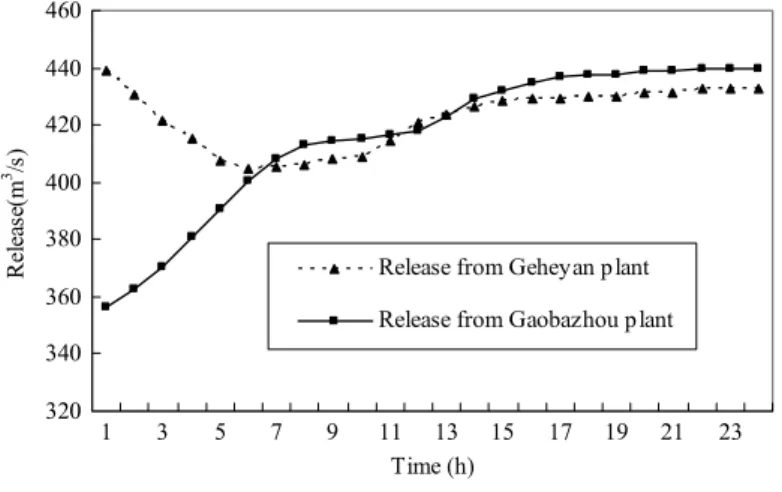
Table 2 gives the results of operation with the conventional operation method, dynamic programming and the IA-PSO method. They show that the hydropower generation of the cascade reservoirs change with three different methods. Cascade hydropower stations will enable 4.83% more electricity with the IA-PSO algorithm than the conventional operation. Furthermore, the IA-PSO increases 0.03% of the hydropower rate, so it is better than dynamic programming. Since the results of dynamic programming obtained depend strongly on discrete accuracy the IA-PSO has a higher precision in the optimization process. This means that compared to the known and accepted dynamic programming method, the IA-PSO is more accurate for the prediction of hydropower generation in cascade reservoirs. The results of the optimized operation are shown inFigs. 4–6. In the beginning of scheduling, the Geheyan plant releases flow as far as possible to generate more hydropower. The operations of the two reservoirs gradually go into stability when the storage water level of the Gaobazhou reservoir power station gradually reaches the maximum. The release and hydropower from the Geheyan reservoir will thus increase with the release accretion from the downstream dam. Therefore, the hydrographs ofFigs. 4–6will be in line with the operation rules for the short-term optimal scheduling.
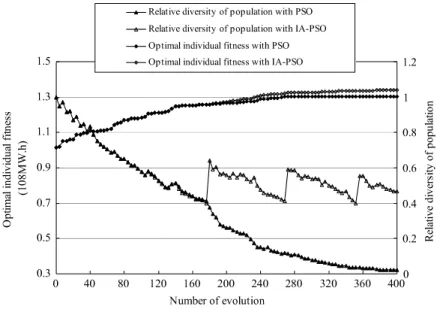
Fig. 7shows the relative diversity of the population and optimal individual fitness with the number of evolution for PSO and IA-PSO algorithms given the same initial conditions. The evolution of the two algorithms is almost the same because of good diversity of the population in the early evolution. But the optimal individual solution in the PSO algorithm appears to have a relatively early convergence with an advance in the evolutionary process due to a decline in population diversity. While the diversity of groups has been well maintained due to self-regulation of immune mechanisms, the IA-PSO algorithm
Fig. 4. Release hydrograph for cascading plants.
Fig. 5. Water level hydrograph of the Geheyan reservoir.
Fig. 6. Water level hydrograph of the Gaobazhou reservoir.
and the relative diversity are distributed over a certain threshold. The best individual solution, therefore, is the global optimization solution rather than present premature convergence. Results reflect that the IA-PSO algorithm surpasses the PSO algorithm in global optimization and in convergence speed.
5. Conclusions
The methodology of the immune algorithm-based particle swarm optimization has been presented in this paper as a solution to the problem of optimizing hydropower in cascade reservoirs, and its effectiveness has been tested by being applied to a reservoir system in the QingJiang River basin.
The conventional operation method and the dynamic programming method were applied to verify the feasibility and superiority of the IA-PSO. It can be concluded from this validation that the IA-PSO has good accuracy in the calculation of
Fig. 7. Comparison of PSO and IA-PSO algorithm.
hydropower generation. The run time is almost the same for the three algorithms. A comparison of A comparison of run time shows that the PSO is somewhat faster than IA-PSO, while dynamic programming is slightly slower than the IA-PSO.
The selection mechanism of particle concentration combined with vaccination is adopted in this methodology to keep explicit diversity of population from a local maximum point and to speed up the convergence in order to search for a better global solution than PSO. The results show that the IA-PSO is able to find the most satisfactory operating policy for the reservoir system. Since this method is effective and efficient for two-cascade hydropower plants, it may be promising to apply it to optimal scheduling of multi-reservoir systems.
Acknowledgments
This paper was supported by the National Natural Science Foundation, China (Grant No. 50739003). The authors would like to thank the reviewers for their valuable comments and suggestions.
References
[1] G. Kuczera, Network linear programming codes for water supply headworks modeling, Journal of Water Resources Planning and Management 119 (3) (1993) 412–417.
[2] J. Lund, I. Ferreira, Operating rule optimization for Missouri River reservoir system, Journal of Water Resources Planning and Management 122 (4) (1996) 287–295.
[3] J. Fredericks, J. Labadie, J. Altenhofen, Decision support system for conjunctive stream-aquifer management, Journal of Water Resources Planning and Management 124 (2) (1998) 69–78.
[4] N.-S. Hsu, K.-W. Cheng, Network flow optimization model for basin-scale water supply planning, Journal of Water Resources Planning and Management 128 (2) (2002) 102–112.
[5] J. Needham, D. Watkins, J. Lund, K. Nanda, Linear programming for flood control in the Iowa and Des Moines Rivers, Journal of Water Resources Planning and Management 126 (3) (2000) 118–127.
[6] C. Wei, N. Hsu, Multireservoir real-time operations for flood control using balanced water level index method, Journal of Environmental Management 88 (2008) 1624–1639.
[7] I. Ahmed, K. Lansey, Optimal operation of multi-reservoir systems under uncertainty, in: D. Phelps (Ed.), Proceedings of the World Water and Environmental Resources Congress, Environmental and Water Resources Institute of ASCE, Reston, VA, 2001.
[8] M. Barros, F. Tsai, S.-L. Yang, J. Lopes, W. Yeh, Optimization of large-scale hydropower system operations, Journal of Water Resources Planning and Management 129 (3) (2003) 178–188.
[9] C.-S. Peng, N. Buras, Practical estimation of inflows into multireservoir system, Journal of Water Resources Planning and Management 126 (5) (2000) 331–334.
[10] J. Yi, J. Labadie, S. Stitt, Dynamic optimal unit commitment and loading in hydropower systems, Journal of Water Resources Planning and Management 129 (5) (2003) 388–398.
[11] Y.C. Wang, J. Yoshitani, K. Fukami, Stochastic multiobjective optimization of reservoirs in parallel, Hydrological Processes 19 (2005) 3551–3567. [12] M. Sharif, R. Wardlaw, Multireservoir systems optimization using genetic algorithms: case study, Journal of Computing in Civil Engineering 14 (4)
(2000) 255–263.
[13] L. Chang, Guiding rational reservoir flood operation using penalty-type genetic algorithm, Journal of Hydrology 354 (2008) 65–74.
[14] L.F.R. Reis, G.A. Walters, D. Savic, F.H. Chaudhry, Mulitreservoir operation planning using hybrid genetic algorithm and linear programming (GA–LP): an alternative stochastic approach, Water Resources Management 19 (2005) 831–848.
[15] H. Raman, V. Chandramouli, Deriving a general operating policy for reservoirs using neural network, Journal of Water Resources Planning and Management 122 (5) (1996) 342–347.
[16] R. Naresh, J. Sharma, Short term hydro scheduling using two-phase neural network, International Journal of Electrical Power & Energy Systems 24 (7) (2002) 583–590.
[17] P. Chaves, F.-J. Chang, Intelligent reservoir operation system based on evolving artificial neural networks, Advances in Water Resources 31 (6) (2008) 926–936.
[18] B. Yu, X. Yuan, J. Wang, Short-term hydro-thermal scheduling using particle swarm optimization method, Energy Conversion and Management 48 (2007) 1902–1908.
[19] Y. He, J. Zhou, X. Xiang, H. Chen, H. Qin, Comparison of different chaotic maps in particle swarm optimization algorithm for long-term cascaded hydroelectric system scheduling, Chaos, Solitons & Fractals 42 (5) (2009) 3169–3176.
[20] A. Li, L. Wang, J. Li, C. Ji, Application of immune algorithm-based particle swarm optimization for optimized load distribution among cascade hydropower stations, Computers & Mathematics with Applications 57 (11) (2009) 1785–1791.
[21] J. Yang, J. Zhou, L. Liu, Y. Li, A novel strategy of Pareto-optimal solution searching in multi-objective particle swarm optimization (MOPSO), Computers & Mathematics with Applications 57 (11–12) (2009) 1995–2000.
[22] W.J. Labadie, Optimal operation of multireservoir systems: state-of-the-art review, Journal of Water Resources Planning and Management 130 (2) (2004) 93–111.
[23] J. Kennedy, R.C. Eberhart, Particle swarm optimization, in: Proceedings of IEEE International Conference on Neural Networks, Piscataway, NJ, 1995, pp. 1942–1948.
[24] K.E. Parsopoulos, V.P. Plagianakos, G.D. Magoulas, M.N. Vrahatis, Improving the particle swarm optimizer by function ‘‘stretching’’, in: N. Hadjisavvas, P.M. Pardalos (Eds.), Advances in Convex Analysis and Global Optimization, Kluwer Academic Publishers, 2001, pp. 445–457.
[25] N. Higashi, H. Iba, Particle swarm optimization with Gaussian mutation, in: Proceedings of the IEEE Swarm Intelligence Symposium, Indianapolis, Indiana, USA, 2003, pp. 72–79.
[26] Y. Jiang, T. Hu, C. Huang, X. Wu, An improved particle swarm optimization algorithm, Applied Mathematics and Computation 193 (2007) 231–239. [27] A.M. Baltar, D.G. Fontane, Use of multiobjective particle swarm optimization in water resources management, Journal of Water Resources Planning