Identification and Estimation of Nonlinear Dynamic Panel Data
Models with Unobserved Covariates
∗Ji-Liang Shiu†and Yingyao Hu‡ April 3, 2010
Abstract
This paper considers nonparametric identification of nonlinear dynamic models for panel data with unobserved voariates. Including such unobserved covariates may control for both the individual-specific unobserved heterogeneity and the endogeneity of the explanatory variables. Without specifying the distribution of the initial condition with the unobserved variables, we show that the models are nonparametrically identified from three periods of data. The main identifying assumption requires the evolution of the observed covariates
depends on the unoberved covariates but not on the lagged dependent variable. We
also propose a sieve maximum likelihood estimator (MLE) and focus on two classes of nonlinear dynamic panel data models, i.e., dynamic discrete choice models and dynamic censored models. We present the asymptotic property of the sieve MLE and investigate the finite sample properties of these sieve-based estimator through a Monte Carlo study. An intertemporal female labor force participation model is estimated as an empirical illustration using a sample from the Panel Study of Income Dynamics (PSID).
Keywords: dynamic nonlinear panel data model, dynamic discrete choice model, dynamic censored model, nonparametric identification, initial condition, random effects, unobserved heterogeneity, unobserved covariate, endogeneity, intertemporal labor force participation,
∗
The authors thank Chin-Wei Yang for proofreading the draft. All errors remain our own.
†
Department of Economics, National Chung-Cheng University, 168 University Rd. Min-Hsiung Chia-Yi, Taiwan. Email: [email protected].
‡
Department of Economics, Johns Hopkins University, 3400 N. Charles Street, Baltimore, MD 21218. Email: [email protected].
1. Introduction
This paper considers nonlinear dynamic models for panel data with unobserved covariates. These models take into account the dynamic processes by allowing the lagged value of the dependent variable as one of the explanatory variables as well as containing observed and un-observed permanent (heterogeneous) or transitory (serially-correlated) individual differences. LetYit be the dependent variable at period tand Xit be a vector of observed covariates for
individuali. We consider nonlinear dynamic panel data models of the form:
(1) Yit =g(Yit−1, Xit, Uit, ξit),
where g is an unknown nonstochastic function, Uit is an unobserved covariate correlated
with other observed explanatory variables (Yit−1, Xit), and ξit stands for a random shock
independent of all other explanatory variables (Yit−1, Xit, Uit). The unobserved covariate Uit
may contain two components as follows:
Uit =Vi+ηit,
whereVi is the unobserved heterogeneity or the random effects correlated with the observed
covariates Xit and ηit is an unobserved serially-correlated component.1 The transitory
com-ponent ηit may be a function of all the time-varying RHS variables in the history, i.e.,
ηit = ϕ
{Yiτ−1, Xiτ, ξiτ}τ=0,1,...,t−1
for some function ϕ. Both observed explanatory vari-ables Yit−1 and Xit become endogeneous if the unobserved covariate Uit is ignored. In this
paper, we provide reasonable assumptions under which the distribution ofYit conditional on
(Yit−1, Xit, Uit), i.e.,fYit|Yit−1,Xit,Uit,is nonparametrically identified. The nonparametric iden-tification offYit|Yit−1,Xit,Uit may lead to that of the general form of our model in equation (1) under certain specifications of the distribution of the random shockξit.
In the econometric literature, there are two approaches to tackling the unobserved hetero-geneityVi: random effects and fixed effects. In the fixed effect approach, much attention has
been devoted to linear models with an additive unobserved effect. The problem can be solved 1
The random effectVi is usually assumed to be independent of other covariates for convenience so that it
mainly causes an efficiency problem instead of an endogeneity problem especially in a linear panel data model. In this paper, we consider a more realistic setting where the individual-specific heterogeneity may be correlated with the covariates from the same individual.
by first applying an appropriate transformation to eliminate the unobserved effect and then implementing instrument variables (IV) in a generalized method of moments (GMM) frame-work. Anderson and Hsiao (1982), Arellano and Bond (1991), Arellano and Bover (1995) and Ahn and Schmidt (1995) employ an IV estimator on a transformation equation through first-differencing. Eliminating the unobserved effects is notably more difficult in nonlinear models and some progress has been made in this area. Chamberlain (1984) considers a con-ditional likelihood approach for logit models with strictly exogenous assumption. Honor´e and Kyriazidou (2000) generalize the conditional probability approach to estimate the unknown parameters without formulating the distribution of the unobserved individual effects or the probability distribution of the initial observations for certain types of discrete choice logit models. However, their results have to rely on a very strong assumption to match the ex-planatory variables in different time-periods. Their estimator is consistent and asymptotically normal but the rate of convergence is not the inverse of the square root of the sample size. Honor´e (1993), Hu (2002) and Honor´e and Hu (2004) obtain moment conditions for estimating dynamic censored regression panel data models.
On the other hand, it is often appealing to take a random effect specification by making assumptions on the distribution of the individual effects. The main difficulty of this approach is the so-called initial conditions problem.2 With a relatively short panel, the initial con-ditions have a very strong impact on the entire path of the observations but they may not be observed in the sample. One remedy to this problem is to specify the distribution of the initial conditions given the unobserved heterogeneity. The drawbacks of this approach are that the corresponding likelihood functions typically involve high order integration and mis-specification of the distributions generally results in inconsistent parameter estimates. The
2
The random effect approach for dynamic models requires the specification on the initial conditions of the process. Specifically, consider a special case of our model (1), dynamic discrete choice models without observed covariatesXit, in the following form:
Yit= 1 (γYit−1+Vi+ξit≥0).
Then the conditional distributionfYit|Yit−1,Vi can be specified and the corresponding likelihood function has
the structure L= Z fYi0|Vi T−1 Y t=1 fYit|Yit−1,VifVidvi,
wherefYi0|Vi denotes the marginal probability ofYi0 given Vi. If the process is not observed from the start
then the initial state for individuali,yi0 cannot be assumed fixed. However, it is not clear that how to derive
the initial conditionfYi0|VifromfYit|Yit−1,Viso it could be internally inconsistent across different time periods
if the evolution of these two process can not be connected. Heckman (1981b) suggested that using a flexible functional form to approximate the initial conditions.
associated computational burden of high order integration has been reduced significantly by recent advances in simulation techniques.3 Hyslop (1999) analyzes the intertemporal labor force participation behavior of married women using maximum simulated likelihood (MSL) estimator to simulate the likelihood function of dynamic probit models with a nontrivial error structure. Wooldridge (2005) suggests a general method for handling the initial conditions problem by using a joint density conditional on the strictly exogenous variables and the ini-tial condition. Honor´e and Tamer (2006) relax the distributional assumption of the initial condition and calculate bounds on parameters of the interest in panel dynamic discrete choice models.
In this paper we adopt the random effect approach for nonlinear dynamic panel data models without specifying the distribution of the initial condition. We treat the unobserved covariate in nonlinear dynamic panel data models as the latent true values in nonlinear mea-surement error models and the observed covariates as the meamea-surement of the latent true values.4 We then utilize the identification results in Hu and Schennach (2008a), where the measurement error is not assumed to be independent of the latent true values. Their results rely on a unique eigenvalue-eigenfunction decomposition of an integral operator associated with joint densities of observable variables and unobservable variables.
The strength of our approach is that we provide nonparametric identification of nonlinear dynamic panel data model using three periods of data without specifying initial conditions. The model may be described in,fYit|Yit−1,Xit,Uit, the conditional distribution of the dependent variable of interest for an individuali,Yit, conditional on a lagged value of that variableYit−1,
explanatory variables Xit, and an unobserved covariate Uit. We show that fYit|Yit−1,Xit,Uit can be nonparametrically identified from a sample of
Xit+1, Yit, Xit,Yit−1, Xit−1 without
parametric assumptions on the distribution of the individuals’ dependent variable conditional on the unobserved covariate in the initial period. The main identifying assumption requires that the dynamic process of the covariatesXit+1 depends on the unoberved covariateUit but
is independent of the lagged dependent variablesYit, Yit−1,and Xit−1 conditional on Xit and
Uit.
3
See Gourieroux and Monfort (1993), Hajivassiliou (1993), Hajivassiliou and Ruud (1994) and Keane (1993) for the reviews of the literature.
4An ideal candidate for the ”measurement” of the latent covariate would be the dependent variable because
it is inherently correlated with the latent covariate. However, such a measurement is not informative enough when the dependent variable is discrete and the latent covariate is continuous.
The identification of fYit|Yit−1,Xit,Uit leads to the identification of the general form of our model in equation (1).5 We present below two motivating examples in the existing literature. The specifications in these two types of models can be used to distinguish between dynamic re-sponses to lagged dependent variables, observed covariates, and unobserved covariates. While the state dependence Yit−1 reflects that experiencing the event in one period should affect
the probability of the event in the next period, the unobserved heterogeneity Vi represents
individual’s inherent ability to resist the transitory shocksηit.
Example 1(Dynamic Discrete-choice Model with an Unobserved Covariate): A binary case of dynamic discrete choice models is as follows:
Yit= 1 Xit0β+γYit−1+Vi+εit ≥0
with ∀i= 1, ..., n;t= 1, ..., T−1,
where 1 (·) is the 0-1 indicator function and the error εit follows an AR(1) process εit =
ρεit−1+ξit for some constantρ. The conditional distribution of the interest is then:
fYit|Xit,Yit−1,Uit = 1−Fξit − Xit0β+γYit−1+Uit Yit Fξit − Xit0β+γYit−1+Uit 1−Yit ,
where Fξit is the CDF of the random shock ξit, Uit = Vi +ηit, and ηit = ρεit−1. Empiri-cal applications of the dynamic discrete-choice model above have been studied in a variety of contexts, such as health status (Contoyannis, Jones, and Rice (2004), Halliday (2002)), brand loyalty (Chintagunta, Kyriazidou, and Perktold (2001)) , welfare participation (Chay, Hoynes, and Hyslop (2001)), and labor force participation (Heckman and Willis (1977), Hys-lop (1999)). Among these studies, the intertemporal labor participation behavior of married women is a natural illustration of the dynamic discrete choice model. In such a model, the dependent variable Yit denotes the t-th period participation decision and the covariate Xit
is the wage or other observable characteristics in that period. The heterogeneity Vi is the
unobserved individual skill level or motivation, while the idiosyncratic disturbanceεit denotes
the luck and the measurement error. Heckman (1978, 1981a,b) has termed the presence of Yit−1 ”true” state dependence and Vi ”spurious” state dependence.
5
Evdokimov (2009) considers a nonparametric panel data model with nonadditive unobserved heterogeneity:
Yit=m(Xit, Vi)+εit. The model has a different focus since our model explicitly includes lags of the endogenous
Example 2(Dynamic Censored Model with an Unobserved Covariate): In many applications, we may have
Yit= max
Xit0 β+γYit−1+Vi+εit,0 with ∀i= 1, ..., n;t= 1, ..., T −1,
withεit =ρεit−1+ξit. It follows that
(2) fYit|Xit,Yit−1,Uit =Fξit − Xit0β+γYit−1+Uit 1(Yit=0) fξit Yit−Xit0 β−γYit−1−Uit 1(Yit>0) .
where Fξit and fξit are the CDF and the PDF of the random shock ξit respectively. The dependent variableYitmay stand for the amount of insurance coverage chosen by an individual
or a firm’s expenditures on R&D. In each case, an economic agent solves an optimization problem andYit= 0 may be an optimal corner solution. For this reason, this type of censored
regression models is also called a corner solution model or a censored model with lagged censored dependent variables.6 Honor´e (1993) and Honor´e and Hu (2004) use a method of moments framework to estimate the model without making distributional assumptions about Vi.
Based on our nonparametric identification results, we propose a semiparametric sieve maximum likelihood estimator (MLE) for the model. We show the consistency of our estimator and the asymptotic normality of its parametric components. The finite sample properties of the proposed sieve MLE are investigated through Monte Carlo simulations of dynamic discrete choice models and dynamic censored models. Our empirical application focuses on how the labor participation decisions of married women respond to their previous participation states, fertility decisions, and nonlabor incomes. We develop and test a variety of dynamic econometric models using a seven year longitudinal sample from the Panel Study of Income Dynamics (PSID) in order to compare the results with those in Hyslop (1999). In the empirical application, we examine three different model specifications, i.e., a static probit model, a maximum simulation likelihood (MSL) model, and a semi-parametric dynamic probit model. Our results find a smaller significant negative effects on nonlabor income variables and a 6This setting rules out certain types of data censoring. For example, if the censoring is due to top-coding,
then it makes sense to consider a lagged value of the latent variable, i.e.,Yit∗=Xit0β+γYit∗−1+vi+εit and
estimated negative effect of children age 0-2 in the the current period and previous period increases by 30% and decline by 50% respectively.
The paper is organized as follows. We present the nonparametric identification of nonlinear dynamic panel data models in Section 2. Section 3 discusses our proposed sieve MLE. Section 4 provides the Monte Carlo study. Section 5 presents an empirical application describing the intertemporal labor participation of married women. Section 6 concludes. Appendices include proofs of consistency and asymptotic normality of the proposed sieve MLE and discussions on how to impose restrictions on sieve coefficients in the sieve MLE.
2. Nonparametric Identification
In this section, we present the assumptions under which the distribution of the depen-dent variable Yit conditional on Yit−1,covariates Xit,and the unobserved covariate Uit, i.e.,
fYit|Yit−1,Xit,Uit,is nonparametrically identified. We start with a panel data containing three periods,{Xit+1, Yit, Xit, Yit−1, Xit−1} fori= 1,2, ..., n. The law of total probability leads to
fXit+1,Yit,Xit,Yit−1,Xit−1 =
Z
fXit+1|Yit,Xit,Yit−1,Xit−1,UitfYit|Xit,Yit−1,Xit−1,UitfXit,Yit−1,Xit−1,UitdUit,
where we omit the arguments in the density function to make the expressions concise. We assume
Assumption 2.1. (Exogeneous shocks) the random shock ξit is independent of ξiτ for any
τ 6=t and {Yiτ−1, Xiτ, Uiτ} for any τ ≤t.
As shown in the two examples above, this assumption has been used in many existing studies in the literature. However, it is still stronger than necessary. For the nonparametric identification of fYit|Yit−1,Xit,Uit, we only need fYit|Xit,Yit−1,Xit−1,Uit = fYit|Xit,Yit−1,Uit, which is implied by Assumption 2.1. Given equation 1, the conditionfYit|Xit,Yit−1,Xit−1,Uit =fYit|Xit,Yit−1,Uit holds if the random shockξit is independent of the covariateXit−1. Assumption 2.1 then implies
fXit+1,Yit,Xit,Yit−1,Xit−1 =
Z
fXit+1|Yit,Xit,Yit−1,Xit−1,UitfYit|Xit,Yit−1,UitfXit,Yit−1,Xit−1,UitdUit.
Assumption 2.2. (Covariate evolution)fXit+1|Yit,Xit,Yit−1,Xit−1,Uit =fXit+1|Xit,Uit.
Assumption 2.2 may be decomposed into two steps. The first step is a Markov-type as-sumptionfXit+1|Yit,Xit,Yit−1,Xit−1,Uit =fXit+1|Yit,Xit,Uit, which implies that the evolution of the observed covariate Xit+1 only depends on all the explanatory variables in the previous
pe-riod (Yit, Xit, Uit). Such Markov-type assumptions make the model tractable without losing
economic intuitions, and therefore, are widely used in dynamic models. The second step is a simplification, i.e., fXit+1|Yit,Xit,Uit = fXit+1|Xit,Uit. In nonlinear models, the dependent vari-ableYitmay either be discrete or truncated, while at least part of covariatesXitis continuous.
In those cases, such a simplification may not lose too much generality. Without this simplica-tion, the nonparametric identification of the model is still feasible using another identification strategy (see Hu and Shum (2009)), which we do not pursue here.
Assumption 2.2 then implies that
(3) fXit+1,Yit,Xit,Yit−1,Xit−1 =
Z
fXit+1|Xit,UitfYit|Xit,Yit−1,UitfXit,Yit−1,Xit−1,UitdUit.
Based on this equation, we may apply the identification results in Hu and Schennach (2008) to show the all the unknown densities on the RHS are identified from the observed density on the LHS. LetLp(X),1≤p <∞ stand for the space of functionh(·) withR
X|h(x)|pdx <∞.
For any 1≤p≤ ∞and any given (yit, xit, yit−1), we define operators as follows:
LXit+1,yit,xit,yit−1,Xit−1 :L p(X t−1)→ Lp(Xt+1) (LXit+1,yit,xit,yit−1,Xit−1h)(u) = Z fXit+1,Yit,Xit,Yit−1,Xit−1(u, yit, xit, yit−1, x)h(x)dx, and Dyit|xit,yit−1,Uit :L p(U)→ Lp(U)
Similarly, we define (LXit+1,xit,yit−1,Xit−1h)(u) = Z fXit+1,Xit,Yit−1,Xit−1(u, xit, yit−1, x)h(x)dx, (LXit+1|xit,Uith)(x) = Z fXit+1|Xit,Uit(x|xit, u)h(u)du, (Lxit,yit−1,Xit−1,Uith)(u) = Z fXit,Yit−1,Xit−1,Uit(xit, yit−1, x, u)h(x)dx.
Eq. (3) is equivalent to the following operator relationship:
LXit+1,yit,xit,yit−1,Xit−1 =LXit+1|xit,UitDyit|xit,yit−1,UitLxit,yit−1,Xit−1,Uit.
Integrating outYitin Eq. (3) leads tofXit+1,Xit,Yit−1,Xit−1 =
R fXit+1|Xit,UitfXit,Yit−1,Xit−1,UitdUit, which is equivalent to LXit+1,xit,yit−1,Xit−1 =LXit+1|xit,UitLxit,yit−1,Xit−1,Uit. with (LXit−1,xit,yit−1,Xit+1h)(u) = R
fXit−1,Xit,Yit−1,Xit+1(u, xit, yit−1, x)h(x)dx. We may then apply the results in Hu and Schennach (2008) to identify fXit+1|Xit,Uit, fYit|Xit,Yit−1,Uit, and fXit,Yit−1,Xit−1,Uit fromfXit+1,Yit,Xit,Yit−1,Xit−1.
We assume
Assumption 2.3. (Invertibility) For any (xit, yit−1) ∈ Xit× Yit−1, LXit−1,xit,yit−1,Xit+1 and LXit+1|xit,Uit are invertible.
Intuitively, this assumption guarantees that the observables contains enough information on the unobserved covariateUit. The invertibility ofLXit−1,xit,yit−1,Xit+1is imposed on observables so that it is testable in principle. The invertibility of LXit+1|xit,Uit requires the covariates in periodt+1, i.e.,Xit+1contain enough information on the unobserved covariateUitconditional
on Xit. For example, we may have Xit+1 = Xit+Uit+h(Xit)it, where it is independent
ofXit and Uit and has a nonvanishing characteristic function on the real line. We use Xit+1
instead of Yit+1 for the information on Uit because the dependent variable Yit+1 is discrete
and Uit is continuous in many interesting applications. In that case, the operator mapping
from functions ofUit to those ofYit+1 can’t be invertible. On the other hand, whenYit+1 is
functions ofUit to those ofYit+1, whileUitorVi is allowed to be independent of the observed
covariatesXit.
Note that when the unobserved component Uit is continuous-valued, the invertibility of
LXit+1|xit,Uit implies that the set of the explanatory variables Xit contains a continuous el-ement Zit. The existence of the continuous component, Zit is essential. It is impossible to
nonparametrically identify a distribution of a continuous unobservable variable only by ob-served discrete variables. The restriction imposed on the continuousZit+1guarantees that the
explanatory variables Xit+1 contains enough information to identify unobserved component
Uit.
This assumption enables us to have
LXit+1,yit,xit,yit−1,Xit−1L
−1
Xit+1,xit,yit−1,Xit−1 =LXit+1|xit,UitDyit|xit,yit−1,UitL
−1
Xit+1|xit,Uit,
which implies a spectral decomposition of the observed operators on the LHS. The eigenvalues are the kernel function of the diagonal operatorDyit|xit,yit−1,Uit and the eigenfunctions are the kernel function fXit+1|Xit,Uit of the operator LXit+1|xit,Uit. In order to make the eigenvalues distinctive, we assume
Assumption 2.4. (Distinctive eigenvalues) there exist a known function ω(·) such that
E[ω(Yit)|xit, yit−1, uit]is monotonic in uit for any given (xit, yit−1).
The function ω(·) may be specified by users, such as ω(y) = y, ω(y) = I(y >0), or ω(y) =y2. For example, we may have ω(y) =I(y= 0) in the two examples above. In both cases, E[I(Yit= 0)|xit, yit−1, uit] = Fξit[−(x
0
itβ+γyit−1+uit)], which is monotonic in uit.
Since the identification from the spectral decomposition is only identified up to uit and its
monotone transformation, we make a normalization assumption to pins down the unobserved covariateuit.
Assumption 2.5. (Normalization) For any given xit∈ Xit, there exists a known functional
Gsuch that G
fXit+1|Xit,Uit(·|xit, uit)
=uit.
The functional G may be the mean, the mode, median, or a quantile. For example, we may haveXit+1=Xit+Uit+h(Xit)itwith an unknown functionh(·) and a zero median
Notice that Theorem 1 in Hu and Schennach (2008) implies that all three densities fXit+1|Xit,Uit, fYit|Xit,Yit−1,Uit, and fXit,Yit−1,Xit−1,Uit are identified under the assumptions in-troduced above. The model of interest is described in the densityfYit|Xit,Yit−1,Uit. The initial condition at periodt−1 is contained in the joint distributionfXit,Yit−1,Xit−1,Uit. The evolution of the covariatesXit is described infXit+1|Xit,Uit. We summarize our identification results as follows:
Theorem 2.1. Under Assumptions 2.1, 2.2, 2.3, 2.4, 2.5, the joint distributionfXit+1,Yit,Xit,Yit−1,Xit−1
uniquely determines the model of interest fYit|Xit,Yit−1,Uit, together with the evolution density
of observed covariatesfXit+1|Xit,Uit and the initial joint distribution fXit,Yit−1,Xit−1,Uit.
3. Estimation
The dynamic panel data model (1) specifies the relationship between a dependent variable of interest for an individuali, Yit, and the explanatory variables including a lagged dependent
variable, a set of possibly time-varying explanatory variablesXit, an unobserved covariateUit.
If we are willing to make a normality assumption onξit, then the model in example 1 becomes
a probit model and the model in example 2 becomes a tobit model. The general specification here covers a number of other dynamic nonlinear panel data model in one framework.
Given that the random shocks{ξit}Tt=0is exogenous, the conditional distributionfYit|Xit,Yit−1,Uit is a combination of the functiong and the distribution ofξit. In most applications, the
func-tion g and the distribution of ξit have a parametric form. That means the model may be
parameterized in the following form,
fYit|Xit,Yit−1,Uit(yit|xit, yit−1, uit;θ),
whereθ includes the unknown parameters in both the functiong and the distribution of ξit.
Under the rank condition in the regular identification of parametric models, the nonparametric identification of fYit|Xit,Yit−1,Uit implies that of the parameter θ, and therefore, the identifi-cation of the function g and the distribution of ξit. In general, we may allow θ = (b, λ)T,
where b is a finite-dimensional parameter vector of interest and λ is a potentially infinite-dimensional nuisance parameter or nonparametric component.7 What is not specified in the
7A participation ofα
model is the evolution of the covariateXit, together with the unobserved componentUit, i.e.,
fXit+1|Xit,Uit, and the initial joint distribution of all the variables fXit,Yit−1,Xit−1,Uit. We con-sider the nonparametric elements (fXit+1|Xit,Uit,λ,fXit,Yit−1,Xit−1,Uit)
T as infinite-dimensional
nuisance parameters in our semiparametric estimator.
Our semiparametric sieve maximum likelihood estimator (sieve MLE) does not require the initial condition assumption for the widely used panel data models, such as dynamic discrete-response models and dynamic censored models. In section 2, we have shown equation (3) uniquely determines (fXit+1|Xit,Uit, fYit|Xit,Yit−1,Uit, fXit,Yit−1,Xit−1,Uit)
T. While the dynamic
panel data model componentfYit|Xit,Yit−1,Uit will be parameterized, the other components are treated as nonparametric nuisance functions. Eq. (3) implies
α0 ≡(fXit+1|Xit,Uit, θ, fXit,Yit−1,Xit−1,Uit) T = arg max (f1,θ,f2)T∈A Eln Z f1(xit+1|xit, uit)fYit|Xit,Yit−1,Uit(yit|xit, yit−1, uit;θ)
×f2(xit, yit−1, xit−1, uit)duit,
which suggests a corresponding semiparametric sieve MLE using an i.i.d. sample{xit+1, yit, xit, yit−1, xit−1}ni=1
b αn≡ ˆ f1,θ,ˆ fˆ2 T = arg max (f1,θ,f2)T∈An 1 n n X i=1 ln Z f1(xit+1|xit, uit)fYit|Xit,Yit−1,Uit(yit|xit, yit−1, uit;θ)
×f2(xit, yit−1, xit−1, uit)duit.
The function space A contains the corresponding true densities and An is a sequence of
approximating sieve spaces.
Our estimator is a direct application of the general semi-parametric sieve MLE in Shen (1997), Chen and Shen (1998), and Ai and Chen (2003). In the appendix, we provide suf-ficient conditoins for the consistency of our semiparametric estimator αbn and those for the
√
nasymptotic normality of the parametric componentbb. The asymptotic theory of the
pro-posed sieve MLE and the detailed development of sieve approximations of the nonparametric components are also provided in Appendix A.
4. Monte Carlo Evidence
In this section we present a Monte Carlo study that investigates the finite sample properties of the proposed sieve MLE estimators in the two different settings, dynamic discrete-choice models and dynamic censored models. We start with the specification of the models as follows.
Semi-parametric Dynamic Probit Models
First, we adopt a parametric assumption forεit. Suppose thatεithas a stationary AR(1) with
an independent Gaussian white noise process,εit=ρεit−1+ξit,ξit∼N(0,1/2). We have
fYit|Xit,Yit−1,Uit = Φξit X 0 itβ+γYit−1+Uit Yit 1−Φξit X 0 itβ+γYit−1+Uit1 −Yit , withUit=Vi+ρεit−1.
The densityfYit|Xit,Yit−1,Uit is fully parameterized andθonly contain the parametric com-ponentb= (γ, β). We approximatefXit+1|Xit,Uit, andfXit,Yit−1,Xit−1,Uit by truncated series in the estimation.
Semi-parametric Dynamic Tobit Models:
We also assume that εit has a stationary AR(1) with an independent Gaussian white noise
process,εit=ρεit−1+ξit. This gives
fYit|Xit,Yit−1,Uit = 1−Φεit X 0 itβ+γYit−1+Uit 1(Yit=0) φεit(yit−X 0 itβ−γYit−1−Uit)1(Yit>0) (4) = 1−Φ Xit0β+γYit−1+Uit σξ 1(Yit=0) × 1 σξ φ yit−Xit0β−γYit−1−Uit σξ 1(Yit>0) ,
and the parameter isθ=b= (γ, β, σ2
ξ).
The data generating process (DGP) for dynamic discrete choice models and dynamic censored models in the Monte Carlo experiments are generated according to the following
processes respectively:
Yit= 1 (β0+β1Xit+γYit−1+Uit+ξit ≥0) with
(5)
Uit=Vi+ρεit−1 ∀ i= 1, ..., N;t= 1, ..., T−1.
and
Yit= max{β0+β1Xit+γYit−1+Uit+ξit,0} with
(6)
Uit=Vi+ρεit−1 ∀ i= 1, ..., N;t= 1, ..., T −1.
whereVi∼N(1,1/2).For simplicity in the implementation, the distribution ofUitis truncated
on [0,2], and our generating processes of covariate evolution have the following formXit+1 =
Xit+h(Xit)it+Uit or fXit+1|Xit,Uit(xt+1|xt, u) = 1 h(xt) f xt+1−xt−u h(xt) ,
wheref is a density function that can be specified under different identification conditions of
Assumption 2.5.8 We consider the mode condition in this paper, and f
(x) =exp(x−ex) in
all simulated data. In addition, we seth(x) = 0.3 exp(−x) to allow heterogeneity and assume the initial observation (y0, x0) and the initial component ξ0 (=i0) equal to zero.
We consider five different values of (γ, σξ2, ρ) in the experiments: (γ, σξ2, ρ) = (0,0.5,0), (0,0.5,0.5), (1,0.5,0), (1,0.5,0.5), (1,0.5,-0.5) and the parameters in the intercept and the ex-ogenous variable are held fixed: β0 = 0 and β1 = −1. In summary, the data generating
processes are as follows:
DGP I: (β0, β1, γ, σξ2, ρ) = (0,−1,0,0.5,0)
DGP II: (β0, β1, γ, σξ2, ρ) = (0,−1,0,0.5,0.5)
DGP III: (β0, β1, γ, σξ2, ρ) = (0,−1,1,0.5,0)
DGP IV: (β0, β1, γ, σξ2, ρ) = (0,−1,1,0.5,0.5)
DGP V: (β0, β1, γ, σξ2, ρ) = (0,−1,1,0.5,−0.5).
8This generating process is also adopted in Hu and Schennach (2008a) and it can be adjusted to a variety
The first two DGPs are not state dependence (γ = 0) while the rest are state dependence withγ = 1. Three different sample sizesN are considered: 250, 500, 1000. To secure a more stationary sample, the sampling data are drawn overT = 7 periods but only last three periods are utilized. A detailed derivation of sieve MLE method is shown in Appendix B.
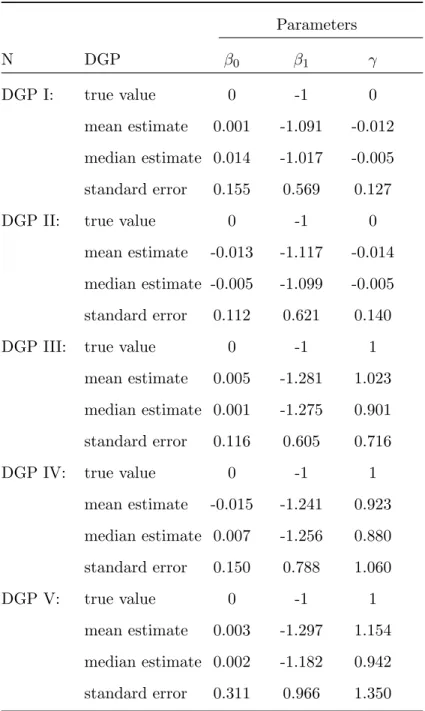
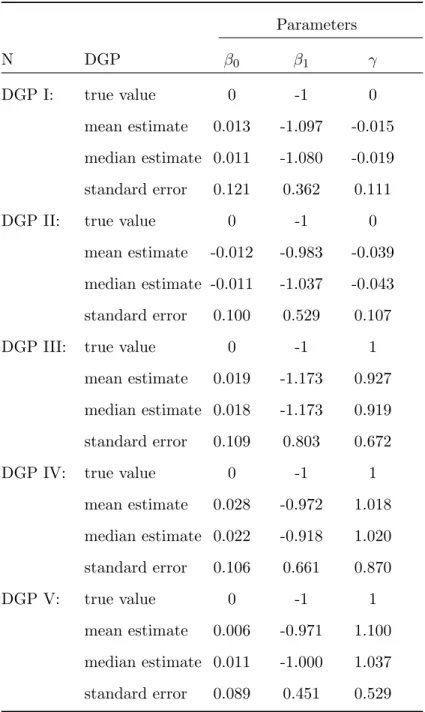
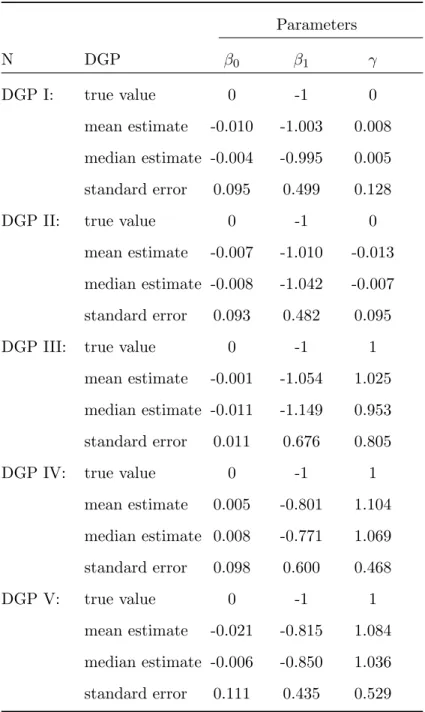
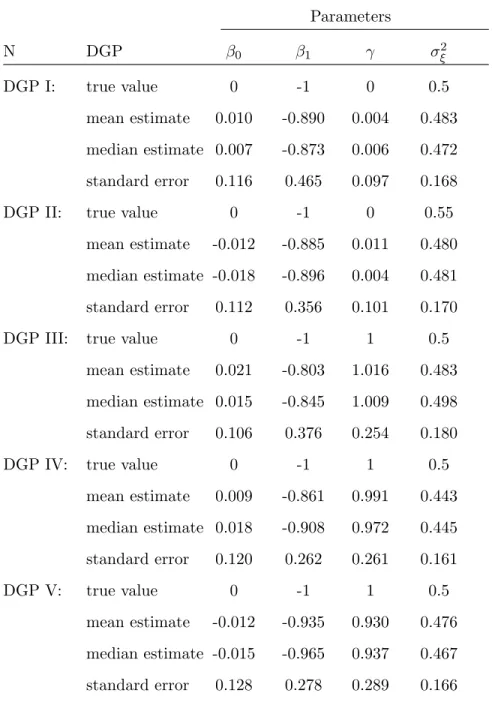
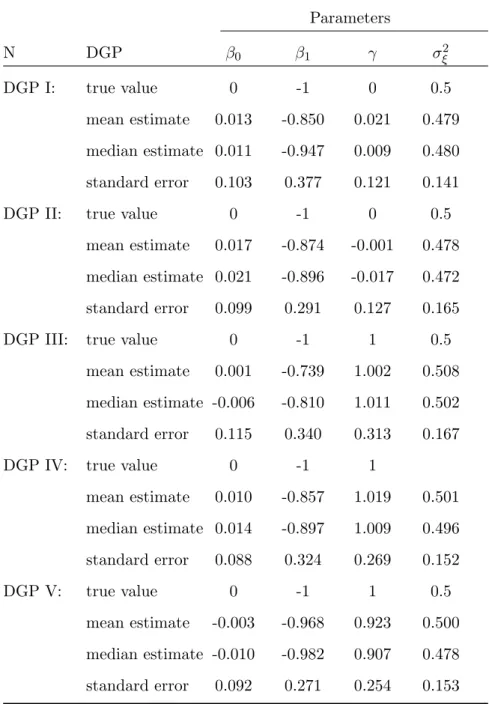
Tables 1, 2, and 3 present simulation results under the semi-parametric probit model. The simulation results of DGP I (only allows for unobserved heterogeneity) show that generally downward bias in the structural model coefficients (β1, γ) for sample sizes N=250 and 500
but upward bias for N=1000. For DGP II, the results have downward bias in the structural model coefficients in (β0, β1, γ). In addition, with nontrivial transitory component (ρ6= 0) in
DGP II, the standard errors ofβ1 are larger except for N=1000. As for DGPs with nontrivial
state dependence, there is less bias for (β0, β1, γ) for DGP III for sample size N=1000 but for
DGP IV & V our results show less bias in sample size N=500. The coefficient estimators of γ in DGP IV & V have very small bias for sample sizes N=500 and 1000, which means that our estimation for state dependence is very precise among processes with serial correlation (ρ 6= 0). In general, there are smaller standard errors in sample size N=1000. For DGPs in this sample size, the parameters are much less precisely estimated, and the means and medians of (β1, γ) are quite different, reflecting some skewness in their respective distributions. Our
estimator provides fairly consistent results in this case.
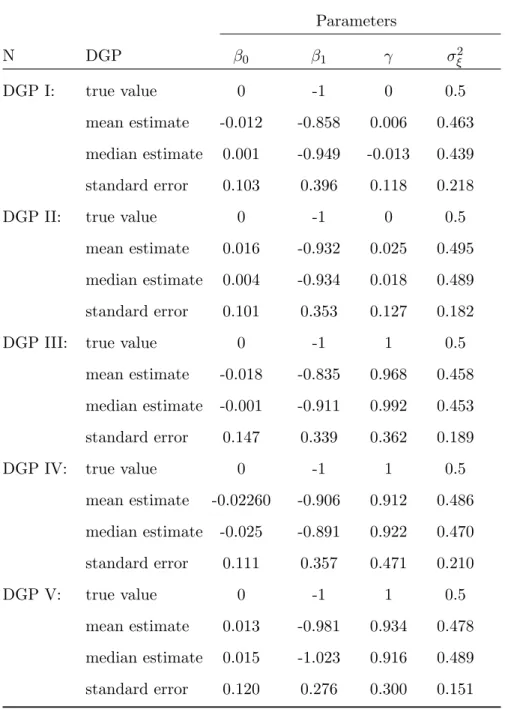
Tables 4, 5, and 6 report the results of estimates for the semi-parametric tobit model. In the tobit model, there is positive bias in β1 and γ for all DGPs with trivial state
depen-dence except forγ in N=1000. In tobit case, we have additional parameters to estimate, σξ2. There is downward bias of the parameter in DGP I & II and their standard errors become smaller as numbers of simulation increase. As for other DGPs in positive state dependence, estimation results ofγ show that there are small bias and precision increase with numbers of simulation. Also, for those DGPs, the means and medians ofβ1 are quite different, reflecting
some skewness in distributions. Our sieve MLE estimators tend to perform well. In general, bias and standard errors in DGPs with state dependence are smaller than those without state dependence.
There are two nuisance parameters, fXt+1|Xt,Ut and fXt,Yt−1,Xt−1,Ut in our Monte Carlo simulation and we use Fourier series to approximate the evolution density and the square root of the initial joint distribution. Since a higher dimensional sieve space is constructed
by tensor product of univariate sieve series, approximation series can be formed from several univariate Fourier series. In the semi-parametric probit model, while in the approximation of the evolution densities we use three univariate Fourier series with the number of term,in= 5,
jn = 2, and kn = 2, in the approximation of the initial joint distribution we have in = 5,
jn = 2, kn= 2, and ln = 2. As for the semi-parametric tobit model, we have similar choices
of approximation series. The detailed sieve expression of those nuisance parameters can be found in Appendix B.
In summary, the Monte Carlo study shows that our semiparametric sieve MLE performs well with a finite sample.
5. Empirical Example
In this section, we apply our estimator to a dynamic discrete choice model, which discribes the labor-force participation decisions of married women given their past participation state and other covariates. The advantage of our estimator is that our model may include (i) arbitrary and unspecified correlated random effects between unobserved time invariant factors such as skill level or motivation and time-varyingXit0s, and (ii) no initial conditions assumption.9 We will compare our estimates with those in Hyslop (1999), which studied a similar empirical model with less general assumptions.
5.1. Data Descriptive
In order to provide comparison of the models developed in this paper and by Hyslop (1999), we also used the data related to waves 12-19 of the the Michigan Panel Survey of Income Dynamics from the calendar years 1979-85 to study married women’s employment decisions. The seven-year sample consists of women aged 18-60 in 1980, continuously married, and the
9
In Hyslop (1999), a correlated random-effects (CRE) specification forviis:
vi= T X
s=0
(δ1s·(#Kids0-2)is+δ2s·(#Kids3-5)is+δ3s·(#Kids6-17)is) + T−1
X
s=0
δ4s·ymis+ηi.
An alternative CRE specification can be:
vi=δ1·(#Kids0-2)i+δ2·(#Kids3-5)i+δ3·(#Kids6-17)i+δ4·y¯mi+ηi,
where ¯xi= T P t=0
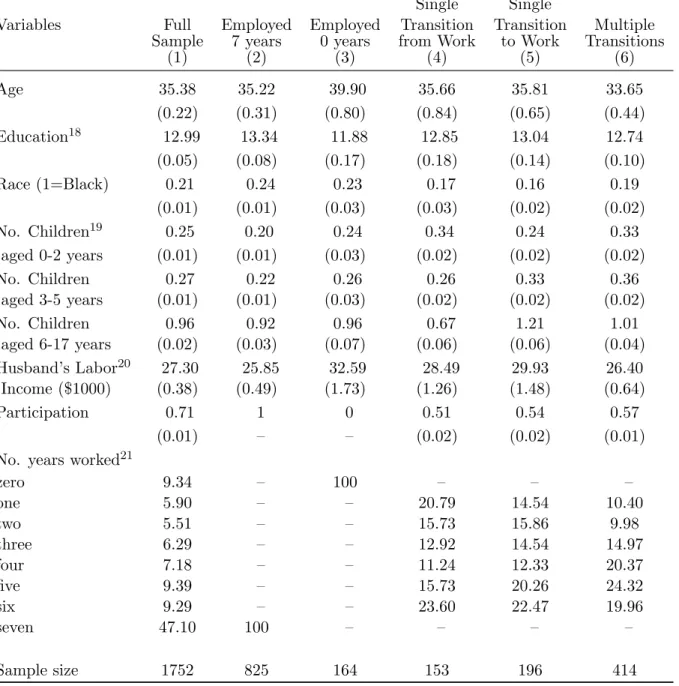
husband is a labor force participant in each of the sample years from. A woman is defined to be a labor market participant if she works for money any time in the sample year.10 The sample contains 1752 married women and also includes both the random Census subsample of families and the nonrandom Survey of Economic Opportunities (SEO) subsample of families.11 The number of possible binary participation sequences over a 7-period panel is 27 = 128 and the sequences can expressed as sequences of zeros and ones of the length 7.12 If we partition the full sample based on all the observed annual participation outcomes of women during the seven-year period, the number of subsamples is up to 128. To provide a useful analysis of the differences of women’s work propensity due to the number of years worked and the associated participation sequences, we choose a small group of dividing criteria. The mutually exclusive sub-sample partition is as follows: we have in column (2) women who work in each year corresponding to a sequence ’1111111’; in column (3), women who never work during the sample period corresponding to a sequence ’0000000’; in column (4), women who experience a single transition from employment to nonemployment-that is, six participation sequences ’1000000’,...,’1111110’; in column (5), women who experience a single transition from nonemployment to employment corresponding to another six participation sequences ’1000000’,...,’1111110’; and in column (6), women who experience more than a single transition in their participation status corresponding to the rest of participation sequences.
Table 7 reports the descriptive statistics from the resulting subsamples. The selection of variables of interest in the table is close to the sample characteristics in Hyslop (1999) and the variables show similar trends and features. Column (1) presents the characteristics of the variables for the whole sample. Comparison of the observed annual participation outcomes with individual’s independent participation decision form a binomial distribution with fixed probability of 0.7 (the average participation rate) indicates there is strong persistence in the married women’s annual participation decisions. If there does not exist any persistence, then about 8 percent of the sample would be expected to work each year, and only 0.02 percent would not work at all, which are quite different from the sample relative frequencies, 47 percent
10
A standard definition of a participant ia that an individual reports both positive annual hours worked and annual earnings. Hyslop (1995) provided a description of the extent of aggregation bias which results from ignoring intra-year labor force transition.
11Hyslop (1995) obtains a sample consisted of 1812 observations. The PSID contains an over-sample of
low-income families called the Survey of Economic Opportunity (SEO).
12
An ’1’ in thet-th position of the sequence denotes participation in yeart, while a ’0’ denotes nonpartici-pation.
and 9 percent respectively. In addition, the rest of the columns demonstrate the difference in the observable variables across the subsamples. For 825 women in the sample whom we observe employment in each of the seven years (column (2)), they are more likely to be better educated than average, or be Black, have fewer dependent children (especially children’s age under 6 years), and their husbands’ labor incomes are lower than average. Women who are never employed (column (3)) are older, less educated, and their husbands’ labor income are higher than average. The women in this group have slightly fewer young children, reflecting the older age of the group. In column (4), women who make a single transition from employment to nonemployment have fewer dependent children but are more likely to have infant children (aged 0-2 years), and their husbands have above average earnings. Women who experience a single transition from nonemployment to employment (column (5)) are less likely to be black and have significantly more children (aged 0-17 years). The last column (6) indicates women who experience multiple employment transitions are younger, have more dependent children of all ages, and their husbands have below-average labor income.
The description of the sample characteristics according to various subsamples suggests that there are several patterns between observable characteristics of individuals and their participation behavior. First, there is a negative income effect from husband’s labor income on women’s willingness for labor market participation (column (2) vs column (3)). Secondly, In general, the presence of children, especially young children, tends to reduce the participation of women, except for women who never work in the sample (column (3)). The numbers of very young and older children between the single-transition subsamples in columns (4) and (5) are 0.34 and 0.24 (aged 0-2 years) and 0.67 and 1.21 (aged 6-17 years) respectively. The differences suggest that women leave employment to have children and re-enter employment as their children reach school age. The life-cycle interpretation is plausible by slight age difference between women in these groups (35.66 and 35.81). However, the age differences between these groups in Hyslop (1999) suggesting that the composition of these samples is determined by more than simply fertility considerations. Finally, the column (6) indicates that the presence of children in all age group (aged 0-17 years), together with low husband’s labor income, increases the number of employment transitions of women.
5.2. Specifications and Estimation Results
According to a theoretic model in Hyslop (1999), the labor-force participation decisions of married women depend on whether or not their market wage offer exceeds their reservation wage, which in turn may depend on their past participation state, namely, suppose Yt is the
t-th period participation decision, Wtis the wage, and W0∗t is a reservation wage then period
tparticipation decision can be formulated by
(7) Yt= 1(Wt> W0∗t−γYt−1)
where 1(·) denotes an indicator function that is equal to 1 if the expression is true and 0 otherwise. An empirical reduced form specification for Eq. (7) is the following
Yit= 1(γYt−1+Xit0β+Uit+ξit>0) ∀i= 1, ..., N;t= 1, ..., T−1
whereXitis a vector of observed demographic and family structure variablesUit captures the
effects of unobserved factors, andβ and γ are parameters. There are two latent sources for the unobserved termUit:
Uit=Vi+ρεit−1
whereViis an individual-specific component, which captures unobserved time invariant factors
possibly correlated with the time-varying Xit0s such as skill level or motivation; and εit is a
serially correlated error term, which captures factors such as transitory wage movements. The estimation results for the various models of labor force participation are presented in Table 8 which includes estimates from static probit models with random effect (column 1), maximum simulation likelihood (MSL) models with random effect13 (column 2), semi-parametric dynamic probit models (column 3). While the first two models in columns are estimated using full seven years of data, the last one is estimated over three-period data. In addition, the last model is the dynamic models without an initial conditions specification. The static probit model is estimated by MSL with 200 replications. It allows for individual-specific random effects but ignores possible dynamic effects of the past employment and potential 13A detailed discussion of MSL models can be found in Hyslop (1999). There are more different specifications
correlation between the unobserved heterogeneity and the regressors. The results are that permanent nonlabor income has a significantly negative effect, transitory income reduces the contemporaneous participation, and preschool children have substantially negative effect. In addition, the variance of unobserved heterogeneity is 0.786. We now turn to dynamic specifications. The specifications in MSL model contain random effects, a stationary AR(1) error component, and first-order state dependence (SD(1)). The results show a large and significant first-order state dependence effect (1.117). The addition of SD(1) and AR(1) error component reduced the effects of nonlabor income variables largely (-0.007 & -0.004) and the contemporaneous fertility variables like #Kid3-5tand #Kid6-17tby approximately 50 percent.
But the estimated effects of younger kids in the past and current periods #Kid0-2t−1 and
#Kid0-2t have stronger negative effects on women’s participation decisions (-0.117 & -0.380).
Including state dependence and serial correlation error component reduce the error variance (0.313) due to unobserved heterogeneity. The estimated AR(1) coefficientρ is -0.146.14
Next, consider the specifications without an initial conditions assumption. The results also show that large first-order state dependence effects on the semi-parametric model (1.089). There exists a strong dependence between married women’s current labor force participation and past labor force participation and relaxing the initial conditions assumption increase the negative effects of nonlabor income variables and their significance in the dynamic models. Permanent income and transitory income both reduce the probability of participation but the effect of permanent nonlabor income has substantially greater magnitude.
The fertility variables in the model are generally similar to those in column (1) and (2) but with less magnitude. That is: each of them has a significantly negative effect on married women’s current labor force participation status, and younger children have stronger effect than older. In our semi-parametric Probit model, the unobserved heterogeneity and the AR(1) component have been mixed into the unobserved covariateUit. They are not identified
so there are no any estimation results.
Although the model allows more flexible approach, its ability to predict the observed participation outcomes does not increase much. We compare frequencies of the participation outcomes predicted by the models in Table 9 to assess their fitting ability. Table 9 presents
14
A correlated random-effects (CRE) is adopted in Hyslop (1999) to test the exogeneity of fertility with respect to participation decisions. His results show that there is no evidence against the exogeneity of fertility decision in dynamic model specifications.
the frequencies of sample distribution and these predicted outcomes by the various estimated models over seven years period. Column (2) presents the predicted frequency from static probit model with random effect. The fraction of the predicted outcomes greatly over-predicts the frequencies of zero, one and six years worked and greatly under-predicts the frequencies of seven years worked. The results from the model MSL greatly under-predicts the frequencies of zero and seven year worked. As a result, the model substantially under-predicts the frequencies of the outcomes with no change in participation status over periods.
The final column in Table 9 contains the predicted frequencies from the semi-parametric probit model. The model predicts the frequencies in each participation outcome adequately for never work, and always work. It over-predicts the frequency of one and six years worked and under-predict the frequency of two, three, four, and five years worked. This is expected if there are larger lagged effect of participation decisions. Without initial conditions assumption, the model predicts the distribution of the number of years worked reasonably well. However, the predictive power from the model (column 3) without initial conditions assumption relative to the dynamic model with initial conditions assumption (column 2) is relatively small. One possible explanation of this is that the source of the serial persistence in participation outcomes over time is not well identified by those regressors. We might need other important regressors like child-care cost or welfare benefit from working.
In comparison to the results in the dynamic probit models allowing for CRE, AR(1), and SD(1) in Hyslop (1999), adding unspecified CRE and avoiding initial conditions have signif-icant effect on the model. Our results find a smaller signifsignif-icant negative effects on nonlabor income variables (-0.221 and -0.106 v.s. -0.285 and -0.140, respectively) and a estimated neg-ative effect of children age 0-2 in the the current period and previous period increases by 30 % (from -0.252 to -0.316) and decline by 50% (from -0.115 to -0.055) respectively. The effects of relaxing assumptions in Hyslop (1999) are similar to the comparison here.
6. Conclusion
This paper presents the nonparametric identification of nonlinear dynamic panel data models with unobserved covariates. We show the models are identified using only three periods of data without initial conditions assumption, and we propose a sieve MLE estimator, which is applied
to two examples, a dynamic discrete-choice model and a dynamic censored model. Both of them allow for three sources of persistence, ”true” state dependence, unobserved individual heterogeneity (”spurious” state dependence), and possible serially correlated transitory error. Monte Carlo experiments have shown that how to deal with specific implementation issues and the sieve MLE estimators perform well for these models. Our sieve MLE is shown to be root n consistent and asymptotically normal. Finally, we apply our estimator to an intertemporal female labor force participation model using a sample from the Panel Study of Income Dynamics (PSID).
Appendix
A. Asymptotic Properties of the Sieve Maximum Likelihood
Estimator
This appendix presents the consistency of our estimator and the asymptotic normality of the parametric component of our estimator. Furthermore, we provide further details on the implementation of the semiparametric sieve estimator, i.e., how to impose restrictions on the sieve coefficients.
Our asymptotic analysis relies on regularity restrictions on function containing the pa-rameters of interestα. Frist, we introduce a typical space of smooth functions, H¨older space. Given a d×1 vector of nonnegative integers, a= (a1, ..., ad)0 and denote [a] =a1+...+ad
and let Da denote the differential operator defined by Da = ∂[a]
∂ξa1 1 ...∂ξdad
. Let m denote the largest integer satisfying γ > γ and set γ =γ +p. The H¨older space Λγ(ν) of order γ > 0 is a collection of functions which arem times continuously differentiable on ν and the γ−th derivative are H¨older continuous with the exponent p. The H¨older space becomes a Banach space with the H¨older norm, i.e.,∀g∈Λγ(ν)
(8) kgkΛγ = sup ξ∈ν |g(ξ)|+ max a1+...+ad=γ sup ξ6=ξ0∈ν |Dag(ξ)−Dag(ξ0)| kξ−ξ0kpE .
The weighted H¨older norm is defined askgkΛγ,ω ≡ k
e
gkΛγ for
e
g(ξ)≡g(ξ)ω(ξ) and the corre-sponding weighted H¨older space is Λγ,ω(ν). Define a weighted H¨older ball as Λγ,ωc (ν)≡ {g ∈
Λγ,ω(ν) : kgkΛγ,ω ≤ c < ∞}. Let ε ∈ R, and W ∈ W with W a compact convex subset in
Rdw. Define the following spaces:
F1 ={f1(·|·,·)∈Λcγ1,ω(X × X × U) :f1(·)≥0 and Z X f1(·|x, u)dx= 1,∀(x, u)∈ X × U }, M={λ(·)∈Λγm,ω c (R) : 0≤λ(·)≤1, λ(−∞) = 0 and λ(∞) = 1}, F2 ={f(·)21/2 ∈Λγ3,ω c (X × Y × X × U) :f(·)2 ≥0 and Z X ×Y×X ×U f2(·, ...,·)dxdydxdu= 1},
where γi > 1 ∀i= 1,2, and γm > 1. Recall that the parameter of the dynamic panel data
model isθ= (b, λ). Suppose thatB is a compact set such that its interior containing the true parametric component of the dynamic panel data modelb0. If the dynamic panel data model
componentfYt|Xt,Yt−1,Ut is fully parameterized, then we do not need the infinite-dimensional function space M. In the case, the parameter θ of the dynamic panel data model only contain a finite-dimensional parameter vectorb. Without loss of generality, we assume that θcontains an unknown function λ. We assume that the parameters of interestfXt+1|Xt,Ut,θ, andfXt,Yt−1,Xt−1,Ut belong to the spaces,F1, Θ≡ B × M, and F2 respectively. The following smoothness and boundedness restrictions to limit the size of the parameter spaces.
Assumption A.1. With γi > 1 ∀i = 1,2, and γm > 1, we have (i) f1(·|·,·) ∈ F1, (ii)
λ(·)∈ M, (iii) f(·)12/2 ∈ F2.
SetA=F1×Θ× F2 and α≡(f1, θ, f2)0. Then the true parameter α0 maximizes:
sup α∈A E ln Z f1(xt+1|xt, ut)fYt|Xt,Yt−1,Ut(yt|xt, yt−1, ut;θ)f2(xt, yt−1, xt−1, ut)dut . (9)
An estimator could then be obtained by maximizing the sample analog of Eq. (9). Define
b Qn(zt;α) = 1 n n X i=1 lnfZt(zit;α) with (10) lnfZt(zit;α)≡ln Z f1(xit+1|xit, ut)fYit|Xit,Yit−1,Ut(yit|xit, yit−1, ut;θ)
×f2(xit, yit−1, xit−1, ut)dut,
wherezt is a realization of a random variableZt≡(Xt+1, Yt, Xt, Yt−1, Xt−1). However, when
estima-tor or a consistent estimaestima-tor which converges very slowly. Denote Θn ≡ B × Mn. The
sieve spaces An ≡ Fn
1 ×Θn × F2n will be introduced to replace the function spaces A to
overcome the problem, namely, maximizing Qbn(zt;α) over An, a sequence of
approxima-tion spaces to A. In the sieve approximation, we consider a finite-dimensional sieve An as
follows. Let pk(·) = (p1(·), ..., pk(·))0 be a vector of some known univariate basis function
and pk(·, ...,·) = (p1(·, ...,·), ..., pk(·, ...,·))0 be multivariate basis function generated by tensor
product construction. The sieve spaces are
F1n={f1(xt+1|xt, v) =pkn1(xt+1, xt, ut)0β1 ∈ F1},
Mn={λ(ε) =pknλ(ε)0β
λ ∈ M},
F2n={f2(xt, yt−1, xt−1, ut)1/2 =pkn2(xt, yt−1, xt−1, ut)0β2∈ F2}.
A consistent sieve MLEαbn is given by
b
αn= arg max
α∈AnQbn(zt;α). (11)
The rest of this appendix show the consistency ofαbnand its convergence rate under different
metrics and the√nasymptotic normality of the parametric componentb.
A.1. Consistency and Convergence Rates
In this section, we first introduce a strong norm k · ks in Newey and Powell (2003) which
would be used to show the consistency of the sieve estimator and then the Fisher norm,k · k, in which the sieve estimator is consistent with a rate faster thann−1/4.
Forα≡(f1, θ, f2)0, (12) kαks=kbkE+kλks,ω+ 2 X s=1 kfsks,ω
wherekbkE is the Euclidean norm andkfsks,ω ≡supξ|fs(ξ)ω(ξ)|withω(ξ) = (1 +kξk2E)−ς/2,
ς > 0. Since the supports of the unobserved variables v and ε could be unbounded, the weighting function w is introduced to deal with unbounded support and has been used in Chen, Hansen, and Scheinkman (1997), Chen, Hong, and Tamer (2005) and Hu and Schennach
(2008a). We make the following assumptions:
Assumption A.2. (i) The data {(Zit)ni=1} are i.i.d.; (ii) The density of Zt, fZt, satisfies
R
ω(ξ)−2fZt(ξ)dξ <∞.
Assumption A.3. (i) b0 ∈ B, a compact subset of Rb; (ii) Assumption A.1 holds under the normkαks.
Assumption A.4. (i) For any α∈ A, there existsΠnα∈ An such that kΠnα−αks=o(1);
(ii) kni→+∞ and kni/n→0 for i= 1, λ,2.
Definition A.1. lnfZt(zt;α) is H¨older continuous with respect to α ∈ An if there exists a
measurable function ch(Zt) with E{ch(Zt)2} < ∞ such that, for all α1, α2 ∈ A, and Zt, we
have
|lnfZt(zt;α1)−lnfZt(zt;α2)| ≤ch(Zt)kα1−α2ks. (13)
Assumption A.5. (i) E{|lnfZt(zt;α)|
2} is bounded; (ii) There exits a measurable
func-tion eh(Zt) with E{h(Ze t)2} < ∞ such that, for any α¯12 = ( ¯f1,θ,¯ f¯2,f¯3) and ω(z¯ t, ε) =
1, ω−1(x
t+1, xt, ut), ω−1(ε), ω−1(xt, yt−1, xt−1, ut))
0
, we have |h1(zt,α¯12,ω)¯ | < eh(Zt). (The
definition ofh1(zt,α¯12,ω)¯ can be found in Eq. (14)).
Applying Theorem 4.1 in Newey and Powell (2003) or Theorem 3.1 of Chen (2007), we obtain the following lemma.
Lemma A.1. Letαbnbe the sieve MLE forα0 identified in section 2 and Assumptions A.1-A.5
holds, then we have kαbn−α0ks=op(1).
The proof of Lemma A.1. After checking the conditions in Theorem 4.1 in Newey and Powell (2003), the only thing we have to show is that lnfZt(zt;α) is H¨older continuous inα. The difference of lnfZt(zt;·) at α1 and α2 is given by
lnfZt(zt;α1)−lnfZt(zt;α2) = d dαlnfZt(zt; ¯α12)[α1−α2] = d dtlnfZt(zt; ¯α12+t(α1−α2)) t=0,
where ¯α12= ( ¯f1,θ,¯ f¯2), a mean value between α1 andα2, and ¯α12+t(α1−α2) = ( ¯f1+t(f11− f12),θ¯+t(θ1−θ2),f¯2+t(f21−f22)). Consider d dtlnfZt(zt; ¯α12+t(α1−α2)) t=0 = 1 fZt(zt; ¯α12) Z (f11−f12)fYit|Xit,Yit−1,Ut(yit|xit, yit−1, ut; ¯θ) ¯f2dut + Z ¯ f1 d dθfYit|Xit,Yit−1,Ut(yit|xit, yit−1, ut; ¯θ)(θ1−θ2) ¯f2dut + Z ¯ f1fYit|Xit,Yit−1,Ut(yit|xit, yit−1, ut; ¯θ)(f21−f22)dut.
Then we can obtain the bounds for H¨older continuous as follows:
d dtlnfZt(zt; ¯α12+t(α1−α2)) t=0 ≤ 1 |fZt(zt; ¯α12)| Z ω −1(x t+1, xt, ut)fYt|Xt,Yt−1,Ut(yt|xt, yt−1, ut; ¯θ) ¯f2 dutkf11−f12ks (14) + Z ¯ f1 d dθfYt|Xt,Yt−1,Ut(yt|xt, yt−1, ut; ¯θ)ω −1(ε) ¯f 2 dutkθ1−θ2ks + Z ¯ f1fYt|Xt,Yt−1,Ut(yt|xt, yt−1, ut; ¯θ)ω −1(x t, yt−1, xt−1, ut) dutkf21−f22ks ≤ 1 |fZt(zt; ¯α12)| Z ω −1(x t+1, xt, ut)fYt|Xt,Yt−1,Ut(yt|xt, yt−1, ut; ¯θ) ¯f2 dut + Z ¯ f1 d dθfYt|Xt,Yt−1,Ut(yit|xt, yt−1, ut; ¯θ)ω −1(ε) ¯f 2 dut + Z f¯1fYt|Xt,Yt−1,Ut(yt|xt, yt−1, ut; ¯θ)ω −1(x t, yt−1, xt−1, ut) dut kα1−α2ks ≡h1(zt,α,¯ ω)¯ kα1−α2ks, where ¯ω(zt, ε) ≡ 1, ω−1(x t+1, xt, v), ω−1(ε), ω−1(xt, yt−1, xt−1, ut) 0
. The property of H¨older continuity is ensured by Assumption A.5. A similar proof can also be found in that of Lemma
2 in Hu and Schennach (2008a). Q.E.D.
Lemma A.1 provides a consistency result under the metrick · ks but the convergence rate under the metric is not faster enough to establish our semi-parametric asymptotic normality and√nconsistency result. In order to achieve this we consider the Fisher normk · kin which
b
αnconverges at a rate faster thann−1/4. In addition, Lemma A.1 allows us to restrict the sieve
estimator αbn to local k · ks-neighborhood around the true parameter α0. For simplicity, we
as: dlnfZt(zt;α) dα [v]≡ dlnfZt(zt;α+τ v) dτ τ=0 a.s. Zt.
In particular, we can have it at the direction [α1−α2] evaluated at α0 by:
dlnfZt(zt;α0) dα [α1−α2]≡ dlnfZt(zt;α0) dα [α1−α0]− dlnfZt(zt;α0) dα [α2−α0] a.s. Zt. Expanding the pathwise derivative of lnfZt(zt;α0) gives:
dlnfZt(zt;α0) dα [α−α0] = 1 fZt(zt;α0) Z (f1−fXt+1|Xt,Ut)fYt|Xt,Yt−1,UtfXt,Yt−1,Xt−1,Utdut + Z fXt+1|Xt,Ut d dθfYit|Xit,Yit−1,Ut(θ−θ0)fXt,Yt−1,Xt−1,Utdut + Z fXt+1|Xt,UtfYit|Xit,Yit−1,Ut(f2−fXt,Yt−1,Xt−1,Ut)dut .
Following the notation, for anyα1, α2 ∈ Awe define the Fisher norm:
kα1−α2k2≡E ( dlnfZt(zt;α0) dα [α1−α2] 2) .
We make the following assumptions to obtain a rate faster thann−1/4.
Assumption A.6. Let kn be the total number of sieve coefficients in the sieve estimatorαbn,
i.e.,kn=kn1+db+knλ+kn2. (knn−1/2lnn)×supξ∈(X ×X ×U ∪R∪X ×Y×X ×U)kp
kn(ξ)k2
E =o(1). Assumption A.7. (i) there exist a measurable functionc(Zt)withE{c(Zt)4}<∞such that
|lnfZt(zt;α)| ≤ c(Zt) for all Zt and α ∈ An; (ii) lnfZt(zt;α) ∈ Λ
τ,ω
c (X × Y × X × Y × X) withτ > dz/2, for allα∈ An, where dz is the dimension of Zt.
Assumption A.8. A is convex inα0, andfYt|Xt,Yt−1,Ut(Yt|Xt, Yt−1, ut;θ) is pathwise
differ-entiable at θ0.
Assumption A.9. lnN(δ,An) =O(knln(kn/δ))where N(δ,An) is the minimum number of balls with radiusδ under the k · ks norm covering An.
Assumption A.10. There exists c1, c2 >0, c1E lnfZt(zt;α0) fZt(zt;α) ≤ kα−α0k2≤c2E lnfZt(zt;α0) fZt(zt;α)
holds for allα∈ An withkα−α0ks=o(1).
Assumption A.11. For any α∈ A, there exists Πnα∈ An such that kΠnα−αk=o(k−µn 1) andk−µn 1 =o(n−1/4).
The following lemma is a direct application of Theorem 3.1 of Ai and Chen (2003) and a similar proof can also be found in that of Theorem 2 in Hu and Schennach (2008b); we omit its proof.
Theorem A.1. Suppose that α0 is identified and Assumptions A.6-A.11 hold, then kαbn−
α0k=op(n−1/4).
A.2. Asymptotic Normality
In this section, we follow the semiparametric MLE framework of Hu and Schennach (2008b) to show the asymptotic normality of the parametric componentbwhich represents the parameter of interest in dynamic panel data models. Let V be the space spanned by A −α0 and ¯V be
completion ofV under the Fisher norm k · k. It follows that V ,¯ k · k
is a Hilbert space with the inner product
hv1, v2i ≡E d dαlnfZt(zt;α0)[v1] d dαlnfZt(zt;α0)[v2] ,
and hv, vi = kvk. For any fixed and nonzero κ ∈ Rdb, f
κ(α−α0) ≡ κ0(b−b0) is linear in
α−α0 and fκ(α−α0) is a linear functional on V ,k · k
. Shen (1997) and Der Vaart (1991) show thatf(α)≡κ0bis a bounded linear functional on ¯V under the operator norm. That is:
|kfκk| ≡ sup {α∈A:kα−α0k>0} |fκ(α−α0)| kα−α0k <∞. (15)
By the Riesz representation theorem, there exists v∗ ∈ V¯ such that for any α ∈ A, I have fκ(α−α0) =hα−α0, v∗i. andkfκk=kv∗k.15 Denote ¯V =Rdb×W andW ≡ F1n× Mn× F2n−
15
Stein (1956) pointed out thatv∗yields the most difficult one-dimensional sub-problem. Begun, Hall, Huang, and Wellner (1983) mentioned thatv∗ represents a worst possible direction to nonparametric component for
(fXt+1|Xt,Ut, λ, fXt,Yt−1,Xt−1,Ut)
0.16 We can expand the first pathwise derivative out as follows:
dlnfZt(zt;α0) dα [α−α0] = dlnfZt(zt;α0) df1 [f1−fXt+1|Xt,Ut] + dlnfZt(zt;α0) db [b−b0] +dlnfZt(zt;α0) dλ [λ−λ0] + dlnfZt(zt;α0) df2 [f2−fXt,Yt−1,Xt−1,Ut].
For each component bj of b, j = 1,2, ..., db, we define wj∗ ∈ W to be the solution to the
following minimization problem associated with the denominator of the operator norm,
w∗j = arg min wj=(f1,λ,f2,f3)0∈W E dlnfZt(zt;α0) dbj −dlnfZt(zt;α0) df1 [f1] − dlnfZt(zt;α0) dλ [λ]− dlnfZt(zt;α0) df2 [f2] . Definew∗ = (w1∗, ..., w∗d b), dlnfZt(zt;α0) df [w ∗ ] = dlnfZt(zt;α0) dh [w1], ..., dlnfZt(zt;α0) df [w ∗ db] , and Dw∗(zt)≡ dlnfZt(zt;α0) d0b − dlnfZt(zt;α0) df [w ∗ ]. (16)
With these notation, we have
kfκk2 = sup {α∈A:kα−α0k>0} |fκ(α−α0)|2 kα−α0k =κ0 E{Dw∗(Zt)0Dw∗(Zt)}−1κ, v∗ ≡(vb∗, vh∗)∈V withvb∗ = (E{Dw∗(Zt)0Dw∗(Zt))−1κandv∗ h =−w ∗×v∗ b. In addition,fκ(α− α0) =κ0(b−b0) =hα−α0, v∗iand dlnfZt(zt;α0) dα [v ∗] =D w∗(zt)v∗
b. See Chen (2007) for detailed
discussion about this linear functional approach. Therefore, the asymptotic distribution of parametric componentbbn reduces to when the linear functional fκ is bounded and what is
estimating parametric component.
16
the asymptotic distribution ofhαbn−α0, v∗i. That is: κ0bbn−b0 =hαbn−α0, v∗i = 1 n n X i=1 dlnfZt(zit;α0) dα [v ∗] +o p(n−1/2) = 1 n n X i=1 κ0 E{Dw∗(Zt)0Dw∗(Zt)−1Dw∗(zit)0+op(n−1/2), and√n(bbn−b0)→N(0,(E{Dw∗(Zt)0Dw∗(Zt)}) −1 ).
We make the following sufficient conditions for the √n−normality of bbn which are also
conditions in Ai and Chen (2003) and Hu and Schennach (2008b):
Assumption A.12. (i) E{Dw∗(Zt)0Dw∗(Zt)} is positive-definite and bounded; (ii) b0 ∈
int(B).
Assumption A.13. There is a vn∗ = (vb∗,−Πnw∗×vb∗) ∈ An−α0 such that kvn∗ −v∗k =
op(n−1/4).
We use the √nconsistency results in the previous section to focus on a smaller neighbor of α0, Define Non ≡ {α ∈ An :kα−α0ks =o(1),kα−α0k =o(n−1/4)} and No ≡ {α ∈ A :
kα−α0ks=o(1),kα−α0k=o(n−1/4)}.
Assumption A.14. There exits a measurable functionbh(Zt)withE{bh(Zt)2}<∞such that,
for anyα¯= ( ¯f1,θ,¯ f¯2), we have h2(zt,α,¯ ω)¯ + h1(zt,α,¯ ω)¯ 2 <bh(Zt). (17)
For ˜f =f1, λ, f2, denote dfZt(zt;α0) df˜ [p kni] = dfZt(zt;α0) df˜ [p kni 1 ], ..., dfZt(zt;α0) df˜ [p kni kni] 0 ∀i= 1, λ,2, dfZt(zt;α0) db = dfZt(zt;α0) db1 , ...,dfZt(zt;α0) dbdb 0 , dfZt(zt;α0) dα [p kn] = dfZt(zt;α0) db 0 , dfZt(zt;α0) df1 [pkn1] 0 , dfZt(zt;α0) dλ [p knλ] 0 , dfZt(zt;α0) df2 [pkn2] 00 , (18) and Ωkn =E dfZt(zt;α0) dα [p kn] dfZt(zt;α0) dα [p kn] 0 .
Assumption A.15. The smallest eigenvalue of the matrix Ωkn is bounded away from zero,
andkpkni
j ks,ω for j = 1,2, ..., kni uniformly in kni.
Assumption A.16.For allα∈ Non, there exists a measurable functionh(Zt)withE|h(Zt)|<
∞ such that d4lnfZt(zt; ¯α+t(α−α0)) dt4 t=0 ≤h(Zt)kα−α0k4s. (19)
Theorem A.2. Suppose thatα0 is identified and Assumptions A.6-A.11 and A.12-A.16 hold,
then√n(bbn−b0)⇒N(0, V−1) where V =E{Dw∗(Zt)0Dw∗(Zt)}.
The proof of Theorem A.2. The likelihood function fZt(zt;α) has a similar expression as the likelihood function in Hu and Schennach (2008a). The proof there can directly apply to our case. We prove the results by showing an envelop condition on the second derivative
of the likelihood function (Assumption A.15). Consider the term sup α∈Non d2lnfZt(zt; ¯α1) dαdα0 [vn, α−α0] ≤ sup α∈Non 1 fZt(zt; ¯α1) d2fZt(zt; ¯α1) dαdα0 [vn, α−α0] −dlnfZt(zt; ¯α1) dα [vn] dlnfZt(zt; ¯α1) dα [α−α0] ≤ sup α∈Non 1 fZt(zt; ¯α1) d2fZt(zt; ¯α1) dαdα0 [vn, α−α0] + dlnfZt(zt; ¯α1) dα [vn] dlnfZt(zt; ¯α1) dα [α−α0] . Then dlnfZt(zt; ¯α1) dα [α−α0] = 1 fZt(zt; ¯α12) Z [f1−fXt+1|Xt,Ut]fYt|Xt,Yt−1,Ut(yt|xt, yt−1, ut; ¯θ) ¯f2dut + Z ¯ f1 d dθfYt|Xt,Yt−1,Ut(yt|xt, yt−1, ut; ¯θ)[θ−θ0] ¯f2dut + Z ¯ f1fYt|Xt,Yt−1,Ut(yt|xt, yt−1, ut; ¯θ)[f2−fXt,Yt−1,Xt−1,Ut]dut .
Therefore, similar to the derivation of H¨older continuity, we obtain
dlnfZt(zt; ¯α1) dα [α−α0] ≤h1(zt,α,¯ ω)¯ kα1−α2ks. and dlnfZt(zt; ¯α1) dα [vn] ≤h1(zt,α,¯ ω)¯ kvnks,
1 fZt(zt; ¯α1) d2f Zt(zt; ¯α1) dαdα0 [vn, α−α0]: 1 fZt(zt; ¯α1) d2fZt(zt; ¯α1) dαdα0 [vn, α−α0] = 1 fZt(zt; ¯α12) Z [vn]f1[θ−θ0] d dθfYt|Xt,Yt−1,Ut(yt|xt, yt−1, v; ¯θ) ¯f2dv + Z [vn]f1[f2−fXt,Yt−1,Xt−1,Ut]fYt|Xt,Yt−1,Ut(yt|xt, yt−1, ut; ¯θ)dv + Z [vn]θ[f1−fXt+1|Xt,Ut] d dθfYt|Xt,Yt−1,Ut(yt|xt, yt−1, ut; ¯θ) ¯f2dut + Z [vn]θ[θ−θ0] d2 dθ2fYt|Xt,Yt−1,V(yt|xt, yt−1, ut; ¯θ) ¯f1f¯2dut + Z [vn]θ[f2−fXt,Yt−1,Xt−1,Ut] d dθfYt|Xt,Yt−1,Ut(yt|xt, yt−1, ut; ¯θ) ¯f1dut + Z [vn]f2[f1−fXt+1|Xt,Ut]fYt|Xt,Yt−1,Ut(yt|xt, yt−1, ut; ¯θ)dut + Z [vn]f2[θ−θ0] d dθfYt|Xt,Yt−1,Ut(yt|xt, yt−1, ut; ¯θ) ¯f1dut . Denoteω−1(xt+1, xt, ut), ω−1(ε), ω−1(xt, yt−1, xt−1, ut) ≡ ¯ ω1−1,ω¯λ−1,ω¯2−1.
The absolute value of the term can be bounded through 1 fZt(zt; ¯α1) d2fZt(zt; ¯α1) dαdα0 [vn, α−α0] (20) ≤ 1 fZt(zt; ¯α12) Z ω¯ −1 1 ω¯ −1 λ d dθfYt|Xt,Yt−1,Ut(yt|xt, yt−1, ut; ¯θ) ¯f2 dutk[vn]f1ksk[θ−θ0]ks + Z ω¯ −1 1 ω¯ −1 2 fYt|Xt,Yt−1,Ut(yt|xt, yt−1, ut; ¯θ) dutk[vn]f1ksk[f2−fXt,Yt−1,Xt−1,Ut]ks + Z ω¯ −1 λ ω¯ −1 1 d dθfYt|Xt,Yt−1,Ut(yt|xt, yt−1, ut; ¯θ) ¯f2 dutk[vn]θksk[f1−fXt+1|Xt,Ut]ks + Z ω¯ −1 λ ω¯ −1 λ d2 dθ2fYt|Xt,Yt−1,Ut(yt|xt, yt−1, ut; ¯θ) ¯f1f¯2 dutk[vn]θksk[θ−θ0]ks + Z ω¯ −1 λ ω¯ −1 2 d dθfYt|Xt,Yt−1,Ut(yt|xt, yt−1, ut; ¯θ) ¯f1 dutk[vn]θksk[f2−fXt,Yt−1,Xt−1,Ut]ks + Z ω¯ −1 2 ω¯ −1 1 fYt|Xt,Yt−1,Ut(yt|xt, yt−1, ut; ¯θ) dutk[vn]f2ksk[f1−fXt+1|Xt,Ut]ks + Z ω¯ −1 2 ω¯ −1 λ d dθfYt|Xt,Yt−1,Ut(yt|xt, yt−1, ut; ¯θ) ¯f1 dutk[vn]f2ksk[θ−θ0]ks ≤ 1 fZt(zt; ¯α12) Z ω¯ −1 1 ω¯ −1 λ d dθfYt|Xt,Yt−1,Ut(yt|xt, yt−1, ut; ¯θ) ¯f2 dut + Z ω¯ −1 1 ω¯ −1 2 fYt|Xt,Yt−1,Ut(yt|xt, yt−1, ut; ¯θ) dut + Z ω¯ −1 λ ω¯ −1 1 d dθfYt|Xt,Yt−1,Ut(yt|xt, yt−1, ut; ¯θ) ¯f2 dut + Z ω¯ −1 λ ω¯ −1 λ d2 dθ2fYt|Xt,Yt−1,Ut(yt|xt, yt−1, ut; ¯θ) ¯f1f¯2 dut + Z ω¯ −1 λ ω¯ −1 2 d dθfYt|Xt,Yt−1,Ut(yt|xt, yt−1, ut; ¯θ) ¯f1 dut + Z ω¯ −1 2 ω¯ −1 1 fYt|Xt,Yt−1,Ut(yt|xt, yt−1, ut; ¯θ) dut + Z ω¯ −1 2 ω¯ −1 λ d dθfYt|Xt,Yt−1,Ut(yt|xt, yt−1, ut; ¯θ) ¯f1 dut k[vn]ksk[α−α0]ks ≡h2(zt,α,¯ ω)¯ k[vn]ksk[α−α0]ks.
Combining all the bounds results in
sup α∈Non d2lnfZt(zt; ¯α1) dαdα0 [vn, α−α0] ≤ sup α∈Non h2(zt,α,¯ ω)¯ + h1(zt,α,¯ ω)¯ 2! k[vn]ksk[α−α0]ks.
approximation of the likelihood function nearα0. Q.E.D.
B. Restrictions on the Sieve Coefficients
This appendix describes the sieve MLE method used to estimate nonlinear dynamic panel data models. We provide detailed derivation of the method based on the likelihood function in Eq. (3). According to Eq. (3), there are several essential parts in the likelihood function, fXt+1|Xt,Ut, fYt|Xt,Yt−1,Ut, and fXt,Yt−1,Xt−1,Ut. While the specifications of fYt|Xt,Yt−1,Ut have been provided in Section 3,fXt+1|Xt,Ut, andfXt,Yt−1,Xt−1,Ut will be treated here. We will show sieve approximations and their constraints of those nonparametric components in the two examples. First, we introduce the sieve estimators for the covariate evolution,fXt+1|Xt,Ut, since we can use the same sieve approximates for them in the examples. Suppose thatxt, ut∈[0, l1]
and (xt+1−ut)∈[−l2, l2].17 The sieve estimators for the covariate evolution are constructed
by Fourier series as follows:
f1(xt+1|xt, ut) = in X i=0 jn X j=0 kn X k=0 γijkp1i(xt+1−ut)p2j(xt)p3k(ut), where p1i(xt+1−ut) = cos iπ l2 (xt+1−ut) or sin iπ l2 (xt+1−ut), p2j(xt) = cos jπ l1 xt, and,p3k(ut) = cos kπ l1 ut.
The conditional density restrictionsR f1(xt+1|xt, ut)dxt+1 = 1 ∀xt, ut implies that a constant
term in the sieve expressionf1(xt+1|xt, ut) equals 21l2.
Next, sincefXt+1|Xt,Ut is identified through Assumption 2.5, one thing remained to show is how to implement the normalization assumption in estimation. Consider the zero mode case, we have ∂x∂
t+1f1(xt+1|xt, ut)|xt+1=ut = 0 for allxt, ut. By properties of the trigonometric functions, sieve coefficients related to terms like siniπl
2(xt+1−ut) survive. The identification restrictions impose restrictions on those coefficients.
17While the range of x
t can be obtained from data set, the domain of ut depends on the modeling of