A Model-Driven Methodology for Developing
Secure Data-Management Applications
David Basin, Manuel Clavel, Marina Egea, Miguel A. Garc´ıa de Dios, Carolina Dania
Abstract—We present a novel model-driven methodology for developing secure data-management applications. System developers proceed by modeling three different views of the desired application: its data model, security model, and GUI model. These models formalize respectively the application’s data domain, authorization policy, and its graphical inter-face together with the application’s behavior. Afterwards a model-transformation function lifts the policy specified by the security model to the GUI model. This allows a separation of concerns where behavior and security are specified separately, and subsequently combined to generate a security-aware GUI model. Finally, a code generator generates a multi-tier application, along with all support for access control, from the security-aware GUI model. We report on applications built using our approach and the associated tool.
Index Terms—Model-driven development, model-driven se-curity, access control, GUI models, model transformation.
I. INTRODUCTION
Data-management applications are focused around so-called CRUD actions that create, read, update, and delete data from persistent storage. These operations are the building blocks for numerous applications, for example dynamic websites where users create accounts, store and update information, and receive customized views based on their stored data. When the data managed is sensitive, then security is a concern and the use of these actions must be controlled.
Access control is the standard approach to restricting users’ actions on data. When the access-control policies are sufficiently simple, it may be possible to formal-ize them declaratively, independent of the application’s business logic. For example, multi-tier systems for web-based applications often build support for role-web-based access control into the application server, which is configured independently of the application’s procedural details. In contrast, fine-grained access control policies may depend not only on the user’s credentials but also on the satisfaction of constraints on the state of the persistence layer, i.e. on the values of stored data items. In such cases, authoriza-tion checks are typically implemented programmatically, by directly encoding them at appropriate places in the application. Unfortunately, these programmatic additions
D. Basin is with ETH Z¨urich, Switzerland.
M. Clavel is with IMDEA Software, Madrid, Spain, and with Univer-sidad Complutense de Madrid, Spain.
M. Egea is with Atos Research & Innovation, Madrid, Spain. C. Dania and M. A. Garc´ıa de Dios are with IMDEA Software, Madrid, Spain.
are cumbersome, error prone, and scale poorly. Moreover, they are difficult to audit and maintain as the authorization checks are spread throughout the code and security policy changes require code changes.
In this paper, we propose a methodology for the model-driven development of secure data-management applica-tions. It consists of languages for modeling multi-tier systems, and a toolkit for generating these systems. Within our methodology, a secure data-management application is modeled using three interrelated models:
1) A data model defines the application’s data domain in terms of its classes, attributes, associations, and (non-CRUD) methods;
2) A security model defines the application’s security policy in terms of authorized access to the actions on the resources provided by the data model.
3) A graphical user interface, or GUI model, defines the application’s graphical interface and application logic. Note, in particular, that this model formalizes both UI structure and behavior.
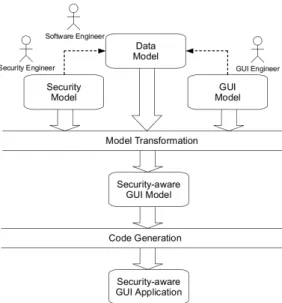
The heart of this methodology, illustrated in Fig. 1, is a model-transformation function that automatically lifts the policy that is specified in the security model to the GUI model. The idea is simple but powerful. The security model specifies under what conditions actions on data are authorized. The control information in the GUI model specifies which actions are executed in response to which events. Lifting essentially consists of prefixing each data action in the GUI model with the authorization check specified in the security model. The resulting GUI model is security aware. It specifies UI structure, information flow with persistent storage, and all authorization checks.
We have implemented this methodology within a toolkit, called ActionGUI [1], that performs this many-models-to-model transformation. From the resulting security-aware GUI model, ActionGUI generates a deployable application, along with all support for access control. In particular, when the security-aware GUI model contains only calls to execute CRUD actions, then ActionGUI will generate the complete implementation automatically.
The methodology and tool that we report on constitute a substantial further development of [2], [3]. In this previous work, we proposed the idea of using model transformations to lift the security policy, formulated in terms of the data model to the GUI model. Here we improve and generalize this previous work and we provide an updated presentation of the modeling languages, the toolkit, and the example applications that we developed.
Fig. 1. Model-driven development of security-aware GUIs.
Let us expand on the main generalization with respect to our previous work. Lifting previously consisted of prefixing each event in the GUI model with the authorization check specified in the security model. However since the data actions executed by an event may change the persistence layer’s state, checking authorization at the level of events, and therefore before executing any data action, is sufficient only if the underlying security policy does not contain authorization constraints (which was explicitly assumed in [3]), or if they do not depend on values that are changed during the execution of the event’s data actions (as was the case in the examples discussed in [2]). To overcome this limitation, we now check authorization before executing each event’s data actions and we provide events with a transaction semantics: either all of the data actions are executed in the given order, or none of them are executed at all.
Overall, we see our contributions as follows. First, our methodology offers Model Driven Architecture’s purported benefits [4], [5] for data-management applications. By working with models, designers can focus on the appli-cation’s data, behavior, security, and presentation, indepen-dent of the different, often complex, technologies that are used to implement them. Second, our use of model trans-formations leads to modularity and separation of concerns: the GUI model and the security model can be changed independently and by different developers, if desired. This avoids the problems mentioned earlier with fine-grained, hardcoded security policies that are difficult to maintain and audit. Finally, our methodology is quite powerful and compares favorably to alternatives, which are described in detail in Section VI on related work. In particular, it leverages well-known security languages [6] for modeling rich, fine-grained access control policies, which must often be manually encoded in other proposals. Moreover, our new language for GUIs supports modeling realistic, dynamic web interfaces (where the web content varies based on the
user’s actions or user-provided data), without limiting the interfaces to a fixed set of templates or interaction patterns, as in other methodologies. Of course, the proof of the pudding is in the eating and we report on applications that we developed, which provide evidence of the applicability of this approach.
Organization: The remainder of this paper is orga-nized as follows. In Section II we present background on the existing modeling languages that we use, namely, ComponentUML and SecureUML; in Appendix A we pro-vide additional explanation on the semantics of the latter. In Section III we introduce a new modeling language, called GUIML, for modeling graphical user interfaces together with their behavior. In Section IV we discuss our many-models-to-model transformation and in Section V we report on our tool support and on example applications that we developed using it. Finally, in Section VI we survey related work and we draw conclusions in Section VII. Due to space limitations, we omit the formal account of our methodology, which is given in the technical report [7]. Instead, we provide in Appendix B a high-level account of the correctness of the model-transformation function, which lies at our methodology’s core.
II. BACKGROUND
For modeling an application’s data and security pol-icy, we leverage existing modeling languages, namely, ComponentUML and SecureUML [6]. In this section we briefly introduce these languages. Since SecureUML uses the Object Constraint Language (OCL) [8] to model autho-rization policies, we also summarize its main features. A. ComponentUML
Data models provide a data-oriented view of a system. Typically they are used to specify how data is structured, the format of data items, and their logical organization, i.e., how data items are grouped and related. Our methodology
employs ComponentUML for data modeling. Component-UML provides a subset of Component-UML class models whereentities (classes) can be related by association and may have at-tributes andmethods. In ComponentUML, associations are binary: they always have two association-ends connecting two, not necessarily distinct, entities.
While ComponentUML and SecureUML have a graphi-cal concrete syntax (see [6]), to simplify and clarify the pre-sentation, we shall use textual concrete syntax. In this syn-tax, entities are declared with the keywordEntityfollowed by the entity’s name, and its attributes and association-ends, which are enclosed within brackets. Attributes and association-ends are declared together with their types. Moreover, since associations are binary, each association-end is declared together with its opposite association-association-end, designated by the keywordoppositeTo. Multiplicities other than * and 1 are specified using OCL invariants. Finally, comments are introduced with //.
As the following example illustrates, ComponentUML models specify how the application’s data is structured, independently of how it will be visualized or accessed.
Example 1: We use a simple chatroom application as a running example throughout this paper. A demo version of this application can be found at [1]. The application provides an online discussion site where users converse by posting messages. Note that there are two types of users: registered and unregistered users. Registered users have their nicknames and passwords stored in the persistence layer. As usual, some options are only available to regis-tered users, who log into the application by entering a valid nickname and password.
Here we use ComponentUML’s textual syntax to model the chatroom’s data model. The model, called Chat-RoomDTM, consists of three entities representing chat-rooms, registered users, and messages. The associations between these entities represent the relations between the registered users and the chatrooms in which they partic-ipate, the relations between the registered users and the messages that they have written, and the relations between the messages and the chatrooms where they have been posted. The entities’ attributes represent that each chatroom has a topic, each chatroom can be public or not, each registered user has a nickname and a password, and each message has a body.
1 EntityChatroom{ 2 Stringtopic 3 Booleanpublic
4 //registered users participating in this chatroom 5 Set(User)participantsoppositeTochatrooms 6 //messages posted in this chatroom
7 Set(Message)messagesoppositeTochatroom} 8 EntityUser{
9 Stringnickname 10 Stringpassword
11 //chatrooms in which this registered user participates 12 Set(Chatroom)chatroomsoppositeToparticipants 13 //messages written by this registered user
14 Set(Message)messagesoppositeToowner}
15EntityMessage{ 16 Stringbody
17 //chatroom where this message is posted
18 ChatroomchatroomoppositeTomessages 19 //registered user that wrote this message
20 UserowneroppositeTomessages} B. Object Constraint Language (OCL)
The Object Constraint Language (OCL) [8] is a lan-guage for specifying constraints and queries using a textual notation. As part of the UML standard, it was originally intended for modeling properties that could not be easily expressed using graphical notation, such as class invariants in a UML class diagram. Every OCL expression is written in the context of a model (called thecontextual model), and is evaluated on an object model (also called theinstanceor scenario) of the contextual model. This evaluation returns a value but does not alter the given object model, since OCL’s evaluation is side-effect free.
OCL is strongly typed. Expressions either have a prim-itive type, a class type, a tuple type, or a collection type. OCL provides standard operators on primitive data, tu-ples, and collections. For example, the operator→includes
checks whether an object is part of a collection. OCL also provides a dot-operator to access the values of the objects’ attributes and association-ends in the given scenario. For example, suppose that the contextual model includes a class
c with an attribute at and an association-end as. Then, if o is an object of the class c in the given scenario, the expression o.at refers to the value of the attribute at for the objectoin this scenario, ando.as refers to the objects linked to the object o through the association-end as. Finally, OCL provides operators to iterate over collections, such as →forAll,→exists, →select, →reject,→collect, and
→iterate. C. SecureUML
SecureUML [6] extends Role-Based Access Control (RBAC) [9] with authorization constraints. These con-straints can be used to specify policies that depend on properties of the system state, for example, that a user can only post a message to a chatroom where the user participates. More specifically, SecureUML allows one to formalize access control decisions that depend on two kinds of information:
1) static information, namely the assignments of users and permissions to roles, and the role hierarchy, and 2) dynamic information, namely the satisfaction of
au-thorization constraints in the current system state. SecureUML therefore supports the modeling of roles and their hierarchies, permissions, actions, resources, and au-thorization constraints. Moreover, one can also model as-signments: which permissions are assigned to a role, which actions are allowed by a permission, which resources are affected by a permission, and which authorization constraint must be satisfied before granting a permission.
In our methodology, we use an extension of SecureUML to specify security policies over ComponentUML models.
TABLE I
SECUREUML+COMPONENTUML:ACTIONS AND RESOURCES.
Resource Atomic Actions Composite Actions Entity create, delete read, update, full access Attribute read, update full access
Method execute
Association-end read, create, delete full access
In this extension, the protected resources are the entities, along with their attributes, methods, and association-ends, while theactions are those shown in Table I.
Note that there are two classes of actions: atomic and composite. Atomic actions are intended to map directly onto existing operations on the persistence layer. Com-posite actionshierarchically group lower-level actions. For example, the full access action for an attribute groups together the read and update actions for this attribute. Finally, authorization constraints are specified using OCL, where the context of an OCL expression is the underlying ComponentUML model. Additionally, OCL expressions in SecureUML models may contain the variables self,caller,
value, andtarget, which are interpreted as follows: • self refers to the root resource upon which the
ac-tion will be performed if the permission is granted. The root resource of an attribute, a method, or an association-end is the entity to which it belongs. • caller refers to the user that will perform the action if
the permission is granted.
• value refers to the value that will be used to update an attribute if the permission is granted.
• target refers to the object that will be added (or removed) at an association-end if the permission is granted.
The reader familiar with the original presentation of SecureUML [6] may notice that we have introduced two new variables that can be used in authorization constraints: the variablesvalueandtarget. Furthermore, to avoid poten-tial ambiguities, we have refined the association-end update action into two separate actions: association-end create and association-end delete.
In our concrete syntax, the entity modeling the system’s users (or, more specifically, the system’scallers) is declared with the keyword User. The roles that these users can take are declared with the keyword Role followed by the role’s name, and its permissions, which are enclosed within brackets. The keyword inherits, appearing between two roles, declares that the first role is subordinated to the second role in the role hierarchy, and therefore inherits all its permissions.
Permissions are introduced by naming the root resources to which they grant access. Each permission consists of a list of actions through which the corresponding root resource can be accessed. Actions on attributes, methods, or association-ends are declared along with their names. For example, Read::attr denotes the read action on the attribute attr. The if–then construction is used to declare that the permission to execute an action is constrained by
a condition. This condition is the authorization constraint that is associated to the permission.
As the following example illustrates, SecureUML models specify the application’s access control policy in a fine-grained way. These models depend, of course, on how the application’s data is structured, but not on how it is visualized or accessed through the application’s graphical user interface.
Example 2: We use the SecureUML’s textual syntax to model a policy for posting and reading chatroom messages. Our model, called ChatRoomSTM, has two roles: the role DefaultR represents everybody, i.e., both registered and unregistered users, and the role UserR represents only reg-istered users. Our policy states that everybody can read any message posted in a public chatroom, but that only regis-tered users can read messages posted in a private chatroom, provided they participate in that chatroom. Moreover, only registered users can post messages in public chatrooms; they can also post to private chatrooms, provided they also participate in that chatroom.
1 UserUser 2 RoleDefaultR{ 3 Chatroom{
4 //everybody can access the messages posted in a 5 //public chatroom
6 ifself.publicthen Read::messages} 7 Message{
8 //everybody can read the body of any message 9 //posted in a public chatroom
10 ifself.chatroom.publicthen Read::body} } 11 RoleUserRinheritsDefaultR{
12 Chatroom{
13 //every registered user can access the messages that 14 //are posted in a chatroom in which she participates 15 ifself.participants→includes(caller)
16 then Read::messages} 17 Message{
18 //every registered user can read the body of any 19 //message that is posted
20 //in a chatroom in which she participates
21 ifself.chatroom.participants→includes(caller) 22 then Read::body
23 //every registered user can create a new message
24 Create
25 //every registered user can claim ownership of any 26 //unowned message
27 ifself.owner.oclIsUndefined() and target=caller 28 then Create::owner
29 //every registered user can change the body of any 30 //message she owns
31 //provided it is not yet posted anywhere 32 ifself.owner=caller
33 and self.chatroom.oclIsUndefined() 34 then Update::body
35 //every registered user can post in a public chatroom any 36 //message she owns,
37 //provided it is not yet posted anywhere 38 ifself.owner=caller and target.public 39 and self.chatroom.oclIsUndefined() 40 then Create::chatroom
42 //she participates, any message she owns, 43 //provided it is not yet posted anywhere 44 ifself.owner=caller and target.participants 45 →includes(caller)
46 and self.chatroom.oclIsUndefined() 47 then Create::chatroom} }
SecureUML provides various constructs for expressing complex access control policies compactly and intuitively, for example, by using action and role hierarchies or by declaring default policies. Nevertheless, as described in Appendix A, every SecureUML model S can be uniquely transformed into a semantically equivalent model S[ for
which the following holds:
Remark 1: Let S be a SecureUML model. Then, for every atomic action act and every role r in S, there is exactly one permission inS[(possibly constrained byfalse)
for rto execute act.
Informally, the model S[ makes the security policy specified in S completely explicit. Thus, let Auth be the function that, for every SecureUML model S, role r, and actionact, returns the authorization constraint associated to the unique permission that is defined inS[forrto execute
act. We will use this function Auth to define the model-transformation that, in our methodology, lifts the security policy from the security model to the GUI model. We conclude this section with some examples that illustrate in which sense Authmakes the security policy specified in a security model explicit.
Example 3: Consider the chatroom’s security model,
ChatRoomSTM, in Example 2. Note that UserR is a subrole of DefaultR (in line 11), which means that
UserR will inherit all the DefaultR’s permissions. Thus, Auth(ChatRoomSTM,UserR,Read::body) returns:
self.chatroom.public (from ln. 10) or
self.chatroom.participants→includes(caller) (from ln. 21).
Note also that the association-end messages is opposite to the association-end owner. This means that a create (respectively delete) action on messages will be constrained by the same authorization that constrains a create (respectively delete) action on owner, having simultaneously replaced the variable self by target and the variable target by self. Thus, although no permission is explicitly given for the role UserR to execute a create action on messages, Auth(ChatRoomSTM,UserR,
Create::messages) returns:
target.owner.oclIsUndefined() and self=caller (from ln. 27).
Finally, note that there is no permission explicitly given to the role DefaultRfor executing an action update on the attribute body. Since permissions are denied by default (and no other rules can be applied in this case, like the ones for role inheritance or opposite association-ends) Auth(ChatRoomSTM,UserR,Update::body) returnsfalse.
III. GUI MODELS
GUI models provide a human-interface oriented view of a system. Together with data models, they constitute platform independent application models, omitting security aspects.
Informally, a GUI consists of widgets, which are visual elements that display information and trigger events that execute actions. In this section we present a key compo-nent of our methodology: a novel language for modeling GUIs for data-management applications, called GUIML (GUI Modeling Language). It is important, however, to understand that GUIML is a language for modeling not only the structure of a GUI, i.e, the elements (widgets) that comprise it, but also the GUI’sbehavior, i.e., how its elements will react (actions) in response to user interactions with them (events). In fact, the key feature of GUIML is the language it provides for modeling the GUI’s behavior, which uses OCL to specify both the conditions and the arguments for the different actions. This feature enables both the security model and the GUI model to “speak” the same language (namely, OCL in the context of the common, underlying data model). This allows us to define rigorously the transformation function that lifts the security policy to the GUI level.
We next briefly describe the main elements of GUIML, namely, widgets (with their associated variables), events, andactions. We will also illustrate them later with a simple example: a window for our chatroom application, where users can read and post messages in a chatroom.
Widgets: A GUIML model consists of widgets of dif-ferent types: windows (pages, when referring to web appli-cations), combo-boxes (selectable lists), tables, date fields, boolean fields (check boxes), buttons, text fields, and labels. Widgets can be displayed in containers, which are also widgets. Widgets other than windows must be contained in another widget, and only windows, combo-boxes and tables may contain other widgets. Widgets may own variables, which store values for later use, and trigger events, which execute actions.
In concrete syntax, a widget is declared with a keyword likeWindow,Button, andTextField, according to its type, followed by the widget’s (local) name, and the declaration of the variables it owns, the events it triggers, and the widgets it contains, all enclosed in brackets. The global name of each widget must be unique. If a widget is a window, its global name is the name given in its declaration. Otherwise, the global name results from concatenating, using dot, the global name of the widget’s container with the name given in its declaration.
Variables: Each widget declaration may contain variable declarations, listing the variables owned by the widget. In concrete syntax, a variable declaration consists of the variable’s type followed by its name.
There are also variables that are, by default, owned by every widget of a given type. These variables are implicitly declared in every widget declaration, and their values are handled in special ways. Here we only discuss
the predefined variables that we will use in our example. The variables caller androle are predefined in every win-dow. They store, respectively, the application’s user and the user’s role. The variable text is predefined in every label, button, and text field. This variable stores the string displayed on the screen within the label, button, and text field; also, when a user types in a text field, the value of its variabletextis automatically updated. The variablerows
is predefined in every combo-box and table. This variable stores the collection of items that can be selected from the combo-box or table. The variablerow is also predefined in every combo-box and table where, for each row, it stores the item that can be selected.
Events: Each widget declaration may contain event declarations. Events are triggered when specific actions are executed upon their widgets, and they themselves can execute actions either on data or on other widgets.
The actions executed when an event is triggered are specified usingstatements. A statement is either an action, a conditional statement, an iteration, or a sequence of statements. In GUIML, the conditions in both conditional statements and iterations are specified using OCL expres-sions, whose context is the underlying ComponentUML model. Additionally, they can refer to the widget variables. In GUIML, when widget variables are used within OCL expressions, they are enclosed in square brackets. Note that each sequence of statements associated to an event is executed as a single transaction: either all its statements successfully execute in the given order, or none of them are executed at all.
In concrete syntax, events are declared by indicating their types followed by the sequence of statements that they execute, enclosed in brackets. In our example we will use two types of events: OnCreateand OnClick. The former are triggered when the widgets are created and the latter are triggered when widgets are clicked upon. In particular, a window is created when an open action that has this window as its target is executed. All the other widgets are created immediately after their corresponding containers are created.
Actions: Every event declaration contains a sequence of statements that specifies the actions executed when the event is triggered. These actions can be executed either on objects belonging to the persistence layer or on objects belonging to the visualization layer. The former are called data actions, and the latter are called GUI actions. Note that some actions may take arguments whose values are only known at run-time, for example a delete action whose argument is the item selected by the user in a combo-box, or an update action whose argument is the number entered by the user in a text field. In GUIML, these values are specified using OCL. Again, the context of these expressions is the underlying ComponentUML model, but they can also refer to the widget variables.
Next, we briefly describe some of the GUIML data actions and their concrete syntax.
• Entity create:It creates a data item in the persistence layer. Its arguments are the typeof the data item and
thevariablethat stores the data item. It is declared by the statementvariable:= newtype.
• Entity delete: It deletes a data item from the persis-tence layer. Its argument is object, which is the data item deleted. It is declared by the statement delete object.
• Attribute read: It reads the value of a data item’s attribute in the persistence layer. Its arguments are the data itemobjectwhose property is read, the attribute read, and thevariable that stores the value read. It is declared by the statementvariable:=object.attribute. • Attribute update: It modifies the value of a data item’s attribute in the persistence layer. Its arguments are the data item object whose attribute is modified, theattributemodified, and the newvalue. It is declared by the statementobject.attribute:= value.
• Association-end read:It reads the collection of items linked to an item’s association-end in the persistence layer. Its arguments are the data item object whose property is read, the association-end assocEnd read, and the variable that stores the collection read. It is declared by the statementvariable:=object.assocEnd. • Association-end create:It creates a link in the persis-tence layer between two data items. Its arguments are the source data item srcObject, the target data item tgtObject, and the association-end assocEnd through which the target data item is linked to the source data item. An association-end create action is declared by the statementsrcObject.assocEnd +=tgtObject. • Association-end delete: It deletes a link in the
per-sistence layer between two data items. Its arguments are the source data item srcObject, the target data itemtgtObject, and the association-endassocEndfrom which the target data item is removed. It is declared by the statementsrcObject.assocEnd –=tgtObject. Finally, we describe some of the GUI actions that are defined in GUIML.
• Set: It updates the value of a variable. Its arguments are the name of thevariableand variable’s newvalue. It is declared by the statement variable:=value. • Open:It opens a window. Its argument istarget, which
names the window opened. Additionally, it may take as arguments any number of pairs (variablei,valuei),
wherevariableiis the name of a variable owned by its
targetwindow, andvalueiis the value that is assigned
tovariablei when target is opened. It is declared by
the statementopentargetwithvariable1:=value1. . . variablen:=valuen.
• Back: It moves back to the previous window. It is declared using the keywordback.
• Fail: It forces a rollback in the current transaction, whereby the corresponding statement is not success-fully executed. It is declared using the keyword fail. • Skip:It does nothing. It is declared using the keyword
skip.
We now provide an example that illustrates the main elements of the GUIML language: a window ReadPostWI
for our chatroom application, where users can read and post messages in (previously selected) a chatroom. As this example will show, GUIML models depend on how the ap-plication’s data is structured — after all, they describe how users interact with this data — but not on the application’s access control policy.1 In our example, this separation of
concerns is reflected by the fact that the GUIML model for the window ReadPostWIis completely unaware of the security policy for reading and posting messages in our chatroom application.
Example 4: We use GUIML to model the window of our chatroom application where users can read and post mes-sages in a chatroom. This window is named ReadPostWI. It owns a variable chatroomSel that stores a previously selected chatroom (the action that opens the window Read-PostWI will assign a value to this variable). The window
ReadPostWIcontains four widgets:
• a table ReadPostsTB for visualizing the messages posted in the selected chatroom;
• a text field WritePostENfor writing a new message; • a button PostBUfor posting in the selected chatroom
the message written in the text fieldWritePostEN; and • a button BackBU for moving back to the previous
window.
The model is as follows:
1 WindowReadPostWI{
2 //this variable stores the previously selected chatroom 3 ChatroomchatroomSel
4 //this table visualizes the messages posted 5 //in the selected chatroom
6 TableReadPostsTB{ 7 OnCreate{
8 rows:=[ReadPostWI.chatroomSel].messages} } 9 //in this text field the user writes its new message
10 TextFieldWritePostEN{ 11 OnCreate{text:=”} }
12 //by clicking on this button, the user posts its new message 13 //in the selected chatroom
14 ButtonPostBU{
15 OnCreate{text:=’Post’} }
16 //by clicking on this button, the user moves back to 17 //the previous window
18 ButtonBackBU{
19 OnCreate{text:=’Back’} } } 20//we continue with this table
21TableReadPostWI.ReadPostsTB{
22 //each column of this table shows the body of a message 23 //of the selected chatroom
24 LabelBodyPostLB{ 25 OnCreate{
26 text:=[ReadPostWI.ReadPostTB.row].body} } } 27//we continue with this button
28ButtonReadPostWI.PostBU{ 29 OnClick{
30 newPost:= newMessage
31 newPost.owner+=[ReadPostWI.caller]
1Of course, in terms of the final application’s usability, there is a
dependency: an application’s GUI can end up being unusable precisely because of the application’s security policy.
32 newPost.body:=[ReadPostWI.WritePostEN.text] 33 newPost.chatroom+=[ReadPostWI.chatroomSel]} } 34//we continue with this button
35ButtonReadPostWI.BackBU{ 36 OnClick{back} }
Note that the tableReadPostTBand the buttonsPostBU
andBackBUare modeled partially inside the window Read-PostWIand partially outside this window. This is supported by our concrete syntax in order to improve the readability of the GUIML models. However, to avoid ambiguities, when a widget is modeled outside its widget container, the widget’s global name is used. Note too that the table ReadPostTB
is unaware of the security policy for visualizing messages, which in our running example states that only registered users are authorized to read messages posted in private chatrooms. Similarly, the button PostBUis unaware of the security policy for posting messages, which is that only registered users can post messages in public chatrooms and in private chatrooms but, in the latter case, they must also participate in these chatrooms.
IV. SECURITY-AWAREGUI MODELS
In this section we describe the heart of our methodology: a model-transformation function Secthat, given a GUIML modelGand a SecureUML modelS, automatically gener-ates a new GUIML modelSec(G, S). The generated model is identical toGexcept that it issecurity awarewith respect toS. The transformation function Secworks by wrapping around every data actionact inGan if-then-else statement with the following arguments:
• a condition that reflects the constraints associated to the permissions specified inS, for each of the different roles, to execute the action act;
• a then-branch that contains the actionact; and • an else-branch that contains the actionfail.
Thus, the semantics of the if-then-else statement ensures that act will only be executed if the constraints associated to the corresponding permissions are satisfied. Moreover, this semantics also guarantees that, if these constraints are not satisfied, then the actionfail will be executed, forcing a rollback in the current transition.
More specifically, to generate the aforementioned if-then-else statement, the function Sec makes use of Remark 1. In particular, for each role r in S, it calls the function Auth(S, r,act) to obtain the expression that ultimately (i.e., when the security policy is made completely explicit) constrains the permission given to
r for executing act. However, since this expression may contain the variables self, value, target, and caller, the function Sec must also replace these variables by the actual arguments of the action act (including its actual user). We denote the resulting OCL expression by Auth(S, r,act)[args], where args are the arguments specified in the GUI model for the action act. Finally, since different roles may be constrained by different expressions, the condition generated by Sec will have the
form:
((r1= [Window.role] andAuth(S,r1,act)[args]) or. . .or
(rn= [Window.role] andAuth(S,rn,act)[args])),
wherer1, . . . , rnare all the roles declared inS. (Recall that
the actual application’s user and its role are always stored in the variables callerandrole, which are owned by every window in the GUI model.)
The following examples illustrate the model-transformation function Sec. As previously mentioned, the complete, formal account of our methodology, including the model-transformation function Sec, is given in [7]. Nevertheless, the interested reader can find in Appendix B a high-level account of the correctness of Sec.
Example 5: Consider line 32 in Example 4. It specifies the third action that will be executed when the button
ReadPostWI.PostBU is clicked upon, namely,
newPost.body:=[ReadPostWI.WritePostEN.text].
Recall that :=refers to an update action, in this case to the actionUpdate::body. The functionSecwill replace this by the following if-then-else statement:
if ((DefaulR = [ReadPostWI.role] and false) or
(UserR = [ReadPostWI.role] and
([newPost].owner = [ReadPostWI.caller] and [newPost].chatroom.oclIsUndefined()))) then newPost.body:=[ReadPostWI.WritePostEN.text] elsefail.
To understand the condition generated by Sec, note that Auth(ChatRoomSTM, DefaultR, Update::body) is equal to false, but that Auth(ChatRoomSTM, UserR,
Update::body) is equal to self.owner = caller and self.chatroom.oclIsUndefined(). Thus, the functionSecmust replace the variable self by the newly created message
newPost (since this is the object upon which the action
Update::bodywill be executed), and the variable callerby
ReadPostWI.caller (since this is the user that will execute the action Update::body).
Example 6: Consider line 31 in Example 4. It specifies the second action that will be executed when the button
ReadPostWI.PostBU is clicked upon, namely,
newPost.owner+=[ReadPostWI.caller].
Recall that+=refers to an association-end create action, in this case to the action Create::owner. Then, the function Sec will replace this line by the following if-then-else statement:
if ((DefaulR = [ReadPostWI.role] and false) or
(UserR = [ReadPostWI.role] and ([newPost].owner.oclIsUndefined()
and [ReadPostWI.caller]=[ReadPostWI.caller]))) then newPost.owner+=[ReadPostWI.caller]
elsefail.
To understand the condition generated by Sec, note that Auth(ChatRoomSTM, DefaultR, Create::owner) is equal to false, but thatAuth(ChatRoomSTM, UserR, Cre-ate::owner) is equal toself.owner.oclIsUndefined() and tar-get=caller. Thus, the functionSecmust replace the variable
self by the newly created message newPost (since this is the object upon which the action Create::owner will be executed), the variable caller by ReadPostWI.caller (since this is the user that will execute the actionCreate::owner), and the variabletargetalso byReadPostWI.caller(since the actual user is precisely the object that will be added by the
Create::owneras the owner of the newly created message). Our next example illustrates how our model transforma-tion Sec leads to modularity and separation of concerns whereby the GUI model and the security model can be changed independently, if desired.
Example 7: Suppose that we decide to allow anyone (not only registered users, but also unregistered ones) to post messages in public chatrooms. To update the chatroom application’s security-aware GUIML model, we just carry out the following steps:
• Step 1 Change the original chatroom’s SecureUML model to reflect our security policy changes. We call the new security model PubChatRoomSTMand show below the new permissions for the role DefaultR
(i.e., for everybody using the application) to create a message, update the body of a message, and post a message in a chatroom:
RoleDefaultR{ Message{
//everybody can create a new message Create
//everybody can change the body of //any unowned message
//provided it is not yet posted anywhere ifself.owner.oclIsUndefined()
and self.chatroom.oclIsUndefined() then Update::body
//everybody can post in a public chatroom //any unowned message
//provided it is not yet posted anywhere
ifself.owner.oclIsUndefined() and target.public and self.chatroom.oclIsUndefined()
then Create::chatroom} }
• Step 2 Apply our model transformation to the original chatroom GUIML model and the modified chatroom SecureUML model to generate the updated security-aware GUIML model. We show below the result of this transformation for line 32 in Example 4.
if ((DefaultR = [ReadPostWI.role] and ([newPost].owner.oclIsUndefined()
and [newPost].chatroom.oclIsUndefined())) or
(UserR = [ReadPostWI.role] and (([newPost].owner.oclIsUndefined()
and [newPost].chatroom.oclIsUndefined()) or
([newPost].owner = [ReadPostWI.caller] and [newPost].chatroom.oclIsUndefined())))) then newPost.body:=[ReadPostWI.WritePostEN.text] elsefail.
It is interesting to compare this result with the one explained in Example 5 for the case of the security model
ChatRoomSTM. To understand the differences, note that Auth(ChatRoomSTM, DefaultR, Update::body) is equal to false, but that Auth(PubChatRoomSTM, DefaultR, Up-date::body) is equal to self.owner.oclIsUndefined() and self.chatroom.oclIsUndefined(). Also, recall that UserR in-herits all permissions from DefaultR and, in particular, its new permission for updating the body of a message, which is constrained by Auth(PubChatRoomSTM,DefaultR, Up-date::body).
Note that in this example, the functionSecmay generate conditions that can be further simplified. However, for the sake of illustration, here and elsewhere, we show the results of Secwithout further simplification.
V. ACTIONGUI TOOLKIT ANDAPPLICATIONS A. ActionGUI Toolkit
Security-aware GUIML models are platform independent and can be mapped to implementations employing differ-ent technologies. This includes desktop applications, web applications, and mobile applications. As part of our work, we built the ActionGUI Toolkit [1], which automatically generates web-based data-management applications from security-aware GUIML models.
The ActionGUI Toolkit features model editors for con-structing and manipulating ComponentUML, SecureUML, and GUIML models. These editors share our own OCL parser, which takes as additional input the variables intro-duced by the different models, along with their respective types: in the case of SecureUML models, the variablesself,
caller,target, andvalue, and in the case of GUIML models, all the given widget variables. Crucially, the ActionGUI Toolkit implements our model transformation to generate security-aware GUIML models. Finally, it includes a code generator that, given a security-aware GUIML model, pro-duces a web application based on the following, standard three-tier architecture.
1) Presentation tier (also known as front-end): Users ac-cess web applications through standard web browsers, which render the content (HTML and JavaScript) dynamically provided by the application server. 2) Application tier: The toolkit generates Java Web
Ap-plications, implemented using the Vaadin framework. The applications run in a servlet container (such as Tomcat or GlassFish), process client requests and, generate content, which is sent back to the client for rendering. They may also manipulate data stored in the persistence tier. When processing client requests, the generated application interprets its underlying security-aware GUIML model. In particular, it per-forms the required security checks before modifying any data stored in the persistence tier or sending
any data to the presentation tier. This involves, of course, dynamically evaluating the OCL expressions appearing in the security-aware GUIML model. 3) Persistence tier (also known as data tier or
back-end): The generated application manages information stored in a database. For each application, the toolkit generates the corresponding database schema from the application’s ComponentUML model.
As a model-driven development tool, the ActionGUI Toolkit produces its best results when the data-management application’s functionality can be reduced to CRUD actions and its dynamics consists of navigating and passing in-formation through windows, and exchanging inin-formation with the underlying database. For applications in this category, ActionGUI automatically generates the complete implementation from the corresponding ComponentUML, SecureUML, and GUIML model. Note that calling CRUD actions is modeled in GUIML using data actions, and navigating and passing information through windows is modeled using GUI actions, namely,open,back, and set. Of course, some data-management applications will re-quire functionality that goes beyond CRUD actions. For example, they may need to send emails, print tables, or export data in some desired format. As expected, the Ac-tionGUI Toolkit does not generate code for such methods. Instead, it includes their implementation — which must be provided by the application developer — in the generated application. When the application needs to interpret one of these methods, it simply calls the method provided.
B. Applications
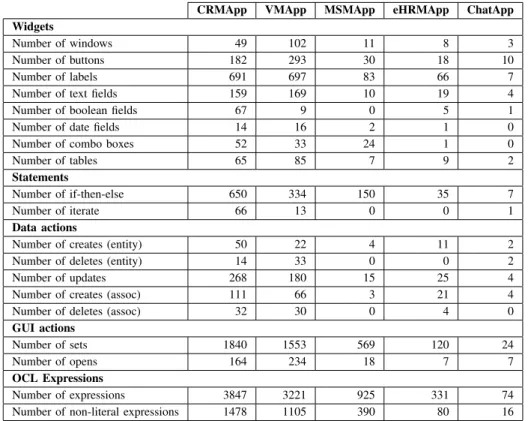
We report here on five web applications that we devel-oped using ActionGUI. Our objective is to show that one can use our methodology and the ActionGUI Toolkit to developnon-toysecure data-management applications. We begin by briefly describing our applications. In Table II we provide different measurements of the applications’ size, defined in terms of their underlying GUIML models.
a) Customer Relationship Management (CRMApp): We have developed a web application for managing cus-tomers of a Hospital and Care Center. This application allows marketing and public relations personnel to manage contact information, including filtering contacts based on different criteria and exporting the results in Excel files. As customer data is highly sensitive, data is subject to a restric-tive access-control policy. For example, a marketing and PR staff member can only access the contact information of those contacts previously selected as targets of a marketing campaign to which he is assigned. The application also allows a General Manager to create marketing campaigns, select the targeted patients, and assign marketing and PR staff members to campaigns.
b) Volunteer Management (VMApp): We have de-veloped a web application for managing a care center’s volunteer program. Using this application, the program’s coordinators can take actions such as: introduce new volun-teers; create, edit, and modify tasks; and propose these tasks
to the volunteers, based on the volunteers’ time availability and preferences. The access-control policy stipulates, for example, that volunteers are only authorized to edit their own personal information, such as their preferences and time availability, and to accept or reject their own tasks.
c) Meal Service Management (MSMApp): This is a web application for managing a student residence’s meal service. Using this application, a resident can notify the administration whether he will have a meal at the resi-dence’s cafeteria, in which of the available time slots, and if he will bring a guest. A resident shall only edit his own meal selection and within a specific time window, which depends on the selected meal. Administrators can create new resident accounts, and list the meals requested for each available time slot.
d) EHealth Record Management (eHRMApp): This is a web application for managing eHealth records. It allows users with the appropriate roles to: register new patients in a hospital and assign to them clinicians (doctor, nurses, etc.); retrieve patient information; register new nurses and doctors in a hospital and assign them to a ward; change nurses or doctors from one ward to another; and move patients to a different practice. The access-control policy regulates, in particular, access to the patients’ highly sensitive records. These records shall only be retrieved by their handling doc-tors, although this policy can be relaxed in an emergency situation.
e) Chatroom (ChatApp): This is an extension of our running example: in addition to posting messages in a selected chatrooms, users can also create and delete chat-rooms, under specific conditions.
CRMApp, VMApp, and MSMApp are commercial ap-plications. They were developed for actual customers, and they are currently being used by their different stakeholders. In contrast, EHRMApp was developed as part of a case study proposed by industrial partners in a European project. The interested reader can find more information about this case study, as well as demo versions of the EHRMApp and ChatApp applications, at [1]. With respect to code-generation, for MSMApp, EHRMApp, and ChatApp, the ActionGUI’s code generator automatically generates 100% of their implementation (no non-CRUD actions are ever called). In contrast, CRMApp and VMApp contain custom code for sending mails and for generating Excel files, which we borrowed from existing Java libraries. For all our examples, the ActionGUI’s code generator produces the corresponding applications in under a minute.
We conclude this section by summarizing the key con-tributions of our methodology and toolkit. Our experience developing the reported applications provides evidence of the methodology’s potential for developing real-world ap-plications. First, the use of model-transformation and code generation frees the developer from programming fine-grained authorization constraints and inserting them at all the required places throughout the application’s code and with the correct arguments. Except for small applications, this is cumbersome and error-prone, since the number of data actions associated to events may be on the order of
hundreds; see, for example, the applications CRMApp and VMApp in Table II. Second, our methodology supports modularity and separation of concerns. In particular, the security model can be changed independently of the GUI model, without requiring one to re-program and re-insert all the new fine-grained authorization constraints since this is automatically done by our model-transformation. This substantially aided developing our applications as our clients changed, several times, their security policies for CRMApp, VMApp, and MSMApp.
VI. RELATEDWORK
Over the past 15 years, there have been numerous re-search advances in the model-driven development of data management applications. Among these, UWE [10], [11], [12], [13] and ZOOM [14] are the most closely related to our work.
As a modeling tool, UWE [10], [11], [12], [13] provides the modeler with a higher-level of abstraction than Ac-tionGUI. In particular, the actions executed by the widgets’ events are described in UWE using natural language. Thus, unless the models are appropriately refined, as discussed in [13], UWE does not support code-generation. In con-trast, UWE provides specific diagrams for modeling GUI presentations andnavigations, which facilitate the task of GUI modeling. In this respect, we define in [15] a mapping that transforms high-level UWE models into more concrete ActionGUI models that, once completed by the modeler, can be directly used to generate the intended applications. Finally, [12] extends UWE to use SecureUML for modeling security policies. However, this work does not use a model-transformation to lift the security policy to the GUI level. Instead the UWE modeler is responsible for adding all the appropriate authorization checks to the GUI model.
Like ActionGUI, ZOOM [14] allows GUI modelers to specify widgets, their events, and their actions. More-over, using an extension of Z [16], one can specify the conditions of the actions and their arguments, similar to how this is done in ActionGUI using OCL. In contrast to ActionGUI, ZOOM does not provide a language for modeling security and security aspects are not explicitly considered in this approach. Moreover, ZOOM does not support code-generation. It only provides interpreters for model animation.
In contrast to ActionGUI, UWE, and ZOOM, the ap-proaches presented in [17], [18], [19] do not provide a language for modeling GUIs. They instead implement different rules for automatically deriving GUIs based on either the application’s data model, as in [17], [18], or the application’s prototypical scenarios, as in [19]. As expected, the behavior of the resulting GUIs is limited and, based on our experience, insufficient to cope with the logic embedded in real data-management applications. Moreover, security aspects are not addressed in these proposals.
There is other related work that falls between the two extremes of full GUI modeling and full GUI derivation. Both the OO-method [20], [21] and WebML [22], [23]
TABLE II
EXAMPLE APPLICATIONS:SIZE OF THE APPLICATION’S MODELS
CRMApp VMApp MSMApp eHRMApp ChatApp
Widgets
Number of windows 49 102 11 8 3
Number of buttons 182 293 30 18 10
Number of labels 691 697 83 66 7
Number of text fields 159 169 10 19 4
Number of boolean fields 67 9 0 5 1
Number of date fields 14 16 2 1 0
Number of combo boxes 52 33 24 1 0
Number of tables 65 85 7 9 2
Statements
Number of if-then-else 650 334 150 35 7
Number of iterate 66 13 0 0 1
Data actions
Number of creates (entity) 50 22 4 11 2
Number of deletes (entity) 14 33 0 0 2
Number of updates 268 180 15 25 4
Number of creates (assoc) 111 66 3 21 4
Number of deletes (assoc) 32 30 0 4 0
GUI actions
Number of sets 1840 1553 569 120 24
Number of opens 164 234 18 7 7
OCL Expressions
Number of expressions 3847 3221 925 331 74
Number of non-literal expressions 1478 1105 390 80 16
support building GUIs using UI-patterns. These patterns specify the possible interactions with the application’s data based on the classes, attributes, and associations that are de-clared in the underlying data model. These approaches have the advantage of reducing the time required for modeling GUIs. However, the UI-patterns impose restrictions on the type of GUIs that can be modeled, both in terms of their structure and their behavior. Moreover, these approaches only support role-based access control, but not fine-grained access control. Other approaches that fall in this category are [24], [25]. In both cases, the modeler must associate to each widget container the specific data type accessed using the widget. As before, the possible interactions with the underlying data is limited by the default behavior implemented for these widget containers. Security aspects are also not considered.
Finally, there are approaches whose primary focus is to support UI design at different levels of abstraction. Prominent examples are the XML User Interface Language (XUL) [26] and the USer Interface eXtensible Markup Language (UsiXML) [27]. XUL is Mozilla’s XML-based language for building user interfaces of applications like Firefox. UsiXML is an XML-compliant markup language that describes the UI for multiple usage contexts, such as Character User Interfaces (CUIs), Graphical User Interfaces (GUIs), Auditory User Interfaces, and Multimodal User Interfaces.
Clearly, ActionGUI is designed for a different purpose than XUL and UsiXML. In particular, ActionGUI is de-signed for developing secure data-management
applica-tions. A key design decision for ActionGUI was to ensure that the security model and the GUI models “speak” the same language. To the best of our knowledge, neither XUL nor UsiXML are concerned with security aspects of the UIs. Moreover, ActionGUI is designed for themodel-driven development of secure data-management applications and this has two clear consequences. First, ActionGUI’s mod-eling languages are designed to be technology-agnostics, in contrast with XUL, which is tightly linked to Mozilla-related technologies. Second, ActionGUI’s modeling lan-guages are designed to support the automatic generation of ready to be deployed applications from the models. As a result, ActionGUI models are more concrete than general UsiXML models, which can be defined at any of the four abstraction levels specified in the Cameleon Reference Framework (CRF) [28]. In particular, a GUIML modeler always works at the CRF-Concrete UI level, while the WAR (Web application ARchive) file generated from a GUIML model (along with the associated security and data models) belongs to the CRF-Final UI level. Also, we note that [29] has carried out promising work on extending our methodology to cope with business processes, which are typically defined at the Task & Concepts abstraction level in CRF. Along these lines, it would be interesting to inves-tigate ways of extending our methodology to support UI modeling at the CRF-Abstract UI level, where interaction details are abstracted away.
VII. CONCLUSIONS
The methodology we proposed constitutes a further de-velopment of the idea of model-driven security [30]. The
two main innovations are an expressive language for mod-eling an application’s graphical user interface and behavior, and a many-models-to-model transformation that lifts a security policy specified on the application’s data model to this behavioral model. Our transformation function captures the idea that authorization policies regulating complex transactions can be generated uniformly from much simpler policies on data. Despite our use of expressive modeling languages, we have shown for data-management applica-tions that it is possible to generate automatically complete deployable applications.
Our methodology is supported by the ActionGUI Toolkit. Applications like those described in Section V-B show the toolkit’s potential for developing real-world applications. Nevertheless, there is still much work ahead to turn this toolkit into a full, robust, industrial-strength development platform. In the short term, we plan to develop improved model editors and better support for integrating custom code. In the long term, we would like to support GUIs running on different platforms, like mobile devices. We also plan to add support for handlingprivacy policies: modeling and generating code to enforce that data usage must follow the purpose for which the data was collected and may entail obligations.
Finally, we would like to support model analysis, based on the formal semantics of our models and on the cor-rectness of our model transformation. The following are examples of questions we would like to be able to formally answer. Will every sequence of action executed by every event in the model preserve the data model’s invariants? Will authorization checks ever force a transaction roll-back? Do the conditions in the GUI model make redundant the au-thorization checks generated by the model transformation? Analysis support would allow us to optimize generated code and support assurance activities like system certification.
ACKNOWLEDGEMENTS
This work is partially supported by the EU FP7-ICT Project “NESSoS: Network of Excellence on Engineering Secure Future Internet Software Services and Systems” (256980), by the Spanish Ministry of Science and Inno-vation Project “DESAFIOS-10” (TIN2009-14599-C03-01), by the Spanish Ministry of Economy and Competitive-ness Project “StrongSoft” (TIN2012-39391-C04-04), and by Comunidad de Madrid Program “PROMETIDOS-CM” (S2009TIC-1465).
REFERENCES
[1] ActionGUI, “The ActionGUI project,” 2013, http://www.actiongui. org.
[2] D. A. Basin, M. Clavel, M. Egea, M. A. G. de Dios, C. Dania, G. Ortiz, and J. Valdazo, “Model-driven development of security-aware GUIs for data-centric applications,” inFoundations of Security Analysis and Design VI - FOSAD Tutorial Lectures, ser. LNCS, A. Aldini and R. Gorrieri, Eds., vol. 6858. Springer, 2011, pp. 101–124.
[3] D. A. Basin, M. Clavel, M. Egea, and M. Schl¨apfer, “Automatic generation of smart, security-aware GUI models,” in Engineering Secure Software and Systems, Second International Symposium, ESSoS 2010, Pisa, Italy, February 3-4, 2010. Proceedings, ser. LNCS, F. Massacci, D. S. Wallach, and N. Zannone, Eds., vol. 5965. Springer, 2010, pp. 201–217.
[4] A. Kleppe, W. Bast, J. B. Warmer, and A. Watson,MDA Explained: The Model Driven Architecture–Practice and Promise. Addison-Wesley, 2003.
[5] Object Management Group, “Model driven architecture guide v. 1.0.1,” OMG, Tech. Rep., 2003, OMG document available at http: //www.omg.org/cgi-bin/doc?omg/03-06-01.
[6] D. Basin, J. Doser, and T. Lodderstedt, “Model driven security: From UML models to access control infrastructures.”ACM Transactions on Software Engineering and Methodology, vol. 15, no. 1, pp. 39–91, 2006.
[7] ActionGUI, “ActionGUI semantics,” IMDEA & ETH, Tech. Rep., 2013, available at http://www.actiongui.org.
[8] Object Management Group, “Object constraint language specifica-tion version 2.3.1,” OMG, Tech. Rep., 2012, http://www.omg.org/ spec/OCL/2.3.1.
[9] D. F. Ferraiolo, R. S. Sandhu, S. Gavrila, D. R. Kuhn, and R. Chan-dramouli, “Proposed NIST standard for role-based access control,” ACM Transactions on Information and System Security, vol. 4, no. 3, pp. 224–274, 2001.
[10] H. Baumeister, N. Koch, and L. Mandel, “Towards a UML extension for hypermedia design,” in Proc. of UML’99, ser. LNCS, R. B. France and B. Rumpe, Eds. Springer, 1999, pp. 614–629. [11] M. Busch and N. Koch, “MagicUWE - a case tool plugin for
modeling web applications,” in Proc. of ICWE’09, ser. LNCS, M. Gaedke, M. Grossniklaus, and O. D´ıaz, Eds., vol. 5648. Springer, 2009, pp. 505–508.
[12] M. Busch, “Integration of security aspects in web engineering,” Mas-ter’s thesis, Institut f¨ur Informatik, Ludwig-Maximilians-Universit¨at, M¨unchen, Germany, 2011.
[13] C. Kroiss, N. Koch, and A. Knapp, “UWE4JSF: A model-driven generation approach for web applications,” in Proc. of ICWE’09, ser. LNCS, M. Gaedke, M. Grossniklaus, and O. D´ıaz, Eds., vol. 5648. Springer, 2009, pp. 493–496.
[14] X. Jia, A. Steele, L. Qin, H. Liu, and C. Jones, “Executable visual software modeling—the ZOOM approach,”Software Quality Control, vol. 15, pp. 27–51, March 2007.
[15] M. Busch and M. A. G. de Dios, “ActionUWE: Transformation of UWE to ActionGUI models,” 2012, http://uwe.pst.ifi.lmu.de/ publications/ActionUWE.pdf.
[16] J. Woodcock and J. Davies,Using Z: specification, refinement, and proof. Upper Saddle River, NJ, USA: Prentice-Hall, Inc., 1996. [17] A. M. R. da Cruz, “Automatic generation of user interfaces from
rigorous domain and use case models,” Ph.D. dissertation, Faculdade de Engenharia da Universidade do Porto, September 2010. [18] A. M. R. da Cruz and J. P. Faria, “A metamodel-based approach for
automatic user interface generation,” in Part I of Proc. of Model Driven Engineering Languages and Systems - 13th International Conference, MODELS 2010, Oslo, Norway, October 3-8, 2010., ser. LNCS, D. C. Petriu, N. Rouquette, and Ø. Haugen, Eds. Springer, 2010, pp. 256–270.
[19] M. Elkoutbi, I. Khriss, and R. Keller, “Automated prototyping of user interfaces based on UML scenarios,” Automated Software Engineering, vol. 13, pp. 5–40, 2006.
[20] O. Pastor, J. G´omez, E. Insfr´an, and V. Pelechano, “The OO-method approach for information systems modeling: from object-oriented conceptual modeling to automated programming,”Information Sys-tems, vol. 26, no. 7, pp. 507–534, 2001.
[21] P. J. Molina, S. Meli´a, and O. Pastor, “Just-UI : A user interface specification model,” inProc. of CADUI’02, C. Kolski and J. Van-derdonckt, Eds., 2002, pp. 63–74.
[22] S. Ceri and P. Fraternali, “The web modeling language - WebML,” 2003, http://www.webml.org.
[23] Web Models Company, “Web ratio – you think, you get,” 2010, http://www.webratio.com.
[24] A. Schramm, A. Preußner, M. Heinrich, and L. Vogel, “Rapid UI development for enterprise applications: Combining manual and model-driven techniques,” inPart I of Proc. of Model Driven En-gineering Languages and Systems - 13th International Conference, MODELS 2010, Oslo, Norway, October 3-8, 2010., ser. LNCS, D. C. Petriu, N. Rouquette, and Ø. Haugen, Eds. Springer, 2010, pp. 271– 285.
[25] V. Kulkarni, S. Reddy, and A. Rajbhoj, “Scaling up model driven engineering - experience and lessons learnt,” inPart II of Proc. of Model Driven Engineering Languages and Systems - 13th Inter-national Conference, MODELS 2010, Oslo, Norway, October 3-8, 2010., ser. LNCS, D. C. Petriu, N. Rouquette, and Ø. Haugen, Eds. Springer, 2010, pp. 331–345.
[26] Mozilla Foundation, “XML user interface language (XUL),” 2013, https://developer.mozilla.org/en-US/docs/XUL.
[27] Q. Limbourg, J. Vanderdonckt, B. Michotte, L. Bouillon, and V. L´opez-Jaquero, “UsiXML: A language supporting multi-path development of user interfaces,” inEngineering Human Computer Interaction and Interactive Systems, Joint Working Conferences EHCI-DSVIS 2004, Hamburg, Germany, July 11-13, 2004, Revised Selected Papers, ser. LNCS, R. Bastide, P. A. Palanque, and J. Roth, Eds., vol. 3425. Springer, 2004, pp. 200–220.
[28] G. Calvary, J. Coutaz, L. Bouillon, M. Florins, Q. Limbourg, L. Marucci, F. Patern`o, C. Santoro, N. Souchon, D. Thevenin, and J. Vanderdonckt, “The CAMELEON reference framework,” 2002, http://giove.isti.cnr.it/projects/cameleon.html.
[29] J. Valdazo, “Developing secure business applications from secure BPMN models,” Master’s thesis, Facultad de Inform´atica, Universi-dad Complutense de Madrid, Madrid, Spain, 2012.
[30] D. A. Basin, M. Clavel, and M. Egea, “A decade of model-driven security,” in Proceedings of the 16th ACM symposium on Access control models and technologies (SACMAT 2011), vol. 1998443. Innsbruck, Austria: New York, NY, USA, 2011, pp. 1–10.
APPENDIX A. Making the Security Policy Explicit
In this appendix we define a transformation that, for every SecureUML model S, produces the SecureUML modelS[, which makes explicit the security policy declared
inS. We define this transformation in four steps. Note that, as stated in Remark 1, the following holds at the end of our transformation: for every atomic action act and every rolerinS, there is exactly one permission inS[(possibly
constrained by false) forrto executeact. Step 1: Copy the explicit permissions
• Atomic actions.Letact be an atomic action. Suppose that there is a permission inS for a rolerto execute act under a constraint auth. Then, there is also a permission in S[for rto executeact under the same
constraint auth.
Step 2: Unfold the security model
• Action hierarchies. Let CA be a composite action. Suppose that there is a permission in S for a role
r to execute CA under a constraint auth. Then for every atomic action act contained in CA, there is a new permission in S[ for rto execute act under the
same constraint auth.
• Role hierarchies. Letact be an atomic action and let
r andr0 be two roles. Suppose that r is a subrole of
r0 in S, and that there is also a permission in S for
r0 to execute act under the constraint auth. There is then a new permission in S[ for the rolerto execute
act under the same constraintauth.
• Delete actions. Let entity be an entity. Suppose that there is a permission inS for a rolerto deleteentity under a constraint auth. Then for every association-endassocowned byentity, there is a new permission inS[ for rto execute the action Delete::assoc under the same constraint auth.
• Opposite association-ends. Let assoc and assoc0 be two opposite association-ends. Let act be the action
Create::assoc. Suppose that there is a permission inS
for a rolerto execute act under the constraintauth. There is then a new permission inS[for the rolerto
executeCreate::assoc0under the constraint that results from simultaneously replacing inauththe variableself
bytarget and the variabletargetbyself. Unfolding is similar whenact is the actionDelete::assoc. Step 3. Add default permissions to the security model
• Denying by default. Letrbe a role and letact be an atomic action. Suppose that there is no permission in
S[ for the rolerto execute act. There is then a new permission in S[ for the role r to executeact under
the constraint false. That is, the role rwill be denied access to execute act in all circumstances.
Step 4. Simplify the resulting security model
• Disjunction of constraints.Letrbe a role and letact be an action. Suppose that there arenpermissions in
S[ for the rolerto executeact. Thesenpermissions
are then simplified to a single permission whose au-thorization constraint results from disjoining together all the authorization constraints of the n individual permissions.
B. Correctness of our Model Transformation
In this paper we have focused on our methodology and tool support for designing and generating secure data-management applications. Our approach also has a formal basis and we sketch here the correctness of our model trans-formation Sec, which is defined relative to the semantics of GUI models. Full details are provided in [7].
We define the semantics of GUI models by first giving a set of inference rules that defines a transition relation
−→between triples of the formhstm, I, θi, wherestm is a statement,Iis a scenario (i.e., an instance of the underlying data model), andθrepresents a state of the widget variables. We provide inference rules for each possible statement: namely, for every type of data action and GUI action (base cases), and for arbitrary sequences of statements, conditional statements, and iterator-statements (inductive cases). In particular, for data actions, the inference rules have form
hact(args), I, θi −→ hskip,res(I),res(θ)i,
where:
• args are the arguments of the data actionact, • res(I)specifies the scenario that results from
execut-ing act(args) in the scenario I and widget variable state θ, and
• res(θ) specifies the widget variables’ new state after executing act(args) in the scenario I and widget variable state θ.
Crucially, no inference rule leading to skip is defined for the GUI actionfail.