Post-adoption Consequences of Software-as-a-Service
on Small and Medium Enterprises
A thesis submitted in fulfilment of the requirements for the degree of Doctor of Philosophy
Khalid Alshammari
BSc Computer Science, University of Ha’il
MSc Information Systems Management, De Montfort University, UK
School of Business IT and Logistics College of Business
RMIT University
Declaration
I certify that except where due acknowledgement has been made, the work is that of the author alone; the work has not been submitted previously, in whole or in part, to qualify for any other academic award; the content of the thesis is the result of work which has been carried out since the official commencement date of the approved research program; any editorial work, paid or unpaid, carried out by a third party is acknowledged; and, ethics procedures and guidelines have been followed.
Khalid Alshammari July 2019
Acknowledgements
This PhD journey has been truly a life-changing experience for me. I would like to thank and express my gratitude and appreciation to all people who have supported and encouraged me through my entire PhD journey.
I would like to express my gratitude to my first supervisor Dr Martin Dick for his support, patience and encouragement. I am really grateful for his valuable guidance. I am also very grateful to my second supervision Dr Arthur Adamopoulos who was very helpful and supportive during challenging times, without their support and guidance this thesis would not have been possible. Special thanks go to the School of Business IT & Logistics staff members for being kind and helpful. I would like also to thank my friends in HDR for creating such a wonderful atmosphere in which to work and making this journey enjoyable. Special Thanks for my dear friend Naif Aljlayel, for his support, thoughts, discussions and insights.
I express my deepest gratitude to my parents, Hamoud and Masha’a, For their unconditional support and love throughout my life. For them being my father and mother. Such love, devotion, commitment, and care for have provided me with one of the greatest lessons in life. I am truly indebted to both of them. I would like to thank my wonderful brothers and sister, Amani, Huda, Abdullah, Ali, Yazid and Abdulrahman for their support and for their love.
Finally, I would like to thank my wife Amal for enduring all of the stressful moments throughout the good and bad days of my PhD. Without her unconditional love, sacrifice, and understanding I would have not made it to the end. Such commitment is something that I will take with me for life.
Abstract
Cloud computing, and particularly Software-as-a-Service (SaaS), has been widely adopted in Saudi Arabia, but how organisations are impacted and changed by the adoption needs greater understanding. The growing number of enterprises especially small and medium enterprises (SMEs) that have adopted cloud services, i.e. SaaS creates an urgent need to understand the implication of SaaS adoption. As a result, the research looks beyond the adoption phase and investigates the post-adoption consequences and implications of Software-as-a-Service on small and medium enterprises.
The research aims to develop a conceptual model of post-adoption consequences of SaaS on SMEs in Saudi Arabia. It mainly aims to (a) investigate how the adoption of SaaS changes the organisation’s structure, (b) determine the implications of SaaS adoption on the organisation’s processes.
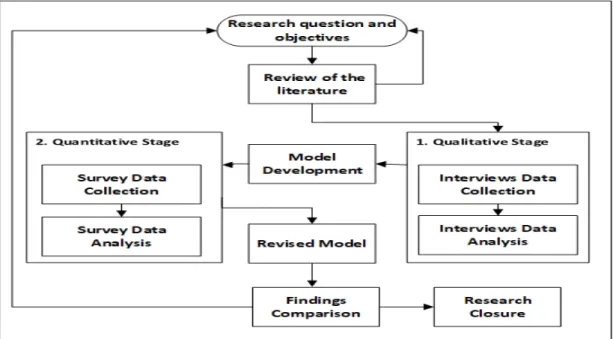
To achieve the research’s objectives the research used a mixed methodology. The first part of conducting the mixed method is a qualitative method of investigation. Semi-structured interviews were conducted with participants from different organisations. The study found three distinct stages of consequences that occur after the initial adoption. These were synthesised into a cohesive model.
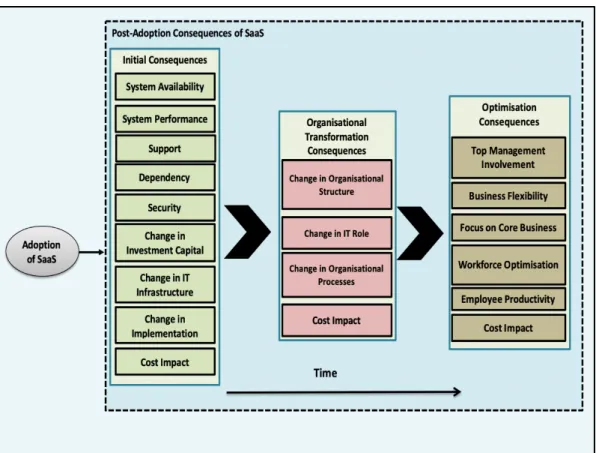
The model consists of (a) Initial Consequences, which are the most immediate changes that occur in the organisation after SaaS adoption and are mostly due to the characteristics of the solution itself. Initial Consequences are System Availability, System Performance, Security, Change in IT Infrastructure, Change in Implementation and Capital Investment Need, Focus on Core Business and Employee Productivity (b) Organisational Transformations, which are the changes the organisation goes through, after a period of time, to transform their business structures, processes and IT roles and operations. Organisational Transformations stage has three consequences that are Change in Organisational Processes, Change in Organisational Structure and Change in IT Department Role, (c) Optimisation Consequences, which are the changes and impacts to the organisation mostly regarding business optimisation. Those consequences are Top Management Involvement, Business Flexibility and Workforce Optimisation.
The second stage of the methodology was a quantitative method of investigation. Based on the emerged model a survey was designed. The main purpose of the survey was to validate the qualitative outcomes and to generalise the findings. The model developed can help organisations to identify and consider the implications of Software-as-a-Service both before and after adoption. The research contributes theoretically and practically to the cloud computing and organisational change research. From the theoretical perspective, the research provides a tested theoretical model describing the post-adoption consequences of Software-as-a-Service on small and medium enterprises in the Saudi Arabian context. On the other hand, the practical perspective, the research provides a set of guidelines for potential adopters of Software-as-a-Service to understand the implications of adoption and implementation on their organisation in the medium term in Saudi Arabia.
Table of Contents
Declaration ... ii
Acknowledgements ... iii
Abstract ... iv
Table of Contents ... vi
List of Tables ... xiv
List of Figures ... xvi
Papers Arising from this Thesis ... 19
Introduction ... 20
1.1 Motivation of the Research ... 20
Why Software-as-a-Service? ... 21
Why Small and Medium Enterprises? ... 23
1.2 Research Aims and Questions ... 24
1.3 Research Methodology ... 24
1.4 Research Contribution and Findings ... 26
1.5 Structure of the Thesis ... 27
Literature Review ... 29
2.1 Background ... 29
Cloud Computing ... 29
Characteristics and Service Models of Cloud Computing ... 32
Cost and Benefits of Cloud Computing ... 35
Software-as-a-Service (SaaS) ... 36
System Performance ... 45
Support ... 47
Security ... 49
Dependency ... 53
Change in IT Infrastructure and Change in Implementation ... 56
Change in Capital Investment ... 58
Changes in Organisational Processes ... 62
Changes in Organisational Structure ... 66
Changes in IT Department Role for an organisation ... 68
Top Management Involvement ... 71
Business Flexibility ... 74
Focus in Core Business ... 78
Employee Productivity and Workforce Optimisation ... 81
2.4 Chapter Summary ... 86
Research Method ... 87
3.1 Research Questions ... 88
3.2 Research Design ... 88
Research Paradigm ... 88
Research Approach and Method ... 90
Mixed Methods ... 91
3.3 Research Process ... 92
Grounded theory ... 99
Data Collection ... 102
Sampling for case studies ... 102
Qualitative Semi-structured interviews ... 104
Reliability and Validity ... 106
Research Analysis ... 108
3.5 Quantitative Stage Design ... 109
Questionnaire Design ... 109
Pre-testing the Questionnaire ... 111
Questionnaire translation ... 112
Survey Analysis Technique ... 113
Survey Data Analysis ... 114
3.6 Research Journey ... 114
3.7 Chapter Summary ... 117
Case Study Findings ... 118
4.1 Consequences relating to Cost ... 120
4.2 Initial Consequences ... 120 System Availability ... 121 System Performance ... 122 Support ... 123 Security ... 124 Dependency ... 126 Change in Implementation ... 128 Changes in IT Infrastructure: ... 129
Change in Organisational Process ... 132
Change in Organisational Structure ... 133
Change in IT Role ... 134
4.4 Optimisation Consequences ... 135
Top Management Involvement ... 135
Business Flexibility ... 136
Focus on Core Business ... 138
Workforce Optimisation ... 139
Employee Productivity ... 140
4.5 Chapter Summary ... 140
Model Relationships ... 142
5.1 Initial Consequences ... 142
System Performance Increases System Availability ... 143
Support enhances System Availability: ... 144
Support increases System Performance: ... 145
Support accelerates Change in IT Infrastructure: ... 146
Change in Implementation Reduces IT Infrastructure: ... 147
Changes in IT Infrastructure increase System Performance: ... 147
Changes in IT infrastructure reduce Capital Investment ... 148
5.2 Organisational Transformation ... 149
Organisation Processes influence Organisational Structure ... 150
Top Management Involvement enhances Employee Productivity: ... 156
Focus on Core Business improves Employee Productivity: ... 157
Focus on Core Business affects Workforce Optimisation: ... 158
5.4 Chapter Summary ... 159
Quantitative Findings ... 160
6.1 Identification of Survey Questions ... 161
6.2 Pre-testing of the Questionnaire ... 162
6.3 Reliability ... 166
System Availability Construct Reliability ... 168
System Performance Construct Reliability ... 168
Support Construct Reliability ... 169
Security Construct Reliability ... 169
Dependency Construct Reliability ... 170
Change in Implementation Construct Reliability ... 170
Change in IT Infrastructure Construct Reliability ... 171
Change in Capital Investment Construct Reliability ... 171
Change in Organisational Processes Construct Reliability ... 172
Change in Organisational Structure Construct Reliability ... 172
Change in IT Role Construct Reliability ... 173
Top Management Involvement Construct Reliability ... 173
Business Flexibility Construct Reliability ... 174
Focus on Core Business Construct Reliability ... 174
Workforce Optimisation Construct Reliability ... 175
System Availability Construct Frequency ... 179
System Performance Construct Frequency ... 180
Support Construct Frequency ... 181
Security Construct Frequency ... 182
Dependency Construct Frequency ... 183
Change in Implementation Construct Frequency ... 184
Change in IT Infrastructure Construct Frequency ... 185
Change in Capital Investment Construct Frequency ... 186
Change in Organisational Processes Construct Frequency ... 187
Change in Organisational Structure Construct Frequency ... 188
Change in IT Role Construct Frequency ... 189
Top Management Involvement Construct Frequency ... 190
Business Flexibility Construct Frequency ... 191
Focus on Core Business Construct Frequency ... 192
Workforce Optimisation Construct Frequency ... 193
Employee Productivity Construct Frequency ... 194
Cost Construct Frequency ... 195
6.5 Items Correlation ... 196
Initial Consequences Correlation table ... 196
Organisational Transformation Correlations ... 197
Optimisation Consequences table ... 198
System Availability ... 206 System Performance ... 209 Support ... 212 Security ... 215 Dependency ... 218 Changes in Implementation ... 222 Changes in IT Infrastructure ... 224
Change in Capital Investment ... 228
Change in Organisational Processes ... 231
Change in Organisational Structure ... 235
Change in IT Role ... 240
Top Management Involvement ... 242
Business Flexibility ... 246
Focus on Core Business ... 249
Workforce Optimisation ... 252
Employee Productivity ... 255
Cost ... 259
7.3 Chapter Summary ... 259
Enfolding of the Literature ... 261
IT Capabilities Model (Garrison, Wakefield & Kim) ... 262
Cloud Computing and Organisational Flexibility (Bharadwaj & Lai) ... 264
Cloud Computing and Entrepreneurship (Ross & Blumenstein) ... 267
Cloud Computing impact on IS Agility (Sawas & Watfa) ... 269
9.1 The essence of the research ... 277
Research Questions ... 279
9.2 Contribution of this research ... 280
9.3 Implications of the Research ... 283
9.4 Limitations of the Research ... 284
9.5 Future Research ... 284
Appendix A: Qualitative Stage Ethical approval (#20007) ... 285
Appendix B: Quantitative Stage Ethical approval (#21481) ... 286
Appendix C: Invitation and Participant Information Sheet ... 287
Appendix D: Participant Consent Form ... 292
Appendix E: Survey’s Questions ... 294
Appendix F: Initial Analysis Codes ... 303
Appendix G: Axial Coding ... 304
Appendix G: Matrix Query ... 305
List of Tables
Table 2-1 Software-as-a-Service Adoption Studies ... 38
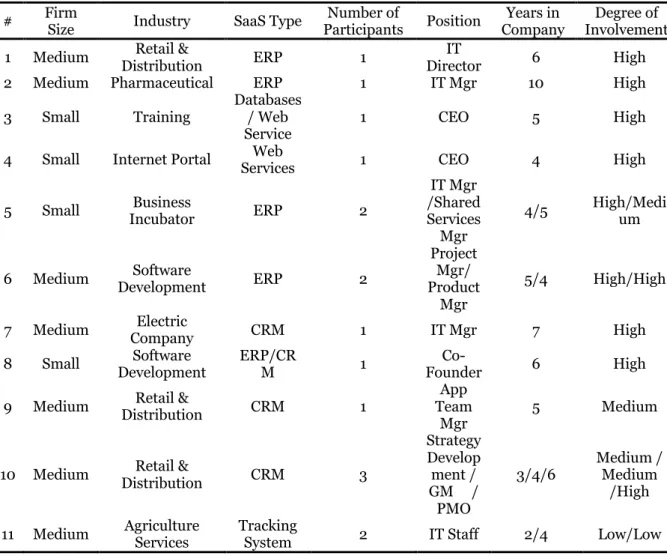
Table 3-1 Sampling ... 103
Table 6-1 Item Used in the Survey for Each Construct ... 162
Table 6-2 Items Reliability, Cronbach Alpha Scores ... 167
Table 6-3 System Availability Construct Reliability ... 168
Table 6-4 System Performance Construct Reliability ... 168
Table 6-5 Support Construct Reliability ... 169
Table 6-6 Security Construct Reliability ... 169
Table 6-7 Dependency Construct Reliability ... 170
Table 6-8 Change in Implementation Construct Reliability ... 170
Table 6-9 Change in IT Infrastructure Construct Reliability ... 171
Table 6-10 Capital Investment Construct Reliability ... 171
Table 6-11 Change in Organisational Processes Construct Reliability ... 172
Table 6-12 Change Structure Organisational Reliability ... 172
Table 6-13 Change in IT Role Construct Reliability ... 173
Table 6-14 Top management Involvement Construct Reliability ... 173
Table 6-15 Business Flexibility Construct Reliability ... 174
Table 6-16 Focus on Core Business Construct Reliability ... 174
Table 6-17 Workforce Optimisation Construct Reliability ... 175
Table 6-18 Employee Productivity Construct Reliability ... 175
Table 6-19 Cost Reliability ... 176 Table 6-20 Distributions of demographic variables gender, age, education, experience, and
Table 6-23 System Performance Construct Mean, Median and Mode ... 180
Table 6-24 Support Construct Mean, Median and Mode ... 181
Table 6-25 Security Construct Mean, Median and Mode ... 182
Table 6-26 Dependency Construct Mean, Median and Mode ... 183
Table 6-27 Change in Implementation Construct Mean, Median and Mode ... 184
Table 6-28 Change in IT Infrastructure Construct Mean, Median and Mode ... 185
Table 6-29 Change in Capital Investment Construct Mean, Median and Mode ... 186
Table 6-30 Change in Processes Construct Mean, Median and Mode ... 187
Table 6-31 Change in Organisational Structure Construct Mean, Median and Mode ... 188
Table 6-32 Change in IT Role Construct Mean, Median and Mode ... 189
Table 6-33 Top Management Involvement Construct Mean, Median and Mode ... 190
Table 6-34 Business Flexibility Construct Mean, Median and Mode ... 191
Table 6-35 Focus on Core Business Construct Mean, Median and Mode ... 192
Table 6-36 Workforce Optimisation Construct Mean, Median and Mode ... 193
Table 6-37 Employee Productivity Construct Mean, Median and Mode ... 194
Table 6-38 Cost Construct Mean, Median and Mode ... 195
Table 6-39 Initial Consequences correlation ... 196
Table 6-40 Organisational Transformation Correlation ... 198
Table 6-41 Optimisation Consequences Correlation ... 198
List of Figures
Figure 2-1 Visual Model of Cloud Computing, Source: Lee, Tang, & Sugumaran 2012, p.2. .... 32
Figure 3-1 Foundations of social research. Sarantakos, 2012, p. 28 ... 89
Figure 3-2 Mixed methods typologies, Source: Plano Clark et al. 2008, p. 1551 ... 91
Figure 3-3 A High-level mixed methods research process plan ... 92
Figure 3-4 Research Plan: theory building process (Eisenhardt 1989) combined with Grounded Theory (Strauss & Corbin 1998) (adapted from (Bruno 2011)) ... 93
Figure 3-5 Iterative coding, Spydnamh 2016, p.1. ... 95
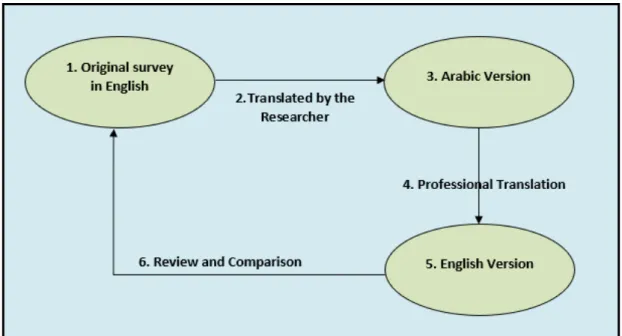
Figure 3-6 Back Translation Process ... 113
Figure 4-1 A Conceptual Framework of Post-Adoption Consequences of SaaS ... 119
Figure 5-1 Initial Consequences Relationship ... 142
Figure 5-2 Organisational Transformation Relationships ... 149
Figure 5-3 Optimisation Consequences Relationships ... 153
Figure 6-1 A Conceptual Framework of Post-Adoption Consequences of SaaS ... 160
Figure 6-2 System Availability Construct Frequency ... 179
Figure 6-3 System Performance Construct Frequency ... 180
Figure 6-4 Support Construct Frequency ... 181
Figure 6-5 Security Construct Frequency ... 182
Figure 6-6 Dependency Construct Frequency ... 183
Figure 6-7 Change in Implementation Construct Frequency ... 184
Figure 6-8 Change in IT Infrastructure Construct Frequency ... 185
Figure 6-9 Change in Capital Investment Construct Frequency ... 186
Figure 6-14 Business Flexibility Construct Frequency ... 191
Figure 6-15 Focus on Core Business Construct Frequency ... 192
Figure 6-16 Workforce Optimisation Construct Frequency ... 193
Figure 6-17 Employee Productivity Construct Frequency ... 194
Figure 6-18 Cost Construct Frequency ... 195
Figure 7-1 The Post-Adoption Consequences of SaaS Framework ... 205
Figure 7-2 System Availability Construct Time Frequency ... 207
Figure 7-3 System Performance Construct Time Frequency ... 210
Figure 7-4 Support Construct Time Frequency ... 213
Figure 7-5 Security Construct Time Frequency ... 216
Figure 7-6 Dependency Construct Time Frequency ... 219
Figure 7-7 Change in Implementation Construct Time Frequency ... 223
Figure 7-8 Change in IT Infrastructure Construct Time Frequency ... 225
Figure 7-9 Change in Capital Investment Construct Time Frequency ... 229
Figure 7-10 Change in Organisational Processes Construct Time Frequency ... 233
Figure 7-11 Change in Organisational Structure Construct Time Frequency ... 237
Figure 7-12 Change in IT Role Construct Time Frequency ... 241
Figure 7-13 Top Management Involvement Construct Time Frequency ... 244
Figure 7-14 Business Flexibility Construct Time Frequency ... 247
Figure 7-15 Focus on Core Business Construct Time Frequency ... 250
Figure 7-16 Workforce Optimisation Construct Time Frequency ... 254
Figure 8-4 Framework for the impact of cloud computing on information systems agility, (Sawas & Watfa 2015) ... 269 Figure 8-5 Model of Socio-Technical Impacts of Software-as-a-Service Usage in Organisations (Jede & Teuteberg 2015) ... 271 Figure 9-1 A Revised Conceptual Framework of Post-Adoption Consequences of SaaS ... 277
Papers Arising from this Thesis
Alshammari, K, Adamopoulos, A & Dick, M 2018, 'Organisational Transformation as a Consequence of Software-as-a-Service Usage by Small and Medium Enterprises.', paper presented to ACIS2018, Sydney,
Introduction
This study is an in-depth investigation of the post-adoption consequences of Software-as-a-Service (SaaS) on Small and Medium Enterprises (SMEs). It investigates the post-adoption consequences of SaaS, such as financial, organisational, managerial and security consequences. It explores the impact of the SaaS service model on SMEs beyond the adoption phase to gain a deeper understanding of its opportunities and drawbacks. Cloud Computing (CC) is a relatively different technological concept and has now been widely adopted by many organisations. There has also been excessive marketing and advertisements that claim CC, and in particular, SaaS services, are the solution for everyone with few costs or drawbacks. Many organisations have rushed to embrace CC services (especially SaaS) with possibly high expectations.
Despite the hype surrounding SaaS technology and its widespread adoption, the consequences of SaaS in organisations, and especially SMEs, has still not been explored in-depth. Relatively few studies have empirically examined the implications of SaaS post-adoption both Saudi Arabia or globally. This study contributes a deeper understanding of the post-adoption consequences of SaaS adoption by SMEs.
1.1 Motivation of the Research
The motivation to undertake this study is to investigate the possible post-adoption consequences of SaaS on SMEs. The need for such an investigation was driven by the emergence of several reasons. First of all, the increasing numbers of businesses that have fully or partially adopted CC, and in particular, SaaS-based services, have not been investigated in depth (El-Gazzar, Hustad & Olsen 2016; Martins et al. 2019).
Second, the lack of empirical studies that show the implications and the consequences of SaaS adoption. There is a lot of existing literature on the cloud and cloud adoption (Alharbi 2014, Alkhater and Wills and Walters, 2014, Alshamaila and Papagiannidis and Li, Low and Chen and Wu, 2011, Gutierrez and Lumsden, 2014, Oliveira and Thomas
However, these studies have focused on the barriers and determinants of cloud adoption, and some of them have investigated the economic impact theoretically. The impact of SaaS on the organisation has not been studied in detail. Therefore, it is essential to explore the real changes brought by SaaS services and investigate the potential post-adoption consequences of SaaS on organisations.
Third, CC is a somewhat different technological concept, and there is a lack of understanding of the impact of CC in the SME context. Marketing and advertisements claim CC, and in particular SaaS, is the solution for everyone, with little costs or drawbacks. Some organisations may have rushed to embrace SaaS services with potentially unrealistic expectations. Thus, introducing practical guidelines on what SMEs might potentially encounter when adopting SaaS services is essential. Also, it could help to assist them in their decision on whether they should or should not adopt SaaS.
Why Software-as-a-Service?
Some computing models have promising capabilities to deliver the vision of utility computing, such as grid computing, cluster computing, and the lately emerged and the most promising, CC (Armbrust et al. 2010; Buyya, Chee Shin & Venugopal 2008). The emergence of CC has transformed the computing world. It has changed the rules and ways of dealing with distributed systems’ soft applications, data storage, and resource services. Thus, due to its many capabilities, shifting organisations’ systems to the cloud has become preferable to running systems on-premises (Low, Chen & Wu 2011).
Plummer et al. (2008) define CC as a style of computing where massively scalable IT-related capabilities are provided as a service using Internet technologies to multiple external customers. According to the National Institute of Standards and Technology (NIST), CC consists of three service models: Infrastructure-as-a-Service (IaaS), Platform-as-a-Service (PaaS) and Software-Platform-as-a-Service (SaaS) and has five essential characteristics; on-demand self-service, broad network access, resource pooling, rapid
However, “at the core of cloud computing is a simple concept: software-as-a-service, or SaaS” (Erdogmus 2009). Generally, the concept of SaaS is about application delivery, which is provided by the cloud service provider instead of installing software on pre-owned computers and servers. The cloud service provider supplies the whole infrastructure and the client connects to the provider’s services via a web portal or third-party middleware. The most common pricing model for licensing and access to the service(s) is pay-per-use (Limbăşan & Rusu 2011). The SaaS model makes it possible for the vendors to deliver the same software instantly to multiple customers at the same time, which enables the providers to charge the subscribers as they use the service (Capachin 2010).
Many studies have been published that investigate CC adoption and implementation. Other studies focus on the factors that affect CC adoption in large, small and medium scale businesses and many theoretical frameworks have been used to describe these factors. Despite the rich literature on the adoption of CC, few studies have looked beyond the adoption phase and how the decision to move to the cloud, affects organisations past the immediate adoption period.
Some studies have investigated and revealed the economic effects of SaaS, which affect whole market structures in many sectors (Bressler & Bressler 2006; Burinskienė & Burinskas 2010; Etro 2009; Gatautis & Vitkauskaite 2008; Shah Alam, Ali & Mohd. Jani 2011; Zafer Acar & Zehir 2010). It has also impacted many businesses, especially small and medium enterprises (SMEs). However, few of these studies have investigated the long-term implications of the adoption.
Other studies have focused on the factors that affect the decision to adopt SaaS in organisations by presenting a range of theoretical frameworks (Alharbi 2014; Alkhater, Wills & Walters 2014; Alshamaila, Papagiannidis & Li 2013; Barth 2015; Ray 2016). These studies have also focused on the determinants and barriers towards the adoption of SaaS. These studies are useful for businesses that are willing to adopt SaaS services (Gutierrez & Lumsden 2014a; Haselmann & Vossen 2011; Low, Chen & Wu 2011; Oliveira, Thomas & Espadanal 2014).
Why Small and Medium Enterprises?
Small and medium enterprises play a crucial role in countries’ economies because they are primary sources of income and employment, they also drive growth and increase innovation. Small and medium enterprises make up more than 99% of businesses across the Organization for Economic Cooperation and Development (OECD) countries (Filipe, Grammatikos & Michala 2016; OECD 2017; Woodward 2009).
Despite the fact that SaaS services are available to everyone, the organisation’s size plays an essential role in the decision to adopt new Information Technology (IT) innovations (Oliveira, Thomas & Espadanal 2014). Large, medium and small businesses are the same in that, SaaS brings more opportunities and helps them roll out new ideas. However, SMEs may see higher benefits from SaaS-based services as it provides them with high-end services and cutting-edge technology with minimal cost and risk (Srinivasan 2013). Some studies have even suggested that SaaS-based services are more relevant to SMEs than other cloud service models (Alshamaila, Papagiannidis & Li 2013; Haselmann & Vossen 2011; van de Weerd, Mangula & Brinkkemper 2016)
This is partly because SMEs are more responsive to rapid changes in technologies. They usually have limited resources and simple IT requirements and need less support compared to large businesses. Many of them are happy to pass IT operations on to a third-party provider, which makes them more flexible and gives them the ability to focus on their core business (Bose & Sugumaran 2008; Taylor, Young & Macaulay 2010; Vijeikis & Makstutis 2009).
Therefore, it is important to explore and understand the implications of adopting the SaaS model, particularly, the ways the SaaS model affects SMEs, as they are major adopters of SaaS-based services and strong economic drivers of economies (Bhardwaj, Jain & Jain 2010; Sultan, N 2010).
1.2 Research Aims and Questions
The research aimed to develop a conceptual model of post-adoption consequences of SaaS on SMEs. It mainly aimed to (a) investigate how the adoption of SaaS changes an organisation’s structure; (b) determine the implications of SaaS adoption on an organisation’s processes; (c) provide a tested theoretical model describing the post-adoption consequences of SaaS on SMEs; and (d) provide a roadmap for potential adopters of SaaS to understand the implications of adoption and implementation on their organisation in the long term.
To achieve the objectives of the research, a primary research question was formulated as follows:
• What are the Post-adoption consequences of Software-as-a-Service (SaaS) on Small and Medium Enterprises (SMEs)?
Also, two secondary questions were proposed to help to answer the primary question of the research:
• How have organisations changed their processes and structure to align with the new system?
• How does timing influence the occurrence of SaaS post-adoption consequences?
1.3 Research Methodology
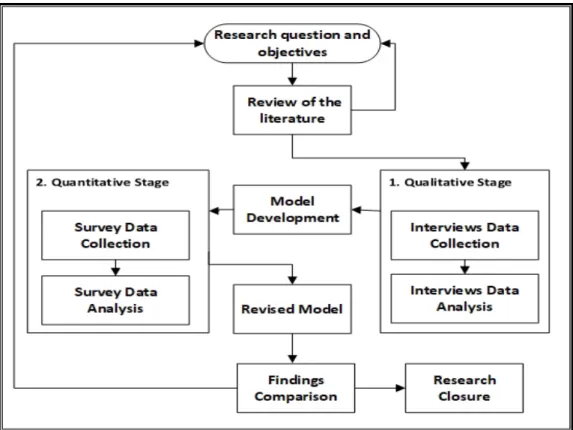
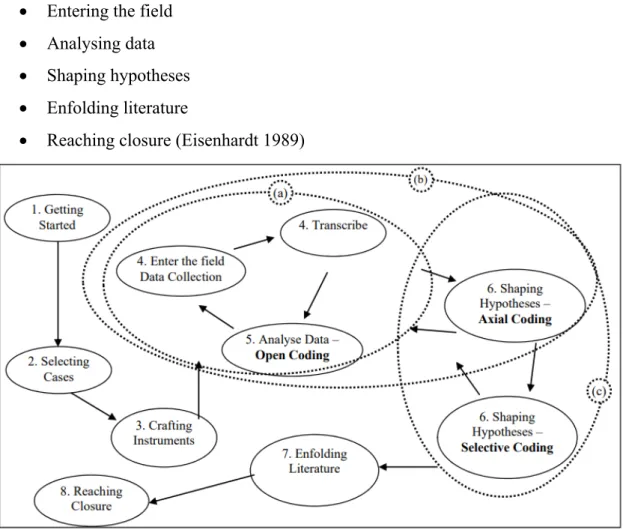
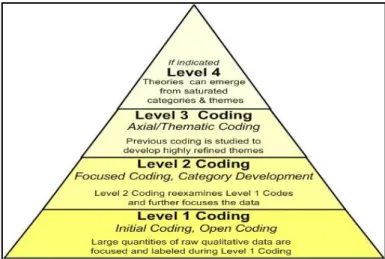
As there is no previous or existing model of post-adoption consequences of SaaS on SMEs and the real situation of SaaS adoption is not well understood, this study was exploratory in nature. Grounded Theory was therefore used in this study as the first stage to understand and describe the real situation of post-adoption consequences of SaaS. A theory was then developed to describe the phenomenon (Strauss and Corbin 1998). Case studies that were recruited for this study were SMEs that had implemented SaaS-based services for at least six months. The interviews were coded using open and axial coding. These codes were then refined and categorised into categories. Then, the categories were
After developing the model, a quantitative approach was used with the use of survey data collected from SMEs that had adopted SaaS-based services. The survey was used to test the model and to generalise the findings. Finally, the findings that emerged from the qualitative and the quantitative data analysis were compared and triangulated with the literature to draw conclusions and to answer the research question.
1.4 Research Contribution and Findings
This study contributes knowledge to the field of SaaS adoption and usage and Information Systems, both theoretically and practically. Theoretically, the research contributes to the field by proposing and validating a conceptual framework for post-adoption consequences of SaaS on SMEs.
This study helps to advance the literature on information systems and SaaS post-adoption by helping academics and practitioners to understand the implications of SaaS adoption and how it may impact the businesses’ processes and structures.
This study is among the first in the field to propose a comprehensive post-adoption consequences framework of SaaS for SMEs. Overall, the revised framework provides an effective tool for practitioners to develop a deeper understanding of the implications of SaaS adoption. Also, it helps to assess the success factors that influence adoption. Another major contribution of this study is the finding that consequences don’t all occur at the same time but there are actually three stages of consequences over time, which has not been discussed previously in other studies. The three stages identified are: Initial Consequences, Organisational Transformation Consequences and Optimisation Consequences.
The Initial Consequences are the immediate impacts that generally occur after adoption of SaaS. This study has identified ten consequences in the initial stage; System Availability, System Performance, Support, Security, Change in Implementation, Change in IT Infrastructure, Capital Investment, Focus on Core Business and Employee Productivity.
Organisational Transformations Consequences are changes that the organisation makes after a period of time, when they realise new possibilities due to changes from the initial consequences. This contribution of this stage is discussed further in the next sub-section. Optimisation Consequences are mostly optimisations to business models such as refocusing on the core business or workforce optimisation. These may occur after organisational transformation or directly after the initial consequences have made an
The framework provides new insights into the timing of post-adoption consequences of SaaS. Organisations should not expect consequences to occur all at once at the same time. They may need to go through a stage of Organisation Transformation to realise the maximum benefits available from SaaS Services. The importance of this contribution is that it can help organisations to assess their expectations of outcomes after adoption.
1.5 Structure of the Thesis
This thesis consists of nine chapters. The remaining chapters are organised in the following manner:
Chapter Two: In this chapter, an extensive review of the literature is provided in the areas of CC, SaaS, the impact of the cloud services on organisations and the literature on the adoption process. An investigation on the areas that SaaS has impacted in other disciplines, such as management and computer science will also be provided. It also discusses and illustrates the need to develop sufficient understanding of post-adoption consequences.
Chapter Three: This chapter describes the research method. It provides an overview of the research paradigm and describes in detail the research method and the rationale for choosing the research method. Insight into the implementation of the research method is presented along with the development of the research instruments, recruiting case studies and sampling, the data collection process, and the data analysis process.
Chapter Four: This chapter reports the findings that emerged from the qualitative data analysis. It also illustrates the analysis process of the qualitative data that was collected from the interviews with the SMEs. Steps and procedures that were undertaken to analyse the interviews data are shown. Then, Grounded Theory techniques, qualitative data analysis software and the coding procedures are discussed.
Chapter Six: This chapter reports the findings that emerged from the quantitative data analysis. It also illustrates the analysis process of the quantitative data that was collected from the surveys. Steps and procedures that were undertaken to analyse the survey data are shown. Then, survey development procedures and quantitative data analysis software are discussed.
Chapter Seven: A discussion is provided on the findings. This chapter has three sections, the first section presents the Post-Adoption Consequences of SaaS Service Framework. The second discusses the findings that have emerged from the qualitative and quantitative stages and compares the two set of findings and reports similarities and differences. The section then compares the findings with the literature.
Chapter Eight: The chapter presents the theory literature enfolding. In this section similar theories from the literature are examined and compared to the study’s framework. The comparison’s findings are then discussed.
Chapter Nine: This chapter summarises this study and shows how the post-adoption consequences of SaaS framework answers the research questions. First, the essence of the theory is explored. Then a discussion on how this theory answers the research questions is presented. The contributions of this current are then highlighted.
Literature Review
This chapter reviews the related literature that is associated with CC and in particular the SaaS service model. As emphasised in the introduction, this study investigates the post-adoption consequences of SaaS on SMEs. The review of the literature is important in order to emphasise the significance and the need for this study.
This chapter is structured as follows. First, an overview of the literature on CC. Then, the chapter will illustrate the status of cloud adoption by SMEs. This will be followed by looking at the literature on cloud adoption. The post-adoption consequences of SaaS are then discussed. Finally, a comprehensive discussion is presented on the post-adoption consequences of SaaS. The identified consequences are going to be discussed and listed based on the emerged model from the qualitative design stage, which was entirely a result of the grounded theory analysis and not influenced by the previous theories or literature.
2.1 Background
In this section, the cloud computing background and its characteristics and service models are discussed. Then the cost and benefits of the cloud are presented along with an overview of Software-as-a-Service delivery model.
Cloud Computing
Cloud computing is an ambiguous technological term. One reason behind the ambiguity is that the cloud can be used in many different applications and scenarios. Another reason is that CC is promoted and hyped up by businesses looking to advertise their selves and therefore applied to product and services that are only marginally related to CC (Qian et al. 2009).
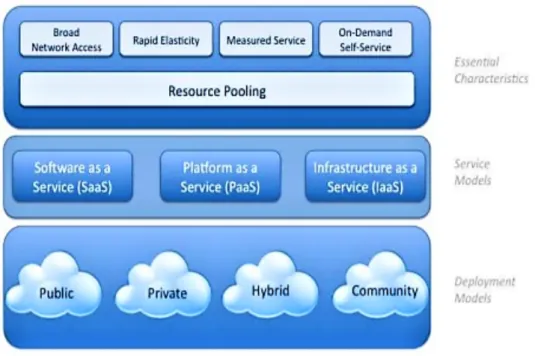
While others prefer to consider CC as a pool of massive scalable, abstracted infrastructure that has the ability and capability to host customers’ applications, which are billed according to their consumption (Erdogmus 2009). Furthermore, Buyya, Chee Shin and Venugopal (2008) define CC as “…a type of parallel and distributed system consisting of a collection of interconnected and virtualised computers that are dynamically provisioned and present as one or more unified computing resources based on service-level agreements established through negotiation between service provider and customer”. While (Wang, L et al. 2010) define CC as “a set of network enabled services, providing scalable, QoS guaranteed, normally personalised, inexpensive computing platforms on demand, which could be accessed in a simple and pervasive way”. Plummer et al. (2008, p. 3) define CC as “a style of computing where massively scalable IT-related capabilities is provided as a service using Internet technologies to multiple external customers”. Plummer’s definition was adopted in this study, as it briefly describes the key features of CC from a service-related angle and takes technical and end-user aspects into account. Taking the definition of the National Institute of Standards and Technology (NIST) into account, CC consists of three service models: IaaS, PaaS, and SaaS. It also has five essential characteristics: on-demand self-service, broad network access, resource pooling, rapid elasticity, measured service (Liu et al. 2011).
Regardless of the many definitions of CC, researchers agree that CC is not a new technological idea (Howie, 2010). There were trials before CC came to its current shape. The first attempt was in 1955. It began by proposing a new approach that tried to provide computing services for public utilities, such as water, electricity, and gas (Parkhill 1966). For about 40 years the endeavours never stopped to achieve such a project. Along the way in the early 90s grid computing attempted to connect supercomputers to take advantage of their capabilities by facilitating access to all organisations that may need them (Foster & Kesselman 2003). These efforts have culminated in CC as we know it today — in terms of providing service models, such as IaaS, SaaS and PaaS.
Whenever an innovation hits the market, businesses are among the first that try to gain the new innovation’s advantages. With regards to CC, for businesses, its services are considered to be the fifth utility, along with electricity, gas, water and the telephone (Buyya, Chee Shin & Venugopal 2008). One of CC’s benefits is its ability to merge itself within new technologies (Polyviou, Pouloudi & Pramatari 2014), such as application and virtualisation (SaaS), with platforms (PaaS), and hardware, networks and other devices (IaaS) (Goscinski & Brock 2010).
The benefits of CC for organisations are quite similar. However, it has provided a new and promising era for SMEs (Haselmann & Vossen 2011). It has been predicted that by 2020, the percentage of American SMEs that will adopt CC will rise to 78% compared to 37% in 2015 (Forbes 2015). By 2020 the projected revenues of cloud computing will exceed $380B compared to $246B in 2017 (Gartner 2017)
There are several studies that have reviewed and classified CC’s overall themes (Asatiani 2015; Géczy, Izumi & Hasida 2012; Low, Chen & Wu 2011). While other studies have focused on specific contexts (Bajenaru 2010; Capachin 2010; Limbăşan & Rusu 2011; Lloret Romero 2012; Yamin & Al Makrami 2015). There have also been several studies on the adoption and implementation of CC (Barth 2015; Nuseibeh 2011; Vidhyalakshmi & Kumar 2016). Together, these studies provide a full picture of CC.
Despite the large amount of literature on CC (Alharbi 2014; Alkhater, Wills & Walters 2014; Alshamaila, Papagiannidis & Li 2013; Barth 2015; Gutierrez & Lumsden 2014b; Low, Chen & Wu 2011; Oliveira, Thomas & Espadanal 2014), there is a lack of studies that look beyond the adoption and implementation phases and how CC changes organisations’ processes.
In summary, CC is where large scalable IT-related capabilities are provided via Internet technologies. Cloud computing is replacing traditional IT and outsourcing with a more flexible approach. Cloud computing technology has three distinct services, IaaS, PaaS
Characteristics and Service Models of Cloud Computing
As with all other technologies, CC has its unique characteristics and varying models (See Figure 2-1). In this section CC’s essential characteristics, its service and deployment models will be presented. According to the NIST, CC has five essential characteristics which are:
Figure 2-1 Visual Model of Cloud Computing, Source: Lee, Tang, & Sugumaran 2012, p.2.
On-demand self-service: A customer can gain computing capabilities, such as server time and storage when needed, with no human interference (Mell & Grance 2011).
Broad network access: Capabilities are accessible and available through the Internet and accessed over standard mechanisms that promote the use of heterogeneous platforms (laptops, mobile phones, tablets, and PCs) (Mell & Grance 2011).
Resource pooling: The provider’s computing properties are shared to serve many consumers, with different physical and virtual resources dynamically assigned and reassigned according to consumer demand. There is a sense of location independence in that the customer generally has no control or knowledge over the exact location of the provided resources but may be able to specify a location at a higher level of abstraction
Rapid elasticity: Capabilities can be elastically provisioned and released, in some cases automatically, to scale outward rapidly and to commensurate inward with demand. To the consumer, the capabilities available for provisioning should be unlimited and can be appropriated in any quantity at any time (Mell & Grance 2011).
Measured service: Cloud systems automatically control and optimise resource use by leveraging a metering capability at some level of abstraction that is appropriate to the type of service (storage, processing, bandwidth, and active user accounts). Resource usage can be monitored, controlled, and reported, providing transparency for both the provider and consumer of the utilised service (Mell & Grance 2011).
These five essential characteristics apply to CC’s three service models which are: SaaS, PaaS, and IaaS. The three service models are illustrated in Figure 2-1.
Software-as-a-Service: provides the end-customer access the providers’ different software applications, which can be accessed through the client’s devices and interface (web browser or email) (Low, Chen & Wu 2011). In this scenario, the client does not have the capability to manage the underlying infrastructure associated with the required services. However, it is possible that the client possesses limited control over specific application configuration settings. The billing method is usually pay-per-use (Mell & Grance 2011).
Platform-as-a-Service: provides the end-customer with capabilities to deploy customer-created or acquired software/applications onto the CC providers’ infrastructure (Mell & Grance 2011). In this scenario, the consumer has access to a range of computers, storage, and databases within a virtualised platform (Low, Chen & Wu 2011).
Infrastructure as a Service: provides an organisation the ability to outsource its supported equipment. However, the cloud provider has the responsibility of providing the organisation with processing, storage, networks, and other fundamental computing resources (Mell & Grance 2011).
Private Cloud: This type of cloud refers to the information technology resources and services, which are owned and held by the organisation that uses them (Orakwue 2010).
Public Cloud: This type of cloud is where the organisation does not own or have the IT-core resources and services on its premises. Instead, it is the provider that owns the resources and provides the services required by the organisation (Hofmann & Woods 2010). The resources and services are not specially tailored to suit the exact need of the organisation as there are many other organisations that have different needs. Thus, organisations must have the flexibility to adjust and align themselves (Géczy, Izumi & Hasida 2012).
Community cloud: This type of cloud is exclusively used by specific communities of customers or organisations that have the same thoughts or share something in common (Mell & Grance 2011).
Hybrid Cloud: This type of cloud is when the cloud infrastructure is a combination of two or more distinct clouds — private, public or community (Mell & Grance 2011). Furthermore, an organisation’s non-critical information and services are outsourced and can be operated by a third-party provider whilst maintaining full control and influence over its critical services and information as they are hosted and operated in-house (Sotomayor et al. 2009). Outsourced services and information can be accessed via the Internet, while critical resources and services are accessed through an internal intranet (Géczy, Izumi & Hasida 2012).
In summary, this section discussed the essential characteristics of CC, the service models and deployment models in greater depth. This section showed that cloud technology has five essential characteristics: on-demand self-service, broad network access, resource pooling, rapid elasticity, measured service. Furthermore, this section presented CC’s four different deployment models: The Private cloud, the Public cloud, the Community cloud, and the Hybrid cloud. Finally, this section also explored CC’s three different service models: IaaS, PaaS, and SaaS.
Cost and Benefits of Cloud Computing
There are many advantages associated with CC. The main and most desired advantages are: satisfying business requirements on demand, improving the efficiency of resource management, lowers costs and energy-saving (Qian et al. 2009). Other researchers claim that easy management, cost reduction, uninterrupted services, and disaster management are among the most attractive advantages of the CC (Idris et al. 2014; Jadeja & Modi 2012).
Many CC advantages have been reported with specific references to cost saving (Garrison, Kim & Wakefield 2012; Jackson & Williams 2011). This is very useful for businesses who have no stable level of demand for their services. This helps to cut their expenditure as they only pay for their exact usage (Duffy 2012). In addition, initial costs that are invested in infrastructure are minimal, which make cloud services even more attractive (Sharon 2012). Another benefit of CC is that customers can enjoy the most advanced protection technologies and procedures available from the cloud providers, which lead to more in-depth experiences and knowledge (Lloret Romero 2012). Agile updating is another benefit of CC. This is where CC providers host the application, and system updates occur smoothly with no maintenance downtime schedule.
However, CC has drawbacks and concerns, which have made some organisations hesitate to adopt cloud services (Gutierrez & Lumsden 2014b). The drawbacks include maturity, downtime, service outage, and performance issues as well (Dutta, Peng & Choudhary 2013; Sharon 2012). Also, a very important disadvantage of CC — which is sometimes discarded when assessing the cloud—is dependency. This situation — where an organisation is completely dependent on the cloud provider — is also known as vendor lock-in (Tsagklis 2013).
In summary, CC technology brings advantages to organisations and individuals that adopt its services. The advantages relate to cost, fast implementation, more in-depth knowledge
Software-as-a-Service (SaaS)
Software-as-a-Service is one of CC’s service models. This model provides the customer with application delivery, instead of installing software on pre-owned computers and servers. The cloud provider provides the whole infrastructure architecture and the client can connect to the provider’s services via a web portal or third-party middleware. Software-as-a-Service facilitates pay-per-use, which is the most common pricing model for license and access (Limbăşan & Rusu 2011). Pay-per-use or subscription pricing models, give the organisations the flexibility to control their expenditures. This is because following such a pricing structure reduces cost and initial investment as there is no need to purchase, install, and maintain complex local servers and computers (Wang, L et al. 2010). Additionally, the SaaS model makes it possible for SaaS providers to deliver the same software instantly to several customers on the same-shared resource at the same time, which enables them to charge customers as they use the service.
The SaaS model makes application implementation more flexible and reduces the cost burden associated with traditional deployments, such as licensing, hardware and software maintenance (Capachin 2010). It offers a variety of services—such as services offered by Google Docs, and Salesforce.com—that grant thousands of users to gain access to the applications (Khan, KM & Malluhi 2010). The SaaS model is useful for specific business needs, such as businesses that benefit from Office360 or Google Docs for office work and file processing, Customer Relationship Management (CRM) offered by Saleforce.com, security through TrendMicro, and electronic financial transactions with PayPal (Chang et al. 2010).
However, there are certain issues associated with SaaS. The first is that customers are not able to configure the software due to customisation limits (Capachin 2010). Off-shelf SaaS applications such as SalesForce.com’s CRM have limited ability to customise the application according to the organisation’s needs (Louridas 2010). SalesForce.com customers have to trust the SaaS provider’s developers to customise their needs because the customer cannot make changes on the application independently (Omondi John, Shawon & Abdulhameed 2014).
Another issue is that it may create distrust between organisations and their clients due to loss of control over the organisation’s resources and information as they are kept under third-party care compared to traditional on-premises resources (Bhardwaj, Jain & Jain 2010). These are just two negative consequences of SaaS; the following sections will explore the positive and negative consequences of the SaaS model.
2.2 SaaS Adoption Studies
There have been many studies that have researched and examined the adoption of cloud computing and SaaS (See Table 2-1). Many theoretical foundations have been used in these studies to constitute their frameworks and models. However, two dominant theories were found to be used extensively: TOE (Technology, Organisation and Environment) and DOI (Diffusion of Innovation). The aim of most of these studies was to produce models to help better understand the factors that influence the adoption of cloud computing.
The main themes that were investigated by these studies were determinants and challenges, such as: factors influencing the adoption process, determinants of SaaS diffusion process, intention to adopt cloud computing services, critical factors affecting the decision to adopt cloud computing, drivers and inhibitors of cloud computing adoption and cloud success factors.
The most cited factors in the studies regarding the adoption of cloud computing were: Security and Privacy (24 papers), Management Support (12 papers) Relative Advantage (12 papers), Normative Pressures (9 papers), Complexity and Cost (7 papers), Flexibility (5 papers), Partner Pressure (5 papers) and Technology Readiness (5 papers).
These studies were conducted in a range of contexts, using different methods and provide valuable insights into the factors that influence the adoption process, including pre-adoption, intentions and decision making. However, few of these studies investigated the
Table 2-1 Software-as-a-Service Adoption Studies
Author (s) Theory Context Method Factors
(Benlian, Koufaris &
Hess 2010) TAM Germany Survey
Customer satisfaction and SaaS continuance intentions SaaS Service Quality (Rapport, Responsiveness, Reliability, Flexibility, Features and Security/ Privacy).
(Benlian & Hess 2011) TRA Germany Survey Perceived RisksSecurity and Managerial), (Performance; Economic; Strategic; Perceived Opportunities (Cost, flexibility, Focus on core competencies and Quality).
(Nuseibeh 2011) TCT,
RDT, DOI -
Literature Review
(Bharadwaj, S & Lal 2012)
DOI, CT, DCT, TAM
India Interviews
perceived usefulness and ease of use, relative advantage, vendor credibility, org. technology orientation
(Park & Ryoo 2013) TFT* Korea Survey Expected BenefitsExpected costs (incumbent IT and breadth use of incumbent (omnipresence and collaboration) IT ).
(Tripathi & Jigeesh 2013)
Conceptua
l -
Literature Review
Security Standardization of API,
Interoperability/Interconnectivity, Customization and Safe Data Storage
(Park & Ryoo 2013) TFT* Korea Survey Expected BenefitsExpected Costs (incumbent IT and breadth use of incumbent (omnipresence and collaboration) IT ).
(Saedi & Iahad 2013) TOE, ANT Malaysia Interviews Human ActorsHumanActors (CC, SMEs, Suppliers, govt., Competitor (managers, Friend, IT specialists), Non-and Business)
(Alshamaila, Papagiannidis & Li 2013)
TOE UK Interviews
relative advantage, risk, compatibility, reach, trialability, firm size, top mgt. support, innovation bias, prior experience, external computing support, industry, market scope, supplier efforts
(Nkhoma, Dang & De
Souza-Daw 2013) TOE
13 Countries
IBM 2012 Survey
Adopter’s style has a significant negative direct impact on the Intention to adopt cloud computing
(Gupta, P, Seetharaman & Raj 2013)
TOE India Survey
Cost Reduction Ease of Use, Convenience, Data Security, Data Privacy.
(Lian, Yen & Wang
2014) TOE, HOT Taiwan Survey
Critical factors affecting the decision to adopt cloud computing data security, perceived technical competence, cost, top manager support, and complexity
(Oliveira, Thomas &
Espadanal 2014) TOE, DOI Portugal Survey
Relative advantage; top management support; complexity; technology readiness; organizational size.
(Polyviou, Pouloudi & Pramatari 2014)
DOI, Mgt.
Fashion Europe Interviews
(Peng & Gala 2014) Conceptua
l India Interviews
Benefits of cloud ERPs (Reduced cost, support, performance, upgrade, mobility). Barriers cloud ERPs
(privacy, security, Vendor lock-in, Integration, organisational challenges) (Omondi John, Shawon & Abdulhameed 2014) Conceptua l USA Survey
The study’s results indicate that a decision to adopt Cloud computing in the enterprise depends on managers’ perception of security, cost-effectiveness, and IT compliance requirements
(Alotaibi 2014) TAM Saudi
Arabia Survey
The study integrated Trust (TR), Anxiety (ANX) and
Perceived Risk (PR) into TAM to determine user acceptance. PU affected by (ANX, PR), PEOU affected by (TR, ANX and PR) and BI affected by (TR and PR)
(Alkhater, Wills & Walters 2014)
TOE, DOI, INT
Saudi
Arabia Interviews
Technological (Availability; Reliability; Security; Privacy; Trust; Relative advantage; Compatibility; Complexity),
Organisational (Top management support; Organisation size; Technology readiness) and Environmental
Author (s) Theory Context Method Factors
(Trinh, Pham & Tran 2015)
TOE, DOI,
PMT -
Literature Review
SaaS Security risk is an important factor to consider in adoption decision
(Prasad & Green
2015) TOE Australia Survey
Strategic and incremental intent, organizational structure and culture, human resource capacity, external factors
(Gangwar, Date & Ramaswamy 2015)
TAM,
TOE India Survey
Technology (Relative advantage, Compatibility and Complexity), Organisation (Organisational competency, Top management support and Training and education).
Environment (Competitive pressure and Trading partner support). Perceived ease of use, and Perceived usefulness ®
Adoption intention
(Gutierrez, Boukrami
& Lumsden 2015) TOE UK Survey
Competitive pressure, complexity, technology readiness and trading partner pressure
(Yang, Z et al. 2015) TAM,
TOE China Survey
Technological readiness (Relative Advantage, Simplicity, Compatibility and Experienceability), Organizational readiness (IT Infrastructure and Management support),
Environmental Readiness (Normative pressures)
(Asatiani 2015) Conceptua
l -
Systemati c Review
Drivers (Cost, Fast implementation, Opportunities for innovation, flexibility, Focus on core competences, Accessibility, Trialability, Relative advantage and Online collaboration), Inhibitors (Security, Performance, Economic and Lock-in), Organization (Management support and Attitudes towards technology), Cloud providers (Provider reputation), External environment (Partner pressure).
(Trinh, Pham & Tran 2015)
TOE, DOI,
PMT -
Literature Review
SaaS Security risk is an important factor to consider in adoption decision
(Martins, Oliveira & Thomas 2016)**
TOE, DOI,
INT Portugal Survey
Determinants affect the intention (relative advantage, complexity, technology competence, top management support, and normative pressures). SaaS adoption (technology competence, coercive pressures, normative pressures, and intention to adopt SaaS), SaaS routinization (top management support, normative pressures, and SaaS adoption)
(Al Isma'ili et al. 2016) TOE, DOI,
ANT Australia Interviews
Adoption influencers: security concerns, cost savings, privacy, geographical restrictions
(Liu, S, Yang & Ran
2016) FIU China Interviews
Value-creating potential of cloud computing comes mainly from flexibility of usage, ubiquity of customer access, and capacity for integration, which create organisational agility
(Kumar, Samalia & Verma 2017)
TAM,
TOE, DOI India Survey
Influential factor to adopt CC (relative advantage, security concerns, top management support, external pressure and service providers’ support)
(Senarathna et al.
2018) TOE, DOI Australia Survey
Factors Influence Adoption of Cloud Computing (Cloud relative advantage, service quality and awareness of cloud)
(Ali, Soar & Shrestha 2018)
TOE, DOI,
DF Australia Interviews
Anticipated benefits (better services, cost reduction, IT infrastructure, access, DR and backup, flexibility, availability, staff optimisation, productivity). Anticipated Risks (ineffective network, security, control over data, data storage, cost, availability of providers, backup, privacy, integration, ignorance of policy-makers, lack of understanding of services, trust; and business transformation).
(Valdebenito &
Quelopana 2019) TOE
Literature Review
Technological Factors (Perceived value, Security concerns, Configurability and customization), Organizational Factors (Organizational readiness, Top management support),
2.3 Consequences of Software-as-a-Service adoption
Cloud computing has become one of the most popular topics in the IT world. It has been predicted that by 2020 the projected revenues of cloud computing will exceed $380B compared to $246B in 2017 (Gartner 2017). This boom in CC was due to the Internet, which enables information to be stored, implemented, and retrieved online as a service to the customers in a pay-per-use manner (Taylor, Young & Macaulay 2010). It is well known that any changes in IT affect the entire market structure of many organisation due to the economic effects (Bressler & Bressler 2006; Burinskienė & Burinskas 2010; Etro 2009; Gatautis & Vitkauskaite 2008; Shah Alam, Ali & Mohd. Jani 2011; Zafer Acar & Zehir 2010). This impact affects all organisations, especially SMEs. The economic effect makes businesses — especially large scale ones — build their own technological capabilities to gain and maintain a competitive advantage by offering value to their customers (Christauskas & Miseviciene 2012).
However, SMEs are more responsive to the rapid changes in technology. Small and medium enterprises usually have simpler IT requirements and need less support compared to large businesses. Also, many of them are happy to pass IT operations to third-party providers, which makes them more flexible and gives them the ability to focus on their core businesses (Bose & Sugumaran 2008; Taylor, Young & Macaulay 2010; Vijeikis & Makstutis 2009).
Small and medium enterprises can benefit from Enterprise Systems (ES)—such as Enterprise Resource Planning (ERP) systems—as these business tools serve to enhance organisational growth (Reuther & Chattopadhyay 2004). However, there is a need to distinguish between financial and non-financial benefits, which may occur when adopting ES in the organisation. Return on investments or cost reduction — or other impacts that affect spending positively — can be considered as financial benefits, whereas, efficiency and organisational effectiveness along with improvement in decision-making processes can be considered as non-financial benefits. Enterprise systems generally make SMEs more responsive to market changes (Gupta, A 2000). Enterprise resource planning systems increase the business’s value and make huge improvements to the business’s
Therefore, ERP systems are essential tools and important to modern businesses that have become empowered with digital tools and information. It is hard for a business to compete if not equipped with such systems. Enterprise systems support business processes and operations thereby making the organisation more flexible and more initiative, so it can compete with other businesses. Enterprise systems can be integrated with the business’s processes, which make the exchange of information and data across the organisation more effective and done in real time. Thus efficiency and effectiveness are associated with ES, which helps organisations to be more flexible and competitive (Stuart, Udechukwu & Al 2010).
Flatter organisational structures and decentralised decision-making are two features that ES promotes. Enterprise systems also enhance information flow, producing accurate information, which leads to various improvements, such as decision-making, improvement in customer service (Madapusi & D'Souza 2012), low inventory level and improved global operations (Beheshti & Beheshti 2010). However, the success of these factors must be assessed, otherwise, organisations will fail to get the full benefits of its adoption (Jha & Saini 2011).
Where, SMEs previously had no ability to obtain such ES to support their operations, with the emergence of cloud services—-such as SaaS—SMEs can now compete with the larger organisations more effectively. SaaS-based services help SMEs to focus more on their core businesses and lower the cost of ownership. Also, it makes it easy for SMEs to choose and select the applications where access is required. Moreover, it gives the SMEs the ability to get access to cutting-edge technologies with no upgrade obligation. Furthermore, it enhances the overall business process and enables SMEs to carry out data transactions along the value chain (Low, Chen & Wu 2011).
It also provides real time benefits and support from the SaaS provider without the need to hire professional staff to maintain the business process or to monitor IT activities. Moreover, cloud ES are faster than traditional ES in terms of implementation as there are
In general, SaaS services has impact on SMEs and there are several consequences that have been identified to have a major impact on adopting SMEs. The identified consequences are going to be discussed in the next section and they are listed based on the emerged model of the qualitative design stage. There are 17 possible consequences that have been identified; System Availability, System Performance, Security, Dependency, Support, Change in IT Infrastructure, Change in Implementation, Capital Investment, Change in Organisational Processes, Change in Organisational Structure, Change in IT Role, Top Management Involvement, Business Flexibility, Focus on Core Business, Workforce Optimisation, Productivity and Cost. Although Cost is one of the consequences, it will not be discussed separately as it pervasive across most of the other consequences. therefore, it will be discussed in relation to other consequences.
It should be noted that there is an alignment between this section of the literature review and the framework which is a key result of this research. This alignment is deliberate and has been used to ensure that the two aspects can be more easily understood in conjunction and also to ensure that the enfolding of the literature and the other research results can take place in an effective manner.
System Availability
The system must be operational all the time to perform business-critical operations with minimal delays or downtimes. By implementing the SaaS model, organisations aim to achieve desired results from the cloud. System availability is among those desired results. The availability of the system is vital for businesses. Srinivasan (2013) stated that SaaS services offer a high level of system reliability and availability. SaaS is capable of allowing users to access the organisation’s services regardless of the platform that they use as long as they have access to the Internet (Iyer & Henderson 2010). Thus, the location of the server is irrelevant in the SaaS model, the employees can work from anywhere even if they are mobile (Saa et al. 2017).
The ability to access the organisation’s services and processes from anywhere and at any time leverages the organisation and its employees with mobility, which is reflected in system availability. The location restrictions that in-house solutions use lead to delays and errors in entering data (Peng & Gala 2014). Also, the inability to check updated data when visiting partners or customers outside the premise. In addition, if an organisation has remote access it could add additional cost with less reliability. Compared to the in-premise solutions, SaaS-based solutions offer employees more flexibility and more accessibility. SaaS based solutions are more practical to solve issues, so information is checked immediately in real time. Therefore, SaaS-based solutions increase mobility accessibility of the system, which contribute to the overall system availability (Peng & Gala 2014).
Studies show that there is a strong connection between implementing the SaaS model and increases in the availability of the organisation’s system. Organisations that adopt the SaaS model gain benefits, such as information visibility and real-time data (Seethamraju 2015). Rupčić and Ivešić (2018) stated that by deploying a SaaS based ERP system, system availability increased. Also, the ability to access to real time information helped employees to perform better as information availability enabled employee empowerment (Davenport 1998).
However, some studies have reported contradictory findings. Sun et al. (2014)) investigated the issue of availability in SaaS-based services. The study cited the issues and challenges that organisations encounter when adopting SaaS-based services. One challenge for SMEs that rely on SaaS-based services is data storage in physical locations. In cloud-based services data can be stored in trans-border servers, which are strictly ruled by the local laws. Therefore, the host country’s laws could limit or affect the availability of the data. Also, the study argued that damage of servers or hard disks or damage from fire could limit the availability of system.