VIDEO AND IMAGE PROCESSING SYSTEM
A THESIS SUBMITTED IN PARTIAL FULFILLMENT OF THE
REQUIREMENTS FOR THE DEGREE OF
Master of Technology
In
VLSI Design and Embedded System
By
Rajeev Kanwar
Roll No: 207EC212
Department of Electronics and Communication Engineering
National Institute of Technology Rourkela
REAL TIME EDGE DETECTION USING SUNDANCE
VIDEO AND IMAGE PROCESSING SYSTEM
A THESIS SUBMITTED IN PARTIAL FULFILLMENT OF THE
REQUIREMENTS FOR THE DEGREE OF
Master of Technology
In
VLSI Design and Embedded System
By
Rajeev Kanwar
Roll No: 207EC212
Under the Guidance of
Asst. Prof. Dr. S.MEHERDepartment of Electronics and Communication Engineering National Institute of Technology
Rourkela 2007-2009
National Institute of Technology
Rourkela
CERTIFICATE
This is to certify that the thesis titled. “Real-Time Edge Detection Using Sundance Video and Image Processing System” submitted by Mr. Rajeev Kanwar in partial fulfillment of the requirements for the award of Master of Technology Degree in Electronics and Communication Engineering with specialization in “VLSI Design And Embe dded System” at the National Institute of Technology, Rourkela (Deemed University) is an
authentic work carried out by him under my supervision and guidance.
To the best of my knowledge, the matter embodied in the thesis has not been submitted to any other University/Institute for the award of any Degree or Diploma.
Date: 25th May, 2009 Dr. S.MEHER Asst. Professor
Dept. of Electronics and Communication Engg. National Institute of Technology
ACKNOWLEDGEMENTS
This project is by far the most significant accomplishment in my life and it would be impossible without people who supported me and believed in me.
I would like to extend my gratitude and my sincere thanks to my honorable, esteemed supervisor Prof. S. Meher, Department of Electronics and Communication Engineering. He is not only a great lecturer with deep vision but also and most importantly a kind person. I sincerely thank for his exemplary guidance and encouragement. His trust and support inspired me in the m ost important moments of making right decisions and I am glad to work with him.
I want to thank all my teachers Prof. G.S. Rath, Prof. G.Panda,Prof. K. K. Mahapatra, Prof. S.K. Patra andfor providing a solid background for my studies and research thereafter. They have been great sources of inspiration to me and I thank them from the bottom of my heart.
I would like to thank all my friends and especially my classmates for all the thoughtful and mind stimulating discussions we had, which prompted us to think beyond the obvious. I’ve enjoyed their companionship so much during my stay at NIT, Rourkela.
I would like to thank all those who made my stay in Rourkela an unforgettable and rewarding experience.
Last but not least I would like to thank my parents, who taught me the value of hard work by their own example. They rendered me enormous support during the whole tenure of my stay in NIT Rourkela.
CONTENTS
Page no.
Abstract i
List of Figure ii
List of Table iii
CHAPTER 1 Introduction 1-10
1.1 Introduction 2
1.2 Literature Review 3
CHAPTER 2 Hardware of Sundance Modules SMT339 11-27
2.1 Introduction 12 2.2 Functional Description 13 2.2.1 Block Diagram 13 2.2.2 Data Flow 14 2.3 Memory Map 16 2.3.1DSP memory map 16
2.3.2 VIRTEX 4 memory map 16
2.4 DSP Unit 16
2.4.1 EMIF peripheral configuration 17
2.4.2 I2C control 17
2.4.3 Flash 18
2.4.4 SDRAM 18
2.5.1 VIRTEX 4 peripherals 19
2.5.2 LED register 19
2.5.3 Comports 19
2.6 Video Encoder and Decoder 20
2.6.1 Video Encoder/Decoder 20
2.6.2 Video encoder register 20
2.6.3 Video Decoder register 21
2.7 High Speed Nt (ZBT) Memory 22
2.8 SLB Interface 22
2.9 Video Ports Others Module 23
2.9.1 Video encoder setup 23
2.9.2 Video Memory 24
2.9.3 EDMA 24
2.9.4 RGB656 single bank EDMA setup 24
2.9.5 RGB656 with embedded sync EDMA setup 25
2.9.6 JTAG 25
2.9.7 Cabels and connectors 25
2.10 Power Consumptions 26
2.11 The Software Supporting Role 26
CHAPTER 3 Edge Detection Techniques Using Sundance Module 28-61 3.1 Introduction to Fundamentals of Edge Detection 29
3.3 Edge Detection 33
3.4 The Four Step of Edge Detection 35
3.5 Edge Detection Using Derivatives 36
3.6 Edge Detection Using Gradient 38
3.6.1 Definition of the gradient 38
3.6.2 Properties of the gradient 39
3.6.3 Estimating the gradient with finite differences 39
3.7 Different Type of Edge Detector 40
3.7.1 Sobel edge detector 41
3.7.2 Prewitt Edge Detector 46
3.7.3 Canny Edge Detector 48
3.7.4 Laplacian of Gaussian 58
CHAPTER 4 Result and Discussions 62-66 4.1 Result of the different operator 63
4.2 comparison and discussion 65 CHAPTER 5 Conclusions and scope of Future work 67-69 6.1 Conclusion 68 6.2 Future Work 68 References 70
LIST OF FIGURE
Figure No. Figure Title Page No.
Figure 2.1 Block Diagram for SMT339 13
Figure 2.2 Data flow diagram 14
Figure2.3 Flow from Video Memory to Encoder 23
Figure 2.4 Video Memory organisation in YCbCr output mode 24
Figure2.5 RGB565 organisation of the video memory 24
Figure3.1 Following signal apply to the edge detector 30
Figure3.2 The gradient first derivative signal 30
Figure3.3 The gradient second derivative signal 31
Figure3.4 Example of different types of edges 32
Figure3.5 Edge Detection Using Derivatives 36
Figure3.6 The edge direction is rotated with respect to the gradient direction 39
by -90 degrees Figure3.7 Sobel convolution kernels 40
Figure3.8 Pseudo-convolution kernels used to quickly compute approximate 41
gradient magnitude Figure3.9 Sobel Explanation how to get output b22 42
Figure3.10 Proposed architecture for sobel edge detection operator. 44
Figure3.11 Masks for the Prewitt gradient edge detector. 46
Figure3.12 Result of Sobel and Prewitt Operator 47
Figure3.13 Discrete Approximation to Gaussian function with σ=1.4 49
Figure3.14 The Sobel operator uses a pair of 3x3 convolution mas 49
Figure3.15 The Orientation Angle is Found to be 3 Degrees 51
Figure3.16 Block diagram implementation of Canny algorithm 53
Figure 3.18: Hardware implementation of symmetric separable 2D filter 55 Figure 3.19: Determine orientation of gradient in the nonmaximal suppression 55
stage
Figure 3.20: Edge strength classification map 56
Figure 3.21: Result of Canny Operator 57 Figure 3.22: Three commonly used discrete approximations to the Laplacian 58
filter.
Figure 3.23: The 2-D Laplacian of Gaussian (LoG) function. The x and y axes 59 are marked in standard deviations (σ)
Figure 3.24: Discrete approximation to LoG function with Gaussian σ = 1.4 59 Figure 3.25: Response of 1-D LoG filter to a step edge 60 Figure 3.26: Result of Laplacian operator 61
LIST OF TABLES
Table No. Table Title Page No.
Table 2.1 DSP Memory Map Description 16
Table 2.2 Virtex 4 Internal Peripherals Memory Map Description 16
Table 2.3 EMIF Configurations. 17
Table 2.4 I2C CONTROL 17
Table 2.5 Shows the GPIO pins values and associated memory access areas. 18
Table 2.6 Virtex 4 LED Register bit Definitions 19
Table 2.7 Virtex 4, Video Encoder Register 20
Table 2.8 Virtex 4, Video Decoder Register 21
Table 2.9 Video Port 0 and Decoder connectivity 21
Table 2.10 Video Port 0 and Decoder Clock connectivity 22
Table 2.11 Video Port 0 Decoder Data to Video Port Data Mapping 22
Table 2.12 JP5 Virtex JTAG Header 25
Table 2.13 JP7 Connector 26
Table 3.1 shows the implementation complexity of the different class of filters 54 as a function of number of multiplication operations
ABSTRACT
Edge detection from images is one of the most important concerns in digital image and video processing. With development in technology, edge detection has been greatly benefited and new avenues for research opened up, one such field being the real time video and image processing whose applications have allowed other digital image and video processing. It consists of the implementation of various image processing algorithms like edge detection using sobel, prewitt, canny and laplacian etc. A different technique is reported to increase the performance of the edge detection. The algorithmic computations in real-time may have high level of time based complexity and hence the use of Sundance Module Video and Image processing system for the implementation of such algorithms is proposed here. In this module is based on the Sundance module SMT339 processor is a dedicated high speed image processing module for use in a wide range of image analysis systems. This processor is combination of the DSP and FPGA processor. The image processing engine is based upon the „Texas Instruments‟ TMS320DM642 Video Digital Signal Processor. And A powerful Vitrex-4 FPGA (XC4VFX60-10) is used onboard as the FPGA processing unit for image data. It is observed that techniques which follow the stage process of detection of noise and filtering of noisy pixels achieve better performance than others. In this thesis such schemes of sobel, prewitt, ca nny and laplacian detector are proposed.
Chapter 1
National Institute Of Technology Rourkela Page 2
1.1 INTRODUCTION
Digital image processing is an ever expanding and dynamic area with applications reaching out into our everyday life such as in medicine, space exploration, surveillance, authentication, automated industry inspection and in many more areas.
Applications such as these involve different processes like image enhancement, and object detection. Implementing such applications on a generable purpose computer can be easier but not very efficient in terms of speed. The reason being the additional constraints put on memory and other peripheral device management. Application specific hardware offers much greater speed than a software implementation.
There are two types of technologies available for hardware design. Full custom hardware design also called as Application Specific Integrated Circuits (ASIC) and semi custom hardware device, which are programmable devices like Digital signal processors (DSP‟s) and Field Programmable Gate Arrays (FPGA‟s).
Full custom ASIC design offers highest performance, but the complexity and the cost associated with the design is very high. The ASIC design cannot be changed; time taken to design the hardware is also very high. ASIC designs are used in high volume commercial applications. In addition, if an error exist in the hardware design, once the design is fabricated, the product goes useless.
DSP‟s are a class of hardware devices that fall somewhere between an ASIC and a PC in terms of the performance and the design complexity. DSP‟s are specialized microprocessor, typically programmed in C, perhaps with assembly code for performance. It is well suited to extremely complex math intensive tasks such as image processing. Hardware design knowledge is still required, but the learning curve is much lower than some other design choices.
Field Programmable Gate Arrays are programmable devices. They are also called reconfigurable devices. Reconfigurable devices are processors which can be programmed with a design, and the design can be by reprogramming the devices. Hardware design techniques such as parallelism and pipelining techniques can be developed on a FPGA,
REAL TIME EDGE DETECTION USING SUNDANCE VIDEO AND IMAGE PROCESSING SYSTEM
National Institute Of Technology Rourkela Page 3
which is not possible in dedicated DSP designs. So FPGAs are ideal choice for implementation of real time image processing algorithms.
FPGAs have traditionally been configured by hardware engineers using a Hardware Design Language (HDL). The principal languages being used are VHDL.VHDL are specialized design techniques that are not immediately accessible to software engineers, who have often been trained using imperative programming languages. Consequently, over the last few years there have been several attempts at translating algorithmic oriented programming languages directly into hardware descriptions. The combination of FPGA AND DSP processors description language by Sundance module SMT339, allows thedesigner to focus more on the specification of an algorithm rather than adopting a structural approach to coding. For these reasons the used for implementation of image processing algorithms on FPGA. The SMT339 provides video input and video output using the TMS320DM642 from Texas Instruments. The hardware is extremely flexible but that comes at the price of enormous complexity. It can take a long time to determine values for all the relevant registers of the numerous components in the processor; a slight error can result in bizarre effects ranging from no input or output at all to strangely corrupted images.
The goal of this thesis is to implement image processing algorithms like convolution and different edge detectors like a Sobel, Prewitt, Canny and Laplacian edge detection through Sundance module and compare against the performance of different detector.
Chapter two provides information on the hardware Sundance module SMT339 and prior related work. Chapter three describes the edge detection algorithms. Chapter four provides the result and discussion. Chapter five summaries the results and future work.
1.2 LITRATURE REVIEW
In this section, work done in the area of edge detection is reviewed and focus has been made on detecting the edges of the digital images. Edge detection is a problem of fundamental importance in image analysis. In typical images, edges characterize object boundaries and are therefore useful for segmentation, registration, and identification of objects in a scene. Edge detection of an image reduces significantly the amount of data and
National Institute Of Technology Rourkela Page 4 filters out information that may be regarded as less relevant, preserving the important structural properties of an image.
A theory of edge detection is presented. The analysis proceeds in two parts. (1)Intensity changes, which occur in a natural image over a wide range of scales, are detected separately at different scales. An appropriate filter for this purpose at a given scale is found to be the second derivative of a Gaussian, and provided some simple conditions are satisfied, these primary filters need not be orientation-dependent. Thus, intensity changes at a given scale are best detected by finding the zero values of for image. The intensity changes thus discovered in each of the channels are then represented by oriented primitives called zero-crossing segments. (2) Intensity changes in images arise from surface discontinuities or from reflectance or illumination boundaries, and these all have the property that they are spatially localized. Because of this, the zero-crossing segments from the different channels are not independent, and rules are deduced for combining them into a description of the image. This description is called the raw primal sketch. The theory explains several basic psychophysical findings, and the operation of forming oriented zero-crossing segments from the output of centre-surround filters acting on the image forms the basis for a physiological model of simple cells.
Due to the large amount of literature on edge detection, I do not intend this to be a comprehensive literature survey. However, in the following paragraphs, mention some important works on edge detection and compare results to these methods. Unlike all the other methods have encountered, the step expansion filter is based on template matching, and specifically on the novel method of matching using non orthogonal expansion. The step expansion filter is optimal in the sense of SNR, since Expansion Matching in general is an optimal SNR template matching method. Other methods follow the approach of defining a specific set of criteria for the given edge model, and optimizing them, in most cases using numerical methods. In contrast, the Expansion Matching approach is analytical, and is generalized so that it easily yields the optimal SNR operator for any desired edge model.
Many works have been performed on obtaining an edge detection operator. Most noted amongst these is the work of Canny [1] who showed that the ideal operator that
REAL TIME EDGE DETECTION USING SUNDANCE VIDEO AND IMAGE PROCESSING SYSTEM
National Institute Of Technology Rourkela Page 5
maximizes the conventional signal-to-noise ratio in detecting a particular edge is correlation with the same edge model itself. However, this detection is not well localized and requires an additional localization criterion. A third criterion that suppresses multiple responses was also included and numerical optimization resulted in the desired edge detector. Canny‟s edge detector for step edges is well approximated by the Derivative of Gaussian mask. In contrast, our edge detector formulation is based on the fact that SNR implicitly defines all the desired properties of good detection and localization (sharp peak, good localization and minimal off-center response), and thus given an edge model, the optimal SNR filter for this model also results in a good edge detector. While Canny [1] worked with finite extent filters. Deriche [2] used the same approach with infinite extent filters, with the objective of obtaining an efficient recursive implementation. The resulting operator has the form of an even, exponentially damped sinusoid and is different from our Step Expansion Filter. Furthermore, the step expansion filter is also infinite in width, and has an efficient recursive implementation as well.
Another work using infinite width filters is due to Sarkar and Boyer [3], [4]. In this work, Canny‟s signal-to-noise ratio and localization criterion, along with another criterion for spurious response are optimized using the variational approach and nonlinear constrained optimization. A recursive approximation to these filters is also presented. A comprehensive set of results with different values of the Multiple Response Criterion (MRC) reveals that for some values of the MRC, the filters are somewhat similar in appearance to our Step Expansion Filter. Spacek [5] combined all three of Canny‟s criteria into one performance measure and simplified the differential equation that yields the optimal filter. To yield the actual optimal filter, he fixed two of the six parameters involved and determined the remaining four using boundary conditions. The work of Petrou and Kittler [6] extends Spacek‟s works for ramp edges.
Shen, Castan, and Zhao [7], [8] present as an optimal operator for edge detection, an exponential filter. Analytically, this exponential filter is equivalent to the integral of the Step Expansion Filter that we present. Unlike Shen eral use Expansion Matching and optimize the SNR criterion, and obtain an exact analytical relationship between the variance of the expected input noise, and the width (decay parameter in the exponential term) of our Filter.
National Institute Of Technology Rourkela Page 6 On the other hand, Shen and Castan [7] desire to: a) minimize the energy in the desired filter‟s response to noise, b) minimize the energy in the derivative of the above noisy response, and c) maximize the energy of the peak center response to the step edge. Unlike the SNR, these criteria do not consider the off-center response of the filter to the template (in this case the step edge model) as undesired noise. Also, their work does not address the problem of determining an appropriate detector width for a given input noise. Our approach also offers a general method for easily designing optimal SNR detectors for any edge model, not only step edges, and can also easily incorporate colored noise models. Another important point is that the edge maps generated by the two methods are not identical, since we detect the peaks of the filter output, whereas Shen and Castan obtain the zero crossings of the output of their exponential filter. The fundamental difference here is that while the step expansion filter and the exponential filter are related by a simple integral equation, detecting the peaks of the step expansion filter output in a white noise environment (as per our analytical model) is not equivalent to detecting the zero crossings of in a white noise environment (as Shen and Castan propose) since the noise model undergoes a change (actually becomes more colored and low pass) due to the integration. A more detailed discussion of this point can be found in the work of Sarkar and Boyer [3].
Modestino and Fries [9] suggest to use the Laplacian of an image in order to detect edges. In their work they use random fields, and cast the problem as one of obtaining the minimum mean squared error estimate of the true Laplacian of the actual input image from a given noisy input image. This obviously results in the Wiener filter of the Laplacian as the optimal filter. Modestino and Fries do not use this filter itself, but instead use a spatial frequency weighted version of the Laplacian (basically a Gaussian low-pass spatial filter) to avoid difficulties in the digital implementation of the optimum Wiener filter. Furthermore, their work is concentrated on realizing this filter using a recursive implementation. Note that their Wiener filter has no connection to the SNR optimization that we perform. The Wiener restoration filter use is based on regarding the given edge model as a blurring function, which has been shown to be an efficient and regularized implementation of the nonorthogonal expansion for matching [10].
REAL TIME EDGE DETECTION USING SUNDANCE VIDEO AND IMAGE PROCESSING SYSTEM
National Institute Of Technology Rourkela Page 7
Other ideas in the field of edge detection include the work of Dickley er al. [11] who obtained the spherical wave function as their ideal filter, based on the definition of an edge as a step discontinuity between regions of uniform intensity. Another significant work is that of Marr and Hildreth [12] who suggested the isotropic Laplacian of Gaussian mask on the image and identified the resulting zero-crossings as the edges of the image. A numerical method using interpolated data proposed by Haralick [13] involved locating edges as the zerocrossings of the second directional derivative in the direction of the gradient. A surface-fitting approach was used by Nalwa and Binford [14] wherein, at each point, the edge detector performs a best- fit of surfaces within a localized window, i.e., least squared error with minimal number of parameters.
A lot of the attention is focused to edge detection, being a crucial part in most of the algorithms. Classically, the first stage of edge detection (e.g. the gradient operator, Robert operator, the Sobel operator, the Prewitt operator) is the evaluation of derivatives of the image intensity. Smoothing filter and surface fitting are used as regularization techniques to make differentiation more immune to noise.
Raman Maini and J. S. Sobel [15] evaluated the performance of the Prewitt edge detector for noisy image and demonstrated that the Prewitt edge detector works quite well for digital image corrupted with Poisson noise whereas its performance decreases sharply for other kind of noise.
Davis, L. S. [16] has suggested Gaussian preconvolution for this purpose. However, all the Gaussian and Gaussian- like smoothing filters, while smoothing out the noise, also remove genuine high frequency edge features, degrade localization and degrade the detection of low- contrast edges. The classical operators emphasize the high frequency components in the image and therefore act poorly in cases of moderate low SNR and/or low spatial resolution of the imaging device. The awareness of this has lead to new approaches in which balanced trade-offs between noise suppression, image deblurring and the ability to resolve interfering edges, altogether resulting in operators acting like band-pass filters e.g. Canny. Sharifi, M. et al. [17] introduces a new classification of most important and commonly used edge detection algorithms, namely ISEF, Canny, Marr-Hildreth, Sobel, Kirch and Laplacian. They discussed the advantages and disadvantages of these algorithms.
National Institute Of Technology Rourkela Page 8 Shin, M.C et al. [18] presented an evaluation of edge detector performance using a structure from motion task. They found that the Canny detector had the best test performance and the best robustness in convergence and is one of the faster executing detectors. It performs the best for the task of structure from motion. This conclusion is similar to that reached by Heath et al. [20] in the context of human visual edge rating experiment.
Rital, S. et al. [19] proposed a new algorithm of edge detection based on properties of hyper graph theory and showed this algorithm is accurate, robust on both synthetic and real image corrupted by noise. Li Dong Zhang and Du Yan Bi [21] presented an edge detection algorithm that the gradient image is segmented in two orthogonal orientations and local maxima are derived from the section curves. They showed that this algorithm can improve the edge resolution and insensitivity to noise.
Zhao Yu-qian et al. [22] proposed a novel mathematic morphological algorithm to detect lungs CT medical image edge. They showed that this algorithm is more efficient for medical image denoising and edge detecting than the usually used template-based edge detection algorithms such as Laplacian of Gaussian operator and Sobel edge detector, and general morphological edge detection algorithm such as morphological gradient operation and dilation residue edge detector.
Fesharaki, M.N.and Hellestrand, G.R [23] presented a new edge detection algorithm based on a statistical approach using the student t-test. They selected a 5x5 window and partitioned into eight different orientations in order to detect edges. One of the partitioning matched with the direction of the edge in the image s hows the highest values for the defined statistic in that algorithm. They show that this method suppresses noise significantly with preserving edges without a prior knowledge about the power of noise in the image.
Lim [25] defines an edge in an image as a boundary or contour at which a significant change occurs in some physical aspect of the image. Edge detection is a method as significant as thresholding. A survey of the differences between particular edge detectors is presented by Schowengerdt [26]. Four different edge detector operators are examined and it is shown that the Sobel edge detector provides very thick and sometimes very inaccurate
REAL TIME EDGE DETECTION USING SUNDANCE VIDEO AND IMAGE PROCESSING SYSTEM
National Institute Of Technology Rourkela Page 9
edges, especially when applied to noisy images. The LoG operator provides slightly better results.
Edges can be detected in many ways such as Laplacian Roberts, Sobel and gradient [27]. In both intensity and color, linear operators can detect edges through the use of masks that represent the „ideal‟ edge steps in various directions. They can also detect lines and curves in much the same way.
Traditional edge detectors were based on a rather small 3x3 neighborhood, which only examined each pixel‟s nearest neighbor. This may work well but due to the size of the neighborhood that is being examined, there are limitations to the accuracy of the final edge. These local neighborhoods will only detect local discontinuities, and it is possible that this may cause „false‟ edges to be extracted. „A more powerful approach is to use a set of first or second difference operators based on neighborhoods having a range of sizes (e.g. increasing by factors of 2) and combine their outputs, so that discontinuities can be detected at many different scales‟ [28]. Usually, gradient operators, Laplacian operators, and zero-crossing operators are used for edge detection. The gradient operators compute some quantity related to the magnitude of the slope of the underlying image gray tone intensity surface of which the observed image pixel values are noisy discretized samples. The Laplacian operators compute some quantity related to the Laplacian of the underlying image gray tone intensity surface. The zero-crossing operators determine whether or not the digital Laplacian or the estimated second direction derivative has a zero-crossing within the pixel. There are many ways to perform edge detection. However, the most may be grouped into three categories, gradient (Approximations of the first derivative), Laplacian (Zero crossing detectors) and Image approximation algorithms. Edge detectors based on gradient concept are the Roberts [29], Prewit and Sobel [30] show the effect of these filters on the sensing images. The major drawback of such an operator in segmentation is the fact that determining the actual location of the edge, slope turn overs point, is difficult. A more effective operator is the Laplacian, which uses the second derivative in determining the edge.
The design of edge detectors is work deals not with the design of an edge detector, but rather the methodology for comparing edge detectors. The comparison was done by Abdou and
National Institute Of Technology Rourkela Page 10 Pratt [31]. This was followed by work by Fram and Deutsch [32], Peli and Malah [33], and more recently, Ramesh and Haralick [34]. The emphasis in this line of work has been to characterize the edge detector based on local signal considerations. The typical quantitative measures have been the probability of false alarms, probability of missed edges, errors of estimation in the edge angle, localization errors, and the tolerance to distorted edges, corners, and junctions.
The use of human judges to rate image outputs must be approached systematically. Experiments must be designed and conducted carefully, and results must be interpreted with the appropriate statistical tools. The use of statistical analysis in vision system performance characterization has been rare. The only prior work in the area that we are aware of is that of Nair et al. [35], who used statistical ranking procedures to compare neural network-based object recognition systems. In a related work, in 1975 Fram and Deutsch [32] used human subjects to judge the discriminability of certain synthetic edge signatures. These results were then compared with the edge detectors available at that time. The focus was on human versus machine performance rather than using human ratings to compare different edge detectors.
There are numerous other works that describe edge detection techniques approaches. However, I do not mention any here, since my work is aimed at using the edge detection criterion to formulate an edge detector for a given edge model and compare our results to the different edge detector.
Chapter 2
Hardware of Sundance
Modules SMT339
National Institute Of Technology Rourkela Page 12
2.1 INTRODUCTION
The SMT339 is a dedicated high speed image processing module for use in a wide range of image analysis systems. The module can be plugged into a standard TIM single width slot and can be accessed by either a standard Comport, or Rocket Serial Link (RSL) Interface.
The image processing engine is based upon the „Texas Instruments‟ TMS320DM642 [36] Video Digital Signal Processor. It is fully software compatible with C64x using Code Composer Studio.
The DM642 [38] runs at a clock rate of 720MHz. It features two level cache based
architecture. There are 16K Bytes of level one program cache (Direct mapped), 16K Bytes of level one data cache (2-Way Set-Associative) and 256K Bytes of level two cache that is
shared program and data space (Flexible RAM/Cache Allocation). The DM642 can perform
4, 16 x 16 Multiplies or 8, 8 x 8 Multiplies per clock cycle.
A powerful Vitrex-4 FPGA (XC4VFX60-10)[37] is used onboard as the FPGA processing unit for image data. 8 Mbytes of ZBT SRAM is provided as a FPGA memory resource. Processing functions such as Colour Space Conversion (CSC), Discrete Cosine Transforms (DCT), Fast Fourier Transforms (FFT) and convolution can be implemented, without using any of the DSP‟s resources.
If required, the Virtex 4 has 2 Power PC hardware cores that can be incorporated into the system design. The Module features a single „Philips Semiconductors‟ SAA7109AE/108AE video decoder/encoder [37] that accept most PAL and NTSC standards, and can output processed images in PAL/NTSC or VGA (1280x1024, or HD TV Y/Pb/Pr) The DM642 has 128 Mbytes of high speed SDRAM (Micron MT48LC64M32F2S5) available onboard for image processing and an 8Mbytes FLASH device is fitted to store programs and FPGA configuration information. The module supports a full Sundance LVDS Bus (SLB) interface for use with mezzanine cards providing the flexibility for other image formats to be accepted and other output formats to be generated.
REAL TIME EDGE DETECTION USING SUNDANCE VIDEO AND IMAGE PROCESSING SYSTEM
National Institute Of Technology Rourkela Page 13
2.2 FUNCTIONAL DESCRIPTION
The basic block diagram of the SMT339 and its components is illustrated in Figure 1.
2.2.1 BLOCK DIAGRAM
\
Figure 2.1: Block Diagram for S MT339
The Texas Instruments Module (TIM) form- factor SMT339 is mounted on a carrier that might be PCI, PCI-X, VME, Compact- PCI, or even stand-alone. The carrier provides a home and power to the module and usually an inte rface to a host computer. A variety of analog video formats can be connected to the system through its video decoder. Alternatively, a range of digital video sources may be connected to the appropriate I/O daughtercard. The input sources are routed to the FPGA, which is a 60,000-logic-cell Xilinx® Virtex™-4 FX60 device. The data can be preprocessed here before passing to the DSP. The FPGA has two independent 8-MB banks of ZBTRAM, which are ideal for frame stores for the various pre- and post-processing functions performed on the FPGA. The DSP is a Texas Instruments TMS320DM642 video digital signal processor. You can program it using Texas Instruments‟s Code Composer Studio, which is fully software-compatible with
National Institute Of Technology Rourkela Page 14 the C64x DSP range. Clocked at 720 MHz, it is capable of 5.76 GMACs per second and is linked to the FPGA by three bidirectional video ports, with more ports for control and other data. All of the illustrated interconnections are already implemented in the FPGA, leaving you free to implement the specific functions required for your application. The DSP also comes with 128 MB of fast SDRAM. This 64-bit-wide memory holds the image buffers for the DSP and program/data space. There is an output from the FPGA to a video encoder so that a live image (raw, part, or fully processed) can be displayed directly on a monitor – which is particularly useful when developing algorithms. Digital output may be obtained from the appropriate I/O daughtercard attached to the Sundance LVDS bus (SLB)[39] interface or from high-speed serial links: connectivity to and from other modules is provided by 16 Xilinx RocketIO™ channels in the form of four Sundance rocket serial links (RSLs), giving the system significant expandability.
2.2.2 DATA FLOW
Figure 2.2 : DATA FLOW DIAGRAM
This is shows how the image data flows through the hardware resources when configured for our person-tracking imaging system. Video is captured by the video decoder
REAL TIME EDGE DETECTION USING SUNDANCE VIDEO AND IMAGE PROCESSING SYSTEM
National Institute Of Technology Rourkela Page 15
and fed to the FPGA. The decoder can handle a variety of different input formats from PAL/NTSC CVBS or separate YC. Alternatively, you can input digital video through a daughter card digital interface module. The FPGA pre-processes the incoming video stream using one of the ZBTRAM banks as an image buffer. A slow- moving reference image is maintained by iterating each pixel by one bit per frame towards its value on the current image. The current image is compared with the reference image to calculate a difference image. A great feature of this system, with its large and powerful FPGA, is that it is very easy to experiment with different preprocessors like spatial filters, edge enhancement filters, or histogram functions – and see the results immediately on the system‟s live output. The calculated difference image, together with the current image, is passed to the DSP for analysis. The DSP performs a detection algorithm on the difference image, extracting the silhouette and looking for the characteristic shape of a person in the moving parts of t he image.
Various properties of a person detected in the field of view can then be calculated from this, such as:
• The coordinates of the corners of a region of interest around the person • The center point (calculated as the mid-point of the region‟s corners) • Their center of gravity (based on the center of the area of their silhouette)
• The coordinates of their entire outline (possibly returned in a binary overlay image of the scene)
The FPGA then post-processes this information, recombining it with the source image. For example, you could overlay an outline around the person, change their color, or perform other manipulations. The results of the calculations are then available on a live video output but they may also be output through the daughtercard or through other interfaces for transfer to, logging, or display on digital video systems.
National Institute Of Technology Rourkela Page 16
2.3 MEMORY MAP
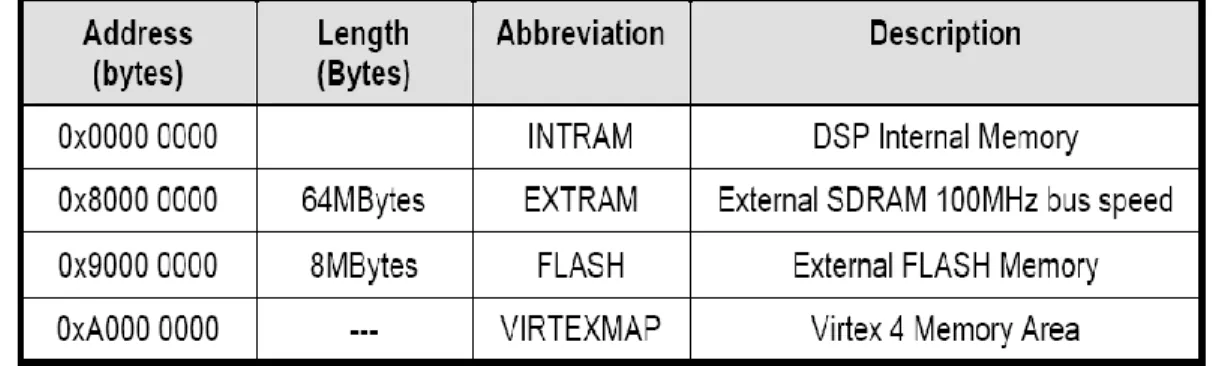
The various addresses and lengths of the peripherals shown in Figure 1 are shown in Table
2.3.1 DSP MEMORY MAP
Table 2.1 DSP Memory Map Description
2.3.2 VIRTEX 4 MEMORY MAP
Table 2.2 Virtex 4 Internal Peripherals Memory Map Description
2.4 DSP UNIT
As illustrated in Figure 1 the SMT339[38] is based around the „Texas Instruments‟ TMS320DM642 Video Imaging Processor. The processor is based around the second generation VelociTI Texas Instruments TMS320C6000 generation of processors. This processor has 3 built- in video imaging ports (each 20 bit) which each have 2 channels capable of sample rates up to 80MHz over a 10 bit bus, the direction of each channel being
REAL TIME EDGE DETECTION USING SUNDANCE VIDEO AND IMAGE PROCESSING SYSTEM
National Institute Of Technology Rourkela Page 17
configurable as input or output. This allows Images to be DMA‟ed directly to the SDRAM for processing, while the processed image can be viewed on one of the output channels. Input YCbCr formats with embedded sync information can be accepted by the video ports as well as RAW data modes. The DM642 DSP has 128Mbytes of high speed SDRAM memory available for program and data space, an 8Mbyte FLASH allows FPGA configuring data and DSP program data to be stored. The DSP‟s EMIF bus is also routed to the Virtex 4 FPGA, which allows the mapping of the Comports and the RSL directly into the DSP‟s memory map. The EMAC, serial ports and Audio channels are routed from the DSP to the Virtex 4, this allows the EMAC, SLB or Audio physical interfaces to be added to the system if required. Software development and real-time debugging can be achieved using Code Composer Studio (Texas Instruments) via the JTAG interface.
2.4.1 EMIF PERIPHERAL CONFIGURATION
The various peripherals are mapped into the DSP memory space into chip select spaces as illustrated in Table 2.3 EMIF Configurations.
2.4.2 I2C CONTROL
The DM642 DSP [36] has a built- in I2
C interface for controlling internal peripherals. This 2 wire serial bus is connected to 3 devices in the system. The devices and their respective I2C addresses are illustrated in the Table 2.4 below.
National Institute Of Technology Rourkela Page 18 2.4.3 FLASH
8Mbytes of flash memory is provided with direct access by the DM642. This device contains boot code for the DSP and the configuration data for the FPGA. This is a 16-bit wide device. The flash device can be re-programmed by the DM642 at any time. There is a software protection mechanism to stop most errant applications from destroying the device‟s contents. For extra safety a jumper (JP1) must be inserted to allow write operations. Note that the flash memory is connected as a 16 bit device, but during a DM642 boot (internal function of the C6x) only the bottom 8 bits are used. There are a number of DSP General Purpose pins connected to the FLASH devices Bank Pins in order to allow access to the upper FLASH areas.
Table 2.5: below shows the GPIO pins values and associated memory access areas.
2.4.4 SDRAM
There are128Mbytes of SDRAM connected to the DM642 processor via its external memory interface (EMIF). The EMIF clock runs at 100MHz and the bus width is 64bits, organized as 2 banks of 32bits. This allows a peak data transfer rate of 400Mbytes/second.
2.5 VIRTEX 4 FPGA
The FPGA on the SMT339 is a Virtex 4 FX60 device (XC4VFX6010FF1152). It is connected to the DSP‟s EMIF and therefore allows its internal peripherals to be accessed at 100MHz clock rates and a bus width of 64bits. This allows high speed transfers to be initiated at request. It should, however, be noted that sustained large transfer will affect the DSP‟s peak performance if the DSP‟s algorithm is running in external SDRAM memory. To avoid this, the application can be run in internal DSP memory.
REAL TIME EDGE DETECTION USING SUNDANCE VIDEO AND IMAGE PROCESSING SYSTEM
National Institute Of Technology Rourkela Page 19
Some of the FPGA‟s features are listed below.
• The Virtex-4 enhanced PowerPC™ 405 core delivers 680 DMIPS performance at 450 MHz and the new Auxiliary Processor Unit (APU) controller
• 400+ MHz clock rates
• 2.8Mbits of internal block RAM available.
• Up to 444 18X18 embedded multipliers.
• Extensive library of DSP algorithms.
2.5.1 VIRTEX 4 PERIPHERALS
The Standard firmware supplied with a SMT339 contains interfaces for the peripherals listed below.
• Mapping of 2 Video Ports and related control registers • Mapping of 2 communication ports
• LED Register Mapping
• Video Encoder Control Register • Video Decoder Control Register
2.5.2 LED REGISTER
There are 4 LEDS mapped in the Virtex 4 firmware that can be accessed via the DSP over the EMIF. The resister is located at 0xA00D0000 and is mapped as follows.
Table 2.6: Virtex 4 LED Register bit Definitions
Virtex 4 LED Register bit Definiti ons
2.5.3 COMPORTS
There are 2 Comports implemented in the standard FPGA configuration file. Comport 3 and Comport 2. Comport 3 is usually routed via the carrier module to the Host CPU for setup and control by 3L or other applications. See the SMT6400 for detailed operation of how they can be used.
National Institute Of Technology Rourkela Page 20
2.6 VIDEO ENCODER AND DECODER
2.6.1 VIDEO ENCODER / DECODER
The encoder/decoder is based on the „Philips Semiconductors‟ SAA7109AE/108AE. This provides decoding of PAL, NTSC and SECAM signal standards. On-board scaling circuitry allows the output image size to be specified by the DSP using the I2C interface. Two inputs are available through on-board connectors. These can be defined as 2x CVBS or 1 Y/C channel, again configured over the I2C interface. Image data from the decoder flows through the FPGA, for potential pre-processing, before being routed to the DSP video ports. The video encoder section of the device allows data from the DSP (which can be post processed by the FPGA) to be displayed in a number of different output formats. These include PAL, NTSC and VGA with resolutions up to 1280x1024 at 60Hz. Alternatively the encoder can output High Definition (HDTV) resolution images of 1920x1080 interlaced (or 1920 x 720 progressive) at 50Hz or 60Hz. The input format to the encoder is selectable between YCrCb and RGB. The encoder also has output look- up tables and a hardware cursor sprite which can be implemented by the user via the I2C bus.
2.6.2 VIDEO ENCODER REGISTER
The Video Encoder Register (0xA00D 8000) in the Virtex 4 allows various firmware parameters to be setup correctly. By default Video Port 1 is connected to the video encoder.
Table 2.7: Virtex 4, Video Encoder Register
Virtex 4, Vi deo Enc oder Register
ENC_RST – Encoder Reset, when „1‟ the Reset pin on the video encoder is active.
TRI_C – When „0‟ the Video port Control Lines (HSync and VSync) are driven by the
Encoder. The Encoder is in Master Sync mode. When „1‟ the Video Port Sync Pins are Tri-Stated.
TVD – TV Detected. Read only bit that returns a 1 in a load is detected on the CVBS video
REAL TIME EDGE DETECTION USING SUNDANCE VIDEO AND IMAGE PROCESSING SYSTEM
National Institute Of Technology Rourkela Page 21
D_MUX – When this bit is „0‟ the Video Port D[9..2] is fed directly to the encoder pins
D[7..0]. When set to a logic „1‟ the data stream from the video port is assumed to be RGB656 and is de- multiplexed from the Lower 16 bits of the Video Port 1 before driving the encoder pins.
2.6.3 VIDEO DECODER REGISTER
The Video Decoder Register (0xA00E 0000) in the Virtex 4 allows various firmware parameters to be setup correctly. By default Video Port 0 is connected to the video decoder.
Table 2.8: Virtex 4, Video Decoder Register
Virtex 4, Vi deo Dec oder Register
DEC_RST – Decoder Reset, when „1‟ the Reset pin on the video decoder is active.
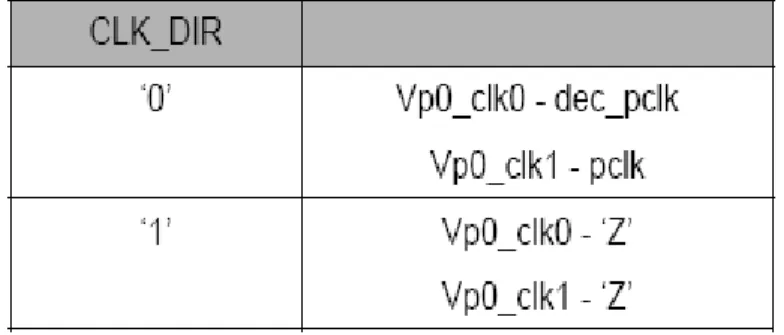
CLK_DIR – When „0‟ the Video Port 0 clk0 and clk1 pins are both driven by the decoders‟
pixel clock. When „1‟ the Virtex pins are tri-stated.
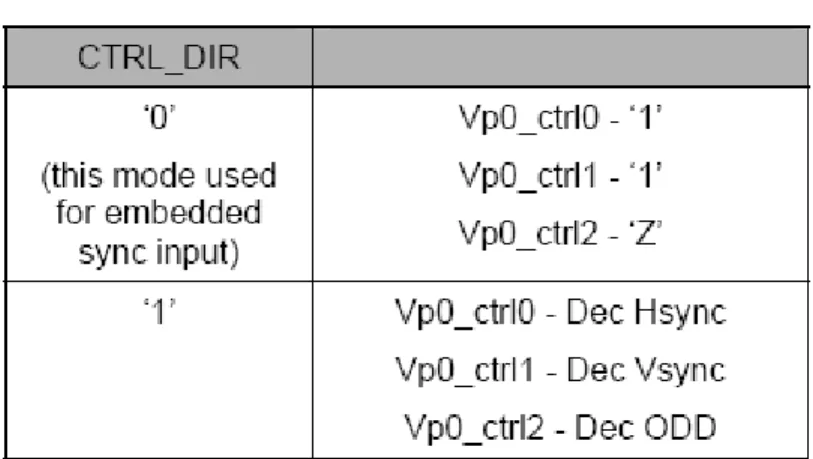
CTRL_DIR – Driving of the various Video 0 control signals.
The tables below shows the state of video port control and data signals for diffe rent values of CTRL_DIR and CLK_DIR.
National Institute Of Technology Rourkela Page 22 Table 2.10 : Video Port 0 and Decoder Clock connectivity
Table 2.11: Video Port 0 Decoder Data to Video Port Data Mapping
2.7 HIGH SPEED Nt (ZBT) MEMORY
There is just over 8Mbytes of high speed, no turnaround, (Nt) SRAM is connected to the FPGA allowing high speed data storage capability to FPGA cores that require external memory. The memory is based on two separate Samsung K7N321801M devices which are each 2M by 18-bit devices, allowing independent access of each device
2.8 SLB INTERFACE
The Sundance LVDS Bus (SLB) is a dual-port parallel interconnection link that is capable of supporting data transfers at up to 700 MHz. Each port can be assigned with a 16-bit differential bus, a clock and an over range differential lines. The SLB is a link for data and clocks but also for control signals; it is based on a Samtec QSH/QTH-DP series (0.5mm pitch) connectors. The use of the SLB means that other customer specific input or output
REAL TIME EDGE DETECTION USING SUNDANCE VIDEO AND IMAGE PROCESSING SYSTEM
National Institute Of Technology Rourkela Page 23
methods can be supported without the need for re-design of the hardware. Some examples of IO interfaces are listed below.
Input Output
• Camera Link • USB • Firewire • IDE
• CMOS Sensor • Fiber Channel
• Fiber Channel • LCD/Plasma Display drivers • DVI • DVI
2.9 VIDEO PORTS AND OTHERS MODULES
The SMT339 has 3 video ports connected from the DSP to the Virtex 4 FPGA. Video port 0 is, by default, routed to the video decoder and video port 1 is connected to the video encoder. Video Port 1 is unused in the default FPGA configuration and is reserved for upgraded firmware when the SMT339 is used with carrier boards such as the SMT114, or SLB cards such as the SMT339. The port is reserved for either: an extra video input/output or, the port is reserved for use as a SPI interface.
2.9.1 VIDEO ENCODER SETUP
The video encoder has a wide rage of operational features; such has output format, lookup tables, and cursor insertion and colour space conversions. This section describes the basics operation of the encoder. The figure below illustrates the flow from data in DSP memory to final output by the encoder together with the necessary stages that require initialising.
National Institute Of Technology Rourkela Page 24 2.9.2 VIDEO MEMORY
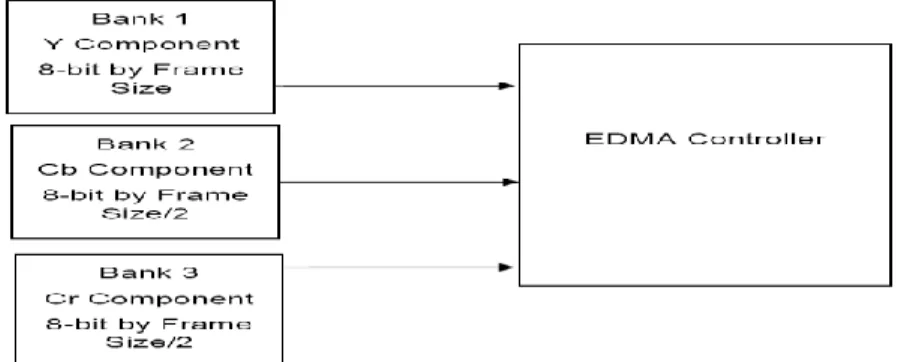
The memory in these examples is organised in 2 different ways, this is illustrated below.
Figure 2.4 : Video Memory organisation in YCbCr output mode
The second example illustrates the memory organisation for RGB565 output. This time there is a single bank and each RGB element is 20-bits. The data stored is modified so that only the lower 16 bits are actually used.
Figure2.5: RGB565 organisation of the video me mory 2.9.3 EDMA
The next step is instruct the EDMA to transfer data the video data into the Video Ports input FIFO channel. For the RGB656 format this will involve a single EDMA channel. For the YCrCb format 3 separate EDMA channels require initialization.
2.9.4 RGB656 SINGLE BANK EDMA SETUP
Requests to the EDMA controller are set by the Video Port Input FIFO threshold levels. Usually each request transfers a complete video line output.DMA transfers are done 64-bits at a time as the video port input FIFO is 64-bits wide, therefore, an even number of words must be transferred. The Video Encode Register at 0xA0001 D000 bit 4 must be set to „1‟ when in RGB656 output mode. This allows demultiplexing of the data before being sent to the Encoder.
REAL TIME EDGE DETECTION USING SUNDANCE VIDEO AND IMAGE PROCESSING SYSTEM
National Institute Of Technology Rourkela Page 25
2.9.5 BT656 WITH EMBEDDED SYNC EDMA SETUP
Three separate EDMA channels must me setup for this mode. One for the Y channel, one for the Cr channel and one for the Cb channel.
The size of the EDMA is 180 (64bit transfers) for the Y channel which represent 720 pixels (as data is transferred line by line). The Cb and Cr channels must be half of this representing the chroma content of the YCrYCb data stream.
2.9.6 JTAG
There are two separate JTAG chains on the SMT339 module. One allows the DSP chain to be accessed while the other allows the Virtex 4 to be configured.
1. DSP JTAG Chain
This is used by code composer studio to access the DSP. There is provision to extend the number of processors in the chain by adding a DSP via a SLB mezzanine card. If this is added then the SLB JTAG bypass jumper (JP3) should be removed.
2. Virtex 4 JTAG chain
This can be accessed via the JP5 connector using Xilinx tools. JP1 - Flash Write Protect jumper – Fit to write enable JP2 - Virtex Program Enable – Remove to Erase FPGA
JP3 - DSP JTAG chain –If removed the DSP JTAG chain is extended to a extra SLB interface card DSP. Fit for normal operation.
2.9.7 CABELS AND CONNECTORS Table 2.12: JP5 Virtex JTAG Header
National Institute Of Technology Rourkela Page 26 Table 2.13: JP7 Connector
Mixed RGB/VGA channel Output
The pinout of the connector is show below.
2.10 POWER CONSUMPTIONS
This module must have 5V supplied through the TIM connectors. In addition, a 3.3V supply is required and should be supplied through the TIM mounting holes. Contained on the module are linear regulators for the DM642 and FPGA. The DM642 core voltage is provided through a linear regulator from 3.3V. All supplies a guaranteed to meet the worst possible requirements of the FPGAs.
2.11 THE SOFTWARE SUPPORTING ROLE
This all sounds great in principle, but any DSP engineer is sure to wonder what sorcery would be required to realize such a cooperative combination in practice. Fortunately, the SMT339 (as with
Sundance‟s many other modules) is supported by a comprehensive environment of development tools conceived to address this very problem. Besides the many VHDL cores and DSP library modules available, a coherent software model is necessary to simplify the overall application development for these mixed-processor systems. Diamond from 3L Limited provides this model by describing multiprocessor systems as a number of independent tasks that communicate over channels. Whether these tasks are executing on DSPs or FPGAs, Diamond manages the interconnections and programming so that you can concentrate on their application.
REAL TIME EDGE DETECTION USING SUNDANCE VIDEO AND IMAGE PROCESSING SYSTEM
National Institute Of Technology Rourkela Page 27
Diamond uses the FPGAs on Sundance DSP TIMs by automatically adding the engineer‟s tasks to the standard Sundance firmware. These tasks are created in VHDL or tools such as Xilinx System Generator, or they can be standard net list files, allowing you to bring proprietary cores into the system and mix them with standard and user-developed cores. Diamond automatically adds the logic to allow the tasks to communicate with other tasks; it then builds an FPGA bit stream using the standard Xilinx tools.
This technique creates a hardware independence that allows you to make major changes to the underlying hardware without having to change any code. It is now possible to expand the hardware by adding DSPs or FPGAs as required, without so much as a recompilation. Repositioning a task on a different DSP reduces to only a tiny change in a single text file. Thus, when more processing power becomes necessary, you can add it at will, and none of the existing development is made redundant. Even if a task needs to be moved from a DSP to an FPGA for acceleration, the surrounding functions are not affected.
Chapter 3
EDGE DETECTION TECNIQUES
USING SUNDANCE MODULE
REAL TIME EDGE DETECTION USING SUNDANCE VIDEO AND IMAGE PROCESSING SYSTEM
National Institute Of Technology Rourkela Page 29
3.1
INTRODUCTION TO FUNDAMENTALS OF EDGE DETECTION
Edge detection refers to the process of identifying and locating sharp discontinuities in an image. The discontinuities are abrupt changes in pixel intensity which characterize boundaries of objects in a scene. Classical methods of edge detection involve convolving the image with an operator (a 2-D filter), which is constructed to be se nsitive to large gradients in the image while returning values of zero in uniform regions. This is an extremely large number of edge detection operators available, each designed to be sensitive to certain types of edges. Variables involved in the selection of an edge detection operator include:1) Edge orientation: The geometry of the operator determines a characteristic direction in which it is most sensitive to edges. Operators can be optimized to look for horizontal, vertical, or diagonal edges.
2) Noise environment: Edge detection is difficult in noisy images, since both the noise and the edges contain high- frequency content. Attempts to reduce the noise result in blurred and distorted edges. Operators used on noisy images are typically larger in scope, so they can average enough data to discount localized noisy pixels. This results in less accurate localization of the detected edges.
3) Edge structure: Not all edges involve a step change in intensity. Effects such as refraction or poor focus can result in objects with boundaries defined by a gradual change in intensity. The operator needs to be chosen to be responsive to such a gradual change in those cases. Newer wavelet-based techniques actually characterize the nature of the transition for each edge in order to distinguish, for example, edges associated with hair from edges associated with a face.
There are many ways to perform edge detection. However, the majority of different methods may be grouped into two categories:
Gradient: The gradient method detects the edges by looking for the maximum and minimum in the first derivative of the image.
Laplacian: The Laplacian method searches for zero crossings [4] in the second derivative of the image to find edges. An edge has the one-dimensional shape of a
National Institute Of Technology Rourkela Page 30 ramp and calculating the derivative of the image can highlight its location. Suppose we have the following signal, with an edge shown by the jump in intensity below:
Figure3.1: following signal apply to the edge detector
If we take the gradient of this signal (which, in one dimension, is just the first derivative with respect to t) we get the following:
Figure3.2: the gradient first derivative signal
Clearly, the derivative shows a maximum located at the center of the edge in the original signal. This method of locating an edge is characteristic of the “gradient filter” family of edge detection filters and includes the Sobel method. A pixel location is declared an edge location if the value of the gradient exceeds some threshold. As mentioned before, edges will have higher pixel intensity values than those surrounding it. So once a threshold is set, you can compare the gradient value to the threshold value and detect an edge whenever the threshold is exceeded. Furthermore, when the first derivative is at a ma ximum, the second derivative is zero. As a result, another alternative to finding the location of an edge is to locate the zeros in the second derivative. This method is known as the Laplacian and the second derivative [13] of the signal is shown below:
REAL TIME EDGE DETECTION USING SUNDANCE VIDEO AND IMAGE PROCESSING SYSTEM
National Institute Of Technology Rourkela Page 31
Figure3.3: the gradient second derivative signal
The purpose of detecting sharp changes in image brightness is to capture important events and changes in properties of the world. It can be shown that under rather general assumptions for an image formation model, discontinuities in image brightness are likely to correspond to:
I. discontinuities in depth,
II. discontinuities in surface orientation, III. changes in material properties and IV. Variations in scene illumination.
In the ideal case, the result of applying an edge detector to an image may lead to a set of connected curves that indicate the boundaries of objects, the boundaries of surface markings as well curves that correspond to discontinuities in surface orie ntation. Thus, applying an edge detector to an image may significantly reduce the amount of data to be processed and may therefore filter out information that may be regarded as less relevant, while preserving the important structural properties of an image. If the edge detection step is successful, the subsequent task of interpreting the information contents in the original image may therefore be substantially simplified. Unfortunately, however, it is not always possible to obtain such ideal edges from real life images of moderate complexity. Edges extracted from non-trivial images are often hampered by fragmentation, meaning that the edge curves are not connected, missing edge segments as well as false edges not corresponding to interesting phenomena in the image -- thus complicating the subsequent task of interpreting the image data.
National Institute Of Technology Rourkela Page 32 3.2 A SIMPLE EDGE MODEL
Although certain literature has considered the detection of ideal step edges, the edges obtained from natural images are usually not at all ideal step edges. Instead they are normally affected by one or several of the following effects:
focal blur caused by a finite depth-of-field and finite point spread function. Penumbral blur caused by shadows created by light sources of non-zero radius. Shading at a smooth object edge.
local specularities or interreflections in the vicinity of object edges.
Although the following model does not capture the full variability of real- life edges, the error function erf has been used by a number of researchers as the simplest extension of the ideal step edge model for modeling the effects of edge blur in practical applications. Thus, a one-dimensional image f which has exactly one edge placed at x = 0 may be modeled as:
At the left side of the edge, the intensity is , and right of the edge it is . The scale parameter σ is called the blur scale of the edge.
(a) (b) Figure3.4: Example of different types of edges
REAL TIME EDGE DETECTION USING SUNDANCE VIDEO AND IMAGE PROCESSING SYSTEM
National Institute Of Technology Rourkela Page 33
3.3 EDGE DETECTION
We‟ve discussed smoothing and diffusion as a way of getting rid of the effects of noise in an image. Now we‟re going to discuss the problem of finding the boundaries between piece-wise constant regions in the image, when these regions have been corrupted by noise. As usual, we will begin by considering a 1D problem. But in the case of edge detection, we‟ll also have to discuss the 2D problem, because there are some issues that arise in 2D that don‟t show up in 1D.
1. 1D Edge Detection
1D edge detection consists of three, key steps. a. Reduce the effects of noise.
b. Measure the magnitude of change in the region. c. Find peaks of change
i. Non-maximum suppression ii. Thresholding
The logic of this is that we need to avoid the effects of noise, and then we need to measure the amount of change in intensity in the image, so that we can find places where intensity is changing rapidly. We want to find peaks, because in the neighborhood of an edge, after smoothing, there may be many pixels where the image is changing rapidly, but we only want to identify one of them as the edge.
We have already discussed (1), reducing the effects of noise with smoothing. We also need to consider how to do convolution discretely. One way to do this is to sample the filter (eg., sample the values of a Gaussian at some discrete points). One must be careful about two things:
1. Normalize the sampled Gaussian, so that it sums to 1.
2. Be sure to use a wide enough filter to capture the Gaussian shape. This is done heuristically, but is important.
We mention that Canny has considered the question of finding the optimal way to smooth a noisy step edge in order to find edges, and has found that the optimal smoothing function [3][6][7] is approximately a Gaussian. Canny defined optimality by defining some
National Institute Of Technology Rourkela Page 34 reasonable criteria, such as accurate localization and lack of false positives. We also mention that it is particularly important to reduce the effects of noise before taking a derivative. One way to justify this is to note that white noise has a uniform power spectrum, while scene structure is usually more low frequency than high frequency. A derivative is a high-pass filter. So the derivative preserves the noise much more than the structure. The way to avoid this is to low-pass filter the image first, which removes noise much more than it removes structure. In 1D, it is easy to measure the amount of change. The way that we measure change is by taking a derivative.
Finding peaks is also simple.
1) We look for points where the magnitude of the derivative is bigger than at the two neighboring points. (We could also look for places where the second derivative is 0, although this is slightly trickier in the discrete case). This is called non- maximum suppression [10]and is equivalent to finding the place where the first derivative is a maximum.
2) We also look for peaks where the magnitude of the first derivative is above some threshold. This eliminates spurious edges.
2. 2D Edge Detection
We perform Edge Detection by performing essentially the same steps. However, some of these steps will look a little different in 2D.
1) Reduce the effects of noise. This is exactly the same. I am smoothing with a Gaussian. The only difference is that I am using a 2D Gaussian. One useful thing to note, though, is that we can decompose a 2D Gaussian into two 1D Gaussians, which improves efficiency.
2) Measure the magnitude of change in the region. In 1D we measure change with a derivative. In 2D, we measure change with a gradient. This is a 2D vector. We produce it by combining the partial derivative in the x and y directions. The direction of the gradient provides the direction of maximum change. The magnitude of the gradient tells us how fast the image is changing if we move in that direction. One way to think about this is that when